I often hear business owners use the terms ‘website design’ and ‘website development’ like they’re the same thing. And while they are two sides of the same coin, they're completely different disciplines that require their own unique goals and skill sets.
From my real experience running a marketing agency in Melbourne, getting this distinction right from the start is crucial. It’s the classic difference between an architect who draws up the blueprint for your dream online store and the builder who actually constructs it, making sure it's solid, secure, and ready for customers.
The Architect and The Builder: Unpacking Website Design vs Development
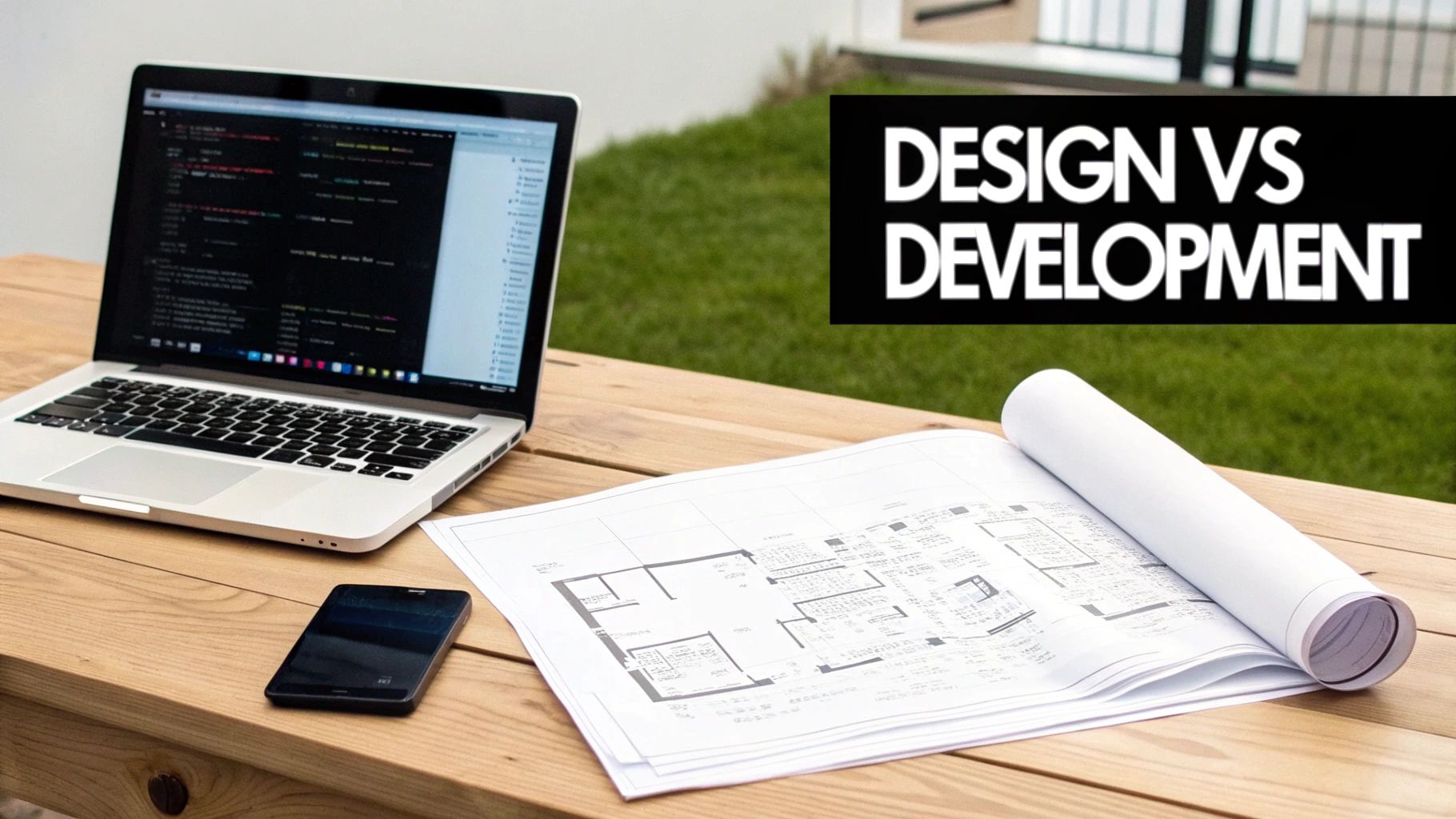
When I sit down with an eCommerce client, one of the first things we do is clarify this exact distinction. Getting it right from the get-go prevents a world of confusion and makes sure we’re all speaking the same language. Let's break it down in a way that actually makes sense for your online business.
Website design is all about the look, feel, and user experience (UX). It’s the visual strategy that maps out how your website will guide and communicate with your customers. Think about your favourite online store—the colours, the easy navigation, where the "Add to Cart" button is placed—that’s all intentional design work aimed at making you buy.
On the other hand, website development is the engine under the bonnet. It’s the technical construction that uses code to bring the designer's vision to life. When you click "Add to Cart" and the item magically appears in your shopping basket, or when your payment is processed securely, that's the hard work of a developer.
The Designer’s Blueprint
As the "architect," a website designer focuses on creating a seamless, intuitive journey for your customers. Their main job is to solve the user's problems visually before a single line of code is written.
- User Experience (UX) Design: This is the deep thinking behind a site's structure. For an eCommerce site, a UX designer maps out the entire customer flow, from landing on a product page to a frictionless checkout process, ensuring there are zero frustrations that could cost you a sale.
- User Interface (UI) Design: This is the visual layer—the colours, fonts, icons, and interactive elements that make up the screen. The UI designer makes the site aesthetically pleasing and ensures your brand's personality shines through every pixel, building trust with your shoppers.
To really get your head around the creative side of things, it helps to understand the fundamental UX design vs UI design differences. A designer creates a beautiful and functional plan; without it, the developer has nothing to build.
The Developer’s Toolkit
The developer is the "builder" who takes the designer’s blueprints and turns them into a fully functioning, interactive website. They’re the ones writing the code that makes everything tick. This work is generally split into two main areas.
Front-End Development: This involves building the parts of the website that users actually see and interact with. They use languages like HTML, CSS, and JavaScript to bring the UI design to life, making sure buttons are clickable and product galleries run smoothly.
Back-End Development: This is all the server-side work that users don't see but absolutely rely on. It includes managing the customer database, securely processing payments through gateways like Stripe or PayPal, and handling all the site's data. It’s the technical foundation that holds the entire eCommerce store up.
To give you a clearer picture, here’s a quick side-by-side comparison.
Website Design vs Website Development At a Glance
This table breaks down the core differences in roles, tools, and goals, helping you see where one discipline ends and the other begins.
| Aspect | Website Design (The Architect) | Website Development (The Builder) |
|---|---|---|
| Primary Goal | Create a visually appealing, user-friendly, and intuitive shopping experience. | Build a functional, responsive, and technically sound website based on the design. |
| Focus | User journey, aesthetics, branding, conversion rate optimisation, and visual layout. | Code, functionality, server performance, database management, and payment security. |
| Key Roles | UX Designer, UI Designer, Visual Designer, Graphic Designer. | Front-End Developer, Back-End Developer, Full-Stack Developer. |
| Common Tools | Figma, Sketch, Adobe XD, Photoshop, Illustrator, InVision. | Visual Studio Code, HTML, CSS, JavaScript, PHP, Python, React, Git. |
| Deliverables | Wireframes, mockups, style guides, user flow diagrams, prototypes. | A live, functioning eCommerce store, databases, server configuration, APIs. |
| Analogy | The architect who designs the retail store blueprint. | The builder who constructs the store from the blueprint. |
Essentially, the designer asks "what should the shopping experience look and feel like to maximise sales?" while the developer asks "how do we build this to make it work reliably and securely?"
I've seen firsthand how crucial this is. A well-designed site that's poorly developed will crash during a sales event. A technically perfect site with a confusing design won't convert visitors into customers. You absolutely need both to succeed.
Choosing Your Digital Storefront: WordPress vs Shopify
As a digital marketing agency in Melbourne, one of the first and most critical conversations I have with any new eCommerce client is about their platform. Nine times out of ten, it comes down to a choice between two giants: WordPress (specifically with the WooCommerce plugin) and Shopify.
Both are absolute powerhouses, but they’re built for fundamentally different business owners. I’ve seen eCommerce businesses pick the right one and thrive, and I've seen others pick the wrong one and pay the price in developer headaches and lost sales. My goal here is to give you an honest, experience-based breakdown to help you make the right call from day one.
Shopify: The All-in-One E-commerce Engine
If you want to get an online store up and running quickly—and you want it to be secure, reliable, and straightforward—Shopify is almost always the answer. I think of it as the ultimate "software as a service" (SaaS) solution for eCommerce. You pay a monthly fee, and in return, you get a system where all the tricky stuff like hosting, security (PCI compliance), and technical maintenance is handled for you.
For many of my clients, this peace of mind is priceless. They don't want to worry about server updates or security patches; they just want to focus on their products and their Facebook ads.
We’ve worked with several Melbourne-based brands that started on Shopify and scaled to six figures in their first year. The platform is built for growth, allowing them to focus entirely on marketing and product, not on technical upkeep. A skilled Shopify developer can customise themes and integrate apps to create a beautiful, high-converting store. Our work with Shopify development partners allows us to build powerful stores that integrate with your Instagram Shop and Facebook shop seamlessly.
Shopify's true strength lies in its simplicity and its incredible ecosystem. The app store is packed with tools for everything from email marketing to loyalty programs, making it easy to add new features without needing a developer for every little change.
WordPress: The King of Customisation
Then there’s WordPress. Powering a huge chunk of the internet, it's the undisputed champion of flexibility. When you pair it with the WooCommerce plugin, it transforms into a formidable eCommerce platform that gives you 100% control over every single pixel and line of code.
This is the path for businesses with unique requirements or a long-term vision that an "out-of-the-box" solution simply can't accommodate. As a team of wordpress developers in melbourne, this is where my team and I get to build truly bespoke solutions.
Here’s where WordPress really shines for eCommerce:
- Total Design Freedom: We aren't limited by a theme's structure. As a wordpress development company, we can build a completely custom user experience from the ground up, perfectly matching your brand's vision.
- Custom Functionality: Need to integrate with a unique inventory system or a third-party API? No problem. We can build a custom plugin to handle exactly that. A wordpress web developer can create functionality you can't find anywhere else.
- SEO Dominance: While Shopify's SEO is good, WordPress offers unparalleled control over technical SEO, which can be a huge advantage in competitive markets. Our team, as an experienced SEO agency in Melbourne, often recommends WordPress for this very reason. It's fantastic for local SEO and dominating your city's search results.
- No Transaction Fees: Unlike Shopify, which charges its own fee on top of the payment processor's cut (unless you use Shopify Payments), WooCommerce doesn't. You only pay your payment gateway fees.
For instance, we can leverage our skills in building custom blocks in Gutenberg. This allows a client's marketing team to create beautiful, complex product landing pages for their Google Ads for service based businesses campaigns without ever needing to touch a line of code. This level of granular control is something Shopify just can't match.
Ultimately, the choice comes down to your priorities. Do you value speed and simplicity, or do you need complete control and limitless customisation? Both can lead to a massively successful online store, but choosing the right foundation is the first critical step in your journey.
So, How Much Does a High-Performing Website Really Cost in Australia?
It's the question I get in almost every first meeting with a new eCommerce client: "Let's cut to the chase, how much is this actually going to cost?" And while the classic, frustrating answer is "it depends," I know that's not helpful when you're trying to budget. So, I'm going to pull back the curtain and give you a genuine, transparent breakdown of what you can realistically expect to invest in a professional website here in Australia.
First, let's get one thing straight. A website isn't just a digital brochure; it's your hardest-working salesperson, your lead-generation machine, and the central hub for your entire eCommerce operation. Thinking of it as a one-off expense is the wrong way to look at it. It’s an investment, and like any good one, the returns from your Google Shopping Ads and organic traffic should far outweigh the initial cost.
Breaking Down the Price Brackets
From my experience as a marketing agency in Melbourne, website projects for eCommerce businesses tend to fall into three main buckets, depending on how complex and custom they need to be.
The Starter Site (AUD $3,000 – $8,000): This is your entry point. It's the perfect launchpad for a startup or a small eCommerce brand that needs a professional, solid online presence. Think of a clean, well-designed site on WordPress or a basic Shopify store built on a premium theme, set up to get you selling fast. It’s all about building a functional, future-proof foundation.
The E-commerce Growth Engine (AUD $8,000 – $25,000): This is the sweet spot where most serious eCommerce businesses land. A budget like this allows for a semi-custom design on Shopify or a more tailored WordPress development project. We're talking advanced theme customisations, connecting key marketing tools like Klaviyo, and a deep dive into user experience to really drive conversions from your Google ads for contact form submissions.
The Custom Enterprise Solution (AUD $25,000+): When you've got complex needs, this is where true customisation comes into play. This could mean getting a dedicated Shopify developer to build a custom app, creating intricate Shopify API integrations for your inventory system, or developing a large-scale WordPress site with unique features that simply don't exist off the shelf. Maybe you need a shopify development crash course for your internal team, which we can also facilitate.
Knowing how much does it cost to start google ads is one thing, but that budget is wasted if your website can't convert the traffic. The investment in a quality site pays for itself by making your ad spend more efficient.
What Pushes the Price Up or Down?
A few key things will move that final price tag. If you understand these, you'll be able to have a much more productive chat with any digital marketing agency in Melbourne you talk to.
The biggest price driver is almost always the level of customisation. Kicking things off with a pre-built theme is a cost-effective way to start, but building a completely bespoke design from a blank canvas requires a whole lot more design and development time from a top-tier wordpress website developer.
Here are the common variables I run through with my clients:
- Custom Features: Need a unique product builder, a subscription model, or an advanced booking system? Anything that a standard app or plugin can't handle will need custom development work, which adds to the cost.
- API Integrations: Connecting your website to other systems—like your inventory platform, CRM, or accounting software—requires a developer to work with APIs. The more complex these connections are, the more hours it takes.
- Content and SEO: Are you providing all the text and images, or do you need a hand with professional copywriting and photography? Getting an SEO agency in Melbourne to set up your site's SEO foundation and manage your Google My Business profile is another crucial investment that adds to the initial scope but pays off massively down the track.
A well-built website is a direct investment in your business's future. Alpha Omega Digital is a marketing agency based in Melbourne, Australia but also services clients from Sydney, Brisbane, Newcastle, Perth, Adelaide, Darwin and Hobart. Have a project in mind? Contact us.
Building a Foundation for Marketing Success
Here's a hard truth I've learned over the years running a Facebook ads agency: launching a beautiful website is only step one. If no one can find it, or if it doesn't actually support your marketing efforts, then it’s just a pretty digital business card that no one ever sees.
This is where the technical side of website development becomes absolutely critical for success.
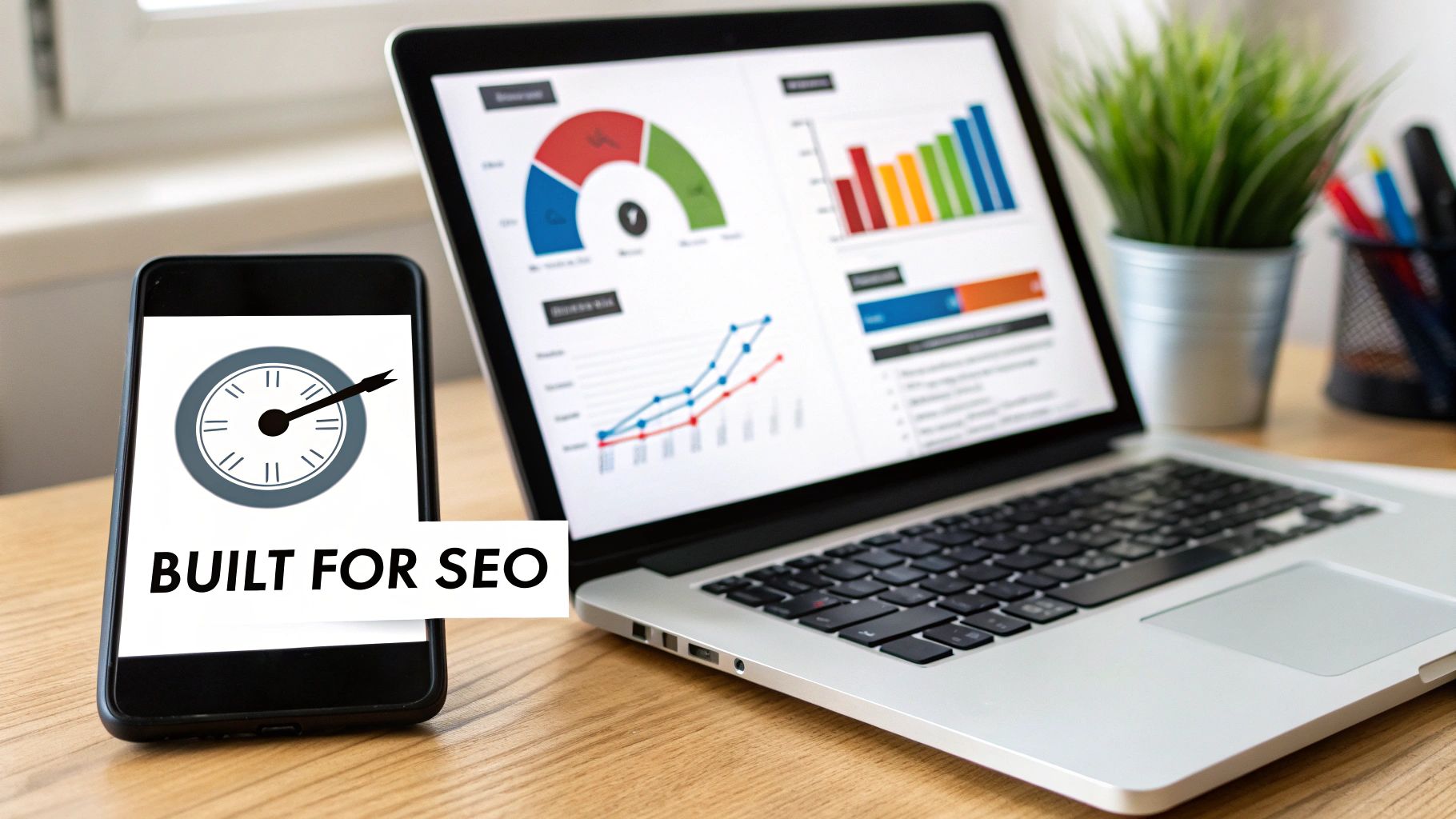
As an SEO agency in Melbourne, we don't treat search engine optimisation as an afterthought. It’s not something we bolt on after the site is built. Instead, we bake it directly into the development process from the very first line of code. This isn’t about stuffing keywords into pages; it’s about building a technically sound foundation that Google loves to crawl and rank, which is essential for any beginners guide to google shopping ads.
Technical SEO: The Non-Negotiable Essentials
Think of technical SEO as the plumbing and wiring of your house. You don't see it, but if it's done poorly, nothing else works correctly. For an eCommerce store, getting this right is the difference between showing up on page one for valuable keywords and getting lost in the search results, especially when running Google shopping ads for dropshipping.
Here’s what our focus on technical SEO during a build actually involves:
- Clean Site Architecture: We structure your site logically, like a well-organised library. This means creating clear URL structures and internal linking that helps both users and search engines easily understand what your site is about.
- Mobile-First Responsiveness: With a huge percentage of online shopping happening on mobile devices, a site that works flawlessly on a phone isn't a feature—it's a requirement. We design and build for the mobile experience first, ensuring every button and product image is perfect on a smaller screen.
- Blazing-Fast Site Speed: Every second counts. A site that takes too long to load doesn’t just frustrate users; it gets penalised by Google. We optimise images, streamline code, and use modern development techniques to ensure your pages load almost instantly. A slow site is often the reason your google shopping ads not spending budget.
A slow website is a conversion killer. In fact, a one-second delay in page load time can result in a 7% reduction in conversions. For an online store, that's a direct hit to your bottom line. We build for speed because speed equals revenue.
Setting Up Tracking for Real Results
A website without proper tracking is like flying a plane blind. You have no idea what’s working, where your customers are coming from, or how to measure success facebook ads. This is why setting up robust analytics and tracking from day one is a core part of our development work. We handle the full setup of GTM and google analytics.
We implement two essential tools on every eCommerce site we build:
- Setting up Google Tag Manager Containers: Instead of cluttering your site's code with a dozen different tracking scripts, we set up a Google Tag Manager container. This acts as a central hub, allowing us to manage all your marketing tags (like Google Analytics, Google Ads, and Facebook Pixel) in one clean, organised place. This keeps your site fast and your data accurate.
- Setting up Meta conversion API: With recent privacy changes, the standard Meta Pixel is less reliable. Our conversions API installation for meta sends data directly from your server to Facebook. This creates a stable, accurate connection, ensuring your Facebook and Instagram campaigns are optimised with the best possible data. Don't fall into the trap where you dont quit facebook ads too early; proper tracking shows you the real picture.
Building a technically sound website is about giving your marketing the best possible chance to succeed. When your SEO, PMAX vs google shopping ads campaigns, and Meta ads creative testing process are built on a solid foundation, every dollar you spend works harder.
Connecting Your Ecosystem with Custom Development
Your website doesn't exist in a bubble. For a modern eCommerce business to run efficiently, it has to talk to all the other tools you rely on every single day—your inventory system, your CRM, your accounting software, and your marketing platforms. This is where we go beyond standard website builds and step into the world of custom development.
This is for businesses that have hit a wall with 'off-the-shelf' solutions. When a pre-built app or a simple plugin just won't cut it, we come in to build custom connections that make your business run smarter, not harder. This is where website development truly shifts from just building a site into creating a powerful, automated business tool that saves you time and makes you more money.
The Power of APIs for E-commerce
The magic behind all of this is something called an API, or Application Programming Interface. The easiest way to think of it is as a universal translator that lets different software programs have a conversation. As both WordPress and Shopify development partners, we use APIs to build bridges between your website and the other critical systems you use.
For our eCommerce clients, the Shopify Developer API is an incredibly powerful tool. It gives our shopify developers the keys to build custom solutions that go far beyond anything you'll find in the Shopify App Store.
Your website should be the central hub of your business operations, not just another isolated tool. Custom API development is what makes this a reality, automating tedious tasks and unlocking new opportunities for growth and efficiency.
Real-World Examples of Custom Development
This can all sound a bit abstract, so let’s talk about what this actually looks like in practice. I’ve seen first-hand how custom development can solve some very real, and often frustrating, business problems for my clients.
Here are a few examples of projects our team has tackled:
- Building Custom Shopify apps using Shopify CLI: We worked with a Melbourne-based retailer who needed a unique product bundling feature that no existing app could handle. Using the Shopify API and the Shopify CLI, our shopify developer built a private app just for them. It lets customers create their own custom gift boxes and automatically syncs the correct inventory levels in the background. No more manual stocktakes.
- Automating Appointments with AI: For service-based businesses like tradies, hairdressers or beauty therapists, missed calls are lost money. We set up a custom number through Twilio to power an AI receptionist. This AI appointment setter works 24/7, never gets sick, and books appointments directly into their calendar, saving thousands in lost business. Check out our AI voice agent pricing for more details on how this can transform businesses like dentists, restaurants, and doctors in Australia.
- Flexible Content with Custom WordPress Blocks: A fast-growing eCommerce brand needed their marketing team to create stunning, unique landing pages without constantly needing a developer. We solved this by building custom blocks in Gutenberg, the WordPress editor. Now, their team can drag and drop beautifully designed, pre-approved content sections to build new campaign pages in minutes, not days. This is a core part of our wordpress development services.
Why Custom Development is a Game-Changer
Investing in custom development is really about building a competitive advantage. While your competitors are stuck trying to force clunky, off-the-shelf tools to work together, you're operating with a perfectly integrated system designed specifically for how you do business.
Whether it’s the work of a dedicated wordpress developer creating a unique plugin or a team of shopify developers crafting a bespoke app, these custom solutions are what separate the good websites from the great ones. They turn your site into an active, intelligent asset that works for you around the clock.
Our Six-Step Process From Vision to High-Converting Reality
So, how do we actually pull all of this together? A successful website project doesn't happen by chance. It’s the direct result of a clear, structured, and transparent process that keeps everyone on the same page from the first chat to the final launch.
Over the years, I've seen plenty of projects go off the rails because of poor communication or a fuzzy plan. That’s why we’ve refined our approach into a proven, six-step process that turns an initial idea into a genuine, profitable asset for your business. It’s designed to keep projects on track, on budget, and laser-focused on delivering real results.
Effectively navigating the launch of a new website requires a solid grasp of project management for web development, which is why we’ve built our process to be both thorough and refreshingly straightforward.
Phase 1 and 2: Discovery and Design
This is where it all begins. We start by digging deep into your eCommerce business, not just scratching the surface.
Discovery & Strategy: First up, we sit down to properly understand your goals, your target audience, your competitors, and what success actually looks like for you. This isn’t just a casual chat; it's a strategic deep-dive that forms the blueprint for the entire project. We map out the user journey and define the key performance indicators (KPIs) we'll use to measure success down the track.
Design & User Experience (UX): With a clear strategy locked in, our designers get to work. We create wireframes and high-fidelity mockups that bring the site's structure and visual identity to life. This is a highly collaborative phase where we refine the look and feel until it perfectly aligns with your brand and is optimised for conversions from day one.
Phase 3 and 4: Development and Onboarding
Once the blueprint is approved, our builders get on the tools.
Development: This is where our Melbourne-based WordPress developers and Shopify experts turn the approved designs into a fully functional website. Whether it's building custom blocks in Gutenberg for a WordPress development project or integrating the Shopify Developer API, we write clean, efficient code built for speed and scalability.
Content & Onboarding: A great site needs great content. We work with you to populate the site with compelling copy and images that connect with your audience. Before we go live, we provide comprehensive training, showing you exactly how to manage your new site, add products, and update content so you feel completely confident from day one.
The diagram below shows how we make sure everything talks to each other, integrating your website with essential business systems like a CRM through an API for seamless data flow.
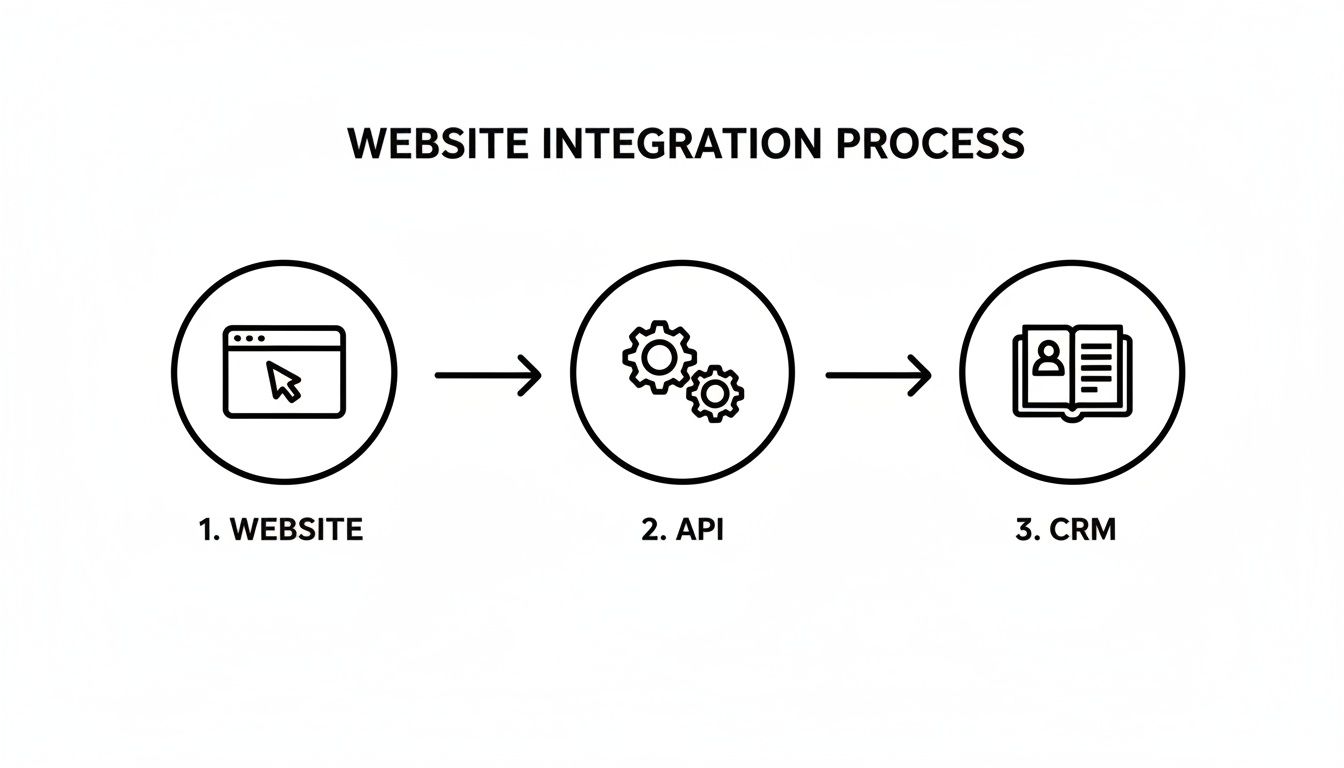
This process shows that a well-built website isn't just an isolated tool—it’s the central hub of your entire business ecosystem.
Phase 5 and 6: Launch and Optimisation
Going live isn't the finish line; it’s just the beginning of the growth phase.
Launch & Testing: We handle the entire technical launch process, from migrating the site to your live server to running final, meticulous tests. Our pre-launch checklist ensures every link works, every form submits correctly, and every page loads perfectly across all devices. No stone is left unturned.
Optimisation & Scaling: After launch, our focus shifts to data. We use tools like Google Analytics to monitor performance and pull insights from Google Ads campaigns to identify opportunities for improvement. Marketing your business = consistency. We analyse everything from campaign priority in google ads to which creative is performing best, making ongoing optimisations to turn a great website into a high-converting, revenue-generating machine. We also recommend using the best call tracking softwares for PPC call campaigns like CallRail for PPC for tradies.
Your Website Questions Answered
When you're thinking about investing in a new website, questions are going to pop up. It's only natural. I get asked the same key things by eCommerce owners from Melbourne to Sydney, so I've put together some straightforward answers to help you know what to expect.
How Long Does It Take to Build a Website?
This is the big one, and the honest answer is: it depends on what we're building.
For a simple, professional eCommerce store using a premium theme, we can often turn it around in 4-6 weeks. This is perfect for a business new to selling online.
But if we're talking about a custom eCommerce store on Shopify or a more complex WordPress development project with unique features, it's a bigger job. For those, a timeline of 3-6 months is more realistic. We map out a full project plan right at the start, so you'll have a clear picture from day one.
What Are the Ongoing Costs After Launch?
Once your site is live, there are a few running costs to keep it secure, online, and performing well. Think of it like a physical retail store – you've paid for the fit-out, but you still need to pay rent and utilities.
- Domain Name: This is a small annual fee to keep your www address.
- Website Hosting: For Shopify sites, this is wrapped into your monthly subscription. For WordPress, you'll need a separate hosting plan.
- Maintenance Plan: This is non-negotiable for WordPress sites. Our care plans handle all the crucial security updates, daily backups, and software patches to stop problems before they start and keep your site running smoothly.
Do I Need to Provide All the Content for My Site?
You know your brand and products better than anyone, but that doesn't mean you have to write every single word yourself. We can absolutely help with this.
Our process kicks off with a content strategy phase, and we have professional copywriters ready to create compelling, SEO-friendly text that speaks directly to your ideal customer. We’ll work with you to make sure the final copy perfectly captures your brand's voice and is structured to get people to buy.
Can You Integrate My Website with Other Tools?
Yes, definitely. In fact, connecting your website to the other tools you use is one of the most important things we do. A skilled wordpress developer or shopify developer can make your site the central hub of your business operations.
We regularly integrate websites with things like:
- Customer Relationship Managers (CRMs)
- Email marketing platforms like Klaviyo or Mailchimp
- Accounting software like Xero
- Custom APIs for things like inventory or booking systems
During our strategy sessions, we'll map out every integration you need to build a seamless system that saves you time and makes your business run better. Understanding the Shopify developer API is key to making these integrations work flawlessly.
At Alpha Omega Digital, we believe a great website is the foundation of your business's growth. As a marketing agency based in Melbourne, Australia, we also service clients from Sydney, Brisbane, Newcastle, Perth, Adelaide, Darwin, and Hobart. Have a project in mind? Contact us