A high-quality website is easily the most powerful tool for any modern building and construction business. It's your 24/7 salesperson, your digital portfolio, and your lead generation machine all rolled into one. The best websites for builders aren’t just online brochures; they’re strategic assets designed from the ground up to attract your ideal clients, show off your craftsmanship, and drive real business growth with quote requests and phone calls.
Laying Your Digital Foundation Before the First Click
Before a single line of code gets written or a design is even mocked up, we need a solid blueprint. This is something I stress with every single client at our Melbourne agency.
Jumping into a website build without a clear strategy is exactly like starting construction without architectural plans—it’s inefficient, it gets expensive fast, and the final result will almost certainly miss the mark. This initial discovery and strategy phase is all about making sure every single part of your new website has a job to do.
First, Who Is Your Ideal Client?
The very first thing we need to do is get crystal clear on who you're actually trying to attract. This one decision influences every other choice we’ll make, from the site's design to the tone of voice we use in your project descriptions.
Are you targeting:
- Residential Homeowners: People looking for custom new builds, major renovations, or home extensions?
- Commercial Developers: Who need reliable partners for large-scale projects, office fit-outs, or multi-unit developments?
- Property Managers: On the hunt for dependable contractors to handle ongoing maintenance and repair contracts?
Knowing your audience helps you tailor the entire online experience to speak directly to their needs and solve their specific problems.
Next, Map Out What You Want Visitors to Do
Once you know who you’re talking to, you need to decide what you want them to do when they land on your site. A website without clear goals just leaves visitors confused, and confused visitors don't turn into leads. I always work with my clients to map out the most important user journeys.
For a construction business, the actions you want people to take are usually very specific:
- Request a Quote: This is almost always the main goal. Your "Request a Quote" button needs to be unmissable, and the form itself has to be quick and easy to fill out.
- Call Directly: For urgent jobs or for clients who just prefer to talk to a real person, a clickable phone number is essential, especially on mobile.
- View Your Project Portfolio: Letting potential clients browse your best work is crucial. It’s how you build trust and prove you have the skills to deliver.
- Download a Brochure or Guide: This can be a fantastic way to capture leads who are still in the early research phase and aren't quite ready to commit.
My Experience: I've seen builders literally double their online leads just by making their phone number a clickable link in the website header and plastering a "Get a Free Quote" button on every single project page. Don't ever make potential clients hunt for a way to contact you.
The process is pretty straightforward: define your client, map out the actions you want them to take, and set clear goals so you can measure what’s working.
Your website goals should be broken down into primary objectives (the main reason the site exists) and secondary objectives (valuable actions that still support the business).
Essential Website Goals for Construction Businesses
| Goal Type | Primary Objective | Key Performance Indicator (KPI) |
|---|---|---|
| Primary | Generate Qualified Leads | Number of quote forms submitted |
| Primary | Drive Direct Enquiries | Number of click-to-call conversions |
| Secondary | Build Trust and Credibility | Time spent on portfolio pages |
| Secondary | Educate Potential Clients | Number of brochure/guide downloads |
| Secondary | Improve Local Search Visibility | Increase in organic traffic from local searches |
Having this kind of clarity ensures that every design and development choice is made with a purpose, ultimately leading to a website that works hard for your business.
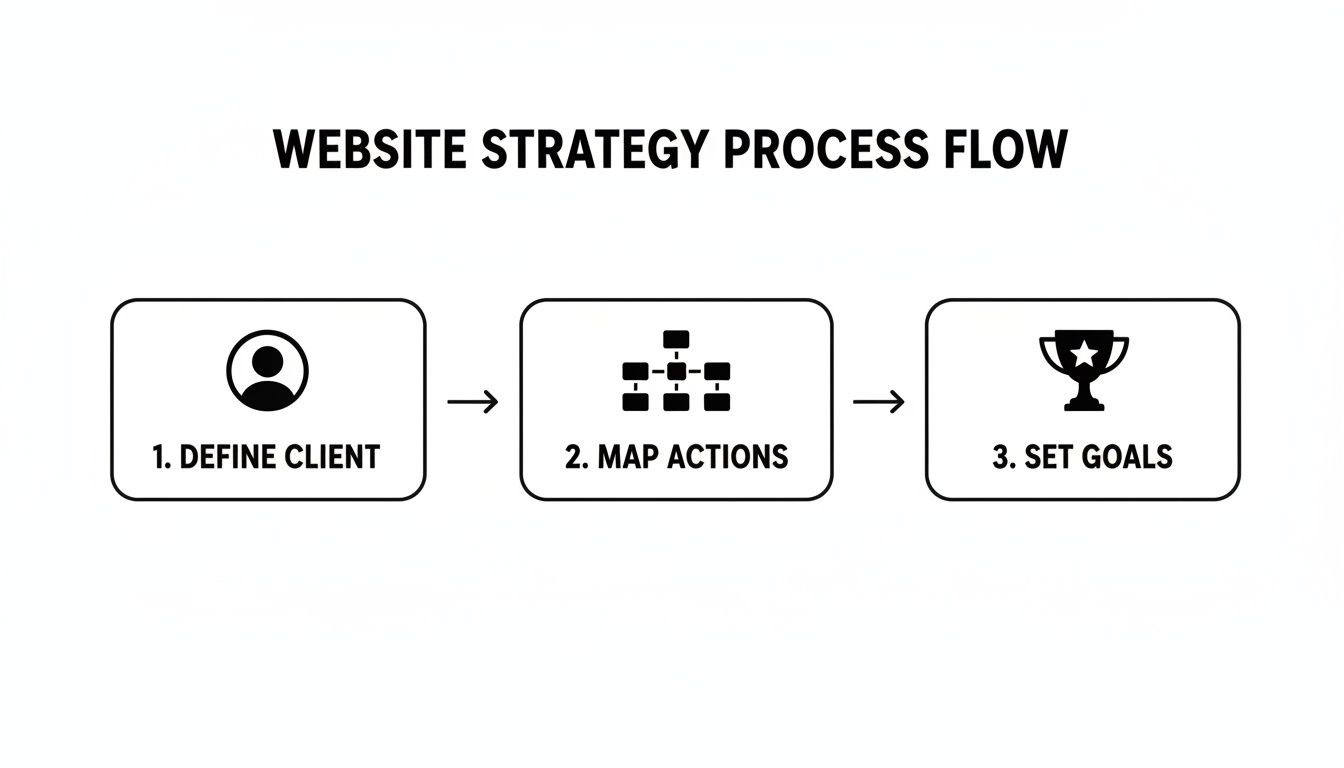
This strategic flow ensures your website is built from the ground up to serve your business, not just to look good. This is especially vital in a booming market; Australia's construction industry is projected to hit around AUD 256.14 billion by 2029, creating a massive opportunity for builders who know how to market themselves online. You can read the full research on construction industry growth trends to see just how big the opportunity is.
Getting Your Essential Pages Right: From Digital Showroom to Lead Magnet
Alright, you've nailed down your strategy. Now for the fun part: building out the core pages of your website. I like to think of these as the different rooms in your digital showroom. Each one needs a clear purpose, guiding a potential client from just browsing to picking up the phone.
Your website has one job: to be your hardest-working salesperson, 24/7. As a digital marketing agency in Melbourne, I've seen it time and time again—a builder's online presence can go from a simple listing to a lead-generation powerhouse just by getting these key pages right.
Your High-Impact 'Services' Page
This is usually the first stop after the homepage. A potential client lands here with one simple question in their head: "Can you do what I need?" Your job is to answer that, quickly and clearly.
Vague descriptions are a killer. Get specific. Show them you're a specialist.
Are you known for:
- Custom Home Builds: Don't just say it. Detail your process from that first sketch to handing over the keys.
- Commercial Fit-Outs: Talk about how you navigate tight deadlines and the unique demands of commercial projects.
- Renovations & Extensions: Highlight your skill in seamlessly blending the new with the old.
- Specific Trades: If you're a sparky or a plumber, have dedicated pages for high-value services like 'switchboard upgrades' or 'hot water system installation'. This is a massive win for targeted SEO.
Each service you list should link directly to a relevant project in your portfolio. It’s the ultimate proof. You're not just saying you can do the work—you're showing them you've already done it, and done it well.
The 'About Us' Page That Actually Builds Trust
Let's be honest, people hire people, especially in the building game. Your 'About Us' page is where you stop being just another company and start being human. It’s your chance to build a genuine connection.
Share the story of how you got started. Why construction? What are the non-negotiables for you when it comes to quality or client communication? Introduce the key members of your team with a photo and a quick bio. Putting a face to the name makes your business so much more approachable.
The Australian construction market is enormous. In the December 2025 quarter alone, the total value of building work done was a staggering AUD 44,103.4 million. Residential construction accounted for a huge 61% of that, which tells you just how many homeowners are out there looking for a builder they can genuinely trust. You can discover more about Australian construction activity to get a feel for the landscape. Your 'About Us' page is where that trust-building starts.
Project Galleries That Work as Case Studies
Your 'Projects' or 'Portfolio' section is the heart and soul of your website. But please, don't just make it a photo dump. Think of each project as a mini-case study. It's your visual proof of quality.
My advice is to structure every project page with a clear beginning, middle, and end. Kick off with the client's initial problem or vision, show a few key 'in-progress' shots, and then blow them away with stunning 'after' photos. If you can, cap it off with a glowing testimonial from the client.
We work with clients all the time to make sure their high-quality work is displayed in a clean, professional layout that’s easy for users to navigate.
This screenshot gives you an idea of how a clean design puts your services front and centre. Notice the clear contact options and simple navigation—these are the details that turn visitors into leads. Our web design Melbourne team lives by this principle: clarity directs attention and drives action.
Landing Pages for Your Paid Ads
Finally, a quick but crucial point. If you're spending money on paid advertising, you absolutely must have dedicated landing pages. Sending traffic from a super-specific ad for "Google Ads for Plumbers" to your generic homepage is like throwing money down the drain.
A good landing page has a single focus: getting that click to convert. It needs a headline that perfectly matches the ad, bullet points that spell out the benefits, a simple contact form, and zero distracting navigation. This is a core tactic our Google Ads agency uses to skyrocket conversion rates for tradies and builders.
Building a Portfolio That Sells Your Craftsmanship
As a builder, your portfolio is your absolute best sales tool. I can't say this enough. I’ve seen too many incredible craftspeople let themselves down with a few blurry, badly-lit phone pictures. It honestly doesn't matter how amazing your work is if the photos make it look second-rate.
At our agency, we always treat the portfolio section as the centrepiece of any website for a building or construction company. This is the exact spot where you stop talking about your quality and start proving it. Getting this right isn't about luck; it's a deliberate process that turns a simple gallery into a persuasive sales machine.
Invest in Professional Photography and Videography
This one is non-negotiable. If you take just one piece of advice from this entire guide, let it be this. Professional photos and videos are not an expense—they're a crucial investment in your brand. The difference between a DIY shot and a pro photo is night and day.
A professional photographer knows how to find the perfect angles, use lighting to bring out the texture and quality of your materials, and stage a space to make it feel aspirational.
Make sure you're getting these assets:
- High-Resolution "After" Shots: These are your hero images. They need to be sharp, bright, and make potential clients dream.
- Dramatic "Before" Photos: The transformation is an incredibly compelling story. It shows you solve problems and create massive value.
- Drone Footage: For new builds, huge renovations, or jobs with impressive landscaping, nothing communicates scale and polish like drone footage. It immediately adds a premium, high-end feel to your work.
From my experience, clients often make decisions with their heart first, then justify it with logic later. Incredible visuals create that emotional "wow" moment that makes someone want to work with you before they've even read a word.
Frame Every Project as a Mini Case Study
Your portfolio shouldn't just be a gallery of finished jobs; it should be a collection of success stories. Don’t just show the result—tell the story behind it. This is how you prove your expertise and show off your problem-solving skills.
I always structure project pages for my clients using a simple but powerful narrative. It looks something like this.
Start with the client's problem or vision. Was it an old, clunky kitchen that just didn't work for a growing family? Or maybe a commercial space that needed a full fit-out on a seriously tight deadline?
Then, explain your clever solution. This is your time to shine. Talk about how you tackled the challenge. Did you totally reconfigure the layout? Did you track down some unique, hard-to-find materials? Maybe you developed a custom fix for a tricky structural issue?
Finally, show off the exceptional result. This is where you hit them with the beautiful "after" photos. But just as importantly, you need to describe the outcome. How did your work actually improve the client's life or their business?
This approach shifts your positioning from just another builder to a trusted partner and expert problem-solver. It’s a core strategy we use when working with a WordPress developer to build out these custom portfolio layouts. It’s all about telling a compelling story.
Enhance the User Experience and Build Social Proof
A brilliant portfolio also has to be easy to use. If a potential client is looking for examples of kitchen renovations, they shouldn’t be forced to scroll through dozens of commercial fit-outs to find what they need.
Here are a few practical things you can do to make it better:
- Implement Project Filters: Let people filter your work by project type (e.g., New Build, Renovation, Extension, Outdoor Area) or even by location (e.g., Melbourne, Sydney).
- Use High-Resolution Viewers: Don't let your stunning photos get stuck as small thumbnails. Use a lightbox or a gallery viewer that lets people zoom in and see every single detail in high resolution.
- Embed Client Testimonials: The absolute best place for a glowing review is right next to the project it’s talking about. Putting a client quote directly on that project’s page gives you powerful social proof at the exact moment a prospect is judging your work.
Winning Local Search So Clients in Your Suburb Can Find You
Let's be blunt: a stunning portfolio of your work is completely useless if potential clients in your own backyard can't find you online. For any builder or tradie, showing up on Google when someone types "builder near me" is everything. This is where Local SEO comes into play, and from my experience running a Melbourne-based agency, it's the single most powerful strategy for the construction industry.
You can't just throw "Sydney" or "Melbourne" on your homepage and expect the phone to ring. Your ideal clients aren't searching that broadly. They're looking for a "custom home builder in Brighton" or "renovations in Richmond." Winning at local search means getting hyper-specific and dominating your service area, one suburb at a time.
For a deep dive, this guide to Local SEO for contractors is a fantastic resource, but let's break down the core tactics that deliver real results.
Get Your Google Business Profile Dialled In
Your Google Business Profile (GBP) is the absolute cornerstone of your local visibility. It's the engine behind the Google Map Pack—that little box with three local businesses that pops up at the very top of search results. Getting a spot there is like having a shopfront on the busiest street in town, and it’s completely free.
But here’s the thing: optimising your profile isn't a one-off job. It's an ongoing task.
- Fill out every single field: Don’t get lazy here. Add all your services, your exact business hours, and write a detailed description packed with keywords about what you do and where you do it.
- Chase those five-star reviews: Positive reviews are pure gold for social proof and rankings. You need to get into the habit of actively asking every single happy client to leave you a review. Make it part of your project completion process.
- Use Google Posts regularly: Treat this like a mini-blog for your business. Post weekly updates with photos from current jobs, announce special offers, or show off a recently completed project. It’s a massive signal to Google that you're active, busy, and engaged.
An actively managed GBP tells Google your business is relevant and trustworthy, which directly boosts your chances of ranking.
To help you get started, here's a checklist of the core actions you should take to improve your local visibility right now.
Local SEO Checklist for Construction Websites
Actionable steps to improve your visibility in local search results and attract clients in your service area.
| SEO Tactic | Description | Impact on Ranking |
|---|---|---|
| GBP Optimisation | Fully complete your Google Business Profile, including services, hours, photos, and regular posts. | High |
| Location Pages | Create dedicated service pages for each key suburb you operate in (e.g., "Home Builder Camberwell"). | High |
| Gather Reviews | Actively request and respond to customer reviews on Google and other relevant platforms. | High |
| Local Citations | Build consistent Name, Address, and Phone (NAP) listings in directories like Yellow Pages and TrueLocal. | Medium |
| On-Page SEO | Include local keywords (suburb names) naturally in your page titles, headings, and body content. | Medium |
| Local Link Building | Earn links from local businesses, suppliers, or community organisations. | Medium |
Focusing on these tasks will create a powerful foundation that makes it easier for local customers to find and choose your business.
Build Hyper-Specific Location Pages
This is a tactic that has delivered incredible results for our clients. Instead of creating one generic "Services" page, you need to build out dedicated pages for each of your core services in your main suburbs.
For example, don't stop at a single "New Builds" page. Create separate, targeted pages like:
- "New Home Builder Brighton"
- "Custom Home Builder Toorak"
- "Luxury Home Builder Camberwell"
Each of these pages needs unique content. Talk about specific projects you've completed in that suburb. Mention the local council, the distinct architectural styles of the area, and feature testimonials from clients who actually live there. This strategy screams to Google that you are the authority for that service in that exact location.
A builder we worked with saw a 40% jump in qualified leads within three months, purely from creating ten of these suburb-specific pages. It works because it targets customers with incredibly high purchase intent.
The Grunt Work: Building Local Citations
Finally, you need to build what are called "local citations." A citation is simply any online mention of your business's Name, Address, and Phone number (NAP). Getting your business listed accurately in reputable Australian directories like TrueLocal, Yellow Pages, and other industry-specific portals helps solidify your digital footprint.
The absolute key here is consistency. Your NAP details must be 100% identical across every single listing. Even a small variation like "St" instead of "Street" can confuse Google and dilute your authority. Yes, it’s a tedious process, but it’s a fundamental piece of the local SEO puzzle that cements your business's connection to your physical service area.
Driving Qualified Leads with Paid Ads and Flawless Tracking
Look, a brilliant website is fantastic, but it’s not much use if your ideal clients never find it. While local SEO is the long game for organic growth, paid ads are the secret weapon for getting targeted traffic right now. I manage campaigns for service businesses day in and day out, and I can tell you a well-run ads strategy is a complete game-changer for builders and tradies.
You’re not just throwing money at Google and hoping for the best. You're putting your business directly in front of people who are actively, and often urgently, searching for the exact services you offer.
PPC for Tradies: Your Unfair Advantage
Think about how a potential customer searches when they have a problem. They aren't just browsing. They're on a mission, typing specific phrases like "emergency plumber near me" or "custom home builder quote." Pay-per-click (PPC) advertising on platforms like Google Ads lets you show up at that exact moment of need.
Here at our digital marketing agency in Melbourne, we see the best results from campaigns that are super focused. We don't bother bidding on a broad, expensive term like "builder." Instead, we target long-tail keywords that tell us someone is ready to make a call:
- Home extension cost estimate Sydney
- Bathroom renovation contractor Brighton
- Local electrician for switchboard upgrade
The best part about PPC for tradies is the control. If you’re booked solid for the next two months, you can simply pause your campaigns. When you're ready to fill up the diary again, you just flick them back on. It gives you an incredible level of control over your lead flow.
Building Landing Pages That Turn Clicks into Calls
One of the most common and costly mistakes I see is sending paid ad traffic straight to the homepage. A person who clicked your ad for "kitchen renovations" doesn't want to dig through your whole site to find the right page. They want instant confirmation they've landed in the right spot.
This is why we use dedicated landing pages. A solid landing page for a construction service ad should have:
- A Matching Headline: The headline must echo the ad they just clicked.
- Clear Value Proposition: Use bullet points to list the key benefits of your service.
- Social Proof: A couple of powerful client testimonials work wonders.
- A Simple Form: Just ask for the essentials—name, phone, email, and a quick message.
- A Big, Obvious CTA: A button like "Get Your Free Quote Now" should be impossible to miss.
By stripping away all other distractions—like the main navigation—you guide the user towards the one action you want them to take.
The Critical Role of Flawless Tracking
Here’s the part that separates the pros from the amateurs: if you're not tracking your results, you're just gambling with your marketing budget. Setting up proper tracking is the only way to know what's working, what's not, and where to put your money for the best return.
From my experience, businesses that meticulously track their conversions can often reduce their cost-per-lead by over 50% within just a few months. Data isn't just a nice-to-have; it's the blueprint for profitable advertising.
This is where a robust understanding of Google Ads conversion tracking becomes non-negotiable. We use tools like Google Tag Manager and Google Analytics to monitor every single form submission and phone call that comes from an ad.
We set up specific "Goals" or "Conversions" for every important action on a client's website. This means we track every time someone fills out the "Request a Quote" form, clicks the phone number on their mobile, or even downloads a project brochure.
This is a real-world look at how we show campaign results. The "cost per conversion" figure tells you exactly what you're paying for each lead, which is the metric that truly matters for any service business.
For businesses where the phone is the main source of leads, we go a step further with advanced call tracking software like CallRail. This tech assigns a unique phone number to each of your ad campaigns. It lets us see precisely which ad, keyword, or campaign made a customer pick up the phone. It's the ultimate way to tie your ad spend directly to ringing phones and make every dollar accountable.
Alright, let's get into the nuts and bolts. The technology powering your website is its foundation. It’s not about getting bogged down in code and jargon; it’s about making a smart, practical choice that ensures your site is fast, reliable, and can actually grow with your business.
From my experience as a WordPress developer in Melbourne, the tech you choose can be the difference between a lead-generating machine and a slow, clunky digital business card that just sits there. For builders and construction companies, the recommendation I give is almost always the same.
The Only Platform I Trust for Builders
I’ve built sites on just about every platform you can name, but when it comes to the construction industry, WordPress is the undisputed champion. It’s not just because it powers over 43% of all websites on the internet; it’s about the sheer flexibility it offers.
Unlike closed-off systems like Squarespace or Wix, WordPress gives you—and me as your developer—complete control. You’re never stuck with a limited set of templates or locked-in features.
- Proper Custom Designs: We can build a completely unique design from the ground up that reflects your brand and the quality of your craftsmanship. It won’t be a slightly tweaked template that a dozen of your competitors are already using.
- Features That Actually Fit Your Business: Need a multi-step quote form where clients can upload architectural plans? Want a gallery of your projects that can be filtered by service or suburb? As a WordPress developer, I can build exactly what you need without hitting a wall imposed by the platform.
- Dominating Local SEO: WordPress is practically built for search engines. Its structure, combined with the right plugins, gives us the power to implement the kind of granular, suburb-specific SEO that gets construction businesses found by local clients.
In short, it’s a rock-solid foundation that we can mould to your exact business needs, now and in the future.
The image below is from our own site, showing how we talk about our WordPress specialisation. Notice the focus is on tangible outcomes—custom design, SEO, scalability. These are the real-world benefits that matter.
The platform you choose should empower your business goals, not restrict them. That’s why a flexible solution is so crucial.
Getting the Technical Details Right Before Launch
Choosing WordPress is step one. But the environment it lives in is just as important for a smooth, successful launch.
Don’t Skimp on Hosting: Seriously, don't cheap out here. Slow load times are a conversion killer, especially for a potential client on their phone at a job site. Investing in quality, Australian-based hosting is non-negotiable. It keeps your site fast for your local audience and ensures you have support when you need it.
Lock It Down: Construction websites get targeted by spammers and hackers just like any other site. The basics are mandatory: an SSL certificate (the little padlock in the browser bar), strong passwords, and a reliable security plugin.
Before any site I build goes live, it goes through a meticulous pre-launch checklist. This is my non-negotiable final quality check that prevents those "oops" moments after launch. I click every button, test every link, and submit every form. I check how it looks on different phones and run one last SEO audit to ensure every page title and meta description is optimised. It's this final check that guarantees a seamless, professional launch day.
Over the years, I've had countless chats with builders, tradies, and construction company owners about getting a new website off the ground. A few questions always come up, so I wanted to tackle them head-on.
Let's cut through the jargon. My goal here is to give you straight, honest answers based on my experience building digital tools for businesses just like yours across Australia. We’ll cover everything from costs and timelines to the features that actually get you more leads. Think of this as the conversation we'd have over a coffee.