A website for your construction company isn't just an online business card anymore. In my experience, it’s your hardest-working employee — your best salesperson, lead generator, and project showcase, all rolled into one. When I see a well-built site, I see a machine that establishes instant credibility and works around the clock to bring in qualified clients who are ready to get started.
Why Your Website Is Your Most Valuable Asset
As a marketing agency in Melbourne, I've seen the same story play out over and over. A talented builder or contractor does phenomenal work, but their online presence is either non-existent or looks like it's stuck in 2005. From my perspective, it’s a massive missed opportunity, especially when you look at the sheer scale of the industry.
The Australian construction market is enormous. We're talking a market size set to hit AUD $641.1 billion this year, with over 431,000 businesses all fighting for a slice of the pie. In a field that crowded, I believe a powerful website isn't a "nice-to-have"; it's the one tool that separates the market leaders from everyone else. You can get the full picture from these construction industry statistics.
Shifting from an Online Brochure to a Lead Machine
The real mental shift needs to happen here: your website isn't some static document you set and forget. It's an active, high-performing team member that should be delivering a measurable return.
From my experience, this is what this "employee" does for you 24/7:
- Qualifies Your Leads: A great website answers the common questions upfront, shows off the specific type of work you excel at, and gives clear next steps. This whole process naturally weeds out the tyre-kickers and brings you clients who are a perfect fit.
- Builds Unshakeable Trust: High-quality photos, detailed project case studies, and real client testimonials prove your expertise long before you even pick up the phone. This is something I've seen work time and again.
- Shows Off Your Best Work: Unlike a physical folder you lug around, your website can display your entire project portfolio to an unlimited audience, anytime, anywhere.
- Captures Business After Hours: Your ideal clients aren't just browsing from 9 to 5. Your website is always on, ready to grab their details through a contact form or quote request while you’re off the tools. I've seen leads come in at 2 AM that turned into major projects.
We’ve helped countless Aussie builders completely transform their digital footprint, taking them from a dated, invisible site to a genuine lead-generating powerhouse. My entire goal is to create a digital asset that directly and positively impacts your bottom line.
Based on my experience, a well-crafted website for a construction company does more than just look professional—it functions as an automated sales funnel, guiding high-value clients from initial interest to a signed contract.
Showcasing Modern Capabilities
Your website is also the perfect platform to signal that you’re a forward-thinking business. Modern construction is about more than just bricks and mortar; it's increasingly about leveraging smart technology to improve safety and efficiency.
For example, showcasing your use of drones to survey sites or monitor project progress instantly sets you apart. It’s the ideal way to demonstrate a commitment to innovation. To get a better sense of how this technology is being used on-site, it's worth reading up on the modern drone use in construction.
Ultimately, a professional website isn't about marketing fluff. It’s about building a tangible system that consistently brings in new business. Once you start seeing your site as your most diligent employee, you begin to grasp its true potential for driving real growth and establishing your firm as a leader. In my opinion, it's the single most effective investment you can make in the long-term health of your business.
Just like a real-world build, a high-converting website needs a solid set of plans before you even think about breaking ground. This is the part everyone wants to skip—the strategy, the 'why'—but I've learned that getting this digital blueprint right from the start saves a mountain of headaches, time, and money down the track.
The first question I always ask a new construction client is simple: who are we actually building this for? Are you targeting cashed-up clients for luxury home builds in Toorak? Do you specialise in commercial fit-outs across the Sydney CBD? Or are you chasing massive, large-scale government infrastructure projects? Your ideal client changes everything.
Once we’ve locked in who we're talking to, we can start mapping out a site structure that feels completely natural to them. A potential client should land on your homepage and know exactly where to find your services, your past projects, and how to get in touch. From my experience, confusion is the #1 killer of leads.
This whole planning phase is about turning an old, tired website into a genuine, lead-generating machine.
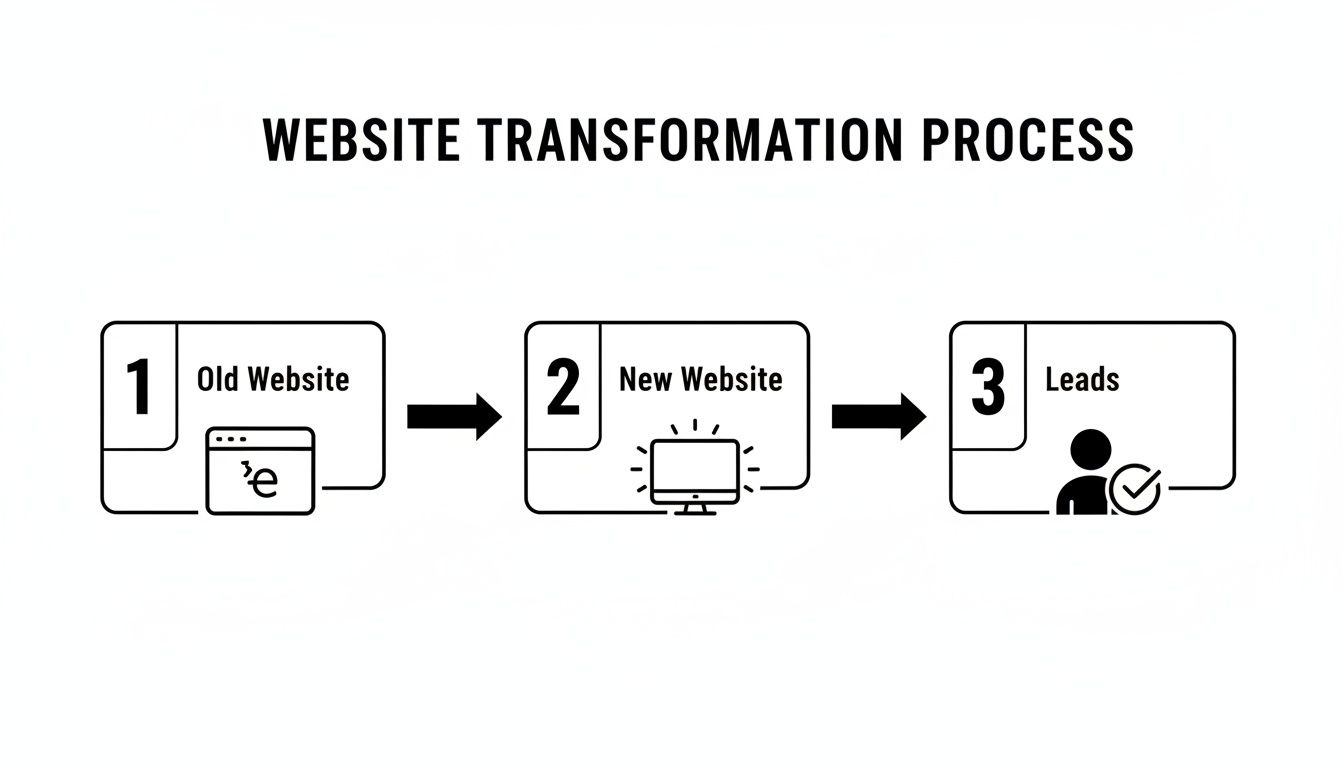
When you nail the strategy, a website refresh isn't just a facelift; it’s a direct path to more qualified enquiries for your business.
Nailing Your Core Website Pages
Every good construction website is built on a handful of essential pages. I think of these as the main structural pillars of your digital presence. They’re non-negotiable for building trust and getting that phone to ring.
Here's a breakdown of the must-have pages and their strategic purpose. These are the pages we'll build out to create a high-converting experience for your visitors.
Essential Pages for a Construction Company Website
| Page | Core Purpose | Key Elements to Include |
|---|---|---|
| Homepage | Your digital front door. It must instantly communicate what you do, who you serve, and guide visitors towards the next logical step. | A powerful hero image/video, a clear value proposition, logos of past clients, and strong calls-to-action (CTAs). |
| About Us | To build a human connection and tell your story. This is where you build trust beyond just the work itself. | Your company history, mission and values, key team member profiles, and any industry accreditations or awards. |
| Services | To detail your offerings and explain the value you deliver. This educates potential clients on your capabilities. | Dedicated pages for each core service (e.g., Custom Homes, Renovations), detailed descriptions, and relevant imagery. |
| Project Portfolio | To provide undeniable proof of your quality and expertise. This is often the most visited section of the site. | High-quality photos and videos, project case studies with client testimonials, and filters to sort by project type or location. |
| Contact Us | To make it incredibly easy for a motivated prospect to get in touch. Remove all friction. | A simple contact form, direct phone number and email, business address with a map, and clear business hours. |
Getting these core pages right is the foundation for a site that not only looks professional but also actively works to win you new business.
With the Australian construction industry projected to grow at a compound annual rate of 3-3.5% through 2026—and potentially as high as 6.8% in the years after—a targeted website is your key to capturing that growth. Given the residential sector makes up around 42% of all construction, I believe you can’t afford to be invisible online. You can read more in the latest Australian construction forecasts.
Structuring Your Site for a Natural User Flow
With your key pages defined, we need to think about how a visitor will actually move through them. My goal is to create a seamless path that guides someone from casual interest to actively requesting a quote.
A well-planned site structure isn't just a nice-to-have for users; I know for a fact it's absolutely fundamental for good SEO. Google rewards websites that are logically organised and easy for its bots to crawl and understand.
A typical journey for a potential client might look something like this from my experience:
- They land on your Homepage after a Google search for "custom home builder in Melbourne."
- Intrigued, they click through to your Project Portfolio to see the quality of your work.
- Impressed by what they see, they visit the About Us page to learn more about your company’s story and values.
- Feeling confident, they finally navigate to the Contact page to fill out your quote request form.
By mapping out these flows, we make sure there are no dead ends or confusing paths. Every single page should have a clear next step, pulling that user one step closer to becoming a paying client. This foundational work is what separates a simple online brochure from a genuine business-building asset.
Designing a Site That Builds Instant Trust
In the construction world, your reputation isn't just important—it's everything. It's built on solid foundations and the quality of your finished work. Your website is your digital handshake, and I've seen firsthand that it has to signal that same level of quality and professionalism the second a potential client lands on your page.
It’s not about being flashy or trendy. It’s about building instant trust.
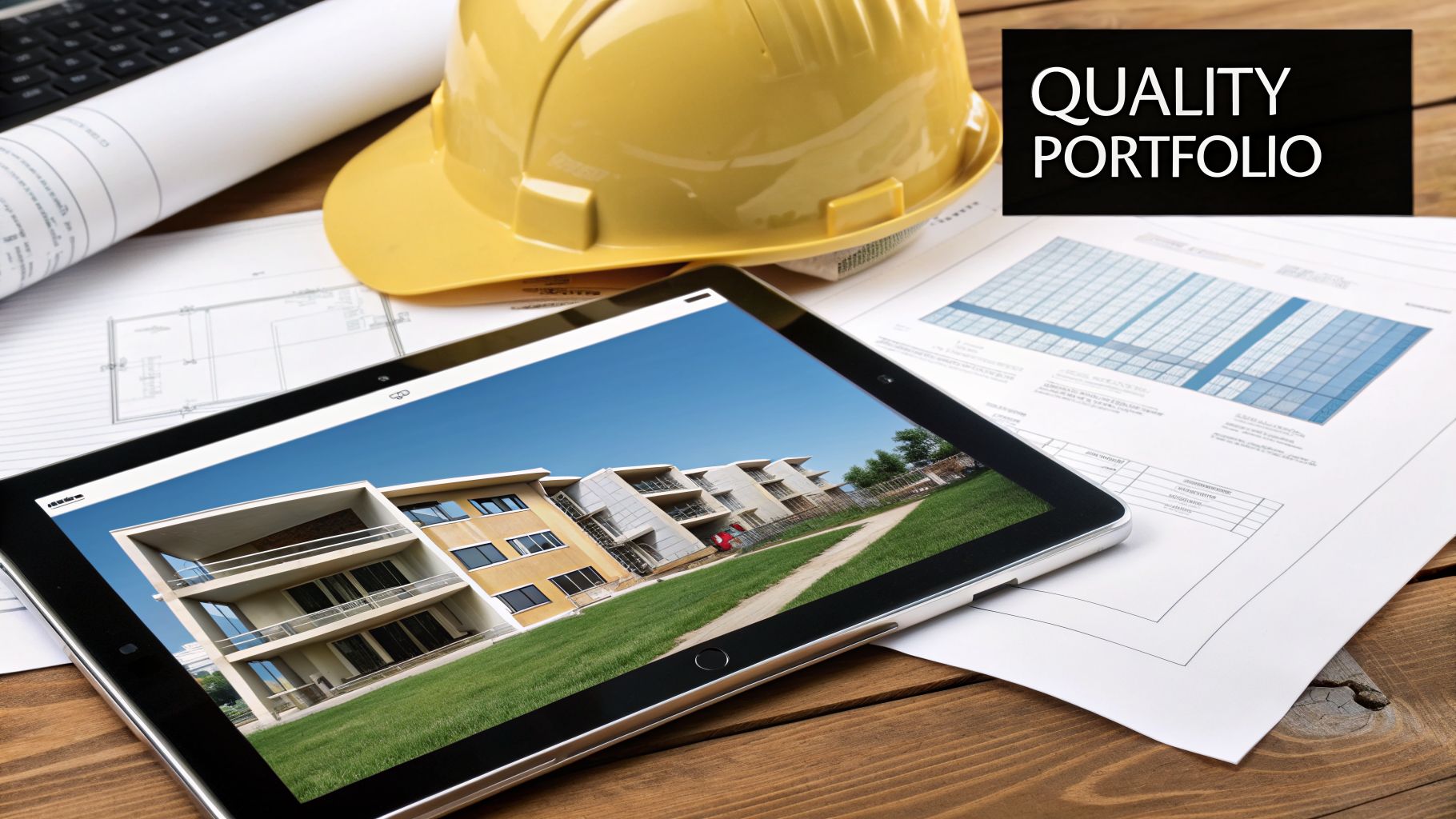
The design needs to feel as solid and well-planned as one of your builds. This means a clean, professional layout that’s dead simple to navigate, especially on a mobile phone. Forget cluttered pages and confusing menus; your design should let your craftsmanship speak for itself.
Your Portfolio Is Your Greatest Asset
For any builder, your project portfolio isn’t just a gallery; it’s your most powerful sales tool. This is where you show, not just tell. Skimping on photography is one of the biggest and most common mistakes I see construction companies make.
You absolutely must invest in stunning, high-resolution photos and videos of your best work. Grainy, poorly lit phone pictures scream amateur. Professional imagery, on the other hand, lets a potential client zoom in and see the fine details and quality you bring to every job.
Think about how people will use it. I always recommend organising your portfolio with simple filters for different project types like "New Builds," "Renovations," or "Commercial." This helps visitors quickly find work that’s relevant to what they need.
Crafting Compelling Project Case Studies
A great portfolio is so much more than a slideshow of pretty pictures. The best construction websites turn each project into a short, compelling case study. A simple story structure works wonders here, and it's a technique I use all the time.
I always tell my clients to tell the whole story for each key project:
- The Client’s Challenge: What problem did the client need you to solve? Were they trying to build their dream family home on a tricky, sloping block? Did they need a commercial fit-out done with minimal disruption to their business?
- Your Solution: Explain your approach. What made your process the right one? This is your chance to show off your problem-solving skills and expertise.
- The Outstanding Result: Show it off with your best photos and videos. But just as importantly, include a direct quote or testimonial from the happy client right there. That mix of stunning visuals and genuine social proof is incredibly persuasive.
From my experience, a project case study should do more than just show what you built; it should tell the story of how you solved a client's problem and delivered an exceptional outcome. That's what builds confidence and drives enquiries.
This storytelling approach transforms your portfolio from a passive gallery into an active sales tool. It helps potential clients see themselves working with you and imagine their own project coming to life.
The Power of Trust Signals
Beyond your portfolio, your website needs to be layered with what we call trust signals. These are the small but vital elements that make a visitor feel secure and confident in choosing you. For a high-stakes decision like a building project, these are non-negotiable in my book.
Here are the key trust signals I make sure every construction site has front and centre:
- Industry Accreditations: Display logos from organisations like Master Builders Australia or the HIA. These instantly signal your professionalism and that you adhere to industry standards.
- Client Video Testimonials: Written reviews are good, but video testimonials are absolute gold. A short clip of a real client talking about their positive experience with you is one of the most powerful trust-builders there is.
- Easy-to-Find Contact Info: Your phone number, email, and physical address should be clearly visible on every single page, usually in the header or footer. Making people hunt for this information makes you look shady.
- "About Us" Page: A genuine 'About Us' page with photos of you and your key team members helps humanise your business. People want to know who they’ll be dealing with.
By combining a clean, professional design with a stunning portfolio and prominent trust signals, your website stops being just another marketing tool. It becomes a testament to your quality, making potential clients feel confident that you’re the right builder to bring their vision to reality.
Choosing Your Tech Stack for Performance and Growth
When we sit down with a construction company, one of the first big decisions we have to make is what to actually build the website on. This isn't just a technical detail; it's the foundation of your entire digital presence. The technology you choose is the engine under the bonnet—it dictates how fast your site runs, how easily you can update it, and whether it can grow with you over the next five to ten years.
From my real-world experience, getting this right from the start is absolutely crucial.
After years of building sites for tradies and construction firms, I can tell you that for the vast majority of them, the clear winner is WordPress. As a WordPress developer in Melbourne, it's our top choice because it offers unmatched flexibility and serious SEO power. Most importantly, it gives you full control over your digital asset, which is something you just don't get with those restrictive, template-based site builders.
Custom WordPress vs Template Sites
A question I get all the time is whether to use a pre-made template or invest in a proper custom build. I get it. Templates look cheaper on the surface, but I’ve seen them cause major headaches and hidden costs down the track. They’re often bloated with junk code that kills your site speed, offer very limited design options that make you look like every other builder, and can become a complete nightmare to update or add new features to.
A custom WordPress site, on the other hand, is built from the ground up, specifically for your business.
- Lean and Fast: We only build in the code and features you actually need. The result is a much, much faster website, which is a massive factor for both Google rankings and keeping impatient clients from clicking away.
- A Truly Unique Design: Your website will have a one-of-a-kind design that genuinely reflects your brand and showcases your projects perfectly. In a crowded market, this is how you stand out.
- Built to Scale: As your business grows, a custom site can easily grow with you. Adding new service pages, advanced portfolio galleries, or even integrated client portals is straightforward when the foundation is solid.
I always say that investing in a custom WordPress site is like commissioning a custom-built home versus buying a project home. One is built to your exact specifications and designed to last; the other forces you to fit into a pre-made box.
Right now, Australia's construction industry is experiencing a massive boom. Employment has hit over 1.3 million workers, and projections show we'll need around 300,000 more by mid-2027 to keep up. A robust, custom-built website is the digital infrastructure you need to manage this growth, attract top talent, and showcase the high-calibre work that wins those major contracts. You can dig into more data on Australia's construction workforce demands.
Essential WordPress Plugins for Builders
The real power of WordPress comes from its plugins. As a WordPress development company, we've developed a go-to list of essential tools we install on almost every construction client’s site. My goal isn’t to load up on dozens of plugins, but to choose a few powerful ones that get the job done right.
Our Core Plugin Recommendations:
| Plugin Category | Our Recommendation | Why I Use It |
|---|---|---|
| Advanced Forms | Gravity Forms | This allows us to build incredibly detailed quote request forms. We can add file uploads for plans, conditional logic that only asks relevant questions, and multi-step forms that feel less intimidating for potential clients to complete. |
| SEO | Yoast SEO or Rank Math | These plugins give us granular control over on-page SEO. We can fine-tune titles, meta descriptions, and make sure every single page is set up to rank for its target keywords in Google. |
| Image Optimisation | ShortPixel | Large, high-resolution project photos are non-negotiable for builders but can absolutely destroy site speed. This plugin automatically compresses images without any noticeable loss in quality, ensuring your site stays lightning-fast. |
| Security | Wordfence | This provides a firewall and malware scanner to protect your site from brute-force attacks and other common threats. It’s essential for keeping your digital asset secure. |
Now, for some clients who have a small product side to their business—like selling branded merch or specific building materials—we also have plenty of experience as Shopify developers in Melbourne.
But for a service-based construction business focused on generating high-quality leads, WordPress is unequivocally the superior platform in my experience. It’s built for content, portfolios, and local SEO—exactly what a builder needs to grow their business online.
Winning Local Projects with SEO and Google Ads
Having a brilliant website is one thing, but it’s pretty useless if your ideal clients can't actually find it. From my experience, a great-looking site without eyes on it is just a digital ghost, and this is where a smart, targeted traffic strategy makes all the difference.
Homeowners and developers don’t just search for "builder". Their searches are loaded with intent. They’re typing things like “custom home builder in Brighton” or “commercial contractor Sydney CBD” straight into Google, looking for an immediate solution to a very specific problem.
Getting your business in front of those high-intent searches means a two-pronged attack in my book: long-term organic growth through Local SEO and immediate, targeted visibility with Google Ads.
The Slow Burn: Local SEO
Local Search Engine Optimisation (SEO) is all about making your business more visible in Google's local search results. Think of it as a marathon, not a sprint. The payoff is a sustainable stream of free, highly qualified traffic that grows over time as you build digital authority in your specific service area.
Here’s where I recommend you focus your efforts:
- Google Business Profile (GBP) Optimisation: Your GBP listing is your single most important asset for local search. It needs to be completely filled out with your correct name, address, phone number (NAP), hours, and a detailed description packed with the right keywords. Regularly upload high-quality photos of your finished projects, your team on-site, and anything that shows off your work.
- Gathering Five-Star Reviews: Consistently getting new, positive reviews on your GBP is arguably the single biggest local ranking factor I see. You have to actively ask every happy client for a review. It builds immense trust and social proof that Google loves to see.
- Building Local Citations: This is just a fancy way of saying you need to get your business name, address, and phone number listed consistently across relevant online directories. Think Yellow Pages, TrueLocal, and any industry-specific portals. Consistency is key here.
Beyond just an online presence, implementing effective digital marketing for roofers and other specialised trades can seriously amplify your reach, directly impacting your ability to win local jobs. SEO is the foundation of that entire strategy.
Immediate Results with Google Ads
While SEO is building up steam in the background, Google Ads delivers results now. It lets you pay to jump the queue, placing your website at the very top of the search results for the exact keywords your ideal clients are using.
For a service business like a builder, this is incredibly powerful. Imagine your site showing up first every single time someone in your service area searches for "kitchen renovation specialist near me". This is how I drive a steady, predictable stream of quote requests and phone calls, right from day one. It’s a vital strategy we use when running campaigns like Google Ads for plumbers, and the exact same principles apply to builders.
The real magic happens when you combine Local SEO with Google Ads. The long-term trust from SEO and the immediate leads from paid ads create a powerful, self-reinforcing growth loop for your construction business. I've seen it work wonders.
Let's break down how these two essential strategies really stack up against each other.
Local SEO vs. Google Ads: Which Is Right for You?
It’s easy to get confused about where to put your money and effort. This table should clear things up.
| Factor | Local SEO | Google Ads |
|---|---|---|
| Speed to Results | Slow (3-12+ months) | Fast (Immediate) |
| Cost | "Free" (requires time/expertise) | Pay-per-click (direct ad spend) |
| Longevity | Results are sustainable and build over time | Results stop when you stop paying |
| Targeting | Broad targeting within a geographic area | Highly specific keyword and demographic targeting |
| Trust Factor | High (organic results are trusted more) | Lower (users know it's a paid ad) |
Ultimately, it’s not a question of choosing one over the other. The most successful construction companies I've worked with use both.
We often see clients start with Google Ads to get the phone ringing immediately while we work on building their long-term SEO foundation in the background. It's a proven one-two punch that gets results now and sets you up for the future.
Your website is the final piece of the puzzle. Both SEO and Google Ads are designed to drive traffic to your site. It’s your website’s job to take that hard-won traffic and turn it into actual phone calls and signed contracts. Without a high-converting site, all that ad spend and SEO effort just goes to waste.
Common Questions from Construction Business Owners
When builders and contractors come to us, they’ve usually got a few big questions weighing on their minds. It’s understandable. A new website is a serious investment of time and money, and you want to get it right the first time.
Over the years, I've heard the same things pop up again and again. So, let’s cut through the noise and get straight to the honest, no-fluff answers based on my experience.
How Much Does a Professional Construction Website Cost?
This is always the first question, and my real answer is: it depends entirely on what you need it to do. You can grab an off-the-shelf template for a few thousand dollars, but you’re essentially renting a digital space that looks like every other builder's site. It’s not an asset you truly own.
For a custom-designed WordPress site built to actually generate leads—with detailed project galleries, smart quote forms, and a proper SEO foundation—you should be budgeting somewhere in the $10,000 to $25,000+ range. At our Melbourne web design agency, we don't see this as a cost; we see it as an investment in your single most important business-generating tool.
I always say a great website isn't an expense; it’s a machine that brings in high-value leads for years. When it's built right, the return on that investment makes the upfront cost feel small.
How Long Does the Whole Build Process Take?
From our first strategy session to the day we push your new site live, a typical custom website project takes between 6 and 12 weeks. This timeline gives us the breathing room to do things properly without cutting corners.
The process usually breaks down like this:
- Discovery & Planning (Approx. 2 weeks): This is where we nail down the strategy, sitemap, and how users will navigate the site.
- Design & Feedback (Approx. 2-3 weeks): We create the visual mockups and work with you to refine the look and feel.
- Development & Content (Approx. 4-6 weeks): The longest phase. We get into the code, build out the site, and load in all your project photos and text.
- Final Checks & Launch (Approx. 1 week): We run through our quality assurance checklist, test everything, and push the button to go live.
Honestly, the biggest factor that can speed up or slow down a project is client feedback. The more decisive you are and the quicker you can provide content, the faster we can move.
Should I Use WordPress or Shopify for My Construction Business?
For 99.9% of builders, contractors, and tradies, WordPress is the only choice that makes sense. As a professional WordPress developer, I can tell you it’s built from the ground up for service-based businesses that need to showcase their work, build trust, and capture leads. Its flexibility for custom design and power for SEO is exactly what you need.
Shopify is an incredible platform, but it’s designed for e-commerce—selling physical products. You’re a builder, not an online retailer. Using Shopify would be like trying to frame a house with a screwdriver. It's the wrong tool for the job.
Now, if you were running an online store selling building supplies, we'd be having a very different conversation. We build those for our ecommerce marketing agency clients on Shopify all the time. But for your construction business? It's WordPress all the way.
Is a Blog Really Necessary for My Site?
Yes. One hundred percent. From my experience, a blog isn't just for recipes or travel stories; it's your single most powerful tool for winning the long game of SEO.
Think about the questions your ideal clients are typing into Google right now. Things like, "cost to build a deck in Melbourne" or "what to look for in a luxury home builder."
Every time you publish an article that answers one of those questions, you’re positioning yourself as the go-to expert. You build massive trust and start ranking for valuable search terms that drive free, qualified traffic straight to your digital front door. If you're serious about getting new business online, a blog isn't an optional extra—it’s essential.
At Alpha Omega Digital, we don’t just build websites; we build lead-generation assets for construction companies. I'm based in Melbourne, Australia but our agency also services clients from Sydney, Brisbane, Newcastle, Perth, Adelaide, Darwin and Hobart.
Have a project in mind? Get in touch with us.
If you're a business with a paid ads budget of at least 3k a month, I'd love to offer you a low risk deal- get a month of paid ads management FREE. Apply now on our contact page.