Let's be honest, the term "sales funnel" sounds like something cooked up in a marketing lab. When I first started out, it felt like this abstract, overly complicated concept. But the lightbulb moment for me was realising it’s not some abstract jargon—it's something we all experience in the real world, every single day.
A sales funnel is really just a map of the journey someone takes from discovering your brand to actually buying something. It’s the structured path you create to guide them from being a curious browser to a paying customer. From my experience as a marketing agency in Melbourne, getting your head around this is the first step to growing your business on purpose, not by accident.
Let’s Ditch the Jargon: The Sales Funnel in the Real World
Think about a busy retail strip in Melbourne on a Saturday. The entire process, from someone just glancing at a shop window to becoming a repeat customer, is a physical sales funnel in action. You're already familiar with how this works, even if you’ve never used the marketing terms for it.
The Window Display: Grabbing Attention
Picture someone walking down the street, not really looking for anything in particular. Suddenly, a striking window display at a clothing store catches their eye. This is the Awareness stage. It’s the very top of your funnel, where the only goal is to get noticed in a sea of distractions.
For an eCommerce business, your "window display" could be a compelling Facebook ad, a sharp Instagram post, or showing up on the first page of Google. As a digital marketing agency in Melbourne, we see this stage go wrong all the time. So many businesses either have no window display at all, or it’s just not interesting enough to make anyone pause their endless scrolling.
The goal of the Awareness stage isn’t to make a sale; it’s to start a conversation. You just want to interrupt someone long enough for them to think, "Hmm, what's this?"
Stepping Inside: Browsing the Aisles
Intrigued, the person steps inside. They start wandering the aisles, picking up a few items, checking the quality, and looking at price tags. Welcome to the Consideration stage. They’ve gone from being a passive window shopper to an active prospect, figuring out if what you offer is right for them.
Online, this is the moment a user clicks your ad and lands on your website. They’re now exploring:
- Your Shopify product pages: They're reading descriptions, flicking through photos, and scanning customer reviews. A great Shopify developer ensures this experience is seamless.
- Your WordPress product pages: They're trying to understand your product and how it can solve their specific problem. A skilled WordPress developer in Melbourne can make these pages convert.
This is a make-or-break moment. If your website is slow, confusing, or looks like it was designed in 2005, they’ll turn around and walk straight back out. We've seen countless eCommerce businesses in Melbourne lose sales right here, simply because their site wasn't built to turn that initial flicker of interest into a real decision.
Heading to the Checkout: Making the Decision
Finally, after browsing and finding the perfect item, the customer heads to the counter to pay. This is the Decision or Conversion stage—the narrowest part at the bottom of the funnel. They've made up their mind and are ready to pull out their wallet.
Online, this is your checkout process or the "Add to Cart" button. The reason this analogy works so well is that it shows a sales funnel for what it really is: a structured path. It’s how you intentionally guide potential customers from that first glance to the final sale, turning casual interest into actual revenue.
Mapping the Four Core Stages of a Modern Sales Funnel
So, we've covered the big picture. Now, let’s get into the nuts and bolts and break the funnel down into the four core stages that actually matter for your online business. I see these as distinct phases in a customer's mindset, and getting your timing right is everything.
This isn’t just theory. As a marketing agency in Melbourne, we build campaigns for eCommerce clients around these exact stages every single day. I'll walk you through each one, from the top of the funnel (ToFu) right down to the bottom (BoFu), using practical examples from the trenches.
Stage 1: Awareness (Top of Funnel)
This is the widest part of the funnel, where your potential customers don't even know you exist yet. They have a problem or a desire, but your brand isn’t on their radar as a potential solution. Your entire goal here is to get noticed and make a great first impression.
The customer's mindset is simple: "I'm just browsing" or "I have this problem I need to solve." They aren't looking to buy from you specifically.
For our eCommerce clients, this is where we use tools like Facebook Ads and Instagram Ads. As a specialist Facebook ads agency, we run campaigns with eye-catching visuals and compelling copy to stop them from scrolling. It’s the digital equivalent of that striking window display we talked about earlier. We’re not asking for a sale; we're just introducing the brand. The key is consistency in your marketing efforts; you can't just run ads for a week and expect miracles.
Stage 2: Consideration (Middle of Funnel)
Once you've grabbed their attention, they slide into the Consideration stage. Here, they know who you are and are actively figuring out if your product is the right fit. They're comparing you to competitors, reading reviews, and digging into the details.
Their mindset shifts to: "Is this the right solution for me? What are my options?"
A high-quality Shopify development partner really shines at this stage. We work with clients to build detailed product pages with high-resolution images, video demonstrations, comprehensive descriptions, and genuine customer reviews. This content is designed to answer every possible question and build trust, showing them exactly why your product is the better choice. Utilizing the Shopify Developer API allows for custom solutions that can make your product pages stand out even more.
Here’s a simple way to visualise the customer's journey from just looking to seriously considering a purchase.
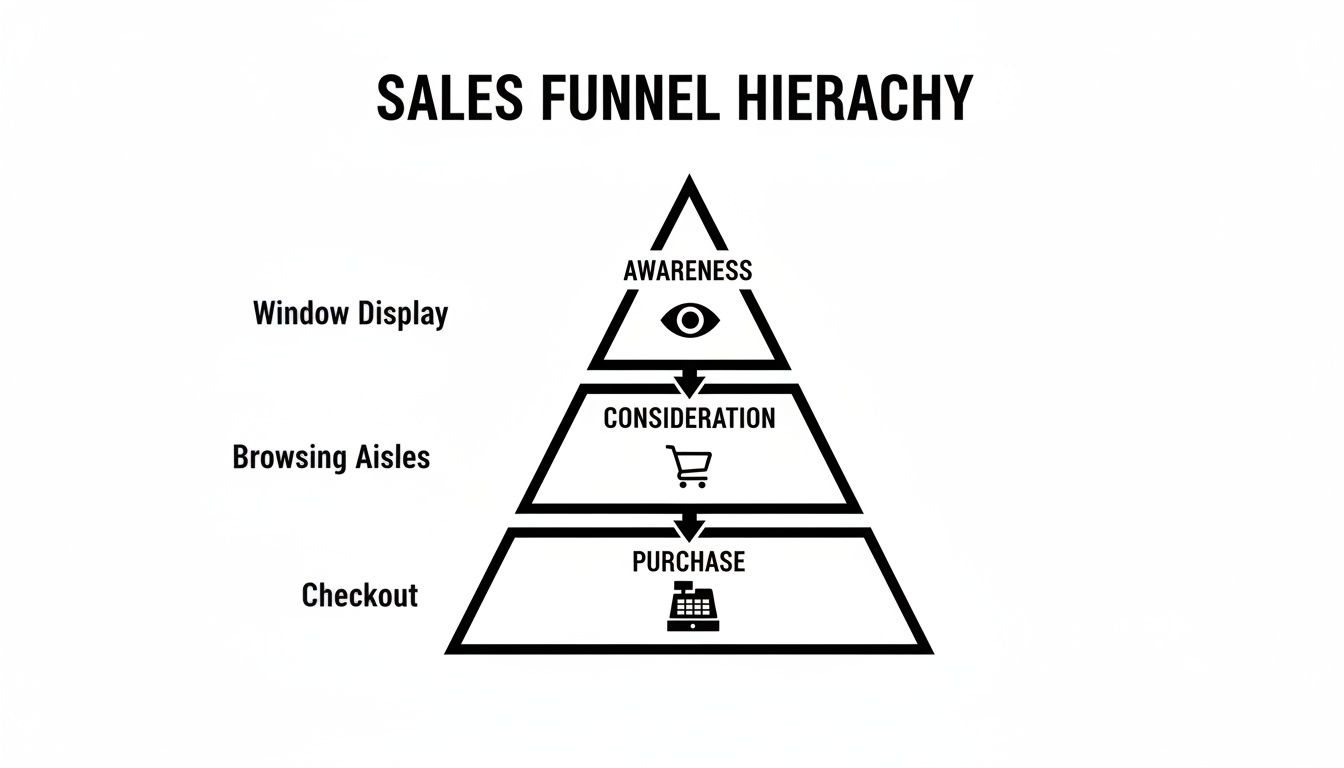
This visual shows how the journey mirrors a physical shopping experience, narrowing down from broad awareness to a specific intent to purchase.
Stage 3: Conversion (Bottom of Funnel)
This is the moment of truth. The customer is on the verge of buying. They’ve added an item to their cart. Your job now is to make this final step as easy and frictionless as possible.
Their mindset is now: "I'm ready to buy this."
This is where so many businesses drop the ball. A clunky checkout process can kill a sale in an instant. This is why having an expert WordPress web developer is so important for businesses using WooCommerce; they ensure your checkout is simple and your site is fast. For Shopify stores, we implement abandoned cart email automations that offer a gentle nudge or a small discount to bring hesitant buyers back over the line. Even small details, like optimising for mobile, can make a huge difference.
Stage 4: Loyalty (Post-Funnel)
The sale isn't the end of the journey; it's the beginning of a long-term relationship. The Loyalty stage is all about turning one-time buyers into repeat customers and brand advocates. It costs far less to keep a customer than to find a new one, making this stage incredibly profitable.
The customer's mindset becomes: "I had a great experience and I trust this brand."
We help businesses build loyalty through post-purchase email sequences that provide value, ask for reviews, and offer exclusive deals to returning customers. For businesses on platforms like Shopify, engaging with customers through an Instagram Shop or Facebook Shop is also a fantastic way to keep the conversation going and encourage that next purchase.
To bring it all together, here’s a quick breakdown of how these stages look in practice for eCommerce businesses.
Sales Funnel Stages and Corresponding Marketing Activities for eCommerce
| Funnel Stage | Customer Mindset ('What are they thinking?') | Example Marketing Tactic (eCommerce) | Technical Implementation |
|---|---|---|---|
| Awareness | "I have a problem/need, but I don't know the solution yet." | Running targeted Instagram video ads showcasing a new product line. | Setting up Meta Conversion API via GTM for accurate tracking. |
| Consideration | "I'm researching options. Which brand is the best fit for me?" | Creating detailed product pages with customer reviews, videos, and specs. | Custom Shopify design or WordPress design to enhance user experience. |
| Conversion | "I've made my decision and I'm ready to commit." | Sending an abandoned cart email with a 10% discount code. | Optimizing checkout with a fast, one-page process. |
| Loyalty | "I loved my experience and I trust this company." | Sending a post-purchase email offering a discount on their next order. | Integrating email marketing platform with Shopify customer data. |
Understanding this flow is the key. When you match your marketing message to your customer's mindset, you stop shouting into the void and start having meaningful conversations that naturally lead to sales.
Why Your Funnel Is Leaking Money and How to Plug the Gaps
Let's get straight to the point: your current sales funnel is almost certainly losing you money. I see it every single day when I talk to eCommerce store owners. They spend a fortune on ads to get people to their website, but then a huge chunk of those potential customers simply vanish before they ever make a purchase.
This isn't a feeling; it's a statistical reality. In Australia, the average eCommerce site converts only 1.78% of visitors into paying customers. With Australian online retail generating around AU$56.07 billion annually, that tiny percentage represents a massive pool of lost revenue. Millions of people are showing interest, but something along the way is making them leave. You can read more about these Australian eCommerce benchmarks to see how you stack up.
This gap between visitors and customers is what we call a “leaky funnel.” It’s where your marketing investment drains away without giving you a return. For a Shopify or WordPress store owner, shifting that conversion rate from 1.8% to even 3% could literally double your revenue without needing a single extra visitor. For businesses running Google Shopping Ads, a leaky funnel often looks like your Google Shopping ads not spending budget because the system learns your site doesn't convert well.
Identifying the Common Leaks in Your Funnel
So, where is all that money going? The leaks usually happen at predictable friction points in the customer journey. Based on the hundreds of sites I’ve audited as a marketing agency in Melbourne, these are the most common culprits that kill conversions.
- A Slow or Confusing Website: If your site takes more than a couple of seconds to load, you've lost a huge portion of your audience. Similarly, a poorly organised site built by an inexperienced wordpress developer makes it hard for users to find what they need, causing them to give up in frustration.
- A Painful Checkout Process: Have you ever tried to buy something online, only to be hit with unexpected shipping costs, forced to create an account, or faced with a ridiculously long form? These are sale-killers. A smooth, transparent checkout is non-negotiable.
- Lack of Trust Signals: People are cautious about where they spend their money online. Without clear customer reviews, security badges, and professional Shopify design, potential buyers will hesitate and ultimately click away.
- No Follow-Up Strategy: Around 70% of online shopping carts are abandoned. If you aren't using automated emails to remind these highly interested prospects about what they left behind, you are leaving a massive amount of money on the table.
A leaky funnel isn't just a marketing problem; it's a business problem. Each person who leaves represents a lost sale, a missed customer relationship, and wasted ad spend that could have been invested in growth.
Plugging the Gaps with a Strategic Approach
Fixing a leaky funnel isn't about a single magic bullet. It’s about methodically identifying and addressing each point of friction. It starts with a solid foundation—a professionally built website. Whether you need an expert WordPress developer or a Shopify development partner, your site has to be fast, intuitive, and trustworthy. We often recommend building custom blocks in Gutenberg for WordPress or even building custom Shopify apps using Shopify CLI for unique functionality that improves user experience.
From there, we look at the entire journey. We use tools like Google Tag Manager and Google Analytics to see exactly where users are dropping off. Are they abandoning their carts on the shipping page? Then we need to simplify that step or offer clearer shipping options. Setting up proper GTM and Google Analytics tracking is step one.
Next, we implement automated systems. A simple abandoned cart email sequence can recover a significant percentage of would-be lost sales. We also run a rigorous Meta ads creative testing process to ensure the messaging at the top of the funnel is pulling in the right audience from the start.
Ultimately, plugging the gaps means transforming your website from a simple online brochure into a high-performance sales machine. It’s about making small, data-driven improvements that create a massive impact on your bottom line.
A Practical Blueprint for Building Your High-Converting Funnel
Alright, enough theory. Let’s get our hands dirty and map out what a high-performing sales funnel actually looks like in the real world. From my experience running a marketing agency in Melbourne, I've seen that the best funnels are tailored specifically to the business model.
I’m going to walk you through a practical blueprint I use for my eCommerce clients, which is where my core expertise lies. This is a structure we've refined over years of working with Shopify stores.
Before we dive in, remember that any good funnel starts with a deep understanding of your customer. You can't persuade someone if you don't know who you're talking to. It’s why we always start by helping clients figure out how to create buyer personas that actually get results.
The Shopify eCommerce Funnel Blueprint
For eCommerce brands, the goal is direct: drive sales. The funnel needs to be seamless, trustworthy, and built to capture both impulse buys and considered purchases. Here’s a structure that just works.
- Awareness (Top of Funnel): We kick things off with a targeted Facebook Ads campaign. Using dynamic, eye-catching video and carousel ads, we introduce the brand's unique products to cold audiences who fit the ideal customer profile. The goal here isn't an immediate sale; it's about generating clicks and driving curious traffic to the website. Mastering Facebook ads is a skill, and it's important not to quit too early if you don't see results in the first few days.
- Consideration (Middle of Funnel): Once someone lands on the site, our Shopify development work really shines. Product pages have to be immaculate, featuring high-quality images, detailed descriptions, and social proof like reviews or user-generated content. We also use retargeting ads to show different product angles or benefits to people who visited but didn't add anything to their cart. This is where a deep understanding of platforms like Google Shopping ads for dropshipping can be crucial.
- Conversion (Bottom of Funnel): This is where we lock in the sale. The checkout process must be lightning-fast with minimal friction. Crucially, we set up a smart abandoned cart email automation. This sequence sends a series of reminders—first a simple nudge, then maybe some social proof, and finally a small, time-sensitive discount to get them over the line. Comparing PMAX vs Google Shopping ads is also a key consideration here to capture high-intent buyers.
This structured approach methodically turns casual browsers into loyal customers by giving them the right message at the right time. Our experience as a WordPress development company also informs our approach to WooCommerce stores, ensuring a robust and scalable solution.
Looking at sales funnel data in Australia shows why this matters so much. Local eCommerce stats show Google Ads visitors convert at around 4.8%, miles ahead of the 1.78% all-traffic average, because these users are much deeper into their buying journey. The typical Australian Shopify store sees a 1.4% conversion rate, but the top 10% hit 4.7% or higher by obsessively optimising every single touchpoint.
Whether you’re selling products on Shopify or WordPress, a well-defined funnel gives you a predictable, repeatable system for growth.
How to Measure and Optimise Your Funnel for Better Results
In my experience, you can't improve what you don't measure. Building a sales funnel is one thing, but knowing if it's actually working—and where it's breaking—is where the real magic happens. This is where we move away from guesswork and into data-driven decisions that actually grow your bottom line.
Demystifying funnel analytics starts with using the right tools. At our digital marketing agency in Melbourne, we rely on a core toolkit to track what really matters at every stage of the journey. Without these, you’re essentially flying blind.
The two non-negotiables are Google Analytics and Google Tag Manager (GTM). Google Analytics is like the scoreboard for your website, showing you who is visiting, where they came from, and what they do. GTM is the engine that collects all this specific data, allowing us to track everything from button clicks to form submissions without needing to constantly bother a WordPress developer in Sydney. Setting up Google Tag Manager containers correctly is a foundational step.
Key Metrics That Tell the Real Story
Once the tools are set up, we focus on the numbers that tell a story. Vanity metrics like 'likes' or 'followers' don't pay the bills. We track Key Performance Indicators (KPIs) that directly impact your revenue. Learning how to measure success on Facebook ads is critical.
Here are the crucial ones we monitor for our clients:
- Click-Through Rate (CTR): This measures how many people who see your ad (e.g., on Google or Facebook) actually click on it. A low CTR tells us the ad creative or targeting at the top of the funnel isn't resonating.
- Landing Page Conversion Rate: Of all the people who land on your page, how many take the desired action (like buying a product)? This metric tells us how effective your website is at the Consideration stage.
- Cost Per Acquisition (CPA): This is the total cost of acquiring one paying customer. If your CPA is higher than the profit you make from that customer, your funnel is fundamentally broken.
- Return on Ad Spend (ROAS): For every dollar you spend on advertising, how much revenue do you get back? A high ROAS means your funnel is profitable and ready to scale.
These numbers are your funnel’s vital signs. They show us exactly where the blockages are. A high CTR but low conversion rate points to a problem with your landing page, not your ads. A high conversion rate but a terrible ROAS means your pricing or offer needs a rethink.
The Importance of Accurate Tracking
None of these metrics matter if your tracking is sloppy. This is why the precise Conversions API installation for Meta is non-negotiable for anyone running Facebook or Instagram ads. It allows for server-side tracking that is more reliable than the old pixel, giving us a much clearer picture of what's actually driving results. This is something our team of Shopify developers are experts at implementing.
A modern Australian sales funnel is a series of conversion steps: from a raw lead to a Marketing Qualified Lead (MQL), then a Sales Qualified Lead (SQL), and finally a customer. Local data shows that from lead to MQL, only about 5–10% progress. From MQL to SQL, a realistic benchmark is 20–30%.
To learn more about these local benchmarks, you can find helpful insights on Australian business conversion rates.
For businesses using video content to feed their sales funnel, effective optimisation is key. Applying proven YouTube SEO optimization tips to your video strategy can significantly boost top-of-funnel awareness and drive more qualified traffic into your system. By measuring, testing, and refining each stage, we transform a leaky bucket into a streamlined and profitable system.
Let's Build Your Sales Funnel Together
So, we've covered a lot of ground. You now see that a sales funnel isn't just some marketing term—it's the actual path you guide a customer down, from the moment they first hear about you to the day they become a loyal buyer. We’ve walked through the stages, pointed out where most businesses lose money, and even mapped out what a funnel looks like for e-commerce businesses.
But knowing is one thing; doing is another. A high-performance funnel isn't a "set and forget" machine. It’s a living system that needs constant monitoring, sharp measurement, and expert tweaking. My team and I at Alpha Omega Digital? This is what we do, day in and day out.
Your Hands-On Funnel Partner in Melbourne
As a marketing agency based in Melbourne, we don’t just talk strategy—we build, manage, and optimise every single piece of the funnel for our clients across Australia. We’re in the trenches with you, handling the tech, the ads, and the data.
Our work covers the entire customer journey:
- The Foundation: It all starts with a rock-solid website. We provide expert WordPress development and Shopify development to build a fast, trustworthy online presence that’s designed to convert from day one. Our team includes talented WordPress developers and Shopify development partners.
- The Traffic: A funnel is useless without people in it. We run highly targeted Google Ads and Facebook Ads campaigns to fill the top of your funnel with qualified prospects who are actually looking for what you offer. This includes everything from a beginner's guide to Google Shopping ads to advanced campaign priority tactics in Google Ads.
- The Measurement & Optimisation: We get our hands dirty with the technical setup of Google Analytics and the Meta Conversion API. This ensures every dollar you spend is tracked and every decision we make is backed by real numbers, not guesswork.
Think of us as a hybrid team. We have the technical chops of a WordPress development company combined with the strategic brain of a performance marketing agency. Whether it's building a custom site with a dedicated wordpress website developer or running the ad campaigns that bring in the sales, we manage it all under one roof.
Alpha Omega Digital is a marketing agency based in Melbourne, Australia but also services clients from Sydney, Brisbane, Newcastle, Perth, Adelaide, Darwin and Hobart. Have a project in mind? Get in touch
Common Questions I Hear About Sales Funnels
I get asked about the nuts and bolts of sales funnels all the time. After walking people through the strategy, there are always a few practical questions that come up. So, let’s tackle some of the most common ones right here.
How Much Does It Cost To Build a Sales Funnel?
This is a bit like asking how much it costs to build a house—it really depends on the blueprint. A simple funnel for an eCommerce store, built on an existing Shopify website and powered by a few Google Ads, could be pretty affordable to get going. The main costs are your ad spend and the time it takes to create campaigns that actually convert. Wondering how much does it cost to start Google Ads? You can start with a small daily budget and scale up.
But if you're looking at a complex eCommerce funnel on Shopify, the investment can be much more significant. You might be looking at professional Shopify development to customise your product pages, subscriptions for various marketing automation apps, a solid budget for testing Facebook Ads creative, and the management fees from a marketing agency in Melbourne. The cost really just scales with the complexity and the tools needed to pull it all together.
How Long Until I See Results?
This is another "it depends" answer, but I can give you some realistic timelines from my own experience. With a high-intent channel like Google Ads, you can often start seeing traffic and even sales within the first week of launching. The person searching has an immediate need, so the results tend to come in fast.
On the other hand, an eCommerce funnel driven by social media ads takes a bit more patience. The first phase is all about gathering data—finding out which ads connect with people and who is actually clicking. While you might see some initial sales, it usually takes 30 to 90 days of consistent testing and tweaking to build a predictable, profitable system. The key is not to quit too early.
What’s the Real Difference Between a Sales Funnel and the Customer Journey?
This is a fantastic question because these terms get thrown around interchangeably, but they’re actually two sides of the same coin.
- The Sales Funnel is your business's point of view. It’s the structured, deliberate path you build to guide a potential customer from awareness to a sale. Think of it as your roadmap for marketing and sales.
- The Customer Journey is the customer’s point of view. It's their entire experience with your brand, which is often messy, emotional, and definitely not a straight line. It includes every thought, feeling, and touchpoint they have with you—even the ones you never planned for.
Here’s a simple way to think about it: your sales funnel is the perfectly paved road you construct, but the customer journey is the actual route someone takes, which might involve a few scenic detours and unexpected stops. A truly great sales funnel is one that aligns as closely as possible with that natural, human journey.
Alpha Omega Digital is a marketing agency based in Melbourne, Australia but also services clients from Sydney, Brisbane, Newcastle, Perth, Adelaide, Darwin and Hobart. Have a project in mind? Contact us