As a marketing agency in Melbourne, I talk to small business owners all the time. One of the most common things I hear, especially from eCommerce brands, is the frustration of being stuck on the paid advertising treadmill. You pour money into Facebook Ads or Google Ads, get a spike in traffic, feel that rush of excitement, and then… it stops. The moment you turn off the ad spend, your visitor numbers flatline. It's like renting traffic instead of actually owning it, and it's an exhausting way to grow a business.
This is the fundamental difference I try to explain. Paid ads are brilliant for a quick boost, launching a new product, or testing a marketing angle. But SEO? Search Engine Optimisation is about building a powerful, long-term asset for your business. It's the engine that brings in a steady stream of customers who are actively searching for exactly what you sell, day in and day out.
Why SEO is Your Best Long-Term eCommerce Investment
Let's be clear: when I talk about effective SEO services for small businesses, I'm not talking about quick hacks or trying to trick Google. I'm talking about building something real and valuable. It's a strategic process that creates a predictable flow of high-intent customers to your online store.
Building a Digital Asset, Not Just Renting Clicks
I like to use a simple analogy. Imagine your business is a physical store.
- Paid Ads: This is like paying for a flashy billboard on the West Gate Bridge. It gets a ton of eyeballs and drives people to your store, but only for as long as you keep paying the massive weekly fee. The second you stop, the billboard comes down, and that source of traffic is gone.
- SEO: This is like buying the land and building your flagship store in a prime spot like Chapel Street. It takes time, a solid blueprint, and consistent effort to build. But once it's established, it becomes a landmark. People seek it out, and it brings in consistent foot traffic for years to come, long after the construction costs are paid off.
This is what SEO does for your online store. Every optimised product page, every helpful blog post, and every quality backlink you earn is another brick in your digital foundation. It's permanent. This approach also builds something paid ads can't: genuine trust. When a potential customer finds your Shopify or WordPress store organically on the first page of Google, there's an inherent credibility. It’s no surprise that over 75% of searchers never even bother scrolling past the first page. For long-term growth, being on that first page is everything.
The Financial Sense of SEO for Australian eCommerce
This isn't just my opinion; it's a clear financial trend. Small businesses across Australia are shifting their focus to the power of organic growth. Data shows that the average monthly spend on SEO is set to hit $1,350 in 2025.
This investment is pushing the total value of Australia’s SEO industry towards an estimated $1.5 billion, a strong indicator of the confidence businesses have in its lasting return on investment. You can dig deeper into the numbers by exploring more data on Australian SEO trends.
Ultimately, investing in the right SEO services for small businesses is about choosing sustainable growth over short-term boosts. It’s a commitment to building a brand that attracts your ideal customers, month after month, without having to pay for every single click.
The Four Pillars of a Winning eCommerce SEO Strategy
When I first start working with a new eCommerce client, they often tell me SEO sounds overwhelmingly complex. But in my experience, it really boils down to four key pillars that support each other. If one is weak, the whole structure becomes unstable. I think of it like building a house: you wouldn't install a beautiful kitchen on a cracked foundation. The same logic applies to your website.
1. Technical SEO: The Foundation of Your Online Store
This is ground zero. Technical SEO is all about ensuring search engines like Google can easily find, crawl, and understand your website's structure. For an eCommerce store, this is non-negotiable. It's the plumbing, wiring, and concrete slab of your digital presence.
If Google's bots get stuck because of slow page load times (a huge issue with many Shopify themes), broken links, or a confusing site structure, they'll simply give up. You could have the best products in the world, but if the technical foundation is a mess, no one will find them through search.
As a WordPress developer in Melbourne, I've seen poorly built sites cripple an online store's potential. Key technical elements for eCommerce include:
- Site Speed: How fast your pages load, especially on mobile.
- Mobile-Friendliness: Ensuring your store is flawless on a smartphone.
- Crawlability: A clean site structure so Google can discover all your products.
- Schema Markup: Code that helps Google understand product details like price, stock, and reviews.
2. On-Page SEO: Optimising Your Digital Shelves
Once the foundation is solid, it's time to optimise the individual pages. This is On-Page SEO. It’s about making sure every product page, category page, and blog post is perfectly set up to tell both customers and search engines what it's about.
For an eCommerce business, this includes:
- Keyword Research: Finding the exact terms customers use when searching for your products. We go for long-tail keywords with high buyer intent, like "vegan leather crossbody bag Melbourne" instead of just "handbags."
- Optimised Product & Category Pages: Using those keywords in your product titles, descriptions, and image alt-text.
- Compelling Meta Descriptions: Writing those little summaries that show up in Google to convince someone to click on your store, not your competitor's.
At the heart of any successful SEO strategy lies effective conducting keyword research. This becomes the blueprint for your entire on-page plan.
3. Content Marketing: Attracting Customers Before They're Ready to Buy
Your house is built, the rooms are decorated. Now you need to fill it with things that attract people. That’s Content Marketing. For an eCommerce store, this is your opportunity to become a trusted resource, not just a seller.
This flowchart shows why SEO is a long-term asset that builds organic traffic, whereas paid ads are more like renting short-term visibility.
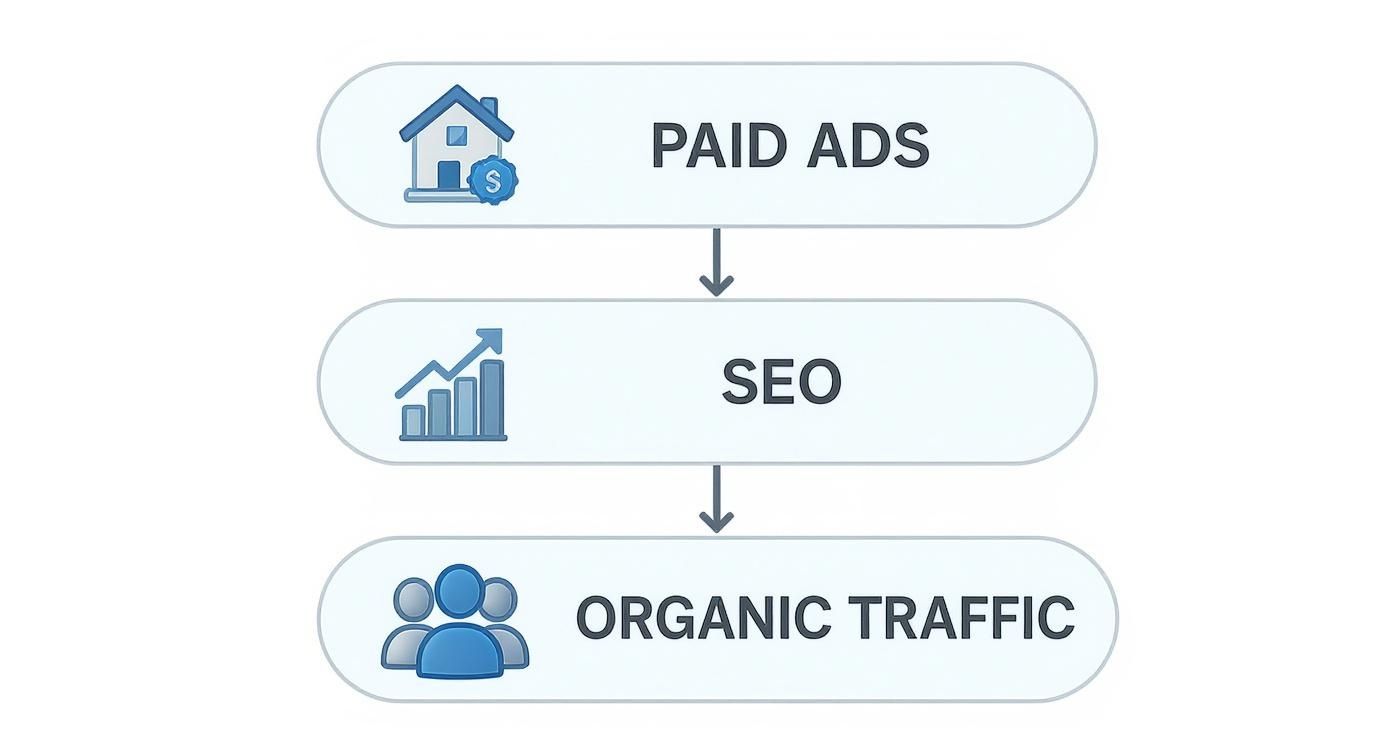
As the visual shows, ads can give you a boost, but a solid content and SEO foundation is what delivers sustainable, long-term growth.
For an online store, great content could be:
- In-depth Buyer's Guides: "The Ultimate Guide to Choosing the Right Running Shoes for Beginners."
- How-To Articles: "How to Care for Your Cast Iron Skillet," which naturally features your products.
- Comparison Posts: "Our Product vs. Competitor X: An Honest Breakdown."
This type of content attracts customers at the top of the funnel and gives other websites a reason to link to you, which brings us to the final pillar.
4. Off-Page SEO: Building Your Online Reputation
Finally, we have Off-Page SEO. This is all about building your store's reputation and authority across the web. The most powerful signal here is a backlink—when another reputable website links to a page on your site.
Think of each backlink as a vote of confidence. It tells Google that you're a credible source. For an eCommerce store, earning links from product review blogs, industry magazines, or complementary brands builds immense trust. We'll dive deeper into this later, but it's the element that solidifies your position at the top of the search results.
Mastering Local SEO for eCommerce in Melbourne
For any eCommerce business that also has a physical presence—a warehouse for local pickup, a showroom, or even just a registered office in Melbourne—Local SEO is a massive competitive advantage. It’s how you beat the big national retailers in your own backyard.
When a customer searches for "handmade candles near me" or "eco-friendly kids toys Melbourne," they're not just browsing. They have high purchase intent and are ready to buy now. Being the top result for these searches can drive significant, immediate revenue.
Your Google Business Profile: Your Digital Front Door
Your Google Business Profile (GBP) is the absolute cornerstone of Local SEO. It’s the info box that appears in Google Search and on Google Maps. For a local eCommerce business, it’s often the first interaction a customer has with your brand.
A crucial first step is thoroughly optimizing your Google My Business profile. This goes way beyond just listing your address. To turn it into a customer magnet, you need to:
- Complete Every Section: Fill out your business description, services, and attributes.
- Enable the "Products" Feature: You can list your top-selling items directly on your GBP, complete with images, descriptions, and prices. This is hugely powerful for eCommerce.
- Upload High-Quality Photos: Show off your products, your packaging, and maybe even your local team or workspace.
- Use Google Posts: Announce new arrivals, promote a sale, or share a link to your latest blog post.
- Encourage and Respond to Reviews: This is critical for building trust.
The impact of a well-managed GBP can't be overstated. A staggering 61% of local businesses still haven't fully optimised their Google Business listings, effectively leaving money on the table for their competitors.
The Power of Reviews and Local Citations
Beyond your GBP, building local trust comes down to two things: reviews and citations. These are the signals that tell both customers and Google you're a legitimate, trusted local business.
For a local business, a steady stream of positive reviews is more valuable than almost any other marketing activity. It's direct feedback that builds immense trust and directly influences your ranking in the local "map pack."
Here’s a simple breakdown of what to focus on:
| Local SEO Element | What It Is | Why It Matters for eCommerce |
|---|---|---|
| Customer Reviews | Feedback on platforms like Google, Facebook, and product review sites. | Builds immense social proof for your products, increases trust, and is a major local ranking factor. Google wants to recommend businesses people genuinely like. |
| Local Citations | Mentions of your business's Name, Address, and Phone number (NAP) on other websites. | Confirms your physical location to Google. Consistency across directories like TrueLocal and industry sites builds authority and verifies you are a real local entity. |
Encouraging reviews should be part of your post-purchase email sequence. A simple, polite request can make a world of difference. Likewise, ensuring your business information is consistent everywhere online might seem small, but these details are what Google uses to verify your legitimacy.
A Practical Guide to Link Building for eCommerce
Let's be real: link building often sounds technical and intimidating. Some old-school, shady SEO tactics gave it a bad name. But when I talk about it with my eCommerce clients, I explain it in a much simpler way: it’s about building relationships and proving your credibility.
Think of it like this: every time another website links to one of your product pages or blog posts, it’s a public vote of confidence. It's a signal to Google that says, “Hey, this online store is legit and knows its stuff. You should trust them.” The more of these high-quality “votes” you get, the more authority your website gains, and the higher you rank.
. | Irrelevant: The site has nothing to do with your business (e.g., a gambling site). |
| Good Authority: The site is well-respected and has its own traffic. | Low Quality: The site is brand new, has no traffic, and is full of spammy ads. |
| Natural Placement: The link is placed naturally within a piece of high-quality content. | Forced Placement: The link is in a footer or a massive, unrelated list of hundreds of links. |
Ultimately, a good link building strategy is about quality over quantity. Earning just a few powerful, relevant links each month is far more valuable than acquiring hundreds of spammy ones.
How to Choose the Right SEO Agency in Melbourne
Choosing a partner to handle your eCommerce store's SEO is a huge decision. I've seen it go both ways for businesses here in Melbourne. The right agency can be your single biggest driver of growth. The wrong one can waste your money, damage your rankings with risky tactics, and leave you worse off than when you started.
The industry is full of jargon and big promises, so it can be tough to see through the sales pitch. Here’s my practical advice based on years of experience on what actually matters.
Spotting the Major Red Flags
Before we talk about what a good agency does, let’s talk about how to spot a bad one. If you hear any of these, run for the hills.
The biggest red flag is a "guaranteed #1 ranking." Nobody can ethically guarantee a specific ranking on Google. The algorithm is incredibly complex and changes constantly. Anyone claiming they can control it is either lying or using black-hat tactics that will get your site penalised.
Other warning signs include:
- Vague, "Secret Sauce" Strategies: If an agency can't clearly explain what they're going to do and why, they're hiding something. A good partner wants you to understand the process.
- Focusing Only on Rankings: Rankings are nice, but they don't pay the bills. The real goal is traffic that leads to sales. An agency obsessed with one or two vanity keywords is missing the big picture: driving revenue for your eCommerce store.
- Owning Your Assets: You must have full ownership and admin access to your Google Analytics, Google Search Console, and Google Business Profile. I’ve seen horror stories where businesses are held hostage because their agency won't hand over the keys.
Key Questions to Ask Any Potential SEO Agency
Once you've weeded out the bad apples, it's time to dig deeper. A good digital marketing agency in Melbourne should be able to answer these questions confidently.
- Can You Show Me Case Studies for eCommerce Businesses Like Mine? Look for proven results with other Shopify or WordPress stores. Ask them to walk you through the strategy they used and the specific results they achieved—not just traffic, but increases in organic revenue.
- What Does Your Reporting Look Like? Ask for a sample report. It should clearly show metrics that matter to an eCommerce business: organic traffic, conversion rate, transactions, and return on ad spend (ROAS) for your SEO investment.
- How Will We Communicate? A good partnership is built on clear communication. Will you have a dedicated account manager? Will you get monthly reports and strategy calls? You need a partner, not a ghost.
- What Is Your Approach to Link Building? This is a big one. Ask them to explain their process. If they talk about buying links or using "private blog networks" (PBNs), that's a sign of a high-risk strategy. You want to hear them talk about earning links through great content and genuine outreach to relevant sites in your industry.
The goal is to find a transparent partner who is truly invested in your success. They should feel like an extension of your team, not just a vendor you pay every month.
Ultimately, choosing an SEO agency is about finding the right fit. The right partner will focus on your business goals, educate you along the way, and build a strategy that delivers sustainable, long-term growth for your store.
Ready to Grow Your Business?
Let's wrap this up. Investing in professional SEO services for small businesses, especially for eCommerce, isn't just another marketing expense—it’s a long-term commitment to building a powerful, sustainable growth channel. It's the difference between constantly paying to acquire customers and building a system where they find you for free.
From fixing the technical foundations with a skilled WordPress developer to dominating local searches in your city, you now have a clear roadmap. The next step is taking action.
Getting to the top of Google is a marathon, not a sprint, but the payoff is immense. It creates a predictable stream of sales and builds a digital asset that continues to deliver value for years. If you're ready to see what a professional SEO strategy can do for your business, my team and I are here to help.
Your competitors are already investing in this. The best time to start was last year. The second-best time is today. Don't wait to build the most powerful marketing asset your business will ever own.
Alpha Omega Digital is a marketing agency based in Melbourne, Australia, but we also work with clients from Sydney, Brisbane, Newcastle, Perth, Adelaide, Darwin and Hobart. Have a project in mind? Get in touch with us.
Your eCommerce SEO Questions, Answered
As someone who works with Melbourne business owners every day, I get asked a lot of questions about SEO. It’s a big step, and it’s smart to want a clear picture before you invest your hard-earned money. Here are some of the most common questions I hear, with honest answers based on my experience.
How Long Does SEO Take to Show Results?
This is the big one, and the honest answer is: SEO is a marathon, not a sprint. You can usually expect to see some early positive movement—think small ranking jumps and a bit more traffic—within 3 to 6 months. This initial phase is all about fixing the technical foundations and getting Google to notice your new and improved content.
But the significant, business-changing results? The kind that brings in a steady, reliable stream of leads or online sales? That often takes 6 to 12 months to really build up.
The timeline really depends on how competitive your industry is, the current health of your website, and how consistently we stick to the strategy. Think of it like getting a business in shape; you don't build real strength and endurance overnight.
What Should a Small Business Budget for SEO?
SEO costs in Australia can be all over the place, but for a small business looking for real quality, a monthly retainer with a good SEO agency in Melbourne typically starts at around $1,500. This can go up to $5,000 or more, depending on your goals and just how aggressive you want to be in your market.
A word of caution: be very wary of offers that seem too good to be true, like a few hundred dollars a month. Cheap SEO almost always means they're cutting corners somewhere. This could be with low-quality content or risky link-building tactics that can do more harm than good in the long run. It's better to see it as an investment in a core business asset that will pay you back for years.
Can I Do SEO Myself for My Business?
Absolutely. You can definitely get started with the fundamentals on your own, and I always encourage business owners to be involved. Simple things like fully optimising your Google Business Profile, encouraging more customer reviews, and writing blog posts about your expertise are fantastic first steps.
But as your business grows, the more complex parts of SEO—the technical side, deep competitor analysis, and strategic link building—start to demand a lot more time and expertise. Most business owners eventually find that hiring an agency frees them up to do what they do best: run their business. They leave the complexities to experts who can drive faster, more impactful growth.
Is Local SEO or National SEO More Important?
This one is simple: it comes down entirely to your business model. It's a crucial distinction to make.
-
Local SEO is for you if: You serve customers in a specific geographic area. This is perfect for a Shopify store offering local pickup in Melbourne, a tradie who covers the eastern suburbs, or a local café. The whole game is about showing up for people searching for services 'near me'.
-
National SEO is for you if: You run a purely online e-commerce business that ships Australia-wide. Your customer could be anywhere in the country, so your strategy needs a much broader reach.
In my experience, many of the most successful businesses start by completely dominating their local market first, then strategically expanding their reach from that strong foundation.
Alpha Omega Digital is a marketing agency based in Melbourne, Australia but also services clients from Sydney, Brisbane, Newcastle, Perth, Adelaide, Darwin and Hobart. Have a project in mind? Contact us.
[email protected]
Read more insights from our team on web design, paid ads, and growth strategy.