You're probably here because you've already spent money on Meta ads and the outcome didn't match the promise.
Maybe you boosted a few posts. Maybe you hired a freelancer. Maybe you brought on an agency that sent polished reports but never really explained why sales were flat, why leads were junk, or why the account kept swinging from “great week” to “what happened?” If that sounds familiar, you're not alone.
We work with Australian businesses that are usually in one of two positions. They either have a decent product and poor tracking, or they have decent tracking and poor offers, landing pages, and creative. Very few come in with the full system working properly. That's why choosing a Facebook Ads agency in Australia isn't really about finding someone to launch campaigns. It's about finding a team that can connect ads, website performance, tracking, creative, and commercial reality into one organised growth system.
For eCommerce brands, that means product feeds, Shopify or WordPress performance, clean event tracking, and ads built around margin, not vanity. For service businesses, it means lead quality, call handling, booking flow, follow-up speed, and actual revenue. A click is only useful if it moves someone closer to buying.
That's the lens I'm writing from here. Not theory. Not recycled platform advice. Real-world work from a Melbourne-based digital marketing agency that has seen plenty of good businesses waste budget because the setup underneath the campaigns wasn't built to convert.
Tired of Wasting Money on Facebook Ads That Don't Work?
I've had this conversation more times than I can count.
A business owner comes to us frustrated. They've spent money on Facebook and Instagram ads. Traffic went up. Maybe there were a few add to carts, some messages, a handful of leads, or a temporary burst of sales. But it never felt stable. Nothing looked repeatable. Every month started from scratch.
The pattern is usually the same. Someone ran broad campaigns with average creative, weak landing pages, and messy tracking. Then they judged the platform too early, or worse, kept spending without fixing the underlying issues. Meta gets blamed for everything, even when the account never had the basics in place.
What this usually looks like in real life
For eCommerce brands, the symptoms are obvious:
- Traffic with no purchase intent means people are landing on product pages but not engaging in a meaningful way.
- Retargeting that feels dead often points to poor event quality, small audiences, or creative that says nothing new.
- Creative fatigue happens when the same ad runs too long and nobody has a real testing process.
For service businesses, the signs are different but just as costly:
- Lead forms attract low-quality enquiries because the offer is too broad or the questions are too weak.
- Calls go unanswered because nobody built a system around follow-up.
- Sales teams blame leads while marketing blames the campaign structure.
None of that gets fixed by “just increasing budget”.
Most failed ad accounts don't fail because Meta ads can't work. They fail because the business treated paid media like a shortcut instead of a system.
The slot machine feeling is usually a setup problem
When business owners say Facebook ads feel random, I get it. If the account is badly structured, the results do look random.
You launch a campaign. One ad set looks promising. Then performance drops. You swap creative. Costs bounce around. You duplicate a winning ad. It dies. You try a new audience. Nothing happens. At that point, it feels like gambling.
What's happening is simpler. The account doesn't have enough strategic control.
A proper Facebook Ads agency in Australia should be able to explain:
- what audience you're trying to reach
- what stage of awareness they're in
- what message they need first
- where the click lands
- what event is being measured
- what commercial result matters most
If the answer is just “we're testing a few things,” that's not enough.
Why Australian businesses get stuck here
A lot of Australian brands sit in an awkward middle ground. They're too established to keep guessing, but not so large that they can absorb waste without feeling it. That's especially true for growing eCommerce stores and owner-led businesses.
When you're running paid traffic in Australia, every bad decision compounds fast. Weak product pages hurt conversion. Slow mobile performance hurts session quality. Poor feed hygiene hurts catalog campaigns. Sloppy reporting creates false confidence. Then the business starts making decisions off the wrong signals.
That's where a strong Facebook Meta Ads agency should act less like a media buyer and more like a commercial partner.
What changes when the right team gets involved
The biggest difference isn't usually some secret tactic inside Ads Manager.
It's discipline.
A good agency looks at the whole path:
| Stage | Bad setup | Strong setup |
|---|---|---|
| Offer | Generic and forgettable | Clear reason to act now |
| Creative | Repetitive, bland, product-only | Hook-led, angle-driven, tested properly |
| Landing page | Slow, cluttered, unclear | Fast, focused, easy to buy from |
| Tracking | Partial, unreliable | Clean events and useful reporting |
| Optimisation | Reactive | Structured and evidence-based |
That's why some businesses think they need a new platform when they really need a better operating system around the platform they already use.
The hard truth about boosted posts and cheap management
A lot of businesses start with the cheapest path. That's understandable. But boosted posts rarely build a reliable acquisition engine, and low-cost account management often means low attention, low strategic input, and low accountability.
Cheap management looks affordable until you add up the waste:
- ad spend on the wrong audience
- clicks landing on underperforming pages
- leads that never become customers
- months of reporting with no real business clarity
That's why serious operators look for a marketing agency Melbourne businesses can talk to, challenge, and plan with. Not just a vendor who pushes buttons and disappears.
Practical rule: If your agency can't clearly explain why sales aren't happening after the click, they're not managing the whole growth problem.
What working ads actually feel like
When a Meta account is healthy, it doesn't feel magical. It feels understandable.
You know which creatives are pulling in first-time buyers. You know which landing pages are converting. You know where lead quality drops. You know when to scale and when to pause. Your reports are tied to actual outcomes, not surface-level activity.
That doesn't mean every week is perfect. Paid media always has some volatility. But it should not feel chaotic.
That's the standard businesses should expect from a digital marketing agency Melbourne brands trust with meaningful budget. Not perfection. Clarity, control, and commercial logic.
The Real Job of a Top Facebook Ads Agency in Australia
A business owner comes to us after three months of “busy” ad activity. Spend is up. Traffic is up. Sales are flat, or lead quality has dropped. Ads Manager looks full of campaigns, ad sets, and creative variations, but nobody can explain why the account is not producing profit.
That gap defines the actual job.
A top Facebook ads agency in Australia is not there to keep the platform active. The job is to build Meta into a reliable acquisition channel that fits the business model, margin, sales cycle, and customer buying behaviour. That means the work starts well before a campaign goes live and continues well after the click.
Meta gives advertisers a lot of control. You can choose objectives, placements, audience settings, and run ads across Facebook, Instagram, Messenger, and WhatsApp through Ads Manager, as outlined in Meta's business advertising tools. The platform is flexible. The hard part is judgment.
Good agencies make commercial decisions, not just platform decisions
Underperforming accounts usually fail because nobody made clear decisions about the business behind the ads.
A strong agency should be working through questions like these:
- Which product, service, or offer deserves budget first
- Whether the account should split national demand from state or metro demand
- Who the campaign is speaking to at each stage of awareness
- What promise the ad is making, and whether the page supports it
- How success will be judged beyond clicks and reach
That work sounds simple. It rarely is.
We see this all the time with Australian eCommerce brands. A founder wants to advertise the full catalogue because every product matters internally. The account performs better when we narrow the focus to the ranges with the strongest average order value, best conversion rate, or clearest buying trigger. The same principle applies to service businesses. A clinic might offer ten services, but one treatment often carries the margin, urgency, and search demand that makes paid social viable.
Media buying is one layer of the job
Buying traffic is the visible part. The bigger responsibility is creating the conditions for that traffic to turn into revenue.
That includes offer selection, campaign structure, creative direction, landing page alignment, and reporting that ties spend back to business outcomes. If an agency is only adjusting bids, budgets, and audiences, they are managing one part of the system.
The stronger agencies treat Meta as one input into growth, not a self-contained channel.
For Australian businesses, that matters because market conditions vary more than people expect. A national fashion brand, a Sydney legal practice, and a Brisbane home services company should not be using the same account logic. One needs merchandising and repeat purchase strategy. One needs trust and qualification. One needs local intent and fast response handling.
Broad targeting does not fix a weak message
A lot of accounts rely on reach without enough thought going into message fit.
Australia gives you a meaningful audience on Meta, but broad access to users is not the same as demand. If the hook is generic, the offer is weak, or the page does not match the ad, wider targeting just gives you a larger sample of the wrong result.
A sharper approach usually wins. For example, a skincare brand can spend heavily speaking to everyone and get average results, or it can build separate campaigns around concerns like acne, redness, or sensitivity, then send each click to a page that continues the same conversation. That is not a platform trick. It is basic commercial discipline.
What the agency should be doing behind the scenes
The day-to-day work is less glamorous than many business owners expect. It is mostly diagnosis, prioritisation, and repeated improvement.
| Area | Weak agency behaviour | Strong agency behaviour |
|---|---|---|
| Account planning | Starts with ads first | Starts with offer, economics, and conversion path |
| Audience strategy | Uses generic targeting and hopes Meta finds buyers | Uses customer data, buying signals, and clear exclusions |
| Creative testing | Replaces ads only after performance drops | Tests hooks, formats, proof, objections, and offers on purpose |
| Budget management | Spreads spend across too many ideas | Pushes budget toward campaigns with real commercial evidence |
| Reporting | Sends screenshots and top-line metrics | Explains what drove sales, leads, CAC, and ROAS |
That difference is easy to miss if you only look at how often an agency posts updates or sends reports.
The agency should challenge your assumptions
This is one of the clearest signs you are dealing with people who know what they are doing.
A capable agency will question weak offers, confusing pages, poor lead forms, and internal preferences that hurt performance. We have told clients to stop promoting their best-looking product because the margin was too thin. We have pushed service businesses to remove fields from enquiry forms because completion rates were falling. I have also told founders that their preferred headline was clever but unclear, and the plainer version would sell more.
That can feel uncomfortable. It usually helps.
Agencies that avoid those conversations often preserve the relationship at the expense of the result.
Local market knowledge changes the work
Australian ad accounts benefit from local context. Language, timing, geography, and trust cues all affect response.
A campaign written in generic “international” English often feels slightly off here. That small mismatch can lower click-through rate, reduce trust on the landing page, or bring in the wrong kind of lead. State-based demand also matters. What works nationally for an online store is different from what works for a service business that depends on suburbs, call handling, and appointment availability.
We have seen this across Melbourne businesses in particular. Local campaigns improve when the copy reflects how people speak, when offers respect local buying conditions, and when service areas are structured around real demand instead of arbitrary radius targeting.
A serious agency understands the site and tracking setup as part of the job
At this juncture, weaker agencies get exposed.
If the team running Meta ads does not understand how the website is built, how tracking is configured, and where the user experience breaks, they cannot manage the whole acquisition system. They are buying traffic into a black box.
For Australian businesses on Shopify or WordPress, that usually means the agency needs to be comfortable discussing things like theme constraints, collection structure, page templates, form handling, checkout friction, GTM, pixel behaviour, and Conversions API setup. The point is not that the agency must be a full development team in every case. The point is that they need enough technical competence to identify what is hurting performance and get it fixed.
That is why businesses often start by asking for web or development help when the deeper problem is growth coordination. They are trying to solve ads, tracking, and site performance together.
What no longer works
Some agency habits still show up in proposals and retainers. They usually waste time and budget.
These approaches tend to underperform:
- set-and-forget campaign management
- recycling the same creative angle for too long
- reporting on platform metrics without sales context
- treating Meta as separate from the website and CRM
- saying yes to every client request without commercial pushback
The better standard is straightforward. A Facebook ads agency in Australia should help a business get clearer on its offer, tighter in its targeting, stronger in its creative, cleaner in its post-click journey, and more accurate in how it measures results.
That is the actual job.
The Technical Foundation That Makes or Breaks Your Ads
A Melbourne retailer can spend thousands on Meta in a month, see strong click-through rates, and still miss sales targets because the product pages load slowly, the cart drops key events, or the server-side setup is patchy. From the outside, it looks like an ad problem. In practice, the issue often sits in the site build, the tracking stack, or the handoff between them.
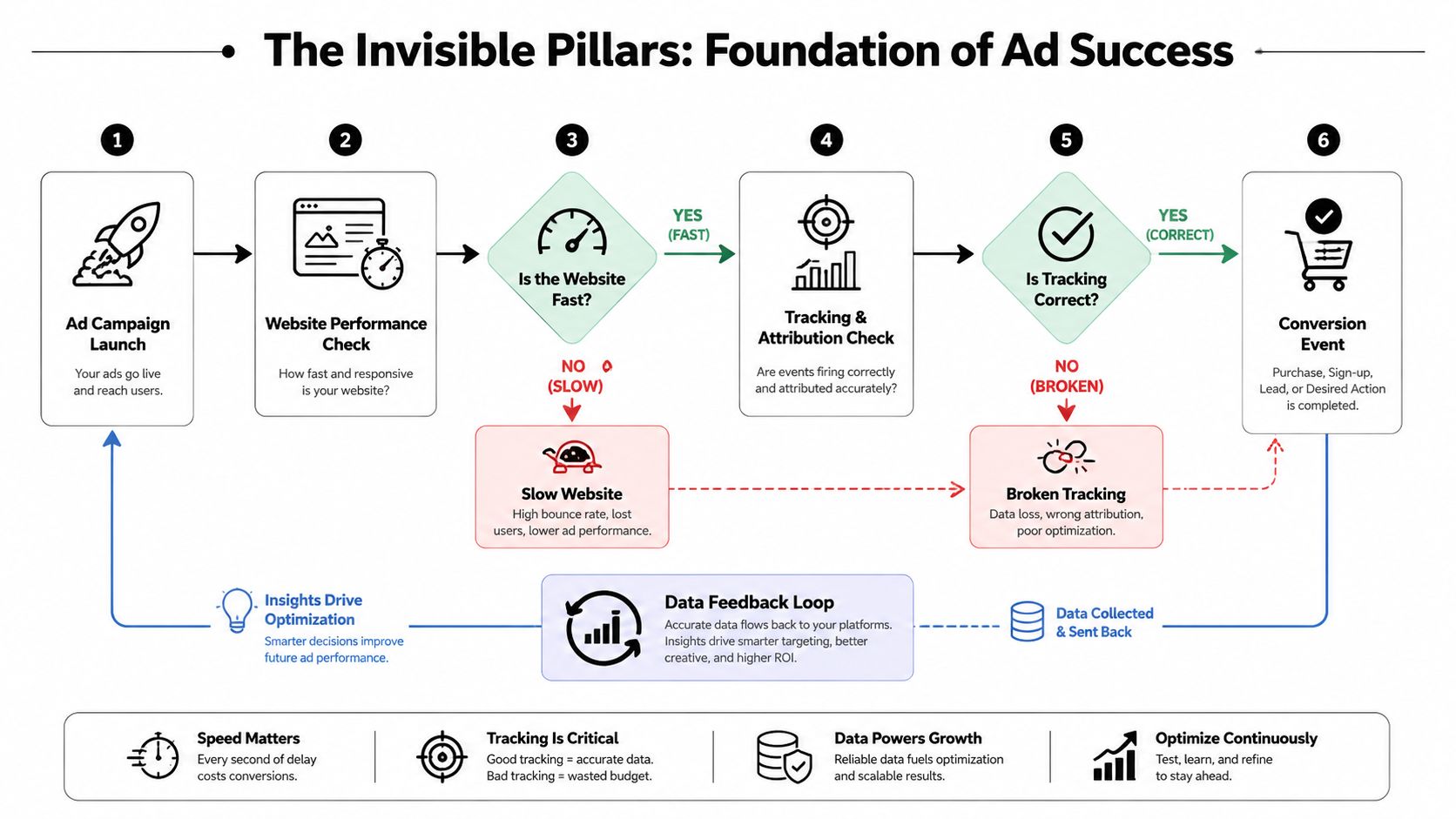
That is why technical setup sits so close to performance. Meta can only optimise from the signals it receives. If those signals are incomplete, duplicated, or delayed, campaign decisions get worse.
Website performance shapes conversion before the algorithm has a chance
We regularly audit accounts where the media buying is fine, but the website is doing the damage. Slow pages, poor mobile layouts, weak category structure, buried shipping details, and awkward forms all reduce the value of every click you pay for.
For eCommerce, the weak points are usually predictable:
- confusing collection and product hierarchy
- slow mobile page speed
- poor product imagery placement
- missing trust signals near add to cart
- checkout friction caused by apps, theme edits, or unclear delivery information
For service businesses, the pattern changes but the consequence is the same. Leads fall when service pages are vague, forms ask too much too early, click-to-call is hard to find, or proof points are too generic to build confidence.
Good creative gets the visit. The website has to finish the job.
Tracking quality decides whether optimisation is smart or expensive guesswork
Australian agencies have had to work through weaker attribution, privacy restrictions, and noisier platform reporting for years. That is one reason stronger operators now put more attention into CAPI, server-side tracking, and cleaner testing frameworks, as discussed in this Australian view on Facebook ads agency trends.
We see the same thing across Shopify stores and WordPress builds. If the purchase event fires twice, if lead events miss key parameters, or if browser and server events are not deduplicated properly, Meta learns from bad inputs. Then the account starts favouring the wrong users, the wrong placements, or the wrong creative.
The stack that usually matters most
The technical setup does not need to be fancy. It needs to be reliable. In most cases, we want these parts working together:
- Meta Pixel for browser-side tracking
- Conversions API for stronger server-side event coverage
- Google Tag Manager for cleaner tag control and change management
- Google Analytics for user behaviour and channel context
- Platform-specific implementation based on how Shopify, WooCommerce, or a custom WordPress setup handles products, forms, and checkout
The shortcomings of weaker agencies become apparent. They can launch campaigns, but they cannot trace the path from ad click to sale, diagnose event loss, or coordinate fixes with a developer. A top Facebook ads agency in Australia needs enough technical depth to spot whether the problem is campaign structure, site architecture, app conflict, plugin bloat, or event mapping.
Shopify and WordPress fail in different ways
The trade-offs are different on each platform, so the fixes are different too.
WordPress builds
On WordPress, tracking and conversion issues often come from bloated themes, plugin overlap, broken form handling, poor caching, and page builders that generate messy output. WooCommerce adds another layer. Variation handling, cart behaviour, and checkout plugins can all interfere with both conversion rate and event quality.
We often find that a business does not need a full rebuild. It might need template cleanup, fewer plugins, better GTM governance, or clearer event mapping between forms, product actions, and completed sales. Sometimes a custom Gutenberg block setup is the better call because it gives the marketing team more control over landing pages without adding more page builder overhead.
Shopify stores
Shopify tends to break differently. Apps stack up over time. Themes slow down. Product feeds get inconsistent. Custom scripts or app injections interfere with tracking, especially after theme changes or app swaps.
A store can look polished and still have major measurement problems underneath. We have seen add-to-cart events fail on some product templates, purchase values pass incorrectly, and catalogue quality hold back dynamic ads because the product data was messy. In those cases, campaign tweaks are secondary. Cleaning up the storefront and tracking setup produces the bigger lift.
Clean data makes testing worth doing
Creative testing only helps when the event data is trustworthy.
If lead submissions fail to register, or purchase events are inconsistent across browser and server, Ads Manager becomes harder to read. Teams pause ads that were helping revenue and scale ads that looked efficient in-platform but were not producing profit. That mistake is common, and it gets expensive fast.
Technical reality: The ad account can only optimise around the events your site and tracking setup send back.
What we check before increasing spend
Before we recommend a budget increase, we usually want clear answers to six questions:
Is the mobile experience fast and easy to use?
Most Meta traffic is mobile. If the page is clunky on a phone, performance suffers before targeting even matters.Does the conversion path make sense?
The route from click to cart, checkout, enquiry, or booking needs to be obvious and low-friction.Are Pixel and CAPI aligned properly?
Browser and server events should pass consistently, with correct deduplication and clean parameters.Is GTM under control?
Random tags, old triggers, and undocumented changes create reporting noise and break trust in the numbers.Does the landing page continue the ad message?
Offers, products, and calls to action need to match what the ad promised.Are platform-specific issues being handled by the right people?
Shopify and WordPress both need informed technical support if you want ads, site performance, and tracking to work together.
That last point matters more than many businesses expect. When web, tracking, and paid media sit in separate silos, small fixes take weeks and performance stalls. Alpha Omega Digital handles web development and paid advertising in the same business, which helps when campaign growth depends on technical changes being made quickly and measured properly.
Decoding the Numbers What to Expect from Your Ad Spend
Let's talk about the part every business owner asks about first. Cost.
Not because cost is the only thing that matters, but because budget determines how much room you have to test, learn, and improve. If the budget is too tight for the category, you don't get enough signal. If it's spent badly, you get activity without commercial progress.
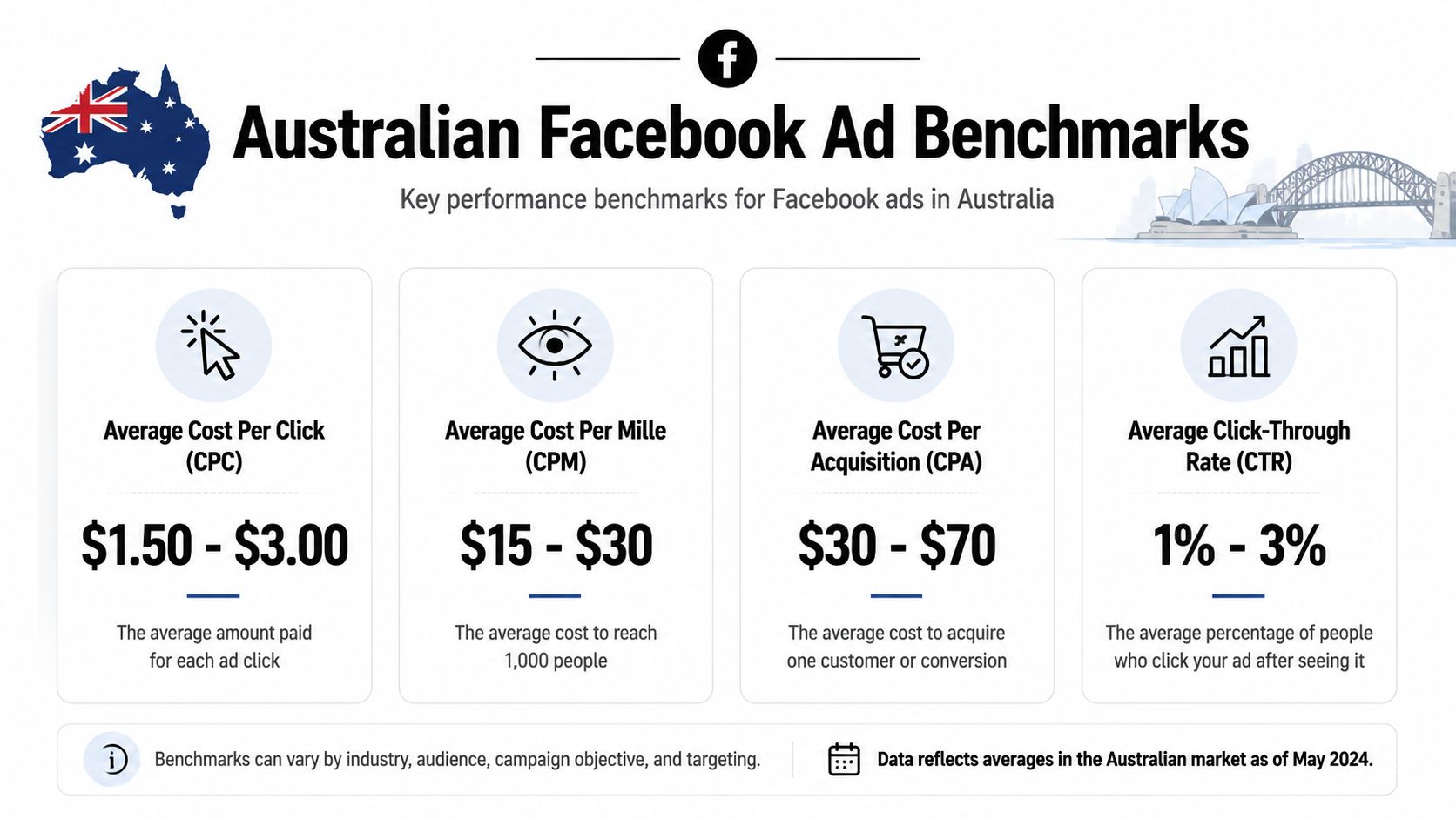
In Australia, Facebook and Instagram advertising costs in 2025 were benchmarked at an average CPC of AUD 1.15 to AUD 3.20, an average CPM of AUD 11.04, and performance-focused campaigns were often estimated at AUD 20 to AUD 50 per acquisition, depending on audience quality, bidding strategy, and creative relevance, according to Australian Meta ad cost benchmarks.
Those figures are useful. They are not guarantees.
Benchmarks help, but context matters more
A benchmark is a starting point. It tells you what range might be normal. It doesn't tell you whether your campaign is healthy.
A low CPC can still be bad if the traffic doesn't buy. A higher acquisition cost can still be excellent if customer value and repeat purchase behaviour support it.
That's why I look at ad spend through a business lens first:
- what's the average order value?
- what's the margin?
- what's the expected repeat behaviour?
- how strong is the site conversion path?
- how good is the offer?
Without those answers, spend targets are just guesses.
What the spend usually needs to accomplish
If a business is serious about Meta as a growth channel, the budget has to do more than buy traffic.
It needs to fund:
- audience testing
- creative testing
- learning time for the account
- retargeting coverage
- enough data to make confident decisions
That's why tiny budgets often create misleading conclusions. If the account can't gather enough meaningful conversion data, every decision becomes fragile.
Here's a practical way to think about budget quality:
| Budget situation | What usually happens |
|---|---|
| Too low for the goal | The business expects clarity but gets noise |
| Enough to test, not enough to scale | Useful learning, limited momentum |
| Healthy and disciplined | Better feedback loops and smarter optimisation |
Why buyer intent changes the economics
Not all traffic has the same value.
An eCommerce brand selling impulse-friendly products with strong creative may be able to convert colder traffic faster than a premium product that needs more education. A service business offering urgent help will behave differently from one selling long-consideration professional services.
That's why a digital marketing agency Melbourne businesses hire should ask more than “what's your budget?” They should ask what kind of customer journey they're funding.
Spend without structure gets expensive fast
A lot of wasted budget comes from weak allocation, not weak demand.
Common examples:
- too much spend on prospecting before the landing page is ready
- too little spend on retargeting to support the full funnel
- scaling off short bursts of performance
- keeping mediocre creatives live because they're “not terrible”
None of those are dramatic mistakes on their own. Together, they steadily drain the account.
Good budget management isn't about spending less. It's about making sure each dollar teaches the account something useful or earns its place back through revenue.
What to expect from a serious agency conversation about budget
If you're speaking to a Facebook Ads agency in Australia and they're credible, they won't promise neat outcomes from day one.
They should talk to you about:
- testing windows
- learning periods
- offer-market fit
- category difficulty
- landing page readiness
- what success should look like at your stage
They should also be comfortable saying when the budget doesn't match the goal.
That honesty matters more than optimism.
Why some businesses still struggle even with decent spend
This is the part many people miss. Higher spend does not automatically create better outcomes.
A larger budget poured into:
- unclear messaging
- weak mobile UX
- poor tracking
- irrelevant traffic
- low-trust landing pages
will make the inefficiency more obvious.
That's why the best outcomes usually come from a joined-up system where spend, creative, and site experience improve together.
A realistic commercial mindset beats vanity metrics
For eCommerce brands, the question isn't “can Meta get clicks?” It's whether the full system can produce purchases at a cost the business can live with.
For service businesses, it's whether the campaign can create qualified enquiries that are answered, followed up, and closed.
That's why I'd rather have a disciplined account with fewer but better signals than a busy account full of surface-level movement.
Our Proven Meta Ads Creative and Campaign Process
A campaign goes live on Monday. By Friday, the client is asking why sales are flat, the cost per lead is drifting, and three different ads have been switched off after a handful of comments and clicks. I've seen that cycle plenty of times. The problem usually is not effort. It's a process that never gave the account a fair chance to produce a clear answer.
Strong Meta performance comes from controlled testing, clean handover between creative and media buying, and a website that can carry the message through to purchase or enquiry. For Australian brands on Shopify and service businesses on WordPress, that also means the ad account cannot operate in isolation. Creative decisions need to flow into landing pages, product pages, forms, and tracking setup if you want better sales and cleaner ROAS.
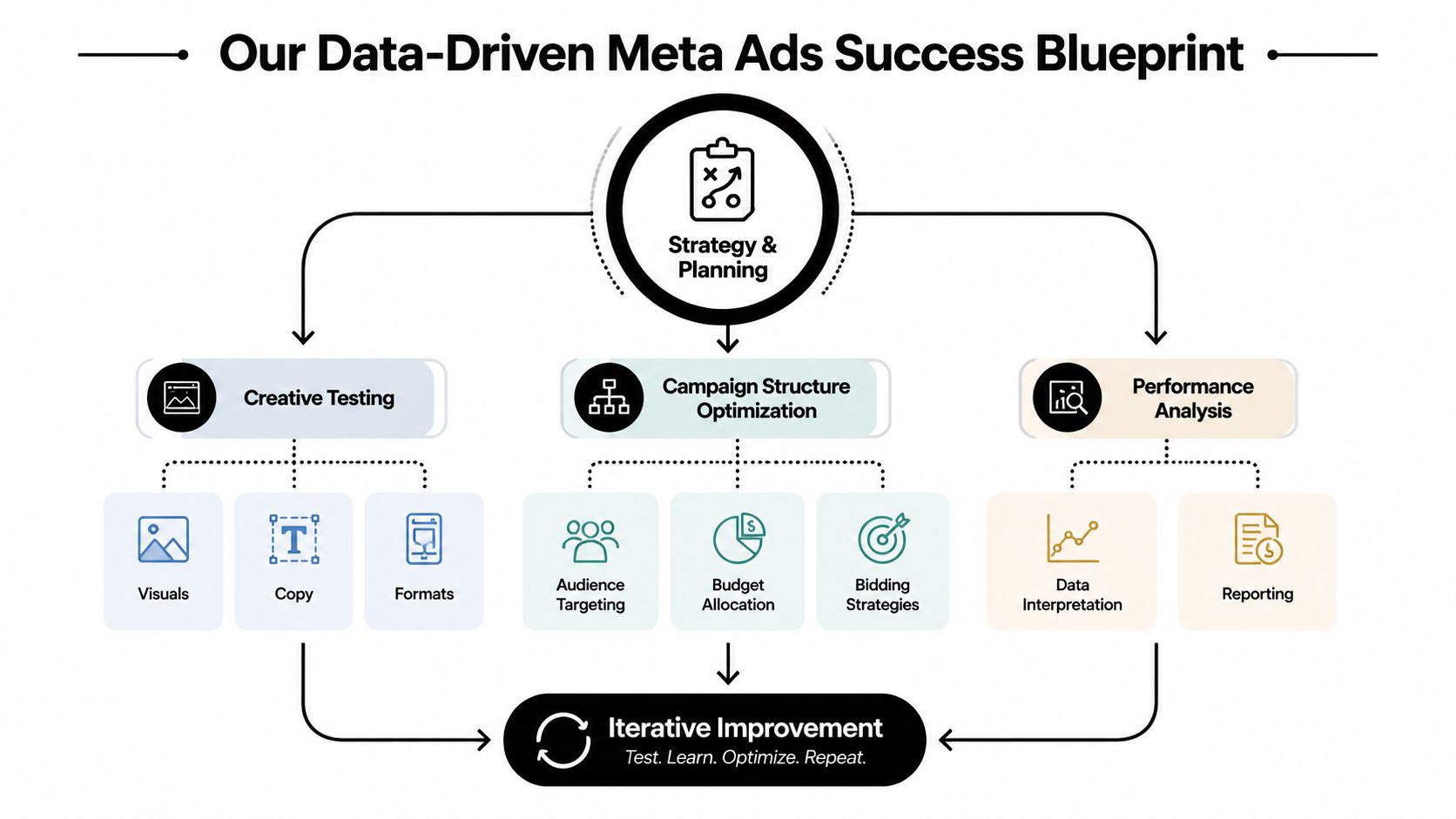
Creative testing starts with the sales angle
A lot of accounts confuse creative testing with design testing. They swap the image, change a headline, and call it a test.
That rarely teaches you much.
We start with the sales argument behind the ad. The angle might focus on a customer problem, a practical benefit, a specific objection, proof from existing buyers, a founder message, or a direct offer. Once that angle is clear, we build variations around it and test whether the market responds.
Typical angle categories include:
- problem-solution messaging
- benefit-led copy
- objection handling
- review and testimonial ads
- founder or brand-story hooks
- offer-led promotions
If every ad is saying the same thing in slightly different clothes, the account stays noisy and the learnings stay weak.
Campaign structure needs to protect the test
We build campaigns so one useful result can lead to the next decision. That sounds simple, but plenty of accounts make it impossible by changing too many variables at once.
A test loses value when the team launches a new audience, new landing page, new offer, and new creative in the same week. If results improve, nobody knows why. If they get worse, nobody knows what to fix first.
A cleaner campaign structure answers a few basic questions:
- What is this campaign trying to produce?
- Which message angle is under test?
- Which audience group is seeing it?
- How much budget does it need before we judge it?
- What result qualifies it for more spend?
That discipline matters more than fancy naming conventions inside Ads Manager.
How we build the funnel across Meta campaigns
We treat prospecting, retargeting, and bottom-of-funnel conversion work as different jobs. Each stage needs different creative and often a different page experience as well.
Stage one with prospecting
At the top of funnel, the ad has to earn attention from people who do not know the brand yet. For eCommerce, that often means a clear buying reason, a sharp product promise, or a practical problem being solved. For service businesses, it usually means showing relevance fast and reducing uncertainty about what happens next.
We test formats based on what the offer needs. Some products need a fast visual demo. Some services need a founder video or a straight-talking static ad. Some categories respond better to UGC-style content because it feels closer to a customer recommendation than a polished campaign asset.
Stage two with retargeting
Retargeting works best when it advances the conversation. Repeating the same message to someone who already clicked or viewed a product is lazy media buying.
We use retargeting to answer the questions people tend to have after first contact:
- Is this product worth the price?
- How does it compare with alternatives?
- What are shipping, returns, or booking terms?
- Can I trust this business?
- Why should I act now?
For service brands, this can mean stronger trust cues, clearer service outcomes, and a booking path with less friction. For eCommerce, it often means product proof, review-led creatives, bundle logic, and urgency used with restraint.
Stage three with bottom-of-funnel conversion work
At the bottom of funnel, the job is simple. Remove doubt and make the next step easy.
For an online store, that might mean cart recovery creative, product-specific reminders, shipping reassurance, or a landing page that reflects the exact promise in the ad. For lead generation, it often means tighter booking prompts, stronger proof, and forms that ask only what the sales team needs.
That last point matters. I've seen decent Meta campaigns underperform because the site asked for too much too early.
What we test inside the ads
We do not bet the month on one hero creative. We test the parts that influence response and conversion quality.
| Creative variable | What we want to learn |
|---|---|
| Hook | What stops the right buyer and gets attention quickly |
| Format | Whether static, video, carousel, or UGC-style creative explains the offer better |
| Message depth | Whether the buyer needs a short pitch or more education before clicking |
| Offer framing | Which value proposition creates intent |
| Call to action | What gets the next action started without adding friction |
Good testing is less about chasing novelty and more about building a repeatable way to improve conversion rates over time. If you want a plain-English breakdown of how businesses should judge ad efficiency, these essential ROAS insights for entrepreneurs are a useful reference point.
Creative should attract the right buyer, set the expectation, and prepare the click. The page has to finish the job.
What usually breaks the process
Poor results often come from a handful of avoidable habits:
- launching too many weak concepts at once
- picking winners based on internal opinion instead of buying behaviour
- relying only on polished brand creative when direct response angles are needed
- making changes before enough signal has come through
- sending paid traffic to pages that do not match the ad
The last one gets expensive fast. A strong ad can still fail if the product page is cluttered, the service landing page buries the offer, or mobile load speed turns a warm click into a bounce.
Paid media and the website team need to work as one system
This process improves faster when the paid team and the web team share the same goals. If an angle is working in Meta, that message should show up on the landing page headline, product description, collection order, offer block, or lead form.
In practice, we often make changes such as:
- updating Shopify product or collection templates for paid traffic
- building campaign-specific landing pages
- changing page sections to reflect stronger hooks
- refining forms and booking flows on WordPress sites
- adjusting on-page trust elements based on objections seen in ad comments and sales calls
That is one of the key differences between a media buyer and a proper agency partner. The ad account might identify the winning message, but growth usually comes from carrying that message through the full path from impression to sale.
Measuring What Matters From Clicks to Customers
The easiest way to lose trust in marketing is to report on the wrong things.
Reach looks nice. Clicks can be interesting. Engagement can be flattering. None of those pay wages, fund stock, or justify a growing ad budget by themselves.
For Australian agencies running Facebook ads, the technical edge usually comes from measurement discipline. That includes transparent performance reporting, optimisation around cost per conversion or return on ad spend, and iterative creative testing. It also depends on clean conversion tracking and attribution-aware reporting, which is especially important for SMBs in Melbourne where small changes in CPA can materially affect profitability, as outlined in this Melbourne agency reporting perspective.
The metrics I care about first
For eCommerce, I usually care most about:
- purchase value
- cost per purchase
- return on ad spend
- new customer quality
- conversion path drop-off points
For lead generation, I care about:
- qualified lead cost
- close rate by source
- booking rate
- call answer rate
- downstream revenue quality
If the reporting stops at form submissions or click volume, the business is still partly blind.
Attribution gets messy fast
A buyer might see your Meta ad, leave, come back through Google, sign up to email, and purchase later. A service prospect might click an ad, browse, call the next day, then book after a follow-up.
That's normal.
The mistake is pretending one platform report tells the whole story. It doesn't. You need a blended view that respects how people behave.
That's why GTM, Google Analytics, platform reporting, CRM data, and sometimes call tracking all need to talk to each other as well as possible.
What a useful report should answer
A useful report doesn't just describe platform activity. It should help a business make decisions.
It should answer questions like:
- Which campaigns are creating profitable customers?
- Which creatives attract attention but fail to convert?
- Which landing pages underperform?
- Which audience segments deserve more budget?
- Is lead quality improving or declining?
That's the difference between a report and an operating tool.
If reporting doesn't help you decide what to do next, it's admin, not strategy.
ROAS matters, but it isn't the whole story
A lot of business owners use ROAS as the main scorecard, and that makes sense. It's one of the clearest ways to judge whether ad spend is generating revenue. If you want a clean explanation of the concept, this guide on essential ROAS insights for entrepreneurs is worth reading.
But ROAS still needs context.
A campaign might show strong ROAS while bringing in low-value customers. Another might look weaker at first but be more useful for new customer acquisition or repeat purchase potential. That's why agencies need to interpret numbers, not just present them.
How we connect platform data to business decisions
When measurement is working properly, the business can act faster and with less emotion.
Here's how that usually plays out:
| Data point | Business decision it should influence |
|---|---|
| Rising cost per conversion | Review audience fit, creative fatigue, landing page friction |
| High click volume, low sales | Diagnose post-click experience and offer alignment |
| Strong retargeting, weak prospecting | Improve top-of-funnel creative and acquisition angle |
| Lead volume up, quality down | Tighten qualification and offer framing |
The point isn't to produce more dashboards. It's to produce more confidence.
Why clean measurement protects budget
When reporting is vague, businesses often overreact. They pause campaigns too early, scale the wrong things, or keep funding accounts that aren't producing value.
Clean measurement creates discipline. It lets you keep your head when performance is mixed, because you can see whether the weakness is in traffic quality, creative, landing page conversion, lead handling, or attribution gaps.
That kind of clarity is one of the main reasons businesses move from a generic supplier to a serious digital marketing agency Melbourne operators can plan around long term.
Your Checklist for Choosing the Right Australian Agency
A business owner comes to us after six months with another agency. Spend is up. Reporting looks polished. Sales are flat, lead quality is ordinary, and nobody can explain whether the problem sits in Meta, the website, tracking, or follow-up. That is usually the point where the agency selection process starts to matter more than the ad account.
Hiring the right team is a commercial decision. You are choosing who gets to influence budget, tracking, creative, landing pages, and the way performance is judged. In Australia, the strongest agencies do more than buy media. They connect Meta ads to Shopify or WordPress, configure GTM and CAPI properly, and work toward the business outcome that matters, more purchases, more qualified leads, and stronger return from spend.
Use this section as a practical filter before you sign anything.
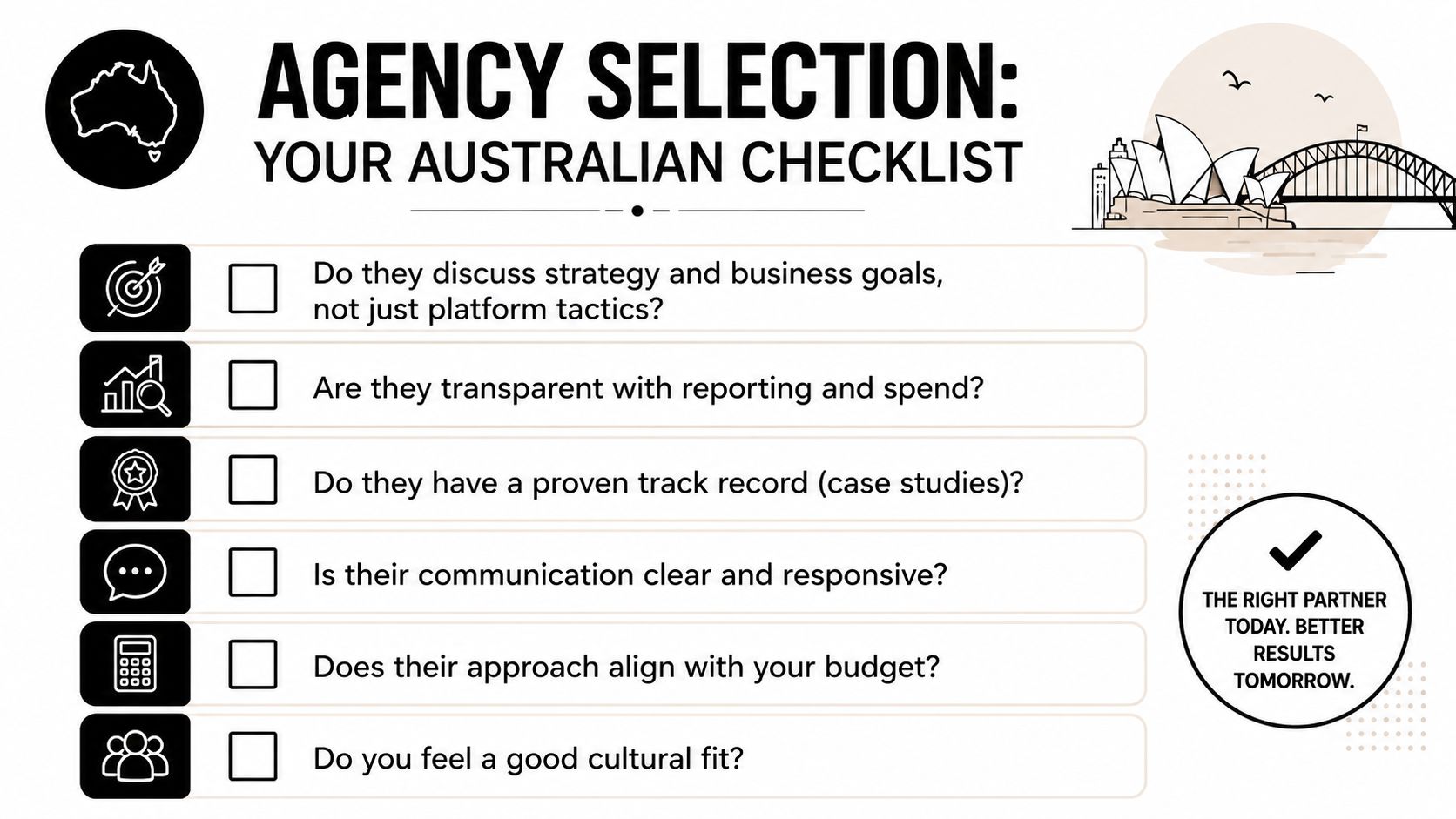
Start with the questions they ask you
The first call tells you a lot.
An agency that knows what it is doing will ask how the business makes money before it talks about campaign structure. We want to know margin, average order value, lead-to-sale rate, sales cycle length, fulfilment limits, repeat purchase behaviour, and what has already failed. Without that context, media buying becomes guesswork.
A proper Facebook Ads agency in Australia should want to understand:
- your customer economics
- your sales process
- your website platform
- your current tracking setup
- your offer strength
- your reporting requirements
If the conversation stays at the level of traffic, impressions, and vague promises of growth, keep looking.
Check whether they understand your platform
Ads do not convert in Ads Manager. They convert on the site, in the checkout, in the form flow, or on the phone after a lead comes through.
That is why platform knowledge matters. If you run Shopify, the agency should be comfortable discussing theme limitations, collection page structure, product feeds, checkout friction, app conflicts, and how event tracking behaves across the storefront. If you run WordPress or WooCommerce, they should understand plugins, form tracking, page speed issues, page builders, and the trade-offs that come with a heavily customised site.
Ask whether they can help with:
- Shopify design and development issues that affect conversion
- WordPress or WooCommerce changes tied to campaign performance
- GTM and Google Analytics configuration
- Meta Conversions API setup
- landing page changes based on campaign data
We see this constantly. A campaign underperforms, and the underlying issue turns out to be duplicate events, a slow mobile product page, a broken form, or poor checkout UX. An agency that only talks about targeting is only handling part of the job.
Review their testing process
Creative testing separates disciplined operators from agencies that are just cycling headlines and hoping for a result.
Ask how they structure tests. Ask what they change first, offer angle, hook, format, audience, landing page, or call to action. Ask how they decide a test has produced a useful signal. Ask what happens after a winner is found. Good answers are specific and tied to decision-making.
Questions worth asking:
- what variables do you test first, and why?
- how do you isolate learnings between creative, audience, and landing page?
- what tells you a creative should be scaled?
- what do you check first when performance drops?
If the response sounds improvised, the account probably is.
Transparency should be built into the relationship
You should not have to chase basic information.
A good agency makes it easy to understand what is happening in the account, what has changed, and how success is being judged. That includes management fees, ad spend allocation, reporting cadence, and clear ownership of the assets being used. It also means they can explain poor performance without hiding behind platform jargon.
You should know:
- what you are paying for management
- where budget is being allocated
- what changes are being made
- how success is defined
- how often performance is reviewed
Clear reporting helps, but clear thinking matters more.
Watch how they handle difficult truths
This is one of the clearest signals.
The right agency will tell you when the offer is weak, the website is hurting conversion, the budget does not fit the target, or the sales team is slow to follow up leads. We have had those conversations with Melbourne service businesses and Australian eCommerce brands many times. They are not always comfortable, but they are usually the turning point.
Agencies that avoid friction often keep campaigns running against problems they do not control and do not want to name. That protects the relationship in the short term and hurts results over time.
Here's a good video to watch while you're evaluating service providers:
A shortlist table you can use
| What to assess | Good sign | Red flag |
|---|---|---|
| Business understanding | They ask direct questions about margins, sales process, and targets | They jump straight to tactics |
| Technical depth | They can discuss Shopify, WordPress, GTM, and CAPI with confidence | They only talk about ads inside the platform |
| Reporting quality | Reports explain what happened, why it happened, and what changes next | Screenshot reporting with no interpretation |
| Creative process | Testing is structured and documented | “We'll try a few ads and see” |
| Communication | Clear, direct, and commercially aware | Evasive, defensive, or overly sales-driven |
Look at how they position themselves
An agency's own marketing is a useful clue. If they cannot explain their offer clearly, publish helpful material, or present their own services in a way that makes sense, it is fair to question how they will represent your business.
I pay attention to whether an agency can speak across channels and systems without sounding generic. A business looking for a broader marketing agency Melbourne companies can rely on often needs more than media buying. It may need landing page work, platform support, tracking fixes, and advice on how paid traffic fits with the wider sales process.
That broader view is often what separates a supplier from a long-term growth partner.
Why Alpha Omega Digital is Different and Our Low-Risk Offer
A common pattern looks like this. The ads are live, spend is going out every day, and results are inconsistent. The agency says the creative needs work. The developer says the tracking is fine. The business owner is left trying to work out why sales or leads still do not line up with spend.
That gap between channels, platforms, and operations is the core growth problem for a lot of Australian businesses. We built Alpha Omega Digital to handle that gap properly.
We work best with businesses that need more than ad account management. They need paid social tied to Shopify or WordPress, Meta tied to GTM and Conversions API, landing pages tied to the offer, and reporting tied to what the business cares about most. Revenue, qualified leads, booked jobs, and margin.
That matters in eCommerce and service businesses for different reasons.
For eCommerce, the weak point is often post-click. We have seen stores spend hard on Meta, Google Ads, Shopping, and email, then lose momentum because product pages do not sell, tracking misses key events, or the cart and checkout experience creates friction. Better media buying helps, but it does not fix a store that struggles to convert.
For service businesses, the weak point is often follow-up. We have seen lead generation campaigns produce enough enquiries to grow, but the business still misses revenue because calls go unanswered, contact forms sit untouched, or admin teams respond too slowly. In that case, the ad platform is only one part of the job.
We built the agency around joined-up execution
The wider agency skill set matters here because growth problems rarely sit neatly inside one service.
A client might come to us for Meta ads and quickly find the bigger issue sits in one of these areas:
- Facebook ads management
- Google Ads management
- GTM and Google Analytics setup
- Meta Conversions API configuration
- landing page changes
- Shopify or WordPress support
- local SEO and Google Business Profile improvements
- reporting on calls, form leads, and sales quality
Handled separately, these jobs tend to drag on. Handled together, they give the campaign a fair shot.
The service-business angle many agencies miss
One of the most effective fixes for lead generation businesses has nothing to do with audience targeting.
It is what happens when someone tries to call.
For tradies, clinics, salons, restaurants, and other appointment-led businesses, missed calls are missed revenue. We have seen cases where improving call handling lifted results faster than changing campaigns. A practical setup can include a custom number, call routing, after-hours answering logic, lead capture, and direct booking into a calendar or Calendly flow.
The benefit is straightforward:
- enquiries are not lost after hours
- response times improve
- bookings happen faster
- staff spend less time chasing cold leads the next day
That kind of operational improvement often beats another round of small account tweaks.
What working with us tends to look like
We support businesses that want one team to connect the moving parts. That can include Google Ads for plumbers, Facebook ads for electricians, and Google Ads management.
Not every business needs every service. Plenty do need one agency that can identify whether the bottleneck sits in the ad account, the site, the tracking, the offer, or the sales process, then fix the right problem first.
That is the difference in practice. We do not treat paid social as an isolated media buying task if the actual issue sits elsewhere in the funnel.
The kind of client fit that works best
We are usually a strong fit for businesses that already have some traction and want to scale with more control. They care about reporting quality, they are open to fixing site and tracking issues, and they want to know which leads or sales are worth paying for.
We are usually not the right fit for businesses chasing the cheapest management fee or looking for a yes-person. Good growth work involves pushback. If the offer is weak, the page is underperforming, or the tracking is unreliable, we will say so.
Our low-risk offer is simple. If your business has a paid ads budget of at least 3k a month, we will offer one month of paid ads management free. Apply through the contact page.
If you want a Melbourne-based team that can handle the ads, tracking, landing pages, and technical work behind growth, have a look at Alpha Omega Digital. We work with businesses across Melbourne, Sydney, Brisbane, Newcastle, Perth, Adelaide, Darwin, and Hobart. If you have a project in mind and a paid ads budget of at least 3k a month, apply through the contact page and we will see if the fit is right.
Alpha Omega Digital
Read more insights from our team on web design, paid ads, and growth strategy.