Let me be blunt: hiring the right web developer for WordPress is one of the most critical business decisions you'll make. It’s not just an IT task. I've seen firsthand how a great developer partnership builds a 24/7 sales machine, while a bad one creates a digital money pit that bleeds your marketing budget dry.
This guide is based on my real-world experience as a marketing agency in Melbourne helping eCommerce businesses thrive. I'm here to give you an insider's look into what truly matters when you're looking for a WordPress partner. This is about finding someone who gets your business goals, not just a coder who takes orders.
Why Your Developer Is a Business Partner, Not Just a Coder

Let's reframe this conversation. You're not just buying a website; you’re investing in the single most important tool that will drive your eCommerce business forward. A standard coder will build exactly what you ask for, no questions asked. A strategic development partner, on the other hand, asks why.
They want to know your business objectives, who your customers are, and how this website fits into your bigger marketing picture. As a digital marketing agency in Melbourne, we’ve seen the difference this makes time and time again. It’s the gap between a website that just sits there and one that actively pulls in leads and sales.
A high-performance developer doesn't just write code; they build business assets. Their entire focus is on creating a platform that delivers a measurable return on your investment.
More Than Just a Pretty Face
A visually appealing website is just table stakes. What really matters for an eCommerce business is what's under the bonnet. I’ve lost count of the number of rescue projects I’ve taken on where a business paid a fortune for a site that looked great but was painfully slow, impossible to update, and completely invisible to Google.
A real strategic partner understands the technical foundations of a successful website:
- Performance: They obsess over site speed because they know that every millisecond of delay costs you conversions.
- Technical SEO: The site is built from the ground up to be loved by search engines, giving your content the best possible chance to rank. A top seo agency in Melbourne will confirm this is crucial.
- User Experience (UX): Every button, form, and menu is designed with a clear purpose—guiding visitors towards the "add to cart" and "checkout" buttons.
- Marketing Integration: They make sure tools like Google Tag Manager and the Meta Conversions API are perfectly implemented so you can accurately track your ad spend. This is critical for measuring the success of your Facebook ads and avoiding quitting your campaigns too early.
To put it simply, a standard developer builds what you ask for, while a strategic partner builds what your business needs. This table breaks down the difference.
Comparing a Standard Coder vs a Strategic Development Partner
| Characteristic | Standard Developer | High-Performance Developer |
|---|---|---|
| Focus | Executes a list of tasks and features. | Achieves specific business outcomes (leads, sales, efficiency). |
| Approach | Follows instructions without question. | Asks "why" to understand the goal behind the request. |
| Technical Scope | Writes code to make the site function. | Engineers for speed, SEO, UX, and marketing integration. |
| Design View | Cares about aesthetics. | Cares about conversion-focused design and user journeys. |
| Post-Launch | The job is done at launch. | Sees launch as the starting line for ongoing optimisation. |
| Communication | Provides updates on tasks completed. | Provides updates on progress towards business goals. |
Spotting a high-performance developer from this list is your first big step toward building a site that delivers a genuine return.
The WordPress Advantage in Australia
There's a very good reason WordPress is the dominant force online, and for Australian businesses, its flexibility is unmatched.
Here in Australia, WordPress powers a huge slice of the web, with 469,707 live websites as of early 2024. That makes up 1.54% of all global WordPress sites, placing the country at #11 worldwide for its adoption. And with WordPress's global market share climbing from over 40% to 43.4%, Australian businesses simply can't afford a subpar website. You can dive deeper into the data on these WordPress developer trends in Australia.
Whether you're an eCommerce brand that also needs a powerful Shopify developer in Melbourne or a service business aiming to dominate local search, the right platform is critical. A skilled WordPress developer in Melbourne turns the platform’s potential into a high-performance business asset that works tirelessly for you. This is what we focus on at Alpha Omega Digital—building a foundation for real, measurable growth.
Defining Your Project Scope to Get Accurate Quotes
Before you even think about typing "hire a web developer for wordpress" into Google, you need a rock-solid plan. I've seen it happen too many times: an eCommerce business rushes this part and ends up burning through their budget on a site that completely misses the mark. It's the fastest way to get frustrated and feel like your investment was a total waste.
To avoid that, let’s walk through the exact process I use to help clients define their project scope with total clarity. This isn't just about creating a to-do list for a developer; it's about building a strategic document that aligns your business goals with your website's actual job.
Getting this right ensures you attract strategic partners—like a results-focused digital marketing agency in Melbourne—not just order-takers. It also means you can compare the proposals you receive on an apples-to-apples basis, making your decision so much easier.
Start With Your Business Objectives
First things first: what is the primary job of this website? Forget about colours and fonts for a moment and think about money. A website is a tool to make your business more successful.
Your goals need to be specific and measurable. Here are a few examples I see all the time from eCommerce clients:
- For eCommerce: "Increase online sales by 25% within 12 months."
- For Lead Generation: "Generate 50 qualified leads per month through our contact form for our wholesale channel."
- For Brand Building: "Establish our brand as the premium choice in our niche, supporting a higher price point."
Once you have this core objective, every other decision you make should support it. This clarity prevents "scope creep"—those little additions that seem small but end up derailing your timeline and budget.
Define Your Ideal Customer
You're not building the website for yourself; you're building it for your customer. Who are they? What do they care about? What problems are they trying to solve when they land on your site?
Create a simple customer profile. It doesn't need to be a 20-page document. Just answer these questions:
- What are their biggest pain points related to your product or service?
- What information do they need to make a purchasing decision?
- What websites do they already use and like? What do they dislike?
- Are they tech-savvy, or do they need a very simple, guided experience?
A WordPress developer in Melbourne who understands your customer can make much smarter design and functionality choices. For an eCommerce site, this informs everything from the checkout process to product filtering. For a service site, it dictates how you present your case studies and calls to action.
Don't just list features. For every feature you request, you should be able to answer the question: "How does this help my ideal customer and move them closer to my primary business goal?"
List Your Non-Negotiable Features
Now you can get into the specifics. Based on your goals and your customer, what must the website do? This is where you connect your business needs to the technical requirements.
I always tell clients to categorise their features into "Must-Haves" and "Nice-to-Haves." This is crucial for managing your budget. If the quotes come in too high, you know exactly where to trim from the "Nice-to-Have" list without gutting the core purpose of the site.
Your list of must-haves could include things like:
- eCommerce Functionality: A seamless WooCommerce setup with specific payment gateways (like Stripe or PayPal) and shipping integrations for Australian carriers.
- Custom Content Layouts: Perhaps you need a WordPress web developer to build custom Gutenberg blocks. This lets you easily create unique, brand-aligned page layouts without being stuck in a rigid template.
- Crucial Integrations: This is a big one. You'll likely need a flawless setup for Google Tag Manager to manage all your tracking scripts, plus the Meta Conversions API for accurate Facebook and Instagram ad tracking. A top-tier Facebook ads agency will tell you this is non-negotiable.
- Lead Generation Forms: Contact forms that integrate directly with your CRM or email marketing software.
- A Blog/Content Hub: An easy-to-manage system for publishing articles that will fuel your SEO and content marketing efforts.
Having this detailed list turns a vague idea like "I need a new website" into a clear, actionable plan. It's the kind of brief a professional WordPress development company can use to give you an accurate and realistic quote.
The True Cost of WordPress Development in Australia
I’ve had countless conversations with business owners who are completely bewildered by the massive range of quotes they get for a new website. The cost of hiring a web developer for wordpress can feel like a total lottery, but it’s crucial to understand what you're actually paying for.
When you're trying to set a budget, you'll generally find that quotes fall into three main buckets. Getting your head around these is the first step to figuring out what’s right for your business and what to expect in the Australian market.
Breaking Down the Pricing Models
Here are the most common ways developers and agencies charge for their work:
- Hourly Rates: This is as straightforward as it gets—you pay for the actual time spent on your project. It’s flexible and works well for ongoing tweaks or projects where the scope isn’t perfectly defined. The risk? It can become a blank cheque if you don't have clear communication and regular check-ins.
- Fixed Project Fees: You get one single price for the entire project, start to finish. This gives you budget certainty, which is a massive plus for most businesses. The catch is that it hinges entirely on having a rock-solid, crystal-clear project scope from the get-go. Any changes or "can we just add…" moments will almost certainly cost extra.
- Ongoing Retainers: This is a fixed monthly fee for a set amount of work, covering everything from maintenance and security to strategic improvements. This is perfect for businesses that need continuous optimisation and a long-term partner for growth, which is the model we prefer for our clients at Alpha Omega Digital.
The right model really depends on what you need. A quick fix might suit an hourly rate, a standard brochure site is great for a fixed fee, but an eCommerce business that's serious about growth and results almost always benefits from a retainer.
Why a Good Developer Costs What They Do
It’s tempting to find a freelancer on a global marketplace with a low hourly rate, compare it to a quote from a Melbourne-based agency, and assume the agency is trying to rip you off. But that comparison is fundamentally flawed. You're not just paying for one person's time; you're investing in a team's collective expertise, their processes, and their strategic insight.
The salary benchmarks for skilled developers in Australia tell an important story. WordPress developers here have strong earning potential, with average salaries ranging from AUD 58,869 to AUD 103,701 in cities like Canberra, often with a degree to back it up. This reflects the high demand for true experts who can build custom, high-performance solutions. To deliver exceptional results, top Australian agencies need to hire and retain this top-tier talent. You can discover more about the developer salary data in Australia.
When you hire a professional WordPress development company, you're paying for that calibre of talent to be focused on your business.
The most expensive website you can ever build is a "cheap" one. A low-cost site that’s slow, insecure, and invisible to Google will cost you far more in lost revenue and missed opportunities than investing in a high-performance asset from day one.
Realistic Budget Ranges for Australian Businesses
So, what should you actually expect to budget? Based on my experience building sites for all kinds of Australian eCommerce businesses, here are some realistic ballpark figures to get you started.
| Project Type | Typical Budget Range (AUD) | What You're Getting |
|---|---|---|
| Basic Service Business Site | $5,000 – $15,000 | A professional, mobile-responsive site focused on generating leads. |
| Advanced Brochure Site | $15,000 – $30,000 | Custom design, unique functionality, and deeper system integrations. |
| Standard WooCommerce Store | $20,000 – $40,000 | A solid eCommerce foundation with standard payment and shipping setups. |
| Complex Custom eCommerce | $40,000+ | A fully custom online store with API integrations and bespoke features. |
Think of these as starting points. The final cost from any WordPress developer in Sydney or Melbourne will ultimately depend on the complexity, design, and specific functions your business needs to succeed.
The key is to stop seeing your website as a cost. It’s an investment in the most powerful sales and marketing tool you will ever own.
How to Vet Developers and Spot the Red Flags
So, you’ve mapped out your project and have a shortlist of developers or agencies. Now comes the hard part: separating the real pros from the pretenders. This is where you need to get forensic. I'm going to share my personal checklist for vetting any web developer for wordpress, and it goes way beyond just glancing at a few pretty portfolio sites.
A flashy portfolio is easy enough to cobble together. What really tells you if a project will succeed is a developer's process, their communication, and whether they understand that a website is a business tool, not just a digital brochure.
Look Beyond the Pretty Pictures
When you’re reviewing a developer’s past work, don’t let the slick visuals distract you. The real story is always hidden under the hood.
Here’s what I check immediately:
- Website Speed: I run their portfolio sites through Google's PageSpeed Insights. A slow site is a dead site. If their own clients' websites are sluggish, you can bet yours will be too. A score below 80 on mobile is a major red flag for me.
- The Mobile Experience: I don’t just shrink my browser window to see if it’s "responsive." I grab my phone and actually use the site. Is navigating a pain? Can I fill out a form without having to pinch and zoom? A frustrating mobile experience is a guaranteed conversion killer.
- Cleanliness of Code: You don't need to be a coder for this one. Just right-click on one of their portfolio sites and hit "View Page Source." Does it look like a chaotic mess of inline styles and random scripts? While it’s not a perfect science, organised-looking code is often a sign of a disciplined developer.
These simple checks give you a real-world glimpse into their quality standards. A developer who cares about performance and user experience for their other clients is far more likely to do the same for you.
Key Questions to Ask in the Interview
Once you get them on a call, your mission is to understand how they think. Their answers to these questions will tell you almost everything you need to know.
“Walk me through your development process, from start to finish, for a project like this.”
A professional will lay out a clear, structured process. You want to hear them talk about discovery, wireframing, design, development on a staging server, client testing, and a planned launch. If you get a vague answer like, “We just get in there and start building,” it’s a massive red flag.
“How do you approach website performance and technical SEO?”
Listen for specific terms like “image compression,” “caching strategies,” “clean code,” “schema markup,” and “Core Web Vitals.” If they give you a blank stare or just say, “Oh, we install Yoast,” you know they’re out of their depth. A top-tier WordPress developer in Sydney or Melbourne builds for performance from the very first line of code.
“What’s your experience with setting up tracking like Google Tag Manager and the Meta Conversions API?”
For me, this is a deal-breaker. If you’re paying a Google Ads agency or a Facebook ads agency to drive traffic, broken tracking is the same as setting your money on fire. They must be able to speak confidently about setting these tools up correctly.
“Can you show me an example of a truly custom feature you’ve built?”
This question separates the theme assemblers from the actual developers. Ask them to screen-share and walk you through a custom Gutenberg block they coded, a unique plugin integration, or a connection to an external API they’ve built. It proves they can solve real problems, not just install off-the-shelf solutions.
A developer's inability to explain technical choices in simple, business-focused terms is a huge red flag. They should be able to tell you why they recommend a certain approach and how it will actually benefit your bottom line.
Critical Red Flags That Scream "Run Away"
Over the years, I've learned to spot these warning signs from a mile away. If you see any of these, I’d think twice, or better yet, just walk away.
- Over-reliance on Bloated Page Builders: If their entire portfolio is made with heavy, drag-and-drop page builders like Divi or Elementor, it often signals a lack of fundamental coding skills. These tools can be useful, but a true professional knows how to build lightweight, custom solutions for maximum performance.
- The "Yes" Person: A developer who agrees to every single request without pushback isn't a partner; they're an order-taker. A great developer challenges your ideas, asks clarifying questions, and suggests better alternatives based on their experience. You want an expert, not a yes-man.
- Poor Communication: Are their emails unclear? Do they take days to get back to you? This behaviour will only get worse once they’ve got your deposit. Clear, prompt communication is the absolute foundation of a successful project.
- No Mention of a Staging Server: Any developer who suggests working directly on your live website is an amateur, full stop. A professional workflow always involves a separate staging or development environment where the site is built and tested safely.
Taking the time to be thorough in this vetting phase is what separates a smooth, successful project from a costly, stressful nightmare. It’s the single most important step in finding a true partner for your business.
Onboarding Your Developer for a Successful Launch
You’ve found your developer or agency. Congratulations! But the work doesn’t stop here. My years of experience as a WordPress developer in Melbourne have taught me one crucial lesson: a chaotic start almost always guarantees a chaotic project. A smooth, organised onboarding process is the foundation for a website that actually launches on time and on budget.
A top-tier developer or agency should take the lead on this, but how prepared you are will make it infinitely smoother. It’s all about turning a contract into a real, collaborative partnership from day one. This initial phase sets the tone for everything that follows.
Your Go-To Onboarding Checklist
To get things moving efficiently, I always kick off projects with a clear checklist. This simple step prevents the endless back-and-forth emails chasing logins or brand files. Before a single line of code gets written, you should have a central place for everything.
Here’s the go-to list I send to clients:
- Access & Logins: Grant them access to your domain registrar, current website hosting, Google Analytics, and Google Tag Manager. Use a secure password manager like 1Password or LastPass—never, ever send credentials over email.
- Brand Assets: Create a shared folder with your logo files (in vector format like SVG or AI if possible), your brand style guide, font files, and any existing marketing materials.
- Content & Imagery: Have all your final website copy, high-resolution images, and videos organised and ready. Honestly, delays in content are the single biggest cause of project delays I see.
- Communication Channels: Set up a dedicated Slack channel or a project management board in Trello or Asana. This keeps all communication in one place and out of your cluttered inbox.
Getting these items sorted upfront means your developer can hit the ground running.
This infographic shows the high-level vetting process that gets you to this crucial onboarding stage.
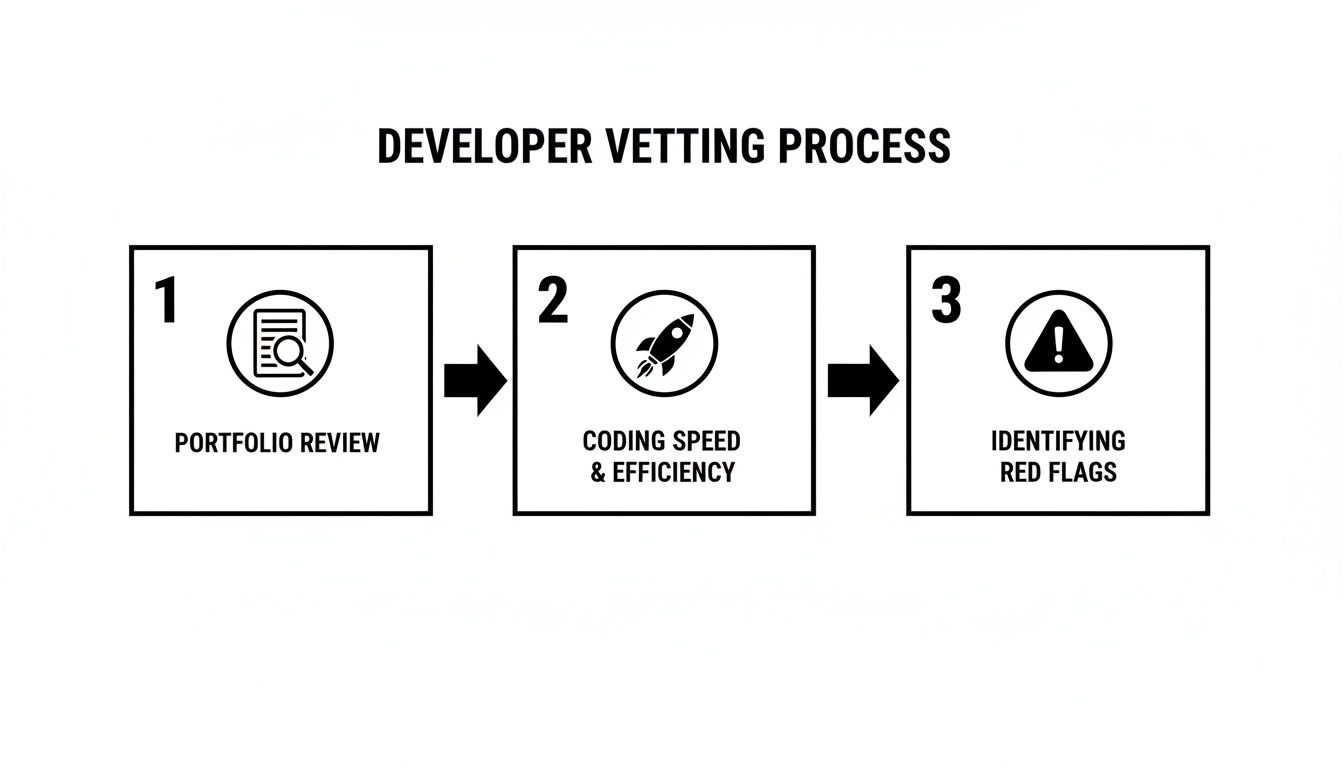
As you can see, after you've evaluated portfolios and performance and checked for red flags, you arrive at the all-important onboarding step.
Defining Milestones and Timelines Together
Once your developer has what they need, the next job is to co-create a project timeline with clear milestones. This shouldn't just be a document they send you; it should be a collaborative discussion. When building a site as a WordPress development company, we always break the project down into clear phases.
Typical milestones often look something like this:
- Initial Setup & Staging Environment Creation
- Homepage Design & Approval
- Internal Page Templates & Build-out
- Client Review & Feedback Sessions
- Final Revisions & Pre-launch Checks
- Launch Day
A professional staging environment is non-negotiable. This is a private copy of your website where all development and testing happens. Any developer who suggests working directly on your live site is putting your business at massive risk.
This structured approach makes sure everyone knows what’s happening, what's expected of them, and when. It’s the best way to prevent nasty surprises and keep the project from derailing.
As you onboard, it's also the perfect time to make sure your developer is skilled with key marketing tools. For example, their ability to properly configure a GTM WordPress plugin is vital for setting up the robust data tracking your business needs for growth.
Beyond the Build: Website Maintenance and Growth
I've seen it happen countless times. A business owner breathes a huge sigh of relief on launch day, thinking the job is finally done. But launching your website isn't the finish line. It's the starting line.
From that moment on, the real work begins. Your new WordPress site is a living, breathing asset, and without ongoing attention, its value will quickly fade. It's like buying a brand new car and never taking it in for a service—it won't take long before performance drops and things start to break.
Defence: The Core of Website Maintenance
Before we can even talk about growing your site, we need to make sure it's protected. A solid maintenance plan is non-negotiable for any serious business. It’s the foundational work that keeps your investment secure, fast, and running smoothly.
Here’s what any decent maintenance plan, like those we offer as a WordPress development company, absolutely must include:
- Daily Backups: Not weekly, but daily. If something goes wrong, you need the ability to restore a recent version of your site instantly, minimising any downtime or lost sales.
- Security Scans: Proactive malware scanning and firewall monitoring are essential for blocking threats before they can do any real damage.
- Performance Monitoring: We keep a constant eye on your site speed and Core Web Vitals. This ensures your user experience stays top-notch and your Google rankings don't take a hit.
- Crucial Updates: This means regularly updating the WordPress core, all your plugins, and your theme to patch security holes and ensure everything plays nicely together.
This is the bare minimum. It’s the essential servicing that keeps your site healthy and functional.
Offence: Turning Maintenance Into Growth
But just playing defence isn’t how you win. The real return on your investment comes from continuous, data-driven optimisation. This is where a strategic partner, like a dedicated digital marketing agency in Melbourne, truly proves their worth.
We don't just build and bail. We partner with you for the long haul, using data to make your site work harder for your business.
This proactive approach involves:
- Analysing User Behaviour: We dive deep into Google Analytics and use heat-mapping tools to see exactly how visitors are interacting with your site. Where are they clicking? At what point are they leaving? This tells us what's working and what isn't.
- A/B Testing: We constantly test variations of headlines, calls to action, and page layouts to find what actually boosts your conversion rates. This isn't guesswork; it's a scientific process to make your site more effective.
- SEO Refinement: A skilled SEO agency in Melbourne will tell you that SEO is never a "set and forget" task. We continuously work on your content and technical SEO to drive more qualified traffic from search engines.
A website without an ongoing growth strategy is like a high-performance car left to rust in the garage. Maintenance keeps it running, but optimisation is what makes it win races.
To push things even further, a great web developer for wordpress will look for growth opportunities in your user experience. A perfect example is integrating a smart AI chat bot for WordPress. This isn't just about maintenance; it’s a growth tactic that provides instant answers to customer questions, captures leads 24/7, and improves the entire user journey—turning your site into an even more powerful tool for your business.
We Get These Questions a Lot
When you're looking to hire a web developer for wordpress, a few key questions always seem to pop up. Here are the straightforward answers I give clients to help them get clarity and make the right call for their business.
Should I Hire a Freelancer or an Agency?
For a simple, one-off task with a very clear brief, a freelancer can be a great option. They get the job done and that’s that.
But if you’re a business that’s serious about growth, an agency brings a whole different level of strategic depth. You’re not just hiring a coder; you’re getting a full team of specialists—developers, designers, SEO experts, and paid ads managers—all working in sync. This integrated approach ensures your website and marketing campaigns are built to work together from day one.
As a marketing agency in Melbourne, we offer the reliability and strategic oversight that a solo freelancer usually can't provide. This is especially critical for complex eCommerce or lead generation sites where every single element needs to be pulling its weight and driving results.
How Long Does It Take to Build a Custom WordPress Site?
A straightforward, brochure-style site can often be turned around in 4-6 weeks. But for something more complex, like a custom eCommerce store on WooCommerce or a site needing specialised integrations, you should realistically budget for 8-12 weeks or even longer.
Honestly, the biggest variable is often you—how clear your initial brief is and how quickly you can provide feedback.
Be extremely sceptical of any WordPress developer in Sydney who promises a "custom" site in a few days. They're almost certainly just reskinning a generic template that hasn’t been optimised for your specific goals.
What Makes a WordPress Site Good for SEO?
In the hands of a skilled WordPress website developer, the platform is an absolute SEO powerhouse. It's not about just installing an SEO plugin and calling it a day.
A true professional ensures your site is built on a foundation of clean code, has a logical URL structure, loads at blazing-fast speeds, and delivers a flawless mobile experience. These aren’t just nice-to-haves; they are massive Google ranking factors.
We don’t see SEO as an add-on. We build every single site with SEO as a core pillar from the very beginning.
As a marketing agency based in Melbourne, Australia, Alpha Omega Digital also services clients from Sydney, Brisbane, Newcastle, Perth, Adelaide, Darwin and Hobart. We don’t just build websites; we build the growth engines that power your business.
Have a project in mind? Contact us. If you're a business with a paid ads budget of at least 3k a month, I'd love to offer you a low risk deal- get a month of paid ads management FREE. Apply now through the contact page.
[email protected]
Read more insights from our team on web design, paid ads, and growth strategy.