Finding a web partner who understands your mission is harder than it looks. I've seen plenty of organisations hire a designer who could make a site look polished, but couldn't translate ministry goals into something practical. For churches and faith-based teams, that gap shows up fast. The homepage looks nice, but sermons are hard to find, event pages are clunky, giving feels bolted on, and volunteers avoid updating the site because the backend is confusing.
That's why I treat Christian web design companies as a strategic choice, not a style choice. Some specialise in church communication. Others are stronger on WordPress development, Shopify design, local SEO, Google Ads, or the sort of conversion thinking you'd expect from a digital marketing agency Melbourne businesses might already know. The best fit depends on whether your ministry needs sector familiarity, stronger technical capability, or both.
If you're comparing options right now, start with the agencies that can connect ministry understanding to real delivery. That means content structure, mobile usability, simple admin workflows, and support after launch. If you're also reviewing wider church systems, this church technology guide is a useful companion read.
1. Alpha Omega Digital
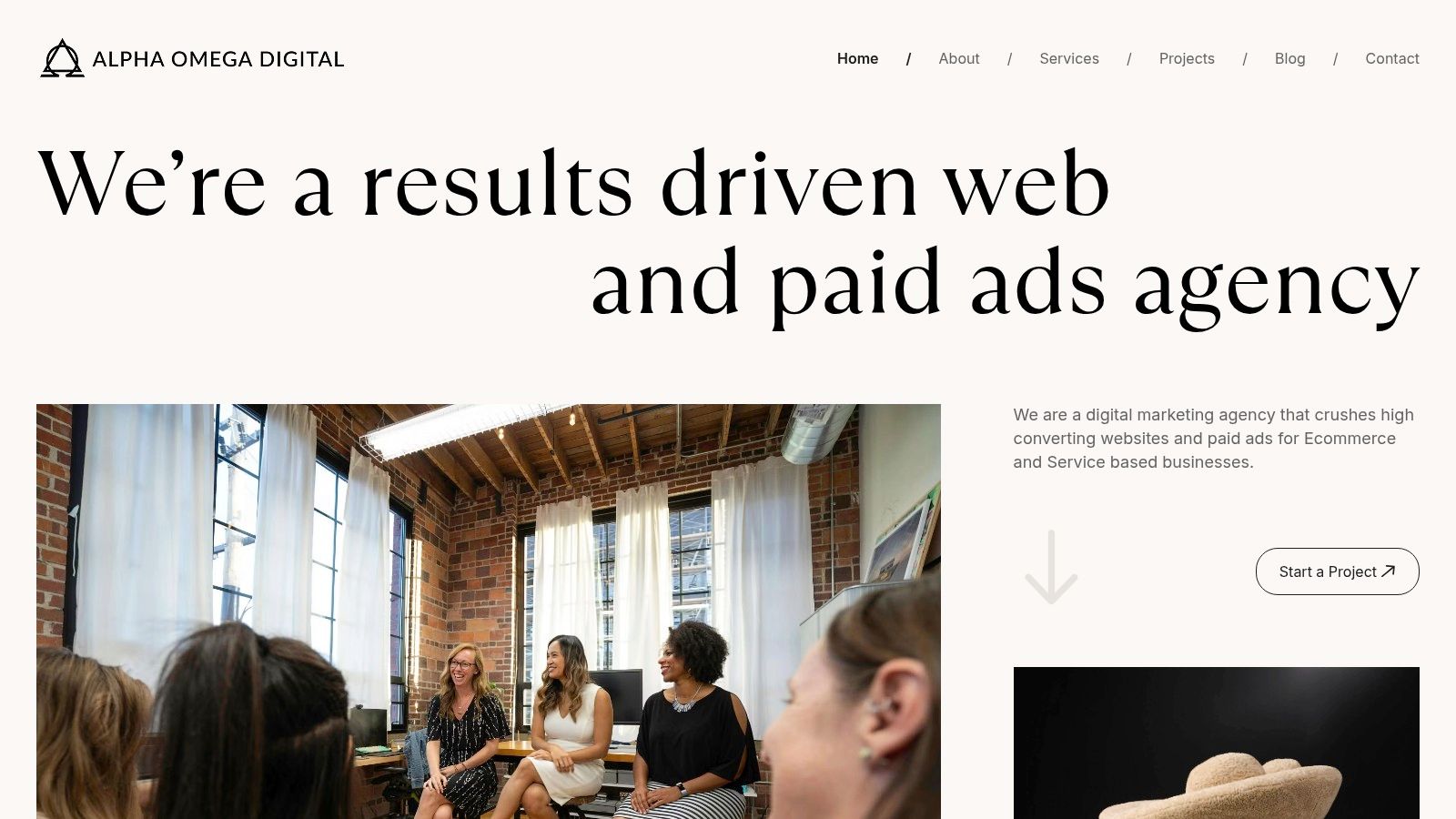
Alpha Omega Digital suits ministries that need more than a polished homepage. If the brief includes a new site, clearer user journeys, campaign support, tracking, and ongoing optimisation, this agency is closer to a digital growth partner than a design-only studio.
I rate that approach highly because a lot of ministry projects break down at the handoff points. Design gets approved, development drifts, analytics is added late, and nobody has mapped what a visitor should do next. Bringing UX, development, paid media, and measurement into one workflow usually reduces those gaps.
Why Alpha Omega Digital is a strong all-round choice
Some Christian web design companies are strongest in church-specific content structure. Alpha Omega Digital is stronger on breadth. That matters if you are not only managing sermons and events, but also donation flows, lead capture, ecommerce, or advertising campaigns tied to landing pages.
Its process is one of the more practical parts of the offer. Discovery, strategy, onboarding, launch, optimisation, and scaling are straightforward stages, and that clarity helps teams make decisions faster. Church boards and ministry staff often need that structure because approval cycles can drag when ownership is unclear.
Practical rule: if an agency cannot explain how it handles discovery, build, launch, tracking, and support, expect scope confusion and expensive revisions.
The Melbourne base will also appeal to organisations that want a local team they can speak with directly, especially when the website is only one part of a broader marketing setup. That becomes more useful when launch includes Google Ads, Meta campaigns, tag setup, analytics configuration, or conversion tracking.
Where it fits best
I would shortlist Alpha Omega Digital for ministries and Christian organisations that need technical capability across several areas at once. That includes custom WordPress work, Gutenberg block development, Shopify builds, paid campaign landing pages, and post-launch optimisation. In practice, that mix is hard to coordinate across multiple vendors without losing speed or accountability.
The trade-off is pretty clear. Pricing is not published, so you need a proposal, and that usually means they are scoping around the actual build rather than selling fixed starter packages. For a simple brochure site, that can be more process and capability than you need. For a ministry that wants the site to support attendance, enquiries, donations, or online sales, the extra capability is often worth paying for.
A few strengths stand out:
- Integrated delivery: design, development, conversion thinking, and traffic acquisition sit in the same team.
- Broad platform capability: a practical fit for WordPress, Shopify, custom landing pages, and tracking-heavy builds.
- Support after launch: optimisation and campaign management are part of the model, not an afterthought.
If I were advising a church leader or ministry director, I would place this option in the "broad capability" category rather than the "church niche specialist" category. That distinction helps. The right choice depends on whether your main risk is sector misunderstanding, or whether your main risk is hiring a team that cannot build and support the full system you need.
2. Narthex Digital
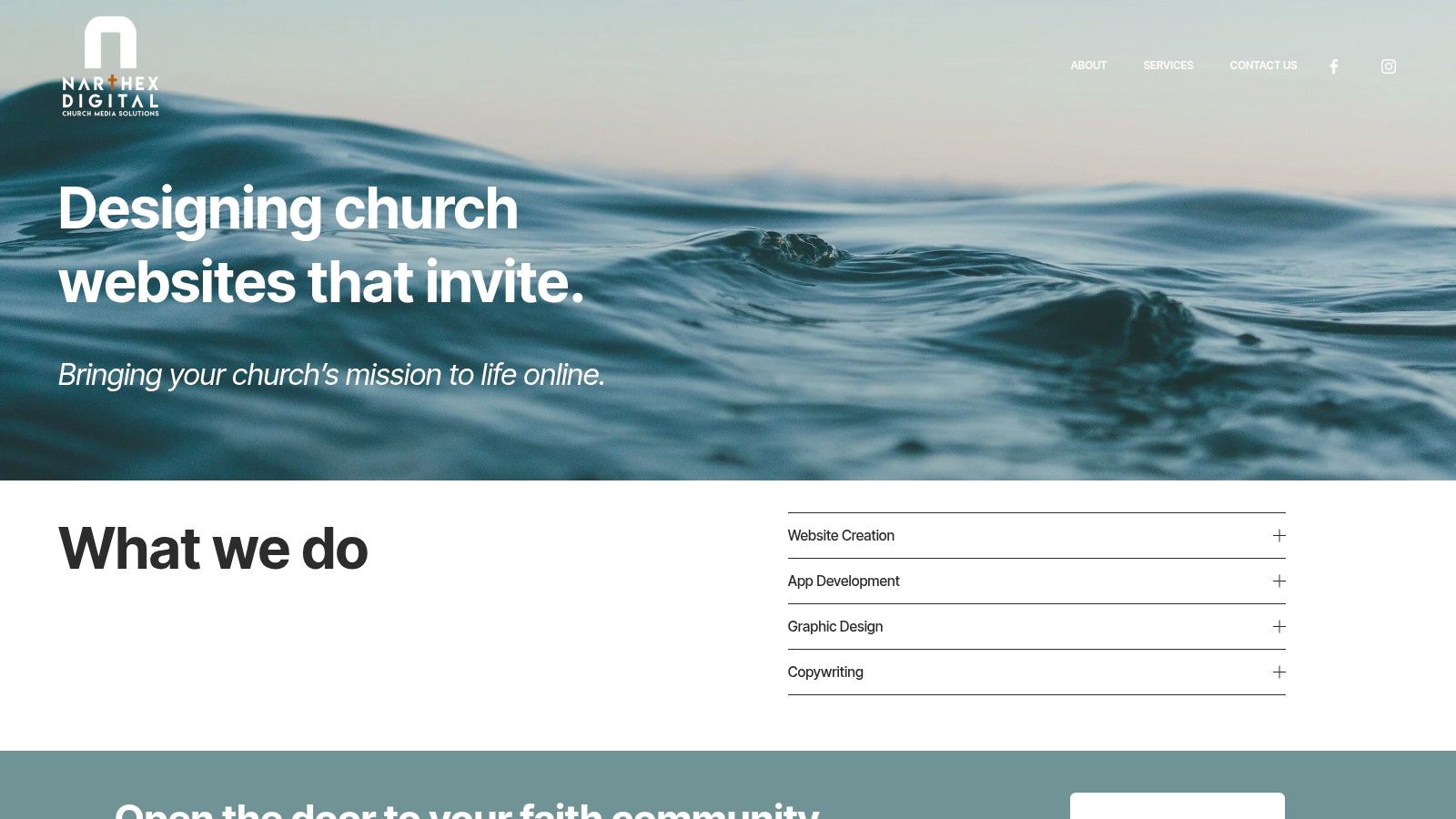
Narthex Digital is one of the more obviously church-specific entries here. If you're a parish or Catholic organisation and you want a team that already understands the rhythms of church communication, this is the appeal. You don't spend the first few meetings explaining what a homily archive is, or why sacramental information has to be easy to find.
That niche focus matters. Some ministries don't need a broad digital marketing agency Melbourne style operator. They need a specialist who already knows the audience, the tone, and the content structure.
Best for parish-centred content and communication
Narthex isn't only selling design. Its offer leans into branding, copy, content support, and parish app development as well. That's useful when the primary bottleneck isn't web development, but getting a church team to organise the information properly.
I'd put them high on the shortlist when the ministry has lots of community-facing information and limited internal capacity to shape it. Parish pages often become messy because nobody owns content structure. A studio with sector familiarity can solve that faster than a generic developer.
The more volunteer-dependent your content workflow is, the more important simple page editing and clear information architecture become.
The caution is fit. Their visible positioning leans Catholic, so independent churches or non-Catholic ministries should make sure the tone and examples align with what they need. That doesn't make them narrow in a bad way. It just means you should confirm platform approach, design flexibility, and support scope early.
3. Box & Circle
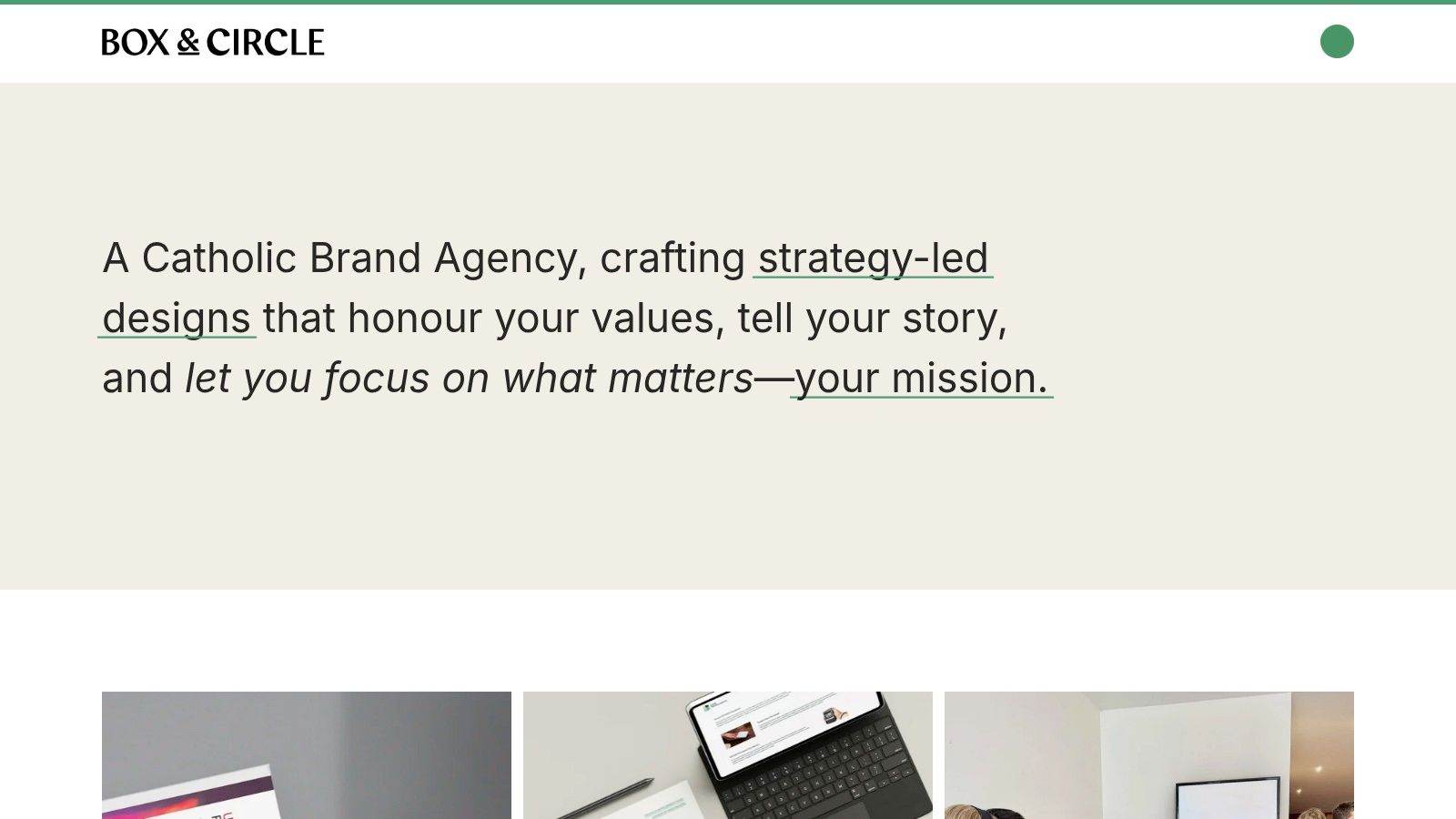
Box & Circle is a different kind of choice. It's less “website supplier” and more “brand partner for Catholic organisations.” That distinction matters if your ministry is rebranding, launching a major campaign, or trying to unify print, events, publications, and digital.
When I see agencies like this, I don't compare them directly with fixed-scope web vendors. I compare them with strategic creative partners. If your website is only one part of a larger communications system, Box & Circle becomes much more interesting.
Best for organisations with brand complexity
This is a strong fit for dioceses, Catholic schools, ministries, and institutions that need consistency across channels. If the challenge is that your website, brochures, campaign materials, and event identity all feel disconnected, a brand-led agency can solve the root problem instead of just redesigning the site surface.
Their in-house website design and development capability is useful because the digital work doesn't get separated from the brand system. That usually leads to stronger visual consistency and cleaner messaging.
A practical upside here is communications maturity. Some church teams already know who they are, but their materials don't show it. Others need help articulating identity first. Box & Circle appears better suited to the second group than a purely technical shop.
Trade-offs to think through
This probably isn't the agency I'd choose for a small church that just needs a fast WordPress refresh. It's more appropriate where stakeholder review, governance, and brand stewardship are part of the brief.
- Strongest use case: Catholic organisations with multiple audiences and formal communications needs.
- Less ideal use case: small ministries needing low-cost launch speed.
- Question to ask: who will manage ongoing page updates after the new brand system is live?
4. Church Design Australia
Church Design Australia is built for ministries that think beyond the website. Its broader creative offering includes branding, film, animation, stage and event design, and merchandise. That makes it a good option when a church launch, conference, or rebrand needs one creative direction across everything.
I've seen this work especially well for churches planning a fresh season of growth. In those cases, the website isn't the only public-facing asset. The event screens, social assets, invite graphics, video pieces, and landing pages all need to feel connected.
Good when your website is part of a bigger rollout
If you're planning Easter campaigns, annual conferences, youth events, or a full ministry refresh, this kind of agency can reduce fragmentation. Instead of hiring one team for the website and another for visuals, you keep the creative logic in one place.
That said, integrated creative shops can be too much for simple jobs. If all you need is sermon pages, staff bios, and a clean contact flow, a specialist web studio may be more efficient.
A ministry site usually performs better when it matches the wider church experience people see on social media, at events, and in print.
Another point worth keeping in mind is mobile. DataReportal reported that Australia had 25.1 million internet users in January 2026, with 34.2 million cellular mobile connections and mobile connections equivalent to 116% of the population, according to this Australian mobile web design snapshot. For church sites, that means responsive layouts, clear tap targets, and real mobile testing should be mandatory. A visually ambitious agency still needs technical discipline.
5. Divine Websites
Divine Websites takes a more practical route. Its pitch is less about big creative strategy and more about making church websites manageable for ordinary teams. That matters a lot in ministry settings where updates are handled by volunteers, office staff, or multiple contributors.
This is one of the first things I check when evaluating Christian web design companies. A beautiful site isn't much use if nobody wants to touch the CMS after launch.
Built around ease of editing
Divine Websites emphasises an easy browser-based CMS, multi-editor workflows, and mailing list support. For churches with decentralised communication, that's useful. One person can update service times, another can post events, and someone else can handle news or member communications without bottlenecking everything through a single admin.
That approach often works better than highly customised systems. Churches rarely fail because the design wasn't advanced enough. They fail because the site becomes stale.
A practical concern is that public technical detail appears fairly limited. If you need custom integrations, a more advanced sermon archive, or ecommerce capability, you'll want to ask what the underlying stack can and can't do before signing off.
Where it fits best
I'd shortlist Divine Websites for churches that want local support, straightforward administration, and a site that can be kept current without developer dependence. It's probably less suited to ministries that need custom Shopify development, bespoke WordPress block systems, or advanced analytics implementation.
6. Diverse Website Design
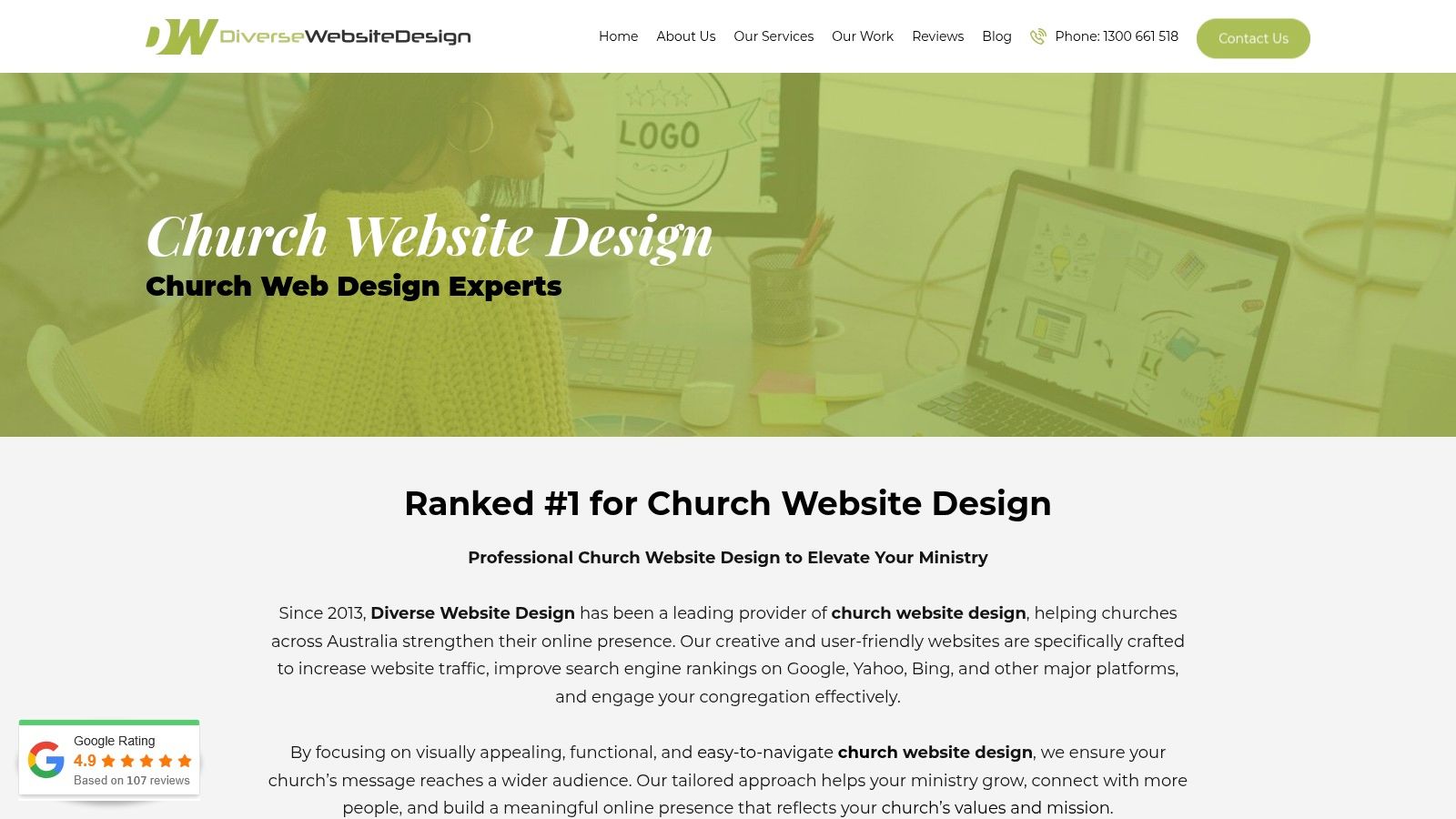
Diverse Website Design's church package is the clearest budget option on this list because it publishes a fixed-price package at A$995. That transparency is useful. A lot of churches just want to know whether a provider is even in range before starting a conversation.
For smaller ministries, that can be refreshing. You're not booking discovery calls just to find out the project is far beyond your budget.
Best for tight budgets and simple scope
The package includes a custom responsive website, CMS access, SEO setup, forms, business email, social integration, and blog support. For a church needing the essentials, that's a workable starting point.
This is the classic trade-off between affordability and flexibility. A standardised package can move faster and cost less because the process is repeatable. But if you need custom user journeys, more strategic messaging, advanced donation integrations, or unique design systems, you'll reach the edge of the package pretty quickly.
- What works well: small churches, new ministries, limited budgets, fast launch timelines.
- What doesn't: projects needing bespoke UX, heavy strategy, or ongoing growth work.
- What to confirm: how add-ons are handled once your needs go beyond the standard package.
Australia's ecommerce environment also matters more now than many ministry teams expect. Australia Post reported that online shopping in Australia reached $63.3 billion in 2023, with 9.8 million households making at least one online purchase, and ecommerce accounted for roughly 18% of retail spending, according to this Australian ecommerce benchmark for web design demand. Even faith-based organisations increasingly need online giving, product sales, event ticketing, or fundraising capability. If that's in your roadmap, ask whether a budget package can grow with you.
7. Eravo Digital
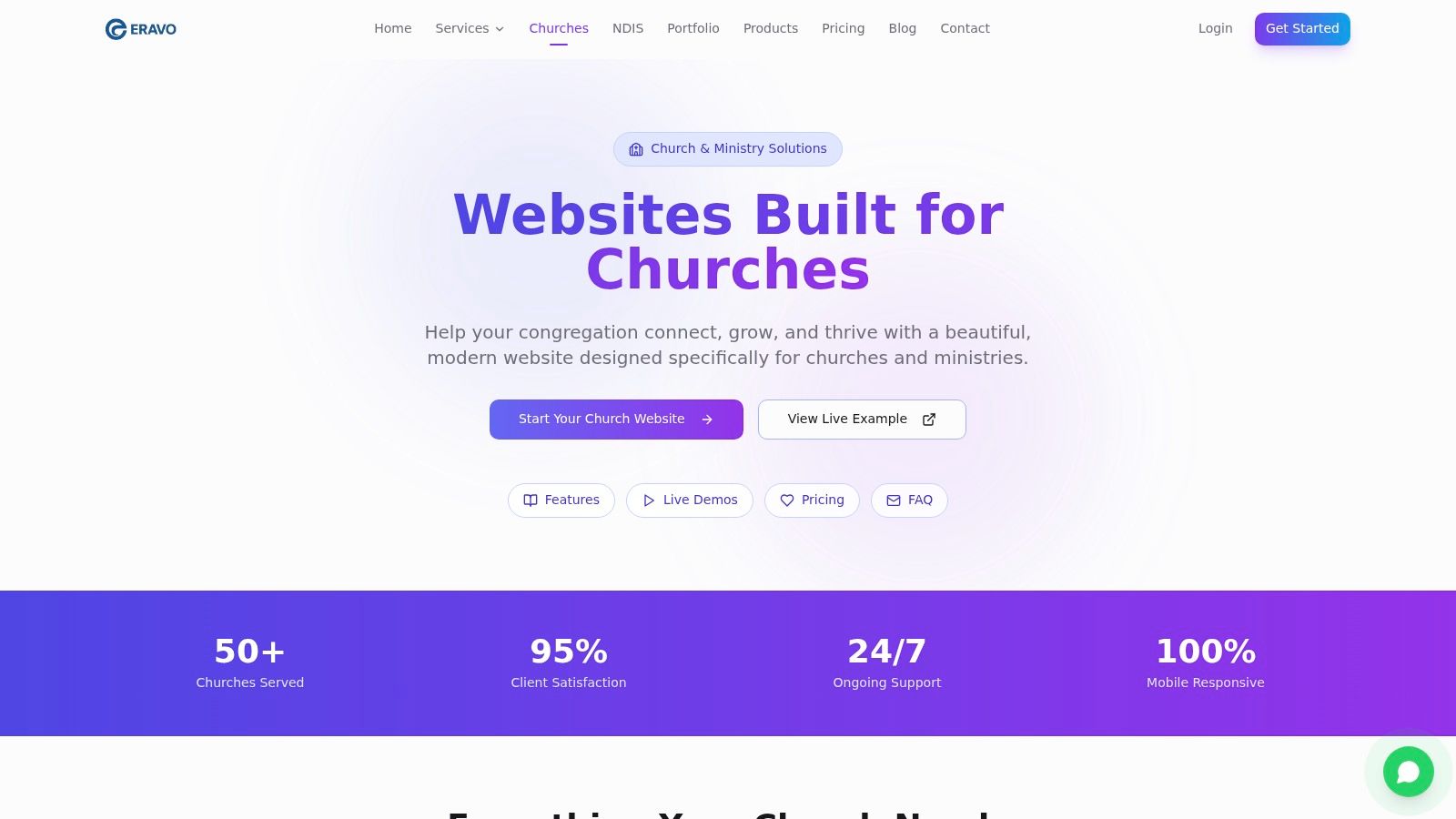
Eravo Digital's church offering sits in a useful middle ground. It isn't exclusively a Christian-sector agency, but it does have a specific churches and ministry service. That can be a good sign when you want church familiarity without giving up broader technical capability.
I usually look at firms like this for ministries that want a modern site now and the option to add custom work later. Not every church project starts complex, but plenty of them grow into integrations, custom forms, membership workflows, or system connections over time.
A sensible option for ministries that may scale later
Eravo emphasises clean design, easy navigation, and engagement-focused pages. That sounds basic, but it's the right basic. Ministries often overcomplicate websites and bury the essential pages. Sermons, events, giving, contact details, and ministry information should never be hard to reach.
Because they also work beyond the church niche, they may be a stronger fit than a purely church-branded studio when the project starts blending into more technical digital work. That could include custom development or broader business systems down the line.
If your site may expand into member portals, CRM connections, or more tailored workflows, ask early how the agency handles custom development after launch.
One caution is that pricing isn't public, and ministry references should be reviewed carefully if sector experience is central to your decision. Still, for teams that want a clean, usable site with room to grow, Eravo is a credible option.
7 Christian Web Design Agencies Compared
| Service | Implementation complexity | Resource requirements | Expected outcomes | Ideal use cases | Key advantages |
|---|---|---|---|---|---|
| Alpha Omega Digital | Medium–High: custom WordPress/Shopify builds plus paid campaigns | Moderate–High: design/dev time, ongoing ad budget, analytics & client input | Improved conversion rates, measurable ROAS, scalable revenue | SMBs, eCommerce brands and startups wanting integrated web + performance marketing | Integrated UX/dev + paid media, repeatable six-step process, post-launch support |
| Narthex Digital (AU) | Low–Medium: church-tailored sites and companion parish apps | Low–Medium: content/copywriting, app dev when required | Faith-focused communication, improved parish engagement and content delivery | Catholic parishes and faith communities seeking sector expertise and apps | Niche church focus, parish apps, end-to-end content support |
| Box & Circle (Catholic brand agency, AU) | Medium: strategy-led branding and in-house website development | Medium: brand strategy, design, print and digital production resources | Cohesive brand systems across print, events and digital channels | Dioceses, Catholic universities and ministries needing unified branding | Deep Catholic sector knowledge, multi-channel brand delivery |
| Church Design Australia (AU) | High: full creative suite (branding, film, events, web) | High: cross-disciplinary creative production, event/stage resources | Integrated creative direction for launches, conferences and digital presence | Large rebrands, conferences or ministries requiring end-to-end creative services | One vendor for full creative suite, values-driven process |
| Divine Websites (AU) | Low: simple CMS sites focused on volunteer usability | Low: local hosting/support, minimal technical maintenance, volunteer editors | Manageable site editing, decentralised updates, basic mailing list tools | Small churches and volunteer-led teams needing easy editing and hosting | Volunteer-friendly CMS, multi-editor workflows, local support |
| Diverse Website Design – Church Website Design (AU) | Low: fixed-price, standardised church package | Low: predictable scope, fast turnaround, limited customisation | Affordable, functional CMS site with core integrations (SEO, forms) | Small parishes with tight budgets wanting quick, transparent delivery | Clear fixed price (A$995), quick to scope and start |
| Eravo Digital – Church & Ministry Websites (AU) | Medium: clean, scalable church sites with option for custom work | Medium: design resources, potential for later custom integrations | Modern, usable church sites with room to scale functionality | Ministries wanting contemporary sites with future customisation potential | Usability-focused approach, ability to grow into custom integrations |
How to Choose the Right Partner for Your Ministry
A church board meeting often turns this into the wrong debate. One person prefers the agency with the nicest homepage. Another wants the lowest quote. The better question is simpler. What kind of partner does your ministry need over the next two to three years?
That shifts the decision from vendor shopping to capability matching.
I use four checks. Do they understand ministry goals well enough to shape content and structure, not just visuals? Can they build on a platform your staff or volunteers will keep updated? Have they handled organisations with your level of complexity, whether that means one parish site or a multi-campus ministry with events, donations, and campaigns? After launch, will they still be useful when something breaks, a page needs updating, or reporting and promotion become part of the brief?
Search visibility matters here too. Churches, schools, and ministries are often judged before anyone makes contact. People search, scan a few pages, and decide whether the organisation feels clear, current, and trustworthy. A site can look polished and still fail if visitors cannot find service times, staff contacts, giving information, or next steps without effort.
The pattern is usually straightforward:
- Choose a niche church specialist if ministry familiarity, pastoral tone, and volunteer-friendly editing matter most.
- Choose a broader performance-focused agency if the website also needs ads, analytics, ecommerce, CRM integration, or conversion tracking.
- Choose a brand-led partner if the website is one part of a wider rebrand, launch, conference, or communications project.
Internal capacity should drive the final call. If your team will not maintain a complex setup, a custom build can become a burden within months. If paid media, GA4, GTM, Shopify, or ongoing landing page work are likely next, it makes sense to choose a partner who can handle that stack now instead of rebuilding later.
My short version is this. Alpha Omega Digital suits ministries that need stronger technical execution and growth support alongside design, as noted earlier. Narthex Digital and Box & Circle make more sense for Catholic and parish contexts. Divine Websites and Diverse Website Design fit simpler, budget-conscious church builds. Eravo Digital and Church Design Australia are stronger options when usability, creative rollout, or broader communications support sit inside the brief.
If you're considering Alpha Omega Digital and your organisation already has a paid ads budget of at least $3,000 a month, there's a practical offer attached. You can get one month of paid ads management free by applying through the contact page. They're a Melbourne-based agency working across major Australian cities, with in-house capability across WordPress, Shopify, web design, Google Ads, Meta Ads, tracking, and conversion-focused growth.
[email protected]
Read more insights from our team on web design, paid ads, and growth strategy.