If you're comparing web design quotes in Melbourne right now, you're probably staring at a messy spread of options. One provider says they can do it for $999. Another sends a proposal that looks more like a mortgage application. A freelancer promises speed. An agency promises strategy. Most business owners I talk to aren't trying to buy a website. They're trying to avoid making an expensive mistake.
That's where the phrase affordable web design Melbourne gets misunderstood. Cheap is easy to find. Value is harder. The core question isn't whether a website costs less upfront. It's whether it helps you generate enquiries, sales, bookings, or repeat business without forcing a rebuild six months later.
I run a digital marketing agency Melbourne businesses use when they want the website and the growth engine to work together. That means WordPress development, Shopify development, Google Ads, Meta ads, GTM, Google Analytics, local SEO, and conversion tracking all need to line up. A site that looks fine but can't measure contact form submissions, can't support Google Shopping, or can't scale with your campaigns isn't affordable. It's a delay.
The Melbourne Web Design Maze You Are Not Alone
A business owner called me after collecting a handful of quotes from Melbourne providers. One was a basic fixed-price package. Another came from a larger agency. A third was from a solo operator who seemed capable, but the scope was vague. Her question wasn't unusual. She asked, "Why is this all over the place if everyone says they build websites?"
The short answer is that not everyone is selling the same thing.
Some providers are selling a template with your logo swapped in. Some are selling custom design without strategy. Some are selling development hours. Some are selling business outcomes. Those are very different offers, even when the screenshots look similar in a proposal.
The market is crowded. According to IBISWorld's overview of Australia's web design services industry, the industry comprises 3,581 businesses as of 2026 and has a market size of $1.5 billion. That tells you two things. First, businesses are investing online. Second, you need a partner who helps you stand out instead of blending into a very busy field.
Why cheap quotes feel tempting
When you're already spending on branding, ads, stock, staff, or fit-out, a low web quote feels sensible. I get it. Especially for small businesses, cash flow matters. But a website isn't a framed brochure. It's usually the destination for your Google Ads, your Facebook ads, your Google My Business traffic, your SEO traffic, your Instagram shop clicks, and your word-of-mouth referrals.
If the site is slow, confusing, or impossible to update, every other marketing channel gets weaker.
Practical rule: If a web proposal talks more about colours and pages than enquiries, checkout flow, tracking, or search visibility, you're not looking at a growth asset. You're looking at a design file turned into a website.
What business owners usually miss
Most clients don't come to me saying, "I need better information architecture" or "I need Meta Conversion API installed properly." They say they need a website that works. Fair enough. But "works" usually means all of this:
- Loads properly on mobile because that's where a lot of visits happen
- Guides people to action with a clear call, form, or add-to-cart path
- Supports local SEO so suburb and service searches have a chance to convert
- Tracks real actions through Google Tag Manager, GA4, Meta events, and form submissions
- Can grow later without being trapped in a rigid monthly package
I've seen plenty of Melbourne businesses buy a low-cost site, then pay again for SEO fixes, then again for tracking, then again for a redesign when the thing still doesn't convert. That's why the affordable versus effective question matters more than the headline price.
Decoding Melbourne Web Design Prices What Your Money Really Buys
A Melbourne plumber gets quoted $1,200 by one provider and $6,500 by another for what sounds like the same thing. Both say "5-page website." Both promise a professional design. Six months later, the cheaper site is live, but calls are thin, the contact form sends half the leads nowhere, and Google Ads traffic lands on pages that were never built to convert. That price gap makes more sense once you look past the page count and into what is being built.
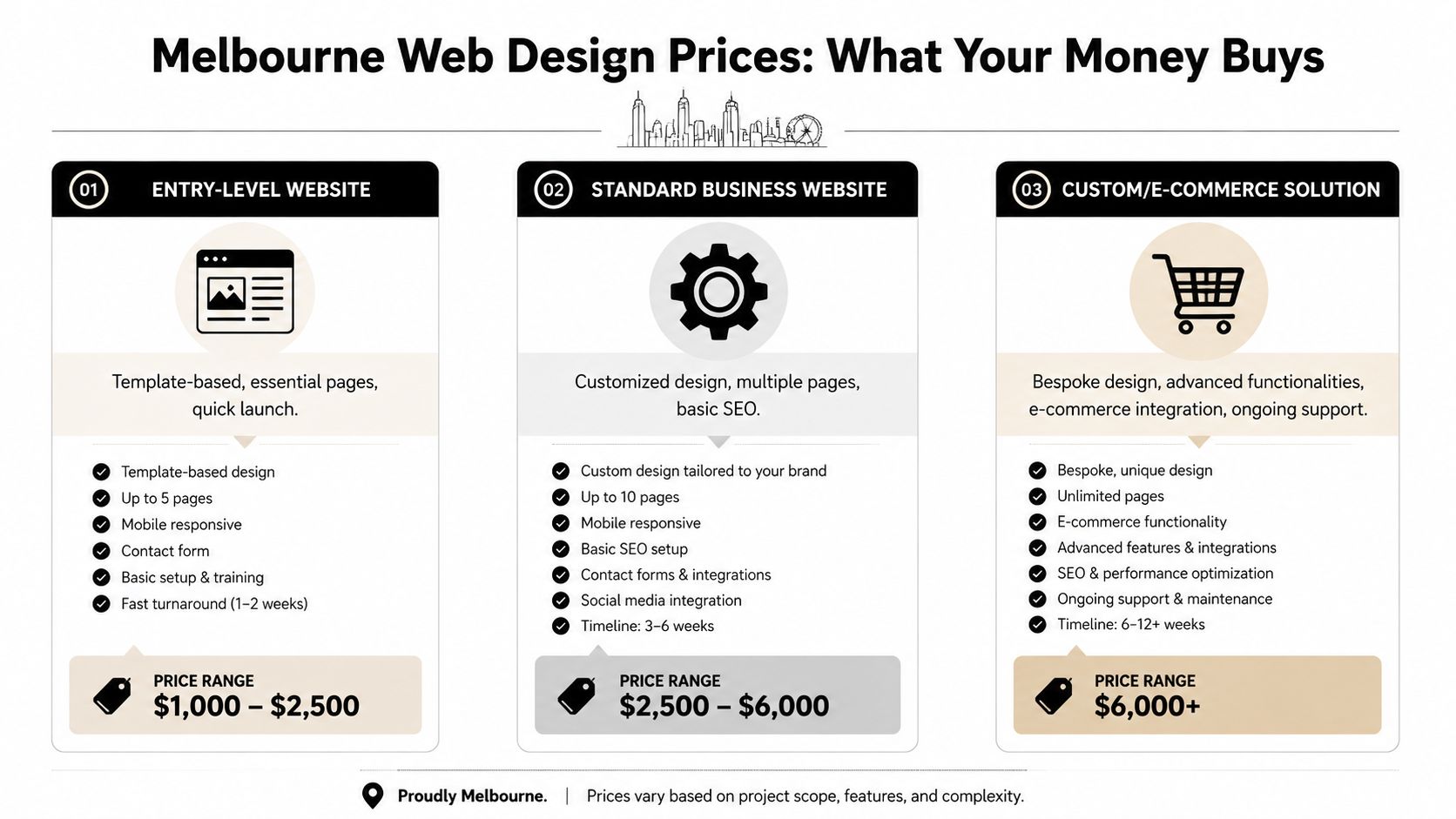
In Melbourne, a service-based website can sit anywhere from budget-template territory up to a properly planned custom build. The headline number matters less than what that number includes. I have reviewed plenty of proposals that looked affordable at first, then turned expensive once the owner had to pay extra for copy fixes, SEO structure, tracking, speed work, or a rebuild.
A practical way to read pricing tiers
| Website tier | Typical fit | What you usually get | What often gets missed |
|---|---|---|---|
| Entry-level | New businesses that need a basic web presence fast | Template setup, standard pages, simple contact form, basic launch | Sales messaging, search intent planning, conversion layout, tracking setup, room to grow |
| Standard business site | Established service businesses that need enquiries, calls, or bookings | Customised design, stronger mobile layout, clearer calls to action, better page planning, foundational SEO setup | Advanced integrations, custom calculators, member areas, or more complex automations |
| Custom or eCommerce build | Retailers, multi-service businesses, franchises, or brands with specific workflows | Custom design, deeper discovery, integration work, testing, tailored functionality, better future flexibility | Scope control can become the issue if requirements are vague |
The cheapest option usually buys production time, not business thinking.
That can still be fine. A holding page, a one-person startup site, or a short-term launch site does not always need a heavy strategy process. Problems start when a business expects a low-cost build to support lead generation, local search visibility, ad traffic, and future updates without paying for the planning needed to make those pieces work together.
I see the same pattern often. The owner saves money upfront, then pays another contractor to fix page structure, then another to install analytics properly, then another to repair mobile layout issues. A slightly higher investment at the start often costs less overall because the site is built to bring in enquiries instead of just looking presentable.
What you are usually paying for
A stronger mid-range build often includes work that never shows up in screenshots but affects results every week:
- Site structure and page planning so visitors reach the right service page quickly
- Copy direction and call-to-action placement so the site asks for the enquiry at the right moment
- Mobile-first layout decisions because that is where a lot of small business traffic comes from
- Local SEO foundations such as service-area targeting, metadata, internal page hierarchy, and indexable content
- Tracking setup for forms, calls, purchases, and ad platform events
- Admin usability so the owner can update content without breaking the layout
- Performance work to keep pages fast enough for users and ad traffic
This is the difference between buying a website file and buying a working sales tool.
For service businesses, the middle tier is often the best value-for-money point. It usually gives enough budget for structure, messaging, mobile design, analytics, and clean development without drifting into custom-build pricing that the business may not need yet.
Questions worth asking before you compare quotes
Price comparisons get clearer when the brief gets sharper. Ask each provider:
- Who writes or shapes the page copy?
- Is SEO structure included, or just a plugin installed?
- Are form submissions, phone clicks, and key actions tracked?
- Will the site owner control hosting, domain, and platform access?
- Can new pages or landing pages be added later without rebuilding the theme?
- What happens if the business runs Google Ads or adds new services in six months?
For eCommerce, costs rise quickly because stores involve more moving parts. Product data, collection logic, payment setup, shipping rules, app conflicts, and checkout behaviour all add time. If a store owner has already dealt with rate issues, this guide on troubleshooting Shopify shipping errors shows how one "small" setup problem can affect the buying experience and the support workload behind it.
Cheap web design is not always bad value. Cheap web design that fails to generate leads, sales, or usable data usually is.
WordPress vs Shopify Which Is Right for Your Melbourne Business
This decision shapes everything that follows. I work with businesses that need a flexible content-led site, and I work with brands that need a store built to sell. The right answer depends on the business model, not on which platform has the louder fans online.
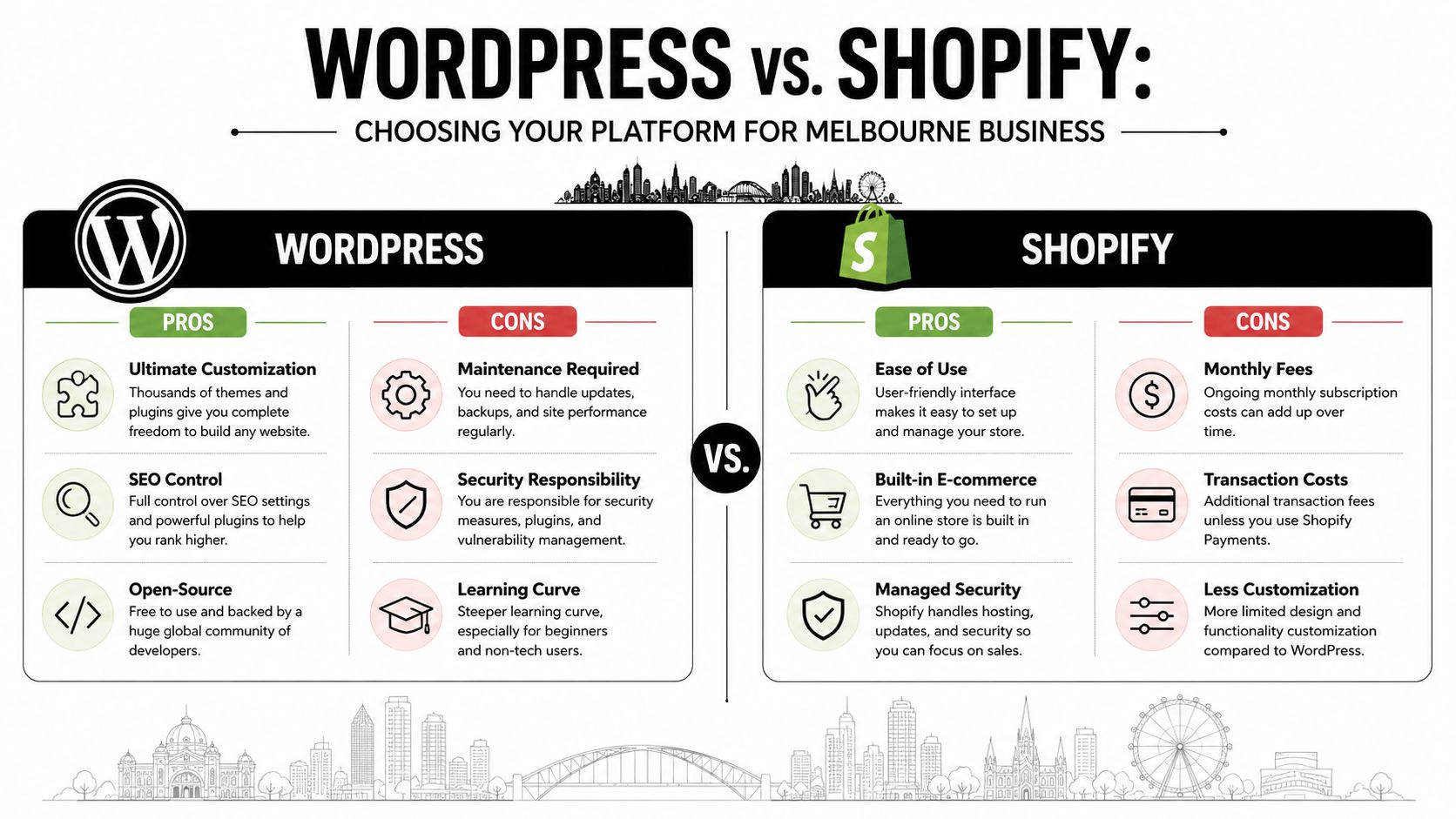
For eCommerce brands, Shopify is often the cleaner path. For service businesses, content-heavy sites, and more bespoke lead-gen setups, WordPress usually gives more freedom.
To make the differences easier to see, this visual gives a practical side-by-side summary.
When WordPress is the better choice
If you run a service business, local brand, content-driven company, or a hybrid site that needs lead generation first and sales second, WordPress is usually more adaptable. A good WordPress developer Melbourne businesses can rely on should be able to handle custom templates, performance improvements, landing page builds, local SEO architecture, blog systems, and custom blocks in Gutenberg.
That matters more than people think.
When I build on WordPress, I want the owner to be able to update pages without breaking layouts. That's where building custom blocks in Gutenberg is valuable. It gives structure to the editing experience instead of leaving staff to wrestle with random page builder elements. It also helps when your SEO agency Melbourne team needs new service pages, suburb pages, or campaign landing pages quickly.
A strong WordPress setup also suits businesses searching for:
- WordPress developer
- wordpress development
- wordpress web developer
- wordpress website developer
- wordpress developers
- wordpress development company
- wordpress development melbourne
If you're comparing agencies, ask whether they do real custom development or just theme tweaking.
When Shopify makes more sense
If your business lives and dies by product sales, Shopify removes a lot of friction. The admin is cleaner for most store owners. Inventory, variants, checkout, collections, basic app integrations, and merchandising are simpler to manage than trying to force eCommerce into the wrong stack.
That doesn't mean Shopify is "easy" once the store gets serious.
A professionally built Shopify website from a local agency typically costs between $10,000 and $50,000 AUD depending on complexity, based on this Australian Shopify development cost perspective. That's consistent with what I see once custom design, app decisions, checkout thinking, third-party integrations, and launch strategy are involved.
What Melbourne eCommerce brands often overlook
A Shopify build isn't only theme design. It often includes:
- Shopify design with collection logic and merchandising flow
- Shopify development for custom sections and theme behaviour
- Shopify API work when apps or systems need to talk to each other
- Building custom Shopify apps using Shopify CLI when off-the-shelf apps don't fit
- Instagram shop and Facebook shop setup considerations
- Google Shopping feed readiness and campaign structure
- Meta Conversion API and event mapping
Shipping is one of the most common pain points after launch. If you're in the weeds with rates and checkout behaviour, this guide on troubleshooting Shopify shipping errors is worth bookmarking because it addresses a problem that catches a lot of store owners off guard.
A practical decision filter
Choose WordPress if your sales process depends on trust, content, service pages, and lead capture.
Choose Shopify if the core job is selling products efficiently, managing a catalogue, and scaling a store with less technical overhead.
Neither platform fixes bad strategy. A weak offer, poor tracking, messy product structure, or confused ad traffic will underperform on both.
Beyond a Pretty Design How to Judge a Website's True Value
I've reviewed plenty of websites that looked polished in a design mock-up and still failed in practice. Nice typography doesn't rescue a weak page structure. A sleek homepage doesn't help if visitors can't work out what you sell, where you operate, or what to do next.
The gap in Melbourne is often exactly that. The critical gap between affordable design and conversion performance keeps catching businesses out. Many cheap sites lack the UX strategy needed to generate sales, so the owner pays once for launch and then pays again for a rebuild later.

What I look at before I care about visuals
When I assess a site, I want to know whether it can support revenue. The checklist is practical.
- Message clarity. Can a new visitor understand the offer fast?
- Page intent. Does each page have one obvious next action?
- Mobile behaviour. Does the site stay usable on an actual phone, not just in a desktop preview?
- Tracking readiness. Can we measure form submissions, calls, purchases, add-to-carts, and key events?
- Search foundations. Is the structure sensible for local SEO and future content growth?
If those basics are weak, redesigning the hero section won't fix much.
Design that converts behaves differently
Conversion-focused design isn't mysterious. It usually looks simpler than overdesigned websites because it's built around decisions. Where do I click? What happens if I submit this form? Why should I trust this business? What options do I have if I'm not ready to buy today?
That last point matters for both lead gen and eCommerce. Some visitors want a quote. Others want to join a list, save a product, or compare options. That's why good landing page thinking matters. If you're improving list growth or top-of-funnel capture, these newsletter acquisition tips are a useful reference because they focus on page behaviour, not decoration.
Websites don't fail because the logo is in the wrong place. They fail because the business never mapped the user's next step.
The marketing layer most cheap builds ignore
Many 'affordable' projects tend to fall short at the point when: The site launches, but nobody planned for:
- Google ads for service based businesses
- Google ads for contact form submissions
- How much it costs to start Google Ads
- What budget to spend on Google Ads
- Campaign priority in Google Ads
- PMAX vs Google Shopping ads
- Google Shopping ads for dropshipping
- Google Shopping ads not spending budget
- Meta ads creative testing process
- How to measure success in Facebook ads
- Facebook ads, don't quit too early
- Conversions API installation for Meta
- Setting up Google Tag Manager containers
- Google Analytics and GTM event planning
- Google My Business and local SEO
If the web designer can't think past launch day, the business ends up stitching the rest together later. That's usually slower and more expensive than building the foundations properly from the start.
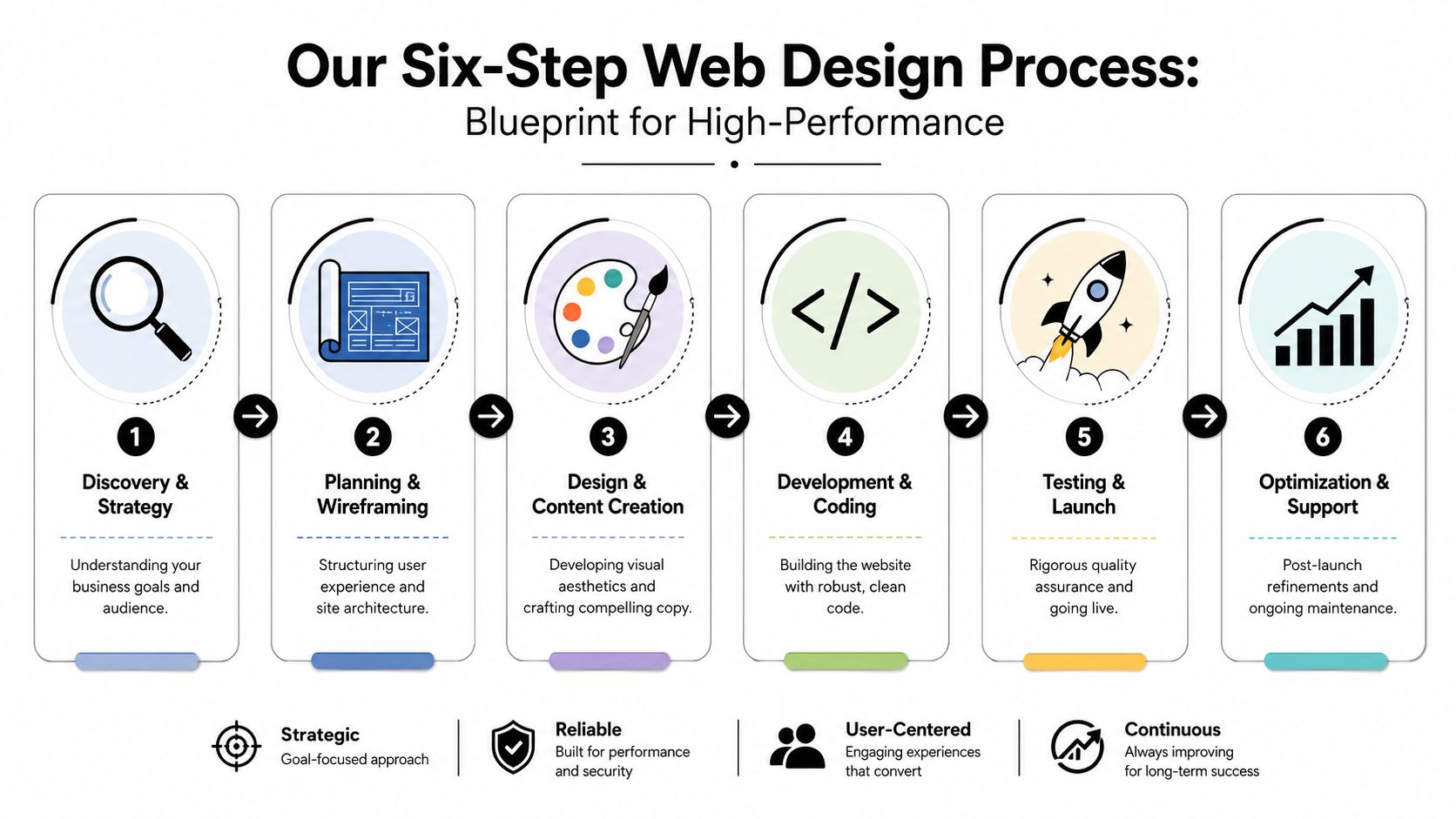
Our Six-Step Process The Blueprint for a High-Performing Site
The websites that hold up over time usually come from a disciplined process, not from random inspiration. When a build runs properly, the owner knows what is being decided, why it matters, and what happens after launch. That also helps avoid one of the biggest traps in this market: low monthly packages that feel easy to say yes to, then become hard to leave.
Many businesses are drawn to low monthly web design offers but don't ask enough about ownership, hosting lock-in, or scalability. That's the trade-off highlighted in this discussion of Melbourne website package lock-in and long-term limits. If custom functionality is restricted, upgrades usually arrive later and cost more than expected.
Step 1 and Step 2 start before design
Discovery and strategy comes first. I want to understand the offer, audience, sales cycle, margins, customer objections, and how leads currently come in. For eCommerce, that means product structure, bundles, collections, repeat purchase behaviour, and how paid traffic will land. For service businesses, that means suburb targeting, offer hierarchy, trust signals, and the path to enquiry.
Planning and wireframing turns that into structure, sorting out navigation, page order, collection logic, landing pages, and CTA placement. If you're running Google Ads later, this planning stage matters. It also matters for a marketing agency Melbourne team managing SEO content, PMAX landing pages, or Google Shopping campaign traffic.
Step 3 and Step 4 are where technical value appears
Design and content creation isn't just selecting fonts and spacing. It's writing pages that make sense, shaping user flow, and designing around action. The same goes for product pages on Shopify. A clean design with weak product messaging still struggles.
Development and coding is where the platform-specific work happens. That can include:
- custom blocks in Gutenberg for WordPress Design workflows
- Shopify theme development and Shopify API integrations
- setting up GTM containers and GA4 events
- Meta Conversion API installation
- contact forms with cleaner tracking for Google Ads
- structured build decisions that support local SEO
For some service businesses, call handling is part of the conversion system. We've also set up custom numbers through Twilio so calls can be answered around the clock, appointments can be booked into a calendar or Calendly, and missed-call leakage is reduced for tradies, hairdressers, beauty therapists, dentists, restaurants, and doctors. When the phone is a major sales channel, that setup matters just as much as the page design.
On real-world builds: A website should make ad tracking, call tracking, and follow-up easier. If every tool feels bolted on afterwards, the build wasn't planned properly.
Step 5 and Step 6 decide whether the site becomes an asset
Testing and launch covers responsiveness, form behaviour, cart flow, event validation, and handover. This is also where many weak builds reveal themselves. Broken forms, poor mobile spacing, app conflicts, and missing analytics tend to show up right before launch if the build has been rushed.
Optimisation and support is where the commercial side kicks in. One option businesses often compare here is Alpha Omega Digital's Web Design Melbourne service, which sits alongside paid traffic, WordPress development, Shopify builds, and performance marketing support. What matters isn't the provider name. It's whether the team can continue into SEO, Google Ads, Meta ads, and conversion improvements after launch instead of disappearing once the invoice is paid.
Your Next Step Invest in Value Not Just a Low Price
By this point, the pattern is usually clear. The best outcome rarely comes from buying the lowest quote. It comes from matching the build to the job the website needs to accomplish.
If you're a service business, that might mean a WordPress site with clean local SEO structure, custom Gutenberg blocks, GTM, GA4, clear enquiry paths, and landing pages built for Google Ads for contact form submissions. If you're in eCommerce, it might mean Shopify design and Shopify development that account for collections, feeds, Meta events, Google Shopping, app conflicts, and long-term scalability.
That also changes how you evaluate agencies.
A capable digital marketing agency Melbourne business owners can trust should understand more than design software. They should be able to talk through WordPress development, Shopify design, Shopify API considerations, local SEO, Google My Business, beginners guide to Google Shopping ads, PMAX vs Google Shopping ads, campaign priority in Google Ads, Meta ads creative testing, conversions API installation for Meta, and the practical reality of what budget to spend on Google Ads. If they can't connect the website to the acquisition channels, they're only solving part of the problem.
Consistency beats bursts of effort here. Businesses that keep refining the site, ad tracking, creative, and landing pages tend to make better decisions because they're measuring what matters. That's especially true for ecommerce marketing, PPC for tradies, Google ads for plumbers, Facebook ads for electricians, and call-driven campaigns where tools like CallRail, GoHighLevel, or Twilio-based setups can improve visibility into lead quality.
I work with businesses in Melbourne first, but the same issues come up across Sydney, Brisbane, Newcastle, Perth, Adelaide, Darwin, and Hobart. Owners want clarity. They want a site they own. They want proper tracking. They want a build that doesn't fall apart when they start running ads or expanding their offer.
Affordable web design in Melbourne is worth pursuing. Just don't confuse affordable with incomplete.
If you're looking for a partner that combines web development with growth strategy, Alpha Omega Digital is a Melbourne-based agency that works with businesses across Melbourne, Sydney, Brisbane, Newcastle, Perth, Adelaide, Darwin and Hobart. Have a project in mind? Contact us. If you're a business with a paid ads budget of at least $3k a month, I'd love to offer you a low risk deal: get a month of paid ads management FREE. Apply now through the contact page.
Alpha Omega Digital
Read more insights from our team on web design, paid ads, and growth strategy.