You've probably had this happen. A tradie lead comes in through Instagram, a clinic enquiry lands in the inbox, and a studio booking gets half-finished in a DM thread. The website sits there looking polished, but the actual booking path lives across Calendly, email, a phone call, and three browser tabs that don't talk to each other.
That's why Shopify for service business setups are worth taking seriously, especially if you want one place where the offer, payment, booking, and follow-up all connect. I build these kinds of flows for Melbourne businesses that need more than a pretty brochure site, they need a store that behaves like a reception desk, a quoting system, and a lead engine at the same time. For service owners across Australia, that usually means less manual admin, faster response times, and fewer leads going cold before anyone follows up.
Introduction Is Shopify Built for Services Like Yours
I've seen service owners start with the wrong question. They ask whether Shopify is “for products” and stop there, when the actual question is whether their current booking process is leaking revenue. If your enquiries live in DMs, your calendar lives somewhere else, and your deposits still rely on manual chasing, the platform choice is already a conversion question, not a design question.
Shopify works well for service businesses when you treat it as a conversion system, not a catalogue. A haircut, a consult, a treatment package, a workshop, or a maintenance plan can all be packaged in ways that let the customer choose, pay, and book without friction. That's the mindset I use when clients ask whether they need WordPress development, Shopify development, or a booking-only tool, because the answer depends on how much control they need over the journey.
There's also a broader reason this matters in Australia. Independent 2026 estimates place Australia's live Shopify store count between about 138,276 and 153,140, with one report putting active stores at about 152,323 in May 2026, which is big enough to support a mature partner and agency market rather than just product sellers (Eightx on the Australian Shopify landscape). The ecosystem is already broad enough that a service business can find help for setup, optimisation, automation, and paid traffic, instead of building everything from scratch.
If you're comparing options, the rest of this guide is written for owners who want the booking path to be clear, measurable, and easy to operate. That includes Melbourne clinics, tradies, studios, consultants, and ecommerce brands adding services alongside products. It also includes teams looking for a marketing agency melbourne or a digital marketing agency melbourne partner that understands both the site build and the lead flow.
How Shopify Works When You Sell Time Not Products
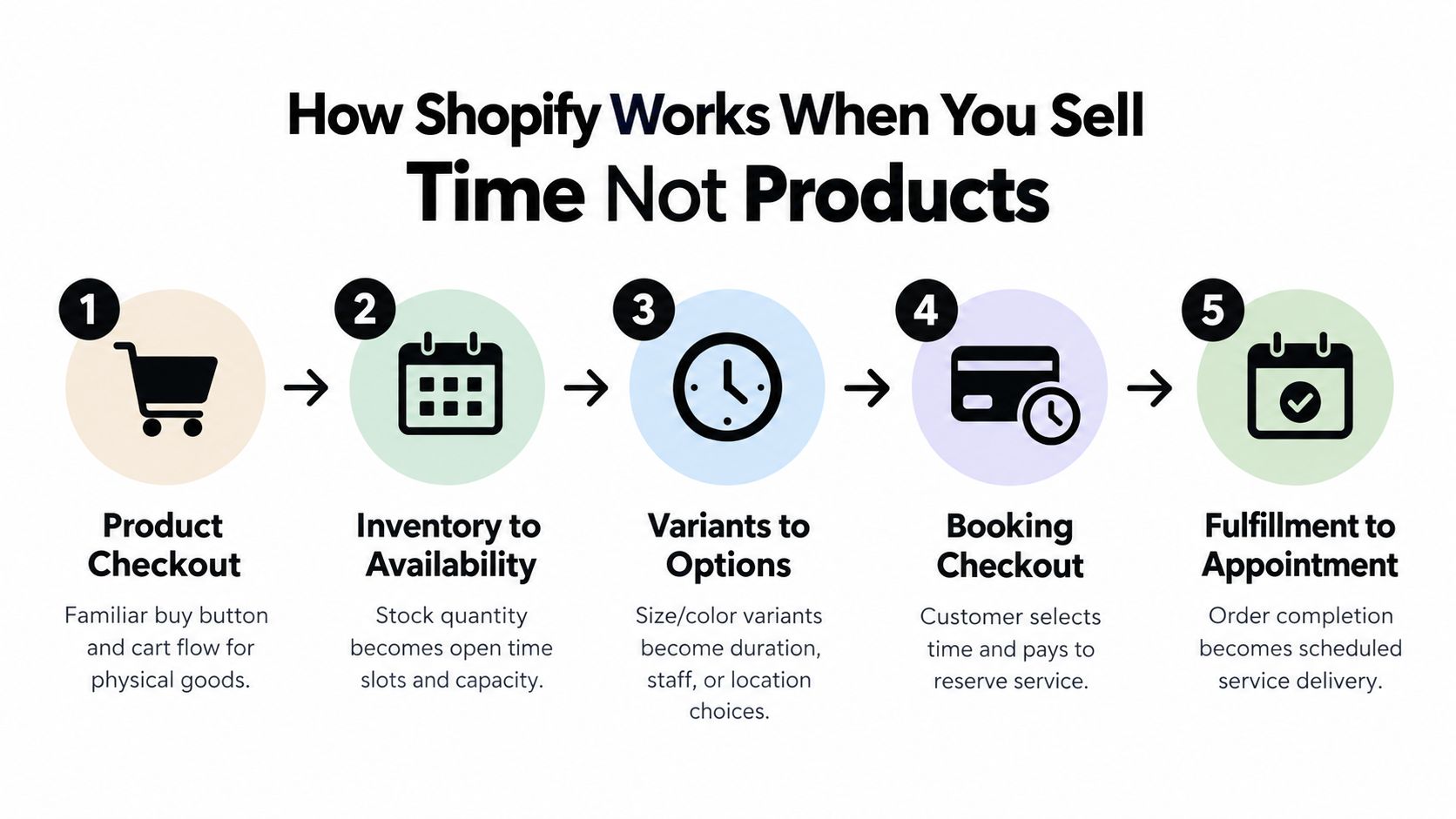
A normal Shopify store thinks in products, stock, variants, and orders. A service business works around availability, duration, staff, locations, deposits, and follow-up. The job is to translate one model into the other without making the customer feel trapped in a product catalogue that does not match what they are buying.
The shop counter and the reception desk
Shopify works like the shop counter. The customer sees an offer, reads the details, adds it to cart, and checks out. For services, the “inventory” is available time, team capacity, or the number of appointments a location can handle in a week.
Booking logic does the rest. Shopify can present the offer cleanly, but calendar rules, staff allocation, buffers, and rescheduling usually come from an app or integration. That is normal. The store handles the commercial part, and the connected tools handle the operational part.
How the objects map
A consultation product can represent one hour of expertise. A training session can map to a date and a room. A retainer can be sold as a recurring service bundle with a clear intake step, then routed into a workflow after purchase. Hybrid offers, such as a device sale plus installation, can sit in the same store if the structure is deliberate.
Practical rule: if the customer can understand the offer, reserve it, and pay without calling you first, Shopify is usually doing its job.
Service thinking matters. Australians spent about A$82.6 billion online in calendar 2025, up roughly 14% year over year, according to an Australia-focused market summary, and monthly online shoppers reached 17.08 million in 2024, up from 11.78 million in 2020 (Eightx overview of Australia's Shopify market). That does not mean every service should behave like a physical retailer, but it does show that online purchasing is normal enough for packaged services, bookings, and lead capture to feel familiar.
The key shift is simple. Shopify is not pretending a service is a product. It gives you a structured checkout, then hands the appointment logic to the right integration so the handoff to CRM, reminders, and follow-up stays clean.
Service Models That Work Well on Shopify
A clinic booking page, a tradie call-out, and a consulting intake form all sell time, but the operating problem is different in each case. I sort the offer first, because that choice decides whether Shopify should handle a single appointment, a shared session, a repeat commitment, or a mixed service-and-product flow.
Which model matches the offer
Five patterns show up repeatedly in service builds. Appointments work best when staff time is the main constraint and the customer needs one specific slot. Classes and group sessions fit when room capacity is tighter than staff time, so the system needs fixed dates, seat limits, and waitlist handling. Consultations and paid discovery suit lead qualification, because the booking itself is part of the sale and the intake needs to do some of the screening.
Subscriptions and retainers make sense for ongoing work, but only if the scope, renewal, and cancellation terms are plain before checkout. Hybrid bundles fit offers like treatment packs, diagnostic kits, or install plus follow-up, where the customer is buying a package that includes both fulfilment and service. The checkout should make that package feel like one decision, not two separate purchases.
| Service Model | Best For | Booking Logic Needed | Checkout Tip |
|---|---|---|---|
| Appointments and one-to-one bookings | Clinics, salons, tradies, personal services | Date, time, staff, buffers, reminders | Keep the deposit visible and simple |
| Classes and group sessions | Studios, workshops, training providers | Fixed sessions, capacity, waitlists | Use one clear session page per event |
| Consultations and paid discovery | Agencies, advisors, professional services | Intake form, qualification, calendar handoff | Make the outcome obvious before checkout |
| Subscriptions and retainers | Maintenance, membership, ongoing support | Renewal, term, cancellation rules | Spell out frequency and scope early |
| Hybrid bundles | Installers, clinics, product-plus-service offers | Product selection plus service scheduling | Separate what ships from what's booked |
The decision rule is practical. Choose Appointments when staff utilisation is the constraint. Choose Classes when room capacity is the constraint. Choose Consultations when lead quality matters more than volume. Choose Subscriptions when the same customer should return under a clear service agreement. Choose Hybrid bundles when the sale only works if the product and the service are ordered together.
The mistake I see most often is forcing one model to carry another model's job. A small business with two core services does not need a platform rebuild to start selling online. It needs the offer packaged cleanly enough that the customer understands what happens after payment, and the team can fulfil it without manual guesswork.
For Melbourne operators, a shopify development company or shopify developer should think past the theme and into the workflow. The right build is the one that matches how the business books, delivers, and follows up, not the one with the busiest homepage.
Essential Apps Integrations and Automations for Service Sellers
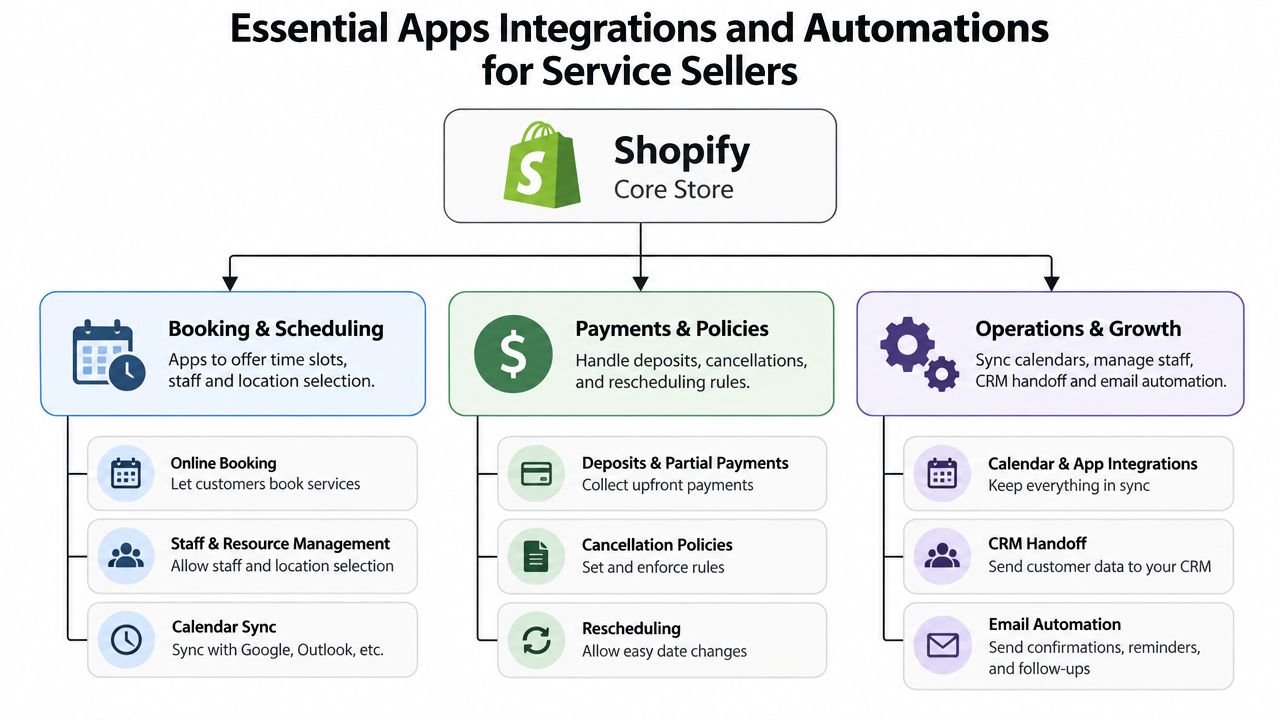
A service store works when the system behaves like one connected workflow, not a pile of separate apps. The path I aim for is simple, booking or form submission, then automation and CRM sync, then follow-up workflow. If that chain is weak, the business ends up with nice design and messy operations.
The stack that actually matters
Booking and scheduling apps handle the visible customer step, time slots, staff choice, location, and reminders. Payments and policies handle deposits, cancellations, and rescheduling rules, which is where a lot of service businesses either win trust or lose it. Operations and growth tools handle the invisible work, calendar sync, staff routing, CRM handoff, and email or SMS automation.
That is also where measurement belongs. If you're serious about paid traffic, connect GTM and Google Analytics properly, then install Meta conversion API tracking so you're not relying on browser pixel data alone. Shopify's Australian guidance on conversion APIs says the server sends marketing data directly to the ad platform's servers, which helps track ad effectiveness without relying only on the browser pixel, and it also notes that the setup requires defining a destination for the data (Shopify guidance on conversion APIs via Kia Ora Digital).
For CRM handoff, I like systems that let the booking or lead submission trigger an immediate internal action, because slow follow-up kills service sales. If your business needs examples of how this should read in a proposal or service-led sales workflow, the GetBill blog for freelancers is a useful reference point for how simple client-facing structure can reduce back-and-forth.
Keep the stack lean: if an app doesn't improve booking speed, tracking, or follow-up, it usually doesn't belong in the build.
The technical side matters, but so does discipline. I've seen service stores get bloated with too many overlapping tools, then nobody knows which app controls the calendar, which one triggers the email, and which one syncs the lead. A clean build uses fewer moving parts and makes every lead traceable from first click to confirmed appointment.
If your services rely on paid acquisition, this is also where a Facebook ads agency, Google ads agency, or seo agency melbourne partner can do useful work, because they can measure what the site is doing instead of guessing from traffic alone. When the store is instrumented correctly, the ads team can see which offer fills the calendar and which one just creates clicks.
Limitations Trade Offs and When to Choose Another Platform
Shopify is strong for packaged services, but it isn't the cleanest answer for every service business. If your booking rules are highly complex, your staff scheduling is dense, or your recurring billing needs are specialised, a booking-first platform or WordPress with the right plugins may be simpler to operate. I'd rather say that plainly than pretend Shopify is a universal fit.
Where the platform can get awkward
The biggest limitation is native scheduling. You're usually depending on paid apps for advanced booking logic, and that adds cost and another layer to maintain. Recurring billing for ongoing services can also be clumsy if the offer has unusual terms, variable renewal logic, or a structure that doesn't fit a standard product cycle.
Complex service organisations can outgrow the simple model quickly. Multi-location clinics, teams with several staff types, or businesses that need branching approvals often need more operational control than a storefront gives by default. In those cases, I often compare Shopify against WordPress development plus booking plugins, or a dedicated booking platform like Acuity or Mindbody, depending on the workflow.
The honest fit test
If your business mainly needs clear offer pages, a reliable payment flow, and a booking handoff, Shopify can work very well. If your business lives or dies on intricate scheduling, membership rules, or multi-step service orchestration, the platform choice should be driven by operations first, not by brand preference. That's the decision point I'd use whether the client is in Melbourne, Sydney, or running from a regional office.
There's also a wider ecosystem reason Shopify remains attractive. Shopify's Australian partner directory includes performance and speed work, store build and redesign, theme customisation, migration, troubleshooting, business strategy guidance, systems integration, and ongoing website management (Shopify Partners Australia). In practice, that means a limitation can often be solved with the right implementation partner, but it still needs to be weighed against the extra app stack and ongoing complexity.
For readers who also think about growth loops and referrals, the ViralRef referral program guide is a handy adjacent read, because service businesses often grow through repeat bookings and referrals as much as through paid traffic. The point is not to force Shopify into every model, it's to choose the platform that keeps the business easy to run.
Recommended Setup Steps From Offer to Launch
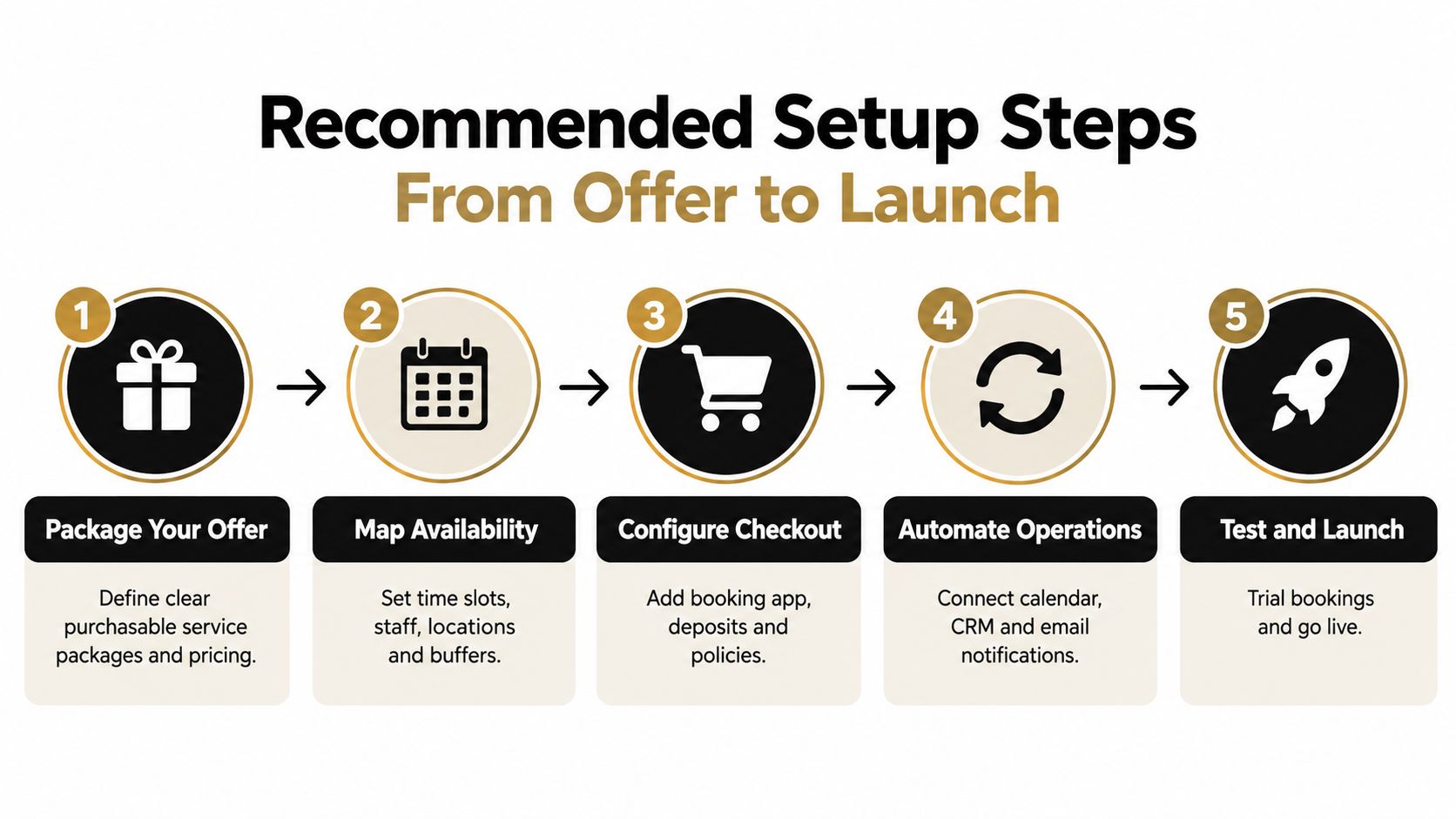
The cleanest builds start with the offer, not the theme. I've watched service businesses waste time tweaking fonts while the problem was that the service itself wasn't packaged in a way a customer could buy confidently. When the offer is sharp, the rest of the setup becomes much easier.
Package the offer before you build
Start by turning the service into something purchasable. That means naming the offer clearly, deciding whether it's one-off, recurring, or bundled, and writing down what the customer gets. If the service needs an intake form, a deposit, or a specific lead time, make that obvious before checkout.
Map the availability and rules
Next, define the booking logic. Set your staff, location, buffer times, blackout periods, and cancellation rules before you touch the design. If the schedule is wrong, no amount of design polish will save the customer experience.
Configure the store and checkout
Build the service pages, collections, and product structure in Shopify so the offer is easy to find. Then install the booking app, connect payment methods, and test the deposit flow from the customer's side. For service businesses that also sell products, the hybrid structure has to stay clean so the booking doesn't feel bolted on.
Connect tracking and QA
Once the commercial flow works, wire in analytics, Google Tag Manager containers, and the conversion API setup. Test the whole experience on mobile, because that's where most service enquiries get judged in a few seconds. I also check whether the confirmation emails, calendar sync, and CRM handoff trigger exactly once, because duplicate leads create a mess fast.
A good launch checklist catches the small failures before the public sees them. Broken booking slots, unclear deposits, and missing notifications are the kinds of issues that make a service business look disorganised even when the underlying work is excellent. That's why I treat QA as part of conversion, not just as a technical finish.
For teams that want broader execution support, Alpha Omega Digital handles Shopify development, Shopify design, WordPress development, and paid ads management from Melbourne, which suits businesses that need the site and the lead engine handled together. If you're already working with a marketing agency melbourne or looking for a more hands-on build partner, the main thing is to launch with the flow proven before you spend on traffic.
Conversion and Marketing Tactics That Fill Your Calendar
A service store doesn't win because it exists. It wins when the right people see it, trust it, and complete the booking without hesitation. That usually comes from a mix of local visibility, paid traffic, and on-site conversion work that removes small points of friction.
The channels that matter most
Local SEO and Google Business Profile work well for location-based service businesses, especially when the enquiry starts with nearby intent. One Australian local SEO source says a complete, active Google Business Profile earns 7 times more clicks than an empty profile, and Australian brands with active profiles logged the highest monthly actions among the countries studied (Australian local SEO statistics). For Melbourne service businesses, that makes the map pack worth treating as a real acquisition channel, not a side task.
Paid search still matters when the intent is strong. For Australian ecommerce stores, Google Shopping ads benchmark around AUD $0.95 average CPC, compared with about AUD $7.60 for Search ads, and a sensible starting budget is AUD $2,000 to $5,000 per month for an AU store (AIAD analytics benchmark). For service businesses, the same principle applies, test the offer with enough budget to learn, then optimise the landing page and follow-up process.
Calls, forms, and proof
If you run PPC for tradies or clinics, call tracking matters. I've had good results setting up a custom number through Twilio so the business can answer calls 24 hours a day, never get sick or tired, and book appointments directly into a calendar or Calendly flow. That kind of setup reduces missed leads for tradies, hairdressers, beauty therapists, dentists, restaurants, and doctors because the lead doesn't have to wait for office hours.
Simple rule for service ads: if you can't track the lead source and the booking outcome, you're paying for noise.
Meta ads can work well too, but only if the creative testing process is disciplined and the tracking is reliable. Good service campaigns usually need proof, urgency around limited slots, and a clear next action, not generic branding. If you're writing the offer page or the sales follow-up, a sample sales proposal examples resource can help shape the tone so the conversion message stays concrete rather than vague.
The shortest path to more bookings is usually not a fancy redesign. It's better tracking, clearer offer packaging, and a follow-up system that doesn't let leads drift for hours. That's the part most owners feel in the calendar, not just in the dashboard.
If you want a Melbourne team that builds Shopify development and WordPress development projects with paid ads and conversion tracking in mind, Alpha Omega Digital can help you package the service, wire the booking flow, and launch it properly. Visit Alpha Omega Digital if you want a practical build partner for a service business that needs more booked jobs, more qualified leads, and less manual admin.
[email protected]
Read more insights from our team on web design, paid ads, and growth strategy.