You've got a Shopify store, a few products that customers like, and advertising accounts that appear busy without producing dependable profit. The usual response is to buy more traffic. In Australian ecommerce, that often magnifies the problem. If the mobile experience is slow, checkout options are limited, tracking is unreliable, or customers never return after the first order, a larger media budget makes the leaks more expensive.
Shopify ecommerce marketing works best as a connected commercial system. Your storefront, Google Shopping campaigns, Meta creative, analytics setup, payment methods, email, SMS and customer service all influence the same outcome: profitable customer value over time. The right approach isn't chasing a flattering platform metric. It's understanding what you can afford to pay for a new customer, improving the percentage of visitors who buy, and building enough repeat demand to make acquisition sustainable.
What the Australian Shopify Market Demands
A Shopify store can have strong products, competent campaigns and steady orders, yet still produce weak returns. In Australia, shoppers have broad choice and limited patience for unclear value, incomplete product information or payment friction. Marketing performance therefore depends on more than traffic volume. It depends on how much profitable customer value each acquired shopper generates over time.
Australians spent about A$82.6 billion online in calendar year 2025, up around 14% year over year, with 9.8 million households, approximately 82% of households, shopping online and an average basket of about A$96, according to Australian online retail market reporting. The opportunity is substantial, but the market is mature. Customers compare offers quickly, recognise familiar checkout patterns and can switch brands after a poor first experience.
Shopify sits inside a crowded local ecosystem. Australian market analysis places the country at roughly 152,323 to 153,140 active Shopify stores in 2026, depending on the census cut, including about 3,653 Shopify Plus stores. Shopify outnumbers WooCommerce by approximately 1.82:1 to 1.9:1, while Afterpay appears on 26.3% of Australian Shopify stores and Klaviyo on 21.4%, as reported in Shopify ecommerce statistics for Australia. That level of adoption gives merchants mature infrastructure, but it also raises customer expectations and increases competition across search, social and marketplaces.
Why acquisition alone isn't enough
A sale attributed to Google Ads or Meta is only the starting point for the commercial calculation. The order still has to cover product cost, fulfilment, packaging, payment processing, returns, customer support and the advertising that produced it. The useful question is whether the contribution remaining after those costs can support acquisition and leave room for profit.
I separate the account into three operating questions:
- Can we acquire the customer? Google, Meta, SEO, partnerships and creative create demand and capture existing intent.
- Can we convert the visit? The offer, product page, trust signals, mobile experience and checkout determine whether that demand becomes an order.
- Can we create another purchase? Product usage, replenishment timing, email, SMS, loyalty and service influence customer value after the first transaction.
Conversion optimisation, retention and repeat revenue are the growth priorities that matter most in this market. A fixed average basket makes margin discipline especially important. If the first order leaves little contribution, repeat purchasing often determines whether the acquisition model works.
The local Shopify ecosystem sets a high baseline
Australian shoppers are accustomed to modern payment and lifecycle experiences. That does not mean every merchant should copy the same technology stack. Each app should earn its place by solving a defined bottleneck without slowing the storefront or creating reporting work the team will not maintain.
The Exerta Shopify app integration can support teams connecting store data with customer and marketing workflows. Assess it, like any other app, by the job it performs, the data it requires, its effect on site speed and the actions its output enables. A dashboard that nobody uses is not a marketing asset.
The practical conclusion is direct. Australian Shopify marketing should balance demand capture, conversion quality and retention economics. Increasing ad spend before those three areas work together can buy more orders without improving the business. A retention-first, unit-economics view makes the trade-off visible: acquire customers at a defensible cost, protect contribution on the first order and create reasons for them to return.
Auditing Your Store for Mobile Conversions and Checkout Friction
Before increasing media spend, I audit the path from landing page to completed order. Australian ecommerce conversion benchmarks cluster around 1.7% to 1.9% overall, with mobile conversion commonly near 1.1% and desktop closer to 2.9%, according to Australian conversion rate benchmarks. Those figures are context, not a universal target. Category, traffic source, price, brand strength and purchase frequency all change the interpretation.
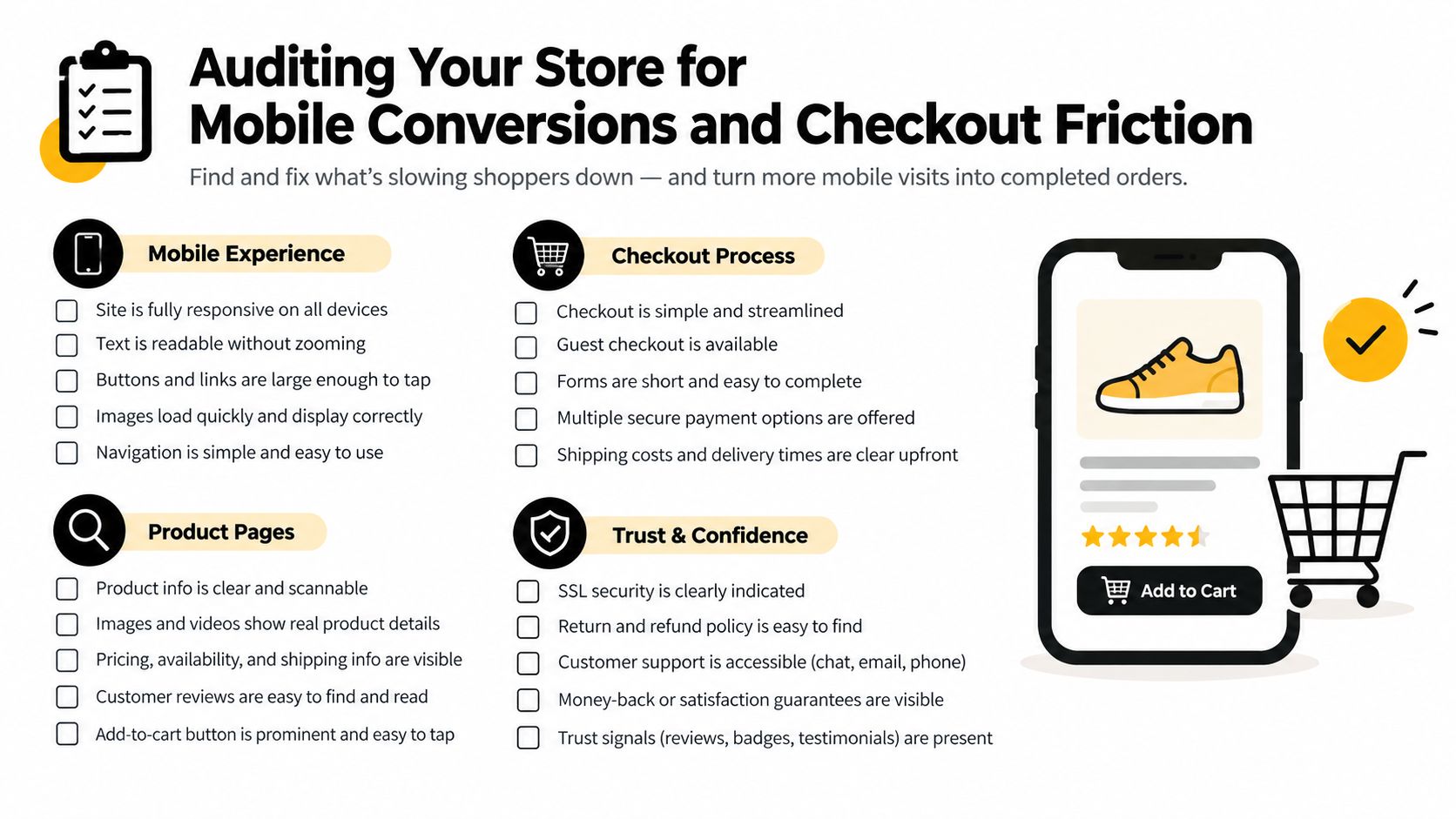
Start with the mobile buying path
Use a real phone, mobile data and a fresh browser session. Don't only inspect the homepage. Test a product discovered through an ad, a collection page, a search result and the checkout itself.
Check these points in order:
- The first screen: The product, core benefit, price, delivery expectation and primary call to action should be understandable without excessive scrolling.
- The product evidence: Product photography, dimensions, materials, usage instructions, reviews and returns information should answer the objections that stop a purchase.
- The interaction: Buttons need to be easy to tap, variant selectors must work cleanly and pop-ups shouldn't cover the buying action.
- The page load: Compress oversized images, remove unnecessary scripts and question every app that delays interaction. Speed matters most when a visitor arrives from a paid placement with limited patience.
- The sticky action: On a long product page, a persistent add-to-cart control can help, but only if it doesn't obscure important information or create accidental taps.
I also compare behaviour by device, landing page and source. A blended conversion rate can hide the fact that paid social visitors struggle while returning email customers convert well, or that one product template works while another creates hesitation.
Treat checkout as a commercial audit
Checkout friction isn't limited to a broken payment button. It includes unexpected delivery costs, unclear dispatch timing, forced account creation, missing local payment methods and forms that ask for information the order doesn't require.
Australian digital advertising guidance highlights the importance of payment coverage, including options such as Apple Pay, Google Pay, PayPal, Shop Pay and Afterpay. The Australian digital advertising overview is useful market context, but your own checkout data should decide which methods deserve priority.
Run a complete test order and inspect:
- Shipping clarity: State the delivery cost and timing before the final step where possible.
- Express payment: Test wallet buttons on the devices your customers use.
- Form burden: Remove fields that don't support fulfilment, compliance or customer service.
- Error handling: Confirm that an invalid card, postcode or discount code produces a clear message.
- Trust reassurance: Make returns, refunds and contact options easy to find.
- Confirmation experience: The order confirmation should explain what happens next, not merely display a receipt.
Practical rule: Don't solve a conversion problem with more traffic until you can identify where visitors leave and why.
Improve the offer before changing the theme
A redesign can't rescue an offer customers don't understand. Test bundles, product education, quantity incentives, delivery thresholds and clearer positioning before commissioning a full visual rebuild. Sometimes the strongest improvement is a better comparison table or a more honest answer to “why this product instead of the cheaper alternative?”
For larger changes, Shopify development can improve the architecture without forcing a complete rebuild. A Shopify developer can create reusable sections, improve product templates, connect inventory or build a better merchandising flow. On WordPress, the same principle applies to WordPress development, responsive WordPress design, performance work and custom blocks in Gutenberg. The platform matters less than whether the implementation removes a measurable buying obstacle.
Record the original device-level conversion, add-to-cart rate, checkout progression and revenue per session. Make one meaningful change at a time where possible. Otherwise, you won't know whether the result came from the offer, the layout, the script reduction or a seasonal shift.
Structuring Paid Media Budgets Across Google and Meta
Google and Meta solve different problems. Google Shopping captures people already expressing product intent. Meta creates and shapes demand through images, video, creators, offers and audience signals. A Shopify store usually needs both eventually, but the order depends on product demand, margin, catalogue depth, creative capacity and the quality of its conversion path.
Shopping campaigns use a cost-per-click model, so you pay when someone clicks. Australian retailers commonly see CPCs around AUD $0.30 to $1.50, although competitive categories can sit above that range, as outlined in Australian paid search benchmarks. CPC alone doesn't tell you whether a campaign works. A cheap click from an unsuitable query is worse than a more expensive click from a shopper who buys and returns.
A practical channel comparison
| Channel | Best For | Budget Floor | Primary KPI |
|---|---|---|---|
| Google Shopping | Existing product demand and high-intent searches | Depends on catalogue and economics | Contribution margin after ad cost |
| Google Search | Branded, category and specific product intent | Enough spend to generate usable query data | Qualified revenue and conversion value |
| Meta Ads | Demand creation, discovery and creative-led acquisition | Enough budget to test audiences and creative without constant resets | New customer contribution and blended efficiency |
| Email and SMS | Repeat purchases, education and win-back | Platform and production resources | Repeat revenue and customer value |
| SEO | Compounding product and category discovery | Consistent content and technical investment | Qualified organic revenue |
Australian guidance commonly places a practical Google Ads starting floor at about AUD $30 to $50 per day, or roughly AUD $900 to $1,500 per month, as a minimum meaningful spend rather than an ideal growth budget, according to Australian Google Ads budget guidance. Other ecommerce budget guidance suggests small catalogues often begin around AUD $2,000 to $4,000 per month, while larger national catalogues may require AUD $5,000 to $15,000 or more, as described in Australian ecommerce Google Ads benchmarks.
How I choose the first channel
If customers already search for the product category and your feed is clean, Google Shopping deserves early attention. If the product is visually demonstrable, emotionally engaging or solves a problem people don't actively search for, Meta may create more useful demand. For high-consideration products, run both, but judge them through a shared measurement model rather than comparing platform-reported ROAS as if the attribution windows were identical.
Creative is the limiting factor for many Meta accounts. I prefer a structured process that tests one variable at a time: the opening visual, problem framing, proof, offer, product demonstration and call to action. Keep a record of what each variation is designed to prove. A practical ecommerce ad creative guide from MerchLoom can help teams organise ideation, but no generator replaces customer language, strong footage and a clear commercial hypothesis.
Google Shopping structure and common traps
For a beginner, connect Shopify to Google Merchant Center, resolve product disapprovals, confirm titles and images, then create the campaign around sales and product groups. Separate products when their margin, demand or promotional strategy differs. Don't split the catalogue into so many tiny campaigns that none receives enough useful data.
If several campaigns target the same products, Australian Shopping guidance recommends setting campaign priority to Low when appropriate. Priority is not a magic bidding lever. It becomes useful only when your campaign structure gives Google a clear reason to treat product groups differently.
For dropshipping, Shopping can work only when product data, delivery promises, returns and landed costs are honest. Long delivery times, inconsistent stock and generic supplier images create poor customer experiences that ads can't repair. PMAX can broaden inventory across Google placements, while Standard Shopping offers more direct control over product targeting and query visibility. The choice between PMAX and Google Shopping should follow your tracking quality and control requirements, not a belief that one campaign type is automatically superior.
Tracking Infrastructure and the Post-Purchase Retention Stack
Attribution is useful, but it isn't the same as truth. Google Ads, Meta, Shopify and GA4 each observe different parts of the customer journey, use different attribution settings and can claim credit for the same order. I use platform reporting for optimisation, then compare it with Shopify revenue, transaction data and blended commercial measures.
The foundation is a well-organised Google Tag Manager container. Name tags, triggers and variables consistently. Keep a change log. Use a staging or preview process before publishing. Your container should capture meaningful events such as product views, add to cart, checkout initiation, purchase, refunds where available and important lead actions, without firing duplicate events.
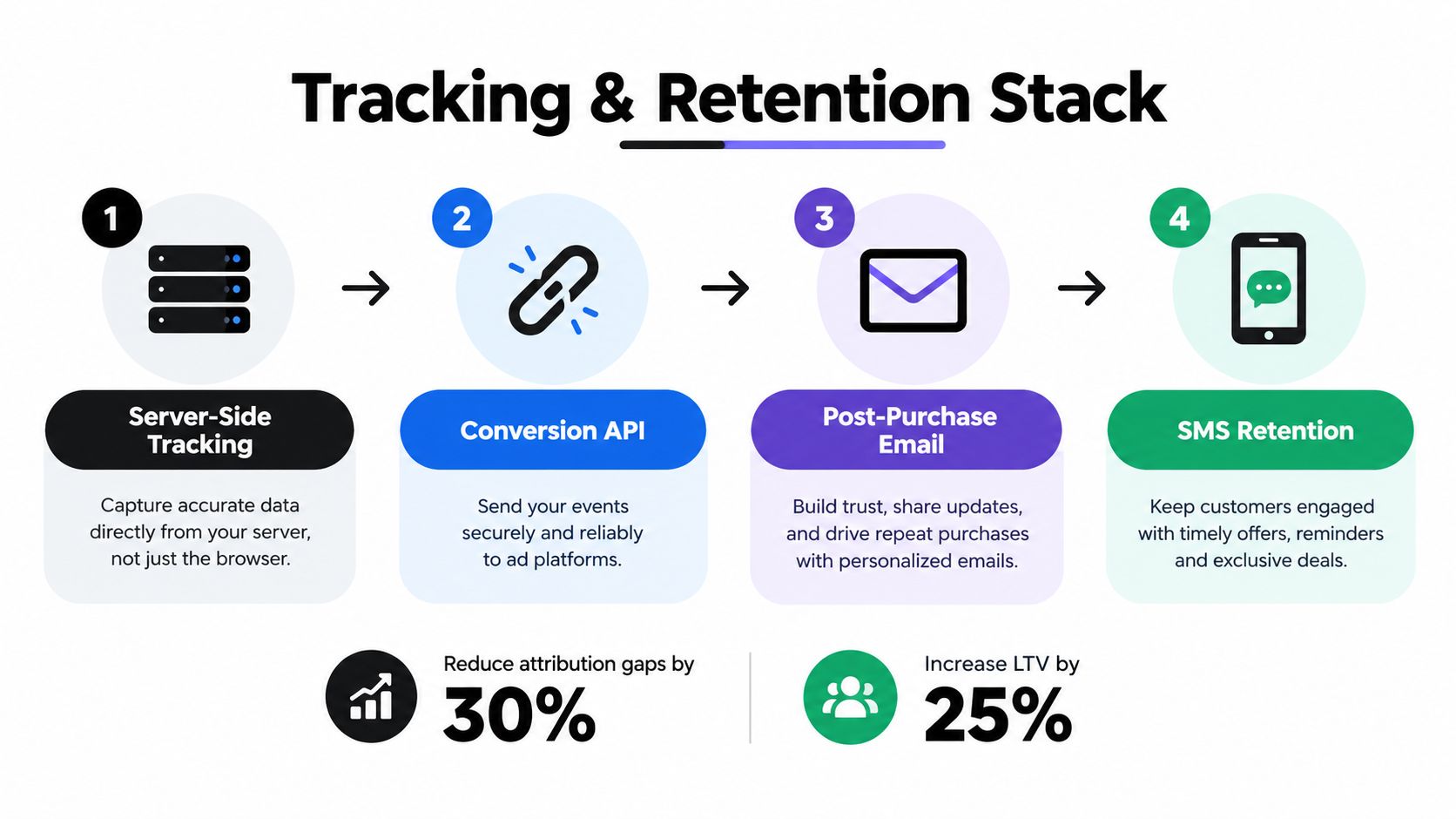
Build the server-side signal carefully
A Meta Conversions API installation can recover signal quality that browser-only tracking misses. It should send event data from a reliable server-side or partner integration, use appropriate customer information handling, deduplicate browser and server events, and exclude cancelled or invalid transactions from purchase reporting.
The implementation needs testing, not just installation. I check event names, event values, currency, event IDs, timing, consent behaviour and duplicate purchase counts. The same discipline applies to GA4. If revenue, tax, shipping or refunds are represented inconsistently across systems, the reporting may look precise while the underlying decisions remain wrong.
The Shopify API can support deeper integrations, custom reporting and operational workflows, but access should be limited to the data and actions the application needs. For a custom app, Shopify CLI provides a practical development workflow. A useful Shopify development crash course should cover app structure, authentication, webhooks, API versioning, testing and deployment rather than treating the API as a collection of copy-and-paste snippets.
Here's the second part of the stack, the part many acquisition-heavy plans underfund.
Retention starts immediately after purchase
A customer who has just paid needs confidence. Send a clear confirmation, dispatch update, delivery guidance and product education. Then use the product's natural usage or replenishment cycle to decide when to ask for a review, recommend a complementary item or present a repeat-purchase offer.
Klaviyo is already present on 21.4% of Australian Shopify stores, while Afterpay appears on 26.3%, according to Australian Shopify store data. The strategic lesson isn't to install both without a plan. It's to treat payment convenience and lifecycle messaging as connected parts of the customer experience.
Useful flows include:
- Welcome: Explain the product category and your reason for existing.
- Post-purchase education: Reduce uncertainty and help customers get the promised result.
- Cross-sell: Recommend products that naturally fit the original order.
- Abandoned checkout: Remind without pretending every visitor is ready to buy.
- Win-back: Reintroduce the brand with a relevant reason to return.
- VIP or loyalty: Recognise customers whose repeat behaviour supports the business.
Email and SMS should reflect consent, frequency preferences and customer context. A retention stack only improves economics when the messages are useful. Sending constant discounts trains customers to wait and can reduce the margin you were trying to protect.
Scaling Profitably Using MER and Contribution Margin
A campaign can generate orders while weakening the business. That happens when the team follows a platform metric and overlooks gross margin, fulfilment costs, refunds, discounts and repeat-purchase behaviour.
I use Marketing Efficiency Ratio, or MER, as a blended management measure. It compares total marketing investment with total revenue across a defined period. Channel reporting still matters, because MER cannot explain which campaign or product drove the result. Its job is different: it shows whether the combined acquisition and retention system is becoming more or less efficient.
Calculate what each order can carry
Begin with contribution margin rather than revenue. Deduct product cost, shipping subsidy, payment fees, packaging, discounts, returns and variable fulfilment costs from the order value. The balance must fund marketing, overhead and profit.
That balance sets the practical ceiling for acquisition. If a first order works only because you assume a future purchase that has not happened, record it as an investment. Do not label it profitable yet. Separate first-order contribution from customer lifetime contribution so the team can see whether retention is improving the underlying model.
A useful management view includes:
| Measure | Question it answers |
|---|---|
| Contribution per first order | Can this product support acquisition now? |
| New customer CAC | What did it cost to acquire a new buyer? |
| Blended MER | Is total marketing producing acceptable revenue? |
| Repeat purchase rate | Are customers coming back? |
| Refund and return cost | Is growth creating operational leakage? |
| Stock availability | Can the business fulfil the demand it is buying? |
Budget size should be treated as a scaling variable, not a target in itself. As spend rises, examine the marginal contribution of each additional dollar. A campaign that is profitable at AUD $2,000 per month can become loss-making at AUD $8,000 if incremental orders come from weaker search queries, lower-intent audiences or discount-dependent buyers.
Review performance by product, query quality and customer type before approving the next increase. Blended MER can remain stable while the underlying mix worsens, particularly when a strong returning-customer base hides weak new-customer economics.
Scale in controlled increments
Increase spend only when contribution margin, stock position, customer service capacity and tracking quality can support it. Monitor search terms, product-level efficiency, marginal return and blended performance. A campaign that works at modest spend may meet weaker demand as it expands, so every additional dollar needs its own commercial review.
Operational strain often appears before the dashboard reflects it. Inventory runs short, dispatch slows, support tickets rise and refunds increase. Scaling media without preparing fulfilment passes the cost to customers, which can reduce future retention and increase the acquisition spend required later.
Management principle: Scale the part of the business that can fulfil and retain the customer, not just the part that can buy another click.
SEO and content can support paid media by capturing demand without paying for every visit. Product comparisons, buying guides, category pages and useful educational content can strengthen discovery and branded demand over time. A local SEO programme, a properly managed Google Business Profile presence and technical website work will not replace ecommerce advertising, but they can reduce dependence on paid acquisition when the content matches real buying questions.
Partnering with an Ecommerce Marketing Agency in Melbourne
Founders often manage their own Google Ads, Meta campaigns, product uploads, customer emails and stock decisions until the account becomes too complicated to run between operational tasks. The warning sign isn't a high spend. It's a marketing system where nobody can explain which products generate contribution, which creative angle attracts new customers, or why mobile shoppers abandon checkout.
A capable digital marketing agency in Melbourne should begin with commercial diagnosis. That means reviewing the catalogue, margins, feed quality, analytics, customer segments, landing pages, creative library and fulfilment constraints before recommending a channel mix. It should also be able to explain what won't be done and why.
What a useful partner should deliver
For Shopify brands, technical capability matters. The agency may need to improve Shopify design, build custom sections, create reusable content blocks, connect the Shopify developer API, develop a private workflow or build custom Shopify apps using Shopify CLI. For WordPress businesses, the equivalent work may involve a WordPress website developer, Gutenberg blocks, theme development, performance improvements or a full WordPress development company.
The agency's media work should include Google Ads, Meta Ads, feed management, remarketing, creative testing, GTM and GA4. If it presents itself as a Facebook Ads agency, ask how it tests hooks, formats, audiences and offers, and how it separates prospecting from retention. If it manages Google Ads for service businesses as well, ask whether ecommerce product economics remain its core competence.
A transparent engagement includes:
- A measurement plan: Events, revenue definitions, attribution limitations and reporting cadence.
- A testing backlog: Specific hypotheses for creative, landing pages, offers and audiences.
- Commercial reporting: MER, CAC, contribution margin and repeat revenue, not only ROAS.
- Technical ownership: Clear responsibility for feeds, tracking, landing pages and implementation.
- Communication: Decisions explained in plain language, with actions tied to evidence.
I'd also check whether the team can support related needs without forcing a generic package. Some brands need a Shopify development partner, others need a WordPress developer, a Google Ads agency or focused Meta Ads management. A Melbourne-based team can also work with brands in Sydney, Brisbane, Newcastle, Perth, Adelaide, Darwin and Hobart when the process, reporting and delivery are organised properly.
Alpha Omega Digital is based in Melbourne and works across conversion-focused WordPress and Shopify development, ecommerce marketing, Google Ads and Meta campaigns. The wider service mix includes ecommerce marketing support, with the appropriate scope depending on the store's technical and commercial requirements. For backlink partnerships, Australian publishers should prioritise useful, relevant editorial resources rather than broad links that don't help readers.
The best agency relationship isn't passive outsourcing. You still own the product, margin, stock and customer promise. The agency should bring the technical execution, testing discipline and reporting needed to turn those assets into a more dependable growth system.
If your ecommerce business has a paid ads budget of at least AUD $3,000 per month, Alpha Omega Digital can manage the tracking, creative testing, Google and Meta campaigns, Shopify conversion work and commercial reporting through a low-risk offer of one month of paid ads management free. Visit Alpha Omega Digital and apply through the contact page to discuss your store, margins and growth priorities.
Alpha Omega Digital
Read more insights from our team on web design, paid ads, and growth strategy.