A homeowner in St Kilda East searches “emergency electrician near me” after a safety switch starts tripping. At the same time, a builder in Brighton is comparing quotes for a multi-unit rewire, while another customer is looking for an EV charger installer in Cranbourne. These searches look similar inside a marketing report, but they represent completely different buying situations.
That distinction is where most electrician marketing campaigns either make money or leak it. A capable electrician marketing agency doesn't treat every click as an interchangeable lead. It separates urgent fault calls from planned projects, connects advertising to answering and dispatch, and measures booked work rather than impressions.
The same operating discipline applies to ecommerce and service businesses. Whether the campaign uses WordPress, Shopify, Google Ads, Meta, Google Tag Manager, or local SEO, the useful question is always the same: what happens after someone clicks?
What an Electrician Marketing Agency Actually Does
At 9pm, a power outage search has very little in common with a switchboard upgrade enquiry submitted during business hours. The first customer wants reassurance and a fast phone response. The second wants evidence, qualifications, project information, and a clear way to request a quote.
A specialist agency builds the marketing system around those differences. It doesn't just publish an ad and send a monthly PDF. It reviews search term reports, removes irrelevant queries, adjusts service-area targeting across Melbourne suburbs, checks whether calls are answered, and matches each campaign to a landing page that reflects the customer's intent.
The work behind the click
For emergency campaigns, the agency may use mobile-first Google Ads with click-to-call assets and tightly controlled location settings. Google Ads guidance for Australian electricians recommends presence-based targeting, which limits ads to people in the selected service area, as well as negative keywords that exclude searches such as apprenticeships, courses, and salary information. The Australian electrician campaign guidance from Odin Digital outlines this intent-based approach.
For planned work, the agency might build dedicated pages for switchboard upgrades, smoke alarm services, commercial maintenance, EV charger installation, or new-home wiring. Each page should answer a different set of questions, show relevant proof, and give the visitor a suitable next step.
The agency also needs to feed lead information back into the business. A form submission without a response is not a successful conversion. A phone call that reaches voicemail during an emergency is not a useful lead. Call tracking, CRM hand-off, SMS follow-up, and dispatch data give the agency visibility beyond the ad platform.
Practical rule: Judge the agency by what it can connect between the search, the conversation, the booking, and the completed job.
A local growth partner, not a report supplier
The best arrangement feels like an extension of the office. The agency knows which suburbs are covered, which services have capacity, which jobs are profitable, and which calls should be prioritised. It can identify that a campaign is attracting low-value DIY searches, that a landing page is confusing visitors, or that a form is producing enquiries nobody has followed up.
That work sits across several service pillars, each with different costs, measures, and failure points. The agency may also support ecommerce operations through WordPress development, Shopify development, custom Gutenberg blocks, Shopify API connections, Google Shopping, Meta conversion tracking, and website conversion work. Those capabilities matter when an electrical business sells products or wants to build an online store alongside its service operation.
The central test is simple. Marketing should help the business answer the right customer, in the right suburb, for the right job, at the right moment.
The Core Services an Electrician Marketing Agency Offers
A full-service package can sound impressive while delivering very little. Ask what changes inside the account, what gets produced, and how the work affects booked jobs.
| Service Pillar | What the Agency Actually Does | Typical Deliverable | Common Misconception |
|---|---|---|---|
| Trade-focused website | Builds service and location pages around real customer intent | WordPress website, landing pages, conversion improvements | A modern design alone creates leads |
| Local SEO | Improves Google Business Profile information, local relevance, citations, and review processes | Profile updates, suburb content, review workflow | Ranking is separate from service quality and response speed |
| Paid search | Separates emergency and planned campaigns, controls search terms, and tracks calls | Google Ads account management and landing-page testing | More clicks automatically means more jobs |
| Paid social | Uses Meta and Instagram to build familiarity, retarget visitors, and test creative | Facebook and Instagram campaigns, creative variations | Facebook Ads should replace high-intent search |
| Automation and measurement | Connects calls, forms, SMS, CRM, and offline job outcomes | GTM container, Google Analytics events, call tracking, reporting | A platform conversion is the same as a booked job |
Website development that supports the campaign
A brochure site with a homepage, services menu, and generic contact form usually leaves too much work to the visitor. A better WordPress design gives each important service a clear page, supports fast mobile interactions, and places phone and enquiry actions where customers can find them.
Custom Gutenberg blocks can help the team manage service comparisons, testimonials, FAQs, licence details, project galleries, and location content without rebuilding the page each time. For an electrician with an ecommerce arm, Shopify design and Shopify development may be more suitable for products such as lighting, fans, accessories, or electrical supplies. A Shopify developer can also use the Shopify API or build custom Shopify apps with Shopify CLI where the standard admin workflow isn't enough.
Measurement and follow-up
Google requires conversion tracking to be enabled through at least one ConversionAction, with the setup beginning by installing a Google tag. Its documentation lists purchases, add-to-carts, quote requests, phone calls, and button clicks as trackable actions in Google Ads conversion setup guidance.
In practice, that means setting up Google Tag Manager containers, defining meaningful events in Google Analytics, and checking whether the data matches actual conversations. Meta campaigns may need the Meta Conversions API installation as well as browser-based tracking. A Facebook Ads agency should explain how it will test creative, preserve useful event data, and measure success beyond reach or follower growth.
No single pillar fixes a campaign where urgent and planned demand are mixed together. The job type needs to shape the page, ad, response process, and reporting from the start.
Splitting Emergency Callouts From Planned Project Work
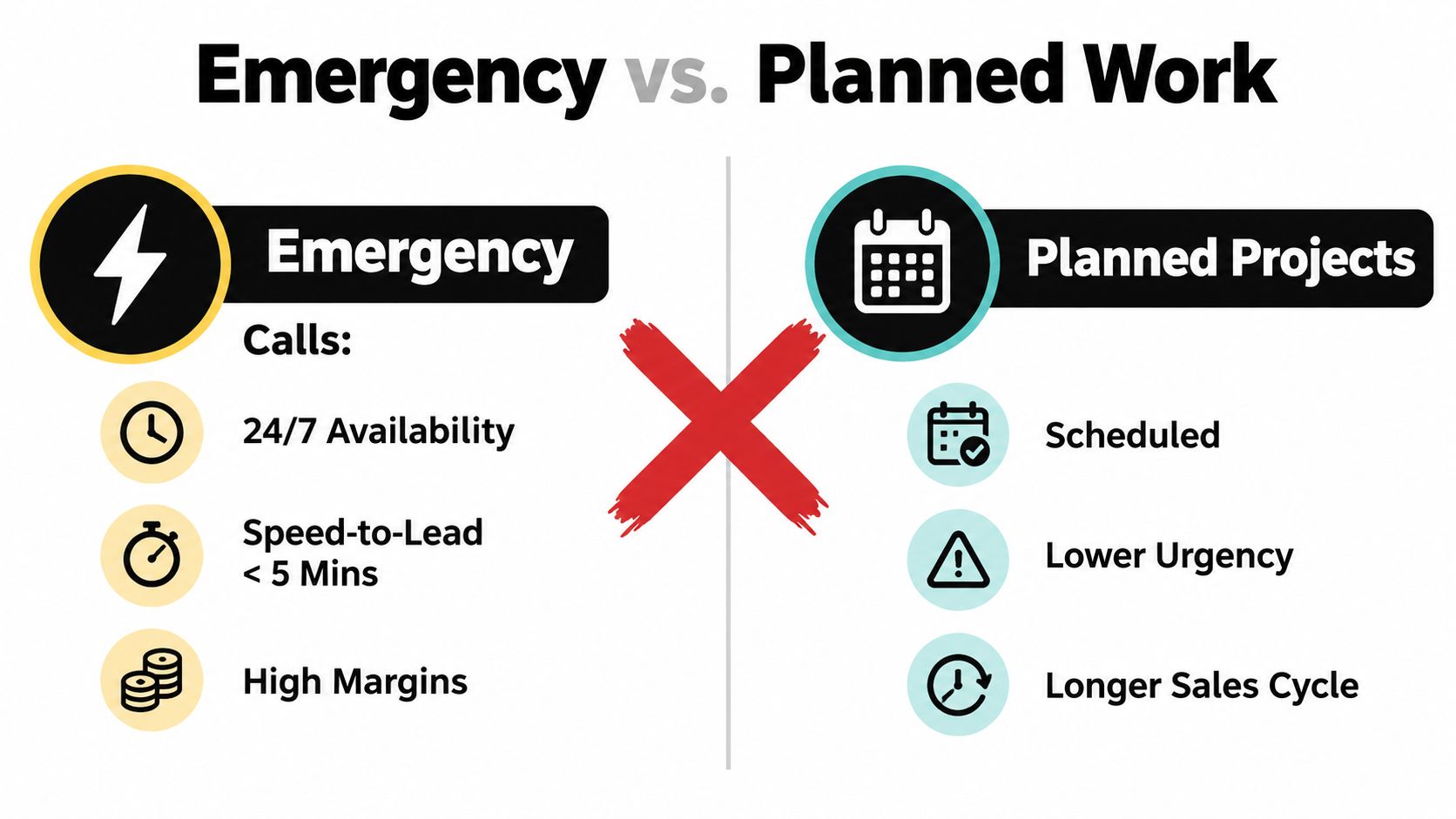
Treating every electrical enquiry as the same lead is one of the fastest ways to lose budget. Someone searching “no power” is not asking the same questions as a property owner comparing switchboard upgrades, and the campaign should not force both people through the same journey.
Build two separate paths
Emergency demand needs a short path:
- Create separate campaigns for searches such as emergency electrician, no power, sparking outlet, and safety switch faults.
- Use mobile-first ads with click-to-call actions.
- Restrict location targeting to the service area using presence-based settings.
- Send visitors to a page that shows availability, service suburbs, licence details, and a prominent phone number.
- Record calls as conversions and distinguish answered calls from missed calls.
- Route after-hours enquiries to a live answering process or trained intake system.
Planned demand needs more context. A switchboard upgrade or EV charger installation page can explain the service, show relevant work, answer common objections, and collect project details. Remarketing can bring back visitors who need time to compare providers, while a quote form can ask about the property, scope, location, and preferred timing.
Use the Melbourne context properly
The St Kilda East homeowner with a tripping safety switch is likely to choose the business that answers first and makes the next step obvious. A Brighton builder pricing a multi-unit rewire may compare capability, insurance, relevant experience, scheduling, and quote quality before making contact.
Those campaigns should use different copy, landing pages, conversion events, and follow-up rules. Emergency calls may need immediate human attention. Planned enquiries can enter a structured sequence that sends confirmation, gathers missing information, and alerts the estimator.
For Australian electricians, Google Local Services Ads can be useful because they appear above standard ads and the map pack, use pay-per-lead pricing rather than pay-per-click, and require licence and insurance verification before activation. The AU trade lead generation guide from 20 Minute Marketing describes the verification and lead-focused structure.
A campaign manager should also keep low-intent searches out of the account. Apprenticeship, training, employment, and salary queries don't belong in a campaign designed to book electrical work.
KPIs and Outcomes You Should Expect
A useful report tells an electrician what to do next. It doesn't hide behind clicks, impressions, reach, or follower counts.
The first layer is lead generation. Track calls, forms, and Local Services Ads leads separately. Then record whether each enquiry was answered, whether it was inside the service area, whether it matched the advertised job type, and whether the customer booked.
Measure the commercial chain
A practical dashboard should include:
- Qualified lead volume: How many enquiries matched the service and location?
- Answered-call rate: How many valuable callers reached a person?
- Booked-job rate: How many qualified leads became appointments?
- Quote conversion: How often did submitted quotes become accepted work?
- Cost per booked job: What did the marketing system cost for actual scheduled work?
- Revenue by source: Which campaign, suburb, and job category produced income?
- Repeat and referral work: Did completed jobs create future opportunities?
The source of truth shouldn't be a platform dashboard alone. Google Ads can record a phone click, but the office needs to record whether the call was answered and whether a job followed. Meta can report a lead, but the team needs to qualify it.
Timeframes need context
Paid search can create demand quickly once tracking, targeting, creative, and landing pages are working together. Local SEO normally requires sustained work on the Google Business Profile, service pages, local relevance, and reviews before it becomes a dependable source of enquiries.
A good agency will set a baseline before making promises. It will explain which measures can improve quickly, which need operational changes, and which depend on capacity, competition, response speed, and close rate.
| KPI / Channel | Realistic Range | Time to Meaningful Result | What It Tells You |
|---|---|---|---|
| Emergency search | Depends on service area, competition, and response process | Can be assessed after the campaign has enough real enquiries | Whether urgent demand is reaching an available electrician |
| Planned project search | Depends on project value, targeting, and quote process | Requires enough quote and sales data | Whether the campaign attracts commercially useful projects |
| Local SEO | No fixed universal range | Builds through consistent optimisation and local proof | Whether organic visibility is becoming a reliable channel |
| Phone campaigns | Varies with answer speed and call quality | Review from the first live calls | Whether media spend is turning into conversations |
| Website forms | Depends on page relevance and friction | Review after qualified submissions accumulate | Whether visitors can request the right service easily |
The right outcome isn't a prettier report. It's a clearer decision about where to invest, which work to stop, and what the office must improve.
How Electrician Marketing Agencies Price Their Work
Agency pricing usually falls into three broad structures. The sensible choice depends on how much work the business needs, how stable its advertising activity is, and whether the agency is responsible for strategy as well as execution.
Monthly retainers
A retainer can cover campaign management, local SEO, landing pages, reporting, and conversion work. It suits an established electrician who wants a consistent operating rhythm and enough support to improve several parts of the funnel.
Check whether advertising spend is separate. It almost always needs to be treated as its own budget, and the proposal should state who pays Google or Meta, who owns the accounts, and what happens if the relationship ends.
Percentage of advertising spend
A percentage model can suit a business scaling a substantial Google Ads or Meta account. The risk is misalignment. If the agency earns more whenever spend rises, the contract should still require clear efficiency reporting, search-term management, conversion tracking, and commercial outcomes.
Ask whether the fee changes when spend is reduced because performance falls. Also confirm whether landing-page work, analytics, call tracking, and offline conversion imports are included or treated as separate services.
Project fees
Project pricing makes sense for a new WordPress website, a Shopify development project, a service landing-page rebuild, or a tracking implementation. It gives the business a defined deliverable, but it doesn't automatically provide ongoing optimisation.
A proposal should describe acceptance criteria, revisions, ownership of the website and creative assets, and the handover process. A low-cost build can become expensive if every important improvement is quoted separately.
For a simple sanity check, compare the total management cost and media budget with the number of booked jobs the business needs to cover them. Don't use raw leads in that calculation. A missed call, an out-of-area enquiry, and an accepted job are different commercial events.
Vetting Checklist and Red Flags When Hiring
Take the sales call as if you're interviewing someone for an operational role. The agency will have access to advertising budgets, customer data, website assets, and sometimes the first conversation with a potential client.
Questions to ask before signing
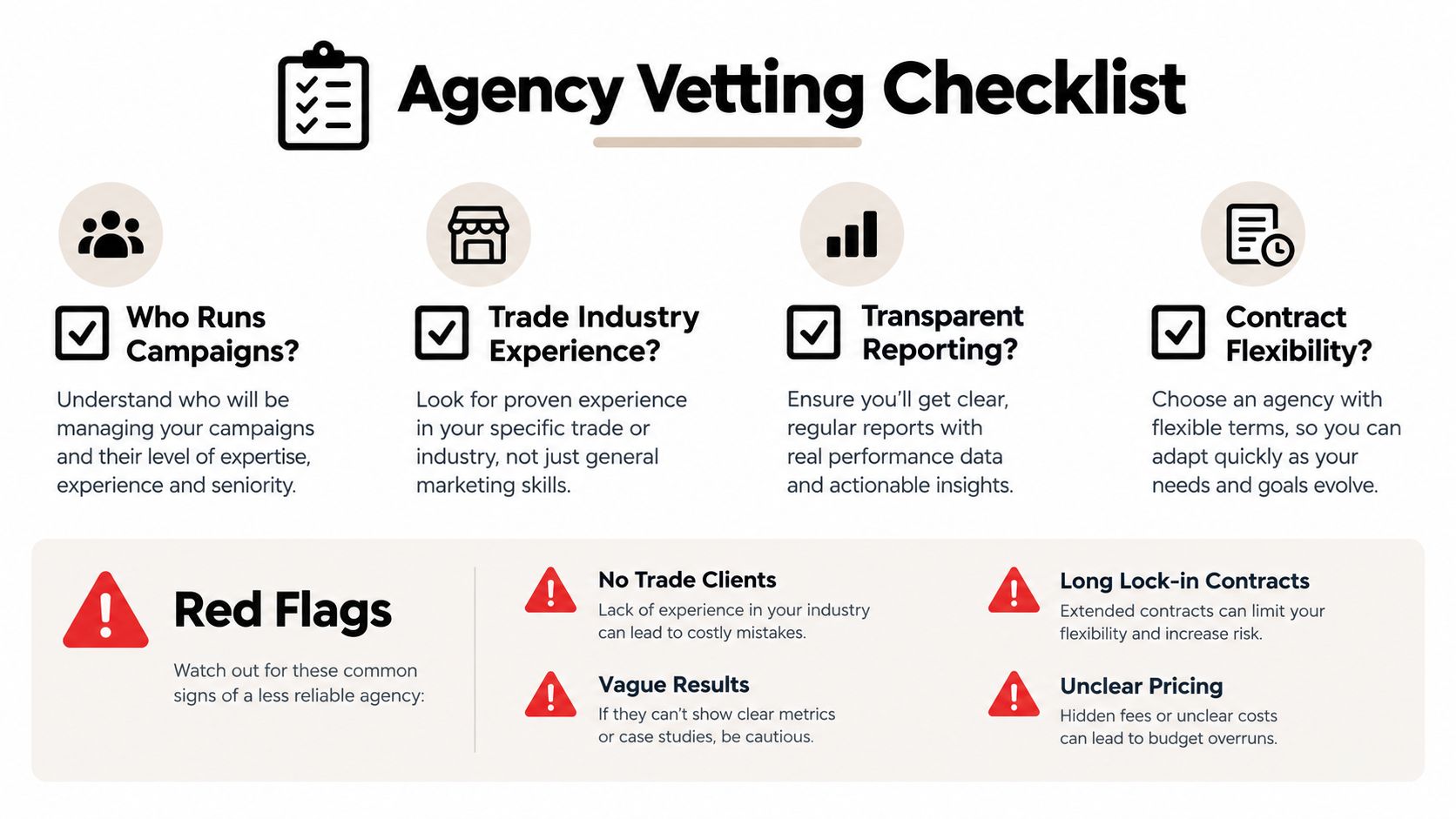
- Who runs the campaigns? Get the name and role of the person making daily changes.
- What trade experience is relevant? Ask for examples involving Australian service areas, electrical work, or similar high-intent trades.
- How are calls measured? Confirm whether the system records source, duration, answer status, service type, and outcome.
- How are offline jobs imported? Find out how completed quotes and booked work reach the reporting system.
- Who owns the accounts? The Google Ads, Meta, Google Business Profile, analytics, tag manager, website, and creative accounts should not be held hostage.
- What happens during onboarding? Expect an audit, tracking plan, campaign structure, landing-page review, and agreed reporting cadence.
- How will job types be separated? The proposal should show a clear distinction between emergency and planned work.
A competent team should be comfortable discussing Google Ads search terms, negative keywords, call handling, landing-page relevance, and CRM data. It should also explain what it won't do.
Red flags that deserve a pause
Be cautious if the agency promises guaranteed rankings, refuses to provide account access, can't name the person managing the work, or presents a baseline-free forecast. A long lock-in without a performance or exit clause can leave an electrician paying for a system that isn't producing useful enquiries.
The agency should also be willing to share lead-source information and call records subject to privacy requirements. If the monthly report shows traffic but not answered calls, qualified leads, bookings, and revenue, it isn't giving the owner enough information to manage the business.
Put these terms in writing:
- Exit terms: State notice periods and what happens to campaigns and assets.
- Data portability: Require access to conversion, call, customer, and reporting data.
- Intellectual property: Clarify ownership of WordPress design, Shopify work, copy, photography, and landing pages.
- Reporting cadence: Agree on weekly operational updates and a useful monthly commercial review.
- Account access: Keep administrator access to advertising, analytics, tag management, and business listings.
An agency doesn't need to promise perfect results. It needs to show its working, own mistakes, and make the next decision easier.
Melbourne and Australia Specific Considerations
Melbourne isn't one uniform service area. Inner-city apartments in Carlton and South Yarra create different access, parking, and electrical requirements from new estates in Cranbourne, Pakenham, and Mickleham. A campaign that reports only on “Melbourne” hides the suburb-level decisions that affect travel time, competition, lead quality, and job value.
Australia's electrical services market is dense. IBISWorld estimates 49,834 businesses operated in the Electrical Services industry in Australia in 2026, with the industry growing at a 1.3% compound annual rate between 2021 and 2026, according to CompanyData's Australian electrical services market information. That makes local acquisition and efficient conversion important for an agency serving electricians.
A separate directory estimates 12,332 electrician businesses across Australia in 2026. It lists New South Wales with 3,191 businesses, Queensland with 2,578, Victoria with 2,478, Western Australia with 1,005, and South Australia with 656. The Australian electrician business distribution data supports a local rather than purely national strategy.
Licensing and trust signals
For a Victorian business, the website should make relevant registration and licensing information easy to find. The agency should confirm the correct details with the client rather than guessing at regulatory language, then place verified trust signals beside the call and quote actions.
Google Business Profile work should cover services, areas, hours, photos, responses to reviews, and accurate contact details. Review requests should follow completed work and comply with platform policies. The profile isn't a decorative listing. It is often one of the first places a customer checks before calling.
Local Services Ads can add another route for eligible trade businesses. Licence and insurance verification create a trust layer, while pay-per-lead billing makes lead quality and credit handling important. The agency should explain eligibility, service-area boundaries, review requirements, disputed leads, and how LSA results will be reported separately from standard Google Ads.
Metro Melbourne may require tighter suburb controls and stronger budget discipline than a regional campaign. Seasonal demand can also shift around heat, renovation activity, property maintenance, and construction schedules. Reports should show suburb, service type, device, call outcome, and booking status rather than presenting one city-wide average.
Action Plan and Next Steps for Electricians
A practical implementation doesn't begin with a new logo or a large content calendar. It begins with evidence.
Start with a one-week audit
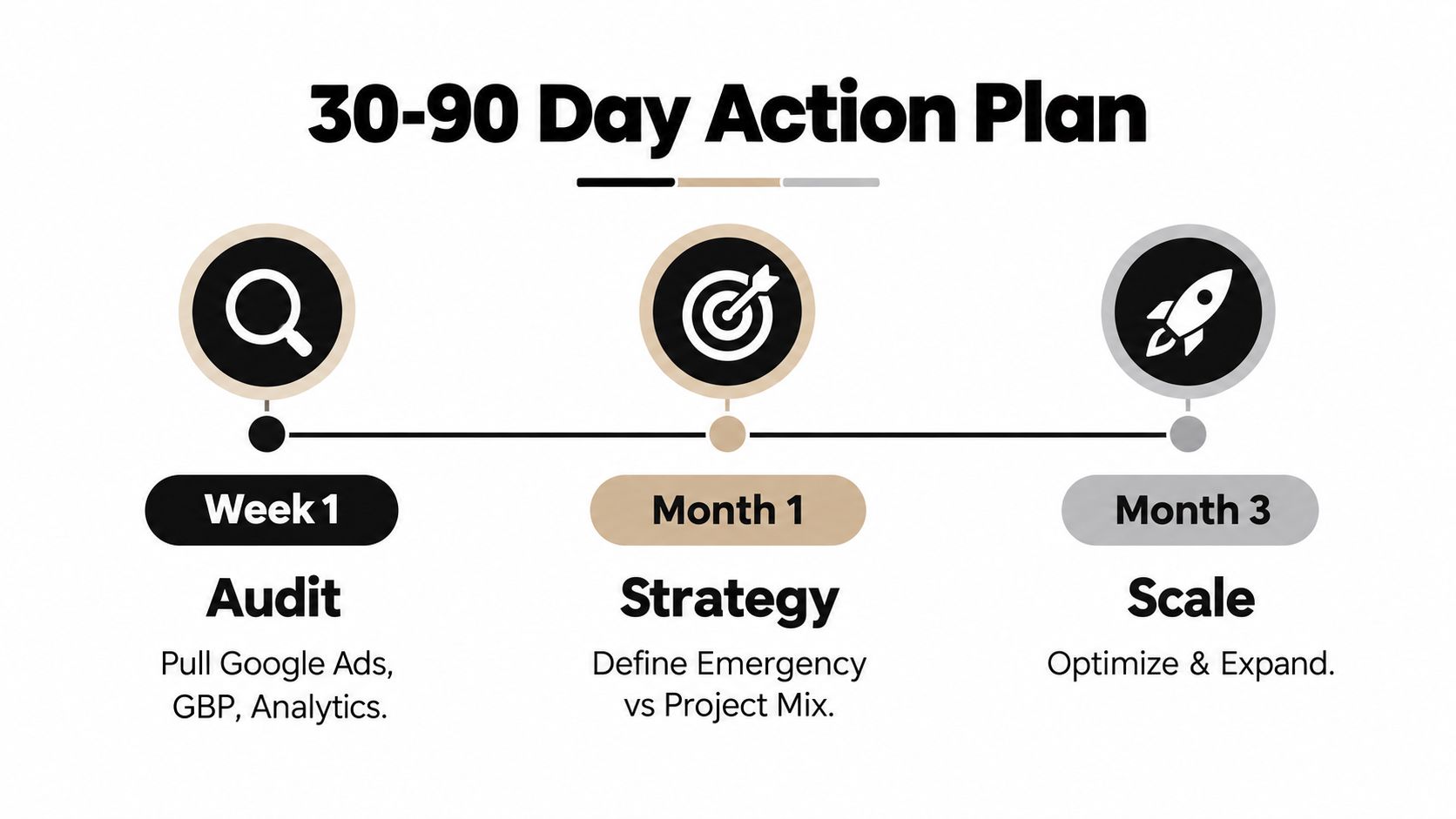
Pull the current Google Ads account, search-term report, Google Business Profile data, website analytics, call records, contact-form submissions, and job-management information. Check whether the business can identify the source of a booked job and whether missed calls are visible.
Review the website on a mobile phone. Can a customer find the phone number immediately? Does the emergency page look different from the EV charger page? Does every service area claim match the actual coverage?
Build a shortlist
Gather several electrician-focused or tradie-focused agencies and ask each one to explain the emergency versus planned structure. Request examples of licence-aware copy, suburb reporting, call tracking, landing-page work, and lead qualification.
A Melbourne operator should also ask whether the agency can support adjacent needs such as WordPress development, Shopify development, Google Shopping, Meta creative testing, Instagram Shop, Facebook Shop, and custom tracking. Those services may matter if the business sells products or wants to diversify its customer acquisition.
Use the first month for infrastructure
Agree on KPI definitions before launch. Create separate campaigns and landing pages, install Google Tag Manager, configure Google Analytics events, connect call tracking, define CRM stages, and decide how completed jobs will be attributed.
Google's own AU materials describe conversion tracking as a two-step process. The business creates a conversion action, then installs the Google tag, as explained in Google's Australian conversion tracking guidance.
For Shopping accounts, campaign structure also needs attention. Google Standard Shopping campaigns use Low, Medium, and High priority levels when the same product is advertised in multiple campaigns for the same country. Google explains that the highest-priority campaign bids first, and a lower-priority campaign can enter when the higher-priority campaign runs out of budget in its Shopping campaign priority documentation. Its automation documentation maps those levels to API values 0, 1, and 2, with Low as the default, in Google Ads Shopping automation documentation.
Review, adjust, and scale
After the first reporting cycle, review qualified calls, missed calls, booked jobs, search terms, suburb performance, and job categories. Don't increase spend just because impressions rose. Scale the campaign that produces suitable work and fix the operational issue when leads are being lost after arrival.
A Twilio-powered custom number can support this process with 24-hour call answering, appointment booking into a business calendar or Calendly, and consistent intake when the owner is on a job. It doesn't get sick or tired, and a properly configured system can reduce lost opportunities for tradies, hairdressers, beauty therapists, dentists, restaurants, and doctors. The important point is not the novelty of automation. It's the connection between the call, the appointment, and the business record.
By the end of the first quarter, the owner should be able to decide whether to increase investment, change the job mix, improve response handling, rebuild a page, or replace the agency. That decision becomes much easier when every enquiry has a source, a category, an outcome, and a commercial value.
If you're a business with a paid ads budget of at least 3k a month, Alpha Omega Digital can build and manage the website, Google Ads, tracking, local SEO, and conversion systems behind electrician lead generation, with support for Melbourne, Sydney, Brisbane, Newcastle, Perth, Adelaide, Darwin, and Hobart. I'd love to offer you a low risk deal, get a month of paid ads management FREE, so visit Alpha Omega Digital and apply through the contact page.
[email protected]
Read more insights from our team on web design, paid ads, and growth strategy.