Alright, let’s cut through the noise. Welcome to a no-nonsense guide on digital ecommerce marketing. As the founder of a Melbourne marketing agency, I’ve spent years in the trenches with ecommerce brands, figuring out what actually turns clicks into loyal customers. This isn’t theory from a textbook; it’s a practical blueprint built from real campaigns for Australian businesses.
What Real Digital Ecommerce Marketing Looks Like
Running a digital marketing agency melbourne businesses trust has shown me one thing: store owners are overwhelmed. They hear about SEO, Google Ads, and Facebook campaigns but struggle to see how it all fits together into a strategy that actually moves the needle on sales.
Digital ecommerce marketing isn’t about throwing spaghetti at the wall to see what sticks. It’s about building a systematic, customer-focused machine that attracts, converts, and keeps people coming back for more.
This guide is here to slice through the jargon. I’ll show you what works on the ground, whether you’re a startup getting your sea legs on Shopify or an established brand running a custom WordPress setup. We’re going to walk through the entire customer journey, from that first Google search right through to them becoming a repeat buyer.
The Core Pillars We’ll Cover
My goal is simple: to give you a clear, actionable plan you can start using straight away. We’ll dive deep into the essential parts of a powerful ecommerce strategy. Here’s a quick look at what’s ahead:
-
Building a Solid Foundation: We’ll kick things off with the non-negotiables: technical SEO and a high-performance website. I’ll explain why a fast, mobile-friendly site, often built by a skilled WordPress developer, is the absolute bedrock of all your marketing.
-
Driving High-Intent Traffic: Next, we’ll get into paid advertising. I’ll pull back the curtain on our agency’s proven methods for creating profitable Google Shopping and PMAX campaigns that deliver a measurable return. No guesswork.
-
Creating Demand on Social Media: Then, we’ll explore how to use platforms like Facebook and Instagram to find new customers. This includes using advanced tools like the Meta Conversions API for tracking and optimisation that’s razor-sharp.
-
Data-Driven Decision Making: Finally, we’ll bring it all together with analytics. You’ll learn how to use tools like Google Tag Manager to truly understand what your customers are doing and make smart decisions that fuel real, sustainable growth.
I’ve always believed that effective marketing boils down to two things: consistency and a deep understanding of the customer. It’s not about finding a magic “hack,” but about building a reliable system that works day in and day out.
This is the exact same strategic thinking our team at Alpha Omega Digital uses to scale ecommerce businesses. We’ve seen it work for clients across Melbourne, Sydney, and beyond—from brands needing a complete Shopify development overhaul to businesses just dipping their toes into Google Ads.
By the end of this guide, you won’t just understand digital ecommerce marketing—you’ll have a blueprint to build a more profitable and resilient online business.
Let’s get started.
Building Your Foundation With Technical SEO And Web Development
Before you even think about spending a dollar on ads, we need to talk about the bedrock of your entire marketing strategy: your website. I’ve seen it time and time again running a digital marketing agency melbourne businesses trust — brilliant ad campaigns fall completely flat because they’re sending eager customers to a slow, confusing, or broken website.
Skipping this step is easily the most common and costly mistake you can make.
A great website isn’t just a digital brochure; it’s your 24/7 salesperson, your brand ambassador, and the engine driving every single conversion. Whether you need a sophisticated WordPress web developer or a streamlined Shopify setup, the core principles don’t change.
Why Technical Excellence Comes First
Think of your website like a physical shop. If the doors are hard to open (slow loading speed), the aisles are a mess (confusing navigation), and the checkout is broken (a clunky payment process), customers will just turn around and leave. It’s that simple.
Technical SEO is the work you do behind the scenes to make sure your online store is fast, secure, and easy for both shoppers and search engines like Google to understand.
This isn’t just a “nice to have.” A strong technical foundation directly impacts how high you rank in search results, how much your ads cost, and most importantly, how many visitors actually become paying customers. The Australian online market is absolutely booming, and you can’t afford to get left behind with a second-rate site.
The proof is in the numbers. Australia’s online shopping market soared to $60.8 billion in 2025, marking an 8.7% increase in that year alone. This sustained growth shows that a high-converting website isn’t an option anymore; for Melbourne businesses, it’s essential for survival. You can dig deeper into this data in the full IBISWorld report on Australian online shopping trends.
Core Pillars Of A High-Performing Ecommerce Site
So, what does this foundation actually look like? It all comes down to a few critical components that any professional wordpress development company or Shopify expert will focus on first. We’re not talking about flashy design here; we’re talking about the underlying structure that holds up your entire business.
Get this right, and every other marketing effort you make has the best possible chance of succeeding. It’s the difference between building your business on solid rock versus shifting sand.
Here’s a breakdown of the essential technical elements that form the bedrock of any successful online store.
Core Technical Pillars For Ecommerce Success
This table outlines the non-negotiable technical elements that are critical for your online store’s growth and search engine visibility.
| Technical Element | Why It Matters For Your Business | Key Action |
|---|---|---|
| Site Speed | Every second of delay costs you sales. A faster site leads to better user experience, higher conversion rates, and improved Google rankings. | Optimise images, use a quality hosting provider, and minimise unnecessary code or plugins. |
| Mobile-First Design | The majority of online shoppers browse and buy on their phones. Your site must provide a seamless experience on mobile devices. | Ensure your design is responsive, with large, easy-to-tap buttons and a simplified navigation menu for smaller screens. |
| Clean Site Architecture | A logical structure makes it easy for customers to find products and for Google to crawl and index your pages effectively. | Create a clear hierarchy with logical category and sub-category pages. Use straightforward URLs and internal linking. |
| Core Web Vitals | These are specific metrics Google uses to measure user experience (loading, interactivity, visual stability). A good score is a direct ranking factor. | Use Google’s PageSpeed Insights tool to identify and fix issues related to LCP, FID, and CLS. |
Nailing these fundamentals ensures your website isn’t just live—it’s ready to perform, convert, and scale.
Mastering Google Ads For Predictable Ecommerce ROI
Google Ads is often the quickest way to get your products in front of people who are literally searching for them, wallet in hand. But it’s also the fastest way to burn through a marketing budget with absolutely nothing to show for it. After managing countless campaigns for Melbourne businesses, I’ve learned what actually works and what doesn’t.
This isn’t about just flicking on some ads and hoping for the best. It’s about building a predictable revenue machine—a system where every dollar you put in generates a measurable and profitable return.
The opportunity in Australia is just massive. In 2023, the local eCommerce market ballooned to $63.6 billion. That number tells you one thing: your customers are out there, and they are actively looking to buy online. For a Melbourne business, a sharp Google Ads strategy is your ticket to tapping into that boom. You can read more about Australia’s latest ecommerce trends here.
Your Starting Point: Google Shopping Ads
For any online store, Google Shopping ads are your bread and butter. You know the ones—the product listings with pictures and prices that pop up right at the top of the search results. Their visual appeal is what makes them so powerful; they grab a shopper’s attention at the exact moment of intent.
The biggest mistake I see is a “set it and forget it” mentality. To make Shopping ads work, you have to be hands-on. That means:
- Optimising Your Product Feed: Your product titles, descriptions, and images need to be top-notch and stuffed with the keywords people are actually typing into Google.
- Strategic Bidding: Don’t treat all your products the same. Bid more aggressively on your bestsellers or items with juicy profit margins.
- Using Negative Keywords: This is non-negotiable. You have to tell Google what not to show your ads for. Adding terms like “free,” “reviews,” or “jobs” stops you from wasting money on clicks from people who were never going to buy.
One of the first things we do for a new client is a full audit of their product feed. It’s amazing how often small tweaks—like rewriting a product title to be more descriptive—can lead to a double-digit increase in click-through rate.
PMAX vs. Standard Shopping: Which Is Right For You?
The big question on every store owner’s mind is whether to stick with a standard Google Shopping campaign or jump on Google’s newer Performance Max (PMAX) campaigns. PMAX is an all-in-one campaign that uses AI to push your ads across all of Google’s channels, from YouTube to Gmail.
Here’s how I break it down for clients:
| Campaign Type | Best For | Key Consideration |
|---|---|---|
| Standard Shopping | Businesses that want total control over bidding, targeting, and which products get seen. Perfect for getting started and learning the ropes. | It’s more hands-on. You need to be in there managing it and understand the campaign structure. |
| Performance Max (PMAX) | Businesses with solid conversion data who want to scale fast and find customers across different channels. | It’s a “black box.” You have less direct control and have to trust Google’s algorithm. It needs good data to work properly. |
For anyone just starting out, I almost always recommend beginning with a standard Shopping campaign. It gives you the control you need to figure out what works before you let Google’s AI take the wheel.
Troubleshooting Common Google Ads Problems
“Why are my Google Shopping ads not spending their budget?” I get asked this almost every week. If this is happening to you, it’s usually one of a few common culprits.
First, your bids might be too low to even enter the auction. Second, pop into your Google Merchant Center and make sure your product feed hasn’t been disapproved for some policy violation. And finally, check that your audience targeting isn’t so ridiculously narrow that you’re choking off your reach.
Getting Google Ads right is a game of constant testing and tweaking. But once you get it dialled in, it becomes one of the most reliable and scalable profit drivers in your entire digital ecommerce marketing strategy.
Winning Customers On Facebook And Instagram
If Google is where you capture people who are already looking for you, Meta’s platforms—Facebook and Instagram—are where you create demand from scratch. As a Facebook ads agency, my team and I live and breathe this stuff, and I can tell you it’s one of the most powerful ways to grow an ecommerce brand when you get it right. This is about way more than just boosting a few posts; it’s about building a predictable machine for finding new customers.
You’re moving beyond people actively searching for your product and starting to introduce your brand to those who don’t even know they need you yet. It’s a totally different mindset from search ads, built around inspiration and discovery.

Setting Up For Success From Day One
Before you spend a single dollar, you need to get your foundations right. This all starts with setting up your Instagram Shop and Facebook Shop. These aren’t just for show; they turn your social profiles into direct sales channels, letting people browse and buy right there in the app.
Once that’s sorted, your most critical job is installing the Meta Conversions API (CAPI). In a world of increasing privacy measures like Apple’s iOS 14 updates, the old Facebook Pixel that lives in a user’s browser just isn’t reliable enough on its own anymore.
CAPI creates a direct, server-to-server link between your website (whether it’s a WordPress site from a wordpress website developer or a Shopify store) and Meta. This makes sure your sales data is tracked properly, even when the browser pixel fails.
Basically, CAPI gives you a much more reliable data connection.
Without this robust tracking, you’re flying blind. You have no real way to know what’s actually driving sales, making it impossible to optimise your campaigns effectively.
Our Agency’s Creative Testing Process
The single biggest lever you can pull in Meta advertising is the creative—the image, video, and text you put in front of people. At our agency, we run a structured Meta ads creative testing process to take the guesswork out of it and find winning ads fast.
Here’s a simplified version of how we do it:
- Develop Creative Hypotheses: We kick things off by brainstorming different angles. Will a product demo video work better? What about a user-generated-content style review? Or maybe a static image that hammers home one unique benefit?
- Isolate Variables: We only test one thing at a time. For example, we might run the same image with three different headlines, or the same headline with three different images.
- Launch Dynamic Creative Ads: We let Meta’s Dynamic Creative feature do the heavy lifting, mixing and matching our assets (images, headlines, descriptions) to find the best combinations for different audiences.
- Analyse Meaningful Metrics: Clicks are nice, but we look deeper. We focus on metrics like Add to Carts, Cost per Purchase, and Return on Ad Spend (ROAS) to find out what’s really making money.
The biggest mistake I see businesses make is giving up on their Facebook ads too early. You can’t judge a campaign’s potential after just a few days. It takes time for Meta’s algorithm to learn and for you to gather enough data to make smart decisions.
Why Consistency Is Your Secret Weapon
Sporadic campaigns almost never build momentum. Real success on platforms like Facebook and Instagram comes from showing up consistently, testing new ideas methodically, and doubling down on what works. It’s this steady, disciplined approach that turns casual scrollers into loyal customers and builds a scalable revenue stream for your business.
Using Analytics And Automation To Fuel Your Growth
You can’t improve what you can’t measure. In my experience, the difference between an ecommerce business that scales and one that stalls often comes down to how well they use data. Without clear analytics, your marketing efforts are just guesswork.
This section is all about building the engine room of your digital marketing machine. We’ll focus on the tech that underpins every smart marketing decision. It’s about moving beyond vanity metrics like ‘likes’ and focusing on data that directly impacts your bottom line. I’ll give you a clear, beginner-friendly guide to setting up the essential tools that paint a vivid picture of how customers actually interact with your store.
Understanding Your Data Foundation
The two most critical tools in your analytics kit are Google Tag Manager (GTM) and Google Analytics (GA4). Think of them as a team:
-
Google Tag Manager (GTM): This is your control panel for all the tracking codes (or “tags”) on your website. Instead of bugging a developer to add code every time you want to track something new, you can manage everything yourself from one central place.
-
Google Analytics (GA4): This is where all that data GTM collects gets sent and organised. It’s your dashboard for understanding user behaviour—where visitors come from, what pages they look at, and where they get stuck and leave.
By setting up a GTM container and linking it to GA4, you create a powerful system for capturing invaluable customer data. Honestly, this is the very first step any professional seo agency melbourne businesses partner with will implement. It’s non-negotiable.
Why Accurate Tracking Is Everything
Properly tracking your data reveals massive opportunities you’d otherwise miss. It tells you which marketing channels are actually driving sales and which ones are just burning through your budget. This is especially crucial in a competitive market.
Victoria is a powerhouse in Australia’s eCommerce scene, projected to hold a 24.3% market share in 2025 within a market valued at a whopping AUD $33.83 billion. With B2C commerce dominating and B2B growing fast, precise analytics are essential for any Melbourne business wanting to capture a piece of that pie. You can explore more about Australia’s booming eCommerce market to really understand the scale of the opportunity here.
Tracking Leads Beyond The Click
For many businesses, particularly service-based ones or those with high-value products, a “sale” doesn’t always happen with a click. Often, it starts with a phone call. And this is where most businesses completely lose track of their ad performance.
A customer sees your Google Ad, picks up the phone, and becomes a lead. Without call tracking, you have no way of knowing which ad or keyword generated that call. Your Google Ads report will show zero conversions, making a profitable campaign look like an absolute failure.
This is where call tracking software like CallRail or GoHighLevel becomes indispensable for PPC campaigns. These tools assign unique, trackable phone numbers to your different ad campaigns. When a customer calls, the software attributes it back to the specific ad they saw, giving you the complete picture of your return on investment. It’s a game-changer.
The Rise Of AI In Lead Capture
Finally, automation is changing how we capture and nurture leads around the clock. An emerging tool that’s becoming a go-to for my service-based clients is the AI receptionist. Think of it as a 24/7 team member that never gets sick, never takes a holiday, and never gets tired.
We can set up a custom number through a service like Twilio that powers an AI voice agent to answer calls anytime. It can handle common questions, qualify leads based on your criteria, and even book appointments directly into your calendar. For tradies, hairdressers, or dentists, this means no more missed calls and thousands saved in lost business. It’s a seriously powerful piece of automation that ensures every single lead is captured, no matter when they decide to reach out.
Putting It All Together Into A Cohesive Growth Plan
All the individual channels we’ve talked about—SEO, Google Ads, Meta campaigns—are powerful on their own. But when you get them working together, that’s when you build real, sustainable momentum. Knowledge without a clear plan for action is just trivia.
In my experience running a marketing agency melbourne businesses rely on, the biggest separator between stores that thrive and those that just tread water is a cohesive growth plan. It’s not about launching random campaigns; it’s about making sure every activity works in concert with the others.
For example, the keyword data from your Google Ads campaigns is pure gold for your SEO strategy. Likewise, the audiences you build through organic social media can be used to create powerful lookalike audiences for your Meta ad campaigns. Each channel should feed and strengthen the others.
This visual shows the simple but powerful flow of a data-driven strategy—from capturing information, to measuring it, and finally, to automating actions.
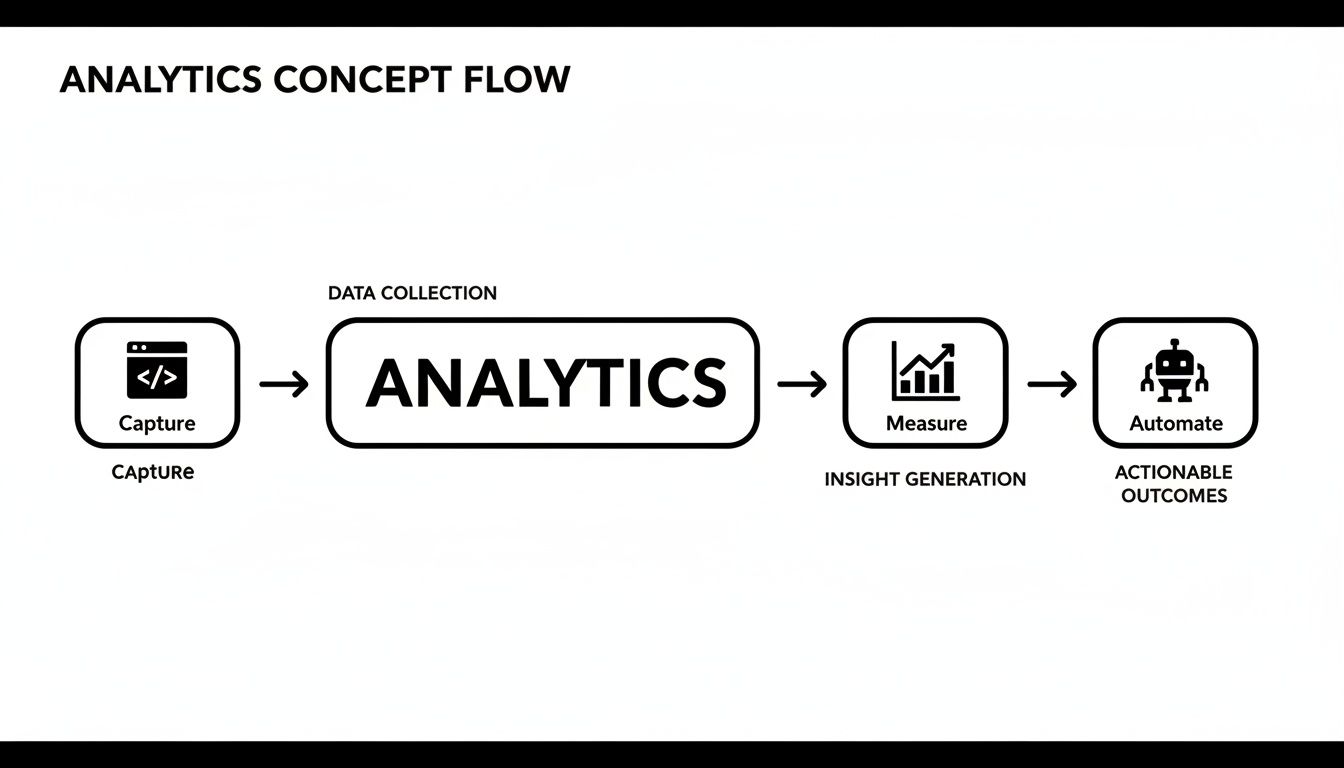
This process makes sure every marketing decision is backed by real customer behaviour, not guesswork.
Creating Your Practical Roadmap
A successful growth plan doesn’t have to be some monstrously complex document. It just needs to be intentional and consistent. Here’s a practical framework I use with my clients:
- Set Clear, Realistic KPIs: Start by defining what success actually looks like. Is it a specific Return on Ad Spend (ROAS)? A percentage increase in organic traffic? Or a target number of leads per month? Be specific.
- Budget Intelligently: Let performance dictate where your money goes. If Google Shopping is delivering a 5x return, it deserves more investment than a Facebook campaign that’s barely breaking even. Let the data guide your spending.
- Embrace Consistency: Your greatest competitive advantage is consistency. Sporadic marketing efforts rarely build momentum. Sticking to a disciplined plan, even when results aren’t immediate, is what builds brand recognition and long-term customer loyalty.
Your marketing channels should operate like a well-oiled machine, not a collection of separate parts. The insights from one should always inform the strategy for another.
This integrated approach is the absolute core of effective digital ecommerce marketing. It’s about creating a sustainable system for growth, not just chasing quick wins. At Alpha Omega Digital, we’ve refined this exact process to help clients across Melbourne, Sydney, Brisbane, and beyond build profitable online businesses.
Have a project in mind? Contact us and let’s build your growth plan together.
Common Questions I Get Asked About Ecommerce Marketing
Over the years, I’ve had these same conversations with founders in boardrooms, over Zoom, and grabbing a coffee here in Melbourne. Here are the questions that come up time and time again when business owners start thinking seriously about ecommerce marketing.
How Much Should I Spend On Google Ads When Starting Out?
There’s no magic number here, but I’ve found a solid starting point for a small ecommerce business is usually between $500 and $1,500 a month. This is enough to get real data on what’s working without you having to mortgage the house.
The trick is to not spread it too thin. Start with just one or two of your most promising campaigns—maybe one for your brand name and a super-targeted Shopping campaign for your bestsellers. Honestly, the goal at this stage isn’t instant profit; it’s to gather intelligence. Once you see which keywords and products are actually making you money, you can start reinvesting the returns and scale up your budget with confidence. At our marketing agency melbourne businesses work with, we always tell clients to start with a test budget they’re comfortable losing and let the data tell us where to go next.
Do I Really Need A Custom Shopify App For My Store?
For most businesses just getting their feet wet, the Shopify App Store has more than enough firepower. But you’ll hit a point where a custom app isn’t just a ‘nice to have’—it becomes essential.
This usually happens when you have a unique way of doing business that an off-the-shelf app just can’t handle. Think complex product customisers, a one-of-a-kind subscription model, or an integration with a custom-built inventory system. A bespoke app, built by an expert Shopify developer, can make your operations smoother, give your customers a better experience, and create a real competitive advantage. Before you jump in though, get crystal clear on the exact problem you’re trying to solve. If no existing app nails it, then investing in a custom build can deliver a massive return in the long run.
What Is The Meta Conversions API And Why Does It Matter?
Think of the Meta Conversions API (or CAPI) as a direct, private line from your website’s server to Facebook. It sends conversion data—like purchases and leads—straight to Meta, completely bypassing the browser.
This is a big deal because the old way of tracking, the browser-based Pixel, has become less reliable thanks to privacy updates like Apple’s iOS14. By creating this server-to-server connection, CAPI gives you a much more stable and accurate picture of how your ads are performing. Setting it up means you stop losing crucial data, which leads to smarter ad optimisation, more accurate reports, and, ultimately, a better return on your ad spend. It’s moved from a recommendation to a non-negotiable for anyone serious about advertising on Facebook and Instagram.
At Alpha Omega Digital, we create and manage these kinds of growth strategies every day. We’re a marketing agency based in Melbourne, Australia but we help clients right across the country, from Sydney and Brisbane to Perth, Adelaide, and beyond. Have a project you want to get moving? Get in touch with us.
Alpha Omega Digital
Read more insights from our team on web design, paid ads, and growth strategy.