You’re probably not short on leads because “Google Ads doesn’t work.” You’re short on leads because the account was built by someone who treated your market like an exercise, not a business. I’ve sat with Melbourne owners who typed “google ads agency near me” at night after watching another week of clicks turn into nothing useful, and the frustration is always the same, the location of the agency feels important until you compare it with the one thing that matters, whether the account can produce qualified enquiries at a sensible cost.
A nearby office can make kickoff meetings easier. It can also make it easier to sell you a polished deck, a long contract, and weak tracking. In Australia, search advertising is the largest single slice of online ad spend, with A$8.0 billion in search ad spend in 2025 inside an A$18.4 billion online ad market, which works out to roughly 43% of Australian online advertising spend, and search ad spend grew 11.5% year on year in 2025 according to the reporting linked in the benchmark source Google Ads statistics Australia. That scale is exactly why the decision deserves more than a distance check.
Why Typing Google Ads Agency Near Me Is Only the First Filter
The phrase google ads agency near me is usually a stress response, not a strategy. You’ve got a website, maybe a few campaigns running, and a nagging sense that the money going into Google isn’t coming back as booked jobs, checkout sales, or qualified form fills. At that point, proximity feels reassuring, because at least you can meet the person face to face and ask them why the numbers look off.
Proximity is useful, but it isn’t performance
A local office doesn’t improve conversion tracking, keyword hygiene, or landing page relevance. A coffee in the same suburb doesn’t make someone better at rebuilding a broken account structure. The market has a lot of agencies that are physically close and strategically far away.
That’s why I treat “near me” as a logistics filter, not a quality signal. It helps if you want the option of an in-person kickoff, or if your business needs rapid alignment between owner, marketer, and developer. It doesn’t tell you whether the agency can manage Google Ads, GTM and Google Analytics, setting up Meta Conversion API, or closed-loop revenue tracking in a way that changes outcomes.
Practical rule: if the agency talks more about being local than about measurement, audience intent, and query quality, it’s usually hiding a weak operating process.
What local can help with, and what it can’t
A Melbourne-based team can understand suburb-level service areas, local seasonality, and how to structure campaigns for city, radius, or suburb targeting. That matters for tradies, clinics, and retailers with real geography behind the demand. It also helps when the agency knows the difference between a Google Ads agency Melbourne search and a genuine account that needs local landing pages, call tracking, and service-area segmentation.
But the account still wins or loses on the same mechanics everywhere. The stronger partner is the one who can explain how they’ll keep the campaign inside local norms, why they’ll rebuild measurement before scaling, and how they’ll prove the work is producing actual business, not just clicks. That’s the filter this guide uses, because once you strip away the location signal, you’re left with the question, who can move your cost per lead and return on ad spend.
Search Tactics That Build a Real Shortlist
A decent shortlist never comes from one search. It comes from layering searches until the fluff falls away. Start with google ads agency melbourne, then tighten the result set with proof-focused searches such as intitle:google ads agency Melbourne and inurl:case-studies Google Ads Melbourne. Those queries surface agencies that bother to publish evidence instead of just repeating the same homepage promises.
Use search, directories, and profile checks together
I’d build the shortlist in four passes.
- Google search operators. Search for agencies that publish case studies, team pages, and service pages with real detail. You’re looking for named verticals, not vague “helped businesses grow” language.
- Google Business Profile reviews. Read reviews for mentions of spend, communication, and tracking, not just “great service.” A review that says the agency improved structure or fixed attribution is far more useful than a five-star emoji parade.
- Clutch and local directories. These help when you want another layer of verification on team size, service mix, and client categories.
- LinkedIn. Use filters for Google Ads and PPC in Victoria, then check whether the people posting are actual operators. Founder history matters because the person selling the work should usually be able to explain the work.
A noisy search result list often looks impressive at first glance. It’s full of agencies with broad service pages, generic testimonials, and stock images. Tighten it by searching for terms that imply proof, then verify whether the agency talks about WordPress development, Shopify development, or Facebook ads agency services in a way that connects back to paid performance rather than dangling unrelated capabilities.
What to record while you compare
Don’t try to remember it all. Put each candidate in a simple spreadsheet and capture the same fields every time.
- Proof of work. Case studies, screenshots, or account explanations.
- Tracking maturity. Mentions of GTM and Google Analytics, enhanced conversions, or offline imports.
- Offer fit. E-commerce, service-based businesses, or both.
- Transparency. Direct access, account ownership, and reporting cadence.
If a firm won’t show its thinking in public, it usually won’t show it in your account either.
Vetting Checklist Using Australian Benchmark Data
The weak pitches start to crack. In Australian SME accounts, the benchmark material in the brief shows CTR around 4.0%, average CPC about A$2.10, conversion rate 4.6%, and average cost per conversion A$46, while top-quartile results move to 6.5%+ CTR, A$1.05 to A$1.55 CPC, 8.0%+ conversion rate, and A$18 to A$28 cost per conversion Australian Google Ads benchmark PDF. That spread is the point. A good agency doesn’t need magic, it needs tighter execution than the average account.
| Australian Google Ads Benchmarks: Average vs Top-Quartile | Metric | AU Average | Top-Quartile | Red Flag |
|---|---|---|---|---|
| Click-through rate | CTR | 4.0% | 6.5%+ | The agency celebrates clicks without improving relevance |
| Cost per click | CPC | A$2.10 | A$1.05 to A$1.55 | CPC rises while search terms stay broad |
| Conversion rate | CVR | 4.6% | 8.0%+ | Landing pages are ignored after launch |
| Cost per conversion | CPA | A$46 | A$18 to A$28 | Reporting stops at leads, not quality |
| Quality score | Quality Score | 5.7/10 | Higher than average | Ad groups are thin, messy, or misaligned |
The numbers only help if the agency uses them correctly
Another Australian benchmark set shows cross-industry search CTR around 3.3% and average conversion rate around 4.1%, while AU/NZ datasets place home services and trades CPCs at A$6.80 to A$14.20 and B2B services CPCs at A$4.20 to A$11.60 Australia benchmarks. That’s why I don’t compare every account against one blunt average. A home services campaign can tolerate a higher CPC because its conversion rate can be stronger, while e-commerce usually needs a different margin logic.
The agency should be able to explain your sector’s actual band, not hide behind a generic platform average. If they can’t tell you why a trade business might accept more expensive clicks than a narrow-margin store, they’re probably selling templates, not thinking.
What to demand before you trust the pitch
The first thing I ask for is tracking depth, because weak measurement makes every other metric suspect. The second is account structure, because cluttered campaigns inflate spend without improving signal. The third is reporting that connects to business outcomes, not just platform numbers.
Strong signal: the agency talks about conversion actions, match types, search term harvesting, and quality of lead, then shows how those feed into decision-making.
Interview Questions That Expose the Right Agency
Treat the discovery call like a working interview. Don’t let the person on the other side turn it into a brand story about awards, founder passion, or how many channels they “can” run. A useful Google Ads partner can explain what happens in the first month, who touches the account each week, and how they decide when a campaign is healthy.
Ask about measurement before media
Start with the question most owners skip, how do you verify the conversion data before you scale spend? A serious answer should mention GA4, Google Tag Manager, enhanced conversions, and offline imports where lead quality matters. For e-commerce, the conversation should also touch on feed accuracy, Shopify API integrations if relevant, and how the agency handles campaign names and event quality.
Then ask what they do in the first two weeks. The strongest operators usually describe a tracking audit, conversion setup, and an attribution review before they touch bids. That’s not because they love delay, it’s because fake confidence from bad data is expensive.
Ask for the operating rhythm
You want to know who owns bids, search term pruning, negative keyword work, RSA testing, and audience exclusions. Ask how often they review creative and whether they change ad copy based on search intent or just rotate it because the dashboard looks stale. If they also manage Facebook ads or Meta ads creative testing process, ask how the paid search and paid social teams share learning, because e-commerce accounts often need both channels talking to each other.
A good answer sounds specific. A bad answer sounds like “we optimise continuously.” That’s not a process, it’s wallpaper.
Ask the questions that expose fluff
- What happens if tracking is broken? If they say they’ll “watch performance” without fixing the source, walk away.
- How do you define a qualified lead? If they can’t separate raw enquiries from sales-ready enquiries, their KPI thinking is too shallow.
- Can I see a sample dashboard? If reporting is vague, the management will be vague too.
Vague answers about attribution, guarantees of a specific ROAS, and refusal to name the senior person responsible are all warning signs. The opposite is a clear roadmap, access to the account, and a willingness to show you how one live optimisation choice gets made.
Pricing Contracts and KPIs Worth Negotiating
Management fee is the least interesting line item on the invoice. The cost lives in contract length, spend commitment, and how the agency defines success. I’ve seen businesses obsess over a lower retainer, then sign a long agreement that traps them in a broken structure for a year.
Pricing should match the job, not the sales script
Australian agency pricing often sits in a few practical shapes. Some charge a percentage of spend, some use a flat retainer, and some mix the two. The decision shouldn’t come down to whichever model sounds neatest in the pitch deck, it should come down to how much work the account needs and how much access you’ll have to the people doing it.
| Common Google Ads Management Pricing Models in Australia | Pricing Model | Typical Range | Best For | Watch Out For |
|---|---|---|---|---|
| Percentage of ad spend | Percentage model | Higher spend accounts | Accounts that need scalable management | Fees can grow without a real performance gain |
| Flat retainer | Fixed monthly fee | Varies by scope | SMBs that want predictable billing | Scope creep if tracking and landing pages are excluded |
| Hybrid model | Base fee plus percentage | Mixed structures | E-commerce and multi-channel accounts | Confusion if deliverables aren’t written down |
If you’re evaluating a marketing agency Melbourne or digital marketing agency Melbourne, ask whether the fee includes landing page advice, tracking support, and reporting, or just ad management. Those hidden gaps matter more than a small difference in monthly retainer.
Tie the deal to business outcomes
The KPI you negotiate should sound like your real business. For a lead-gen business, that might be cost per qualified lead or booked consultation rate. For e-commerce, it might be revenue per click or cost per purchase, not impressions, reach, or CTR alone.
A fair agreement also needs clear account ownership, raw data export rights, and a way out if the work stalls. I’m comfortable with a short initial commitment when the scope is clear, but long lock-ins usually benefit the agency more than the client. A clean contract should let you leave without losing the account architecture you paid to build.
The practical budget question is simple. Use your spend, your target cost per lead, and your expected conversion rate to test whether the management fee has any chance of producing a return before you sign.
Onboarding Timelines and Local Case Studies
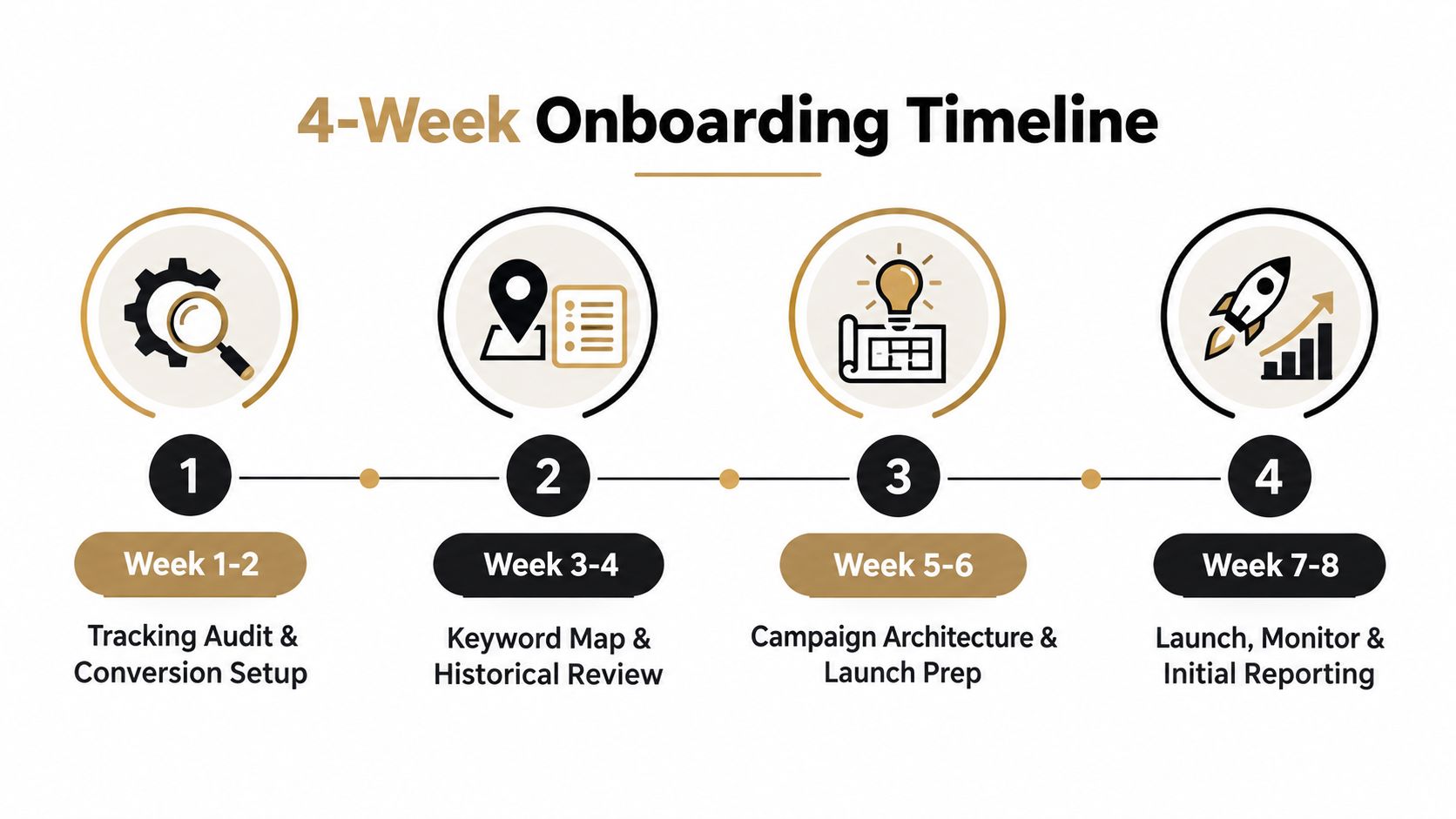
A serious agency should show you the first 90 days before you agree to anything. Not a vague “we’ll get started quickly,” but a written sequence that tells you what gets fixed first and what can wait until the account has enough data.
The first month should be about making the account trustworthy
Weeks 1 and 2 are for tracking audit, conversion setup, and historical review. Weeks 3 and 4 should turn into keyword mapping, audience segmentation, RSA copy, and bid strategy. If the team jumps straight into scaling before that foundation is clean, you’re paying to amplify noise.
That early discipline matters even more for e-commerce, where Google shopping ads can look busy while the account still isn’t spending efficiently. It also matters for trades and service businesses, because Google Ads for service based businesses can generate plenty of form fills that never become usable revenue if the lead quality loop isn’t closed.
What good local outcomes tend to look like
I don’t trust agencies that promise miracles, but I do trust a simple shape of progress. A believable account often gets cleaner before it gets bigger. Search terms tighten, the call tracking gets fixed, and the team learns what converts instead of what merely attracts traffic.
A good Melbourne partner can also connect the paid account with website work. That might mean WordPress development, WordPress design, Shopify development, Shopify design, or even building custom blocks in Gutenberg when the landing page is the bottleneck. For some stores, better site structure and Shopify development crash course style cleanup matter more than more ad budget.
There’s also room for operational tools when the lead flow is messy. If the business needs a better intake process, a custom Twilio number can support 24 hour call answering, avoid missed calls when no one’s available, and book appointments into a calendar or Calendly flow. That kind of setup is useful for tradies, hairdressers, beauty therapists, dentists, restaurants, and doctors when the phone is still the highest-value conversion point.
For Australian businesses that need a local presence to back the campaign, a complete Google Business Profile remains central, because the listing has to be claimed and verified, and the name, address, phone number, service area, hours, and categories need to match the website and other listings Google Business Profile local SEO playbook. That consistency supports map-pack style “near me” visibility and call actions.
Your Next Step With a Melbourne Paid Ads Partner
If you’re running at least A$3,000 a month in ad spend, you’re already past the point where casual management makes sense. At that stage, a free month of paid ads management can be a legitimate low-risk way to test an agency’s operating standard, provided it includes a real audit, conversion tracking rebuild, keyword restructure, and a written 90-day roadmap with measurable targets.
What qualified onboarding should actually cover
The first two weeks inside a neglected account usually uncover the same mess. Tracking has gaps, search terms are too broad, and the original structure was built to make the dashboard look active rather than profitable. Once that’s fixed, the work starts, because the campaign finally has a chance to tell the truth.
If the business is serious, the offer should be serious too. That means an active website, a decision-maker who can approve changes, and a budget that’s large enough to collect useful data without pretending the platform will do the thinking for you. After the free month, the work rolls into a normal management arrangement, and the build stays with you.
You’ll also see clear overlaps between paid search and other parts of the stack. A stronger seo agency melbourne relationship helps landing pages, Facebook ads agency work can feed creative lessons into paid search, and Instagram shop and Facebook shop setup can help retail accounts that need a cleaner commerce path. For more technical builds, teams may also need Shopify development partners, Shopify developer API work, or help with setting up Google Tag Manager containers before the ad budget can perform properly.
If you want a Melbourne team that can audit the account, clean up conversion tracking, and manage Google Ads with a focus on lead quality and real revenue, Alpha Omega Digital works across WordPress, Shopify, and paid media for Australian businesses. If your account is already live and you’ve got at least a $3k monthly budget, reach out through the contact page and start with a proper working review instead of another sales call.
Alpha Omega Digital
Read more insights from our team on web design, paid ads, and growth strategy.