You're staring at a charity budget that's already stretched, a website that's probably doing too many jobs badly, and a board that wants more enquiries without another big media bill. That's exactly where Google Ad Grants for nonprofits can help, if you treat it like a governed acquisition channel instead of “free advertising”. For Australian charities, the difference between useful and useless usually comes down to discipline, not the headline grant figure.
The people who get real value from the programme are the ones who build proper Search campaigns, track outcomes cleanly, and accept the rules upfront. The people who struggle are usually trying to force it to behave like a normal paid account, or they never put the website and measurement foundations in place. If you're running a Melbourne charity, a local service organisation, or a national nonprofit with a limited team, this guide is the practical version, not the brochure version.
Why Google Ad Grants Matter for Australian Nonprofits Right Now
A Melbourne charity can reach people searching for a cause, service, volunteer role, donation option, or event without taking cash from programme delivery. That makes Google Ad Grants relevant to Australian organisations with clear demand and a website ready to receive it. The programme has operated since 2003, providing eligible nonprofits with in-kind Search advertising. It puts the organisation in front of people who already show intent to act.
The Australian nonprofit sector had strong participation in 2019. More than 1,600 not-for-profits were supported by the programme, while 8,109 organisations were enrolled in Google for Nonprofits. Australia was the programme's fourth-largest national market at the time, according to the Access Partnership report.
Search is useful because it captures demand at a decisive point. A potential donor may be ready to give, a volunteer may be looking for a role, or someone may need immediate access to a service. The same principle applies to event registrations and enquiry forms.
Practical rule: assess the grant against three conditions: clear search intent, a functioning website, and a genuine conversion path. If one is missing, the account will generate administration before it generates meaningful results.
The programme also requires active management. Its rules govern what an organisation can advertise, how campaigns operate, and how access is retained. A charity seeking passive funding should look elsewhere. A charity prepared to manage a controlled acquisition channel should assess the grant against its goals, capacity, and ability to convert search demand into action.
What Google Ad Grants Actually Is and Is Not
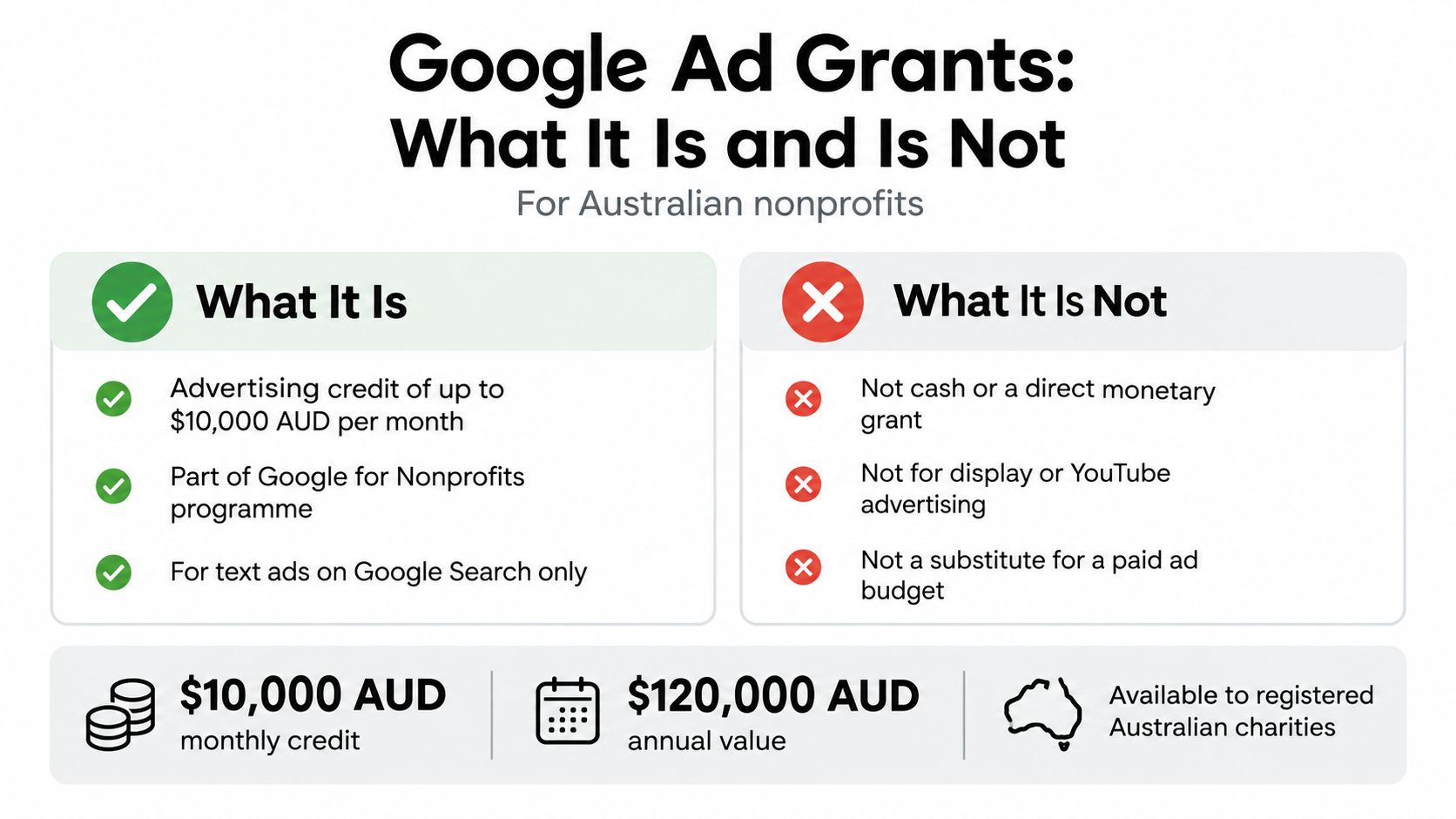
A charity can receive advertising credit through Google Ad Grants, while Google for Nonprofits refers to the broader suite of products and services. They are separate offerings. For eligible organisations, the Australian programme materials describe up to US$10,000 per month for Google Search advertising, with a daily budget of US$329. Confirm the current terms on the Google Australia grant details page before applying.
The useful way to explain it to a board
The grant is ad credit restricted to text-only Search ads. It cannot be transferred into payroll, fundraising, programme delivery, or another budget line. The programme also applies a US$2 maximum cost per click, so the account operates as a governed acquisition channel rather than an open-ended media budget. The Grove Foundry guide provides further context on the Australian CPC restriction.
That distinction matters for approval. The charity still needs suitable search demand, relevant landing pages, conversion tracking, and ongoing account management. Without those elements, the available credit may produce limited practical value.
What you can and cannot assume
The grant can support awareness, donor acquisition, volunteer recruitment, event promotion, and access to services. It does not guarantee that an organisation will use the full allowance. The CPC cap, search volume, keyword competition, landing-page quality, and compliance requirements determine how much of the monthly allocation is realistically deployable.
Treat the advertised amount as a ceiling, not a forecast. In the programme's historical 2019 context, Google economic-impact material described the benefit as US$10,000 in advertising spend per year, a figure that should not replace checking current programme terms. The Access Partnership report records that historical context.
For internal approval, use this wording: Google Ad Grants provides restricted Search advertising credit. Its value depends on the organisation's ability to turn relevant searches into measurable action.
Eligibility, Governance and Website Readiness for Australian Charities
Eligibility starts with the organisation, but approval usually gets decided by the website. Google's Australian nonprofit ecosystem sits alongside the ACNC charity register, which is the public context for verifying charitable status in Australia (ACNC charity search). That doesn't mean ACNC registration alone gets you in. It means your entity details, charitable identity, and operational website need to line up cleanly before you push the apply button.
The site has to look and behave like a real nonprofit asset
The site should clearly identify the Australian entity, explain the mission in plain language, and provide working contact details. It should also use HTTPS, have meaningful content, and offer a secure path to donate, volunteer, book, or enquire. Google's nonprofit support guidance also makes ownership a real issue, because the nonprofit needs to own the domain users land on and control the website's content and technical setup (Google nonprofit support).
If you want a sensible background read on setting up the organisational side before you touch ads, this guide for not-for-profit organisations is worth a look. It's useful because the ad account will only be as clean as the legal and operational structure behind it.
Governance is not optional
I'd put at least two administrators on the account, document who owns the Google account and domain, enable strong authentication, and keep a change log for conversion tags and landing-page URLs. That sounds boring until something breaks and only one person knows where the login lives.
Hard rule: if the organisation can't prove who owns the website, who controls the ads account, and where the conversions are tracked, it's not ready yet.
Readiness checklist
- Legal identity: the charity can substantiate its Australian status and entity details.
- Website control: the organisation owns the domain and can edit the pages people land on.
- Technical hygiene: the site is secure, functional, and free from obvious broken paths.
- Action path: visitors can donate, register, enquire, or volunteer without confusion.
- Admin coverage: two people can access and maintain the account.
- Measurement: conversion tracking exists before launch, not after.
If any of those are shaky, fix them first. The grant is easier to keep than to win back after a bad setup.
Applying for Google Ad Grants Step by Step
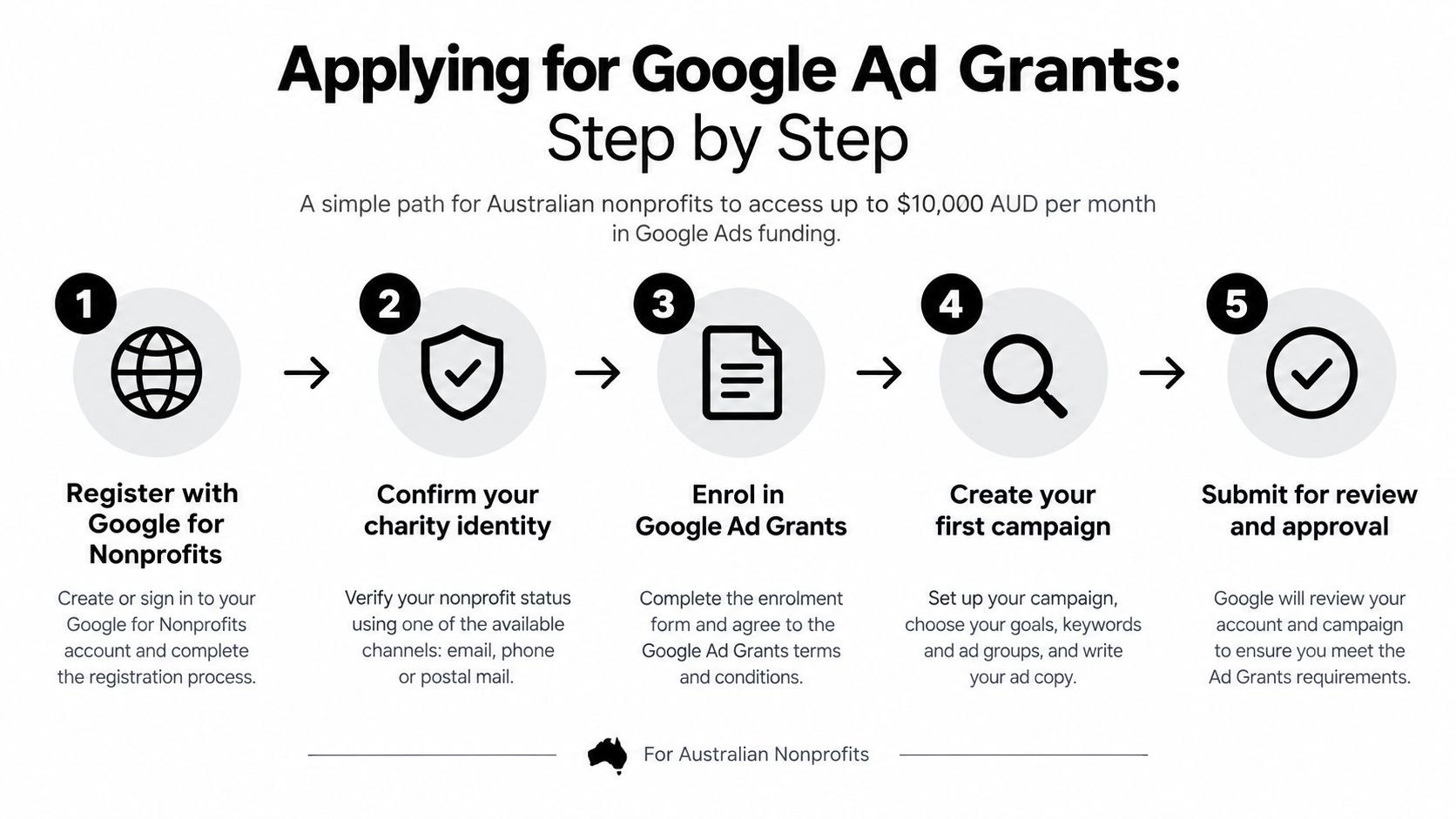
The cleanest application path is simple, but it still trips up teams that rush it. First, get into Google for Nonprofits. Then, confirm identity through the available verification path, activate the Google Ad Grants product, and submit the live website URL with the application details. The process isn't complicated, but it does expect the organisation to look operationally real, not aspirational.
What to prepare before you start
Have the legal entity name, website URL, charity information, and contact details ready. If the website is hosted by a partner, a university, or a fiscal host, sort that structure out first, because Google requires administrative control over the destination domain and a high-quality site. A partner-hosted landing page can complicate ownership, verification, and conversion tracking at the same time, which is exactly how applications stall.
What usually slows things down
The delays I see are rarely mysterious. They're usually caused by an unclear website, weak ownership evidence, or an organisation that can't explain how the ads will be used. If the site has thin content, hidden contact details, or no first-party conversion path, expect friction.
Timeline and internal coordination
A realistic rollout often takes a couple of weeks once the foundations are in place, and longer when site ownership or legal status needs cleaning up. Finance, fundraising, and whoever manages the website all need to be aligned before the application goes in, because the grant is not a one-person job. The account needs the organisation, the website, and the measurement plan to match.
When I'm reviewing an application, I want to see one thing above all else, a clear conversion path that an ordinary supporter could understand without help. If the site can't do that, the application should wait.
The Spendability Problem of the US$10,000 Monthly Grant
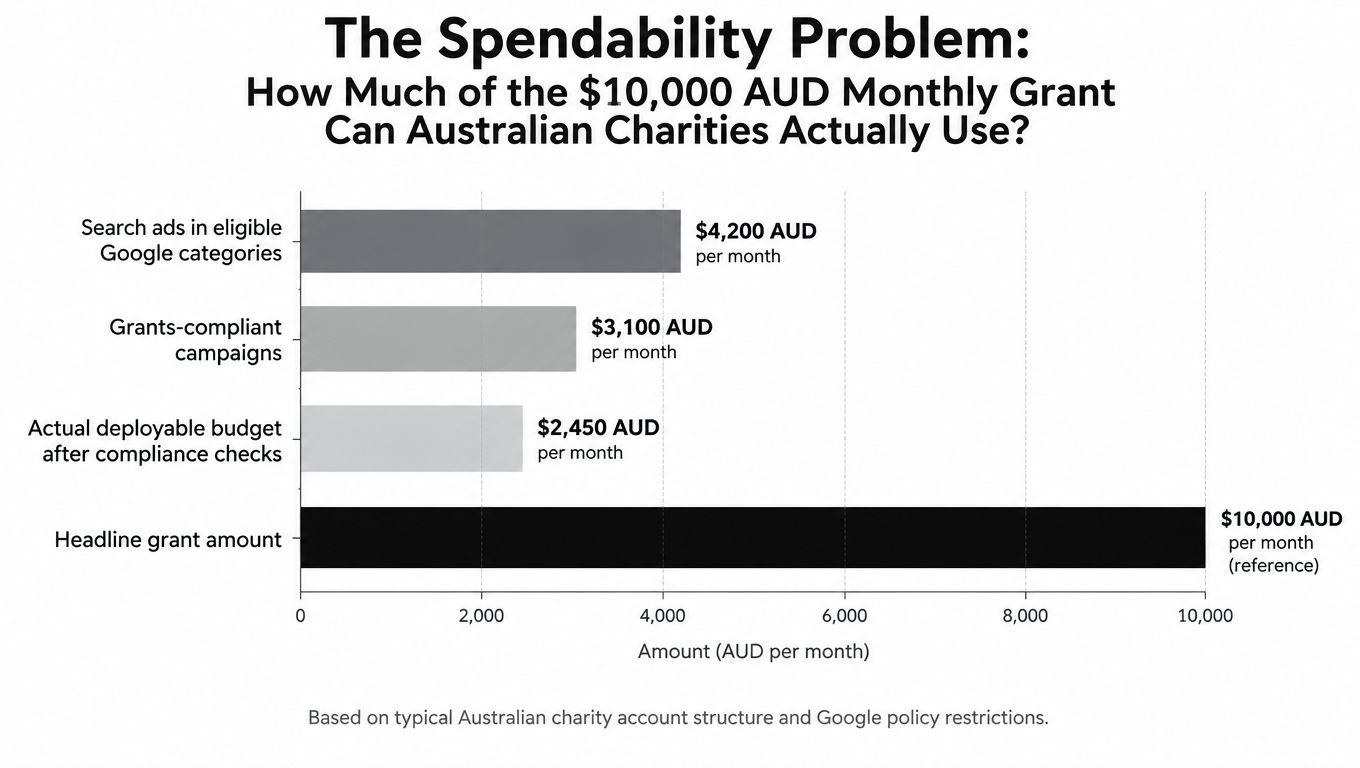
An Australian charity can hold the full monthly allocation and still use only a fraction of it. The programme provides US$329 per day, about US$10,000 per month, for text-only Search ads, with a US$2 maximum cost per click. Those terms make the grant a tightly governed acquisition channel. Search demand, auction prices, location targeting, and account structure determine how much of the allowance can run.
Why the cap changes the maths
A charity cannot buy its way into expensive commercial auctions. If relevant searches regularly require bids above the cap, the account will struggle to enter enough auctions to spend consistently. Broad, high-cost keywords usually create that problem. Tightly matched Australian, local, and cause-specific searches give the account a better chance of securing useful impressions and clicks.
The keyword market, not the budget, decides how much of the allowance is usable.
A spendability diagnostic that actually helps
Assess the account across four keyword groups:
- Branded terms: searches for the organisation's name and close variants.
- Mission terms: searches tied to the cause, service, or problem the charity addresses.
- Action terms: searches with clear intent, such as donate, volunteer, register, or get help.
- Informational terms: educational searches that may attract visitors without prompting action.
Compare expected demand in each group with the US$2 CPC cap. A keyword can be relevant and still fail as a grant target if its auction conditions make it difficult to serve. Informational terms may generate volume, while action terms often produce fewer but more valuable visits.
What usually works better
A focused set of high-intent Australian searches often performs better than a sprawling account built to consume the allocation. Prioritise clicks that can lead to donations, volunteer applications, helpline contacts, or event registrations. Traffic without a credible next action gives the account activity, not acquisition value.
Using only part of the headline amount can be a sound result when the available searches are limited or expensive. Under-spend is preferable to forcing irrelevant keywords into the account and paying for visits that cannot support the charity's goals.
Campaign Structure, Conversions and Ongoing Compliance
Build the account around intent clusters rather than internal departments or whoever requested the campaign first. For an Australian nonprofit, separate donation, service-access, volunteer, and awareness activity into campaigns with distinct goals. Each campaign should have its own keyword themes, landing pages, budget controls, and reporting.
Build the account around intent clusters
Start with clear groups such as donate, volunteer, learn, get help, and event registration. Create tightly related ad groups within each campaign, then send every theme to the page that best answers that search. This structure improves message match and makes it easier to identify which searches can usefully spend the grant under the US$2 CPC cap.
Use one clear destination per ad group. A donation ad should lead to a page where the giving action is immediately visible. A volunteer ad should take users to application information, not a general homepage. Keep service-access traffic separate from awareness traffic so the account supports useful acquisition rather than simply generating activity.
Set up measurement before you optimise
Define conversions around actions the charity can defend, such as a completed donation, volunteer application, phone call, download, newsletter sign-up, or lead submission. Google describes a conversion as a valuable action after an ad interaction, and its guidance recommends linking the active Google Analytics property to the Google Ads account that owns the website conversion actions (Google Ads conversion tracking help).
Give primary status to actions that represent a meaningful outcome. Keep softer actions, such as viewing a donation page or starting a form, as secondary diagnostics unless they are the strongest available signal. Test each conversion path after changes to forms, payment pages, phone numbers, or analytics settings.
Consent and modelling affect what you can trust
Consent settings affect both measurement and the signals available for optimisation. Google requires clear information about collected data and consent where law or policy requires it. When users decline advertising or analytics cookies, Consent Mode changes tag behaviour so those tags do not read or write cookies for the relevant purposes, while cookieless pings can support conversion modelling. Google's guidance also states that modelling requires at least 700 ad clicks over seven days per country and domain grouping, alongside a correctly implemented Consent Mode or IAB TCF v2.0 setup (Google Consent Mode guidance).
Monthly compliance routine
- Check CTR: keep the account above the required level.
- Review ad groups: confirm each campaign still has at least two active ad groups.
- Audit sitelinks: check that extensions lead to useful, working pages.
- Test landing pages: fix broken forms, unclear actions, and slow pages.
- Review search terms: remove irrelevant queries and tighten intent.
- Validate conversions: compare Ads records with donation or CRM records.
Keep the account easy to inspect. Clear labels, focused campaigns, accurate conversion settings, and a monthly review make compliance manageable and expose problems before they restrict delivery.
Simple truth: a grant account is easiest to keep when it is well labelled, tightly governed, and checked every month.
Measuring Real Outcomes Instead of Vanity Metrics
Clicks are not outcomes. Impressions are not outcomes. If a charity reports only those numbers, it's missing the whole point of the programme. What matters is completed donations, volunteer applications, helpline contacts, event registrations, and qualified enquiries, because those are the actions that support the mission.
A board report should show the campaign, the conversion, and the validated result. I'd reconcile Google Ads against the donation processor or CRM, because browser consent settings, cross-device journeys, and payment redirects can all create gaps between platform reporting and what happened. If the numbers don't match perfectly, that doesn't automatically mean the tracking is broken, but it does mean you need to understand the gap before you make decisions.
Build a board-friendly measurement frame
- Donation campaigns: track completed gifts, not landing-page visits.
- Volunteer campaigns: track completed applications, not clicks on the form page.
- Service campaigns: track calls, forms, or bookings that reach a qualified contact point.
- Event campaigns: track registrations, not just page views.
If the organisation uses first-party tracking or server-side support, the goal is the same, cleaner attribution and fewer blind spots. That's especially important when the journey moves across tools, tabs, or payment pages.
What to say when the platform and CRM disagree
Don't argue about which system is “right” in the abstract. Use the CRM, processor, and Ads data together to understand the user journey. The board cares whether the grant produced useful action, not whether one dashboard looked prettier than another.
Board-level metric: validated cost per completed action, by campaign and by intent type.
That metric is far more useful than raw traffic because it tells leadership whether the grant is helping the mission or just producing activity.
A 90-Day Plan and When to Bring in a Specialist
The first month should be about foundations, not clever bidding. Weeks one and two are for eligibility, site readiness, account ownership, and conversion setup. Weeks three to six are for campaign build, landing-page alignment, and initial QA. Weeks seven to ten are for search-term cleanup, ad copy tests, and conversion validation. Weeks eleven and twelve are for the first real compliance audit.
If the account is pulling in low-quality traffic, if conversion data is messy, or if no one internally has time to manage it properly, bring in help. A good specialist is worth it when the organisation needs someone who's managed Grants accounts before and can spot policy risk early. For teams still comparing options, it's sensible to find a performance marketing partner that understands both search performance and compliance discipline.
The decision is simple. If you've got the site, the tracking, and the time, manage it in-house. If you don't, fix the foundations or get expert help before you launch.
If you're an ecommerce or service business that also needs serious paid search discipline, Alpha Omega Digital can help with the same conversion-first approach we use on Google Ads and website work. Visit Alpha Omega Digital if you want a team that can tighten your tracking, sharpen your landing pages, and build a cleaner paid media system around real outcomes.
[email protected]
Read more insights from our team on web design, paid ads, and growth strategy.