Plumber-related Google Ads in Australia typically run between A$11 and A$54 per click for local terms, and emergency queries can climb higher. That’s why plumber Google Ads isn’t a channel you “try”, it’s a channel you make pay back.
For a Melbourne plumber, that cost reality changes the whole game. The account has to be built around calls, booked jobs, and revenue, not vanity clicks or traffic that looks busy on a dashboard.
Why Plumber Google Ads Is a High Stakes Channel in Australia
The first thing I look at in a plumbing account is the bid pressure, because it tells you how fast bad structure can burn money. Independent AU trade benchmarks put plumber-related Google Ads bid ranges at A$11.30 to A$53.95 for “plumber near me” and A$13.09 to A$68.92 for “emergency plumber”, with Melbourne top-of-page bids reaching A$9.04 to A$50.49. That spread matters because it shows how quickly the auction tightens when the customer is ready to book right now, not in a week. The same reporting also places Australia’s internet advertising market at A$18.4 billion in 2025, with search taking 44% of online ad spend. SearchScope Australia research
Practical rule: If the keyword is tied to a burst pipe, blocked drain, or no-hot-water emergency, you’re buying urgency, not just traffic.
Plumbing is exposed to this pressure more than most trades. A single job can be worth a lot, but a poor callout can be thin margin work, so you can’t judge campaigns by clicks alone. The benchmark is whether the campaign is producing profitable booked jobs, not whether the ad got seen.
The three campaign types that actually earn their keep
Search campaigns are the workhorse. They let you control keywords, ad copy, geo-targeting, and landing pages, which is exactly what you want when someone searches for a plumber in your service area. If a campaign is going to catch immediate intent, this is usually where it starts.
Local Services Ads deserve a place early because they change the measurement model. Google’s AU help docs show LSA reporting is built around charged leads from users who saw the ad on search results pages, with reporting for call, message, booking, spend, and lead credits. That’s a cleaner way to buy plumber leads because you’re dealing with lead economics instead of click economics. Google Local Services Ads reporting
Performance Max can help once search is already working. It can pull in calls and forms from Google’s wider inventory, but as a starting point it’s too broad for a lot of plumbing accounts. I’d treat it as a scale layer, not the first line of defence.
| Typical Australian CPC ranges for plumber Google Ads keywords | ||
|---|---|---|
| Keyword Intent | Example Query | Typical AU CPC Range |
| Emergency | emergency plumber near me | Higher than standard local terms, often the most expensive bucket |
| Local service | plumber near me, plumber Melbourne | Broadly in the lower to middle end of plumber auction pressure |
| Specialty service | blocked drain plumber, hot water system replacement | Usually above generic local terms when intent is clear |
Building a Plumber Keyword List That Matches Real Intent
A plumber account falls apart when everything gets dumped into one ad group. The better setup is simple, tight, and annoying in the right way. I split plumbing keywords into emergency, local service, and specialty service, because each one needs a different ad and a different landing page.
Emergency terms need urgency, not polish
For emergency intent, I’d build around terms like emergency plumber, 24 hour plumber near me, burst pipe repair tonight, and blocked drain emergency. These searches are emotionally loaded, so the ad needs to say you can answer now, not just that you exist. In this bucket, the phone is the conversion, not the form.
Local terms need suburb relevance
For local intent, the better keywords are plumber Camberwell, plumbers near me, local plumber Richmond, and plumber [suburb] variations that match your actual service map. These searches are less frantic than emergency terms, but they still show buying intent. They’re ideal when you want to match a suburb page to a suburb search and keep the message clean.
Specialty terms are where margin lives
Specialty service terms are where a lot of profitable plumbing work sits. Think blocked drain plumber, hot water system replacement, gas fitter [suburb], tap repair, and toilet cistern replacement. Those searches usually tell you the customer already knows the problem, which gives you a better chance of turning a click into a booked job.
| Plumber keyword groups by intent with example queries and match types | |||
|---|---|---|---|
| Intent Bucket | Example Keywords | Recommended Match Type | Typical Job Booked |
| Emergency | emergency plumber, 24 hour plumber near me | Phrase match, exact match once proven | Burst pipe, blocked drain, urgent leak |
| Local | plumber [suburb], local plumber Melbourne | Phrase match | General domestic callout |
| Specialty | blocked drain plumber, hot water system replacement, gas fitter [suburb] | Phrase match, exact match for winners | Drain clearing, hot water, gas work |
Phrase match is the safest default. Exact match makes sense once you know what books jobs. Broad match only belongs in a mature account with strong conversion data.
Negative Keywords and Match Types That Stop Wasted Spend
Negative keywords are where a lot of plumber budgets bleed out. The worst waste is easy to spot once you know where to look, because the searches are usually from people who don’t want to hire a plumber at all.
Start with the account-level exclusions
I keep a master list that blocks jobs, apprenticeship, course, training, DIY, how to, wholesale, and free terms. Those searchers are usually after information, employment, or supplies, not a booking. Use broad match negatives here so close variants get caught too.
Then split campaign-level negatives
Emergency campaigns should exclude cheap research terms such as plumber cost guide or average plumber rate if you’re trying to keep the search focused on urgent leads. Specialty campaigns can also block unrelated fixes that pull the wrong caller into the funnel. The goal is to stop paying for people who are price shopping instead of booking.
Keep the weekly cleanup routine tight
I’d check search terms weekly in the first month, then twice a month once the campaign settles. Every Wednesday, I’d prune new negatives and update the shared list. That rhythm matters because plumber accounts attract a steady stream of irrelevant queries, and you only catch them by staying close to the search term report.
| Plumber Negative Keyword Starter List | ||
|---|---|---|
| Category | Example Negatives | Match Type |
| Employment | jobs, apprenticeship, hiring | Broad match negative |
| Education | course, training, certification | Broad match negative |
| DIY | how to fix, replace myself, DIY | Broad match negative |
| Low intent | free, cost guide, average rate | Phrase match or broad match negative |
Don’t over-negatise emergency terms during bad weather or winter spikes. The whole point is to keep low-value traffic out, not to starve the account when urgent demand is paying the bills.
Ad Copy Templates That Earn the Call for Plumbers
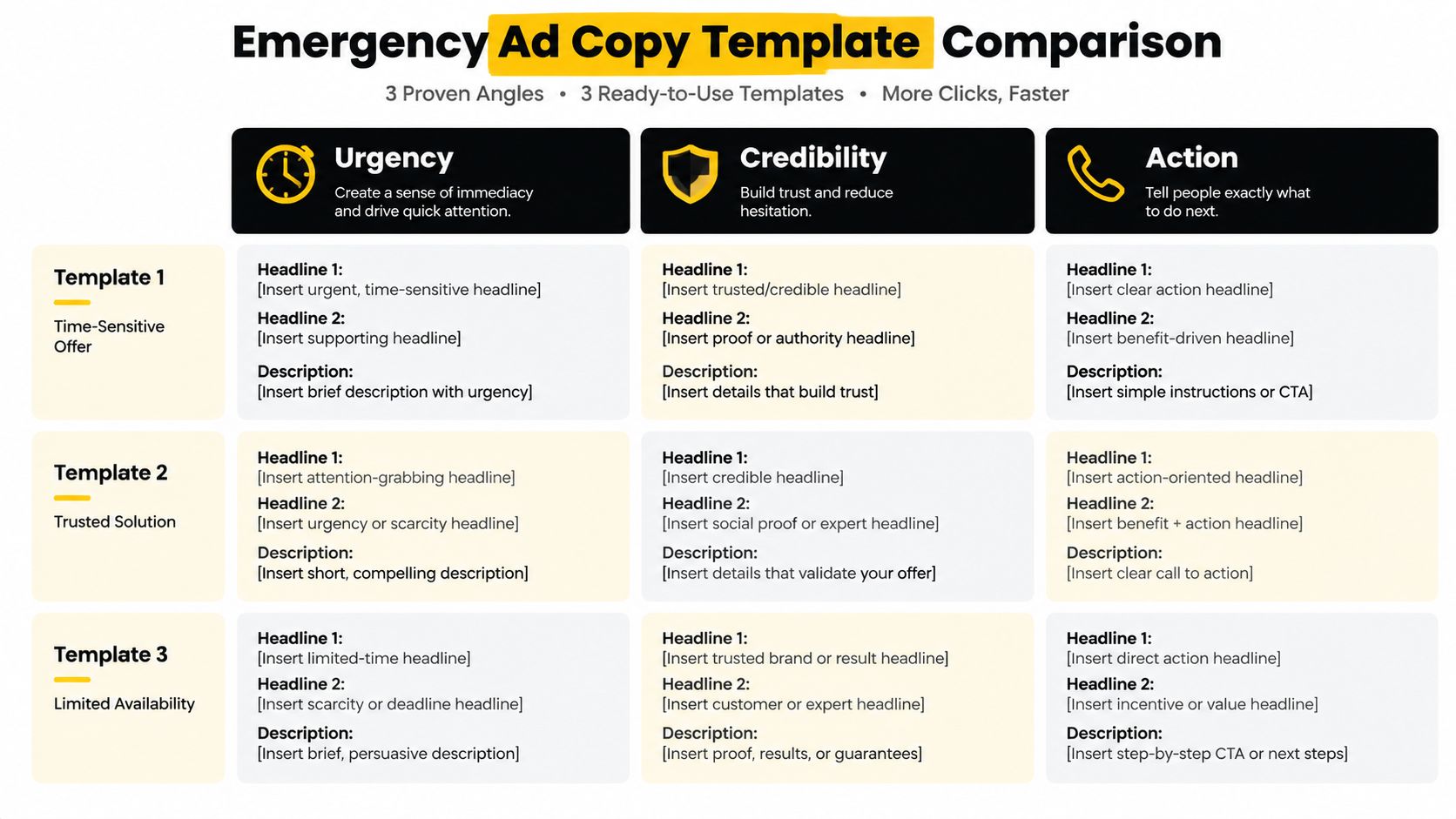
Plumber ads have one job, get the tap on the phone button. The copy has to land the service, the trust signal, and the action fast enough that a stressed customer doesn’t bounce before the page loads.
Emergency, local and specialty ads need different hooks
For emergency searches, the ad should lead with response time. A clean structure is Headline 1: 24/7 Emergency Plumber [Suburb], Headline 2: On-site in 60 Minutes, then a description that says you’re licensed, can offer upfront pricing, and won’t waste the caller’s time. This works because the decision driver is speed.
For local searches, the ad should lead with proximity and proof. I’d use Headline 1: Plumber [Suburb], Headline 2: Same-Day Bookings Open, then a description that includes your Google rating, years operating, and ABN for trust. When the user is comparing nearby options, familiarity and credibility win.
For specialty searches, the ad should lead with the problem and price certainty. Blocked Drain Specialists or Hot Water Repair works better than vague brand language. If you can quote from a clear starting point or note a warranty and payment options, that gives the searcher a reason to keep going.
Practical rule: Pin the first headline to the core offer, then let the rest support the phone call. Don’t waste the top line on brand fluff.
Keep descriptions tight enough for mobile. If the message runs long, the bit that makes the call happen gets chopped off, and you’ve paid for a click that never had a fair chance to convert.
Bidding, Budget and Schedule Strategy for Plumber Campaigns
Bidding only makes sense when you know your break-even lead economics. For Australian plumbing campaigns, a practical paid-search benchmark is a cost per lead of about A$25 to A$65 for local plumbing and electrical searches, with emergency plumber keywords often landing in the A$18 to A$45 CPC range when the setup is tight. IEven Google Ads Australia CPL benchmarks
Pick the bidding mode that matches account maturity
Manual CPC still has a place in fresh accounts, especially while you’re building clean conversion data. It gives you control, which matters when the search terms aren’t stable yet.
Target impression share fits brand campaigns where visibility matters more than precision bidding. I use it sparingly for plumbing because most of the value sits in intent, not in dominating your own name.
Maximise conversions is where most accounts should end up once there’s enough signal. Australian trade benchmarks also note that home-services search campaigns commonly sit around an 8.5% to 14% conversion rate, A$48 to A$135 CPL, and A$6.80 to A$14.20 CPC in benchmark accounts. Carter Media benchmarks
Budgeting has to leave room for data
Google Ads support recommends converting daily budget into monthly spend by multiplying the daily figure by 30.4. Google Ads budgeting help For planning, that matters because local service businesses often struggle when daily spend is too thin to generate enough signal. Australian guidance also says accounts spending less than AUD 30 to 50 per day often struggle to judge performance cleanly. LM Group budget guide
A simple operating setup
- Weekdays: weight 7am to 6pm at full strength.
- Weekends: keep them live at full strength if you take bookings.
- Nights: push more weight only on emergency campaigns.
- Budget floor: don’t choke the auction with tiny spend if you need the account to learn.
A Melbourne plumber doing A$18,000 in monthly job revenue needs budget discipline, not guesswork. I’d use revenue, close rate, and booked-job value to decide how hard the account can push before it starts eating margin.
| Plumber Bid and Budget Settings by Campaign Stage | |||
|---|---|---|---|
| Account Stage | Bidding Mode | Target CPA Range | Daily Budget Logic |
| New account | Manual CPC | Not set yet | Enough spend to gather clean search data |
| Growing account | Maximise conversions | Based on booked-job value | Daily budget that supports stable signal |
| Mature account | Target CPA | Set from real lead-to-job economics | Budget can scale once close rates hold |
Landing Pages and Call Tracking That Attribute Real Jobs
A plumber landing page should be built to make the phone ring, not to win a design award. The phone call is the primary conversion, and the page has to earn it within seconds.
Above the fold should answer four things
The first screen needs a tap-to-call button, the single phone number, the suburb or service area, and trust signals like licensed, ABN, and same-day response. If those don’t appear immediately, you’ve made the customer work too hard. For plumbing, that’s enough friction to lose the booking.
Dedicated pages beat the homepage almost every time. A blocked drain ad should go to a blocked drain page, and a hot water ad should go to a hot water page. That message match helps both conversion and Quality Score because the page says the same thing the ad promised.
Track calls like they matter, because they do
Google forwarding numbers are useful when you want to attribute calls back to campaigns. Third-party dynamic number insertion adds more control when you need to separate sources and protect NAP consistency for local SEO. If you care about rankings and paid lead attribution at the same time, that consistency matters.
A clean flow is simple, click, call, booked job, invoiced revenue, offline conversion upload. That’s how smart bidding learns what a real lead looks like.
For businesses that need a broader web and ad stack around the plumbing account, Alpha Omega Digital can handle Google Ads, landing pages, and tracking setup from one place. That’s useful when the gap between a call and a booked job needs to be visible in the reporting.
A Realistic First Month Optimisation Story for a Plumber Account
The first month usually looks worse before it looks better. I’ve seen Melbourne plumbing accounts start with broad match keywords, no negatives, one ad group, and a daily budget of A$80 that burns through clicks fast because the traffic is loose. That setup usually attracts at least one junk call, often from someone trying to diagnose a DIY mixer tap or asking for a price without a job.
Week one is about proving the problem
The early data often shows the account is paying for intent that isn’t ready to book. That’s not a sign to quit, it’s a sign the structure is wrong. Once you split campaigns by intent and add negatives, the traffic starts to make sense.
Week two is where the waste drops
I’d rebuild into separate ad groups, add around 60 negative keywords including job-seeker terms, and move to phrase and exact match where the account is already showing signal. Ad schedule usually tightens too, often to 6am to 9pm, because the calls become easier to answer and convert.
Week three and four are where the account starts behaving
Emergency call-only ads can run alongside tighter geo-targeting, often around a 15 km radius for a metro plumber, and call extensions should be switched on. Once offline conversions from booked jobs go back into the account, Target CPA can start learning from real revenue instead of raw dials.
| 30-Day Plumber Account Optimisation | |||
|---|---|---|---|
| Week | Focus | What Changed | Outcome |
| Week 1 | Setup and search terms | Broad match, no negatives, single ad group | CPL starts high |
| Week 2 | Cleanup | Negative keywords, tighter match types, cleaner schedule | CPL drops |
| Week 3 | Intent focus | Call-only ads, tighter geo, stronger call assets | More relevant traffic |
| Week 4 | Revenue feedback | Offline conversions uploaded | Better job quality and stabilised bidding |
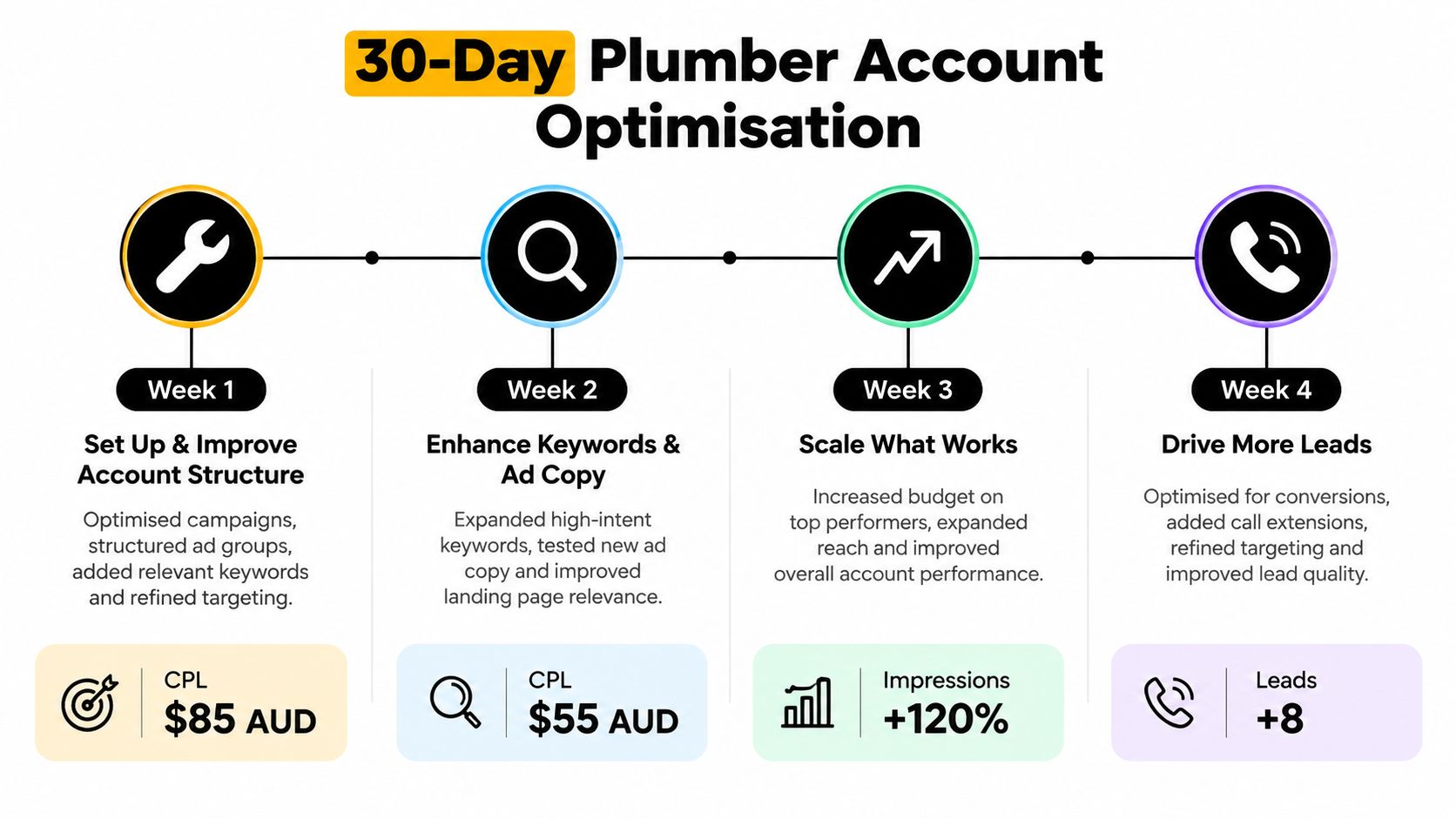
By the end of a clean first month, the account can move from noisy lead flow to something that looks more like a system. In a real-world plumbing build, that often means the booked-job pipeline becomes visible enough to make smarter budget decisions instead of guessing.
If you’re running a plumbing campaign and you’ve got at least A$3k a month in paid media budget, Alpha Omega Digital can set up and manage the account around calls, bookings, and tracked revenue. If you want a Melbourne team that works on Google Ads, landing pages, and the conversion setup behind them, visit Google Ads for Plumbers and get in touch.
Alpha Omega Digital
Read more insights from our team on web design, paid ads, and growth strategy.