A small Australian charity can be approved for Google Ad Grants and still receive almost no useful outcome from it. I've seen organisations celebrate access to the credit, then send every visitor to a slow homepage, count page views as donations, and wonder why the account underperforms. The difficult part usually isn't getting ads eligible. It's building the website, donation journey, measurement setup, and campaign structure that give people a clear reason to act.
For charities researching Google Grants for charities, the practical question is simple: can the organisation turn relevant searches into completed donations, volunteer registrations, enquiries, or service access? The grant can create valuable reach, but it isn't cash, guaranteed traffic, or a substitute for a functioning digital operation.
What Google Ad Grants Actually Gives an Australian Charity
A Melbourne charity gets approved, the board sees the headline figure, and people start talking as if fresh marketing money has arrived. Then the team logs into Google Ads and hits the actual limit. The grant applies to eligible Search ads only. It does not put cash in the bank, and it does not create demand if nobody is searching for what the charity offers.
Google Ad Grants is a long-running in-kind advertising programme that began in 2003. Eligible Australian charities can receive up to US$10,000 per month in Google Search advertising credit, which is a maximum annual value of US$120,000 before currency conversion.
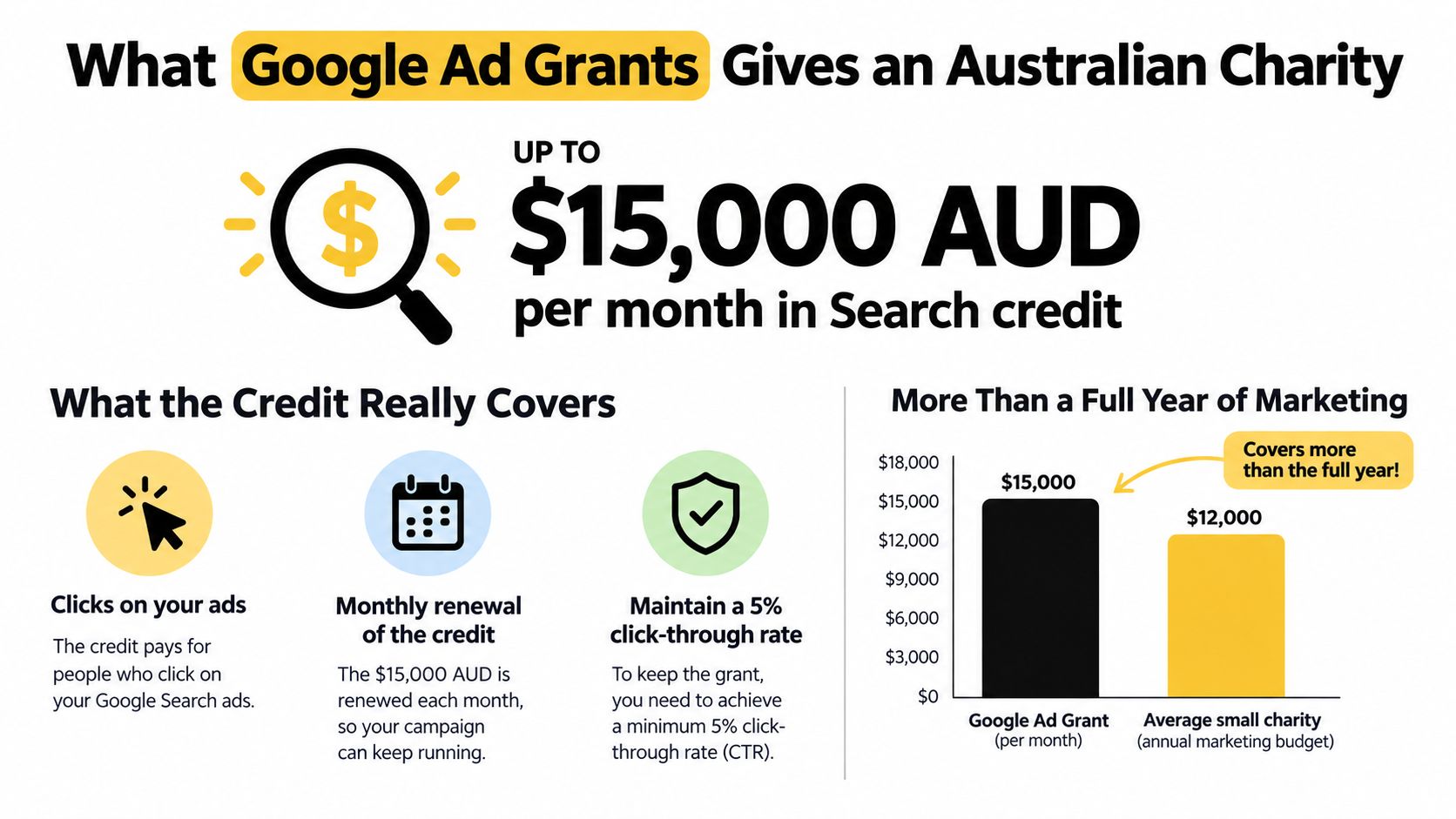
The point that matters in practice is simple. This is credit, not funding the charity can spend anywhere it likes.
The grant is limited to eligible Google Search advertising. It generally cannot be withdrawn, transferred, or redirected into a website rebuild, donation platform fees, staff wages, agency management, photography, or broader brand work. I have seen charities focus on the monthly allowance and miss the harder question, whether their site can turn that attention into donations, volunteer sign-ups, enquiries, or service uptake.
Three things determine whether the credit produces real value:
- Relevant search demand: People need to be searching for the charity's cause, services, donation options, campaigns, or volunteer opportunities.
- A credible website: The landing page needs to explain the work clearly and make the next step obvious.
- Operational capacity: Someone has to review search terms, maintain the account, fix tracking problems, and improve pages that waste traffic.
That last point is where a lot of the grant disappears. If the website is slow, the donation form is clumsy, or conversion tracking is missing, the account can look active while producing very little that a charity can use.
A charity may have access to the full headline allocation and still spend only part of it. Sometimes search volume is limited. Sometimes the campaign structure is weak. Sometimes the ads are fine and the landing page does the damage. Unused credit does not mean the application failed, but it usually means the organisation has not yet built a search programme and website journey that can absorb more demand.
Historical Australian data also shows the programme has operated at meaningful scale. In 2019, 8,109 Australian nonprofits were enrolled in Google for Nonprofits, while more than 1,600 Australian nonprofits received in-kind advertising and related access. The same analysis found that Australian Ad Grants beneficiaries were more than three times higher in 2019 than in 2015, and estimated up to AU$250 million in annual free advertising value in Australia, according to the Google economic-impact analysis for Australia. Those figures describe advertising value and programme reach. They do not mean cash was distributed, and the broader Google for Nonprofits enrolment number is wider than active Ad Grants use.
Practical rule: Treat the grant as donated media inventory. Treat the website, donation flow, and measurement setup as the system that determines whether that inventory turns into results.
Eligibility and the Documents You Will Need
Approval is the easy half. The charities I have set up accounts for in Melbourne rarely fail on paperwork, they fail on what sits behind the paperwork: a website the organisation does not fully control, a status that lapsed, or mission content thin enough that a reviewer cannot verify what the charity does. Get the documents right first, then treat the site itself as part of the eligibility work.

Start with Australian status
An Australian organisation will generally need recognised nonprofit or charitable status. Common pathways include:
- ACNC registration: Confirm that the organisation appears with the Australian Charities and Not-for-profits Commission and that its status is current.
- ATO recognition: Check whether the organisation has Deductible Gift Recipient status or an applicable income-tax-exempt nonprofit status.
- Organisation control: Use a website owned or controlled by the charity, rather than a temporary campaign page with no clear connection to the organisation.
- Mission substance: Make the purpose, programmes, beneficiaries, contact details, and supporting information easy to verify.
Google excludes several categories, including government entities, hospitals, schools, universities, and childcare organisations. A separately constituted charitable foundation may be assessed independently, so the legal structure matters more than the relationship between entities.
The organisation should also accept Google for Nonprofits terms and review the programme's current requirements before applying. Requirements can change, so the official Australian Google Ad Grants page, linked earlier, should be the final reference point.
Don't confuse documents with readiness
A registration certificate can establish eligibility, but it can't make a broken donation form convert. Check the site on a mobile device, test every form, confirm that HTTPS is active, and make sure the visitor can understand the intended action without searching through several menus. This is the part most charities skip, and it is the part that decides whether the grant turns into donations or quietly burns.
If the charity is also preparing funding applications, a resource such as Bidwell's bid writing guide can help organise the underlying case for support, beneficiary outcomes, and programme language. That content often becomes useful on landing pages too, provided it's rewritten for a visitor who needs to act quickly.
Application Walkthrough and Account Setup
Set up the account in the right order. The most avoidable problems happen when a charity creates an unsuitable Google Ads account, mixes personal and organisational ownership, or launches traffic before deciding what counts as a meaningful conversion.

A clean sequence
- Validate the organisation first. Confirm the charity's Australian status, website ownership, contact details, and mission eligibility.
- Create or access Google for Nonprofits. Use an organisational identity and keep administration available to more than one trusted person.
- Accept the relevant terms. Read the Ad Grants conditions rather than treating the activation screen as routine paperwork.
- Create or connect the Google Ads account. Keep the account clearly separated from unrelated commercial advertising activity.
- Claim the grant through the linked profile. Follow the current activation path in the Google for Nonprofits account.
- Build a controlled starter structure. Separate branded searches from generic mission searches and service-area campaigns.
- Configure conversion tracking before launch. Track completed donations, volunteer registrations, enquiry submissions, and other actions that represent mission progress.
The last step deserves more attention than the application itself. A donation button click isn't the same as a completed donation. A contact page view isn't the same as a submitted enquiry. Google Ads needs reliable conversion actions so the charity can distinguish useful acquisition from empty traffic.
For implementation, a practical stack may include Google Tag Manager, Google Analytics, and Google Ads conversion imports. A developer can also use clear landing-page URLs for each campaign theme, allowing analytics reports to separate donation traffic from volunteer and programme traffic.
The activation process changes over time, so follow the current instructions in the account rather than relying on an old tutorial.
Account hygiene from day one
Use naming conventions that a volunteer can understand. A campaign called “Generic Mission Melbourne” is more useful than an automatically generated label. Keep conversion names specific, such as “Completed Donation” or “Volunteer Form Submitted”, and document which page or event triggers each action.
Don't launch every idea at once. Start with a small number of tightly connected themes, validate that the tracking works, then expand based on actual search terms and completed actions.
Where the Credit Usually Disappears on the Landing Page
The landing page often decides whether donated advertising becomes a useful supporter journey or a stream of low-value visits. A charity may improve ad copy and add keywords, but the visitor still leaves if the donation process feels uncertain, slow, or disconnected from the promise in the ad.
An Australian benchmark found that average general-donation-page traffic increased from 4,000 to 5,000 visitors between 2015 and 2018, while conversion declined from 30% to 26%. During the same period, average gift value rose from $118 to $162, and donation income increased from $141,600 to approximately $210,600. The benchmark is detailed in this Australian donation page research report.
| Metric | 2015 | 2018 | Direction |
|---|---|---|---|
| Average general-donation-page traffic | 4,000 visitors | 5,000 visitors | Increased |
| Conversion rate | 30% | 26% | Declined |
| Average gift value | $118 | $162 | Increased |
| Donation income | $141,600 | Approximately $210,600 | Increased |
The lesson isn't that more traffic is unhelpful. It's that traffic growth can hide a weaker conversion path. A charity can attract more visitors while making it harder for each person to complete the intended action.
Remove friction before scaling
Earlier Australian donor research in the same benchmark found that 79% of respondents were more likely to abandon a donation page when the process took more than a few minutes, while 81% said they would donate more if they knew exactly what their donation provided. The report recommended fewer than 10 mandatory fields and completion within 90 seconds.
A practical donation page should:
- Use one page: Avoid sending a supporter through unnecessary steps.
- Limit required fields: Ask only for information needed to process the gift and communicate appropriately.
- Explain impact immediately: Tell the visitor what their contribution supports in concrete language.
- Test mobile completion: A form that works on a desktop can still be awkward on a phone.
- Track the full journey: Measure form starts, payment attempts, and completed donations separately.
- Match the ad promise: A search for a specific programme should land on that programme or a directly relevant donation path.
Counting page views as conversions creates false confidence. It tells the team that people arrived, not that the organisation received money, a volunteer application, or a qualified enquiry.
First Campaign Structure and Keyword Logic
A first campaign should mirror the charity's actual work. The structure I'd hand to a small Australian organisation is simple enough for an internal team to maintain, but specific enough to prevent generic searches from consuming attention.
Build around intent
Brand campaign: Protect searches for the charity's name, programme names, and recognised initiatives. These visitors already know something about the organisation, so direct them to the most relevant page rather than making them stray from the homepage.
Generic mission campaign: Target searches related to the service or cause, such as support programmes, food relief, youth services, community assistance, or volunteering. Keep the keyword themes narrow enough that the ad and landing page can answer the search directly.
Geographic campaign: Add state, city, suburb, or service-area language where the charity serves a defined location. A Melbourne organisation shouldn't rely on national wording if its programmes operate only in selected local communities.
Google's own charity information confirms that Ad Grants is intended to help organisations promote charitable services, recruit volunteers, attract donations, and reach people searching for relevant causes. The campaign structure should reflect those outcomes, not merely maximise impressions.
Give each ad group one job
Use tightly related keywords within each ad group. Write ads that repeat the search intent naturally, then send the click to a page designed for that intent. Sitelinks can expose donation, volunteer, programme, and contact pathways, while callouts can reinforce practical information such as local service access or eligibility.
The weekly review should be operational rather than ceremonial:
- Search terms: Remove irrelevant queries and identify useful language for new ad groups.
- Brand protection: Check that important brand searches reach the right page.
- Landing-page tests: Change one meaningful element at a time, such as the headline, form layout, or impact explanation.
- Conversion quality: Prioritise completed donations, volunteer registrations, and qualified enquiries over raw clicks.
- Geographic relevance: Exclude areas the charity doesn't serve.
A campaign that spends its credit on curious visitors can look busy while producing very little mission value.
Don't use broad cause words without context. Terms such as “charity” or “donate” may attract people with different intentions from the organisation's actual service. Specific, locally relevant searches are usually easier to match to a useful landing page.
Compliance, Reporting, and the Traps That Cost Charities Their Account
Ad Grants compliance isn't a box checked during application. It's an ongoing operating responsibility. Google's programme rules include mission-based advertising requirements and account controls, so the charity should review current requirements in the account and on Google's programme pages rather than relying on an old checklist.
A common mistake is treating 5% as a guaranteed performance target or a complete description of compliance. The figure appears in widely circulated guidance, but charities should verify the current rule and how it applies to their account before making decisions. Compliance and commercial performance are related, but they aren't identical.
The operational traps
- Homepage destination: A generic homepage forces the visitor to work out what to do next.
- Unused credit as a success metric: Available media value doesn't prove that the organisation helped anyone.
- Irrelevant informational searches: High click volume can reduce relevance and waste the team's time.
- Weak conversion setup: Without completed-action tracking, optimisation becomes guesswork.
- No account owner: A volunteer may launch the account but leave nobody responsible for weekly maintenance.
- Unclear campaign intent: Brand, donation, volunteer, and service searches become mixed together.
The reporting rhythm should be practical. Review search terms weekly, examine conversions and donation outcomes monthly, and audit landing pages at least quarterly. Keep a change log so the team knows which campaign, ad, form, or page changed and what happened afterwards.
Measure the mission, not the dashboard
A healthy report connects advertising activity to organisational outcomes. It should show which searches generated completed donations, volunteer applications, useful enquiries, or visits to a service page. Where defensible, assign values to actions, but don't invent values to make a dashboard look positive.
The grant also needs account administration. Keep access current, retain organisational ownership, and make sure the account remains linked to the wider Google for Nonprofits profile. If Google requests information or flags a policy issue, respond promptly and document the correction.
Is Ad Grants Worth the Effort for Your Charity Right Now
For many Australian charities, the main barrier isn't eligibility. It's digital infrastructure. Australian nonprofit technology data indicates that 93.5% of registered nonprofits report needing help with digital marketing strategy, while more than half still can't accept donations online, according to the Little Phil nonprofit technology information.
That changes the order of work. Confirm eligibility, then audit the website before building a large campaign. Check mobile usability, accessibility, HTTPS, donation and enquiry flows, page speed, analytics, and the organisation's ability to respond to new leads or supporters.
A charity is closer to ready when it has:
- A mobile-friendly, organisation-controlled website.
- A working donation or enquiry journey.
- Meaningful conversion tracking.
- Clear service areas and campaign priorities.
- Someone who can review the account weekly.
- A plan for handling donations, volunteer applications, and enquiries after they arrive.
If those pieces aren't in place, applying may create more administration without creating more impact. Fix the conversion path first, then use the grant to amplify a journey that already makes sense.
The next 30 days should produce a practical decision. Validate status, test the website, define conversions, map campaign themes, and assign ownership. If the charity can't complete those tasks, a website and measurement project may be a better first investment than trying to use every dollar of donated media.
Alpha Omega Digital helps Australian organisations connect Google Ads, landing pages, Google Tag Manager, Analytics, and conversion tracking so donated Search credit has a measurable path to real action. If you're also growing a commercial business with a paid ads budget of at least 3k a month, apply through the Alpha Omega Digital contact page for a low-risk deal that includes one month of paid ads management free.
[email protected]
Read more insights from our team on web design, paid ads, and growth strategy.