You’ve probably had this happen. The ads are live, the invoices keep landing, and yet the only thing growing is the amount of time you spend asking, “What did we get for this month?” In Melbourne, that usually shows up after a quarter where cost-per-lead has crept up, the founder is still rewriting Google Ads copy late at night, and the agency keeps talking about impressions when you wanted enquiries.
A serious PPC agency Melbourne businesses can trust should make that feeling disappear, not create more of it. I’m going to be blunt, a lot of agencies sell activity, not accountability. If you’ve been burned before, the actual question isn’t whether paid search can work. It’s whether the next team can prove they’re working on the right things, in the right order, with the right access and the right ownership.
Why Melbourne Businesses Hire a PPC Agency in the First Place
The hire usually happens after a rough quarter. Spend is climbing, leads are flat, and every person in the room has a different theory. The founder wants answers, sales wants more names in the CRM, and the finance team wants to know why the account still looks stuck.
That is the moment when DIY work or a junior freelancer stops cutting it. Paid search, Meta, and retargeting all need different rules, different creative, and different tracking, and sloppy management gets punished fast. One bad landing page or a broken conversion tag can make a decent account look dead. A competent operator can change the numbers quickly, which also means a poor one can burn cash just as fast.
The triggers behind the hire
Owners do not hire for a prettier dashboard. They hire because something in the commercial engine is clearly off.
- Rising cost per lead. The account still spends, but every enquiry feels pricier than it should.
- Seasonal pressure. EOFY and pre-Christmas windows pass while the campaigns underperform.
- Internal time drain. Someone senior is losing nights to ad edits instead of running the business.
- Channel sprawl. Google, Meta, remarketing, and sometimes Bing are all underperforming together.
- Tracking doubt. Nobody trusts the numbers, so nobody trusts the decisions.
A lot of Melbourne businesses also hire when they can see how crowded the channel has become. IAB Australia market context shows digital advertising keeps taking a bigger share of the spend, with search still carrying a large chunk of the total. That matters because PPC is no longer a side experiment. It is a competitive auction where weak accounts get exposed quickly.
Practical rule: if paid media affects revenue, it needs weekly attention from someone inside the account.
Anecdotally, plenty of Melbourne SMBs we audit are already running Google Ads in some form, which is why the gap between “we have campaigns live” and “we have a system that produces enquiries” is so wide. The channel is common. Good management is not. The Australian PPC and SME market notes point in the same direction, but the more useful lesson is simpler. When the market gets crowded, the wrong partner costs more than the fee.
What a Good PPC Agency Does Each Month
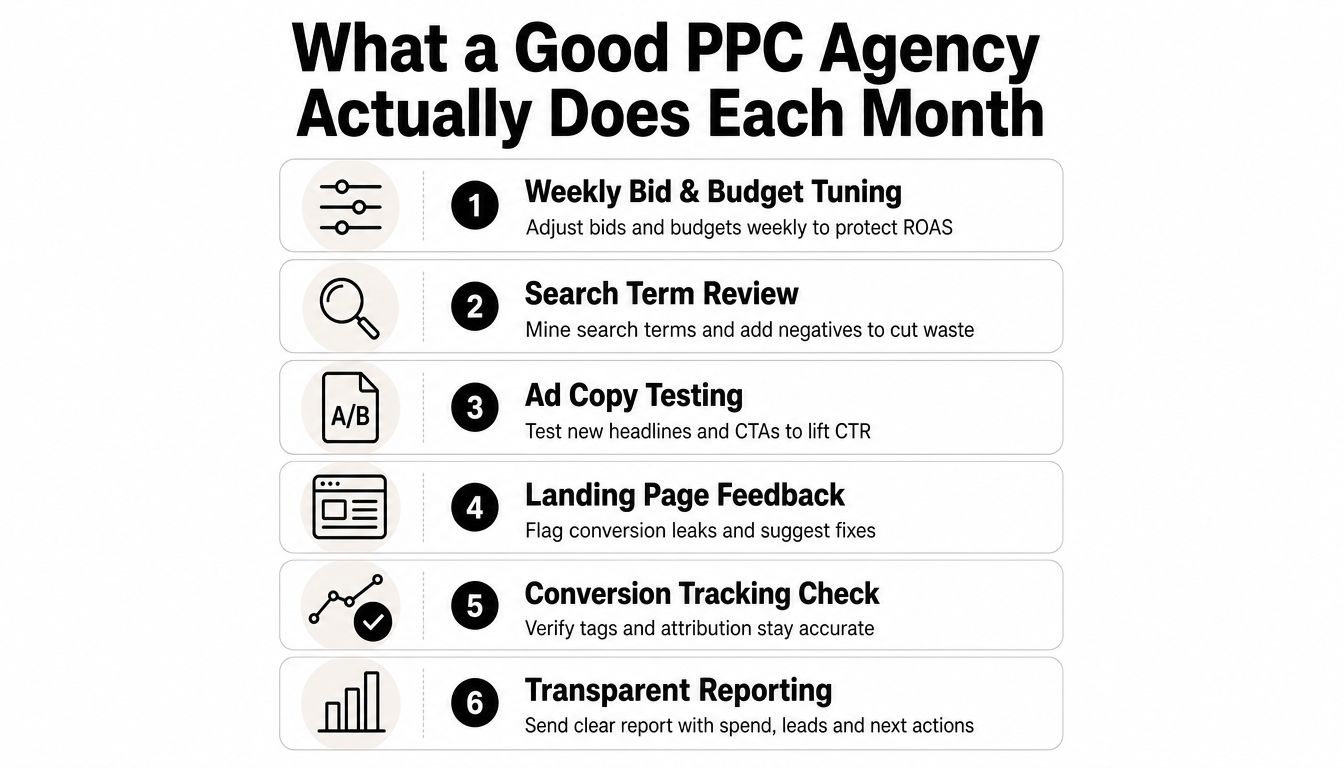
A proper agency doesn’t disappear after launch. It keeps trimming waste, testing angles, and checking whether the account still matches the business reality. If your current partner only sends a dashboard and a few vague comments, that is not management. That is admin.
The first 14 days should tell you a lot. You should get a clear onboarding plan, tracking access sorted, a list of what is being audited, and a direct explanation of what the agency will change first. If that does not happen, the account will drift. A serious Melbourne team also gives you a working rhythm you can see. Weekly budget checks, search term reviews, creative testing, and tracking audits should all connect back to enquiries, revenue, or lead quality.
A live account should show real movement, not just polished slides.
- Weekly bid and budget tuning. Spend moves away from weak segments and toward the parts of the account that convert.
- Search term mining. Negative keywords get added, irrelevant queries get cut, and wasted clicks come down.
- Ad copy testing. Headlines, descriptions, and calls to action get rotated, then the strongest version stays live.
- Landing-page feedback. Friction points and offer mismatches get flagged instead of being ignored.
- Conversion tracking checks. Tags, events, and attribution get validated so the reporting stays usable.
- Transparent reporting. You get commentary, not screenshots.
That last point is where a lot of agencies hide. If the report looks tidy but nothing changed because of it, the account is not being worked hard enough. Good partners tell you what they changed, why they cut spend, what they tested, and what they need from you next. You should also see weekly notes, a monthly strategy call, and fast action when stock issues, launches, or lead-quality problems hit.
A serious operator judges the account against realistic benchmarks, not fantasy results. Australian PPC benchmark guidance puts average search CTR around 3.3%, with search CTRs typically landing in the 3% to 5% range, and average conversion rate around 4.1%. For lead generation, Australian SME benchmark data shows average conversion rates around 4.6%, top-quartile accounts at 8.0%+, and bottom-quartile accounts below 2.0%. Those numbers matter because they tell you when the agency should fix structure, not just nudge bids.
PPC Agency Pricing in Melbourne and What You Get for It
Price tells you how the agency works. If a proposal is messy, unreadable, or padded with vague scope, expect the account management to be the same. The three models I see most in Melbourne are flat retainers, percentage-of-spend, and hybrid or performance-based arrangements.
What each model usually means
A flat retainer gives you the cleanest setup. You pay a fixed management fee, usually somewhere in the rough band of 1,500 to 4,000 for SMB accounts, and the scope should be written down in plain language. This works best when the agency has a named strategist, a defined checklist, and a regular optimisation rhythm. If those pieces are missing, the retainer is just a fee with no discipline behind it.
A percentage-of-spend model usually lands around 10 to 20 percent, with floors for smaller accounts. It can suit a large, complex account, but it creates the wrong incentive if the agency earns more by spending more instead of improving efficiency.
A performance or hybrid structure can work for ecommerce brands with stable funnels and reliable tracking. It is a poor fit for messy lead-gen accounts, because attribution is rarely clean enough early on. Media spend is separate either way, so do not confuse management fees with ad budget.
| PPC Agency Pricing Models in Melbourne | Typical Melbourne Range | Best For | Watch Out For |
|---|---|---|---|
| Flat retainer | 1,500 to 4,000 | SMBs that want predictable support and clear scope | Scope creep, vague inclusions |
| Percentage of spend | 10 to 20 percent, often with floors | Larger accounts with steady budgets | Incentive to grow spend, not efficiency |
| Hybrid or performance | Varies by structure | Ecommerce with reliable tracking and conversion volume | Attribution disputes, complex contracts |
What should be included
A proper fee should buy reporting, campaign builds, ad copy, testing notes, and landing-page feedback. If an agency charges extra for basic optimisation, ask why. If creative, analytics, and strategic review are all sold as separate add-ons, the base fee is probably just an entry ticket.
Read the proposal like an operator, not a buyer of nice words. You want to see who works on the account, how often they touch it, and what happens in the first 14 days after kickoff. Onboarding should include account access, tracking checks, campaign review, and a clear list of changes already in motion. If you only get a welcome email and a promise to “get started soon”, the account is being parked, not worked.
A simple rule helps. If the fee sounds cheap but the proposal is vague, you are buying light oversight and account drift. If the fee is higher and the process is explicit, the agency is pricing for real hands-on work.
Agency vs Freelancer vs In-House for Melbourne SMBs
Choose the setup that matches your spend and your need for oversight. A founder with a modest budget does not need a full internal team, and they also should not hand everything to one freelancer who claims to cover media buying, design, analytics, and CRO at once. Every model has strengths, and every model has a ceiling.
The honest trade-offs
A freelancer can be sharp, fast, and practical. In Melbourne, freelancers often charge 80 to 150 an hour or 1,500 to 4,000 a month in retainers, and the better ones usually know their platforms well. The trade-off is bandwidth. One person cannot always handle strategy, copy, creative, tagging, and reporting without something slipping.
An in-house hire gives you focus and direct access. A full-time operator typically costs 85,000 to 110,000 plus super and tools, which makes sense for ecommerce brands spending 20k+ per month on ads. For most SMBs below that level, it usually costs too much unless paid media is a core growth engine.
A Melbourne PPC agency sits in the middle at roughly 1,800 to 5,000 a month in management fees plus spend. You get strategists, media buyers, copywriters, and analysts under one roof, but the account can still pass through junior hands unless the agency is disciplined.
The key question is who owns the work and how visible that work is. A freelancer can disappear for days if they are overloaded. An in-house hire gives you direct control, but you carry the salary whether results are good or bad. An agency should bring process, checks, and backup, yet some agencies hide weak delivery behind polished reporting. Read the proposal for who touches the account, how often they touch it, and what gets done in the first 14 days. If onboarding starts with a welcome email and not much else, the account is being parked.
| PPC Management Options Compared for Melbourne SMBs | Freelancer | In-House Hire | Melbourne PPC Agency |
|---|---|---|---|
| Cost | Lower monthly cost | Highest total cost | Mid-range fee plus ad spend |
| Expertise depth | Strong in one or two areas | Deep on your business, limited external view | Broader team coverage |
| Speed | Often responsive | Immediate internal access | Depends on process |
| Creative and analytics support | Limited | Requires extra hires or tools | Usually bundled |
| Accountability | Personal, but limited capacity | Direct ownership | Shared responsibility, can dilute senior access |
Pick the model that matches your spend and how much management overhead you can tolerate. Prestige does not pay your invoices.
If you are running ecommerce with clean tracking and serious volume, in-house can make sense. If you are still testing offers, a disciplined agency is usually the better bridge. If your campaigns are small and simple, a freelancer with proven discipline may be enough.
Questions Worth Asking Before You Sign Anything
Treat the sales call like a working interview. You are not buying a polished deck, you are buying the people who will touch your account, how they make decisions, and whether they can explain those decisions without hiding behind jargon. Ask direct questions and stay on the practical details.
The questions I’d ask verbatim
Use these in the room:
- Who physically builds and optimises the account each week?
- Which Melbourne-relevant case studies can you show me, with spend ranges and actual work done?
- Which platforms do you not specialise in?
- How do you structure reporting, and what triggers an optimisation decision?
- What happens if CPL rises for two or three weeks in a row?
- How are media spend and management fees billed?
- Who owns the Google Ads account, Meta pixel, audiences, and conversion data if we leave?
- Can you show me the keyword-level or creative-level plan before launch?
- How will you handle tracking, attribution, and lead quality before ads go live?
Those questions expose the operator fast. Weak agencies answer with fluff. Strong agencies answer crisply and show artefacts, not just opinions. If they cannot say who logs into Google Ads or Meta, assume the work will be handed off.
Early warning signs you shouldn’t ignore
These show up fast.
- Vague monthly reports. If the deck is stuffed with impressions, reach, and brand awareness language while you wanted leads or sales, that is a mismatch.
- Locked-in contracts. A long term with no meaningful review point suggests the agency is selling certainty to itself.
- Access delays. Slow answers about account ownership or pixel control usually mean the account will not stay with senior staff.
- No tracking plan. If they cannot explain measurement before launch, the numbers will not be trustworthy.
- No creative or keyword plan. That usually means the campaign will be improvised after spend has already started.
Australian internet advertising revenue reached A$4.9 billion in the March quarter of 2026, according to IAB Australia Q1 2026 reporting. Spend is concentrated, competition is real, and vague agencies get exposed quickly.
The first fortnight tells you almost everything. If you already feel unsure about access, ownership, or reporting, do not wait for month six to confirm it.
A Realistic First 30 Days With a New PPC Agency
The first month should feel controlled, not glamorous. If the agency is working the account properly, you will see access requests, tracking checks, draft changes, and clear decisions about what gets fixed before spend is pushed harder.
Week 1 is access and audit
A proper agency starts by getting access to Google Ads, Google Tag Manager, analytics, CRM data where it matters, and the old campaign history. Then they audit wasted spend, broken tracking, search term waste, and audience gaps. For Melbourne businesses, that usually means looking at service areas, device splits, and local intent signals that older accounts ignore.
You should also see how they read the proposal in practice. If the proposal is vague on account ownership, reporting, and who does the actual work, the first week will expose it fast.
Week 2 is tracking and rebuild
The conversion map gets agreed, then the technical fixes go live. Google’s own setup guide requires the tag on every page, and ACCC’s explanation of Google Ads conversion tracking shows why that implementation detail matters when conversion data is being used to judge performance. Don’t let anyone scale spend until tracking is trustworthy, because false positives burn money and hide bad decisions.
From there, the account gets rebuilt with tighter geo-targeting and exclusions that match real service zones, product availability, or delivery rules. If your business only serves part of Melbourne, the campaign should reflect that plainly.
Week 3 is creative and control testing
New ad copy, sitelinks, and audiences should go against control groups. The agency should say exactly what they are changing and what they are leaving alone. That is how you tell whether performance improved or whether they just rearranged the numbers.
If they talk only about “optimisation” and cannot point to specific edits, treat that as a warning. A live account should have a trail.
Week 4 is the first real review
By the end of the first month, you should have a baseline report and a 90-day plan. It does not need to be polished. It does need to be specific. You should know what is being cut, what is being expanded, and what the next round of work is targeting.
The most useful question at this point is simple. What changed in the account, and how do we know it happened? If nobody can show you the answer, the work probably was not happening in the account at all.
The ACCC’s proceedings against Google also sit in the background here, because server-side conversion setups are not something an agency should hand-wave away. Google’s conversion API approach sends selected marketing data from a business’s servers to an advertising platform’s servers, and the setup involves defining events, configuring the connection, and checking for duplicate events, as covered in ACCC guidance on Google’s conversion API approach. If your agency shrugs at that side of the setup, they are not serious.
Agencies that also handle the website build, such as a web-and-paid-media team, can keep the ad and landing page work aligned. Alpha Omega Digital sits in that category, handling paid media alongside WordPress and Shopify build work, which matters when campaign performance depends on the page the click lands on.
Your Hire-Ready Checklist and Next Step
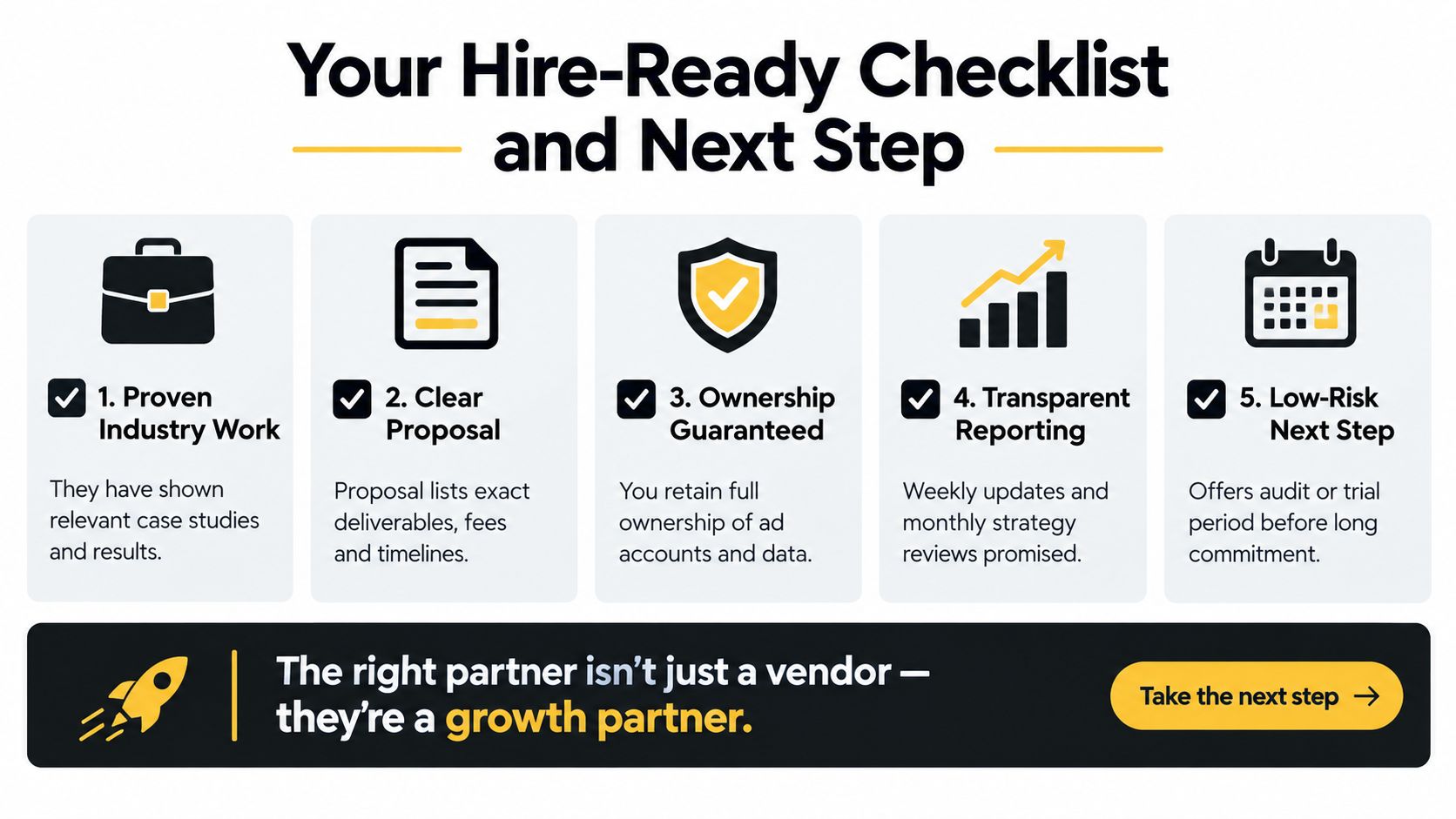
A bad PPC partnership usually looks fine on the surface. The proposal is neat, the deck sounds smart, and then nothing in the account changes. Use a scorecard before you sign. Mark each agency yes or no, then deal with the gaps transparently. If they are vague on ownership, process, or reporting, walk away.
Use this checklist in the room
- Proven industry work. They show relevant case studies and real results.
- Clear proposal. Deliverables, fees, and timelines are written down.
- Ownership guaranteed. You keep full control of ad accounts and data.
- Transparent reporting. Weekly updates and monthly strategy reviews are part of the deal.
- Low-risk entry. They offer an audit or trial period before a long commitment.
How I’d score the agencies
Give one point for every clear yes. Give zero for a vague answer, a dodged question, or a promise with no proof behind it. If an agency looks polished but cannot explain account access, reporting, or who is doing the work, it is not a fit.
Use the first call properly. Bring last quarter’s spend and conversion data, then ask them to read the account back to you in plain English. You want to hear what changed, what they are testing next, and how they will show the work is happening inside the account. If they cannot answer directly, move on.
For businesses that need paid media tied to website and conversion work, Google Ads management and broader ecommerce support are the services to ask about. The point is not the logo on the proposal. The point is whether the ad, landing page, and lead flow are all being worked on by the same team.
Alpha Omega Digital
Read more insights from our team on web design, paid ads, and growth strategy.