
I’ve seen it happen time and time again—so many Australian businesses hit a wall with their DIY ecommerce setup. As the founder of a marketing agency in Melbourne, I've been in the trenches with businesses just like yours. A true Shopify expert isn't just some developer you hire for a one-off job; they’re a strategic partner who can smash through that ceiling. They bring the technical and marketing firepower you need to turn a basic online store into a scalable, high-growth sales machine.
Why Australian Businesses Need a Shopify Expert

From my experience as a digital marketing agency in Melbourne, I've noticed a really clear pattern. A business gets started on a platform like Wix, or maybe even WordPress with WooCommerce. It works well enough at first. They get a site up, list some products, and might even make a few sales. But then, growth happens.
As sales volumes climb, the cracks in that initial platform start to show. The website slows to a crawl, managing inventory becomes a total nightmare, and trying to integrate essential Australian shipping and payment gateways turns into a technical mess. This is the exact moment when savvy business owners realise they need more than just a website; they need a proper ecommerce engine. That's when they start looking for a skilled Shopify developer.
The Great Migration to Shopify
This isn't just something I've noticed; the data backs it up completely. There’s a huge migration happening in the Australian market right now.
Statistics from early 2026 showed that in just 90 days, over 21,679 merchants in Australia made the switch to Shopify from other platforms. A massive chunk of these, almost 9,200, came directly from WooCommerce. This trend highlights a fundamental shift, with businesses actively looking for solutions that can handle serious growth without constant technical fires.
This mass move is driven by a few key triggers I see all the time:
- Scalability Issues: While powerful, WooCommerce often requires constant maintenance and plugin management that just becomes overwhelming. Many businesses find they need a dedicated WordPress developer just to keep things running.
- Need for Advanced Features: Brands want to roll out complex discount rules, loyalty programs, and slick marketing automations that are either native to Shopify or integrate seamlessly.
- Performance and Security: Business owners just get tired of dealing with slow load times and the security vulnerabilities that can plague self-hosted platforms.
The decision to hire a Shopify expert is rarely about building a new store from scratch. More often, it’s a strategic pivot made when a business’s ambition outgrows its current platform’s capabilities.
Beyond a Basic Website
A true Shopify expert does so much more than just customise a theme. They are strategists who get the entire ecommerce ecosystem. For my clients here in Australia, this local expertise is absolutely vital. It means they know the ins and outs of Australia Post integrations, how to navigate the complexities of local payment providers like Afterpay and Zip, and genuinely understand the unique behaviour of Australian online shoppers.
For example, a generic developer might not realise just how critical it is to optimise for mobile, where a huge portion of Australian ecommerce sales happen. A local expert knows this instinctively and will prioritise building a flawless mobile experience from day one. This is a core part of our philosophy at Alpha Omega Digital, our web design Melbourne agency.
Ultimately, Australian businesses need a Shopify expert to understand and implement strategies on how to improve ecommerce conversion rate and boost sales, leading to significant growth. It's about moving from simply having an online presence to running a professional, efficient, and profitable retail operation. The investment in an expert pays for itself by preventing costly mistakes and fast-tracking your path to market leadership.
Define Your Goals Before You Define Your Budget
Alright, before you even think about typing “Shopify expert” into Google, we need to have a serious chat about what your business actually needs. From my experience as a Shopify developer in Melbourne, I can tell you that "I need a new website" isn't a strategy—it's a wish. A clearly defined goal is what separates a successful project from a frustrating, expensive mess.
The very first thing I do with any new client is sit down and map out their specific objectives. This isn't just a casual chat; it’s a deep dive into the real problems and opportunities in their business. Vague goals are the direct cause of scope creep, budget blowouts, and a final product that doesn't really fix anything.
From Vague Ideas to Actionable Goals
Let's get practical. Instead of broad statements, we need to translate what you want into concrete, measurable tasks. This process forces you to think critically about what will genuinely move the needle for your business.
A good project brief should clearly outline your desired outcomes. Here are some examples of how to reframe common requests I hear all the time into goals an expert can actually work with:
The Vague Idea: "My website just feels old."
- The Actionable Goal: "Implement a full Shopify design refresh based on our new branding guidelines, with a major focus on improving the mobile user experience and cutting page load times by 30%."
The Vague Idea: "I just want to sell more."
- The Actionable Goal: "Increase the store's conversion rate by 15% in the next quarter by redesigning the product pages, streamlining the checkout, and setting up targeted Google Shopping ads for dropshipping."
The Vague Idea: "I need to connect my systems."
- The Actionable Goal: "Build a custom integration using the Shopify API to sync our third-party inventory management software with our Shopify store, ensuring real-time stock updates." This is a job for expert Shopify developers.
This level of detail is everything. It tells you exactly what kind of professional you need—a designer, a developer, a marketing specialist, or a full-service agency. If your main goal is driving traffic, for instance, you'll want to find a Facebook ads agency or a Google Ads pro, not just someone who customises themes.
Technical Needs vs. Marketing Goals
Most projects I see have a mix of technical requirements and marketing objectives. It's so important to separate them and be specific about each one.
For example, a client might come to us at our digital marketing agency in Melbourne wanting to "get better results from social media." After digging a little deeper, we usually uncover a series of connected needs that look something like this:
- The Technical Setup: The first job is always technical. We have to correctly install Google Tag Manager and set up the Meta Conversion API to make sure we're accurately tracking every single action a user takes. Without this foundation, any ad spend is just a complete guess. This is a critical step for our Facebook Meta Ads agency team.
- The Marketing Execution: Once the tracking is rock-solid, the focus shifts to marketing. This means creating a Meta ads creative testing process to find winning ad formats and copy, then launching and managing the actual campaigns.
- The Performance Analysis: Finally, we need to measure what success looks like. We would define the key metrics that matter—like Return on Ad Spend (ROAS) or Cost Per Acquisition (CPA)—and report on them clearly.
Getting this clarity upfront is the single most important step in the entire process. It ensures you’re not just hiring a Shopify expert, but the right Shopify expert for your specific challenge.
Doing this groundwork saves you from hiring a brilliant Shopify developer when what you really needed was someone to overhaul your Google Ads campaigns. A clear brief is your roadmap, and it’s what any true professional will ask for before they even think about writing a line of code or launching a single ad.
How to Find and Vet a True Shopify Partner
Alright, you've got a clear project brief in your hands. Now comes the hard part. Finding a genuine growth partner is so much more than a quick Google search for a "Shopify expert". It’s about looking past the slick portfolios and asking the tough questions that reveal true, hard-won expertise.
From my own experience as the head of a digital marketing agency in Melbourne, I've seen businesses hire the wrong person simply because they didn't know what to look for. Let’s fix that.
Where to Look for Top Talent
Your search shouldn't be confined to just one place. Casting a wide net is the best way to compare different types of experts and find someone who’s the right fit for your specific needs and, just as importantly, your budget.
Here are the main channels I always recommend exploring:
- Shopify Experts Marketplace: This is Shopify's official directory, so it’s a reliable place to start. Everyone listed has been vetted by Shopify to some degree, and you can filter your search by service, location, and budget.
- Specialised Agencies: An agency like mine, Alpha Omega Digital, brings a full suite of services together under one roof. If your project needs both Shopify development and performance marketing (like Google Ads or Meta Ads), an agency is often the most efficient choice. You get a dedicated team of specialists managed by a single point of contact.
- Freelance Platforms: Sites like Upwork have a massive pool of freelance Shopify developers. This can be a cost-effective option for smaller, well-defined tasks, but be prepared for more hands-on management from your end.
- Word-of-Mouth Referrals: Don't underestimate the power of a good recommendation. Ask other ecommerce business owners in your network who they’ve worked with and loved. A personal referral is often the most trustworthy source you can find.
The diagram below maps out the simple, effective process of defining your needs before you even start reaching out. Getting this right is half the battle.
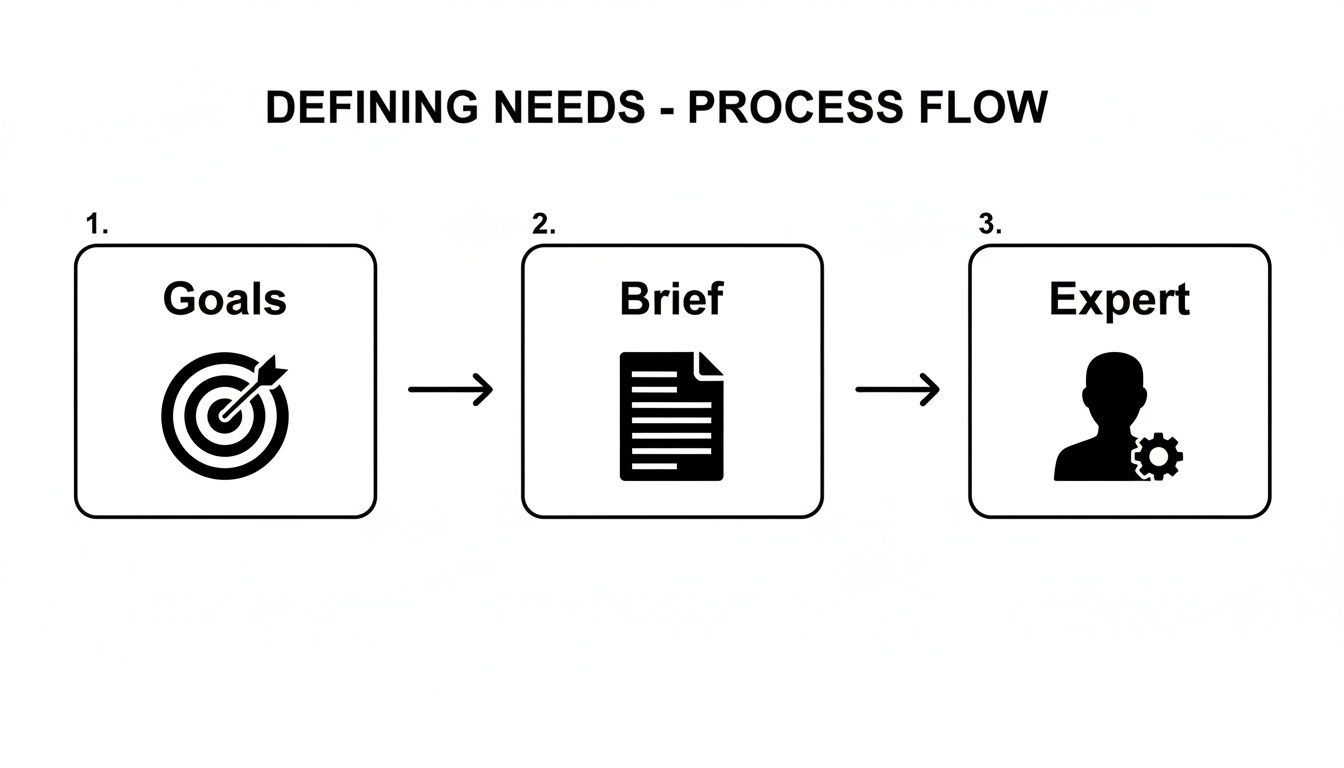
This flow really highlights the path from clarifying your goals to crafting a brief, which then empowers you to pinpoint the right type of expert for the job.
The Questions That Reveal Genuine Expertise
Once you have a shortlist, the real vetting begins. Anyone can call themselves an expert, but their answers to specific, experience-based questions will tell you everything you need to know. Vague, generic responses are a massive red flag.
I always push for the details. Here are some of the exact questions I use to separate the talkers from the doers:
For Technical and Development Roles:
- "Describe a time you used the Shopify API to solve a complex client problem. What was the issue and what was your exact solution?"
- "Walk me through how you'd approach building a custom Shopify app from scratch using Shopify CLI. What are your key steps from concept to deployment?" A good answer here separates a theme customizer from a true Shopify developer API specialist.
- "We want to integrate our WordPress blog with Shopify. How would you go about building custom Gutenberg blocks that pull in Shopify product data?" This is a key skill for any advanced WordPress development company.
For Marketing and Advertising Roles:
- "Walk me through your Meta ads creative testing process for a new fashion brand. How do you decide on a winning creative, and how long do you wait before making that call?"
- "A client's Google Shopping ads aren't spending their budget. What are the first three things you would check, and in what order?"
- "Explain the key differences between PMAX vs. standard Google Shopping ads. When would you strategically use one over the other for an ecommerce store?"
A true expert won’t just give you textbook answers. They’ll share real-world scenarios, talk about what went wrong, what they learned, and how they iterated to get results. That’s the depth of experience you’re paying for.
Spotting the Red Flags
Just as important as asking the right questions is knowing what warning signs to look for. Over the years, I've learned to spot them from a mile away.
To help you with this, I've put together a checklist that breaks down what to look for—and what to run from—when you're talking to potential partners.
Shopify Expert Vetting Checklist
| Evaluation Criteria | What to Look For | Red Flags to Watch For |
|---|---|---|
| Relevant Experience | A portfolio with projects in your industry or with similar challenges. They can articulate the business goals behind their work. | Their portfolio is full of unrelated industries. They can’t provide specific, relevant examples. |
| Communication & Process | A clear, documented process for project management. They define communication frequency and a dedicated point of contact. | They’re vague about their process or how they’ll keep you updated. It feels chaotic or disorganised. |
| Problem-Solving Skills | They confidently discuss past failures and what they learned. They answer complex questions with specific, real-world examples. | They claim they’ve never had a project fail. Their answers to technical questions are generic or textbook-level. |
| Strategic Approach | They ask deep questions about your business, customers, and revenue goals before pitching a solution. | They jump straight into a "one-size-fits-all" sales pitch without understanding your unique needs. |
| Honesty & Transparency | They talk about benchmarks, case studies, and a clear process for achieving results. | They guarantee specific results, like a "#1 ranking" or a "200% ROAS." This is impossible in marketing. |
Keep this checklist handy during your interviews. It’s a practical way to stay objective and make sure you’re not just swayed by a polished sales pitch. A confident expert will have great answers for all these points, while someone who isn't the right fit will quickly show their weak spots.
Understanding Shopify Project Costs and Pricing Models
Let’s get right to it, because I know this is the question on every business owner’s mind: what’s this actually going to cost? Talking about money can feel a bit awkward, but having run a digital marketing agency in Melbourne for years, I've learned that being transparent is the only way to build real trust. So, let's pull back the curtain on the numbers.
The truth is, there’s no one-size-fits-all price tag. The cost of hiring a Shopify expert depends entirely on how big and complex your project is. It's like asking, "How much does a house cost?" Well, are we talking about a small bathroom reno or building a brand-new mansion from the ground up?
Common Pricing Models You'll Encounter
Once you start chatting with freelancers or agencies, you’ll usually come across three main ways they structure their pricing. Each has its pros and cons, and the best fit really hinges on what your project needs.
Hourly Rates: This is pretty common for smaller jobs, ongoing support, or projects where the scope isn't perfectly clear from the get-go. Rates can vary wildly, from maybe $50/hour for an overseas freelancer to well over $200/hour for a senior Shopify developer here in Australia. You get flexibility, but you have to keep a close eye on the clock to stop costs from spiralling.
Fixed-Price Projects: If your project has a crystal-clear scope—like customising a theme or setting up a specific integration—a fixed price is perfect. You know exactly what you’re paying from day one. For example, a basic theme setup might run you a few thousand dollars, while building a custom Shopify app is often a significant five-figure investment. We use this model for a lot of our web design Melbourne projects.
Monthly Retainers: This is the model we use at Alpha Omega Digital for our ongoing growth partnerships. It's ideal for things like managing your Google Ads or running your Meta Ads campaigns. You pay a set fee each month, and you get a dedicated team to manage, optimise, and report on your marketing. It creates consistency and makes sure your brand is always moving forward.
When you're budgeting, think beyond the initial website build. A great site is just the starting point, not the finish line. The real growth comes from consistent, ongoing marketing, so make sure you factor that into your financial plans.
Setting a Realistic Budget
So, how do you actually land on a budget? Start with your goals. A simple theme tweak is a totally different financial ball game than, say, hiring a Facebook ads agency to drive a flood of new traffic.
For a new store build or a major redesign, a budget of $5,000 to $15,000 is a realistic starting point for quality work in Australia. If you need something more complex, like a Shopify developer for API work or custom integrations, you should expect to be in the $20,000+ range.
When it comes to ongoing marketing, a good rule of thumb is to have a dedicated budget for your ad spend plus a management fee. To give you an idea, most of our clients have an ad spend of at least $3,000 per month. Knowing how much it costs to start Google Ads is key; it’s not just about the agency fee but the ad spend itself.
It’s also crucial to ground your budget in the reality of your market. In Australia, the average order value (AOV) for a Shopify store sits between $85 and $92, with a massive 56.26% of all purchases happening on mobile. Understanding metrics like AOV is vital for calculating potential returns and setting realistic targets for your ad campaigns. You can discover more insights on Shopify benchmarks and their impact on profitability on chargebacks911.com. This is where a sharp Shopify expert truly earns their keep—by turning these numbers into a profitable strategy.
Building a Partnership for Long-Term Growth

A successful website launch feels like the finish line, but I’ve seen far too many businesses treat it that way. They invest a ton in a beautiful new store, pop the champagne, and then let it sit there collecting digital dust. The real growth, the kind that actually transforms a business, happens in the months and years that follow.
Thinking your work is done after going live is a massive mistake. Your Shopify store isn’t a static brochure; it’s a living, breathing sales environment that needs constant attention and optimisation. This is where a partnership with a Shopify expert shifts from a one-off project into an ongoing growth strategy.
It's also where my team and I at our marketing agency in Melbourne really get to work. We don’t just build and walk away. We partner with businesses for the long haul, focusing on the levers that actually drive sustained revenue.
Beyond the Launch Day Pop
Post-launch momentum is everything. A good expert won't just sit back and wait for you to bring them ideas; they'll be in the trenches with you, proactively finding opportunities for growth. This means digging deep into the data and using it to make smart, strategic decisions.
Once a site is live, our focus immediately pivots to key growth activities:
- Conversion Rate Optimisation (CRO): We analyse how real users behave, run A/B tests on product pages, and fine-tune the checkout process to turn more of your visitors into actual buyers.
- Advanced Analytics: We get Google Tag Manager and GA4 set up properly so you have crystal-clear data on what’s working and what isn’t. Without precise tracking, you’re just flying blind.
- Paid Ad Mastery: We don't just "run ads." We build and scale high-performing campaigns across Google Ads and Meta, constantly testing creative, audiences, and offers to maximise your return.
This continuous cycle of testing, learning, and improving is what separates the thriving ecommerce brands from the ones that stagnate. It takes a dedicated team that’s just as invested in your success as you are.
Structuring Retainers for Consistent Value
An ongoing retainer is the most effective way to structure this kind of long-term partnership. It guarantees you have a dedicated expert or team consistently working on your business, pushing it forward every single month.
Australia has become one of Shopify's top three English-speaking markets, part of a massive ecosystem of over 3 million stores combined with the US and UK. For Australian merchants, this means access to a mature network of local payment gateways and fulfilment partners. With the country ranking in the top five for Shopify traffic, competition is fierce, making continuous optimisation a flat-out necessity.
A proactive partner helps you navigate this competitive space. For sustained growth, a Shopify expert can guide you on advanced marketing strategies, including how to make UGC that converts for your e-commerce business. It’s all about staying ahead of the curve, not just keeping up.
The goal of a partnership isn’t just to maintain your website. It’s to proactively find new revenue streams, improve customer lifetime value, and build a brand that stands the test of time. Your expert should be your strategic co-pilot.
I've worked with many clients who initially came to our eCommerce marketing agency for a one-off project but stayed for the long-term growth. They saw the value in having a team that understands their brand inside and out, constantly pushing for better results. This collaborative approach is what turns a simple Shopify store into a powerful, scalable business asset.
Common Questions About Hiring a Shopify Expert
I get asked these questions all the time by Australian business owners trying to figure out who to hire. It's totally understandable—there are a lot of different titles floating around, and it can be a bit of a minefield.
Here are some straightforward answers based on my experience helping ecommerce brands in Melbourne and across Australia find the right fit for their team. The goal is to give you a clear, no-nonsense breakdown so you can confidently decide who you need to bring on board.
What Is the Difference Between a Shopify Expert, a Developer, and a Marketer?
This is easily the most common question I get, and it’s a really important one. Hiring the wrong professional for your specific problem is a fast track to wasting time and money.
While their skills can definitely overlap, their core jobs are very different.
Think of it like building a house. You need an architect to draw the plans (the strategist), a builder to construct the frame (the developer), and a real estate agent to bring in buyers (the marketer). They all work on the same house, but they have distinct, critical roles.
To clear things up, I've put together a simple table that breaks down these roles based on the projects we handle here at our marketing agency in Melbourne.
A quick-reference table like this is super helpful for clarifying who does what. It helps you pinpoint exactly which type of professional you need for your Shopify store right now.
Shopify Expert vs Developer vs Marketer
| Role | Primary Focus | When to Hire Them |
|---|---|---|
| Shopify Expert (Strategist) | The big picture of business growth. They connect the dots between your site's performance, marketing, and revenue goals. They define the "what" and the "why." | When you need a high-level plan to increase revenue but aren't sure which levers to pull first. They can oversee both development and marketing. |
| Shopify Developer | The technical nuts and bolts of your store. They handle theme customisations, building custom apps via the Shopify API, fixing bugs, and improving site speed. They build the "how." | When you need custom features, have to integrate third-party systems, need to fix a broken site, or are doing a complex migration. This is a core part of what our Shopify developers in Melbourne do. |
| Digital Marketer | Driving qualified traffic and turning visitors into paying customers. They manage channels like Google Ads, Meta Ads, SEO, and email marketing. They bring you the audience. | When your site is technically solid but you’re just not getting enough traffic or sales. You might need a specialised Facebook ads agency or a Google Ads agency. |
Your choice really comes down to identifying the single biggest bottleneck holding your store back. Is it a technical issue, a lack of traffic, or a missing overall strategy? Answering that will point you directly to the right professional.
My best advice is to first identify your biggest bottleneck. Is it a technical issue holding you back, a lack of traffic, or a need for an overarching strategy? Your answer will point you directly to the right professional.
Can't I Just Do It Myself with an App?
Absolutely, and for many businesses just starting out, apps are a fantastic solution. The Shopify App Store is filled with incredible tools that can add powerful features to your store without needing to write a single line of code.
But a problem often comes up when you start "Frankensteining" your store—bolting on dozens of different apps from different developers.
Each app adds its own code, which can seriously slow down your site. They can also conflict with each other, leading to weird bugs that are a nightmare to troubleshoot. At some point, the cost and headache of managing all those apps just isn't worth it.
A custom solution built by a Shopify developer is often far more efficient, faster, and perfectly tailored to your business workflow.
Do I Need to Hire Someone Local in Australia?
While you can technically work with anyone in the world, I've found there are huge advantages to hiring a local Australian expert or agency.
They just get the nuances of the local market—from navigating Australia Post's shipping quirks to integrating local payment gateways like Afterpay and Zip that your customers expect to see.
More importantly, they work on your time zone. When you need urgent support for a site issue, you don’t want to be waiting 12 hours for someone on the other side of the world to wake up.
This is why businesses from Sydney to Perth often seek out Melbourne-based agencies like ours—for that shared understanding and real-time accessibility.
If you're a business with a paid ads budget of at least 3k a month, I'd love to offer you a low-risk deal—get a month of paid ads management FREE. Apply now through the Alpha Omega Digital contact page.