Let’s be honest, talking about website development for ecommerce can feel a bit dry. But after years of working as a marketing agency in Melbourne, I’ve seen firsthand that your website isn’t just a digital storefront—it’s the engine of your entire business. Get it right, and you’re building a machine that prints money. Get it wrong, and you’re just leaking cash, customers, and opportunities.
This isn’t just about making things look pretty. It’s about engineering a seamless customer journey from the first click to the final “thank you for your order” page. It’s about building a platform that’s not only fast and secure but also perfectly integrated with your marketing efforts, from Google Ads to Facebook ads, so you can actually measure what’s working.
In this guide, I’m going to walk you through the real-world decisions you need to make, based on my experience helping Australian ecommerce businesses scale. We’ll cover everything from choosing the right platform like Shopify or WordPress, to setting up the essential tracking like the Meta Conversions API and Google Analytics, and even diving into advanced topics like building custom Shopify apps or Gutenberg blocks.
Table of Contents
- Why Your Ecommerce Store Is Leaking Money (And How to Fix It)
- The True Cost of a Poorly Built Website
- From Leaks to Profits: A Melbourne Story
- Shopify Vs WordPress: Making the Right Platform Choice
- The Case for Shopify: Simplicity and Speed for Rapid Growth
- The Power of WordPress: Ultimate Customisation and SEO
- Shopify Vs WordPress (WooCommerce) At A Glance
- The Blueprint For A High-Converting Ecommerce Site
- Crystal-Clear Navigation and Site Search
- High-Quality Product Pages That Sell
- A Frictionless Checkout Process
- Don’t Forget Site Speed And Mobile Experience
- Integrating Your Website with a Powerful Marketing Engine
- Building The Technical SEO Foundation
- Setting Up Your Data and Tracking Engine: GTM, GA4, and Meta CAPI
- Mastering Facebook Ads: A Creative Testing Process
- Running Paid Ads for Ecommerce and Service Businesses
- A Beginner’s Guide to Google Shopping Ads
- Google Ads for Service-Based Businesses: Capturing Leads
- PMAX vs. Standard Google Shopping Ads: What I’ve Learned
- What Budget Should You Spend on Google Ads?
- Advanced Development: Taking Your Store to the Next Level
- A Shopify Development Crash Course: Custom Apps with Shopify CLI
- Building Custom Blocks in Gutenberg for WordPress
- Leveraging the Shopify Developer API for Custom Integrations
- Local SEO for Australian Businesses: Getting Found in Your Suburb
- The Power of Google Business Profile (Formerly GMB)
- Why You Need a Melbourne SEO Agency
- The Rise of AI in Customer Service: AI Voice Agents
- What is an AI Voice Agent and How Does It Work?
- Real-World Benefits: Saving Lost Business for Tradies and Salons
- AI Receptionist Australia: Pricing and Features
- Budgeting For Your Ecommerce Website Project
- Factors That Influence Your Project Cost
- Realistic Budget Ranges for Australian Businesses
- Common Questions About Ecommerce Development
- How Long Does It Take To Build An Ecommerce Website?
- Can I Handle Website Development Myself To Save Money?
- What Ongoing Costs Are Involved After The Website Is Built?
1. Why Your Ecommerce Store Is Leaking Money (And How to Fix It)
I’ve seen it more times than I can count in my work as a marketing agency in Melbourne: a brilliant product completely crippled by a clunky, slow, or sketchy-looking website. The biggest lever you can pull for ecommerce growth isn’t a flashier design; it’s rock-solid website development for ecommerce that builds a system to find and convert customers.
Think of your website as your flagship store in the busiest part of town. You wouldn’t let the paint peel, the lights flicker, or have a messy layout that confuses everyone who walks in, right? The same rules apply online, except the consequences of a bad first impression are instant and brutally measurable.
The True Cost of a Poorly Built Website
A shoddy website isn’t just a minor headache; it’s a silent drain on your revenue. Every single person who clicks away from your site out of pure frustration is a lost sale, and from my experience with Aussie businesses, these are the most common leaks bleeding cash from your bottom line:
- High Bounce Rates from Slow Load Times: If your site takes more than a couple of seconds to load, your visitors are already gone. They simply won’t hang around to see your products, no matter how amazing they are.
- Abandoned Carts Due to Clunky Checkouts: Nothing kills a sale faster than a confusing or long-winded checkout process. Customers expect a fast, simple, and secure way to hand over their money.
- Lost Trust and Credibility: A glitchy or poorly designed site screams unprofessionalism. It makes people think twice before typing in their credit card details.
- Missed Opportunities from a Bad User Experience (UX): When people can’t find what they’re looking for easily, they don’t just leave; they head straight to your competitor’s site.
On top of that, inefficient or insecure payment gateways are a huge culprit for lost sales. Knowing how to integrate robust expert payment solutions is absolutely critical. Just one point of friction here can send your conversion rates off a cliff.
From Leaks to Profits: A Melbourne Story
I remember working with a local fashion brand here in Melbourne. They had incredible designs and a solid social media following, but their online sales were completely flat. It didn’t take long to see why: their website was painfully slow, especially on mobile, and finding anything was a nightmare.
We dug into their analytics and found that nearly 70% of their cart abandonments happened the second shipping costs were revealed. Even worse, their mobile bounce rate was over 80%. The site was actively pushing paying customers away.
We rebuilt their website from the ground up, focusing on lightning-fast speed, a mobile-first design, and a transparent, one-page checkout. The results were immediate. Within three months of the relaunch, their mobile conversion rate tripled, and their overall revenue jumped by 45%.
This wasn’t some kind of marketing magic. We just plugged the leaks by investing in proper website development for ecommerce. It’s proof that your website isn’t just a digital brochure; it’s your hardest-working salesperson, on the clock 24/7. When you build it right, it doesn’t leak money—it prints it.
2. Shopify Vs WordPress: Making the Right Platform Choice
The first big question every Aussie ecommerce founder asks is, ‘Should I build my store on Shopify or WordPress with WooCommerce?’ Having built and scaled stores on both, I can tell you there’s no single right answer. The best choice always comes down to your business model, where you see yourself in five years, and how much you want to get your hands dirty with the technical side of things.
Forget the generic feature lists you’ve seen a hundred times. Let’s talk about real-world scenarios I deal with daily. This is the practical, hands-on comparison from someone who’s seen what works (and what doesn’t) for businesses right here in Australia.
The Case for Shopify: Simplicity and Speed for Rapid Growth
For most startups and small businesses, Shopify is an absolute powerhouse. Why? It’s an all-in-one, hosted solution. This means you don’t have to stress about finding a separate web host, managing security updates, or dealing with the technical headaches that pop up with open-source platforms. It just works, straight out of the box.
Think of Shopify as leasing a prime retail space in a high-end shopping centre. The management handles security, maintenance, and the building’s infrastructure. You just focus on designing your store’s interior (your theme), stocking your shelves (adding products), and serving your customers. As an experienced Shopify developer, I’ve seen this platform transform businesses.
Here’s where professional Shopify development can make a massive difference:
- Rapid Launch: We can get a beautiful, functional store live much faster than a custom build, which is perfect when you need to start selling yesterday.
- Bulletproof Security: Shopify handles all PCI compliance and security protocols. This is a massive weight off your shoulders.
- Integrated Ecosystem: Its app store is incredible. Need advanced inventory management or a loyalty program? There’s an app for that, and it usually integrates seamlessly. Our team are official Shopify development partners and know the ecosystem inside out.
The entire platform is built for one thing: selling. Every feature, from the streamlined checkout to inventory tracking, is optimised for commerce. This focus makes it incredibly user-friendly for store owners who just want to run their business.
The flowchart below shows just how easily things can go wrong with a poorly optimised website. A platform like Shopify helps you sidestep many of these foundational issues from day one.
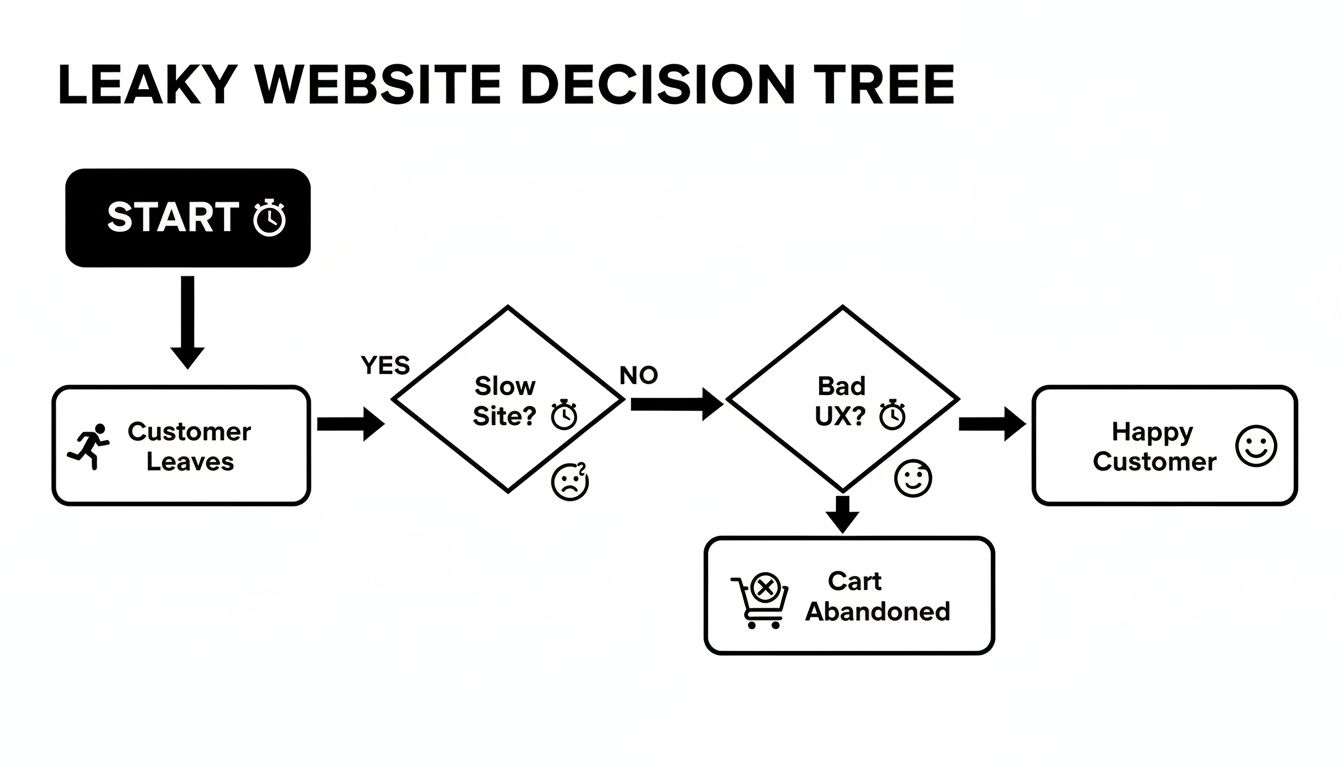
As you can see, basic problems like slow speed or clunky design lead directly to lost customers. A stable, fast platform isn’t a luxury; it’s the price of entry.
The Power of WordPress: Ultimate Customisation and SEO
Now, let’s talk about WordPress with the WooCommerce plugin. If Shopify is like leasing a retail space, think of WordPress as buying your own block of land and building a custom store from the ground up. The potential is limitless, but you’re also responsible for the foundation, the plumbing, and the security.
This is where our team of WordPress developers in Melbourne truly shines. WordPress is the go-to for businesses that need something genuinely unique or have a strong focus on content marketing. I’ve worked as a /wordpress-developer/ for years, and its flexibility is unmatched.
The core strength of WordPress is its complete flexibility. If you can dream it, a skilled WordPress web developer can build it. You are never limited by the platform’s constraints.
So, when is WordPress the right move?
- Complex Product Configurations: If you sell products with tons of variations, require a unique quoting system, or need custom options, WordPress offers the flexibility to build it perfectly.
- Content-Driven Brands: No platform beats WordPress for blogging and content. If your strategy relies on extensive guides, articles, and SEO-driven content, it’s the undisputed champion.
- Unique Functionality: Need to integrate with a custom CRM, a bespoke inventory system, or build a feature that doesn’t exist in any app store? Full-scale WordPress development makes it possible. A proper wordpress-website-developer can bring any vision to life.
The trade-off is that you’re in charge of hosting, security, and maintenance. While this gives you total control, it also means more responsibility. For many established brands looking to create a one-of-a-kind digital flagship, this control is exactly what they need to stand out. The right WordPress development company will manage all the technical heavy lifting for you, giving you the best of both worlds. We’ve helped clients in /wordpress-developer-melbourne and /wordpress-developer-sydney achieve exactly this.
Shopify Vs WordPress (WooCommerce) At A Glance
To make the decision a bit clearer, here’s a direct comparison of the key points for Australian ecommerce businesses.
| Feature | Shopify | WordPress (WooCommerce) |
|---|---|---|
| Ease of Use | Excellent. Very beginner-friendly with a clean, intuitive interface designed purely for ecommerce. | Moderate. Requires more of a learning curve. You’ll manage hosting, plugins, and updates yourself. |
| Hosting & Security | Included. Fully hosted, with top-tier security and PCI compliance handled for you. | DIY. You choose your own hosting provider and are responsible for security measures and updates. |
| Customisation | Good. Highly customisable through themes and a vast app store, but you operate within Shopify’s rules. | Unlimited. Complete freedom. You can build absolutely anything you can imagine. |
| Content & SEO | Good. Has solid blogging features, but WordPress is the undisputed king of content-heavy SEO. | Excellent. Unmatched for blogging, content marketing, and advanced on-page SEO control. |
| Ongoing Costs | Predictable. Monthly subscription fee plus transaction fees (unless using Shopify Payments). | Variable. Lower initial software cost (it’s free), but hosting, premium plugins, and developer fees add up. |
| Best For | Startups, small businesses, and brands wanting a fast, secure, and hassle-free path to selling online. | Brands needing unique functionality, complex product setups, or a heavy content marketing focus. |
Ultimately, there’s no “winner” here. Shopify gets you to market faster with less fuss, making it ideal for the majority of new stores. WordPress offers unparalleled freedom for those with specific, complex needs or a grand vision that won’t fit into a template. The right choice depends entirely on what you’re building.
3. The Blueprint For A High-Converting Ecommerce Site
A beautiful website that doesn’t sell is just an expensive digital brochure. From my experience managing campaigns as a marketing agency in Melbourne, I’ve seen that the jump from a 1% to a 4% conversion rate often boils down to a handful of critical features. These are the absolute non-negotiables for your ecommerce site.
This isn’t about chasing fleeting trends; it’s about understanding customer psychology and removing every single point of friction between a visitor and that checkout button. A store that feels fast, trustworthy, and easy to navigate will always outperform a competitor that misses these fundamentals.
Crystal-Clear Navigation and Site Search
If customers can’t find what they want in a few clicks, they’re gone. It’s that simple. Your navigation should be so intuitive that a first-time visitor knows exactly where to go without even thinking about it. Picture it as the clear, well-lit aisles in a physical store.
I always advise clients to invest in a powerful on-site search function. Shoppers who use search are 2-3 times more likely to convert because they have high buyer intent. They know what they want; your job is to help them find it instantly.
High-Quality Product Pages That Sell
Your product page is your digital salesperson. It needs to do more than just list features; it has to create desire and build unshakeable confidence.
Here’s what every high-converting product page needs:
- Stunning Imagery and Video: Show your product from every angle. Use high-resolution photos, lifestyle shots, and short videos to demonstrate it in action.
- Compelling Product Descriptions: Go beyond the specs. Tell a story about how the product solves a problem or improves the customer’s life.
- An Obvious Call-to-Action (CTA): The ‘Add to Cart’ button should be impossible to miss. Use a contrasting colour that makes it pop right off the page.
- Social Proof: Display customer reviews, ratings, and testimonials prominently. Nothing builds trust faster than seeing other people loving your product. It’s also crucial to set up your Instagram Shop and Facebook Shop to tag products directly in your social posts, creating a seamless path to purchase.
To make sure your ecommerce site is firing on all cylinders, it’s crucial to implement effective strategies for improving e-commerce conversion rates and stop your store from ‘leaking money’. This is where small tweaks to your product pages and checkout can have a massive impact on your bottom line.
A Frictionless Checkout Process
The checkout is where most sales are won or lost. I’ve seen cart abandonment rates of over 70% purely because of a clunky, confusing, or untrustworthy checkout process.
Your goal is to make it as simple as humanly possible for someone to give you their money.
Simplicity is the ultimate sophistication. A one-page checkout, multiple payment options (like Afterpay, PayPal, and Apple Pay), and clear shipping costs upfront can dramatically reduce abandoned carts. Don’t surprise customers with unexpected fees at the final step.
The Australian online retail market is absolutely booming, creating a massive opportunity. By June 2025, online sales in Australia hit $4,703.8 million in a single month, a 3.9% rise. This surge means online sales now account for 12.7% of all retail, with categories like furniture and fashion jumping 21.9% and 14.8% respectively. For Melbourne businesses on Shopify or WordPress, professional website development is essential to convert this growing traffic.
Don’t Forget Site Speed And Mobile Experience
Finally, none of the above matters if your site is slow. A one-second delay in page load time can result in a 7% reduction in conversions. In an ecommerce context, that’s a huge amount of lost revenue. Your site must be lightning-fast on both desktop and mobile.
With over half of all online traffic now coming from mobile devices, your site must be designed for the small screen first. A responsive design isn’t enough; you need a mobile-first experience that is easy to navigate and purchase from with just a thumb. These elements form the bedrock of successful website development for ecommerce. Get them right, and you’re building a foundation for sustainable growth.
4. Integrating Your Website with a Powerful Marketing Engine
Here’s something I’ve seen happen way too often: a business pours a massive budget into a gorgeous new website, launches it, and then… crickets. They sit back and wonder why nobody’s showing up. The secret isn’t just launching a pretty site; it’s weaving your marketing strategy directly into the website development for ecommerce process from day one.
As a digital marketing agency in Melbourne, we don’t just build websites; we build marketing engines. That means every site is constructed with SEO and paid advertising in mind from the ground up. It’s not just a digital storefront—it’s a customer-attracting machine.
Building The Technical SEO Foundation
You can’t just bolt on SEO after your site is built. A high-ranking website is built on a rock-solid technical foundation, which is why it’s one of our first priorities during development. This isn’t about stuffing keywords into pages. It’s about making your site easy for Google to understand, crawl, and ultimately, reward with visibility.
These are the technical SEO cornerstones we build into every single ecommerce project:
- Mobile-First Indexing: Google now primarily uses the mobile version of a website for ranking. So, we design and build for the mobile experience first, making sure it’s fast, flawless, and functional.
- Core Web Vitals: These are Google’s metrics for measuring real-world user experience—things like loading speed, how quickly users can interact with the page, and visual stability. A site that scores well here is far more likely to rank higher.
- Product Schema Markup: This is a type of code that gives search engines specific details about your products, like price, stock levels, and review ratings. It’s the magic behind those eye-catching “rich snippets” in search results that pull in way more clicks.
- Logical URL Structure: Clean, descriptive URLs (like
/shoes/running-shoes/product-name) are infinitely better for both users and search engines than messy, auto-generated ones.
These elements are mostly invisible to the average visitor, but they are absolutely critical for attracting organic traffic. Without them, you’ve essentially built a beautiful shop in the middle of the desert with no roads leading to it.
Setting Up Your Data and Tracking Engine: GTM, GA4, and Meta CAPI
A website without proper tracking is like flying a plane blindfolded. You have no idea what’s working, where your customers are coming from, or how to make things better. This is where we bridge the gap between development and profitable marketing.
The setup might seem a bit technical, but getting it right is non-negotiable for making smart, data-driven decisions. We start by setting up Google Tag Manager containers.
The accuracy of your marketing data directly impacts your return on ad spend. Without a solid tracking setup, you’re just guessing with your budget. We make sure every dollar is tracked, optimised, and delivers a measurable return.
Here’s the standard technical marketing stack we install:
- Google Tag Manager (GTM): We set up a GTM container, which acts as a central hub for all your tracking codes (or “tags”). This lets our marketing team manage and deploy new tracking snippets without needing to bother a developer for every little change. GTM and Google Analytics are the foundation of good data.
- Google Analytics 4 (GA4): Through GTM, we connect your site to GA4 and configure all the key ecommerce events, like
view_item,add_to_cart, andpurchase. This gives you a complete picture of how users behave on your site. - Meta Conversions API (CAPI): Since Apple’s iOS updates made browser-based pixel tracking less reliable, this has become essential. Our Conversions API installation for Meta sends data directly from your server to Meta’s servers. This gives our Facebook ads agency much more accurate tracking, leading to better ad optimisation and reporting you can actually trust. We have a detailed process for setting up the Meta Conversion API.
This integrated approach ensures that from the moment your site goes live, it’s not just selling products—it’s a sophisticated data collection tool. It allows our Google Ads and Meta ads teams to see exactly which campaigns are driving revenue, so we can double down on what works and kill what doesn’t.
Mastering Facebook Ads: A Creative Testing Process
Running successful Meta ads isn’t a “set it and forget it” game. It requires a relentless Meta ads creative testing process. This is how we find winning ad creatives that resonate with your audience and drive sales. The key is consistency. Marketing your business = consistency. You can’t just run a few ads and give up. We often hear from clients that they’re frustrated with their results, but my advice for Facebook ads – don’t quit too early. It takes time to gather data and find what works. A huge part of this is knowing how to measure success on Facebook ads, which goes beyond just looking at sales and includes metrics like ROAS, CPA, and click-through rates.
5. Running Paid Ads for Ecommerce and Service Businesses
Once your site is built and your tracking is solid, it’s time to drive traffic. Paid advertising is the fastest way to get your products in front of high-intent buyers.
A Beginner’s Guide to Google Shopping Ads
For any ecommerce store, Google Shopping Ads are non-negotiable. These are the product listings with images and prices you see at the top of Google search results. They are incredibly effective because they capture users who are actively searching for what you sell. My top tip is to start with a well-structured product feed and a simple campaign. If you’re into Google Shopping Ads for dropshipping, make sure your shipping times are clearly stated to manage customer expectations.
A common issue I see is Google Shopping Ads not spending budget. This is often due to low bids, a disapproved product feed, or narrow targeting. It’s a frustrating problem, but usually fixable by methodically checking your campaign settings and Merchant Center account. Understanding campaign priority in Google Ads is also key to ensuring the right campaigns serve for the right queries.
Google Ads for Service-Based Businesses: Capturing Leads
It’s not just about ecommerce. Google Ads for service-based businesses are incredibly powerful. I’ve run successful campaigns for tradies, consultants, and local professionals. Here, the goal is often Google Ads for contact form submissions or phone calls. A solid strategy involves targeted keywords, compelling ad copy that speaks to a pain point, and a high-converting landing page. We even specialise in PPC for tradies, using specific tactics to generate qualified job leads. For call-based campaigns, using the best call tracking softwares for PPC call campaigns (e.g., CallRail, Go High Level) is essential to attribute calls back to the exact keyword and ad that generated them.
PMAX vs. Standard Google Shopping Ads: What I’ve Learned
The big debate right now is PMAX vs. Google Shopping Ads. Performance Max (PMAX) is Google’s automated, all-in-one campaign type. From my experience, PMAX can deliver incredible results by leveraging Google’s AI across all its channels (YouTube, Display, Search, etc.). However, it offers less control than Standard Shopping. For new businesses, PMAX is often a great starting point. For established brands with specific goals, a hybrid approach using both campaign types can be the most effective strategy.
What Budget Should You Spend on Google Ads?
This is the million-dollar question. I always tell clients: start with a budget you’re comfortable testing with, one that won’t break the bank if you don’t see an immediate return. A good starting point for a small business in Australia is often around $50-$100 per day. The key is to gather enough data to make informed decisions. Answering how much does it cost to start Google Ads depends on your industry and goals, but you need to be prepared to invest for at least 3 months to see real traction. The focus should be on return on ad spend (ROAS), not just the initial cost.
6. Advanced Development: Taking Your Store to the Next Level
Once you have the fundamentals down, you can start exploring more advanced development to create a truly unique customer experience and streamline your operations.
A Shopify Development Crash Course: Custom Apps with Shopify CLI
Sometimes, the Shopify App Store doesn’t have the exact solution you need. That’s when we start building custom Shopify apps using Shopify CLI. This command-line interface allows our developers to quickly spin up, test, and deploy bespoke applications that integrate seamlessly with your store. Whether it’s a unique product customizer, an integration with a niche ERP, or a custom reporting dashboard, a custom app gives you functionality that your competitors can’t just install. This is the heart of our Shopify development crash course for clients who want to understand the possibilities.
Building Custom Blocks in Gutenberg for WordPress
For our WordPress clients, one of the most powerful tools in our arsenal is building custom blocks in Gutenberg. Instead of being locked into a rigid page builder, we can create bespoke, reusable content blocks that are perfectly tailored to your brand. This could be a unique “Meet the Team” block, a custom testimonial slider, or an advanced product grid. It gives your marketing team the flexibility to build beautiful, on-brand pages without ever needing to touch a line of code.
Leveraging the Shopify Developer API for Custom Integrations
The true power of Shopify is unlocked through its API. As an experienced team of shopify-developers, we use the Shopify developer API to build powerful connections between your store and other business-critical systems. This could involve syncing inventory with a third-party logistics (3PL) provider, pushing customer data to a sophisticated CRM, or creating a custom checkout experience. This level of integration is what separates a simple online store from a scalable, automated ecommerce machine.
7. Local SEO for Australian Businesses: Getting Found in Your Suburb
For businesses with a physical presence or a defined service area, showing up in local search results is everything. This is where Local SEO comes in.
The Power of Google Business Profile (Formerly GMB)
Your Google Business Profile (often still called GMB) is your most important asset for local search. It’s the listing that appears in Google Maps and the “local pack” in search results. I’ve helped countless Melbourne businesses optimise their profiles to rank higher. This involves ensuring all your information is accurate, selecting the right categories, actively gathering customer reviews, and regularly posting updates and photos. It’s a simple, free tool that drives real foot traffic and phone calls.
Why You Need a Melbourne SEO Agency
While you can manage your GMB profile yourself, a dedicated SEO agency in Melbourne can take your local visibility to the next level. We handle everything from local keyword research and on-page optimization to building local citations and creating content that targets your specific service areas. The goal is to make your business the obvious choice for anyone searching for your services in Melbourne.
8. The Rise of AI in Customer Service: AI Voice Agents
One of the most exciting areas I’m working on with clients is the implementation of AI Voice Agents. This technology is a game-changer for service-based businesses that rely on phone calls for bookings and inquiries.
What is an AI Voice Agent and How Does It Work?
An AI Voice Agent, sometimes called an AI receptionist, is an automated system that can answer phone calls, have natural conversations with customers, and perform tasks like booking appointments. We set up a custom number for your business through a service like Twilio. When a customer calls, the AI answers instantly, 24/7.
Real-World Benefits: Saving Lost Business for Tradies and Salons
Think about a busy hairdresser, dentist, or tradie. How many calls do they miss while they’re with a client or on a job site? Each missed call is potentially thousands in lost business. Our ai-voice-agent solves this problem. It never gets sick or tired, provides 24-hour call answering, and can book appointments directly into your calendar or Calendly. This is a revolutionary tool for hairdressers, beauty therapists, dentists, restaurants, and doctors who can’t afford to miss a single booking. The ai-appointment-setter ensures your calendar stays full without you having to lift a finger.
AI Receptionist Australia: Pricing and Features
We are seeing a huge demand for the ai receptionist in Australia. The ai voice agent pricing is incredibly cost-effective compared to hiring a full-time human receptionist. For a fraction of the cost, you get a reliable system that captures every lead and books every possible appointment. Our solutions using ai-voice-agents are designed to pay for themselves in just a few weeks by preventing lost revenue. We are also seeing a rise in demand for teams of ai appointment setters that can handle high call volumes for larger businesses.
9. Budgeting For Your Ecommerce Website Project
“So, how much does an ecommerce website actually cost?” It’s a question I get asked nearly every week, and while the honest answer is always “it depends,” that’s not much help when you’re trying to build a budget.
So, I’m going to give you a straight-up breakdown of what to expect, based on the projects we handle day in and day out.
Think of building an ecommerce website like building a house. You can go for a simple, pre-designed template, a semi-custom model with some unique finishes, or a completely bespoke architectural masterpiece. Each one has a different price tag and timeline, and the right choice really comes down to your specific needs and goals.
Factors That Influence Your Project Cost
The final quote you receive isn’t a number we just pull out of thin air. It’s a direct reflection of the time, skill, and complexity needed to build a store that doesn’t just look good but actually works flawlessly and is ready to grow with you.
Here are the main things that move the needle on cost:
- Platform Choice: As we’ve covered, a Shopify build is often more straightforward than a custom WordPress development project. The extra complexity and custom coding required for WordPress naturally mean a higher investment.
- Design Complexity: Are you happy with a premium, pre-built theme that we heavily customise to fit your brand? Or do you need a completely unique design built from scratch? A bespoke design involves a deep dive into UX/UI, wireframing, and custom coding, which requires a bigger budget.
- Custom Features and Integrations: This is a big one. Need to hook into a specialised inventory system using the Shopify developer API? Or maybe you need a custom product configurator built for WordPress? Every unique feature adds to the development timeline and, in turn, the cost.
Realistic Budget Ranges for Australian Businesses
Alright, let’s get into some real numbers. These are the typical ranges you can expect, but remember, a detailed quote will always come down to your specific requirements.
1. Basic Shopify Store (Theme Customisation)
This is the fastest, most cost-effective way to get your store online. We take a high-quality premium theme, customise it with your branding, set up all your products and payment gateways, and get you ready to sell.
- Typical Budget: $5,000 – $10,000
- Typical Timeline: 4-8 Weeks
2. Custom Design on Shopify or WordPress
For businesses that want a look and feel that’s truly their own, we’ll design a custom theme from the ground up. This involves a full design process before our /shopify-developers or /wordpress-developers bring it to life.
- Typical Budget: $15,000 – $30,000+
- Typical Timeline: 10-16 Weeks
3. Fully Bespoke WordPress/WooCommerce Build
This is for established businesses needing complex features, deep system integrations, or a completely unique user experience. This is where a dedicated WordPress developer in Sydney or Melbourne from a top /wordpress-development-company builds a true digital flagship for your brand.
- Typical Budget: $30,000 – $70,000+
- Typical Timeline: 4-6+ Months
Investing properly in your website is more critical than ever. In 2024, the Australian eCommerce market hit a staggering $69 billion in total online spend, fueled by 9.8 million households shopping online. With 17.08 million monthly shoppers—a 45% jump from 2020—poor website development means leaving a massive amount of money on the table for your competitors. Discover more about these Australian ecommerce trends on oceanportlink.com.
These numbers prove the opportunity is massive. A well-built website isn’t an expense; it’s your ticket to getting a piece of this huge, growing market. Your investment in a professional build pays for itself through higher conversions, better customer loyalty, and a solid foundation you can actually grow on.
10. Common Questions About Ecommerce Development
Over the years, I’ve had countless conversations with Melbourne business owners about getting their stores online. They’re often wrestling with the same set of questions about website development for ecommerce. Here are the most common ones I hear, with honest answers based on my direct experience helping brands succeed.
How Long Does It Take To Build An Ecommerce Website?
This is the classic “how long is a piece of string?” question, but I can give you some solid benchmarks. A basic Shopify store, where we customise a pre-built theme, can often be designed, developed, and launched in as little as 4 to 6 weeks. It’s a great way to get to market quickly without cutting corners.
But if you’re after a completely custom-designed Shopify or WordPress site with specific features and integrations, the timeline naturally extends. A project like that typically takes 3 to 6 months from our initial chat to launch day. The final timeframe really depends on things like design revisions, how complex the custom features are, and how many third-party systems we need to connect.
Can I Handle Website Development Myself To Save Money?
Technically, yes. Platforms like Shopify are designed to make it possible for anyone to set up a store. But here’s the reality I’ve seen play out: what you save in upfront cost, you often pay for tenfold in lost sales, security vulnerabilities, and technical headaches down the road.
Professional development ensures your site is secure, fast, and optimised for mobile from day one. More importantly, it guarantees your SEO and marketing analytics are set up correctly, so you’re not flying blind when you start running ads.
Investing in an expert build saves you from accumulating “technical debt”—all those small issues that snowball into massive, expensive problems later on.
What Ongoing Costs Are Involved After The Website Is Built?
Launching your site is a huge milestone, but it’s not the end of the financial story. It’s smart to budget for a few recurring costs to keep your store running smoothly and securely.
These ongoing expenses usually include:
- Platform Fees: Your monthly Shopify subscription or the equivalent for other platforms.
- Domain and Hosting: For WordPress sites, you’ll have annual costs for your domain name and monthly fees for web hosting.
- Premium Apps/Plugins: Many of the best features rely on paid third-party apps, which often have monthly or annual fees.
- Maintenance and Support: A small budget for ongoing support from your agency is wise. This covers security updates, bug fixes, and small improvements to keep your site in top shape.
The opportunity in Australian ecommerce right now is immense and absolutely justifies these investments. In 2024, online shoppers numbered 17.08 million monthly, a massive 45% jump from 2020. This boom led to a yearly spend of $63.6 billion, making up 9.35% of total retail sales. For Melbourne startups, a superior website is critical to capture a piece of this market, especially since 46% of shoppers will ditch their cart over a poor returns process alone. You can read more about these retail trade statistics from the ABS to see the full picture.
Alpha Omega Digital is a marketing agency based in Melbourne, Australia but also services clients from Sydney, Brisbane, Newcastle, Perth, Adelaide, Darwin and Hobart. Have a project in mind? Contact us.