If I've learned one thing after years in this game, it's that a stunning website that doesn't actually bring in business is just an expensive digital brochure. As a marketing agency based right here in Melbourne, I've seen countless local businesses pour money into a beautiful website, only to watch it fail spectacularly. They get a site that looks the part but doesn't bring in a single lead or sale.
This guide is the culmination of my real-world experience. I'm going to pull back the curtain on what it really takes to succeed online, from building a high-performance website to driving profitable traffic with paid ads and SEO. We'll be diving deep into the strategies I use every day for my clients, especially those in the highly competitive eCommerce space.
Forget the generic advice. This is a practical, no-fluff guide for Melbourne business owners who are ready to turn their online presence into their most powerful asset.
Table of Contents
- Why Your Website Is More Than Just a Digital Brochure
- The Performance-Driven Approach I Swear By
- The Hidden Costs of a 'Cheap Website'
- Red Flags to Watch For When Choosing a Provider
- Mastering Web Development: WordPress & Shopify
- WordPress Development: The Power of Customisation
- Why I Recommend Custom WordPress Development
- Building Custom Blocks in Gutenberg
- Shopify Development: The eCommerce King
- Why Shopify is a Game-Changer for Online Stores
- Building Custom Shopify Apps Using Shopify CLI
- Leveraging the Shopify API for Advanced Integrations
- WordPress Development: The Power of Customisation
- Driving Traffic: The Art & Science of Paid Advertising
- Mastering Facebook & Instagram Ads
- Setting Up the Meta Conversion API (CAPI)
- The Meta Ads Creative Testing Process That Works
- How to Measure Success and Why You Shouldn't Quit Too Early
- A Beginner's Guide to Google Ads
- What Budget Should You Spend on Google Ads?
- Google Ads for Service-Based Businesses vs. eCommerce
- Campaign Priority in Google Ads: Understanding the Hierarchy
- The Ultimate Guide to Google Shopping Ads
- PMAX vs. Standard Shopping: Which Is Better?
- Troubleshooting: Google Shopping Ads Not Spending Budget
- Mastering Facebook & Instagram Ads
- Technical Marketing: The Engine Room of Growth
- GTM and Google Analytics: Your Data Foundation
- Local SEO & Google My Business: Winning Your Suburb
- Advanced Call Tracking for PPC Campaigns
- Putting It All Together: A Cohesive Digital Strategy
- Why Marketing Your Business is All About Consistency
- How Much Does It Really Cost to Start?
- Our Proven Process for Success
- Let's Work Together: A Special Offer
1. Why Your Website Is More Than Just a Digital Brochure
Your website isn't a static flyer; it's your most valuable business asset. I can't stress this enough. Think of it as your top salesperson, working 24/7 in the heart of Melbourne to attract visitors, build trust, and guide them towards taking action—whether that’s buying a product from your Shopify store or filling out a contact form for your service.
The Performance-Driven Approach I Swear By
A high-performance website is engineered to do one thing above all else: achieve your business goals. This requires a total shift in mindset from "how it looks" to "how it performs." As a digital marketing agency in Melbourne, my approach always zeroes in on a few key areas that directly impact your bottom line.
These are the non-negotiables for a site that actually works:
- Lightning-Fast Speed: Every second counts online. A slow site frustrates users and gets penalised by search engines. A fast site keeps people engaged and encourages them to see what you offer.
- Mobile-First Design: From a tradie looking up a supplier in Tullamarine to a shopper browsing fashion in South Yarra, most of your audience will find you on a smartphone. Your site has to deliver a flawless experience on small screens.
- Conversion-Focused Layout: The design can't just be artistic; it has to be strategic. This means clear calls-to-action, simple navigation, and a user journey that smoothly guides visitors from discovery to action.
A strategic website serves as the central hub for all your marketing. It’s the destination for your Google Ads, the foundation for your SEO, and the digital storefront for your social media campaigns. Without a high-performing site, you're not just losing clicks; you're losing customers.
The Hidden Costs of a 'Cheap Website'

I see it happen all the time. A hopeful Melbourne business owner gets a quote for a new website for around $1,500 and thinks they've landed an incredible deal. But just a few months down the track, the real nightmare begins. They end up spending thousands more just to fix critical problems that should have been handled from day one.
This is the false economy of a "cheap" website. On the surface, it might look decent, but under the hood, it’s often a disaster waiting to happen. These sites are typically built on shaky foundations with messy code, weak security, and absolutely zero thought for future growth. You can discover more insights about why these websites underperform and how to spot them.
Red Flags to Watch For When Choosing a Provider
Making a smart investment in your digital future means knowing how to spot the warning signs of a cheap, ineffective build. When you're looking for web design in Melbourne, keep an eye out for these red flags.
A provider pushing a quick, cheap solution is often a sign they lack the depth of strategy needed for a high-performing site. Here’s a checklist to help you identify a potentially problematic partner:
- No Clear Strategy: They jump straight to design without asking about your business goals, target audience, or competitors. A great website starts with a plan, not a colour palette.
- Vague or Generic Portfolio: Their portfolio is filled with lookalike websites all built on the same template. This screams a lack of customisation and strategic thinking.
- No Talk of SEO or Performance: If they don't mention site speed, mobile optimisation, or search engine rankings, they aren't building an asset designed for growth.
- Focus on Features, Not Results: They talk about how many pages you get instead of how the website will generate leads or sales for your business.
Your website is a long-term investment. Choosing a cheap provider might save you money upfront, but the costs of lost opportunities, security breaches, and necessary rebuilds will far outweigh any initial savings.
2. Mastering Web Development: WordPress & Shopify
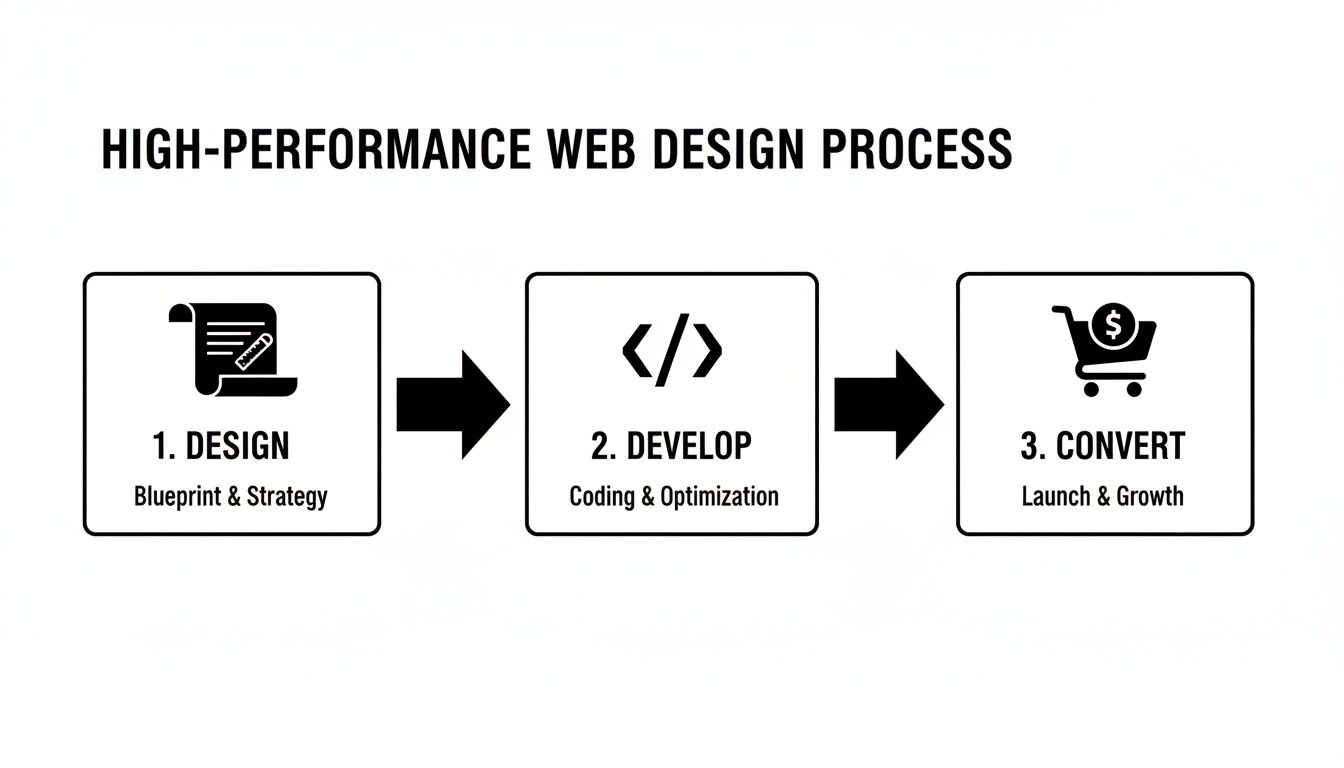
When I talk about web development, I’m not just talking about picking a theme and changing the colours. That's decorating, not developing. True development is about building a custom, high-performance engine for your brand that’s fast, reliable, and tailored to your specific goals. It's the core of what we do as a WordPress development company.
WordPress Development: The Power of Customisation
WordPress is an absolute beast. It powers over 40% of the web for a reason: its flexibility is unmatched. For service businesses, content-heavy sites, or eCommerce stores with unique requirements, it's my go-to platform.
Why I Recommend Custom WordPress Development
Working with a skilled WordPress developer in Melbourne means you're not constrained by a pre-built theme. We build from the ground up. This means:
- No Code Bloat: Your site only has the code it needs, making it significantly faster and more secure than sites built on generic, multi-purpose themes.
- Total Design Freedom: The design is tailored exactly to your brand and strategic goals, not forced into a template's layout.
- Scalability: The site is built on a solid foundation, ready to grow with your business, whether that means adding an online store, a booking system, or complex integrations later on.
Building Custom Blocks in Gutenberg
One of the most powerful features of modern WordPress is the Gutenberg block editor. Instead of being stuck with a single content field, we can build custom, reusable blocks for our clients. For an eCommerce business, this could be a "Shop the Look" block, a "Featured Product Grid," or a "Testimonial Slider" that you can drop onto any page with a click. It gives you incredible power and consistency over your content without needing to touch a line of code. This is a key service offered by an expert WordPress web developer.
Shopify Development: The eCommerce King
For businesses focused purely on selling products online, Shopify is often the perfect solution. It's an incredibly powerful and user-friendly platform designed from the ground up for commerce.
Why Shopify is a Game-Changer for Online Stores
As experienced Shopify developers in Melbourne, we love Shopify because it handles the hard stuff—payments, security, server maintenance—so you can focus on what you do best: selling. It’s robust, scalable, and has an amazing app ecosystem.
Building Custom Shopify Apps Using Shopify CLI
Sometimes, an off-the-shelf app just won't cut it. You might need a unique product customizer, a special wholesale ordering system, or a complex integration with your warehouse. This is where custom app development comes in. Using the Shopify app using Shopify CLI, we can build private apps that solve your specific business challenges, giving you a competitive edge that your rivals can't just buy from the app store.
Leveraging the Shopify API for Advanced Integrations
The true power of Shopify is unlocked through its APIs. The Shopify developer API allows us to connect your store to almost any other system. I’ve used it to sync inventory with a custom ERP, push customer data to a specialised CRM, and create automated marketing workflows. This level of integration is what separates a simple online store from a sophisticated, automated eCommerce machine.
3. Driving Traffic: The Art & Science of Paid Advertising
Having a great website is pointless if no one sees it. This is where paid advertising comes in. As a dedicated Google Ads agency and Facebook Ads agency, I've managed millions in ad spend for Melbourne businesses. The goal is always the same: generate a profitable return on investment.
Mastering Facebook & Instagram Ads
Meta's advertising platform (Facebook & Instagram) is incredibly powerful for eCommerce, especially for building brand awareness and driving impulse buys. But it's also easy to waste a lot of money if you don't know what you're doing.
Setting Up the Meta Conversion API (CAPI)
With Apple's iOS 14 changes and the move away from third-party cookies, browser-based tracking (the Pixel) is less reliable than it used to be. The Meta Conversion API (CAPI) is the solution. It creates a direct, server-to-server connection between your website (e.g., Shopify) and Facebook. This gives Meta more reliable data, which improves your ad targeting, optimisation, and measurement. A proper Conversions API installation for Meta is no longer optional; it's essential for any serious advertiser.
The Meta Ads Creative Testing Process That Works
The single biggest lever you can pull to improve Meta Ads performance is your creative. I use a methodical Meta ads creative testing process. We constantly test different images, videos, headlines, and ad copy to find winning combinations. We start broad, identify what resonates with the audience, and then iterate and refine. This data-driven approach removes the guesswork and is a core part of what makes us one of the best Facebook ads agencies.
How to Measure Success and Why You Shouldn't Quit Too Early
When you're first starting, it's tempting to panic if you don't see sales on day one. But Facebook ads – don't quit too early! The algorithm needs time and data to learn who your best customers are. The key is to measure success not just by sales, but by leading indicators like Add to Carts, Initiate Checkouts, and Cost Per Click. These metrics tell you if you're on the right track before the sales start rolling in consistently.
A Beginner's Guide to Google Ads
Google Ads is all about capturing intent. When someone searches "buy running shoes Melbourne," they're ready to buy now. As a specialised Google Ads agency, my focus is on putting my clients in front of these high-intent customers.
What Budget Should You Spend on Google Ads?
This is the million-dollar question. The honest answer is: it depends. A good starting point for a small business is typically around $1,500 – $3,000 per month. But the real question isn't what budget to spend on Google Ads, but what your Customer Acquisition Cost (CAC) and Lifetime Value (LTV) are. If you know a customer is worth $500 in profit, you can afford to spend up to that amount to acquire them. The goal is to find a profitable budget and then scale it up.
Google Ads for Service-Based Businesses vs. eCommerce
The approach is different. For eCommerce, the focus is on Shopping ads and Return on Ad Spend (ROAS). For service businesses (like Google Ads for plumbers or electricians), the goal is lead generation. We focus on Google ads for contact form submissions and phone calls, tracking the cost per lead as our primary KPI. We even build campaigns specifically for PPC for tradies, targeting local suburbs and emergency keywords.
Campaign Priority in Google Ads: Understanding the Hierarchy
In a Google Shopping setup, campaign priority in Google ads is crucial. It tells Google which campaign to use if a product is eligible to show in multiple campaigns. For example, you can set a high-priority campaign to capture broad traffic with a low bid, and a low-priority campaign with a high bid to target specific best-selling products or branded searches. Mastering this allows for incredibly granular control over your ad spend.
The Ultimate Guide to Google Shopping Ads
For any eCommerce business, Google Shopping is a non-negotiable. Those product listings with images at the top of the search results are marketing gold.
PMAX vs. Standard Shopping: Which Is Better?
Performance Max (PMAX) is Google's new, automated campaign type that runs ads across all of Google's channels (Search, Shopping, YouTube, Display, etc.). PMAX vs Google shopping ads is a hot topic. PMAX can be incredibly powerful but offers less control. Standard Shopping gives you more levers to pull (like negative keywords and priority settings). I often run both, using PMAX for broad reach and Standard Shopping for precise targeting of my most profitable products. It’s a key strategy for any ecommerce marketing agency.
Troubleshooting: Google Shopping Ads Not Spending Budget
It's a common and frustrating problem: you've set up your campaign, but Google shopping ads not spending budget. The cause can be anything from a disapproved product feed in Merchant Center, bids that are too low, a budget that's too small to exit the learning phase, or an audience that's too narrow. It requires a systematic check of every component, from the feed to the campaign settings.
4. Technical Marketing: The Engine Room of Growth
The flashy ads and beautiful websites get all the attention, but it's the technical plumbing behind the scenes that makes it all work. This is the stuff that most agencies skip over, but I've found it's where the real competitive advantages are won.
GTM and Google Analytics: Your Data Foundation
Your business needs a single source of truth for data. For me, that's Google Analytics (GA4), implemented via Google Tag Manager (GTM). GTM is a container that allows us to manage and deploy all our marketing tags (Google Ads, Meta Pixel, Analytics, etc.) without having to edit the website's code every time. Setting up Google Tag Manager containers correctly is the first step in any project I take on. It ensures clean, reliable data for decision-making.
Local SEO & Google My Business: Winning Your Suburb
For businesses with a physical location or service area in Melbourne, Local SEO is critical. A huge part of this is optimising your Google My Business (GMB) profile. This is what appears in the map pack when someone searches "cafe near me" or "electrician Richmond." A well-optimised GMB profile with great reviews, regular posts, and accurate information is often the single most effective marketing tool for a local business. As an SEO agency in Melbourne, this is a foundational piece of our strategy.
Advanced Call Tracking for PPC Campaigns
If you're a service business running ads, you need to know which keywords and ads are making your phone ring. Standard tracking can't do this. This is why I use the best call tracking softwares for PPC call campaigns, like CallRail. These tools assign a unique phone number to each campaign (or even keyword), allowing us to see exactly which click led to which call.
I've even taken this a step further for some clients by setting up a custom number through Twilio. This system includes incredible features like a 24-hour call answering service that never gets sick or tired. It can even book appointments directly into a Calendly link or business calendar, saving thousands in lost business for tradies, hairdressers, and dentists who can't always answer the phone. It's a game-changer.
5. Putting It All Together: A Cohesive Digital Strategy
All these elements—WordPress development, Shopify design, Google Ads, SEO—are powerful on their own. But they become truly unstoppable when they work together as part of a single, cohesive strategy.
Why Marketing Your Business is All About Consistency
Marketing your business = consistency. You can't just run ads for a month and expect to build an empire. You can't just post on social media when you feel like it. Success comes from showing up, day in and day out. It's about consistently testing creatives, refining keywords, publishing content, and optimising your website. That persistent effort is what builds momentum and creates lasting results.
How Much Does It Really Cost to Start?
It's the most common question: how much does it cost to start Google Ads? Or any marketing, for that matter. As I mentioned, a reasonable starting ad budget is $1,500 – $3,000/month. On top of that, you have agency management fees. But the most important cost is the initial investment in a high-performance website. Trying to run ads to a slow, poorly designed site is like pouring water into a leaky bucket. You need to fix the bucket first.
Our Proven Process for Success
My process is built on transparency and partnership.
- Discovery & Strategy: We dive deep into your business, your goals, and your customers. We define what success looks like.
- Build & Implement: We build your core assets—the website, the tracking setup, the ad accounts—the right way, from the ground up.
- Launch & Test: We launch the campaigns and begin the process of gathering real-world data.
- Optimise & Scale: We use that data to refine targeting, improve creative, and scale what's working to maximise your profitability.
6. Let's Work Together: A Special Offer
I've packed a lot of information in here, drawing from my years of experience as the head of a marketing agency in Melbourne. My team at Alpha Omega Digital and I service clients across Australia, from Sydney to Perth, but our roots and deepest expertise are right here.
If you've read this far, you're clearly serious about growing your business.
If you're a business with a paid ads budget of at least $3k a month, I'd love to offer you a low-risk deal: get a month of paid ads management FREE. Apply now through the contact page.
Have a project in mind? Contact us. Let's build something great together.
[email protected]
Read more insights from our team on web design, paid ads, and growth strategy.