If you're looking for a marketing agency Melbourne business owners can lean on, you're probably already dealing with the usual mess. Your website looks acceptable but doesn't convert consistently. Google Ads might be running, but you're not sure which clicks turn into real enquiries or sales. Meta ads bring traffic, yet the results feel volatile. SEO sits on the to-do list, and tracking is half set up, half guessed.
That's a common position for small businesses here. The problem usually isn't a lack of effort. It's that most businesses have separate pieces managed in isolation. One person built the site, another ran ads, someone else installed GA4, and nobody tied the whole system together.
A good digital marketing agency Melbourne businesses hire should fix that. Not with more noise, and not with a bloated service list, but by connecting website, traffic, tracking, and follow-up into one growth system.
What a Melbourne Digital Marketing Agency Should Actually Do for You
Most owners don't need more marketing activity. They need fewer disconnected tasks and a clearer path from click to sale.
A proper small business digital marketing agency should start with the business model, not the channel. If you're a service business, the issue might be missed calls, slow follow-up, or a weak landing page. If you're in ecommerce, the issue might be poor product page UX, messy Shopify data, or Meta campaigns optimising against bad signals.
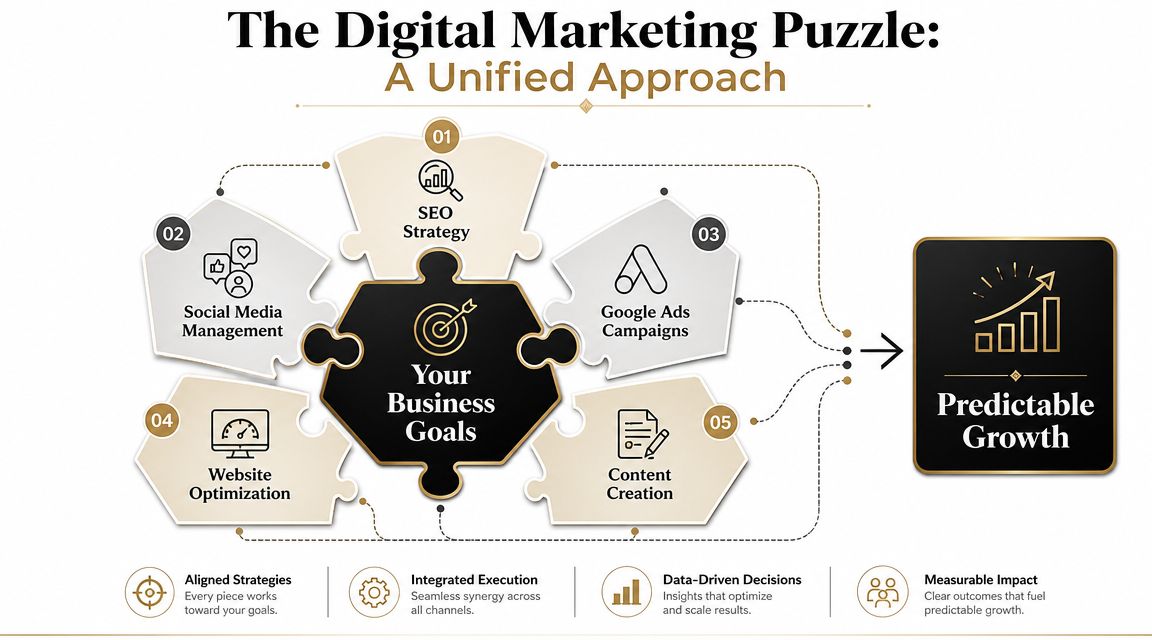
The agency's job is to simplify decisions
The latest ABS Business Characteristics data shows that around 97% of Australian businesses are small businesses, which matters because most agencies are serving owner-led businesses with limited time, limited staff, and tighter budgets. In that environment, improving ROAS, CRM automation, and conversion rates is often a more defensible move than broad awareness spend, as noted in this small business agency discussion.
That matches what we see in Melbourne. A lot of businesses don't need more leads first. They need to stop leaking the leads they're already paying for.
Practical rule: If your sales process is slow, your forms are weak, or no one knows which leads are qualified, buying more traffic usually makes the problem more expensive.
A good local agency should be able to answer questions like:
- Should you scale traffic yet: Not always. Sometimes the first move is fixing a low-converting quote form, poor product filtering, or a clunky checkout.
- Should you build on WordPress or Shopify: That depends on whether you need flexible content and lead gen, or a cleaner ecommerce stack with better native selling tools.
- Should you focus on Google or Meta first: That depends on buyer intent, sales cycle, average order value, and how strong your offer is.
- Should you invest in SEO now: Usually yes for long-term compounding, but not at the expense of broken paid traffic economics.
Melbourne context matters more than many agencies admit
A local operator should understand how different suburbs, audiences, and business categories behave. The buying pattern for a premium ecommerce brand isn't the same as a local trades campaign. Search behaviour, offer framing, call handling, and landing page structure all change.
That's why I prefer a joined-up model. Website build, tracking, ad platform setup, creative testing, and follow-up automation should sit in one conversation. If you want a useful outside perspective on small business growth strategies, that guide covers the broader thinking well. The missing piece for most businesses is execution across the whole stack.
If you're comparing providers, look for a team that can handle ecommerce strategy, paid traffic, UX, and technical setup together. That's the difference between a vendor and a growth partner. Our own work in that direction sits under ecommerce marketing agency.
Your Foundation A High-Converting WordPress or Shopify Website
Your website isn't a brochure. It's where paid traffic either becomes revenue or gets wasted.
I've seen plenty of businesses spend on Google Ads, Meta, and SEO while sending visitors to a site that loads slowly, hides the value proposition, and gives users no clear next step. That setup rarely fails because the ads are bad. It fails because the destination is weak.
WordPress works when flexibility matters
For service businesses, lead generation brands, content-heavy businesses, and companies that need custom page structures, WordPress still gives you serious control. That's especially true when it's built properly rather than patched together with a pile of plugins and a theme that tries to do everything.
As a team doing regular WordPress developer work in Melbourne, we usually care about a few things first:
- Clear page hierarchy: Users should know what you do, who it's for, and what to do next within seconds.
- Custom Gutenberg blocks: These make content editing easier without locking the business into a rigid template.
- Lean builds: Fewer unnecessary scripts, cleaner templates, and fewer plugin conflicts.
- Landing page control: Paid traffic often needs a different page structure from general website traffic.
If you're searching for a wordpress developer melbourne, wordpress development melbourne, or wordpress website developer, don't just ask whether they can build pages. Ask whether they can shape conversion paths, build custom blocks in Gutenberg, and keep the front end fast under ad traffic. That's the part that affects revenue.
For more technical WordPress build support, we also publish details on our WordPress developer and web design Melbourne services.
Shopify is usually the cleaner ecommerce decision
For product-based brands, Shopify is often the more practical option. It gives store owners a simpler backend, cleaner catalogue management, stronger native ecommerce workflows, and a better starting point for scaling paid traffic.
That doesn't mean every Shopify site performs well. Plenty don't. The platform is solid, but poor theme decisions, weak merchandising, and sloppy app installs still hurt conversion.
A strong Shopify build usually includes:
| Area | What matters |
|---|---|
| Theme structure | Clean collection pages, product templates, and mobile-first navigation |
| Conversion flow | Sticky add-to-cart, clear shipping info, trust cues, and fewer checkout distractions |
| Tracking | Proper event setup, GA4, Meta CAPI, and clean data layers where needed |
| Customisation | Theme edits, Shopify API work, and app logic only where it improves operations |
If you're comparing shopify developer, shopify developers, or shopify development partners, look beyond design samples. Ask whether they understand feed quality, product page conversion, Shopify API constraints, and how the store will connect to ads and analytics.
A beautiful store with weak tracking is harder to grow than an average-looking store with clean attribution and a strong offer.
We also build more advanced Shopify solutions when the brief calls for it, including custom logic and app-related work tied to the Shopify developer API. For businesses wanting local support, our Shopify developers Melbourne page outlines where that fits.
Speed is part of conversion, not a nice extra
Google's Core Web Vitals guidance sets clear performance targets. Largest Contentful Paint should be under 2.5 seconds, Interaction to Next Paint under 200 ms, and Cumulative Layout Shift under 0.1, according to Google's Web Vitals guidance referenced in this small business website performance article. The same source notes that a 1-second delay in mobile load time can reduce conversions by up to 20% in retail and lead generation contexts.
That's why we treat speed as part of the brief, not an afterthought. On WordPress, that often means image compression, careful font loading, lighter JavaScript, and cleaner templates. On Shopify, it usually means app restraint, lean section design, and reducing scripts that fight for attention on mobile.
If your ads aren't converting and your bounce rate feels high, start with the site. Traffic quality matters, but the page still has to do its job.
Driving Profitable Growth with Google and Meta Ads
Once the site is ready, paid media becomes much easier to scale with confidence. Without that foundation, even good campaigns can look bad.
Australia's internet advertising market reached A$4.3 billion in the March quarter of 2025, and search accounted for 53.8% of spend, based on the IAB figures cited in this Australian digital advertising market guide. That matters because it confirms what most of us already see in practice. Google Ads isn't a side channel. It's one of the main ways businesses compete for demand.
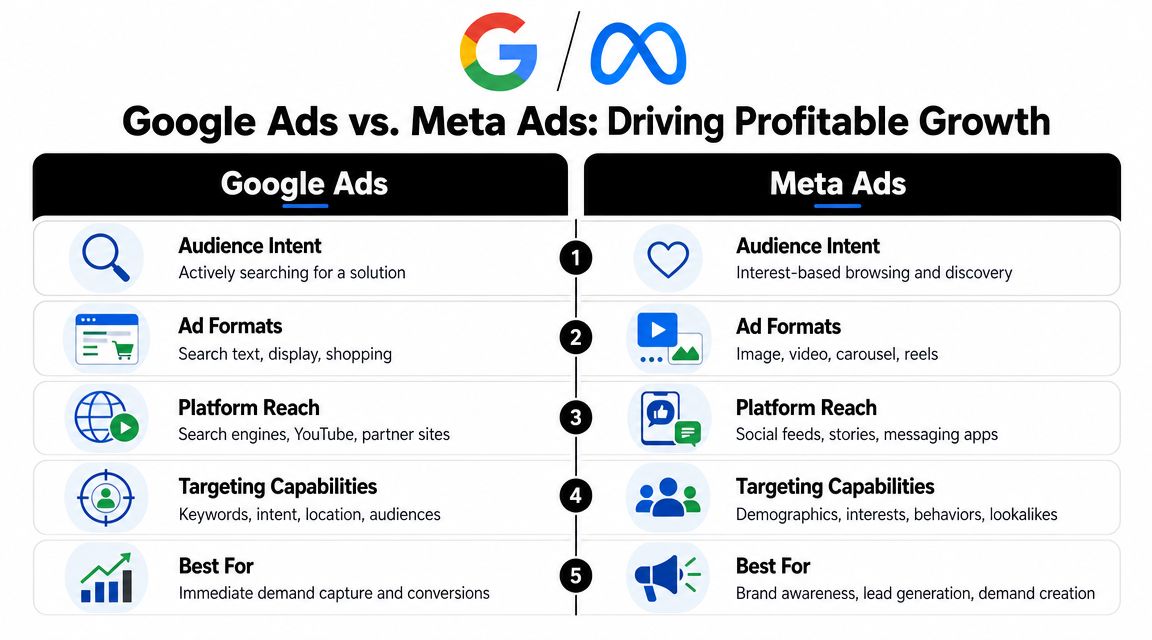
Google Ads captures active intent
Google works best when the buyer already knows what they need or at least knows the problem they want solved.
For service businesses, that usually means campaigns built around tight commercial intent. Searches from people looking for a local provider, requesting a quote, or ready to book. In those accounts, I care less about click volume and more about search term quality, landing page alignment, and whether calls and form submissions are qualified.
That's why Google Ads for service based businesses needs different handling from ecommerce. A tradie campaign might prioritise suburb intent, call extensions, strong landing pages, and call tracking. A lead gen campaign built around Google Ads for contact form submissions needs clean forms, proper thank-you page tracking, and a booking path that doesn't create friction.
For trade campaigns and local lead generation, we've documented examples on our Google Ads agency and Google Ads for plumbers pages.
Meta ads create demand and sharpen retargeting
Meta is different. People aren't searching with the same intent. You're interrupting attention, so the offer, creative, and landing page matter more.
The accounts that hold up over time usually have a disciplined creative testing process. Not random ad variations. Structured tests. Different hooks, angles, formats, offers, and landing experiences. That's where a lot of Facebook campaigns fail. Businesses quit too early, or they judge the platform before they've tested enough creative properly.
For ecommerce brands, Meta is often where product positioning gets refined fastest. You learn which pain points, bundles, visuals, and messages attract the right clicks. For local service brands, Meta can still work well when the offer is concrete and the audience targeting is realistic.
If you're assessing a facebook ads agency or mastering Facebook ads internally, focus on these questions:
- Are they testing creatives in a controlled way
- Are they matching creative to landing page intent
- Are they using first-party signals to improve optimisation
- Are they measuring lead quality, not just cheap leads
We also cover some of that thinking on our Facebook Meta Ads agency, Facebook ads for electricians, and best Facebook ads agency pages.
Ecommerce ad decisions are rarely platform-only decisions
For ecommerce, the common questions are practical ones. Beginners guide to Google Shopping ads topics, Google shopping ads for dropshipping, campaign priority in Google Ads, PMax vs Google Shopping ads, and why Google shopping ads not spending budget. Those are valid questions, but the answer is rarely just inside the ad account.
If Shopping isn't spending, the issue can sit in feed quality, pricing competitiveness, product data, merchant settings, or weak campaign structure. If PMax underperforms, it may be because the account lacks solid conversion signals, has weak creative assets, or blends high and low intent products together.
Paid media works best when the product feed, offer, and landing page are built for the campaign. Not when ads are expected to compensate for weak site fundamentals.
A strong digital marketing agency Melbourne team should be able to tell you when Google is the first move, when Meta should warm the audience, and when the actual fix is on-site merchandising or checkout UX.
The Unseen Technical Details That Maximise Your ROI
A lot of businesses think performance marketing is about campaign settings. It isn't. Campaign settings matter, but the bigger gains often come from the parts nobody sees.
If tracking is broken, channel reports become misleading. If events are vague, bidding gets worse. If CRM outcomes never get fed back into ad platforms, the algorithm keeps optimising for cheap actions instead of valuable ones.
Tracking needs to match the business, not the template
A technically sound setup should use event-based tracking in GA4, UTM parameters, and offline conversion imports so clicks can be tied back to actual revenue or qualified leads. That's the core recommendation in this attribution and optimisation overview. The practical outcome is better comparison of cost per qualified lead and ROAS by channel, which improves bidding and cuts spend on low-intent traffic.
That's why I don't like generic analytics installs.
For a service business, the key events might be:
- Qualified form submissions: Not every form fill deserves equal weight
- Phone calls above a threshold duration: A real sales conversation is more valuable than a missed call or wrong number
- Booked appointments: Stronger than top-of-funnel website actions
- Offline outcomes: Won jobs, closed deals, or confirmed sales where the platform supports it
For ecommerce, the setup needs cleaner product and transaction signals. Add-to-cart alone isn't enough. You want purchase data, checkout progression, and reliable platform matching.
GTM, GA4, and server-side logic affect ad performance
Here, setting up Google Tag Manager containers, GTM and Google Analytics, and conversions API installation for Meta become more than technical chores. They influence how platforms learn.
If you're running Shopify, sending cleaner signals through Meta Conversion API can help compensate for browser-side loss. If you're using WordPress with forms and call campaigns, structured events in GTM and GA4 make it easier to separate enquiry volume from real lead quality.
For stores that need more custom data handling, we sometimes work across the Shopify API, custom scripts, and app logic. For WordPress builds, custom event mapping often sits alongside plugin restraint and cleaner front-end implementation. One local option that covers WordPress, Shopify, paid media, and tracking together is Alpha Omega Digital.
Better attribution doesn't just improve reporting. It changes what the platform learns from, which changes where your budget goes.
Call handling often decides whether ads pay off
For service businesses, a missed phone call can undo a lot of good ad work. That's why call tracking matters, especially for tradies, clinics, salons, and appointment-led businesses.
We often set up custom numbers through Twilio so calls can be routed, tracked, and tied back to campaign sources. That can feed into a system that handles calls around the clock, never gets tired, and can book appointments into a calendar or Calendly workflow. For businesses like plumbers, electricians, hairdressers, beauty therapists, dentists, restaurants, and doctors, this can stop leads from disappearing after hours or during busy periods.
The technical stack doesn't need to be flashy. It needs to be reliable. Clean data, clear attribution, proper event design, and follow-up automation usually outperform a more aggressive ad strategy running on bad measurement.
How to Hire the Right Digital Marketing Agency in Melbourne
Hiring an agency gets easier when you stop looking at service lists and start looking at decision quality.
In Australia, digital-first behaviour is already the norm. The ACMA reported in 2024 that 95% of people aged 16+ used the internet and 88% accessed it daily, which is summarised in this Australian internet usage overview. That means your agency choice matters because most customer journeys begin online, even when the final sale happens by phone, in store, or after several follow-ups.
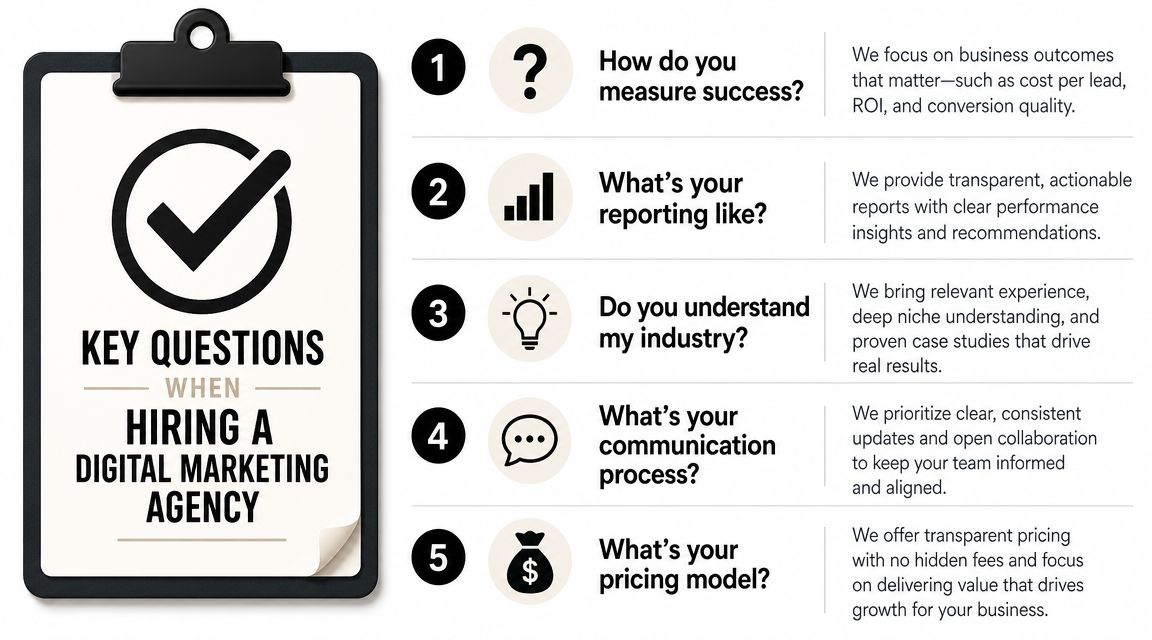
Ask better questions in the first meeting
Most bad agency relationships start with vague promises and weak discovery.
These are the questions I'd ask any marketing agency Melbourne provider before signing:
- How do you measure success: If the answer is impressions, clicks, or vague growth language, keep digging. You want cost per qualified lead, ROAS, booked appointments, or sales contribution.
- What do you need access to before you can give advice: Good agencies usually ask for platform access, analytics, CRM context, and website data before making strong recommendations.
- Who is doing the work: Some agencies sell with a senior person and hand the account to someone junior with little context.
- How do you handle tracking and attribution: If the answer is soft or overly generic, that's a problem.
- What happens if conversion rates are poor: You want a partner who'll challenge the landing page, offer, or sales process, not just blame the platform.
Watch for red flags early
A few red flags turn up again and again:
| Red flag | Why it matters |
|---|---|
| Guaranteed rankings or instant results | No one controls the platforms that tightly |
| Long lock-in contracts from day one | It often protects the agency more than the client |
| No clarity on reporting | You can't improve what you can't inspect |
| Separate website and ad teams with no overlap | Handoffs create delays and blind spots |
| They never ask about your margins or sales process | Then they can't judge lead quality or scale sensibly |
The right agency doesn't just tell you what channels to use. They tell you where you're losing money before the lead even becomes a sale.
Compare the working relationship, not just the proposal
This short video is worth watching if you're still weighing up what good agency selection looks like in practice.
I'd also look at whether the agency can speak clearly about your business type. Ecommerce brands need a different conversation from local service businesses. If you're selling online, ask about feed optimisation, product page UX, retention flows, and Meta CAPI. If you're lead gen focused, ask about phone tracking, form quality, local SEO, and how they qualify leads.
For a broader comparison framework, Website Builder Australia's consultant guide is a useful reference point. It helps business owners sort through options without getting distracted by agency jargon.
The best fit usually feels practical, not theatrical. Clear communication, honest trade-offs, and a willingness to say "don't spend there yet" are signs you're speaking to the right team.
Our Simple Six-Step Process to Predictable Growth
A Melbourne business owner comes to us after trying a bit of everything. The website looks fine at first glance, Google Ads are spending, Meta is sending traffic, and reports show clicks coming in. Yet sales are flat, lead quality is mixed, and nobody can say where the leak is. That usually means the parts were built separately and never made to work as one system.
Our process fixes that. We look at the website, ads, tracking, and follow-up together so decisions are based on how the business grows, not how each channel looks in isolation.
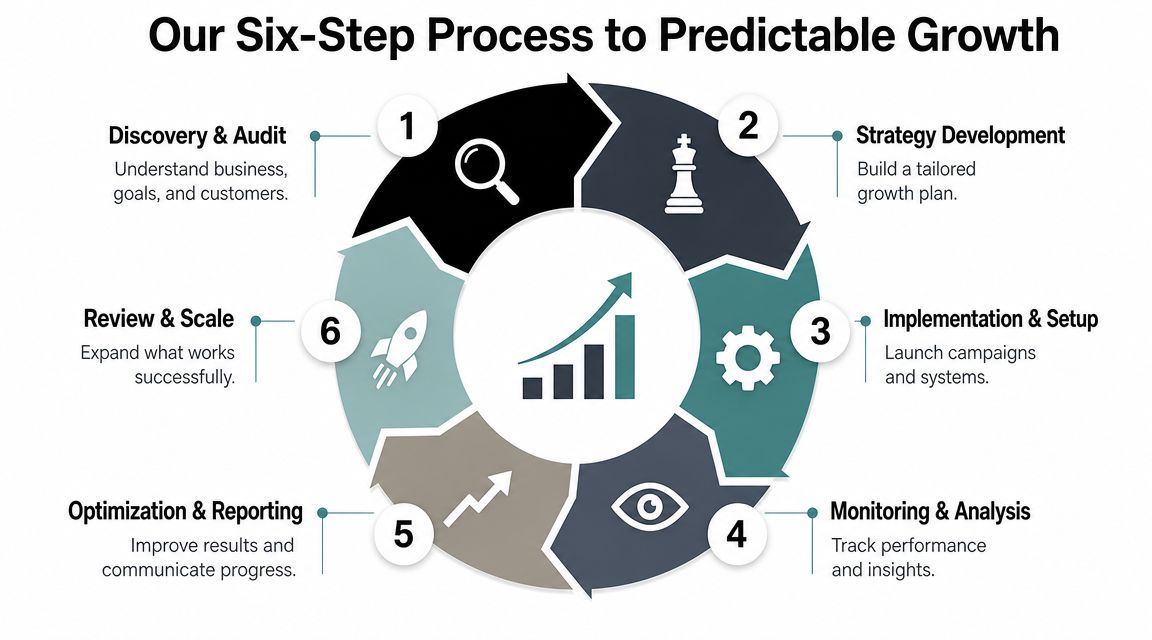
Step one starts with the audit, not the ad account
We start with discovery and audit. That means understanding the business model, margins, sales cycle, website performance, past campaigns, and what happens after an enquiry or purchase. For ecommerce brands, we review platform setup, product structure, feed quality, and checkout friction. For service businesses, we check forms, call handling, landing pages, and suburb targeting.
Next comes strategy and roadmap. Good strategy usually gets simpler before it gets bigger. A small business rarely needs ten active initiatives at once. It needs the few changes most likely to improve conversion rate, tracking quality, and lead or sales volume.
A typical roadmap might prioritise:
- Website fixes first: Improve page speed, reduce friction, or rebuild key landing pages on WordPress or Shopify
- Tracking second: Set up GA4 events, GTM, Meta CAPI, UTM rules, and call attribution properly
- Traffic third: Launch or rebuild Google Ads, Meta ads, or local SEO based on buying intent and commercial value
Setup is where most future problems get prevented
Step three is technical onboarding. It is not the flashy part of the job, but it often decides whether the next six months are clear or messy. We configure pixels, tags, event mapping, CRM connections, call tracking, product feeds, merchant settings, audience structure, and reporting checks before scale is even on the table.
The details vary by platform. On Shopify, that may mean theme checks, app reviews, feed fixes, and API decisions that affect tracking accuracy. On WordPress, it may mean custom forms, template updates, cleaner tag implementation, and making sure the site can support proper testing and attribution. For a business that needs a wordpress web developer, wordpress developers, wordpress development company, wordpress developer sydney, shopify developer, or building custom Shopify apps using Shopify CLI, this stage usually shows whether the provider understands growth or just completes isolated tasks.
Good onboarding can feel slow in the first week. It saves a lot of wasted spend later.
Campaign launch is only the midpoint
Step four is campaign launch. By then, the foundation should be strong enough that traffic has somewhere useful to go and conversions can be measured properly. That could mean a rebuilt Shopify storefront, a local lead generation campaign, Google Shopping, Meta creative testing, or support around Google Business Profile.
Step five is optimise and iterate. Many significant gains emerge here. Search terms get cleaned up, product groups get restructured, creative angles get tested, landing page friction gets reduced, and lead quality gets checked inside the CRM rather than guessed from platform reports.
Ongoing optimisation often includes:
- For ecommerce: Testing collection page layouts, reviewing Shopping structure, comparing PMax with standard Shopping, and refining Meta offers and hooks
- For service businesses: Tightening service-area targeting, improving booking or quote pages, and routing calls better
- For both: Improving reporting so budget decisions reflect revenue and qualified leads, not vanity metrics
Scaling only happens after the system proves itself
The sixth step is scale and grow. We increase budget after the system is producing results at a smaller level. If conversion tracking is unreliable, the landing page is weak, or follow-up is patchy, more spend usually makes the waste more expensive.
Once the system holds together, scaling becomes far more controlled. You can see which products convert, which keywords bring qualified traffic, which audiences respond, and which pages carry the strongest conversion rates. That gives Melbourne business owners a clearer path to growth because the website, paid ads, tracking, and automation are working together instead of pulling in different directions.
We work with businesses in Melbourne and across Australia, including Sydney, Brisbane, Newcastle, Perth, Adelaide, Darwin and Hobart. If you've got a project in mind, you can contact us.
If you want a practical partner rather than another layer of marketing noise, Alpha Omega Digital helps Melbourne businesses connect website performance, paid ads, tracking, and automation into one system that's easier to manage and easier to grow.
[email protected]
Read more insights from our team on web design, paid ads, and growth strategy.