You've probably had the same moment a lot of Melbourne founders have. The store is live, traffic is coming in, the ads are running, but the site still feels harder to improve than it should. You start looking for a Shopify developer Melbourne businesses can trust, and the problem gets bigger than design. You need someone who can work on speed, integrations, tracking, and the commercial side of ecommerce without turning the project into a mess.
That's where the right developer changes the shape of the business. A solid Shopify developer doesn't just “build a store”. They make the store easier to run, easier to measure, and easier to improve without breaking checkout, data, or your team's sanity. In my experience running a Melbourne agency, the best projects are the ones where the developer thinks like a merchant first and a coder second.
The Australian market makes that choice strategic. One 2026 market scan found about 153,140 live Shopify stores in Australia, versus roughly 82,481 WooCommerce stores, which put Shopify at about 65% of the tracked active AU ecommerce stores in that dataset, and about 1.9 times the size of WooCommerce in the same scan (Australia Shopify landscape). The same source estimated only about 3,592 Australian stores were on Shopify Plus, which tells you most opportunities sit in the SME and mid-market layer, not only enterprise builds (Australia Shopify landscape).
For Melbourne businesses, that matters because the local demand is usually practical. Merchants want fast deployment, theme customisation, app integration, and storefronts that convert. They don't want a developer who disappears after launch or hands over a pretty theme that still leaks revenue.
Introduction Why the Right Shopify Developer Matters in Melbourne
A Melbourne ecommerce founder usually starts the search after something has already gone wrong. The theme feels awkward on mobile. The last developer fixed one issue and created three more. Or the ads are spending, but nobody can tell which campaign is driving profitable orders because the tracking is only half-built.
The right Shopify developer Melbourne businesses hire changes that. They build a storefront that supports better conversion, cleaner analytics, and smoother operations as the store grows. That is a different job from someone who merely knows Shopify.
Practical rule: if a developer cannot explain how their build will help you sell, measure, or fulfil better, you are probably talking to a technician, not a growth partner.
I see the difference most clearly in SME and mid-market projects. Shopify Plus is not where most of the action sits, and the Australian market data makes that clear. The same scan that showed broad Shopify adoption also pointed to a relatively small Plus base, which tells me most merchants need help with everyday store quality, not enterprise theatre (Australia Shopify landscape). That means better themes, tighter apps, faster templates, and more disciplined launch work.
A good developer also understands Melbourne's commercial reality. Many stores here are not website-only businesses. They have a physical showroom, a warehouse, a call line, a Google Ads account, and Meta campaigns all trying to touch the same customer. If the developer builds the site in isolation, the business ends up with technical debt that marketing has to work around.
Security and performance matter here too. I look for developers who can explain how they handle access control, app risk, checkout stability, and performance benchmarking before launch, not after a slow site or a compromised account becomes a clean-up job.
That is why hiring the right person matters. You are not just buying code. You are buying fewer bottlenecks, cleaner handovers, and a store that can keep improving after launch instead of stalling at launch.
Understanding What a Shopify Developer Actually Does for Ecommerce Growth
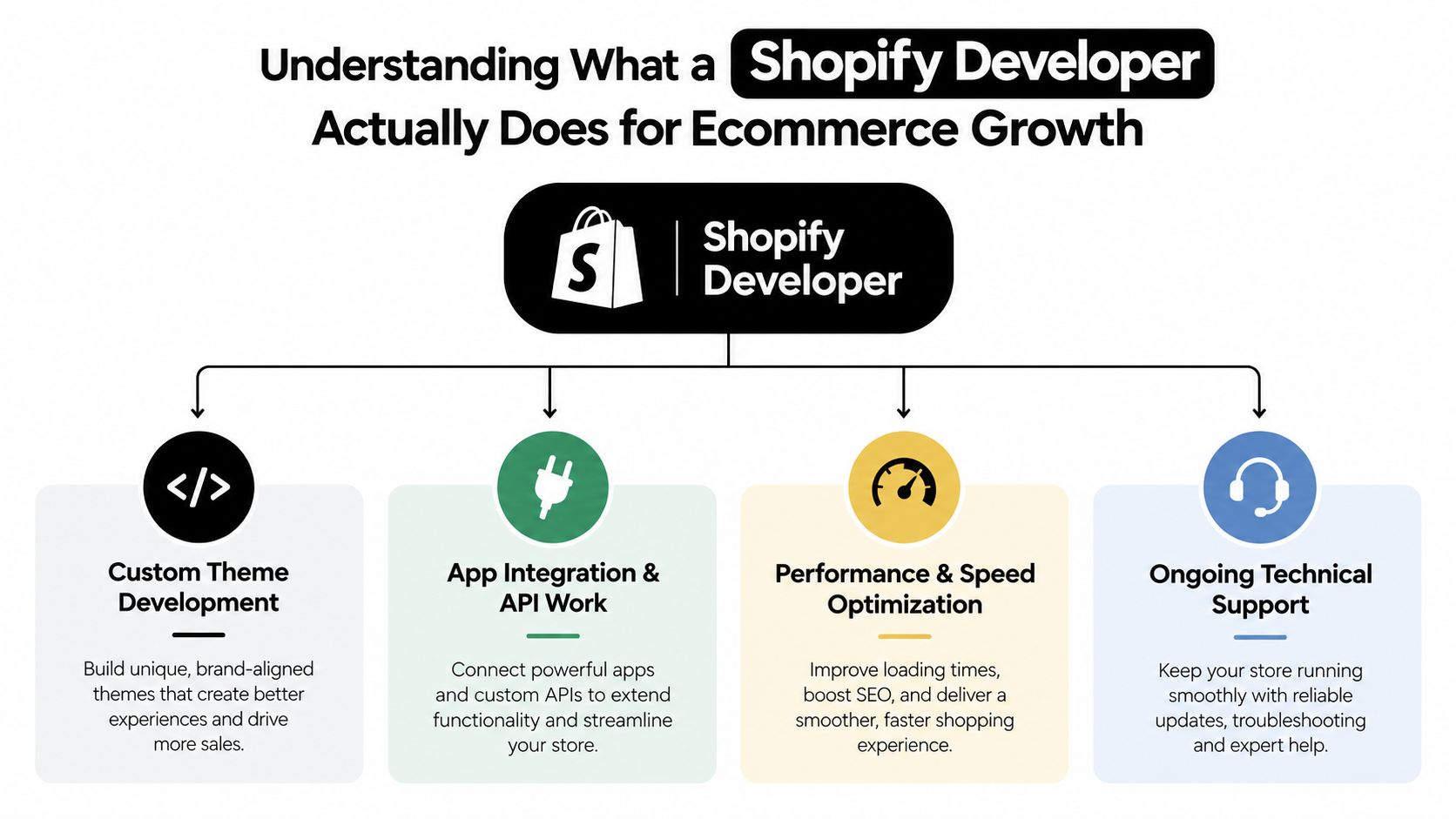
A lot of people think a Shopify developer is there to install a theme, swap a logo, and move on. That's the shallow version. In real ecommerce work, the role spans design logic, analytics setup, app work, speed tuning, and the integration points that keep revenue moving.
The work sits across build, tracking, and operations
A Shopify developer can handle custom theme development, Shopify API work, app integration, and ongoing technical support. In practice, that often means a developer touches the storefront, the measurement layer, and the systems behind fulfilment. If the store also relies on Google Ads or Meta ads, the developer's setup choices affect what gets measured and what gets missed.
For a business comparing options, the choice often comes down to three models. A freelancer can be useful for a narrower scope. An agency can coordinate design, development, and marketing together. A Shopify Partner model matters when you want someone who understands the platform well enough to keep the build maintainable. Each option has a place.
| Model | What it suits | Trade-off |
|---|---|---|
| Freelancer | Small fixes, simple themes, urgent support | Limited bandwidth and weaker coverage if the project grows |
| Agency | Stores that need design, development, ads, and analytics working together | Higher coordination overhead if the scope is vague |
| Shopify Partner-led team | Businesses that want platform-specific delivery and support | Needs a clear brief so you don't overbuy features |
That last point matters. If you want a store that can support performance marketing, the developer should know how to implement the measurement stack, not just the storefront. For example, if you're comparing how to set up tracking, Shopify SEO strategies for small business is a useful reminder that technical work and discoverability are linked, not separate disciplines.
The line between nice design and useful design
Design that looks good but slows the site down is not a win. The same goes for a stack full of apps that each solve one tiny problem while making the site harder to maintain. Good developers make trade-offs visible.
A store should be easy to sell from, easy to report on, and easy to hand over. If one of those is missing, the build isn't finished.
I've seen better outcomes when the developer treats storefront work like an operating system, not a brochure. That means thinking about collections, product pages, event tracking, and support tickets in the same conversation. It's the difference between a site that merely exists and a site that helps the business move.
How to Find and Shortlist a Shopify Developer in Melbourne
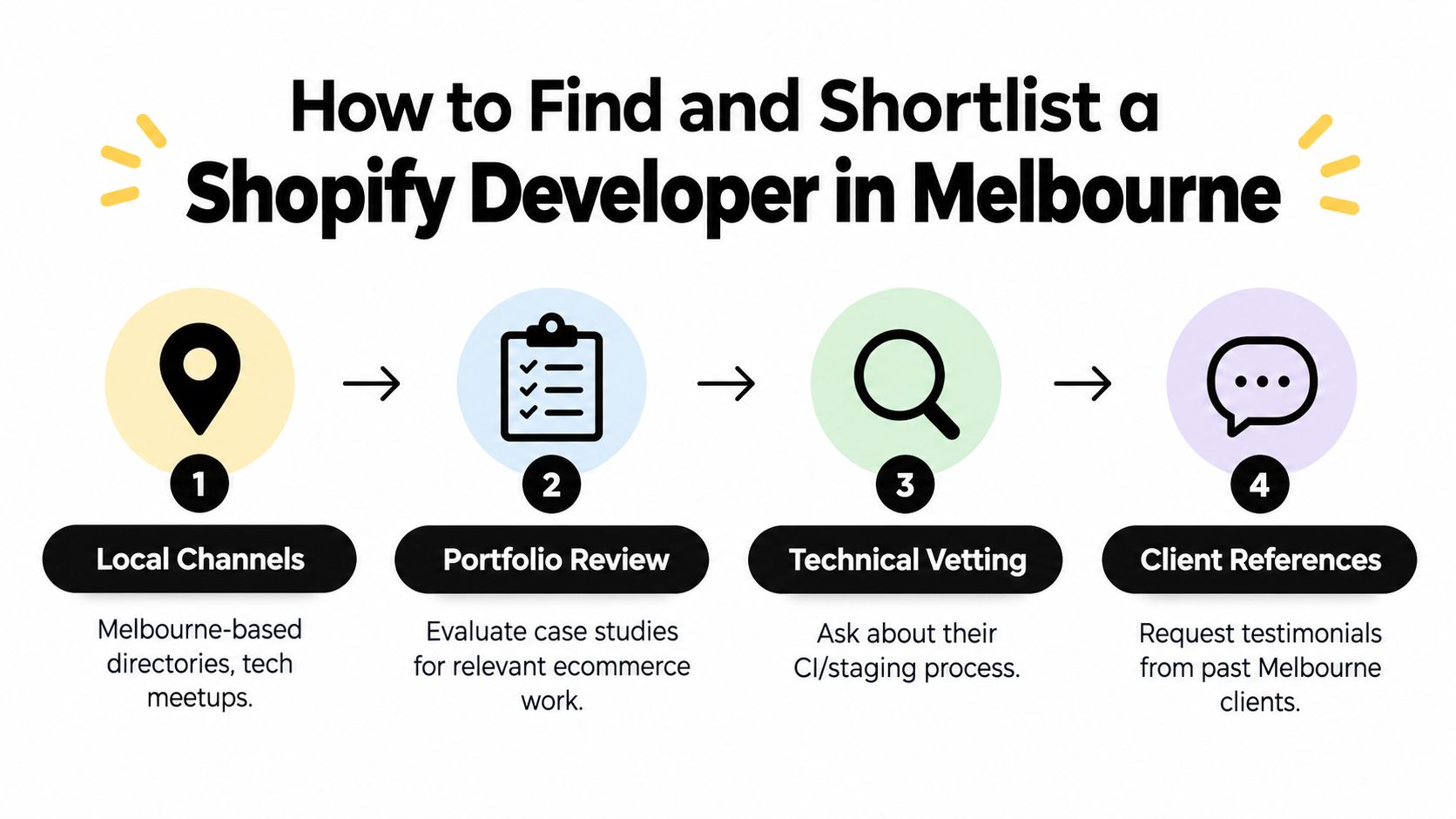
Start local, but don't stop at “local”. The strongest shortlist usually comes from Melbourne agencies, Shopify Partner directories, referrals from Australian ecommerce operators, and live stores you can inspect yourself. I'd rather speak with three teams who can show me relevant Australian work than ten teams with polished overseas portfolios and no local context.
Build the first list with proof, not promises
Look for teams that show actual ecommerce work, not just general web design. A Shopify development company should be able to point to live storefronts, platform migrations, or app work that resembles your situation. If the agency also handles Google Ads or Meta ads, that can be useful, but it shouldn't replace platform depth.
My shortlist filters are simple.
- Melbourne relevance: local context matters when you're planning launches, stock coordination, or showroom and online workflows.
- Ecommerce focus: generic web design isn't enough if you need product architecture, checkout logic, or app integration.
- Platform depth: ask whether they've handled theme customisation, API work, or private app builds.
- Commercial alignment: if your store runs paid traffic, they should understand tracking, conversion, and reporting.
- Operational fit: if you need POS, inventory, or fulfilment coordination, they need to show they've handled similar complexity.
A solid shortlist usually ends up at three or four candidates. Any more than that and the interviews blur together. Any less and you lose contrast.
Test for actual delivery capability
I also like to check how they present their process. If the team talks only about aesthetics, that's a warning sign. If they can talk about staging, approvals, QA, launch sequencing, and post-launch support, you're probably dealing with someone who has shipped real stores.
For a broader lens on outsourcing patterns, TekRecruiter's CTO guide by TekRecruiter is useful because it pushes you to evaluate delivery structure, not just credentials. That's the right habit here too.
Shortlist rule: if a developer can't explain how they avoid breaking the live store while building the new one, move on.
By the time you've finished the first round, you should know who sounds strategic, who sounds hands-on, and who only sounds busy. Those aren't the same thing.
How to Evaluate Portfolios Interview Questions and Technical Checks
A portfolio should answer one question quickly. Did this team ship stores that work better, or did they just make them look cleaner? A pretty homepage is not evidence. Live checkout paths, mobile UX, and measurement discipline are evidence.
What to look for in the work itself
I want to see live stores, not just screenshots. I want to see whether the product pages feel usable on mobile, whether the navigation makes collections easy to browse, and whether the site still feels fast once apps and tracking have been added. If a portfolio only shows design awards or mockups, I treat it as a branding exercise, not a development proof point.
A useful interview often moves through these areas:
- Shopify API experience. Ask what they've integrated and how they handled permissions, data sync, and maintenance.
- Theme structure. Ask how they build reusable sections and blocks, and how they keep the theme easy to update.
- Tracking setup. Ask how they configure GTM, Google Analytics, and Meta Conversions API.
- Performance controls. Ask how they test speed before and after launch.
- Support model. Ask what happens after go-live when something breaks or a new app needs review.
A strong developer won't dodge the boring questions. They'll answer them clearly because they know that boring questions are the ones that protect margin later.
Use a scorecard, not a vibe check
| Evaluation Criteria | What Good Looks Like | Red Flag |
|---|---|---|
| Technical depth | Clear answers on Shopify API, apps, themes, and analytics | Vague references to “custom work” without detail |
| Portfolio relevance | Live ecommerce stores with similar complexity to yours | Only mockups, landing pages, or unrelated sites |
| Performance mindset | Mentions testing, staging, and release checks | Says speed is “handled by Shopify” |
| Measurement discipline | Understands GTM, Google Analytics, and Meta tracking | Treats analytics as an afterthought |
| Commercial fit | Can explain what the build will help the business do | Talks only about design preferences |
Ask questions that expose how they work
I like direct questions. What do you do if an app slows the storefront? How do you test a launch before the public sees it? How do you confirm that Meta events and ecommerce events are firing correctly? What's your process if checkout conversion drops after a new theme release?
Those answers tell you whether the developer thinks like an operator. They also show whether they'll make your marketing team's life easier or harder.
Melbourne Pricing Benchmarks and What Drives Shopify Development Costs
Cheap quotes can be expensive when the scope is wrong. I've seen Melbourne store owners compare two proposals that look similar on paper, then realise one is a light theme refresh and the other is a rebuild with tracking, apps, and custom logic. The gap in outcome is usually bigger than the gap in price.
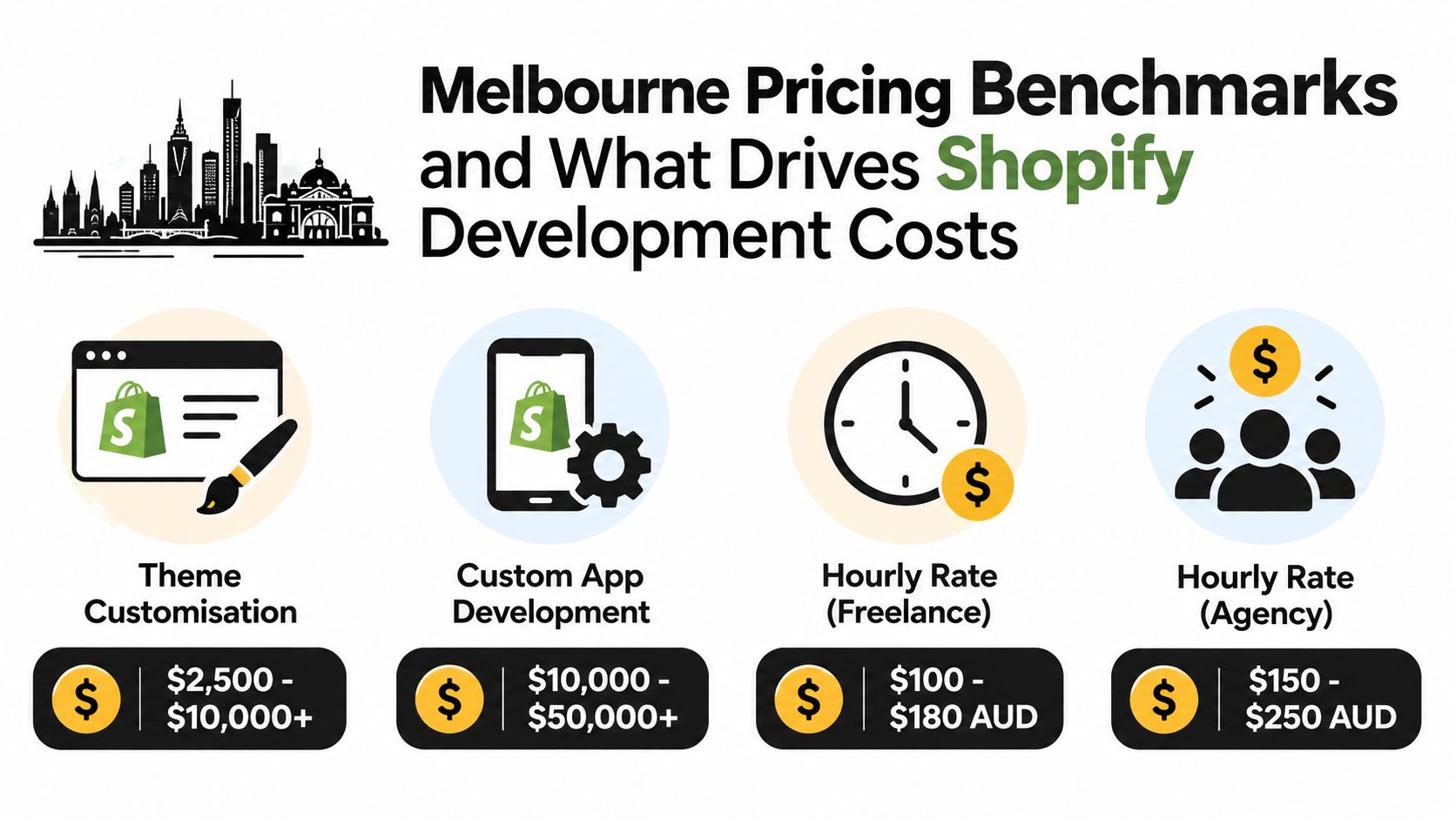
Melbourne pricing is easiest to judge by the type of work, not the platform name. For a modest theme customisation job, a price benchmark infographic for Shopify development services in Melbourne, covering custom apps and hourly rates shows that hourly rates and build costs move quickly once the brief shifts from visual changes to operational work. In practice, theme customisation sits in a different bracket from custom app development, and a store that needs API integrations, migration support, or checkout changes will cost more because the risk and testing load are higher.
The scope drives the price, not the platform name
A store with a few layout edits is not the same as a build that needs custom apps, API integrations, or migration support. The more your store depends on product complexity, operational workflows, and measurement, the more the development scope expands. That is normal.
The pricing conversation gets clearer when you separate the work into buckets.
- Theme customisation: brand changes, layout refinements, section updates, and mobile cleanup.
- Custom app development: work that needs new logic, integration pathways, or custom functionality.
- Tracking setup: GTM containers, analytics configuration, and conversion event handling.
- Support and optimisation: ongoing fixes, speed checks, and small releases after launch.
What makes quotes balloon
The biggest blowouts come from unclear scope. If the brief doesn't define product count, app dependencies, migration responsibilities, or the approval process, each team will estimate differently. Quote comparisons stop being useful fast.
Ask providers how they handle:
- Custom app builds with Shopify CLI
- API integration effort
- Checkout-related changes
- Marketing tracking setup
- Post-launch support terms
Alpha Omega Digital offers Shopify development, including custom Shopify development and Shopify app development, so it sits in the same practical conversation as other Melbourne teams that work on store builds and storefront performance. The point isn't the label. It is whether the team can scope the work cleanly and ship something your business can run.
Cheap is rarely cheap once you factor in fixes, rework, and lost trading time. A proper build costs more upfront, but the better question is whether the store will be easier to improve, easier to measure, and safer to operate after launch.
Don't buy speed alone
A quick launch helps only if the structure behind it is sound. I've seen stores move fast and then spend months cleaning up tracking, app overload, and broken templates. A higher upfront investment can make sense if it leaves you with a store that is easier to improve and easier to measure.
Red Flags Security Gaps and Your Action Plan to Hire With Confidence
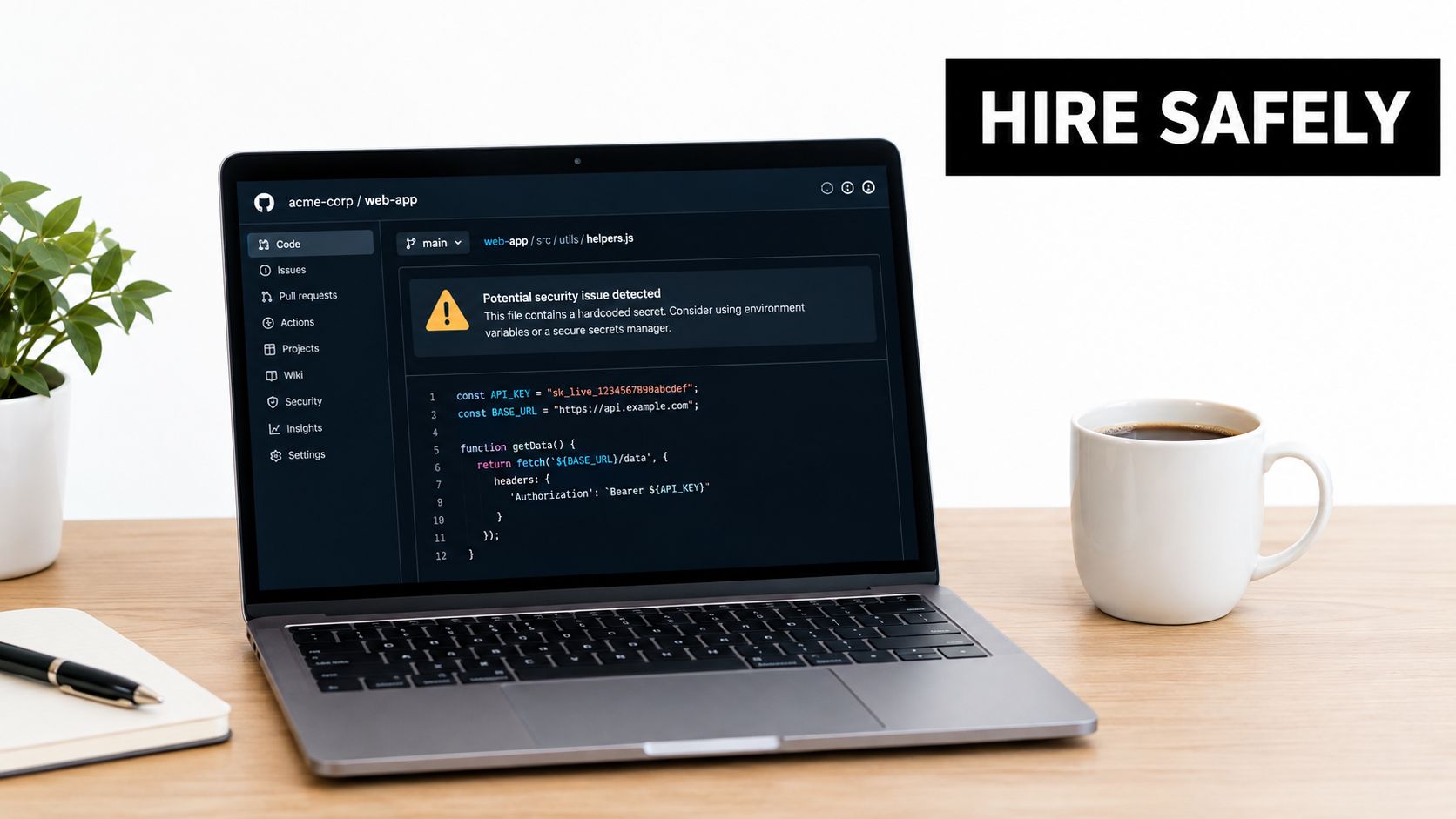
The best clue that a developer is weak is often what they don't mention. If they can't talk about staging, release checks, data handling, or post-launch support, the risk isn't hidden. It's right in front of you.
The red flags I would not ignore
A vague portfolio is a problem. So is a team that can't explain how they test before launch or how they handle app bloat. Poor post-launch support is another one, because most stores don't fail at launch, they fail when the first real change needs to be made and nobody knows who owns it.
Security and privacy deserve a serious seat in the hiring decision. In a 2025 survey of 513 Australian business owners and senior decision-makers, 36% ranked strengthening security, privacy and data protection as their top 2026 tech priority, ahead of international selling at 32% and AI and automation at 31% (Shopify Australia ecommerce trends). That lines up with what I hear from Melbourne SMEs. They want a developer who can keep customer data safer without making the business harder to operate.
Why unified commerce matters in the hire
For retailers with physical stores or showrooms, the right developer also needs to think beyond the online storefront. Shopify's Australian retail research reported that in 2024, 43% of Australian consumers preferred shopping in-store and 26% enjoyed both online and offline equally, while 99% of retail decision makers said they planned to invest in innovation focused on business intelligence, integrated customer experiences and flexible delivery models (Shopify Australia online shopping trends). That makes POS, inventory, fulfilment, and customer data alignment a hiring issue, not a nice-to-have.
If the build creates more silos than it removes, the store gets harder to run, not easier.
My action plan is simple. Check two live references, ask for a walkthrough of their staging and launch process, and confirm who owns post-launch support. Then choose the team that can explain both the technical build and the commercial outcome in plain English.
If you want a Melbourne team that works across Shopify and WordPress builds, paid ads, and conversion-focused implementation, Alpha Omega Digital can take you through that process with a clear scope and measurable handover. If your store needs a cleaner build, better tracking, or a stronger paid traffic setup, contact the team through the site and start with a practical conversation.
[email protected]
Read more insights from our team on web design, paid ads, and growth strategy.