You know the feeling. The leads that used to come in steadily have gone quiet, the homepage looks a bit dated next to sharper competitors, and every time you open the contact form you're half hoping it's broken because the numbers are that bad. In Melbourne, that's usually the moment founders stop blaming ads, stop blaming seasonality, and start looking at the website itself.
That search should be treated like a strategic hire, not a shopping exercise. A strong WordPress website design agency can audit the mess, rebuild the site properly, and get the thing performing without dragging you into every technical decision. A glossy agency will show you mockups. A real one will show you how the site will work after launch, how it'll stay fast, and how it'll keep converting when the campaign spend turns back on.
The right call comes down to more than taste. It's about platform fit, process, pricing honesty, and whether the team can deliver a site that holds up in the Australian market, where speed, mobile usability, and maintenance matter as much as design. If you're comparing agencies now, I'd use this as a practical filter, not a branding exercise.
The Moment Most Melbourne Founders Start Looking for an Agency
I've seen this pattern more times than I can count. A founder opens a dashboard and sees the same thing every week, fewer enquiries, weaker conversion, and a website that suddenly feels expensive for what it's doing. The site hasn't crashed. It just stopped pulling its weight.
What usually happens first
The first instinct is to tweak the headline, move a button, or ask a mate to “freshen it up”. That rarely fixes the underlying issue. If the structure is weak, the mobile experience is clumsy, or the build is bloated, the site can look fine and still underperform.
Practical rule: if your site feels slow to update, slow to load, or slow to convert, the issue is rarely the colour palette.
That's why the agency search matters. A competent team doesn't just redraw pages, they diagnose the business issue behind the site. For some businesses that means a cleaner service funnel. For others it means a WooCommerce rebuild, a faster checkout, or a proper content structure that search engines and people can use.
Why the agency choice is really a business decision
In Melbourne, founders usually don't need another pretty homepage. They need a team that can make decisions quickly, work cleanly, and hand back something that's easier to run than the old site. The difference between a competent agency and a slick one often shows up after launch, when the first update is due and the original developer is nowhere to be found.
That's why I'd look for a partner who can discuss WordPress development, content structure, technical SEO, and ongoing optimisation in the same conversation. If they can't explain those pieces without hiding behind jargon, keep moving. If they can, you'll usually notice it in the rest of the process too, from scoping to delivery to support.
The checklist you want by the end of this guide is simple. You should know what a strong agency looks like, what a fair project should cost, how long it should take, and what post-launch support actually matters. If you can answer those four things, you're in a much better position than most buyers.
Why WordPress Still Runs the Australian Web
WordPress keeps its position because it matches how Australian businesses build sites. Recent tracking shows it powers about 213,776 Australian websites and about 3.6% of tracked WordPress sites globally (BuiltWith WordPress tracking). Australian CMS studies also keep putting it near the top of the pile, which is no surprise if you've spent time inside local SMB, ecommerce, and service-business builds.
Why agencies keep building on it
The reason is practical. WordPress is flexible, widely understood, and backed by a deep local talent pool. Agencies can shape it around a business without forcing the client into a closed system or a rigid template stack.
It also fits the priorities Melbourne buyers keep raising, SEO structure, WooCommerce integration, and the ability to grow without starting again. That is why it still shows up so often in WordPress development, WordPress design, and custom block-based builds. The CMS is not the selling point. The agency is.
What the market says about the opportunity
The Australian SMB site market still has plenty of basic work left undone. ABS-linked reporting found 41.9% of small Australian businesses with 5 to 19 staff had no website, broader surveys reported 59% of Australian small businesses lacked a website, rising to 65% in regional areas, and another Australian small-business digital study found 85% of SMEs display their services on their websites, but only 30% of websites passed a speed test (Australian SMB website stats). That is a lot of repair work, not a niche opportunity.
The technical side matters just as much. For Australian WordPress sites, only 43.44% passed all three Core Web Vitals on mobile, and the median mobile Lighthouse performance score was 38/100 (WordPress performance optimisation data). A serious agency builds for mobile performance from day one. Anything else is cleanup dressed up as process.
| CMS Platform | Estimated AU Market Share | Common Use Cases |
|---|---|---|
| WordPress | 44% in 2025 | Content sites, service businesses, ecommerce, flexible marketing sites |
| Other CMS platforms | Remaining share | Niche builds, simpler brochure sites, platform-specific setups |
The takeaway is simple. WordPress is common, so mediocre agencies survive by selling templates. Good agencies build sites that stay healthy after launch and keep working for the business long after the handover.
What a Real WordPress Website Design Agency Looks Like
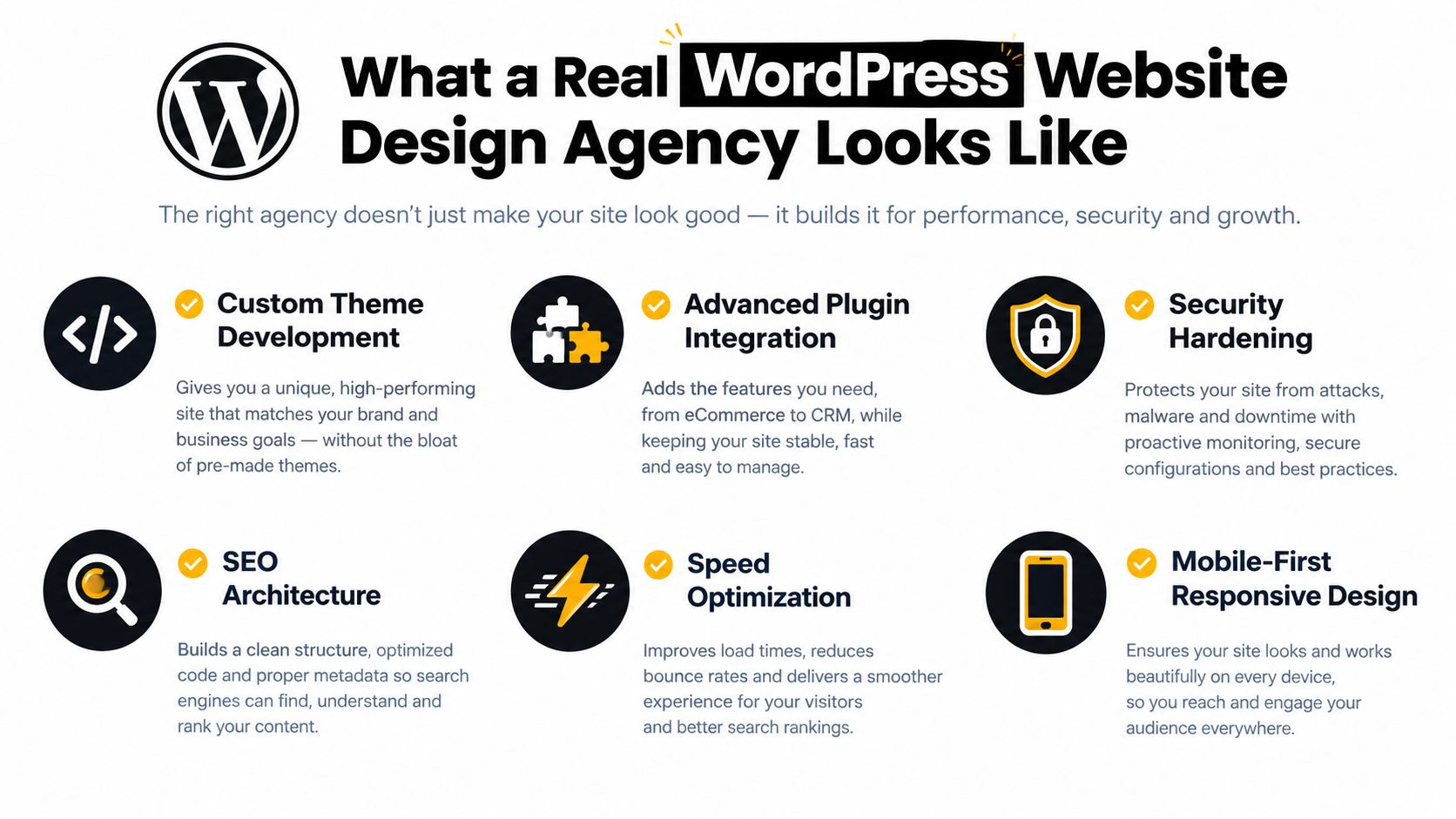
A serious agency doesn't sell you a theme and call it strategy. It builds around your business, your content, and the way your team will use the site once it's live. If the only examples in the portfolio are page-builder sites with glossy screenshots, you're looking at a reseller, not a proper delivery team.
What to check in the build itself
A real agency should be able to talk about custom theme development, block theme architecture, clean ACF or custom block implementation, and a sane plugin stack. If they're relying on a pile of heavy plugins to do basic layout work, you'll feel that later in speed, maintenance, and debugging.
They should also understand accessibility and performance as standard, not as add-ons. For ecommerce clients, that means actual WooCommerce experience, not just one product page they once built for a mate. For service businesses, it means they know how to structure pages for enquiries, not just traffic.
A useful resource if you want to explore how agencies think about the broader category is explore digital agency topics. I'd treat it as background reading, not a buying checklist, but it does help you see how wide the gap is between a full-service team and a design-only shop.
How to read a portfolio properly
Don't get distracted by mockups. Open the live sites. Check whether they load quickly, whether the mobile version feels smooth, and whether the navigation makes sense without instruction. Then look for signs of repeat work, because clients rarely stay with agencies that make life harder after launch.
A polished homepage means very little if the editor breaks every second update.
The red flags are usually obvious once you know where to look. No named developers, no clear ownership of hosting or DNS, vague case studies, and no evidence of real outcomes. I'd also be cautious of anyone who only wants to build with one page builder and talks about “easy editing” while avoiding conversation about code quality.
The shortlist test
If an agency can't show you a recent WordPress build that they're confident enough to link live, keep looking. If they can't discuss performance, maintainability, and content control in plain language, keep looking harder. And if they can't explain how they'd build a site that your team can manage without ringing them for every small change, they're not ready for serious work.
When WordPress Is the Wrong Choice for Your Build
WordPress is still the right default for a lot of Melbourne businesses, but “default” doesn't mean “universal”. There are situations where another stack is cleaner, faster, or easier to govern. A good agency will admit that instead of trying to wedge every brief into the same CMS.
When a performance-first stack wins
If you're running a high-traffic editorial property or a SaaS site where content velocity and speed are critical, a headless build can make more sense. In those setups, frameworks like Next.js or Astro can ship leaner front ends and reduce the amount of theme baggage you carry. If the whole business depends on fast content delivery and aggressive UX tuning, WordPress can still work, but it's not always the smartest first choice.
The second case is a complex B2B portal with deep custom data relationships. If the site needs heavy logic, internal workflows, or unusual user permissions, custom React or Vue on top of a dedicated backend can be cleaner than forcing every requirement through plugins. That's especially true when the brief starts reading like an internal system rather than a marketing site.
Where commerce changes the answer
Pure headless commerce at scale is another case where WordPress starts losing ground. If inventory complexity, checkout reliability, and storefront speed are the core problem, Shopify Hydrogen or a custom commerce stack can be the better conversation. WordPress can do ecommerce, but if the site needs to behave like a platform rather than a store, you should pause before committing.
| Scenario | Use WordPress When… | Choose Headless (Next.js/Astro) When… | Red Flag in WP Pitch |
|---|---|---|---|
| Content-heavy brand site | Your team wants easier editing and sane maintenance | Speed is the main requirement and editorial volume is high | The pitch leans on plugins instead of architecture |
| B2B portal | Content and lead capture matter more than custom logic | The site needs deep data models and custom workflows | The agency keeps forcing page templates over system design |
| Ecommerce at scale | You want marketing flexibility and manageable growth | Checkout, inventory, and storefront speed dominate the brief | They promise everything through add-ons and theme tweaks |
The simple decision rule is this. If your brief sounds like WordPress plus 12 premium plugins, you probably need a different conversation. If it sounds like a marketing site, a content hub, or a store that needs flexibility, WordPress still makes sense.
Pricing, Timelines, and the Costs No One Quotes You
Melbourne buyers still compare agency quotes poorly. They fixate on the headline price, then discover what was excluded, what gets billed later, and how quickly a cheap proposal turns into a rebuild.
What the Melbourne market usually looks like
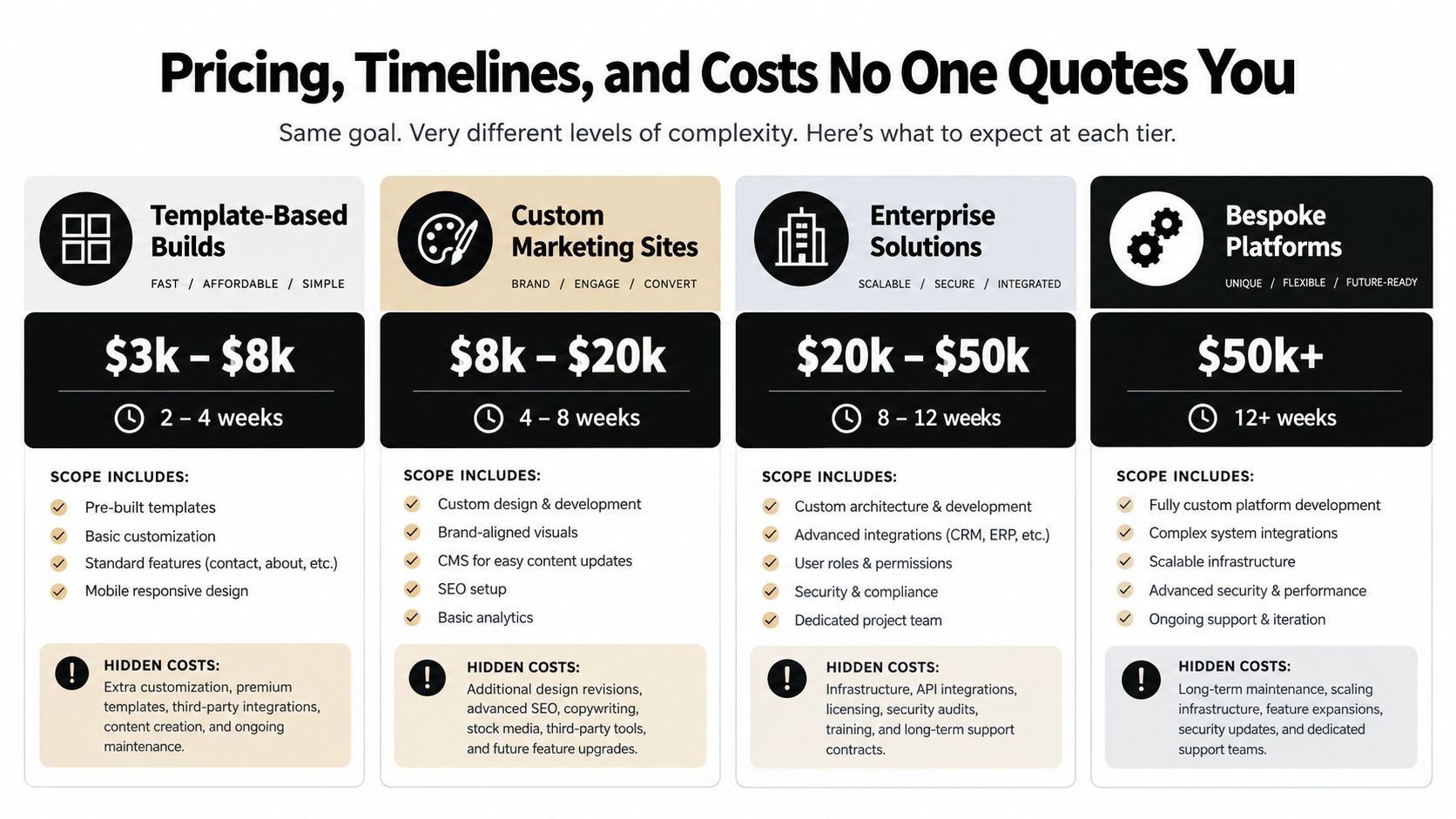
For a template-based build, a sensible range is A$3,000 to A$8,000, usually over 2 to 4 weeks. A custom marketing site often sits in the A$10,000 to A$25,000 range, with 6 to 10 weeks being normal once content and approvals are involved (pricing guidance). WooCommerce stores usually move into A$15,000 to A$45,000 and 8 to 14 weeks, while complex custom builds can sit at A$40,000+ and run for 3 to 6 months.
Those numbers only matter if the scope is tight. A brochure site with five pages is not the same as a conversion-focused build with migration, forms, integrations, and multiple revision rounds. Teams that blur those lines end up arguing about the quote instead of the brief.
The hidden costs that change the total
The proposal usually leaves out the expensive bits. Premium theme and plugin licences can run A$500 to A$3,000 a year, hosting that can support Australian performance expectations can sit at A$150 to A$600 a month, and post-launch retainers can land at A$1,500 to A$5,000 a month. Add content migration, redirect mapping, accessibility remediation, copywriting, and photography, and the total moves quickly.
Buyer rule: if the quote doesn't spell out licences, ownership, and support after launch, the quote isn't finished.
The negotiation points matter too. Fixed scope sounds safe until the change orders start. Time-and-materials sounds flexible until nobody watches the hours. Ask who owns the final design files, who owns the plugin licences, and what happens when the project grows beyond the original scope.
A good agency is blunt about these trade-offs. A glossy one buries them in assumptions and hopes you don't notice until the invoice lands.
Onboarding and the Project Process From Brief to Launch
A proper process saves you from endless revisions and random surprises. The best agencies don't improvise their delivery. They run a sequence, they keep the client involved at the right points, and they make sure decisions happen when they're cheapest to make.
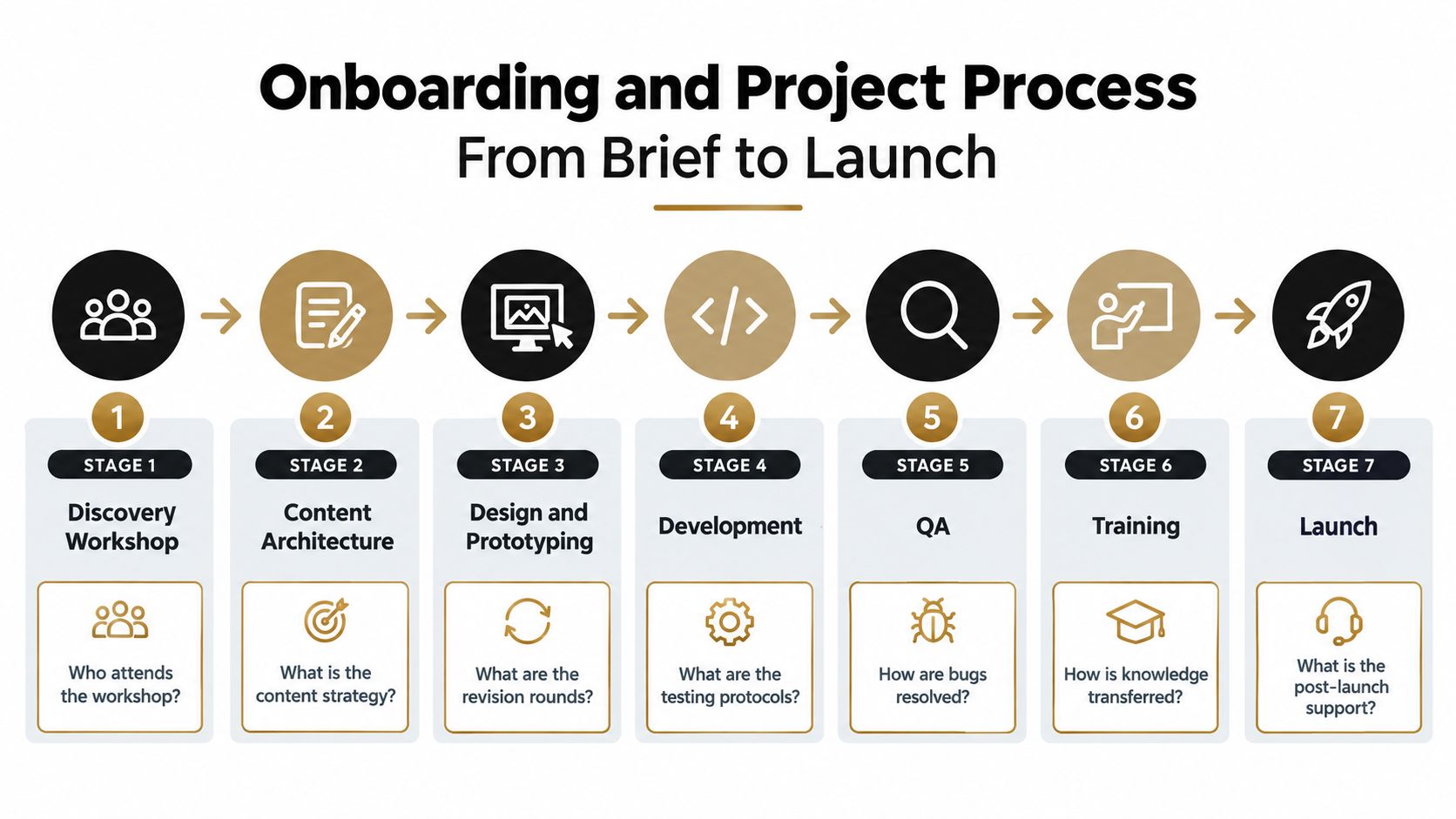
The seven stages I'd expect to see
- Discovery workshop. Ask who attends and what comes out of it. I want a workshop that turns business goals into a real brief, not a vague brainstorm.
- Sitemap and content inventory. Ask whether content is included or whether your team writes it. If that isn't clear early, it gets messy later.
- Visual design in Figma. Ask how many revision rounds are included and who owns the file. Ownership matters when the site grows.
- Development on staging. Ask to see the staging URL and how deploys happen. If there's no staging environment, that's a red flag.
- QA, accessibility, and performance pass. Ask for Lighthouse and WCAG 2.2 AA checks before launch. Launching first and testing later is amateur hour.
- Content load and analytics handover. Ask whether GA4 and Search Console will be configured with you as owner. The accounts should belong to you, not the agency.
- Launch, training, and hypercare. Ask what support window follows go-live. A decent team doesn't vanish on launch day.
The habit that separates reliable teams
I care a lot about weekly demo calls. Not because I want meetings for the sake of meetings, but because recorded progress stops projects drifting into Slack chaos. A Loom showing what changed, what's blocked, and what's next is one of the simplest ways to keep momentum without dragging everyone into unnecessary calls.
If the agency can't explain the work clearly every week, they probably can't manage it clearly either.
WordPress website design agency projects either stay tidy or start slipping. The process itself is the product of the engagement. If the agency is organised, you'll feel it long before launch.
Post-Launch Services That Actually Move the Needle
Launch day is not the finish line. It's the point where the site starts being judged by real users, real traffic, and real problems. The agencies that matter in Melbourne know that the post-launch package is where a lot of the value sits.
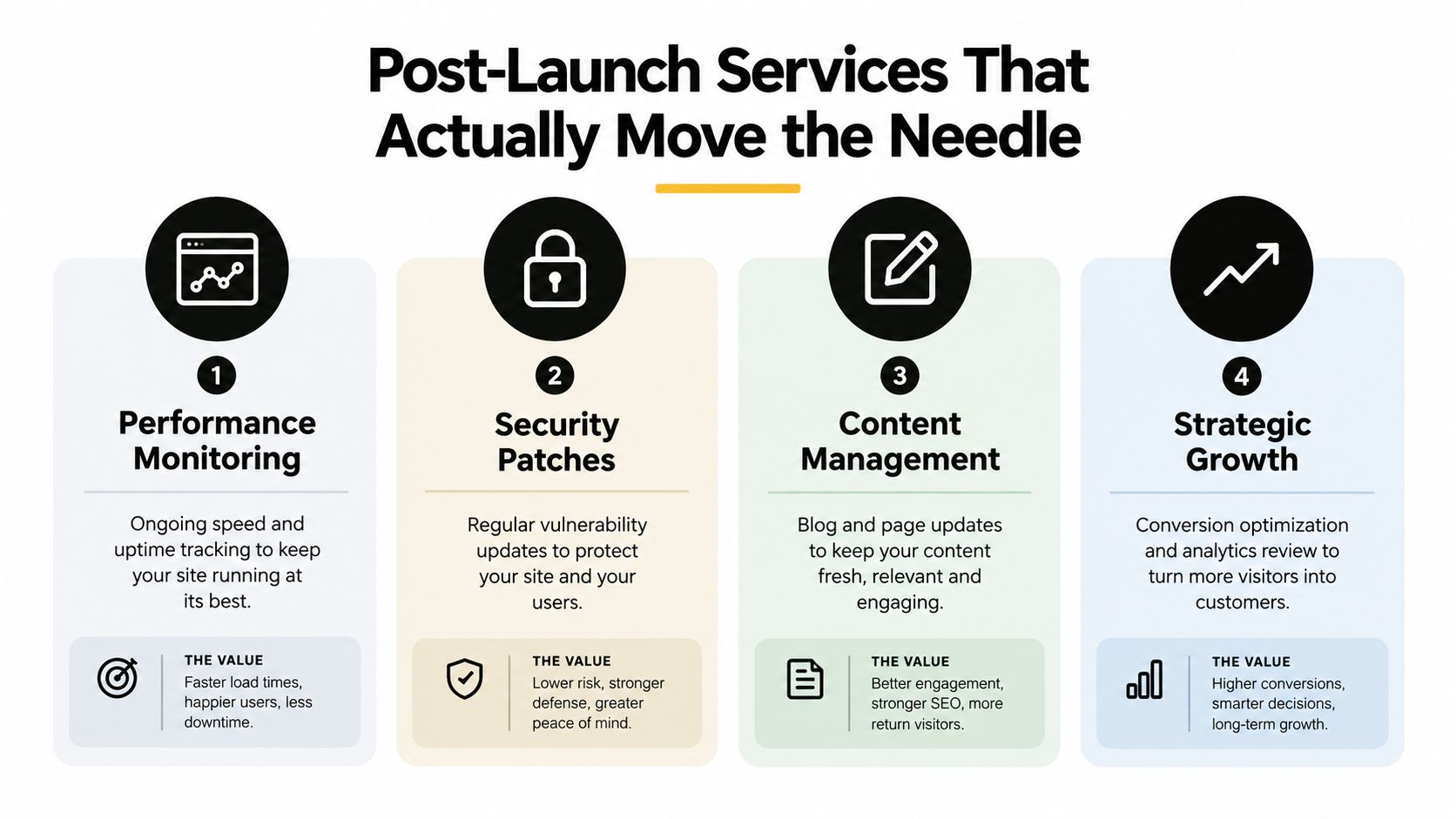
The difference between a glossy retainer and a growth retainer
A glossy retainer usually covers a few updates, some vague “support”, and a monthly report nobody reads. A growth retainer keeps the site healthy and uses the site as a working business asset. That means monitoring performance, fixing regressions, improving content, and tying the website back to campaigns and conversion data.
The first layer is performance monitoring. On mobile, I'd expect the team to watch for LCP under 2.5 seconds, INP under 200, and CLS under 0.1 on Australian 4G. If the site drops below that standard, someone should know why and what's being done about it.
The second layer is security and hosting hygiene. Plugin debt, stale updates, and bad hosting don't usually fail loudly. They rot slowly, which is worse because the business keeps paying for something that is steadily deteriorating.
What good post-launch work looks like
Conversion rate optimisation should be based on real funnel data, not random button colours. If the site brings traffic but enquiries are weak, the agency should be testing page structure, form friction, page intent, and content clarity. Paid campaigns matter too, because landing page iteration and ad performance feed each other.
A serious post-launch package should also include ownership clarity. Who owns analytics? Who handles a regression at 11pm on a Friday? What happens when a plugin update breaks the layout? If the team can answer those questions, they're thinking like operators, not decorators.
The quarterly deliverables I'd expect
- Performance review: speed, uptime, and Core Web Vitals tracking.
- Security review: plugin, theme, and core update status.
- Conversion review: form performance, page flow, and enquiry quality.
- Content review: updates, landing pages, and internal link opportunities.
- Analytics review: GA4, Search Console, and event tracking checks.
Alpha Omega Digital offers WordPress development and ongoing marketing support for businesses that want the website, ads, and measurement to work together, but the point is the model, not the logo. A sensible post-launch plan should keep the site improving after it goes live, not leave it parked until something breaks.
If you want a Melbourne team that can build a proper WordPress site, keep it fast, and tie it back to growth, visit Alpha Omega Digital. They work across WordPress, Shopify, and paid media, so the site, the tracking, and the campaign structure can all be handled in one place. If your current website feels like it's costing you leads, that's the right time to get a second opinion.
[email protected]
Read more insights from our team on web design, paid ads, and growth strategy.