You've invested in a new store, refreshed your catalogue, or launched a campaign, yet the sales still don't match the effort. Visitors arrive from Google, Instagram, or paid ads, then disappear because the mobile experience is slow, the product journey is unclear, or the tracking can't show where the money went. For a Melbourne ecommerce business, choosing a WordPress design agency Melbourne partner should therefore be a commercial decision, not a search for the prettiest portfolio.
A capable agency should connect WordPress development, conversion-focused design, technical SEO, analytics, and paid media. It should also explain the trade-offs between WordPress, Shopify, custom development, and newer hosted platforms in terms you can use to make a decision. This guide focuses on the checks that matter after launch, including mobile performance, CRO, tracking integrity, ongoing support, and the wider role of a digital marketing agency Melbourne ecommerce brands can rely on.
Why Melbourne Businesses Still Struggle with Basic WordPress Sites
A Melbourne retailer can have a polished logo, strong products, and a healthy advertising budget, but still lose sales before a shopper reaches checkout. The homepage may load slowly on a phone, the navigation may bury popular categories, or the product page may ask visitors to make too many decisions at once. From the owner's perspective, the site looks finished. From the customer's perspective, it feels uncertain.
That pattern is common because many businesses treat a website as a one-off design project. They approve colours, approve layouts, publish the site, and only later ask whether product discovery, checkout completion, form submissions, and campaign attribution work properly. A WordPress website developer should be involved in those commercial questions before the first page is designed.

The mobile experience changes the opportunity
One Australian industry summary reports that only 41% of small businesses have a website, which means 59% still do not, and that the gap reaches 65% in regional areas. The same Australian website design statistics summary reports that more than 60% of website visits in Australia come from mobile devices, while 57% of Australians won't recommend a business if its mobile site performs poorly.
Those figures matter to a Melbourne agency because the opportunity isn't to create an online presence. It's to create a reliable sales and enquiry channel for people using phones, often in short sessions and with limited patience. The source also notes that a 1-second load delay can noticeably reduce conversions, which makes image handling, caching, script control, hosting choices, and template design commercial concerns rather than purely technical details.
A good WordPress build starts with the mobile buying path. That includes category discovery, search, filters, product comparison, add-to-cart behaviour, checkout fields, payment messaging, and confirmation emails. A website that only looks convincing on a large desktop monitor hasn't been designed for the conditions in which many Australian shoppers use it.
A brochure can't carry an ecommerce funnel
The most expensive mistake isn't always a broken plugin. It's a site that works technically but gives the customer no strong reason to continue. Weak product photography, unclear delivery information, buried trust signals, and generic calls to action create friction that no amount of extra traffic can fix.
I look for a clear relationship between each template and its job. The homepage should orient new visitors. Collection pages should help shoppers narrow choices. Product pages should answer objections. The cart should preserve momentum. A WordPress development company that can't explain those roles is likely selling presentation rather than performance.
Commercial rule: Before approving a design, ask which customer action each major component is meant to support and how that action will be measured.
Melbourne has demand and competition
The Australian Web Design Services industry includes 3,581 businesses in 2026, and the sector recorded a 3.6% compound annual growth rate between 2021 and 2026, according to Australia's small-business web design market analysis. The same source lists 135 small-business web design firms headquartered in Melbourne.
That density gives buyers choice, but it also makes superficial differentiation easy. Agencies can promise custom design, responsive layouts, and SEO without showing how those capabilities affect revenue. The stronger hiring question is whether the partner can connect UX decisions to measurable outcomes, maintain the site after launch, and improve the system as customer behaviour becomes clearer.
What Really Matters When You Evaluate a WordPress Development Partner
When I assess a WordPress developer Melbourne business can trust, I start with evidence of commercial thinking. A live portfolio is useful because it reveals how the agency handles real navigation, content, forms, responsive states, and ecommerce templates. Screenshots alone hide loading behaviour, accessibility issues, broken links, and the difference between a finished concept and a maintained website.
The second check is technical ownership. A capable WordPress web developer should be comfortable discussing custom themes, Gutenberg blocks, plugin selection, updates, security, staging environments, backups, redirects, structured data, and performance testing. You don't need to become a developer, but you should be able to tell whether the agency is explaining a deliberate system or just assembling a collection of plugins.
A useful independent reference is this guide to WordPress builders tested by Blog Health App, particularly when you're comparing visual builders with more controlled development approaches. The decision isn't that every business needs custom code. It's that the agency should explain what the chosen builder adds, what it limits, and how it will be governed.
The questions that expose capability
| Capability | What to Ask | Red Flag |
|---|---|---|
| Conversion design | Which customer actions will the main templates support, and how will you measure them? | The conversation stays focused on colours, animations, and screenshots. |
| Performance | How will you test mobile templates, image weight, scripts, caching, and hosting? | The agency promises that the site will be fast without naming a testing process. |
| Gutenberg development | Can you build reusable custom blocks with controlled fields and editing rules? | Editors are given unrestricted layout controls that can create inconsistent pages. |
| Tracking | Which events, forms, purchases, and campaign sources will be validated before launch? | Analytics is treated as a code snippet added at the end. |
| Security and maintenance | Who handles updates, backups, monitoring, staging, and emergency fixes? | Support is described as “available” without a defined service model. |
| Ownership | Will the business own its domain, content, data, accounts, and usable website assets? | The proposal leaves access and ownership unclear. |
Gutenberg is more than a page editor
Custom Gutenberg blocks can give a content team controlled flexibility. Instead of asking staff to manipulate a page with a large collection of layout settings, a developer can create blocks for product comparisons, promotional banners, review summaries, feature grids, FAQs, and editorial content. Each block can have defined fields, responsive behaviour, and guardrails that protect the design system.
That approach works well for ecommerce brands that publish regularly. It keeps the content team moving without forcing them to request developer help for every campaign page. It also reduces the temptation to install another plugin every time the marketing team needs a new component.
The trade-off is that custom blocks require planning. The agency must document the editing experience, define reusable patterns, and decide which controls belong with marketers and which should remain fixed in code. If a proposal includes “custom Gutenberg” but doesn't explain those boundaries, ask for a working example.
CRO capability separates delivery from improvement
A site launch is a starting point. The agency should be able to review traffic sources, landing pages, form completions, click behaviour, device performance, funnel drop-offs, and engagement. Conversion data analysis guidance for Australian businesses highlights these areas as part of understanding whether a website is performing, rather than relying on a visual opinion.
For ecommerce, start with a baseline and segment it by device, channel, and category. Australian benchmarking sources place average ecommerce conversion around 1.84% to 1.9%, with category bands commonly ranging from 1.4% to 3.2%, and some top-performing stores exceeding 4.0%, as reported in the Australian ecommerce benchmarking report. Those figures should guide questions, not become promises. Your product mix, traffic quality, price point, brand awareness, and fulfilment experience all affect the result.
How to Choose the Right WordPress Design Agency Melbourne Business
The selection process becomes easier when you stop comparing agencies as if they're interchangeable suppliers. A suitable partner should understand your products, customers, margins, acquisition channels, internal capabilities, and operational constraints before recommending a build.
Start with recent live work. Check the site on a phone, test the navigation, search for a product, inspect the cart, and submit a form if one is available. Look at more than the homepage. A strong WordPress website developer should show thoughtful inner templates, useful error states, clear calls to action, and consistent behaviour across screen sizes.
Start with the business problem
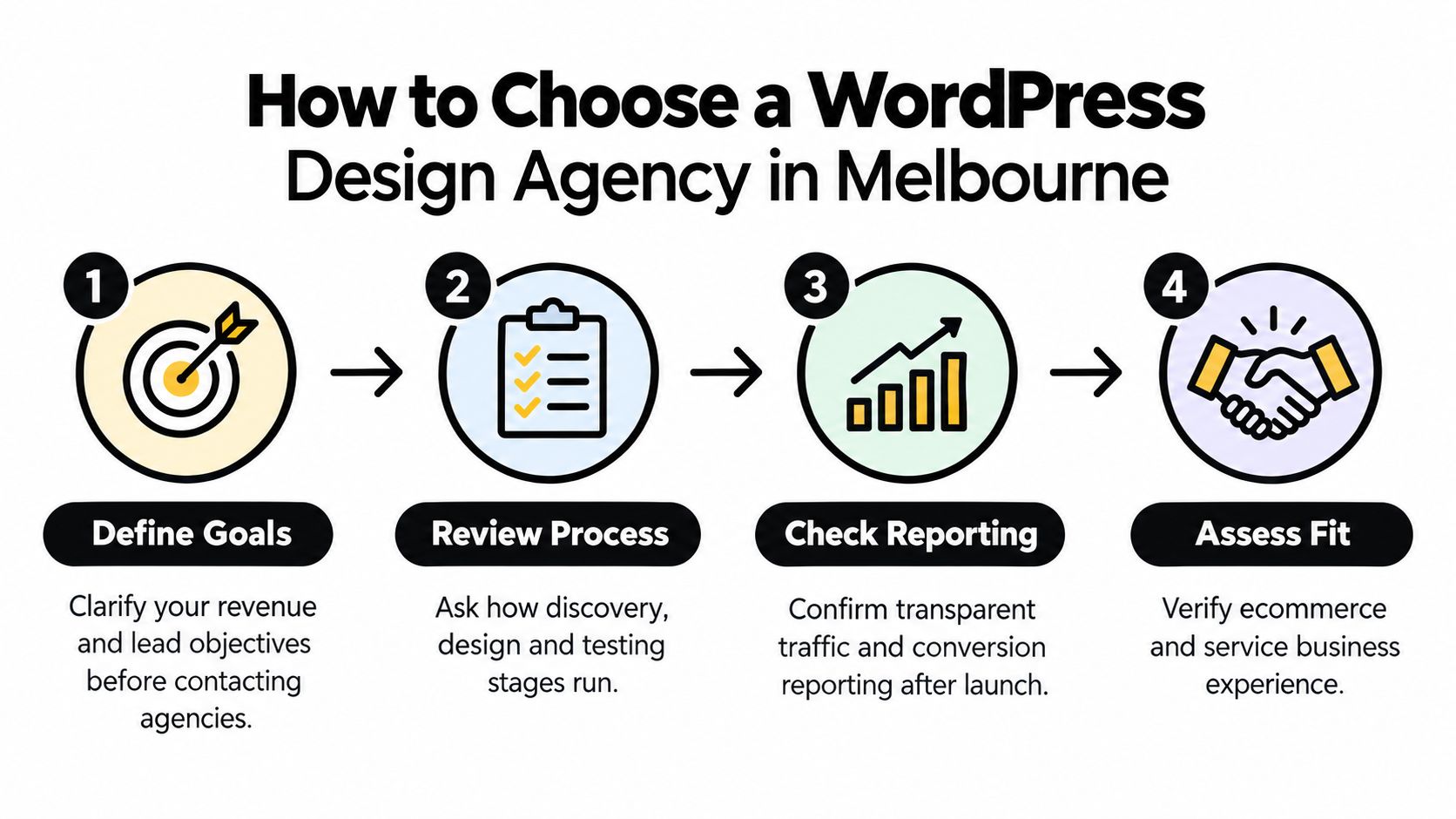
Write down what the current site fails to do. You might need more completed checkouts, better product discovery, stronger organic landing pages, cleaner lead attribution, or a publishing workflow your team can manage. “We need a new website” isn't specific enough to evaluate a proposal.
Ask each agency to connect its recommendations to that problem. If your paid campaigns attract visitors but produce weak revenue, a visual redesign alone may not be the right first investment. You may need landing-page work, improved product information, clearer offers, better tracking, and a testing plan.
Review the process, not just the outcome
A credible proposal should make the delivery path visible. Look for discovery, information architecture, content requirements, wireframes, design review, development, quality assurance, analytics validation, staging approval, launch, and post-launch monitoring. The exact labels can differ, but the decisions shouldn't be hidden.
Ask how the agency handles feedback. A good process distinguishes strategic changes from scope changes and explains how each affects delivery. It should also show who makes decisions, how approvals are recorded, and what happens when content arrives late.
Test technical communication
You can ask practical questions without understanding PHP or JavaScript in depth:
- Templates: Which templates will be custom, and which will use existing components?
- Blocks: What will editors be able to change safely in Gutenberg?
- Performance: How will mobile performance be tested before and after launch?
- Tracking: Which events will be implemented and checked in a test environment?
- Integrations: How will the site connect to email, CRM, payment, fulfilment, and advertising systems?
- Support: What happens when a plugin update conflicts with a custom feature?
The quality of the answer matters more than technical jargon. If the agency can explain the trade-off in plain English, it's more likely to communicate well during delivery.
Verify references and commercial fit
Ask for references from businesses with similar complexity. An ecommerce brand should speak with an ecommerce client, not rely only on a brochure-site testimonial. Ask whether the partner met the agreed scope, responded to problems, protected access, explained decisions, and remained useful after launch.
Finally, inspect the proposal. It should identify deliverables, exclusions, assumptions, responsibilities, payment terms, ownership, support, and change handling. A cheap proposal with missing detail isn't necessarily cheaper. It may move the cost into later amendments, delays, and emergency work.
Pricing Models, Engagement Risks, and When to Walk Away
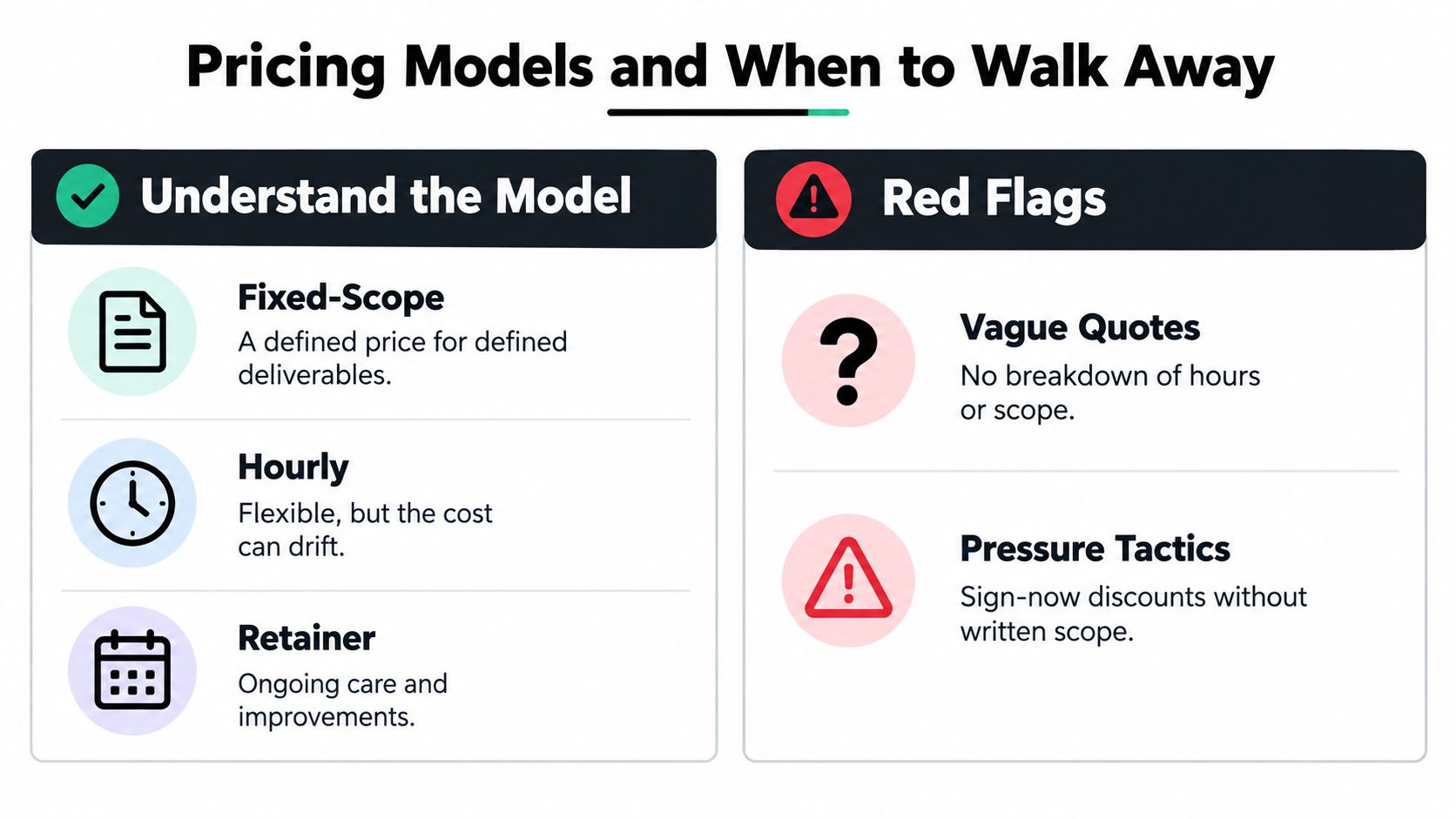
A WordPress project can be priced in several reasonable ways, but each model creates a different relationship between flexibility and control. The problem isn't choosing fixed scope, hourly work, a retainer, or a hybrid arrangement. The problem is signing without understanding what the model includes and how decisions will affect the final cost.
A fixed-scope project suits a defined rebuild with agreed templates, integrations, and acceptance criteria. It gives the buyer a clearer budget, but it can become rigid when discovery uncovers important requirements. Hourly work suits technical investigation, repairs, and evolving development, although the business needs regular reporting to prevent cost drift. A retainer makes sense when the site needs continuous updates, testing, support, and improvement rather than a single delivery event.
Read the scope like an operator
A useful proposal should tell you what the agency will produce. Look for page and template counts, content responsibilities, migration treatment, integrations, forms, redirects, analytics, testing, training, launch support, and post-launch fixes. If “responsive design” appears without any explanation of mobile testing, ask for clarification.
Cheap work can become expensive when the project excludes the parts that make the website usable. A site may launch without complete product data, properly configured tracking, tested checkout states, or a safe update process. Those omissions rarely appear in the initial quote, but they affect revenue and internal workload.
Walk-away signal: If an agency pressures you to sign before it will provide a written scope, you're being asked to accept uncertainty rather than buy a defined service.
Separate construction from ongoing care
Maintenance isn't just updating WordPress. It can include backups, security checks, plugin compatibility, staging tests, performance reviews, content assistance, bug fixes, and development time. Ask whether support is reactive or proactive, whether unused plugins will be removed, and whether the team documents changes.
The same principle applies to advertising accounts and analytics. Your business should retain access to Google Ads, Google Analytics, Google Tag Manager, Meta Business Manager, domain settings, hosting, and ecommerce accounts. An agency can manage those assets without making them inaccessible.
Use the following video as an additional practical reference when discussing how an agency approaches WordPress project decisions:
Watch for promises without conditions
No responsible WordPress developer can guarantee a particular ranking, conversion outcome, or advertising return before examining the business. Be cautious when a quote promises an instant result while ignoring product-market fit, offer quality, fulfilment, traffic quality, or customer service.
Also question sign-now discounts, vague “unlimited revisions”, missing ownership terms, unsupported third-party plugins, and proposals that offer no handover. A good partner can be confident without hiding the conditions that influence success.
WordPress Design Versus Alternatives for Growth-Focused Ecommerce
WordPress is not automatically the right platform for every Melbourne store. The decision depends on how much control your team needs, how complex the content model is, which integrations matter, and who will maintain the system. A business choosing between WordPress, Shopify, Webflow, Framer, or a headless build should compare operating requirements rather than follow platform fashion.
Recent Australian coverage reports that WordPress powers 43% of Australian business websites, while newer platforms are gaining share on new builds, particularly when performance and visual craft are prioritised, as discussed in the Australian web design landscape overview. The useful question is not whether WordPress is popular. It's whether its strengths match your operating model.
WordPress suits content-led commerce
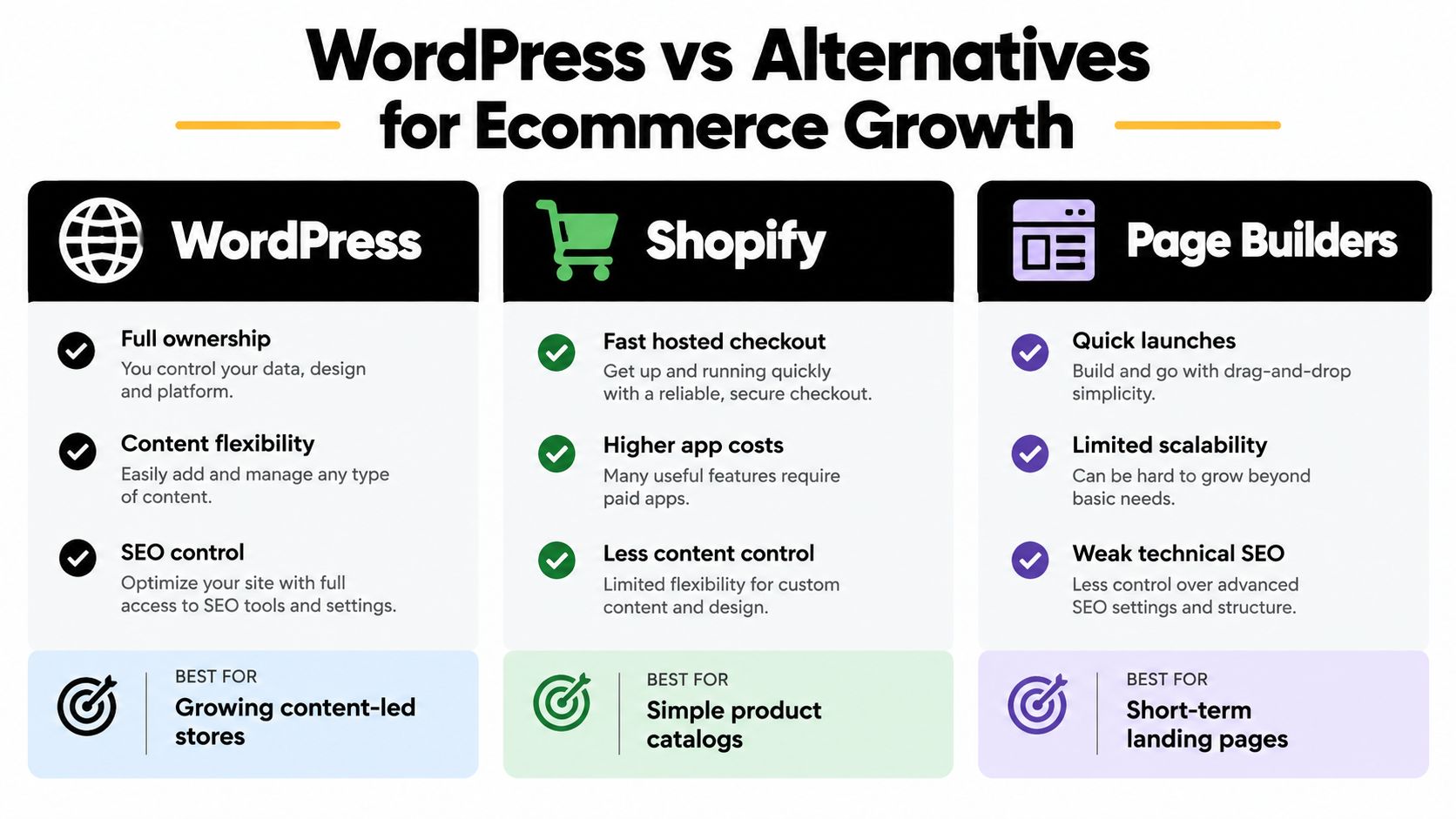
WordPress with WooCommerce can suit brands that need editorial depth, custom content types, flexible SEO control, and integrations beyond a standard product catalogue. A WordPress development Melbourne partner can build custom Gutenberg blocks, product templates, content hubs, comparison tools, quiz flows, and connections to external systems.
The flexibility comes with responsibility. Your team or agency must manage updates, plugin choices, security, hosting, backups, compatibility, and performance. A poorly governed WordPress installation can become difficult to maintain, particularly when several plugins duplicate functionality or inject unnecessary scripts.
Shopify prioritises hosted commerce
Shopify reduces much of the infrastructure responsibility. Its hosted checkout, product management, payment ecosystem, and app marketplace can make it a practical choice for a straightforward catalogue and a team that wants a faster operational start. A Shopify developer can customise themes, build sections, connect services, and extend the store through the Shopify API.
The trade-off appears in app costs, content flexibility, checkout control, data workflows, and dependency on platform rules. Shopify can be excellent for a focused retail operation, but it isn't automatically the best option when publishing, custom functionality, or deep integrations drive the buying journey.
Shopify development can also include custom apps built with Shopify CLI, which gives developers a structured way to create and manage extensions. A Shopify development crash course should cover app architecture, authentication, webhooks, API calls, deployment, testing, and permissions rather than only theme editing. Teams considering a Shopify developer API project should clarify whether they need a private workflow, a public app, an admin extension, a checkout extension, or a data integration.
Page builders and headless builds need discipline
Visual builders can help teams launch campaign pages quickly, but they may create inconsistent layouts, excessive markup, and a growing dependency on builder-specific components. They can work for short-term landing pages when the business accepts those limitations. They're less attractive when a store needs a durable content system and carefully governed templates.
Headless commerce can provide strong control over the front end and may suit complex organisations with technical teams. It also increases the number of systems that need development, deployment, monitoring, and ownership. Buyers researching scalable ecommerce architecture should evaluate the operational burden alongside the flexibility.
Post-Hire Checklist for Measuring Real Website Performance
The agency relationship should produce more than a launched website. It should leave your business with reliable access, documented tracking, a tested buying journey, and a way to identify what needs improvement. Ask for a handover that someone inside the business can understand, even if the agency remains responsible for ongoing work.
Start with account ownership and access. Confirm that your business controls the domain, hosting, WordPress administrator accounts, ecommerce platform, payment provider, Google Analytics, Google Tag Manager, Google Ads, Meta Business Manager, email platform, and CRM. Store access securely and record who is responsible for approving changes.
Validate tracking before spending on traffic
Google Ads conversion tracking requires two concrete actions. You create a conversion action in the account, then install a Google tag on the website, as explained in Google's conversion tracking guidance. Google also recommends auto-tagging and preserving the GCLID through trackers or redirects so campaign conversions can be attributed correctly.
For Shopping campaigns, Google supports measuring conversions by linking Google Analytics to Google Ads or configuring website conversion tracking directly. It also supports offline conversion imports and tag deployment through Tag Manager, according to Google's Shopping campaign measurement documentation.
For implementation, create a clean GTM container structure. Separate tags, triggers, and variables by purpose, use descriptive names, document consent behaviour, and test events in preview mode before publishing. Validate purchases, revenue, transaction identifiers, form submissions, phone clicks, add-to-cart actions, and key engagement events in the receiving platforms.
Configure ecommerce advertising carefully
Google's Shopping automation documentation says standard purchase conversion tracking must already be configured before adding cart data parameters. It also says the Purchase conversion's Conversion goal and action optimisation must be set to Primary, while reporting for Shopping campaign conversions can take longer to appear, as described in Google Ads' Shopping conversion guidance.
For Meta, Shopify Australia explains that the Conversions API sends data server-side from Shopify's server to Meta and recommends enabling it through the Meta data-sharing settings using the Enhanced option for conversion campaigns, as outlined in Shopify's Meta tracking guidance. Your implementation should avoid duplicate browser and server events, preserve event identifiers where required, and test purchase matching before judging campaign performance.
Build a measurement rhythm
Use a baseline for the main templates and segment results by device, traffic source, product category, and landing page. For ecommerce, the practical conversion benchmark is about 1.5% to 2.5% overall, with 3% or higher considered strong, according to Australian conversion-rate optimisation guidance. Treat that range as a starting reference, not a target that overrides your own commercial data.
A disciplined improvement loop looks like this:
- Confirm the baseline: Record traffic, revenue, orders, conversion rate, average order value, and funnel movement before changing templates.
- Find the visible friction: Compare home, collection, product, cart, and checkout behaviour across devices and channels.
- Choose one variable: Test a specific change, such as page speed, headline clarity, trust information, form friction, or checkout steps.
- Document the result: Record the hypothesis, implementation date, segment, outcome, and next decision.
- Review the whole funnel: Check whether more clicks produced better shopping behaviour or merely moved the drop-off further downstream.
The best SEO reporting tools can help organise rankings, visibility, technical findings, and reporting workflows, but reporting software can't replace correct event configuration or commercial interpretation. A dashboard is useful only when the underlying data is trustworthy and the team knows what action follows from it.
Paid media needs the website to be ready
A WordPress design partner and a marketing agency Melbourne ecommerce brand chooses should work from the same measurement plan. Google Ads campaigns need usable landing pages, accurate purchase tracking, and a clear understanding of product margins. Facebook and Instagram ads need creative testing rather than a single permanent advert. A Facebook ads agency should compare hooks, offers, formats, audiences, and post-click behaviour while avoiding premature conclusions.
Meta ads creative testing works best when the team changes one meaningful variable at a time. That could be the opening visual, the product angle, the testimonial treatment, the offer, or the call to action. The account should have enough clean data to make a decision, and the team shouldn't quit too early because an individual advert has a weak first impression. At the same time, consistency doesn't mean leaving poor creative untouched. It means running a repeatable process long enough to learn, then improving the next iteration.
For service businesses, the same tracking discipline applies to Google Ads for contact form submissions, phone calls, and appointment requests. Google Ads for plumbers, electricians, tradies, hairdressers, beauty therapists, dentists, restaurants, and doctors should connect the lead event to what happens after the enquiry. A call that goes unanswered isn't a successful conversion because the phone rang.
A practical call tracking setup can use a custom number through Twilio, with call routing and an answering workflow that supports 24-hour call answering. An automated assistant doesn't get sick or tired, can book appointments into your calendar or Calendly, and can help reduce lost business for tradies and other appointment-led operators. Tools such as CallRail and GoHighLevel can also support PPC call campaigns, but compare number management, recording consent, attribution, CRM integration, appointment booking, reporting, and Australian operating requirements before choosing.
The same principle applies to Google Business Profile, local SEO, Instagram Shop, and Facebook Shop. These channels need accurate product information, consistent business details, clear fulfilment expectations, and a website that can complete the customer journey. A local listing may generate attention, but the website and the response process determine whether that attention becomes revenue.
Alpha Omega Digital is one Melbourne-based option for businesses combining WordPress or Shopify development with Google Ads, Meta advertising, analytics, automation, and conversion-focused website work. The company services Melbourne as well as Sydney, Brisbane, Newcastle, Perth, Adelaide, Darwin, and Hobart.
A strong post-hire handover should leave you with:
- A complete access register: Confirm ownership and administrator access across every platform.
- A tracking map: Document events, triggers, tags, data destinations, consent handling, and test results.
- A performance snapshot: Record mobile behaviour, key template performance, and the main conversion paths.
- A CRO backlog: List prioritised issues with a reason, owner, and proposed test.
- A support agreement: Define response times, included work, escalation, backups, updates, and development boundaries.
- A reporting cadence: Agree which metrics are reviewed, who interprets them, and which decisions follow.
If your ecommerce website needs a technical review, a new WordPress or Shopify build, or paid media connected to reliable conversion tracking, Alpha Omega Digital can help align the site, analytics, and acquisition work. If you're a business with a paid ads budget of at least $3,000 a month, I'd love to offer you a low-risk deal, a month of paid ads management free. Apply now through the contact page.
[email protected]
Read more insights from our team on web design, paid ads, and growth strategy.