You can spend a month chasing electrician leads and still finish with an empty calendar. The phone rings while you're on a job, a shared marketplace sends the same enquiry to several sparkies, and a form submission sits untouched until the next morning. Meanwhile, the marketing report celebrates “lead volume” instead of showing which enquiries became profitable work.
I've run paid campaigns for service businesses in Melbourne, and my view is straightforward. Electrician lead generation should be measured by booked jobs, not raw enquiries. The useful formula is simple:
Ad spend ÷ booked jobs = true cost per acquisition.
That number tells you whether a campaign is helping the business or merely keeping the phone busy.
Why Most Electrician Lead Generation Leaks Money
A typical example is an electrician spending $2,500 a month on Google Ads, receiving a stream of enquiries, and booking only a handful of jobs. The campaign may look active in Google Ads, yet the owner still can't explain which suburb, service, or keyword produced profitable work.
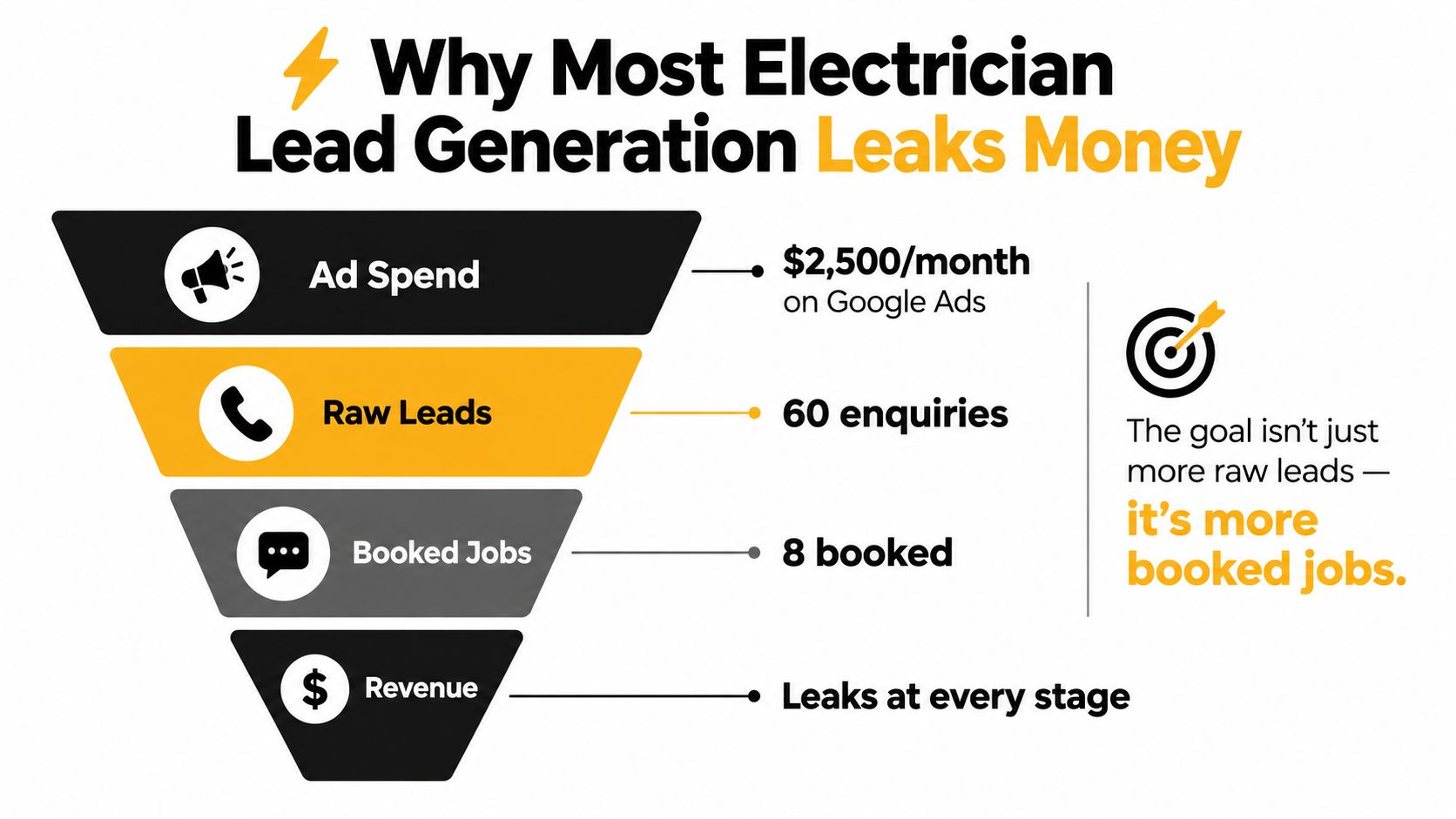
Three leaks usually sit between the click and the job.
- Shared enquiries: Platforms can distribute one customer enquiry among several electricians. You pay to enter a race, then compete on response speed and price.
- Missed calls: An emergency customer rarely leaves a voicemail and waits patiently. If the call arrives after hours, during lunch, or while the team is driving, the job may go to the next business that answers.
- Slow follow-up: Planned work, such as an EV charger installation or switchboard upgrade, needs a clear next step. A form response that sits in an inbox loses momentum quickly.
Australian marketplace activity shows why speed matters. A sector summary reports that Hipages receives a new job lead every 23 seconds, Oneflare lists 12,000+ jobs each week, and ServiceSeeking is used by more than 2 million Australians. The same Australian trades lead-generation overview places electrical work among the core categories on established platforms.
Practical rule: A lead isn't valuable because it arrived. It becomes valuable when it matches your service area, fits your margin, and gets booked.
I also recommend reading the AgentGrown blog for broader ideas on lead handling and automation. The principle is the same across channels: connect the ad, call, form, response, booking, and completed job in one chain.
The operational fix is as important as the campaign. A tightly built Google Ads account can generate strong intent, but it can't book a customer if nobody answers. That's why electrician lead generation needs an answering and booking layer, not just better keywords.
Building the Website That Converts Callers Into Booked Jobs
A customer with a sparking outlet is not browsing your website for inspiration. They want to know whether you handle the problem, whether they can trust you, and how to speak with you now. Put those answers above the fold.
- Can you solve my electrical problem?
- Can I trust you in my home or business?
- How do I book you now?

Lead with a direct call to action, your service area, licence details, and a clear description of the work you handle. Keep the phone number visible on mobile. A visitor should not need to open the navigation or hunt through the footer to call.
Separate services by customer intent. Emergency electrical work, residential installations, commercial maintenance, Level 2 services, switchboard upgrades, smoke alarms, solar-related work, and EV charger installation each need enough detail to qualify the enquiry before it reaches your team.
Build landing pages around the search
Paid traffic should reach a page that matches the customer's query. Someone searching for an emergency electrician in a specific suburb should see that suburb, the relevant service, your response process, proof of completed work, and two clear actions: call or submit a short form.
Use photos of your team, vehicles, equipment, and completed jobs. Include licence and insurance information where appropriate, plus genuine Google reviews. Stock images can make a page look polished, but they do not show that your crew works in the advertised suburb.
A WordPress site can support this structure with custom service templates and Gutenberg blocks for suburb proof, FAQs, reviews, and calls to action. Have a WordPress developer make those blocks reusable so the office team can update pages without editing code. Shopify development, Shopify design, and a Shopify API integration suit ecommerce brands more closely, but the same rule applies: every page needs one clear commercial action.
Measure every phone button, form, and booking action. Use Google Tag Manager for events, GA4 for behaviour, and a dedicated thank-you page for confirmed submissions. For Meta campaigns promoting planned upgrades, install Meta Conversions API alongside browser tracking. The Conversions API Gateway documentation explains the server-side event setup.
The website must turn qualified intent into a call or completed form. Pair it with a 24/7 answering process, because a high-converting page still loses the job when nobody answers.
Google Ads for Electricians Setup and Budgets
I separate electrician campaigns into three intent groups because the customer's urgency and commercial value are different.
Emergency campaigns target searches connected to power outages, sparking, dangerous faults, and urgent repairs. Call-focused ads make sense when the customer needs a conversation immediately.
Installation campaigns target work such as downlights, smoke alarms, EV chargers, and other planned installations. These campaigns can use search ads, lead form assets, and landing pages that explain the installation process.
Upgrade campaigns cover switchboards, three-phase work, solar-related electrical services, and larger projects. Standard search ads are usually more suitable because the customer needs detail before requesting an estimate.
An independent Australian agency guide says Google Ads can produce enquiries in the first week, while Maps and organic search generally take two to four months to compound. It also recommends separate ad groups for emergency, installation, and upgrade intent, alongside suburb-level landing pages and mobile call-focused ads. The Australian Google Ads guidance for tradies supports that structure.
Protect the account with tight location settings, service-area exclusions, scheduling that reflects when calls can be answered, and negative keywords for DIY searches, courses, employment, and unrelated research. Use phrase and exact matching where control matters, then expand only after the search-term report shows commercial intent.
| Business Type | Daily Budget (AUD) | Campaign Split | Primary Ad Format | Target CPL |
|---|---|---|---|---|
| Solo operator with a tightly defined service area | Set from available capacity and target booked-job cost | Emergency, installation, or one priority service | Call-focused search ads and standard search ads | Use tracked results, not a generic target |
| Small team covering several suburbs | Set against crew availability and profitable service categories | Emergency, installation, and upgrades | Search ads with call and lead form assets | Compare by booked job |
| Multi-crew business with a broader radius | Scale only after source-to-booking data is reliable | Separate campaigns by service, suburb, and urgency | Search, call-focused ads, and lead form assets | Calculate from actual booked jobs |
For Australian tradies using pay-per-lead local services models, guidance places lead costs at roughly A$25 to A$80 per lead. The paid search guidance for roofers and dentists is also useful when comparing how different service businesses structure high-intent campaigns.
Don't send every click to the homepage. Match the ad group to a service page and suburb wherever possible. A campaign that produces cheap enquiries outside your service area is not efficient. It's misconfigured.
Local SEO Google Business Profile and Suburb Pages
Local SEO works best when the business profile, website, reviews, and service area all tell the same story. Start with the Google Business Profile category, service list, hours, phone number, and coverage area. Then make sure the website uses the same business details consistently.
The profile should show genuine work, not a library of generic images. Add completed-job photos, answer customer questions, and respond to reviews in a professional way. Track calls and website actions from the profile separately so organic local traffic doesn't get mixed with paid search.
Build suburb pages with evidence
Suburb pages only help when they add local value. Don't publish a template with the suburb name swapped in twenty times. Include relevant service details, real project evidence where available, local access information, service limitations, and a clear booking route.
A strong page can include:
- Specific service context: Explain the work commonly requested by the customers you serve, without making unsupported local claims.
- Proof of coverage: Show the team, vehicle, completed work, licence details, and genuine customer feedback.
- Useful local markup: Use appropriate LocalBusiness and service information, with accurate address and service-area details.
- Clear conversion paths: Give visitors a call button, short form, and emergency instruction where relevant.
Organic search and Google Business Profile traffic can become valuable assets because visibility doesn't stop the moment an ad budget pauses. Paid search remains useful for immediate demand, but the channels should be reported separately.
| Priority | GBP Element | Action | Impact on Calls |
|---|---|---|---|
| High | Primary category and service area | Keep categories and coverage accurate | Supports relevant local discovery |
| High | Phone and hours | Display a number that is answered | Removes friction at the decision point |
| Medium | Reviews | Request genuine feedback after completed work | Builds trust before the call |
| Medium | Photos | Add real work and team imagery | Gives customers practical proof |
| Medium | Questions and answers | Address common service and booking questions | Reduces uncertainty before contact |
The Australian electrical market has structural demand behind it. One industry source reports about 195,900 electricians, annual employment growth of 7,400, more than 4 million rooftop solar installations in 2024, and 3.2 GW of new rooftop capacity added in that year. The Australian electrical industry source connects those electrification trends with installation, maintenance, and upgrade opportunities.
Paid Social Referrals and Lead Marketplaces Compared
Google captures an existing search. Meta can create demand earlier, which makes it useful for planned work. Facebook and Instagram campaigns can promote EV charger installations, switchboard upgrades, renovations, lighting projects, and other services where the customer may not yet be searching.
The creative needs to show the problem and the next step. Use real project photos, a short explanation from the electrician, and a form that asks only for the information needed to qualify the enquiry. Meta lead forms aren't a replacement for a sales process. They're an entry point.
Referrals remain valuable because the customer has already received a recommendation. Build a simple process around completed jobs, property managers, builders, real estate agents, and strata contacts. Ask for the introduction when the customer is satisfied, then record the source in the CRM rather than treating referrals as unmeasured “free” work.
Shared platforms need a harder assessment. Tradify's AU trades summary shows established demand across Hipages, Oneflare, and ServiceSeeking, but the existence of demand doesn't prove profitability for your business. A shared enquiry may be fast, local, and still unprofitable if several electricians receive it or if the work doesn't fit your schedule.
| Channel | Typical CPL (AUD) | Booking Rate | Cost per Booked Job |
|---|---|---|---|
| Google search | Must be calculated from your account | Track qualified calls and forms | Ad spend divided by booked jobs |
| Google Business Profile | No fixed paid lead cost | Track calls and forms separately | Operating and optimisation cost divided by booked jobs |
| Shared lead marketplace | Roughly A$25 to A$80 in AU pay-per-lead guidance | Measure by platform and service | Lead cost divided by booked jobs |
| Meta lead forms | No universal AU electrician benchmark in the verified data | Track by creative and service | Campaign spend divided by booked jobs |
| Referrals | No fixed media cost | Record every referral outcome | Referral and follow-up cost divided by booked jobs |
The right question isn't “Which channel has the cheapest lead?” Ask which source produces suitable jobs at a cost your margin can support. Exclusive lead generation may reduce direct competition, but you still need call handling, qualification, and follow-up before you can claim it works.
Call Tracking 24/7 Answering and Booking Automation
A missed call is not just a reporting problem. It's a customer who may already be speaking with another electrician. I recommend connecting every source to a single pipeline, including Google Ads calls, website calls, forms, Meta leads, referrals, and marketplace enquiries.
Dynamic number insertion can show different tracking numbers based on the visitor's source. Google Ads call assets should use a number that can be answered and attributed. Call recording and transcripts help the owner identify poor-fit enquiries, missed opportunities, and recurring customer questions.
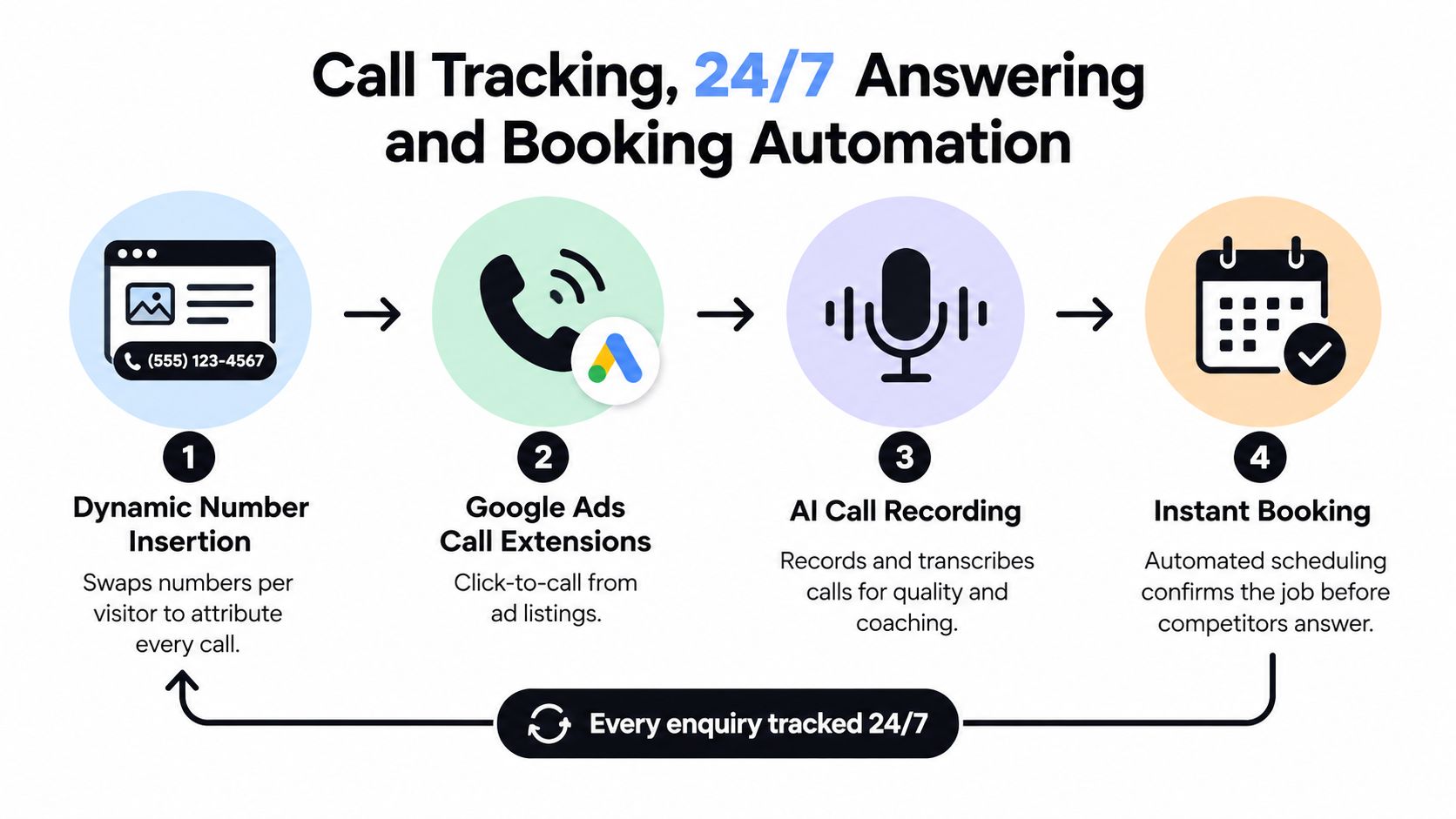
A Twilio-backed custom number can support 24-hour call answering and appointment booking. The answering system doesn't get sick or tired, and it can route emergencies, capture quote requests, and book appointments into your calendar or Calendly. That operational layer can help tradies, hairdressers, beauty therapists, dentists, restaurants, and doctors reduce lost opportunities from unanswered calls.
The workflow should be explicit:
- Call or form arrives: Store the source, service, suburb, and contact details.
- No answer occurs: Send an SMS acknowledging the enquiry and offering a booking route.
- Customer selects a time: Push the appointment into the calendar and CRM.
- Team receives the job: Move the lead through booked, quoted, won, lost, and completed stages.
- Job closes: Trigger a review request and an appropriate follow-up sequence.
Use GoHighLevel, CallRail, or another suitable platform only after deciding what the business needs to measure. The software isn't the strategy. The strategy is a clean connection between source, conversation, booking, and revenue.
Don't promise a particular booking rate without your own data. Instead, review calls for tone, qualification, service-area fit, and whether the customer received a definite next step. A concise answering script should confirm the location, electrical issue, urgency, preferred time, and best contact method. The confirmation message should repeat the appointment details and explain what happens next.
Tracking Analytics and Your Weekly Optimisation Loop
The weekly review should answer one commercial question: which source produced booked work at an acceptable cost?
GA4 can show website events, Google Ads can show campaign and search-term activity, call tracking can show conversations, and the CRM can show whether those conversations became jobs. Configure Google Tag Manager containers carefully so calls, forms, appointment clicks, and thank-you pages use consistent event names.
A Shopify store uses a different measurement environment from a WordPress service website, but both need clean event definitions. Shopify's official API documentation supports custom integrations for ecommerce stores, while a WordPress development company may build custom blocks, forms, and CRM connections for a service business. For ecommerce operators, the same tracking discipline applies to Google Shopping Ads, Performance Max versus standard Shopping campaigns, Instagram Shop, Facebook Shop, and Meta creative testing.
Review the numbers on a fixed day each week. Remove search terms that don't describe a service, reduce exposure in suburbs that don't produce suitable work, improve forms that generate poor enquiries, and check every missed-call record. Marketing consistency matters because a single strong week doesn't prove that a channel is profitable.
| Channel | Weekly Spend | Leads | Booked Jobs | Cost per Booked Job | Revenue Attributed | Action This Week |
|---|---|---|---|---|---|---|
| Google Ads | Record from account | Record qualified enquiries | Record from CRM | Spend ÷ booked jobs | Record completed-job value | Keep, adjust, or pause |
| Google Business Profile | Record operating cost if applicable | Record calls and forms | Record from CRM | Cost ÷ booked jobs | Record completed-job value | Improve profile or service page |
| Meta Ads | Record from Ads Manager | Record qualified forms | Record from CRM | Spend ÷ booked jobs | Record completed-job value | Test creative or audience |
| Referrals | Record follow-up cost | Record introductions | Record from CRM | Cost ÷ booked jobs | Record completed-job value | Strengthen partner process |
| Lead marketplace | Record platform spend | Record valid enquiries | Record from CRM | Spend ÷ booked jobs | Record completed-job value | Keep only profitable services |
Start this week by adding source fields to every form, giving each major channel a trackable number, and marking every enquiry as booked or not booked. Then audit missed calls and create a response process before increasing ad spend.
If you're a business with a paid ads budget of at least 3k a month, Alpha Omega Digital can build and manage the tracking, landing pages, Google Ads, paid social, and follow-up system around booked jobs rather than raw leads. We're based in Melbourne and also service Sydney, Brisbane, Newcastle, Perth, Adelaide, Darwin, and Hobart, so contact Alpha Omega Digital to apply for a low-risk deal that includes a month of paid ads management free.
[email protected]
Read more insights from our team on web design, paid ads, and growth strategy.