The campaign launch is six weeks away. Your fundraising lead is already balancing donor communications, reporting and internal approvals, while the donation form still loses people on mobile. Google Ads haven't produced a clear answer about which campaigns bring in valuable donors. You're looking for a charity marketing agency, but need to know what a capable partner will deliver before you sign.
I'd judge an agency by whether it connects campaign work to the systems and decisions that shape fundraising: donor data, donation journeys, finance reporting and safeguarding. Advertising can bring people to an appeal. It can't fix a broken checkout, unclear use of funds or a follow-up process that leaves new supporters wondering what happened to their donation.
What a Charity Marketing Agency Actually Does
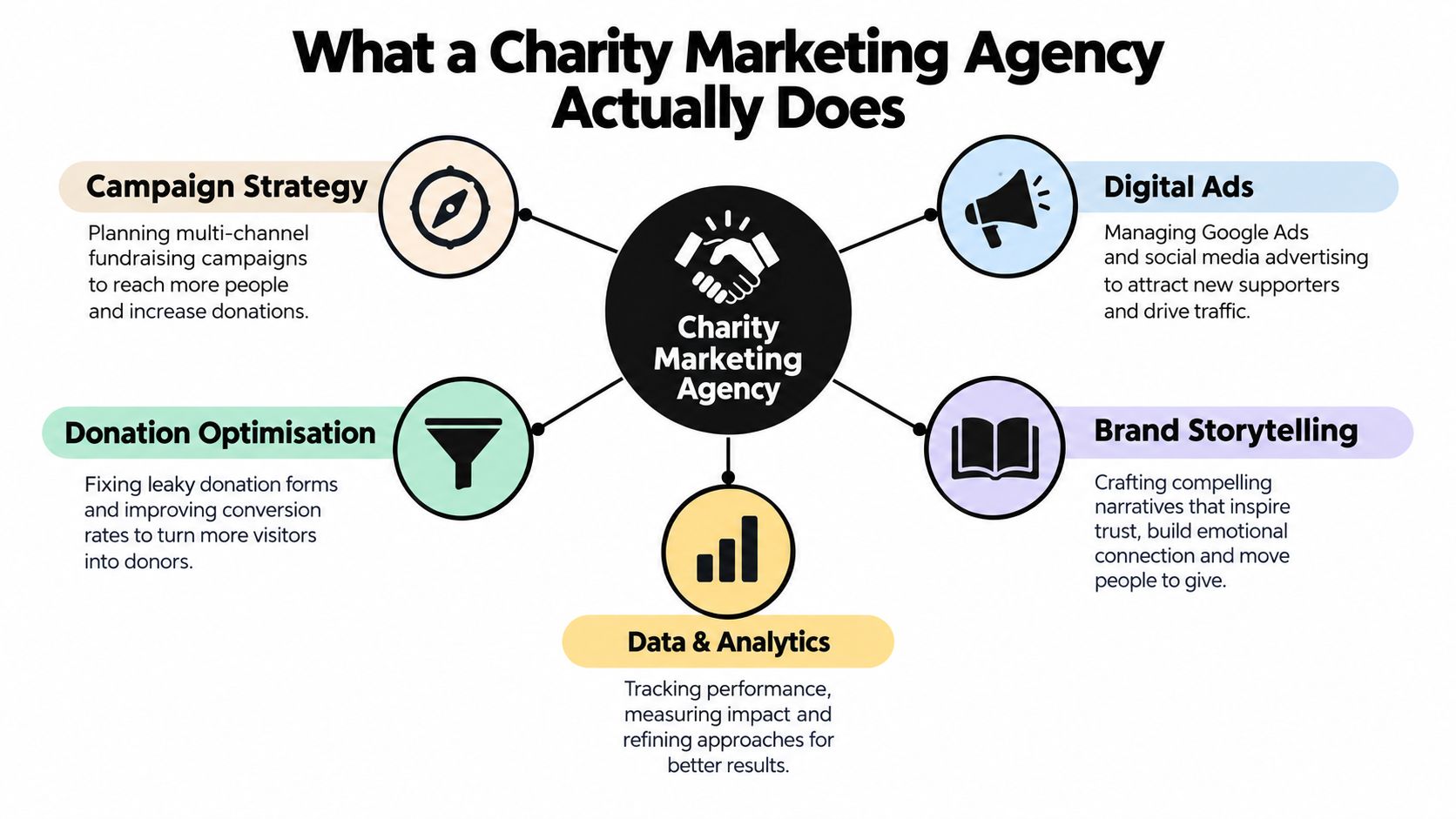
A charity marketing agency is a specialist partner that plans, runs and measures programmes for fundraising, donor acquisition and retention. It should be accountable for the work between the first campaign idea and the donor's experience after giving, not just for publishing ads or supplying a strategy deck.
In the first part of an engagement, I'd expect the agency to establish what's already working and where the journey breaks. That means reviewing past appeals and channel performance, mapping how supporters move from first contact to donation and follow-up, and checking whether campaign data can be matched to your CRM or donor-management system. The agency should then prioritise channels and agree what the first tests will measure.
What should happen before campaigns scale
A useful early work plan usually includes:
- Fundraising audit: Review the appeal, audience, donation page, tracking and follow-up. Look for practical barriers, not just weaknesses in the creative.
- Donor journey mapping: Trace the experience from ad or email click through payment confirmation, welcome message and future communications.
- Channel priorities: Choose channels based on the charity's goals, capacity, audience and available budget, rather than trying to be active everywhere.
- Measurement plan: Agree how the organisation will identify completed donations, recurring gifts, refunds and repeat giving.
- Initial campaign tests: Start with focused experiments that answer a clear question, such as which appeal framing or audience produces qualified donations.
The agency also needs to work with the people who own the data and the donor relationship. CRM administrators, finance staff and safeguarding leads should not be brought in only after a campaign has launched. Their input affects what information can be collected, how donations are reconciled and which stories or images are appropriate to use.
Practical rule: If an agency can report clicks but can't explain how campaign results connect to donations recorded by your organisation, the measurement plan isn't finished.
Core Services a Good Agency Offers Australian Nonprofits
A useful service list starts with the charity's fundraising model, not an agency's preferred channel. A small organisation might need a reliable donation journey and email follow-up before it needs a broad awareness campaign. A national cause with an established donor database may need advanced audience segmentation and conversion tracking.
| Service | What it actually delivers | Best fit |
|---|---|---|
| Fundraising strategy | Campaign objectives, audience choices, message testing and a plan for measuring completed donations | Any organisation preparing an appeal |
| Donor acquisition and retention | Acquisition campaigns paired with welcome, repeat-giving and reactivation journeys | Charities seeking more dependable donor relationships |
| Email and CRM automation | Consent-aware contact flows triggered by actions such as signing up, donating or changing preferences | Organisations with donor records and staff capacity to maintain them |
| Paid media | Google Ads and paid social campaigns connected to relevant landing pages and donation outcomes | Charities with clear priorities and capacity to respond to results |
| Donation-page optimisation | A review of mobile usability, form friction, payment options, trust information and completion tracking | Any charity asking supporters to donate online |
| Storytelling and brand work | Consistent messages and respectful creative that explain the cause and the use of funds | Organisations whose appeals need clearer, more recognisable communication |
What good execution looks like
For donor segmentation, the right number of groups is the number the charity can serve meaningfully. A team may begin with distinctions such as new donors, existing supporters, recurring givers and people who've expressed a particular cause connection. Adding segments without changing the messages or journeys just creates administration.
CRM triggers should reflect real supporter actions. A new donor can receive a timely thank-you and an explanation of what happens next. A person who has already provided their cause connection shouldn't be asked for the same information again. Staff should check that sign-ups reach the CRM and email platform, and that the welcome journey works for each route of entry.
A paid social structure for a small Australian charity should be simple enough to manage and learn from. Separate audiences or creative themes only when each has a clear purpose and enough budget to produce useful observations. If the team can't tell whether a campaign drove donations, improve tracking before adding complexity.
Why Australian Charity Marketing Is Different From General Marketing
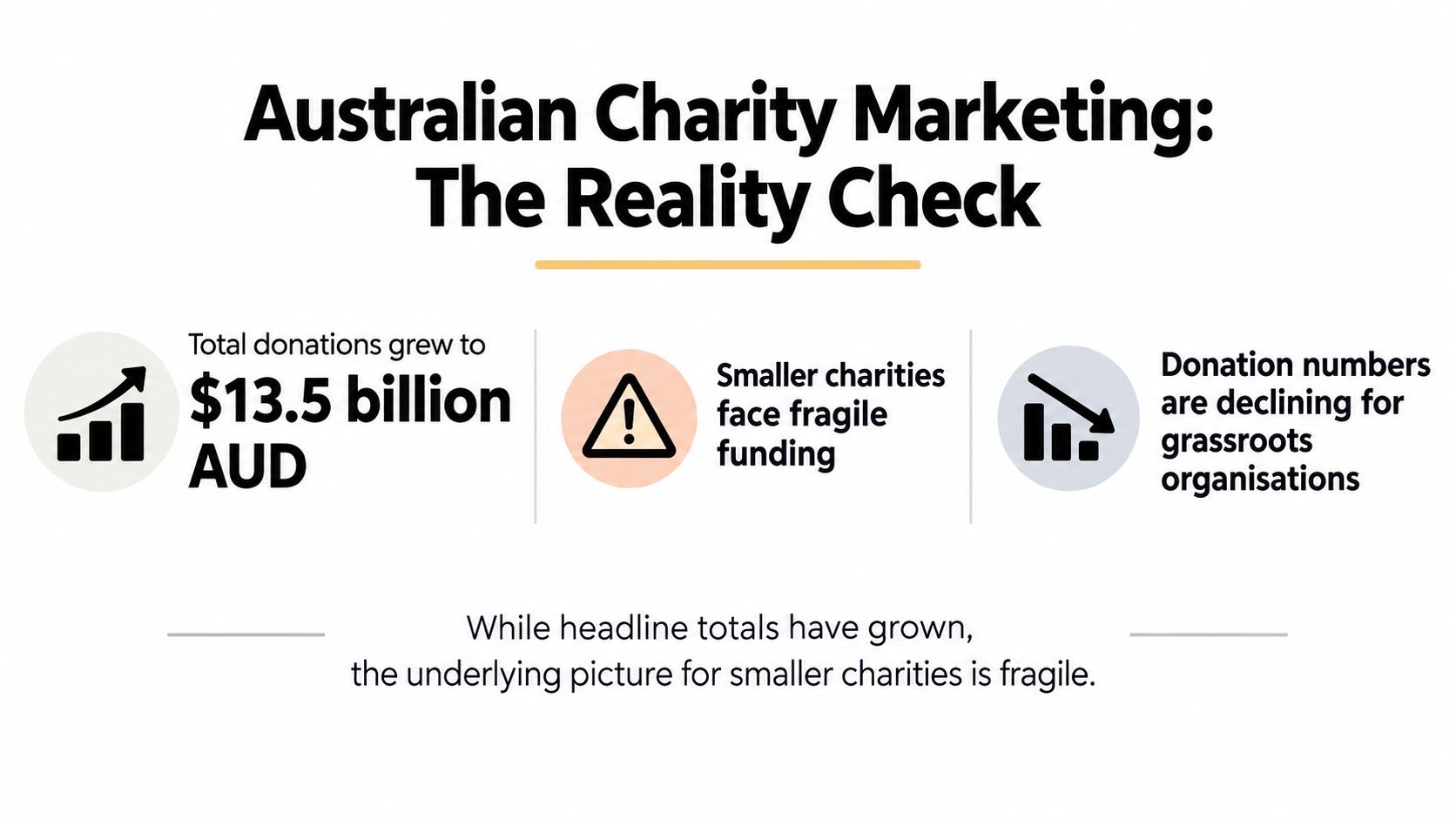
I've sat in board meetings where a charity director cites national giving growth while their own appeal income has been flat for two years. Headline donation totals can make the sector look more secure than the typical charity's fundraising experience. The Australian Charities Report records $13.9 billion in donations and bequests in 2022, an increase of more than $584 million from the previous year. The later reporting period shows why totals need context: donations and bequests reached $18.9 billion in 2023, substantially affected by an exceptional $4.9 billion gift to the Minderoo Foundation group. Excluding that gift, reported donations were approximately $14 billion, only $54 million higher than the previous year.
If an agency's pitch deck leads with sector growth, ask what that figure means for your charity specifically.
Small charities feel the gap most sharply. An Australian Parliament document based on ACNC data reports that charities with annual revenue below $500,000 made up 60.2% of all charities, and donations and bequests represented 77.8% of small-charity revenue, compared with 14.3% for large charities. A weak appeal can affect an organisation's ability to deliver its work. The sensible marketing response is repeatable fundraising and retention systems, sized to your donor file rather than to a sector headline.
Treat the donation journey as an integration problem
Charities often run campaigns across systems that don't share a clean view of the donor. A 2023 Australian not-for-profit technology report found that 71% of organisations used two or more platforms to accept donations, while only 22% said their systems enabled them to understand service impact. Advertising and donation tracking need to be designed alongside the charity's CRM, payment tools and finance processes, and that work should be scoped before media spend begins.
A workable setup attaches campaign source data to the donation record, reconciles payment-platform transactions against the charity's own records and separates a completed gift from a click or form start. Without that connection, an agency can optimise towards cheap traffic while the charity stays unable to assess donor quality. Ask any agency you're vetting how they define a conversion. If the answer ends at a page view, keep looking.
The ACNC's Charity Register was searched more than 2 million times, as described in the peer-reviewed study of Australian donor behaviour and social networks. Donors check. A donation page should clearly identify the organisation and explain how funds will be used, so supporters don't have to take trust on faith.
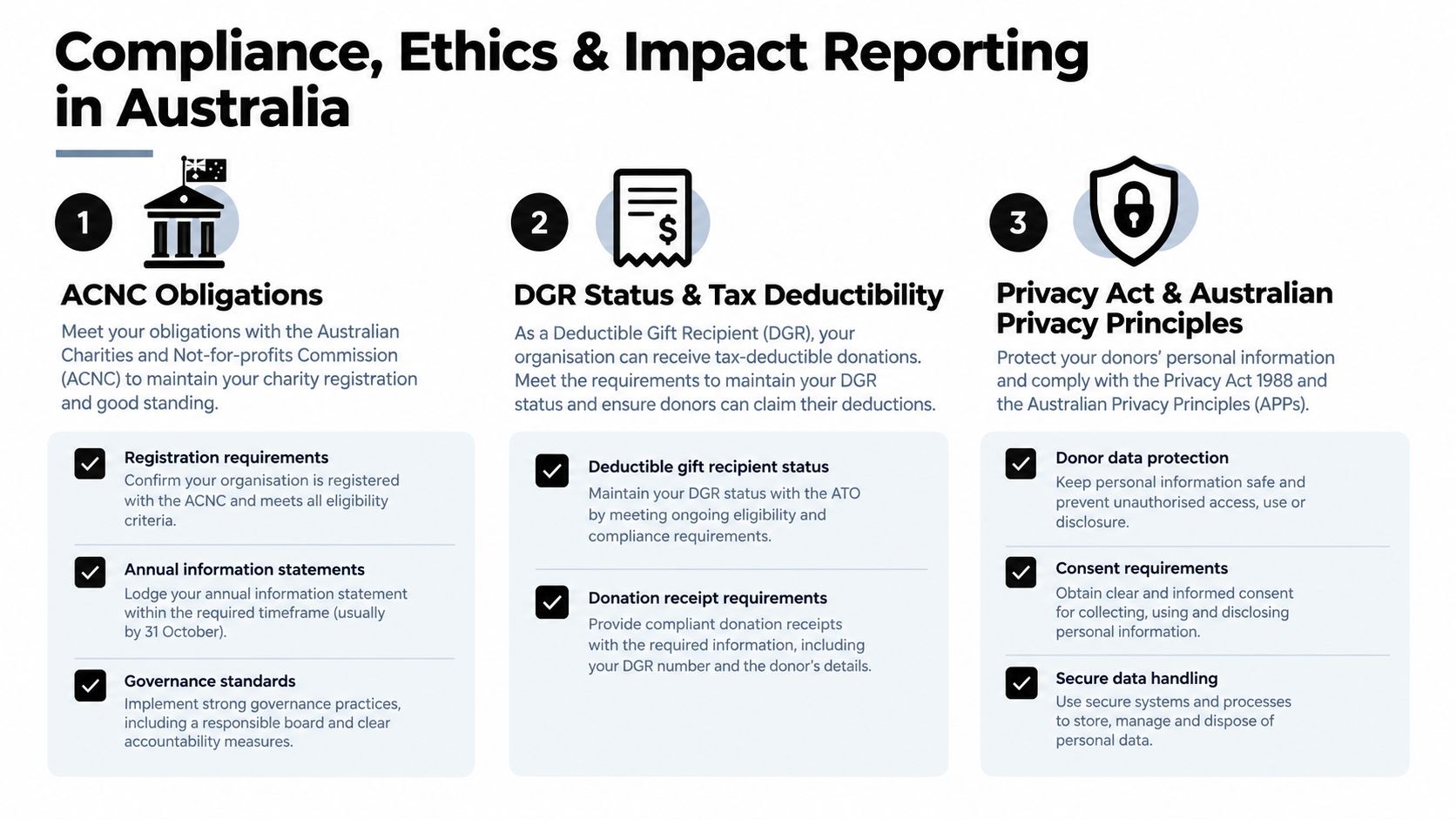
Compliance, Ethics, and Impact Reporting in Australia
Campaign work should sit inside the charity's governance and privacy practices. Before launch, confirm the organisation's ACNC information, what its DGR status means for the specific appeal and how donation receipts will be issued. Donor data collection, use and storage should be checked against the organisation's obligations under the Privacy Act and the Australian Privacy Principles where applicable. The agency should be able to explain its role in that process without presenting itself as the charity's legal adviser.
Use beneficiary stories with care. Get informed consent, explain where the material may appear and avoid imagery or copy that strips people of dignity to manufacture urgency. Campaign claims about outcomes should be checked with the staff who deliver the service. Don't use a moving story as a substitute for explaining what a donation funds.
Put boundaries around AI and reporting
AI tools can assist with drafting alternative headlines or checking accessibility, but the charity should set clear rules before staff enter information into them. The 2025 Infoxchange digital technology research shared by Janelle Cook reports that 67% of surveyed organisations were using generative AI, while only 14% had an official AI policy or governance framework. Don't put identifiable donor or beneficiary information into public AI tools, and don't publish synthetic testimonials, unverified impact claims or AI-generated depictions that could mislead supporters. A named staff member should review creative and targeting decisions before anything goes live.
Impact reporting doesn't need to be elaborate to be useful. A small charity can report the campaign's costs, completed donations, recurring-gift sign-ups and the next step it took to thank or update supporters. If a particular number can't be reconciled to the charity's records, label the uncertainty instead of dressing it up as a firm outcome.
For teams building evaluation into their work, practical evaluation advice from Unitism® can help clarify what an intervention is meant to change and how that change will be assessed.
How to Choose and Vet a Charity Marketing Agency
Ask for evidence that resembles your organisation's actual challenge. A strong example should explain the starting problem, the work completed, how donations were measured and what limitations affected the result. A vague claim about growing awareness won't tell you whether the agency can repair a donation journey or work with your CRM.

Ask these questions before signing
- How will you segment our donors, and what will change for each group?
- How do you measure recurring giving and repeat donations?
- Which donation events will appear in your reporting, and how are they verified?
- What reporting cadence do you recommend, and who will attend?
- How will you coordinate with our CRM and finance teams?
- What donor and beneficiary information do you need access to?
- How do you handle consent, data security and access when a project ends?
- How do you review beneficiary stories, claims and campaign creative?
- Can we start with a pilot that has clear scope, decision points and exit terms?
- Will you agree in writing not to use personal data for your own purposes or enter it into public AI tools?
A good agency should be comfortable discussing compatible tools, data access and reporting limitations. It should also be willing to work with your internal team instead of insisting that every function be handed over. When you're defining how to evaluate a campaign beyond impressions, this guide to measuring activation success offers another useful perspective on connecting activity with an intended outcome.
Watch for red flags: case studies with no clear role for the agency, reporting that names clicks but not donations, evasive answers about privacy, or pressure to sign a long commitment before testing the working relationship. If the agency proposes a pilot, agree in advance what data it will access, what it will deliver and how either side can end the work.
Budgets, Fees, and ROI Benchmarks for Australian Charities
Two agencies can quote on the same brief and land thousands of dollars apart, so the headline number alone tells you little. What matters is how the quote is structured. Most charity marketing agencies bill through a monthly retainer, a percentage of managed media spend, a fixed project fee, or some mix of the three. Ask for a line-by-line split between management fees, media spend, creative production and technical implementation, so your team can see what each allocation pays for. Percentage-of-media models deserve a pointed follow-up: does the agency earn more by recommending a bigger budget?
The budget itself should cover the complete route from campaign click to reconciled donation record. A charity spending $8,000 a month on paid media while its donation form fails on mobile is buying traffic, not donors. Agree on a focused scope the organisation can properly measure rather than a long channel list it cannot maintain, and expect the practical figure to shift with the appeal, audience size, payment processing costs and your capacity to follow up new supporters.
Measure fundraising value, not just platform activity
A useful scorecard shows both acquisition cost and the quality of the relationship that follows. Set definitions before the campaign starts, then check they can be reconciled against your own records rather than the platform's dashboard.
- Cost per acquired donor: Campaign and acquisition costs divided by newly acquired donors, using an agreed attribution method.
- Second-gift rate: The share of first-time donors who give again within the period the charity chooses to assess.
- Donor lifetime value: The value of a donor's giving over time, read alongside the costs of acquisition and stewardship.
- Average gift: The typical donation amount, reviewed by campaign and donor group rather than treated as a single universal target.
- Recurring-giving conversion: The share of eligible supporters who begin an ongoing gift, with cancellations and payment failures monitored too.
As noted earlier, Australian donor behaviour is far from uniform, so treat sector benchmarks as context rather than targets. A cheap cost per first donation can still conceal weak retention, which is why acquisition and subsequent giving belong in the same reporting conversation. When an agency quotes benchmark performance, ask which dataset it comes from, whether it reflects Australian conditions, and whether the figure counts confirmed gifts or platform-reported conversions. Be wary of anyone who promises a specific return before seeing your donor file.
Two Short Case-Style Examples of What Good Looks Like
Consider a small Melbourne community charity without an in-house marketer. It has a monthly media budget of $5,000 and supporters are abandoning its GiveNow form. In a sensible 90-day engagement, the agency first traces the donation journey, checks the form on mobile and agrees with the charity how completed gifts will be matched to campaign sources. It then tests a focused appeal and makes sure new donors receive a clear thank-you and follow-up. The useful result isn't a promised fundraising lift. It's a working path from campaign click to reconciled donation, with evidence showing where supporters still drop out.
A different challenge faces a mid-sized national cause that already has a CRM and an established donor programme. The agency can work with the charity to create practical supporter segments, build a recurring-giving appeal and connect Meta campaign events to confirmed donation records using the Meta Conversions API. It should test whether the extra tracking improves the charity's ability to understand campaign outcomes, while keeping consent and data governance under the organisation's control.
The first example needs integration discipline before more media. The second needs careful audience and creative choices built on systems that already hold useful donor information.
In both cases, the buyer should ask the agency to distinguish what it controls from what depends on the charity's own systems, approvals and donor records. That distinction makes the final report more credible and gives the internal team a useful account of what to improve next.
Your Next Steps Checklist Before Hiring an Agency
Use this checklist to keep the buying decision grounded in your actual fundraising needs:
- Audit your donor data. Check where sign-ups and donations are stored, who can access them and whether campaign sources are retained.
- Write a one-page brief. State the fundraising problem, audience, channels already in use, constraints and the outcome you need to measure.
- Define a 90-day pilot. Agree on scope, access, deliverables, reporting, decision points and exit terms before work starts.
- Set the scorecard in advance. Choose measures that connect acquisition with repeat giving, and confirm how the charity will verify them.
- Reserve a decision window. Review the pilot results with the people responsible for fundraising, finance, data and safeguarding before extending the engagement.
If your organisation has a paid media budget of at least $3,000 a month, Alpha Omega Digital offers a month of paid ads management free as a low-risk way to assess fit. Contact the team to discuss the campaign, the tracking requirements and what a practical pilot should include.
Alpha Omega Digital is a Melbourne-based agency that supports charities with paid advertising and the website and measurement work connected to fundraising campaigns. If you're comparing partners, Alpha Omega Digital can discuss a practical pilot and whether its services suit your organisation's needs.
[email protected]
Read more insights from our team on web design, paid ads, and growth strategy.