Your creative is ready, the landing page works, and someone has promised the campaign will launch tomorrow. Then Meta rejects the ad with a social issues flag, even though you thought you were promoting a community initiative, not running an election campaign.
That's where running political ads on Facebook/Meta becomes different from ordinary ecommerce advertising. Before I'd commit a launch date, I'd separate the platform setup, the evidence behind the message and the Australian legal requirements. Getting through Meta's review is only one of those jobs.
What Counts as a Political Ad on Meta
A clothing retailer promoting a jacket is running a commercial campaign. That same retailer paying to promote a message urging voters to support a candidate because of their manufacturing policy needs a different assessment. The product hasn't changed, but the purpose of the communication has.
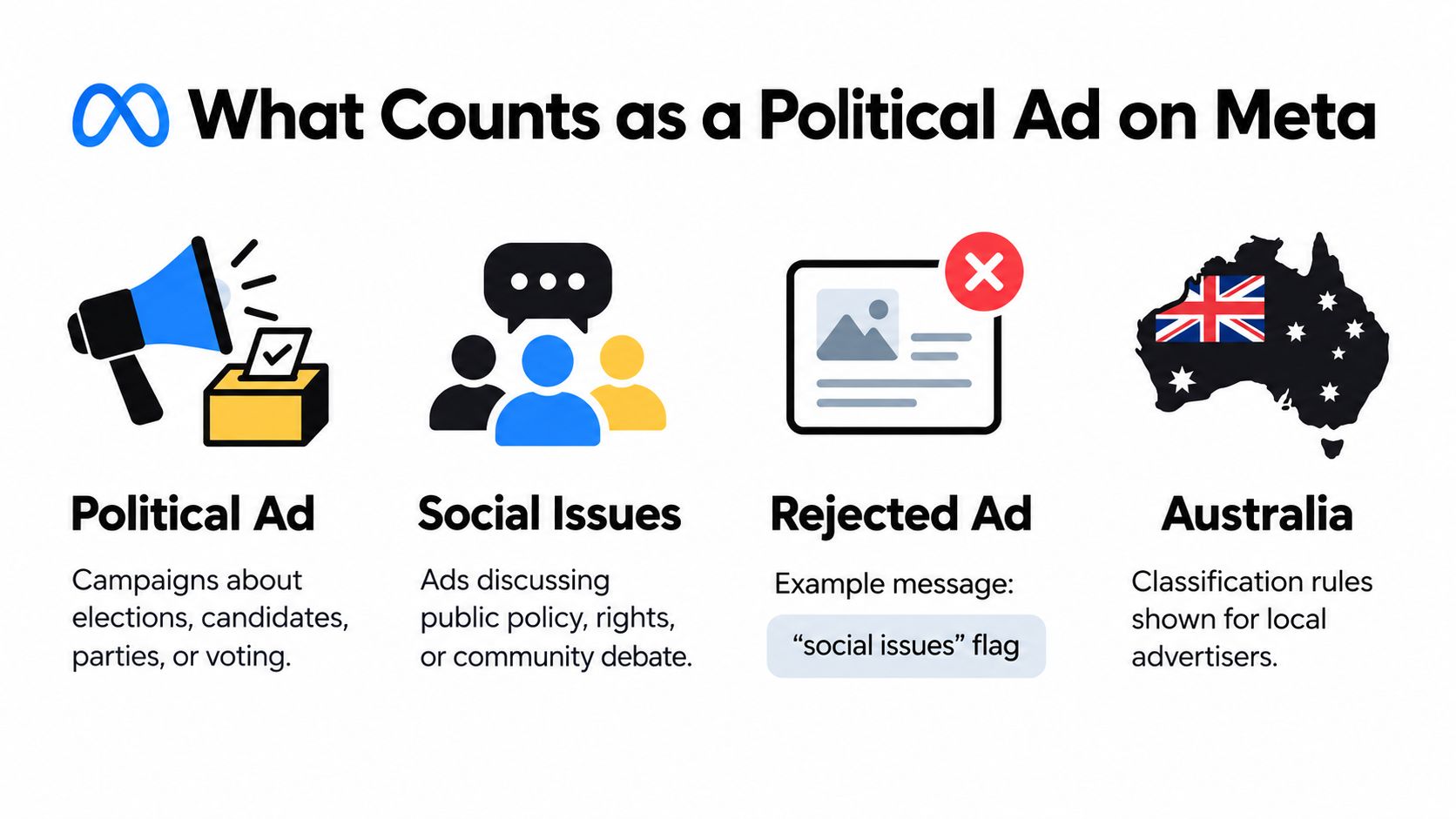
For Australian advertisers, the sensible starting point is to examine references to elections, candidates, parties, referendums, voting and public-policy advocacy. Don't assume that being a business, charity or community organisation keeps your advertising outside political or social issue review.
The classification overview below is a useful starting point, not a substitute for checking the requirements displayed in your Australian account.
Look at the whole message
I'd review the ad, landing page, sponsor and intended action together. A neutral-looking headline can lead to a petition asking people to oppose a government policy. A founder's video can move from explaining a business problem to expressly supporting a political candidate.
Use these questions before commissioning creative:
- Subject: Does the message discuss a candidate, election, referendum or contested public-policy issue?
- Action: Are people being asked to vote, lobby, sign a petition or support political advocacy?
- Destination: Does the landing page introduce political content that isn't obvious in the ad?
- Sponsorship: Who commissioned the communication, and whose interests does it represent?
These are screening questions, not a definitive legal classification.
This isn't a marginal advertising channel
A study of Australia's 2022 federal election identified 56,224 ads from 1,549 sponsors; within its analysed pre-polling months, 47,503 ads from 1,438 sponsors generated more than 1.11 billion impressions, with expenditure of approximately A$18.4 million, according to UTS's analysis of election advertising expenditure.
Those figures describe the study's defined dataset, not every election-related communication. They show why advertisers should treat political advertising as a substantial, publicly scrutinised activity rather than an ordinary boosted-post exercise.
For an ecommerce brand entering an advocacy debate, my recommendation is straightforward: classify the communication before producing the campaign. Renaming a political message as brand awareness won't resolve the underlying issue.
Getting Authorised Before You Spend a Cent
Start with the people and business assets, not the ad creative. Identity checks, organisational details, Page access and disclaimer approval are separate dependencies. Having access to Ads Manager doesn't establish that the person, Page and ad account are ready for political advertising.
Use the Australian authorisation workflow presented in your account. Don't copy a US tutorial's mailing-address requirements, electoral registration references or election restrictions into an Australian launch plan.
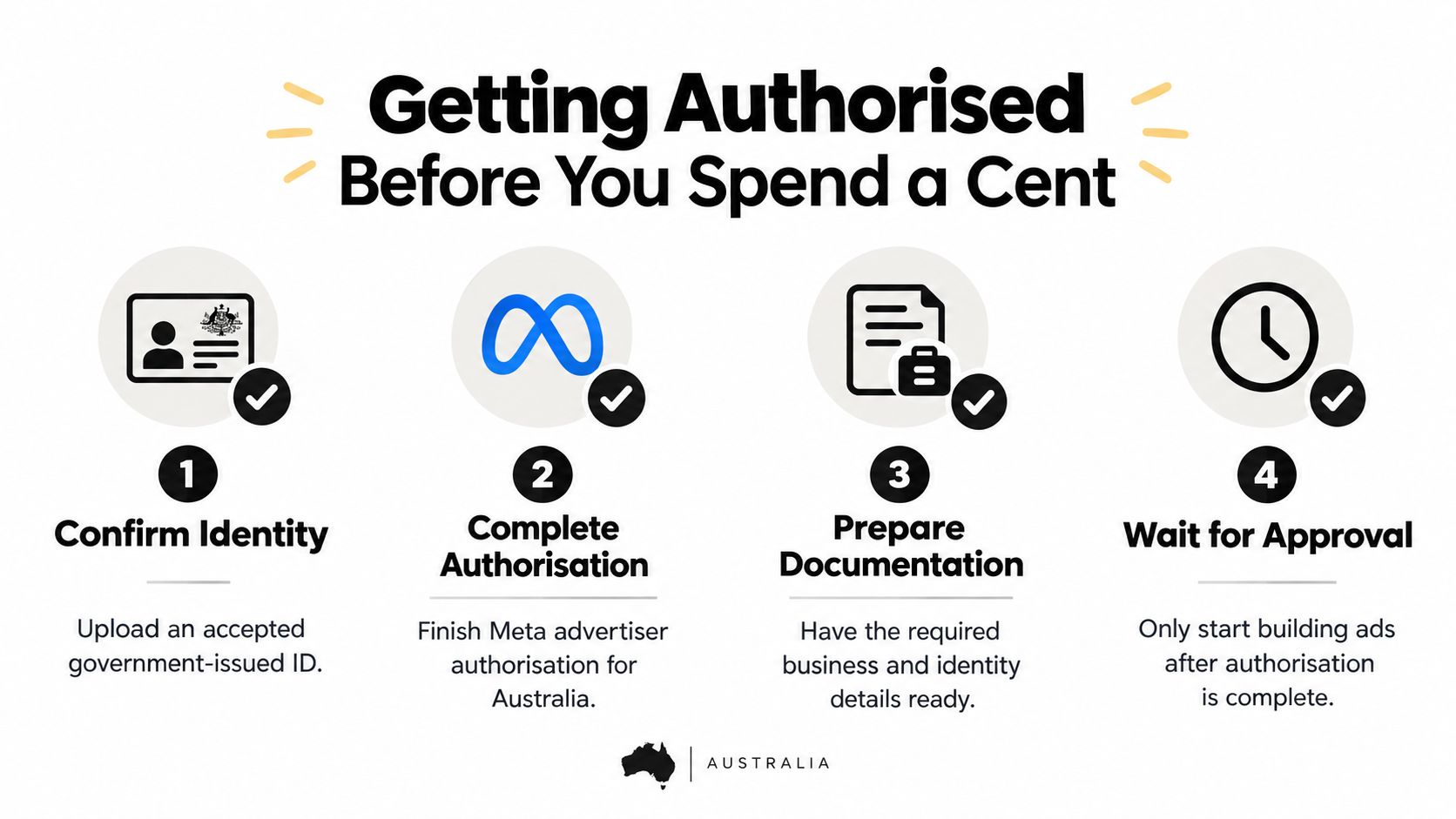
This checklist summarises the preparation work.
Prepare the authorisation file
Before starting, nominate a person responsible for completing the process and another responsible for approving the sponsor information. They might be the same person in a small organisation, but the responsibilities still need to be explicit.
- Identity evidence: Have an accepted government-issued ID available and follow the current Australian identity-confirmation prompts.
- Account security: Check the security requirements and permissions for everyone who needs to manage the campaign.
- Organisation details: Prepare the legal name and supporting documents requested by the workflow. Resolve inconsistent names before submission.
- Page and account connection: Confirm that the intended Facebook Page and advertising account are connected through the appropriate business assets.
- Funding disclosure: Prepare the proposed Paid for by disclaimer using the responsible funding entity's details, rather than automatically inserting the agency's trading name.
An individual's completed identity check shouldn't be treated as proof that every organisational requirement has also been satisfied. Likewise, an organisation having Australian operations doesn't remove the need to meet the specific eligibility and documentation requirements shown by Meta.
Planning rule: Don't promise delivery against an authorisation request that's still pending.
Allow for approval taking days rather than assuming it will happen within hours. That's a scheduling precaution, not a guaranteed turnaround. Build room for document queries, permission problems and resubmissions without relying on a fixed approval deadline.
Check the finished setup
Your internal handover should record the authorised person, Page, advertising account, approved disclaimer and outstanding issues. Store confirmation screenshots where the campaign manager can find them.
I'd also make a clear distinction between approved infrastructure and approved advertising. Completing the setup doesn't pre-approve the claims, imagery or destination of an ad you haven't submitted.
The walkthrough below can help orient the team, but the live Australian account prompts should govern the actual submission.
Setting Up Your Political Ad Campaign in Ads Manager
Consider a hypothetical state candidate promoting a local public meeting. The immediate goal is attendance, not online purchases, so copying an ecommerce sales campaign would create the wrong measurement framework.
I'd start by agreeing on the action that matters: a completed registration from someone eligible to attend. Awareness and engagement can support that goal, but neither should be reported as a substitute for registrations.
The campaign build needs a deliberate review of the objective, classification, disclosure and destination.

Build around the intended outcome
Choose the available objective that best matches the approved campaign goal. Awareness suits distribution; lead collection can suit volunteer enquiries or event registrations. Donations need their own destination, eligibility and payment checks rather than a casual assumption that a retail checkout setup will transfer cleanly.
Complete the political or social issue declaration wherever the current Ads Manager workflow requires it. Interface labels can change, so don't depend on an old screenshot showing where a particular setting used to sit.
Then check the campaign as a connected system:
- Disclosure: Select the approved disclaimer and confirm that the intended sponsor is associated with the ad.
- Creative: Use claims that the campaign can substantiate, with a clear action and an identifiable speaker.
- Destination: Match the promise in the ad to the registration, information or donation page.
- Measurement: Test the completed action, not merely the button click that precedes it.
Preview placements and control production
Inspect feed, Stories and Reels previews individually. Keep essential sponsor and authorisation information out of areas that interface elements may obscure, and check how the platform presents its own disclosure on each available placement.
For production support, resources explaining how to automate social content with AI can help organise drafts and variations. I'd keep evidence checks, sponsor approval and the assessment of altered imagery or audio under named human control.
Set a budget the organisation can authorise and monitor, then schedule around the event and the approval status. Don't make an unapproved campaign the only way people can discover a time-sensitive meeting.
Finally, inspect the published ad rather than stopping at the preview. Check the destination, disclosure and public Ad Library record.
Australian political and social issue ads are retained in Meta's Ad Library for seven years, and analysis of the 2025 campaign estimated third-party Facebook and Instagram expenditure at more than A$7.5 million during the official campaign period, according to the Australian political advertising report's Ad Library analysis. Treat that record as public and durable, not as an asset you can assume disappears when delivery stops.
Targeting Limits and the Ad Review Process
Don't build the strategy around a targeting option you haven't checked. Equally, don't assume that an Australian political campaign inherits every restriction described in an overseas special-ad-category tutorial.
The responsible comparison is between what your ordinary campaign could use and what the current Australian political-ad workflow permits. Availability can depend on the market, account, objective and current policy.
Standard Ads vs Political Ads Targeting on Meta
| Option | Standard Ads | Political and Social Issue Ads |
|---|---|---|
| Geographic targeting | Configure around the commercial service or delivery area | Check available controls and align delivery with the relevant electorate or community |
| Age and demographic settings | Use available settings subject to applicable policies | Verify the options in the political campaign workflow rather than assuming identical access |
| Detailed interests | Available interests depend on current platform settings | Don't assume political beliefs or sensitive affiliations are targetable |
| Custom audiences | Require an appropriate data basis and policy-compliant use | Assess consent, provenance and sensitivity before proposing their use |
| Lookalike or automated expansion | Availability varies by campaign setup | Confirm eligibility and whether expansion fits the intended geographic scope |
| Creative strategy | Often organised around product benefits and purchase intent | Organise around evidenced messages, location and an appropriate public action |
The table is a planning framework, not a promise that a particular control will appear in every account. I'd ask the campaign manager to record the actual available settings before presenting an audience strategy.
Make review problems diagnosable
When an ad is rejected, save the rejection notice, ad identifier, creative, destination and relevant settings before editing anything. Otherwise, the team can lose track of which version Meta reviewed.
Check the obvious dependencies first:
- Classification: Was the required political or social issue declaration completed?
- Disclosure: Does the selected disclaimer match the intended sponsor?
- Content: Can the campaign substantiate the claim and explain the imagery?
- Access: Are the responsible person, Page and ad account configured appropriately?
These are troubleshooting checks, not a ranked list of rejection causes.
Ask for a review of the actual decision. Don't create a replacement account or conceal the subject to get around enforcement.
Use the review or appeal option available in the relevant account interface and provide a concise explanation supported by documents. Avoid rewriting every component at once unless you've identified a broader problem, because that makes the disputed issue harder to isolate.
There's no reliable delivery promise while an ad is under review. For a time-sensitive campaign, prepare approved alternatives and an owned-channel communication plan instead of assuming a last-minute appeal will succeed.
Staying Compliant with Australian Electoral Law
Meta approval is not AEC clearance. Meta decides whether an advertisement can run on its platform. Australian electoral law determines whether an electoral communication needs authorisation and whether the communication meets the applicable requirements.
A platform-generated funding disclosure shouldn't be treated as a complete legal authorisation statement. Confirm the required authoriser details, wording and presentation for the communication and medium with the relevant electoral authority or appropriately qualified adviser.
The creator and community Page grey zone
Ordinary unpaid political commentary is different from commissioned electoral communication. Payment to create or distribute content, politically sponsored publication, conditional gifts-in-kind or communication on behalf of a political entity can change the authorisation assessment.
During the 2025 federal election period, the AEC reviewed 1,020 social-media communications that breached the Commonwealth Electoral Act and issued 164 corrective letters or emails, as set out in the AEC's guidance on social-media electoral communications.
For an ecommerce business, that means a creator agreement deserves attention when it moves beyond product promotion into electoral advocacy. A post can look informal while still being paid, directed or sponsored.
The same concern applies to a community Page that accepts payment to publish a campaign message. Calling the distribution organic doesn't answer who commissioned it or whether authorisation is required.
Give each participant a defined responsibility
| Participant | Responsibility to document |
|---|---|
| Advertiser | Campaign purpose, evidence supporting claims and approval authority |
| Sponsoring entity | Funding arrangements and the identity behind the communication |
| Agency | Production records, platform setup and implementation of approved disclosures |
| Creator | Payment or benefits received, approved script and publication obligations |
| Page owner | Publication access, final post checks and handling requested corrections |
Don't leave responsibility implied in an email saying the agency will “handle compliance”. Specify who obtains legal advice, who approves the authorisation statement and who can stop publication.
Keep the evidence with the asset: Save the approved copy, sponsor instructions, invoices, authorisation advice and published screenshots together.
Monitor after publication as well. Creators may edit captions, community Pages may repost cropped artwork, and campaign teams may reuse an approved asset in a different context.
The Commonwealth framework also isn't a substitute for checking the requirements relevant to a state or territory election. Get advice for the actual campaign, rather than treating a previous federal campaign's paperwork as universal permission.
What Australian Election Spending Teaches Advertisers
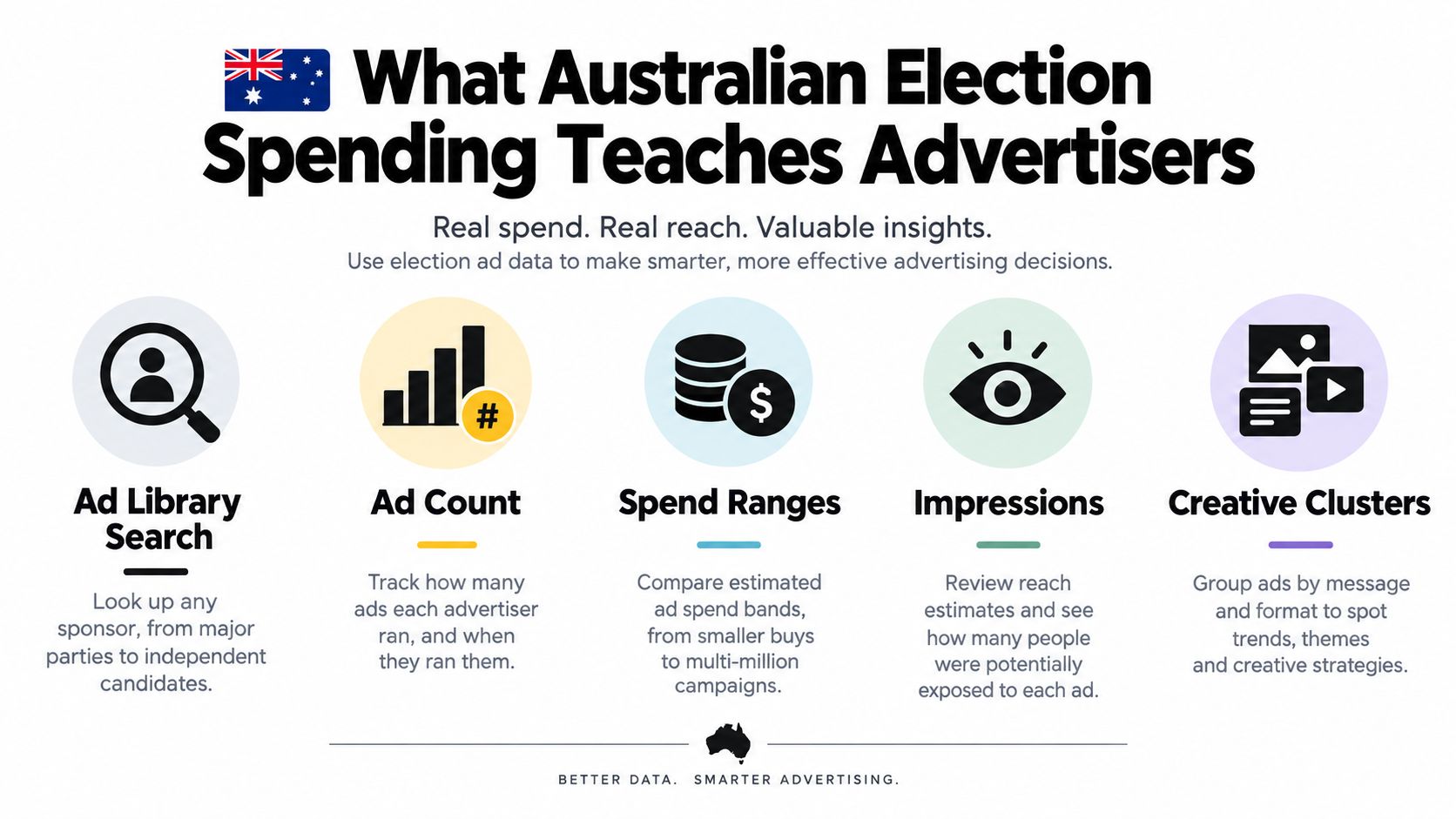
I'd use the Ad Library as a structured benchmarking dataset, not a gallery of headlines to copy. The useful question is how an advertiser distributes messages across creative, timing and geography, then whether your own campaign can justify a different approach.
Record the sponsor, start date, copy angle, format and visible delivery information. Where figures are reported as ranges, preserve those ranges instead of turning them into invented precise totals.
The workflow below keeps the analysis focused on observable information.
Compare like with like
During the final two months of the 2022 federal election, parties and candidates ran 26,945 ads and spent at least A$12.5 million; the ALP accounted for at least A$5 million, the Liberal Party approximately A$3 million, and Kooyong approximately A$339,450, while 73% of surveyed Australian voters reported encountering political ads they knew were misleading, according to the Australia Institute's advertising research and exit poll.
That dataset has a different scope from the broader study discussed earlier. Don't combine the totals or present them as interchangeable estimates.
Build a working spreadsheet around:
- Message clusters: Group related promises, concerns and calls to action rather than counting every variation as a new strategy.
- Geographic relevance: Separate national messaging from locally specific creative where the available data supports it.
- Format and timing: Note whether sponsors use video, static artwork or repeated messages around particular events.
- Evidence status: Record which claims your own team could substantiate before considering a comparable approach.
Measure actions you can verify
Spending and impressions don't establish persuasion. A competitor running many ads might be testing variations, distributing local messages or repeating unsuccessful creative; the public record alone doesn't settle that question.
Define success through verified supporter registrations, completed volunteer forms, attributable donations or an appropriately designed polling-lift experiment. Keep incomplete submissions and duplicate records separate from meaningful outcomes.
The misleading-ad survey result also supports a practical editorial priority: make evidence review part of production. Cheap reach isn't a useful saving if the team can't defend the message it distributed.
Mistakes That Get Political Ads Rejected or Worse
The most useful pre-flight check is a record of decisions, not a reassuring message that everything looks fine. I'd want the campaign owner to know what has been checked, who approved it and what remains unresolved.
Use failure and prevention pairs
- Launching against an unfinished setup: Don't tie a public promise to pending authorisation. Release the campaign only when the required setup and ad approvals are confirmed.
- Using the wrong sponsor identity: Don't default to the agency because it operates the account. Obtain written approval of the responsible entity's disclosure details.
- Boosting without reassessment: Recheck a post when paid distribution is proposed. Its earlier publication doesn't settle the requirements for advertising it.
- Publishing an unsupported claim: Require the evidence before final creative approval. If the wording goes beyond the evidence, rewrite it.
- Changing an approved asset casually: Treat a new destination, caption, creator edit or sponsoring arrangement as something that may require another review.
- Losing the publication record: Save the live version and approvals, not just the design file that preceded them.
Buy the right help
An ecommerce business doesn't necessarily need a political campaign for every public statement. Sometimes the more appropriate choice is ordinary product advertising, a carefully reviewed unpaid statement or no paid amplification at all.
If you're comparing a marketing agency Melbourne businesses can use for this work, ask how it separates platform operations from legal advice. Request a clear scope covering creative approval, sponsor documentation, campaign monitoring and escalation when something changes.
A capable Meta operator should be comfortable saying that a legal question needs an electoral-law specialist. A legal adviser, in turn, shouldn't be expected to diagnose an advertising account's permissions or conversion tracking.
Good campaign management includes knowing when not to press Publish.
For businesses accustomed to purchase campaigns, the biggest adjustment is operational. You're still managing creative, delivery and outcomes, but you also need a defensible record of who authorised the communication and why the published claims are supportable.
Don't quit because an initial review needs correction, and don't keep resubmitting blindly either. Identify the issue, document the response and make a deliberate decision about whether the campaign is ready to run.
At Alpha Omega Digital, our Melbourne-based team offers Facebook and Instagram campaign planning, creative testing and measurement, with platform setup kept distinct from the electoral-law advice a political campaign may require. If your business has a paid ads budget of at least $3,000 a month, I'd love to offer you a low-risk deal: get your first month of paid ads management free, and apply through the contact page with your campaign goal, sponsor details and intended launch date.
Alpha Omega Digital
Read more insights from our team on web design, paid ads, and growth strategy.