You have a post ready, a budget approved, and a start date that is closer than it feels. The creative talks about an election, a candidate, or a cost-of-living policy, and someone on the team is about to hit Boost. That is the moment most Australian launches stall. Meta can reject the ad, the disclaimer can name the wrong entity, or an authorisation line can be missing from the caption even though it sits on the Page.
I would not treat How to Run Political Ads on Facebook and Instagram in Australia (2026 Guide) as a media-buying checklist. The gates that decide whether the ad can run are legal and platform approvals, and they do not open together. Sort those before you touch audiences or budgets.
Two Approvals Every Political Ad Needs Before It Runs
Most setup notes collapse two jobs into one. Meta's political and social issue authorisation and Australia's electoral authorisation are separate gates. Passing one does not open the other.
Meta applies its gate before publication. Ads about elections, politics, or designated social issues need identity checks with official documents, a verified "Paid for by" disclaimer, and a connected Page and ad account. That duty covers third-party advocacy groups, not only parties and candidates. A narrow exception exists for an identified news publisher. The rest of the field has to finish the process first.
The Australian gate sits beside it. Federal electoral advertising is regulated under the Commonwealth Electoral Act 1918, which is built to identify who authorised a voter communication. The law does not generally require every political claim to be factually correct. Its focus is authorisation and stopping deception about how to cast a vote. State rules then add their own tests. Victoria treats digital ads, social posts, profiles, and websites as electoral material that needs authorisation. South Australia requires the authoriser's name and street address on online electoral ads. South Australia and the Australian Capital Territory have truth-in-political-advertising laws. There is no single national truth-in-political-advertising standard.
| Approval | Who applies it | What it checks | What it does not check |
|---|---|---|---|
| Meta political and social issue authorisation | Meta, before publication | Advertiser identity with official documents and the "Paid for by" disclaimer | Factual accuracy of claims or full funding context |
| Federal electoral authorisation | Commonwealth Electoral Act 1918 | Who authorised the communication and that the authoriser is identified | Whether Meta has already approved the ad |
| Victorian electoral material | Victorian state rules | Authorisation on digital ads, social posts, profiles and websites | Whether federal wording satisfies state rules |
| South Australian online electoral ads | South Australian rules | Authoriser's name and street address | Whether the federal authorisation is enough |
| Truth-in-advertising claims | South Australia and ACT laws | Claims made in political advertising in those jurisdictions | Scope and wording, which need counsel to confirm |
Practical rule: Decide first whether the campaign is federal electoral communication, state electoral material, or general issue advocacy. That choice sets every later document, disclaimer, and caption.
Keep the two approval files separate. A Meta screenshot does not prove the Australian statement is right, and a correct authorisation line does not prove Meta has cleared the account.
How to Launch a Compliant Political Ad, Step by Step
The sequence is what catches teams. People write the ad, then hunt for the paperwork. Reverse that.
The paperwork question applies to more than booked ads. An unpaid or creator post can need authorisation even when Ads Manager never opens, so run this sequence on everything the campaign publishes, paid or unpaid.
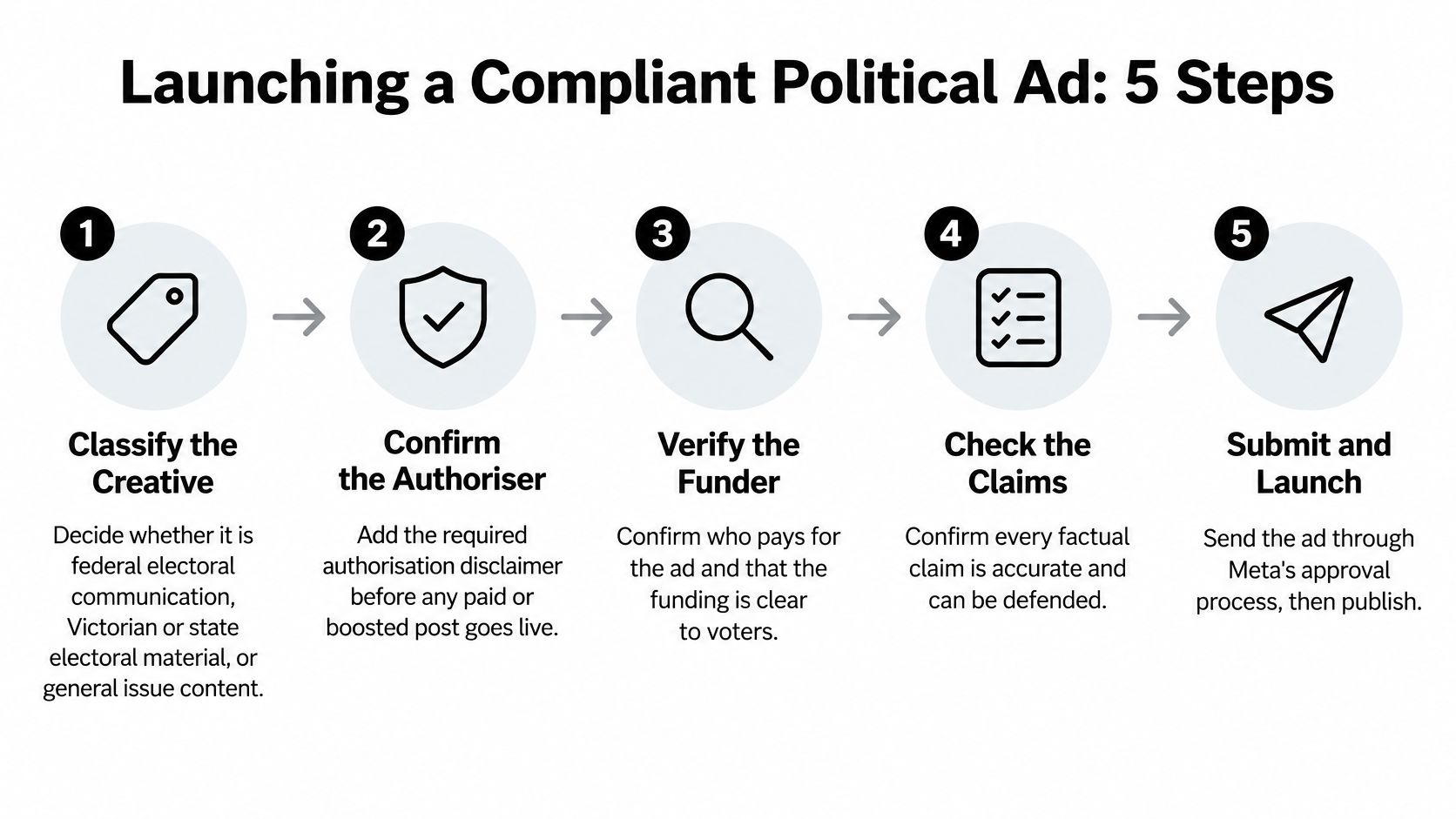
Work through these steps in order, because each one depends on the record created by the step before it.
- Classify the creative. Label it federal electoral communication, Victorian or other state electoral material, or general issue advocacy. The label decides which authorisation statement you need, and federal wording does not automatically satisfy a state rule.
- Name the responsible entity and authoriser. Use the legal name. Trading names and personal profiles fail the check. If the payer and the authoriser differ, write both names down before anyone opens Ads Manager.
- Finish Meta authorisation. Verify identity with official documents and leave review time before the planned start date. Check Meta's authorisation help for current review times rather than assuming a same-day pass.
- Create the "Paid for by" disclaimer. Match the paying entity exactly. A shortened brand name is a common rejection.
- Connect the authorised Page and ad account. Confirm both show the same entity. A Page owned by a volunteer committee attached to an ad account owned by a consultant will fail this check.
- Place the Australian authorisation in the creative or caption. Carrying it on the Page alone leaves the ad itself unmarked. Confirm the wording against current Australian Electoral Commission guidance for that jurisdiction. In South Australia, online electoral ads need the authoriser's name and street address.
- Treat each object separately. Every variant, placement, boosted post, and collaboration is its own compliance item. The AEC treats paid influencer or creator communications made by or for a political or disclosure entity as requiring authorisation, and a political entity's repost or accepted collaboration can become a separately authorisable communication. Have electoral counsel review claims and wording before publication.
- Archive the file. Keep screenshots, invoices, targeting settings, approvals, and the final creative. Victorian digital ads, social posts, profiles, and websites are electoral material, so the archive has to cover more than the ad unit.
The slip that sends a clean ad live dirty
A team approves one ad, duplicates it, changes the claim and the disclaimer, and publishes the copy without its own check. The original record does not cover the new words.
The fix is procedural. Any change to the claim, the disclaimer, the authoriser, or the funding entity starts the sequence again from step 1, even when the audience and budget stay identical.
Can you point to a record for every step above? If any answer is no, the ad is not ready.
When Unpaid, Creator and Boosted Posts Count as Regulated
People assume an unpaid post sits outside the rules because nobody opened Ads Manager. That assumption is the gap.

The AEC's April 2025 notice is the practical warning. Authorisation may be required where content is paid advertising, where payment or in-kind support is involved, or where material is communicated by or on behalf of a political entity. Paid influencers, podcasters, and creators who communicate electoral matter must be authorised. A political entity's cross-post of otherwise unpaid content can create the same obligation. During the 2025 election the AEC asked Meta to remove unauthorised electoral advertisements from a campaign group.
Ask three questions before anyone posts.
- Did money or in-kind support change hands? A fee, a gifted product, or free production tied to an electoral message is enough to check.
- Was the content made by or for a political entity? Volunteer pages and accepted collaborations count when the campaign is behind them.
- Is the purpose electoral? A community update that tells people how to vote, or who to support, is not a casual post.
A yes to any question means you check authorisation before it goes live. Unpaid does not mean unregulated. The relationship, the distribution, and the purpose can matter as much as the media buy.
| Content | Likely trigger | Action before posting |
|---|---|---|
| Original unpaid post by a party or candidate | Electoral matter published by or for a political entity | Authorise the wording and keep a record |
| Boosted organic post | Spend to promote it makes it paid distribution | Treat it as a new ad and create the variant after approval |
| Paid creator or influencer | Paid communication made by or for a political or disclosure entity | Put the authorisation statement in the caption and log the approval |
| Gifted product or free production | In-kind support tied to an electoral message | Assess with counsel before the content goes live |
| Volunteer or community page post | Made by or on behalf of the campaign or entity | Confirm independence and disclose any link |
| Candidate repost of creator content | Cross-posting by a political entity can be separately authorisable | Authorise the repost or remove it |
For every creator or volunteer post, file the brief, the fee or gift, the approval, the final caption, and the date it went live. That file is what you show if the arrangement is questioned later.
Verifying Who Funds an Ad and Defending Its Claims
Meta approval cuts platform-policy risk. It does not prove the ad is accurate, and it does not show voters the full funding story. Those are two different gates, and clearing the first one says nothing about the second.
Australia has no single national truth-in-political-advertising standard, so a correctly authorised ad can still carry a contested claim. Transparency researchers have called for real-time disclosure of third-party funding so voters can see who is paying while a campaign is still running. I would treat that gap as a risk to manage rather than a loophole to exploit, because the reputational cost lands on your campaign, not on Meta.
Run three checks this week.
- Map the money. List every entity that funds the campaign and confirm the disclaimer names the one that pays. If a donor pays the invoice and a committee appears on the ad, fix the name before the next impression.
- Separate advocacy from a product ad. A business arguing for a policy needs different wording from a shop selling a product. Do not let a commercial offer hide inside an electoral message, or the reverse.
- Keep an evidence file for each claim. Store the source, the date, who approved the wording, and where it ran. If you need a method to evaluate online news sources before a statistic goes into a caption, do that before sign-off, not after a complaint.
Creators should present as independent only where that is true. Disclose any payment in the same post. Check the live Ad Library on a set day, because rival and third-party ads can appear overnight.
An agency can run the account. The client still owns the landing page content and the claims on it, along with budgets, pricing, stock, the sales process, and customer service. Final sign-off stays with the client.
Testing, Budgets and Monitoring After Launch
Most wasted spend in political campaigns comes from a single boosted post run with no structure. When it underperforms, you cannot tell whether the audience, the creative, or the page caused the result, and you keep paying while you guess.
Build separate ad sets for prospecting, retargeting, and each target geography. Hold the audience, objective, placement, creative, and landing page steady enough that a change has one cause. Use Australian location settings and exclude under-age users where the rules require it. Start with a limited-budget learning phase and broad, legally permitted targeting. I would not scale a creative that has already drawn a complaint, whatever its early numbers look like.
Treat every boosted post as a paid political ad inside the same structure. It counts toward the budget, it appears in your reporting, and it sits in the weekly review alongside the ad set variants.
The Parliamentary Education Office explains that Australian law centres on access, timing, identification, and authorisation rather than a general factual-accuracy rule. That gap is why fact-checking, version control, and written substantiation belong before launch, especially when an issue ad may sit under different federal or state rules.
What the public spend record actually shows
During the 2025 federal campaign, from 28 March to 3 May, third-party groups spent more than A$7.5 million on Facebook and Instagram, according to analysis of Meta Ad Library data by UTS, with estimated third-party spending across Meta- and Google-owned platforms reaching about A$40 million. Party and candidate spending on Facebook and Instagram adds millions more per federal campaign. There is no reliable national success rate to quote. These figures show volume and make the case for a spend ceiling; they say nothing about the return you should expect.
Send every impression to a campaign landing page with source parameters, a privacy disclosure, and one conversion event. Reconcile Meta delivery with the CRM and deduplicate leads before you calculate cost per acquisition.
| Metric | What it tells you | Action when it moves |
|---|---|---|
| Reach by state and cohort | Whether the message lands where your target seats or geography sit | Narrow the geography if spend falls outside the target |
| Frequency | How often the same people see the ad | Refresh the creative when frequency climbs and engagement falls |
| Cost per completed video view | The cost of attention, separate from clicks | Pause creatives that cost far more than the rest of the set |
| Landing page conversion rate | Whether visitors take the action | Fix the page before adding budget |
| Cost per verified lead | Cost of a lead checked against the CRM after deduplication | Compare variants only after reconciling the counts |
| Negative feedback rate | Complaints and hides | Pause any creative with complaints or factual disputes |
| Ad Library and competitor activity | Duplicate or competing campaigns | Review weekly and during any spike in spend |
Review those rows weekly, and pause the same day if a complaint or a factual dispute lands.
Fixing Failures and Confirming Authorisation Before Each Boost
The failures that eat a week are an ad rejected, pulled, or missing from the Ad Library after you thought it was approved. Most trace back to a mismatch between three names: the paying entity, the disclaimer, and the Australian authorisation statement on the creative. Meta's approval and the electoral authorisation are two separate gates, and an ad can clear one while failing the other. Check the three names before you touch targeting.
| Symptom | Likely cause | First fix |
|---|---|---|
| Ad rejected for the political category | Authorisation or identity check is incomplete | Match the legal entity documents exactly and resubmit |
| Disclaimer shows the wrong name | Page name differs from the paying entity | Update the disclaimer to the legal entity and create a new variant |
| Ad missing from the Ad Library | Authorisation not linked or still processing | Confirm the ad account connection and disclaimer status, then escalate to Meta support if it stays absent |
| Ad removed after a complaint or AEC request | Authorisation statement missing from the creative | Add the statement to the caption and re-run with an approval record |
| Boosted post not treated as political | Post created before authorisation | Create a new variant after approval |
| Ad delivering in the wrong state | Geographic setting too broad | Set state-level locations and check the South Australian address rule |
| Budget not spending | Learning phase or narrow audiences | Broaden legally permitted targeting and allow time |
| Cost per lead spikes | Creative fatigue or landing page mismatch | Pause the creative and check the landing page message |
Work the table from the symptom you can observe directly. A rejection surfaces in Ads Manager with a reason attached, while a missing Ad Library entry needs you to search the Library under your Page name before you know anything is wrong.
The pre-spend gate
Do not boost until all of these are true.
- Entity match: The legal name on the identity documents, the Page, and the ad account is the same.
- Meta status: The account shows political authorisation as approved, not pending.
- Disclaimer: It names the paying entity, not a nickname.
- Caption: Every creative carries the Australian authorisation statement required for that jurisdiction.
- File: Approvals and claim sources are stored, including the version you are about to run.
Run this gate again whenever anything changes. A new creative, a new jurisdiction, or a new disclaimer resets it, and a federal by-election and a South Australian state campaign do not share the same authorisation wording. The fastest check is the Ad Library: search your Page name and read what voters already see. Verify current rules on the AEC and Meta authorisation pages before each campaign, and book electoral counsel for state-specific or claim-heavy campaigns. This guide cannot replace that advice.
If you want hands-on campaign management, Alpha Omega Digital runs Meta campaigns for Australian clients. Advertising budgets are paid separately unless otherwise agreed, and we are responsible for campaign management only. We do not guarantee enquiries, sales, ROAS, CPA, or conversion rates.
Alpha Omega Digital is a Melbourne agency that plans and manages Facebook and Instagram campaigns, including the approval records political and issue ads need before they spend. We work with Australian businesses from our Melbourne base, and we keep management separate from your media budget. If you have a project in mind, visit Alpha Omega Digital and apply through the contact page.
Alpha Omega Digital
Read more insights from our team on web design, paid ads, and growth strategy.