I still remember the first pest control account I opened for a Melbourne operator. The phone wasn’t ringing, the inbox was quiet, and the owner kept saying the same thing every tradie says after a bad month, “We’re getting clicks, but they’re the wrong jobs.” The actual problem wasn’t Google Ads itself, it was the way the account was built, the keywords were too broad, the landing page was too generic, and the budget was being burned on searches that never had a chance of turning into booked work.
Google Ads for Pest Control works when it’s built around intent, not vanity traffic. In Australia, that matters because the market is big enough to support a serious paid search programme, with 38,700 building cleaning, pest control, and other support services businesses nationally and 21,020 monthly searches for Google Ads services from that sector, according to one industry source linked below. Pest control demand is also granular, with specific searches like “pest control near me” at 14,800 monthly searches, “termite treatment” at 6,600, “termite inspection” at 4,400, “rodent control” at 2,400, and “cockroach control” at 1,900, which is exactly why the right campaign structure beats a broad one every time. For Melbourne businesses, the opportunity isn’t just to buy traffic, it’s to buy the right call at the right moment. House of Geeks’ Australian pest control Google Ads industry data and King Tradie’s Australian pest control keyword research both point to the same conclusion, the money is in intent.
The other thing I learned early is that pest control clicks aren’t all equal. Someone searching for “termite inspection” is usually closer to a booking than someone typing a generic service phrase, and that difference changes everything, from ad copy to the landing page to the bidding strategy. A lot of accounts fail because they chase the biggest visible keyword, then wonder why the leads don’t feel profitable.
If you’re running a Melbourne pest control business, or you’re managing one, the winning move is usually to treat Google Ads like a precision lead engine. That means separating emergency jobs from inspections, being honest in the copy, filtering out junk traffic, and measuring only the actions that put money on the board. It also means accepting that seasonality and service type matter, because a termite enquiry is not the same thing as a one-off spray job, and your account should never pretend they are.
Introduction to Google Ads for Pest Control
The most effective pest control campaigns start by selling a specific outcome, not a generic service. A homeowner searching after spotting termites, or a business owner dealing with rodents, is reacting to a problem with a clear end goal. That is the point where Google Ads can do real work, if the campaign matches the search intent instead of lumping every enquiry together.
Why generic traffic usually disappoints
Broad keywords can look appealing in the interface, but they often pull in people who are researching, comparing, or trying to do the job themselves. For a service business that needs calls and booked jobs, that kind of traffic burns budget quickly. Generic pest searches still have volume in Australia, yet the better commercial opportunity usually sits in more specific phrases, especially when the query signals a pest type, a suburb, or an urgent need. King Tradie’s Australian pest control keyword research shows that there is enough search variety to build campaigns around intent rather than hope.
Seasonality matters too. In Australia, pest demand shifts through the year, and the words people use change with it. Termite concerns, cockroach problems, rodent pressure, and emergency callouts do not all rise at the same time, so a campaign that treats them as one bucket will waste spend on the wrong clicks. I’d rather pay more for a search that is likely to book than buy cheap traffic that never becomes work.
What changed in the account that worked
The account improved once we stopped treating every pest enquiry the same. Service-led ad groups, each tied to a matching landing page, gave the searcher a clearer next step and gave the account cleaner signals. One page for termites, another for rodents, another for emergency callouts, another for inspections. That simple split is often the difference between a campaign that looks active and one that produces usable leads.
Practical rule: if the search intent is different, the landing page should be different too.
That rule matters even more when you are spending in local markets where cost pressure changes by service type. A termite inspection, a same-day callout, and a routine spray job do not compete on the same terms, and they should not be forced into the same bidding approach. Carter Media’s Australian benchmark data reflects that pressure across categories, which is why a single account-wide setup usually leaves money on the table.
Why this channel suits pest control
Pest control is a quick-decision service. A customer with a live problem usually wants someone who answers fast, explains the next step clearly, and gets the booking moving. Google Ads fits that behaviour because it reaches people at the moment they are looking for help, not after they have drifted away from the problem.
That is also why it works so well for Australian pest control businesses that have tight operations behind the ads. If the office answers calls promptly, the quote process is clear, and the campaign focuses on the services the business prefers to offer, search traffic can become a dependable source of jobs. It fails when it is asked to act like a broad brand campaign or when it spends too much time chasing low-intent clicks.
The right mindset before launch
Before I launch a pest control account, I want three things nailed down. Which services make the most money. Which suburbs or service areas are worth paying for. Which enquiries the business wants more of.
If those decisions are vague, the campaign usually becomes messy very quickly. The better approach is to build around the jobs that matter, then keep tightening the search terms until the budget is going toward people who are ready to call. That is how you avoid generic clicks and use Google Ads as a lead engine instead of a traffic source.
Planning Campaign Structure
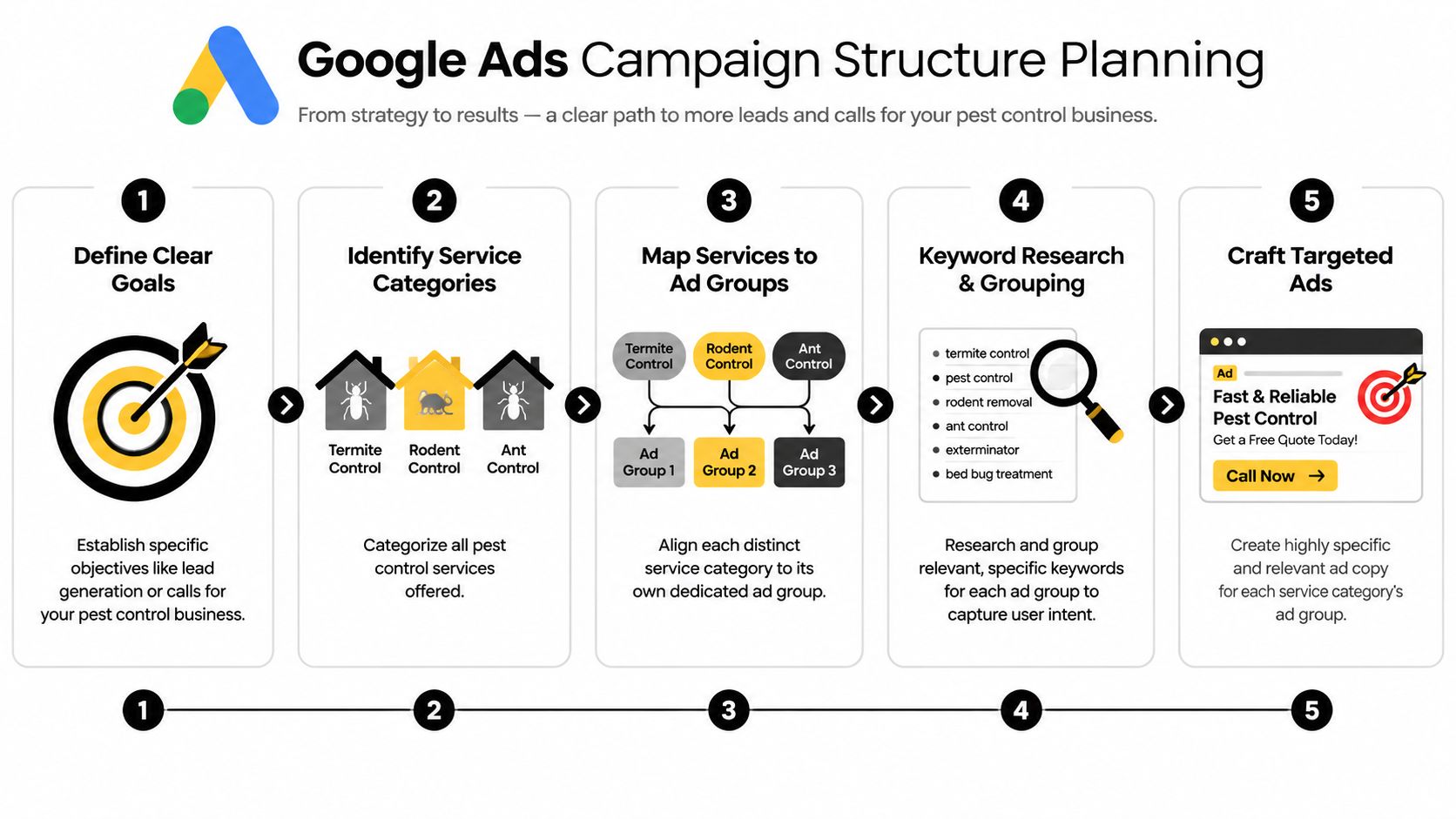
Start with the services, then build the account around how people search in Australia. Emergency callouts, inspections, termite treatment, rodent control, and cockroach treatment each deserve their own campaign logic. That keeps budgets pointed at the jobs that matter and stops one service from stealing credit from another.
Build the account around service groups
I map pest control accounts in layers. Campaigns should reflect the main business buckets, then ad groups should split by pest type or intent type. A person searching for an urgent response should not land in the same ad group as someone looking for a scheduled inspection. That mix creates vague ads and weaker conversion rates.
For most pest control businesses, the structure usually breaks into emergency work, inspections, treatments, and commercial enquiries. Inside those campaigns, keep the ad groups tight. “Termite treatment” belongs in one place, “rodent control” in another, and “cockroach control” in another, rather than forcing everything into one general bucket.
Seasonality matters here too. In Australia, demand shifts with weather, pest cycles, and property maintenance timing, so the account should make room for that pattern. I often separate campaigns or ad groups for services that spike at different times, then give each one its own budget and messaging. That reduces wasted spend on generic clicks and makes it easier to push budget toward the search terms that are converting.
Why local landing pages matter
A local landing page does two jobs. It tells the searcher they are in the right place, and it gives the campaign a tighter relevance signal. If the ad says pest control in Melbourne and the page opens with a generic homepage banner, some of that momentum is gone before the visitor reads a word.
I’ve seen homepage traffic look busy while service pages effectively produce the bookings. The homepage often behaves like a brochure. The service page behaves like a closer. For agencies building paid search around service pages, Alpha Omega Digital’s ecommerce marketing agency page is a useful reference point for how page structure can support lead flow, even if the business sits in a different sector.
Keep the budget tied to intent
This part matters because some owners assume structure is overkill for a smaller pest control business. It isn’t. The search market is broad enough to waste money fast, but specific enough to reward tidy campaign design. If emergency enquiries book faster than inspections, or if termite work produces better value over time than a one-off spray, the account should give stronger services more room.
The cleanest accounts are the ones where every dollar has a purpose. That does not need to look fancy inside Google Ads. It needs to keep spend away from weak clicks and toward the searches that show real buying intent.
A simple structure I’d trust
- Emergency campaign, for urgent, high-intent calls that need immediate response.
- Inspection campaign, for quotes, site visits, and property checks.
- Treatment campaign, for specific pest services and recurring work.
- Commercial campaign, for higher-value business enquiries that need different messaging.
That structure is not about tidy labels in Google Ads. It is about getting the searcher to the right page, with the right message, and the right next step.
A structured approach like this is also the kind of thinking shown on House of Geeks’ industry page, where the focus stays on service fit rather than broad traffic.
Researching Keywords and Setting Negatives
Keyword research for pest control starts with intent, then seasonality. A lot of spend gets wasted when campaigns chase broad terms that look busy but do not match what the caller wants. In Australia, that matters even more because the pressure changes with the weather, the pest, and how urgent the job feels.
A good keyword list should separate emergency calls from planned work, then split those groups by season. Someone searching “pest control near me” is usually ready to act. Someone searching for a specific pest in a specific month is often even closer to booking, because the problem is already front of mind. That is where you get better value than from generic clicks.
High-intent keywords I’d build around
| Keyword | Monthly Searches | Intent |
|---|---|---|
| pest control near me | 14,800 | High local intent |
| termite treatment | 6,600 | High service intent |
| termite inspection | 4,400 | High inspection intent |
| rodent control | 2,400 | High service intent |
| cockroach control | 1,900 | High service intent |
As mentioned earlier, service-specific queries total 29,800 monthly searches with an average difficulty of 38/100, according to King Tradie’s pest control marketing data. The useful part is not just the volume. It is the spread of intent. That spread lets you build tighter ad groups and keeps the ad copy honest.
I would also build seasonal clusters around the pests that spike at different times of year. Spider control summer and rodent control winter are simple examples, but the key value is in matching the wording to the timing. When a homeowner is already dealing with a seasonal pest, the keyword itself does part of the sales work.
Why negatives save money
Negatives stop the campaign from paying for people who are only looking around. I would exclude DIY, jobs, franchise, training, and product-led searches unless there is a clear service angle. The search term report will usually show the waste quickly, and once it shows up, it keeps showing up until you block it.
That is why cheap clicks are not the goal. A low cost per click still burns budget if the searcher is a student, a job seeker, or someone looking for a can of spray instead of a technician. The account can look active while the phone stays quiet.
Practical rule: if the searcher wants to learn, train, work, or compare products, that query usually belongs on the negative list unless it clearly signals commercial intent.
Match type discipline matters too
Broad match can work, but only after the account has enough conversion history and the negative list is tight. Before that, it often pulls in queries that sound close but behave very differently. Exact and phrase match are usually safer starting points for pest control because they keep the traffic closer to the service being sold.
That does not mean broad match has no place. It means broad match should come later, once the search terms are clean and the account is already showing which queries lead to booked work.
Don’t buy the same intent twice
One common mistake is bidding on a broad service term in one campaign and then chasing the same query again in another. That creates internal competition and makes it harder to see which part of the account is doing the work. Budget gets spread thin, and the reporting becomes harder to trust.
Each keyword cluster needs a clear job. One cluster should focus on emergency work, another on inspections, another on treatment, and another on commercial leads if the business takes them. Seasonal keywords fit into that system well, because they let the account shift with demand instead of forcing one set of ads to do everything.
The cleanest accounts are usually the most specific ones. They cut out noise, keep the search terms relevant, and leave room for the enquiries that are ready to become jobs.
Crafting Effective Ad Copy and Extensions
Good pest control ad copy doesn’t try to sound clever. It tries to sound useful, fast, and believable. The person searching is usually under pressure, so the ad needs to answer three questions quickly, can you handle the problem, are you local, and can you help now?
Write for urgency without overpromising
The ACCC reminder matters here, because misleading claims in ads can create real problems. In an Australian case involving Google ads that used terms like “Fair Work Ombudsman” and “Free 24/7 Employer Advice”, the ACCC said the ads were misleading, which is a useful warning for any service advertiser tempted to stretch the truth. For pest control, that means keeping claims honest, keeping licensing boundaries clear, and avoiding copy that implies things you can’t deliver. ACCC’s Employsure Google ads ruling is a good reminder that urgency and accuracy need to sit together.
A strong headline usually leads with the service, then adds the local angle or the availability angle. “Termite Treatment Melbourne” is boring in the best possible way, because it says exactly what the searcher wants to know. If you add a response promise, make sure the business can honour it.
Use extensions to do some of the selling
Extensions help the ad occupy more of the page and make the offer feel more complete. Call extensions are obvious for pest control because the phone often converts better than a form. Sitelinks can send people to termite pages, rodent pages, and inspection pages. Structured snippets can list the services without stuffing the headline.
I usually keep the copy tight and let the extensions carry the detail. That way the main ad stays focused, while the extra elements handle service breadth, proof, and contact points. The cleaner the structure, the easier it is for a searcher to choose.
A practical ad set I’d test
- Headline one, the service plus the city or suburb.
- Headline two, a short trust signal like licensed technicians or fast response.
- Headline three, a booking prompt or call prompt.
- Description one, the problem and the solution in plain language.
- Description two, a local service note and a strong next step.
I’d keep the copy conservative enough to satisfy compliance and strong enough to earn the click. That balance is where good service ads live.
Twilio can improve the call experience
A custom number routed through Twilio is useful when the business wants tighter call handling. You can set up a number that answers all day, doesn’t get tired, and books appointments into a calendar or Calendly workflow, which matters when missed calls equal missed revenue. For tradies, hairdressers, beauty therapists, dentists, restaurants, and doctors, that kind of setup can help stop simple enquiries from slipping through the cracks.
Where call tracking fits
Call tracking should not sit in a vague “brand nice-to-have” bucket. It should sit inside the conversion stack, because pest control enquiries often start with a ring rather than a form. If you want a practical reference for how call-focused account setups are handled, Alpha Omega Digital’s Google Ads for plumbers page is a relevant internal resource, since plumbing and pest control share the same urgency-driven lead pattern.
Sample extension logic
- Call extension, for immediate mobile responders.
- Sitelink extension, for termite, rodents, inspections, and emergency pages.
- Structured snippet, for the actual pest services offered.
- Location extension, where the business has a clear service area and wants trust signals.
The point of extensions is not decoration. The point is to make the ad more complete than the competitor’s ad, without making it misleading.
When the copy is accurate, the extensions are relevant, and the call path is simple, the ad starts doing real work instead of just buying attention.
Optimising Landing Pages for Conversion
A pest control landing page should feel like the answer to the search query, not a brochure with a phone number on it. I’ve seen accounts where the ads were solid but the page was too generic, too busy, or too slow. In those cases, the campaign gets blamed for a problem that started on the site.

Build the page around one action
The page should make one action obvious, call, book, or request an inspection. If there are too many competing buttons, the visitor hesitates. If the hero area is cluttered, trust drops. If the form is too long, mobile visitors often bail before completing it.
A strong layout usually opens with the service, the location, and a clear next step. A booking prompt like “Book a Free Inspection” can work well if the business offers it. The page should then back that up with simple proof, licensing, service area notes, and a short explanation of what happens next.
Match the page to the search intent
Dedicated pages matter because not all pest searches mean the same thing. Someone wanting termite treatment doesn’t need a general pest overview. Someone needing emergency help doesn’t want to scroll through a long content page before finding the phone number. If the page doesn’t match the problem, the searcher leaves.
The strongest Australian case study I can point to reported more than 100 inbound leads per month, an average cost per conversion of about $30, and a click-to-lead conversion rate of 30% over two years when dedicated landing pages were used, according to CliqMC’s Zero Pests case study. That result doesn’t come from luck, it comes from alignment between the ad, the page, and the lead capture flow.
Keep the conversion path short
I prefer short forms for pest control unless the business requires more qualification. The more urgent the service, the more likely a phone call or a simple form will win. For quote requests and inspection jobs, make the next step immediate and clear.
A mobile-first layout matters too, because urgent searches often happen on phones. If the page loads slowly or the call button is buried, you’re handing the lead to the next business in the auction. That’s a self-inflicted loss.
The page should answer the searcher before they have time to second-guess you.
Use trust signals that actually mean something
Licensing badges, certification references, service area details, and a plain-language explanation of the process all help. If you can show that the business is local, insured, and ready to act, that lowers friction. Avoid stock photos that look fake or overproduced, because they can weaken trust faster than no image at all.
A note on integrations
If your pest control business also relies on ecommerce or custom site work, the same conversion discipline can carry across. For stores and service brands that need tighter site development, Alpha Omega Digital’s Shopify developers Melbourne page is one practical example of how technical build decisions can affect conversion flow.
The page should support the sale, not explain the whole industry
A lot of pest control pages try to educate the visitor out of taking action. That’s a mistake. Education belongs in supporting content, but the landing page should close the loop. The goal is to get the booking, then let the team do the explaining after contact is made.
A clean page, a short form, a strong call button, and a clear promise usually beat a long page full of generic reassurance.
Setting Up Tracking and Bidding Strategies
A pest control account can burn through budget fast if tracking is loose. I’ve seen campaigns judged as poor performers when the real problem was simple, the account was feeding Google Ads the wrong conversion signals, so the bidding system kept optimising for the wrong actions.
Track the actions that matter
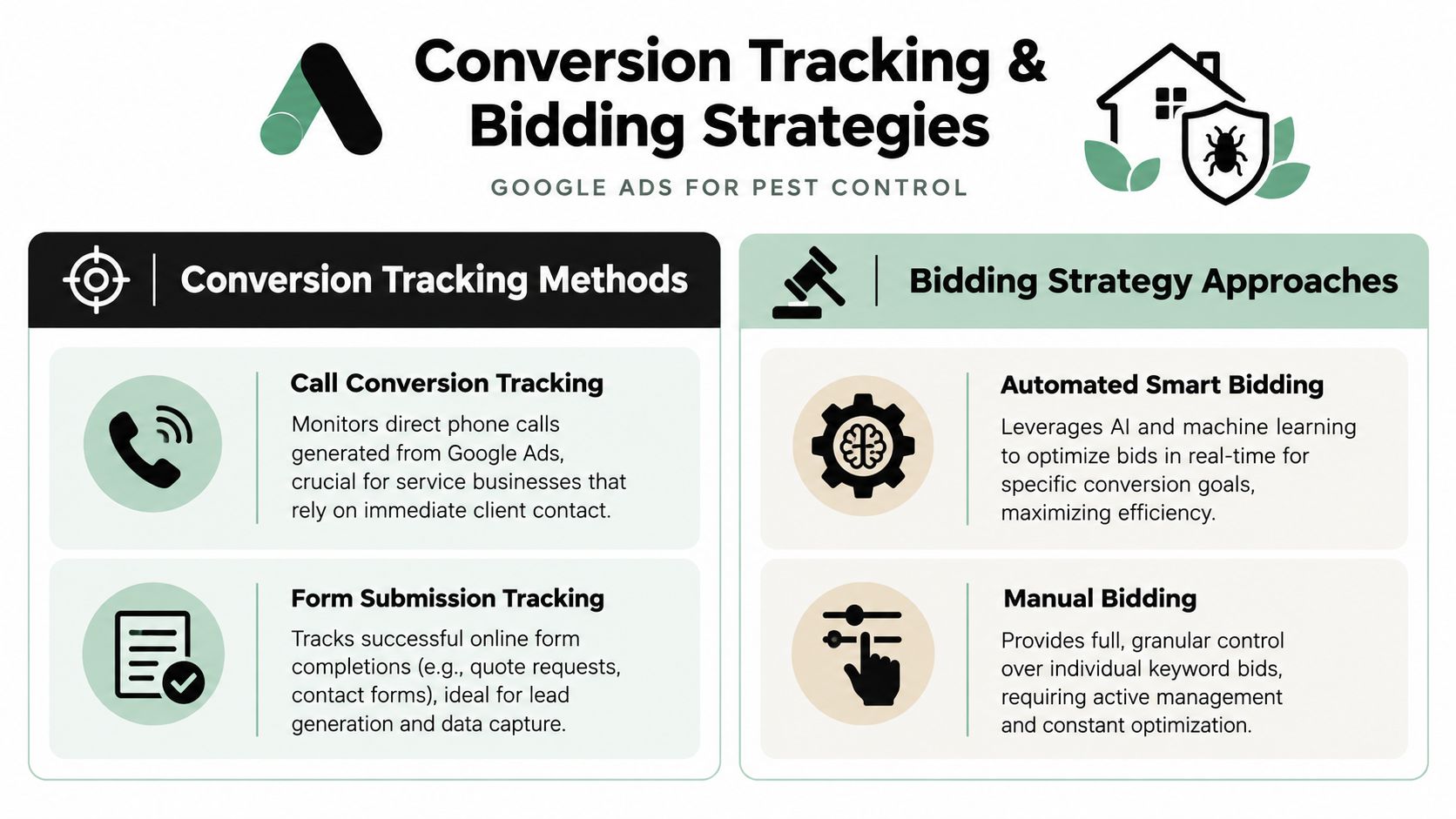
For pest control, calls and forms are the conversions that matter most. If the business sells over the phone, call tracking needs to be clean and consistent. If forms are used for quote requests or inspections, those submissions should be tracked separately so Google can tell the difference between a quick enquiry and a booked job.
Google Tag Manager and Google Analytics are usually the cleanest way to set this up. Once the tags are stable, the account can learn from actual lead behaviour instead of raw clicks. A booked call is stronger than a page visit, and the bidding system should be trained on that difference.
How I compare bidding options
Manual bidding gives more control, which helps early on when the account is small or the data is messy. Target CPA tends to work better once you know what a good lead costs and the conversion data is clean enough for automation. Maximise Conversions can also work, but only if the tracking is accurate and the landing page is doing its job.
Season matters here too. In Australia, demand for different pests moves with weather and service urgency, so I’d be more aggressive with Target CPA during peak periods for high-value pests, then pull back to Manual CPC when demand softens or the search mix turns less commercial. That shift helps keep spend tied to real intent instead of paying the same way for every click.
The wrong choice is usually not the bidding strategy itself. The wrong choice is using automation before the conversion data is trustworthy. If the system learns from junk signals, it gets very good at buying junk.
Use benchmark pressure as a reality check
As the benchmark data mentioned earlier suggests, pest control top-of-page bids can sit in a wide range, and home-services CPLs can vary just as much. That makes the account’s own lead quality more important than any single average. If your costs sit well outside the range you expect, it is usually a sign to check the query mix, the geo settings, or the landing page before you touch bids.
If you are paying too much for weak leads, cutting bids is not always the right answer. Sometimes the problem is the search term, sometimes it is the service area, and sometimes the page is sending mixed signals. Diagnose first, then adjust the strategy.
A custom Twilio number can improve lead handling
A Twilio-based number helps when you want calls tracked cleanly and answered consistently. It can route calls to the right person, keep the line open around the clock, and book appointments into a calendar or Calendly flow. For service businesses, that can reduce missed opportunities and make the lead path easier to measure.
Keep your campaign settings tight
Location targeting should match the actual service area, not the whole metro if the business cannot service it properly. Device behaviour matters too, since urgent pest searches often happen on mobile. If the settings are too broad, the account can spend on people who were never likely to book.
The same discipline applies across the setup. Use the bidding strategy as a tool, not a crutch. Manual bidding suits control. Automated bidding suits scale. The smart move is to match the strategy to the quality of the data you have.
Continuous Optimisation and Troubleshooting
A pest control account never stays still for long. Search demand shifts, competitors change bids, and the busiest services move around with the season. The job is to watch the account closely enough to catch waste early, then adjust before the budget disappears into low-value traffic.
The weekly routine I’d trust
Every week, I’d review search terms, check call quality, and look for any sudden spend creep. If a query is attracting clicks without showing signs of commercial intent, it goes on the negative list. If one service line is producing better leads than the others, I’d protect that budget instead of spreading spend too evenly.
The monthly work is different. That’s when I’d audit bid performance, look at device splits, check whether the landing pages are still aligned, and review whether a certain suburb or service type is absorbing spend without enough return. Quarterly, I’d refresh the landing pages, tighten the headlines, and reassess whether the business has changed its offering.
Watch for seasonal shifts, not just averages
Pest control demand isn’t flat, and the account shouldn’t be managed like it is. A generic keyword can look reasonable in a quiet month and terrible when the wrong season hits. The better approach is to use the search trend data inside Google Ads Insights and spot when query mix starts shifting toward more urgent or more commercial phrases.
That matters because some traffic is more valuable than other traffic even when the headline numbers look similar. If a seasonal shift pushes people toward high-intent service searches, the account should lean into those terms. If a generic phrase starts eating budget without delivering bookings, pause it and let the more profitable queries take over.
Troubleshoot from the symptom backwards
Low impression share doesn’t always mean the budget is too small. Sometimes it means the keywords are too broad, the bids are too cautious, or the ads aren’t relevant enough to compete well. Cost spikes can happen for the same reason, especially in metro areas where competitive pressure moves quickly.
Ad disapprovals need careful handling too. The ACCC example earlier is a reminder that claims must be accurate and licensing boundaries respected. If the copy is too aggressive, or if it implies something the business can’t support, the ad can get stuck before it even has a chance to serve.
A short optimisation checklist
- Review search terms weekly, and cut the obvious junk before it piles up.
- Audit calls and forms monthly, so the bidding decisions reflect real leads.
- Refresh landing pages quarterly, especially if the service mix has changed.
- Check geo settings often, because service areas are easy to widen by accident.
- Shift budget toward high-value intent, especially when the generic terms start getting expensive.
The bigger lesson
The best pest control accounts don’t chase more clicks for the sake of it. They chase better matching, cleaner tracking, and tighter follow-up. That’s why generic traffic often gets paused while term-specific, location-specific, or commercial-intent traffic gets more budget.
If you run pest control ads in Australia, consistency matters more than drama. The account wins when the structure stays disciplined, the search terms are reviewed properly, and the leads are handled fast.
If you want a Melbourne team that can build the campaign structure, landing pages, and tracking properly for Google Ads for Pest Control, Alpha Omega Digital handles paid search alongside WordPress and Shopify work for Australian businesses. If you’ve got a paid ads budget of at least 3k a month, visit Alpha Omega Digital and get in touch through the contact page about the month of paid ads management free offer.
Alpha Omega Digital
Read more insights from our team on web design, paid ads, and growth strategy.