You can spend weeks polishing colours, swapping fonts, and rewriting headlines, then still lose the job because the site makes people hunt for the phone number. That’s the reality for a lot of tradie websites in Melbourne, Sydney, and every other busy local market. The work isn’t won by looking modern, it’s won by making it easy for a homeowner or site manager to trust you, call you, and book you fast.
I’ve rebuilt enough WordPress and Shopify sites to know the pattern. The tradies who win online usually don’t have the fanciest design, they have a site that answers the right question immediately, routes enquiries cleanly, and feels credible on a phone at the exact moment someone’s ready to act. In a market with 2,729,648 actively trading businesses at 30 June 2025 and 2,656,469 small businesses in June 2025, according to the ABS, standing out with a clear web presence isn’t optional, it’s part of competing properly in Australian services markets. ABS business counts release
Why Most Tradie Websites Lose Jobs Before the First Call
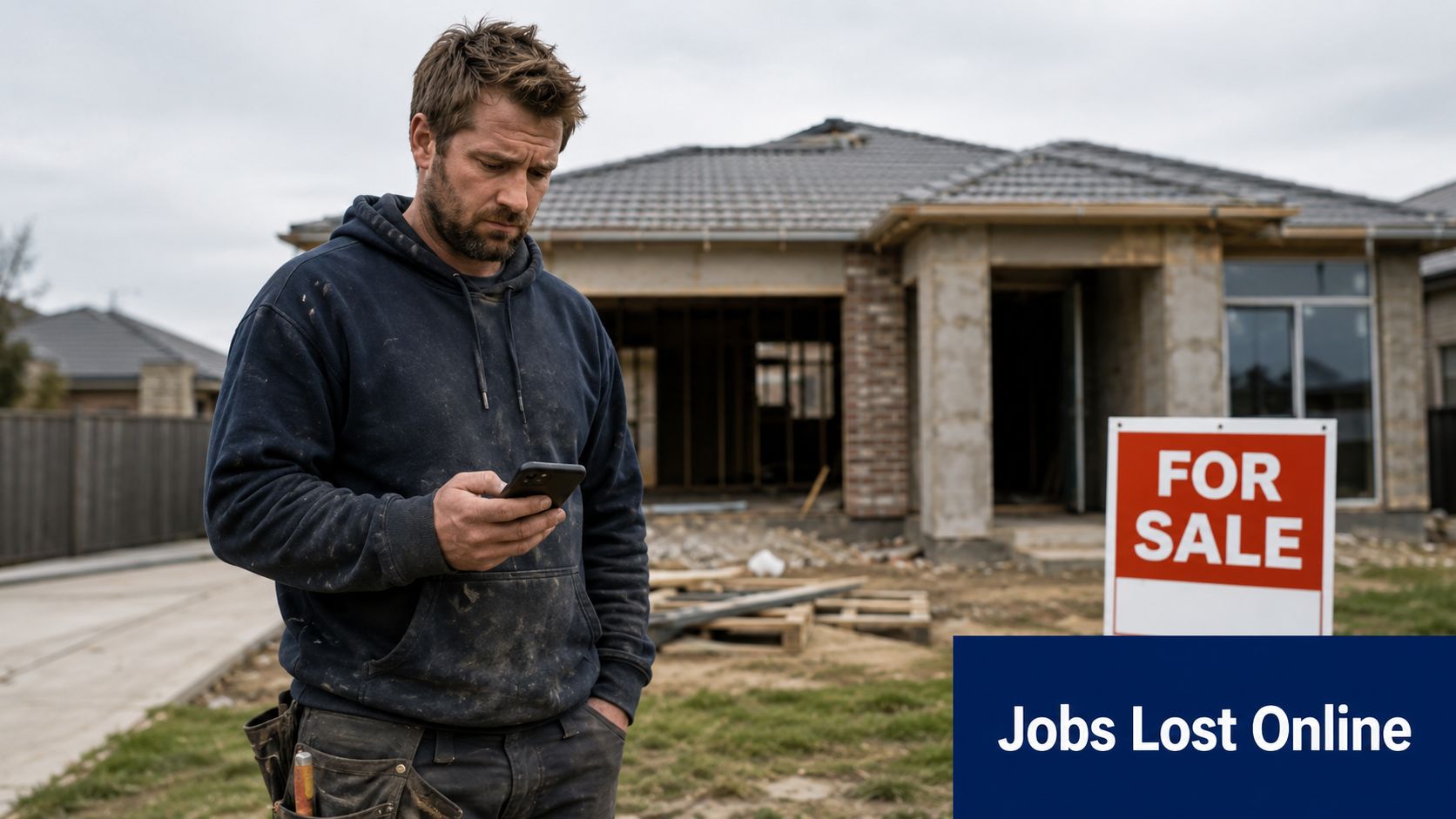
A plumber rings me after a slow month, and the first thing he says is usually the same. “We’ve got a website, but I don’t think it’s doing anything.” Then I open it on my phone and the problem is obvious. The hero section says something vague, the phone number is buried, the service area is unclear, and the only button on screen sends me to a generic contact page.
That is common for many tradie websites in Melbourne, Sydney, and other busy local markets. The work is won by making it easy for a homeowner or site manager to trust you, call you, and book you fast.
That’s a conversion problem. A site can look tidy and still lose the job if the first screen does not make the next step obvious. Australian websites already convert at 1.78%, below the global average of 1.88% and APAC’s 2.76%, so a tradie site has no room for extra friction. Website conversion benchmark
The first screen has to earn trust fast
I see the same mistakes over and over. Generic hero copy. Carousel banners that nobody waits for. Phone numbers that sit in the footer like an afterthought. Long forms that ask for too much before the visitor has even decided they are in the right place. Those are the quiet job killers.
Practical rule: if a stranger lands on the site and cannot tell what you do, where you work, and how to contact you within a few seconds, the site is wasting traffic.
The better sites are direct. They state the service, show the trade clearly, and give one obvious next step. That is why tradie web design has to be built around speed-to-lead, not just visual polish.
A crowded market rewards clarity, not decoration
The Australian business base keeps growing, and small-business competition is not easing off. The ABS reports 2,729,648 actively trading businesses and 2,656,469 small businesses in its latest release, which shows how much attention local services compete for across the country. ABS business counts release
That matters because most tradies sell locally to homeowners, property managers, builders, and other small-business-style buyers. Those people usually compare a few options, skim on mobile, and call the one that feels easiest to trust. If your site does not answer the job-fast question, a competitor’s simpler site probably will.
Treasury’s small business statistics also found that 62% of SMEs had a website and another 7% intended to get one within 12 months, while 72% of SMEs with websites said the site improved business effectiveness. Treasury SME statistics
That is the shift. A tradie site is a working sales asset. It needs to make the phone ring, fill the booking calendar, or qualify the lead properly before it lands in your inbox.
Essential Pages and Enquiry Flows That Convert
A tradie site doesn’t need thirty pages. It needs the right pages, arranged so a visitor can move from problem to proof to enquiry without detours. I usually build around a simple structure, then tighten the enquiry path so the site feels obvious on mobile and still makes sense on desktop. If the structure is messy, the lead flow gets messy too.
The core page stack
Start with a homepage that says what you do, where you work, and what makes you worth calling. Then build service pages for each job type, because a visitor searching for emergency plumbing shouldn’t land on a page that talks about general maintenance in broad terms. Add suburb or service area pages where local intent matters, especially if you want suburb-level visibility and stronger routing from local search.
After that, add the pages that reduce hesitation. An about page with real people. A reviews page that shows actual client trust. A gallery or completed-jobs page with real work photos, not stock imagery. A FAQ or pricing page that handles common objections before they become abandoned enquiries.
Best practice: every important page should point to one primary action, and that action should stay consistent. If the page wants calls, quote requests, and bookings all at once, most visitors will do none of them.
Build the enquiry path around the type of job
Not every tradie enquiry should follow the same path. An emergency job needs click-to-call front and centre. A non-urgent renovation can tolerate a short form. A productised service, like a maintenance package or installation booking, might work better with a booking flow that captures job type, location, and timing.
A clean flow looks like this:
- Homepage enters the lead with a clear service statement and one primary CTA.
- Service page builds confidence with process, proof, and job-specific FAQs.
- Suburb page or service area page narrows intent for local relevance.
- Contact form or call path closes the loop with only the fields you need.
A lot of tradie sites fail because the form asks for too much. Name, email, phone, address, job details, preferred date, how they found you, and a dozen other fields. That’s fine for back-office data collection later, not for first contact. Keep the first form short, then qualify further after the enquiry is captured.
The same idea works after hours. If someone’s contacting you at night, don’t force them into a dead-end form and hope for the best. Route them to a fast response path, a booking option, or a clear promise that their enquiry has been received. The more immediate the acknowledgement, the fewer leads slip away.
Trust signals belong close to the action
Real reviews, completed-job photos, licence details, guarantees, and service coverage should sit where the visitor can see them before they scroll too far. If the CTA is “Get a Free Quote,” place trust beside it, not on a separate page nobody reads. When I map this properly in WordPress development or Shopify development, the result is usually simpler than clients expect, but much stronger in practice.
Choosing Your Platform Without Overbuilding
The best platform depends on what the business sells. I’ve built tradie sites in both WordPress Design and Shopify Design, and the wrong choice usually costs more in maintenance, not just upfront build time. If the site is mostly about generating local leads, service pages, and suburb pages, WordPress usually gives more room to shape the content structure. If the business has productised services, simple offers, or commerce-like workflows, Shopify can be cleaner to manage.
WordPress for local control and flexible content
WordPress works well when the site needs a lot of custom page types. I use it for tradies who want suburb pages, service pages, FAQs, blog content, and custom Gutenberg blocks that let the team add proof without breaking the layout. It also suits businesses that want more freedom over local SEO structure and editorial control.
A good WordPress developer can keep the build lean and still give the client proper editing flexibility. That matters when the owner wants to update a gallery, add new testimonials, or spin up new service pages without waiting on an agency every time. If the business grows into a broader content play, WordPress usually scales better on the content side.
Shopify for productised offers and simpler operations
Shopify makes more sense when the site behaves a bit like a store. I’m talking about packaged services, booking-oriented offers, add-ons, deposits, or service businesses that want a very controlled admin experience. A strong Shopify developer can tie the site to the catalogue, theme settings, and custom flows without turning the backend into a maintenance burden.
Shopify also has a clearer path if you need integrations with Shopify API or you’re building custom features through Shopify CLI. That’s useful when the business wants more control over checkout-like journeys, quote-style product pages, or a custom app in the future. If you’re comparing shopify-developer-api work with lighter brochure-style builds, that decision should come down to how much operational complexity you want to own.
WordPress vs Shopify for Tradie Websites
| Criteria | WordPress | Shopify |
|---|---|---|
| Content structure | Strong for service pages, suburb pages, FAQs, blogs, and custom layouts | Good for simpler content sets and productised offers |
| Editing flexibility | Excellent with custom blocks and tailored templates | Easy for structured commerce-style edits |
| Local SEO control | Strong | Adequate, but usually less flexible for service-heavy builds |
| Maintenance | Needs sensible upkeep and updates | More managed, less technical overhead |
| Integrations | Broad plugin ecosystem | Strong commerce and app ecosystem |
| Best fit for tradies | Lead-generation sites with many location and service pages | Tradies selling packaged offers, add-ons, or simple eCommerce-style services |
The label matters less than the fit. I’ve seen businesses overbuy platform complexity because they wanted a shiny stack, not a site that made sense for their sales process. If the business is service-first, keep it service-first.
Mobile First Design and Speed That Lifts Leads
Most tradie enquiries happen when someone’s already in problem-solving mode. They’re on a phone, they’ve got a leak, a broken switch, a damaged panel, or a job that needs sorting quickly. That means the site has to feel immediate, not clever. It should look like a business that’s ready to answer, not a portfolio piece waiting for applause.
Design for the thumb, not the desktop demo
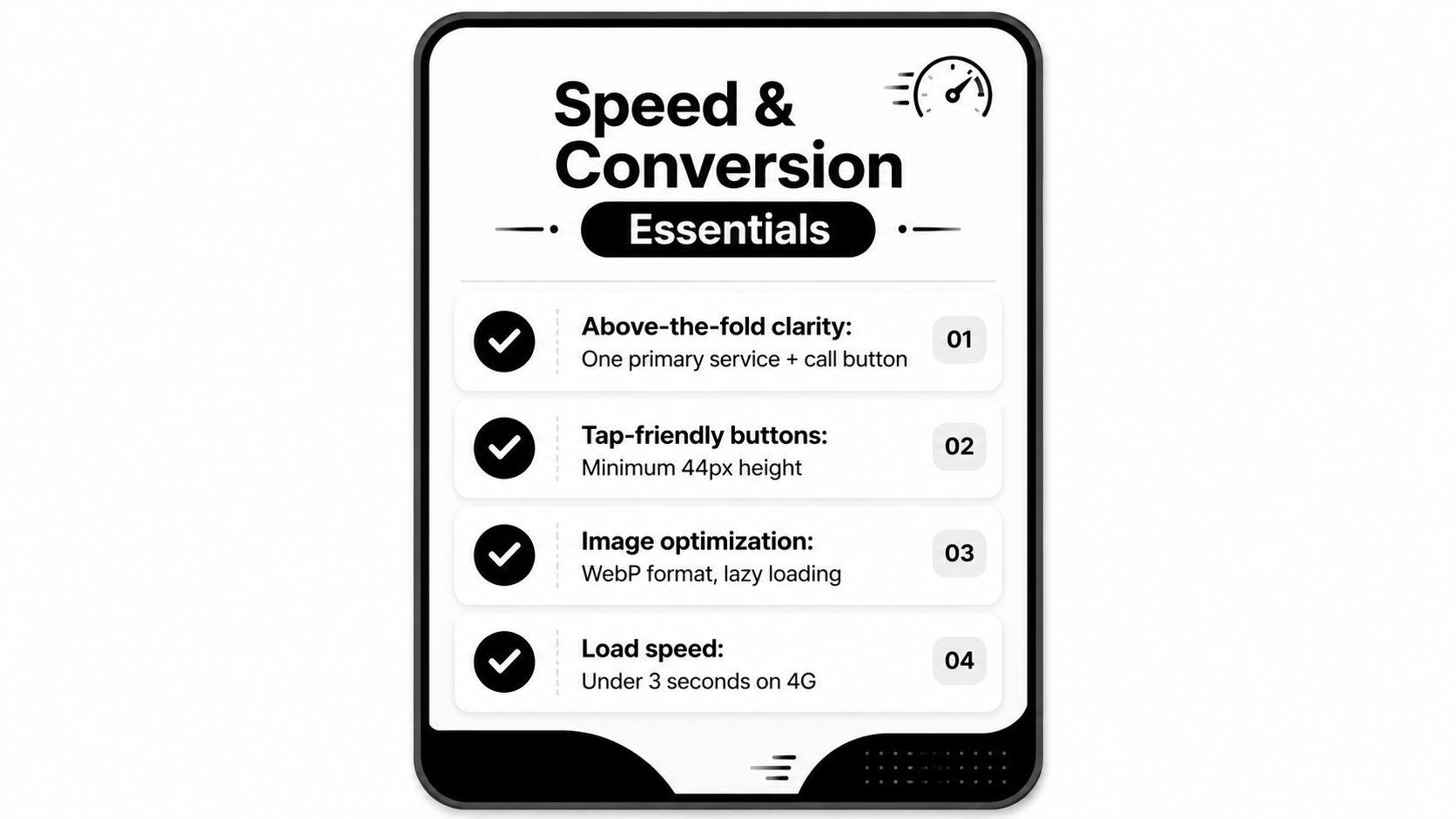
The first job is visibility. Put one primary CTA above the fold, like Get a Free Quote or Call Now, and don’t compete with yourself using three different buttons. Sticky call buttons work well on small screens because they remove the need to scroll back up when the visitor has already decided.
The form should stay short. Ask for the minimum needed to respond well, then qualify later if needed. Pair the form with reviews and real job photos near the conversion point, because those trust cues help the visitor move from interest to action.
What slows mobile leads down most is not one giant issue, it’s a stack of small ones. Heavy sliders, oversized images, cluttered menus, and scripts nobody uses all add friction before the first tap.
Speed is a conversion lever, not a technical vanity metric
Independent Australian optimisation commentary reports that faster sites can convert 40%+ higher than slow sites, and one Australian case example showed a load-time reduction from 7s to 1.8s with a 35% bounce-rate reduction. Australian optimisation guidance Those numbers are useful because they show what happens when you remove delay from a service site that depends on fast action.
The practical fixes are straightforward. Compress images. Defer non-critical scripts. Simplify mobile layouts. Strip out sliders unless they help the sale. Keep the contact action visible on small screens, because a visitor who’s ready to call won’t wait for a decorative animation.
Mobile conversion checklist I’d actually use
- One clear headline: Say the trade, the service, and the area in plain language.
- One primary CTA: Pick call or quote first, then support it with a secondary action if needed.
- Real proof near the CTA: Reviews, completed jobs, and licence or coverage cues.
- Fast-loading media: Use compressed assets and avoid anything that drags the first render.
- Tap-friendly layout: Buttons need space, and menus shouldn’t require precision tapping.
A site can be visually simple and still feel premium if it loads quickly and answers the right question. That’s the difference between a polished brochure and a lead engine.
If you’re checking performance in a real build, Google Ads landing pages and organic pages need the same discipline. Slow pages waste traffic, whether that traffic came from search, social, or a referral.
Local SEO Booking and Tracking Setup That Pays Back
A tradie site should do more than look credible. It should be wired so you can tell where the leads came from, which pages helped them convert, and which campaigns deserve more budget. That starts with local visibility, then moves into measurement. Without both, you’re guessing.
Google Business Profile and local intent
A complete Google Business Profile earns 7× more clicks than an empty profile, and Australian brands with active profiles recorded the highest monthly actions among the countries studied, which makes GBP optimisation a concrete lead-generation lever for Melbourne businesses. Local SEO statistics for Australia The practical takeaway is simple, complete profiles get more attention, and attention drives actions.
Your website should reinforce that profile, not fight it. Service pages should map to actual search intent, suburb pages should support local relevance, and the site structure should make it obvious what kind of jobs you take and where you take them. That also helps with AI-style discovery because organised content is easier to summarise and route.
Set up measurement before the ads start
For tracking, I’d always start with Google Tag Manager or the Google tag so contact forms and other key actions can be measured properly. Google’s own measurement guidance says businesses can use either approach for web activity tracking. Google Ads measurement and conversion tracking If the site lives on Shopify, Google’s conversion setup through the Google & YouTube app involves installing the app, connecting the correct Google account, and choosing the measurement path in the flow. Shopify Google Ads conversion setup
For Meta campaigns, I’d install the official Facebook and Instagram sales channel, connect the dataset, enable Conversions API with maximum data sharing, and verify both browser and server events with deduplication in Events Manager. Meta Shopify tracking flow That setup is worth doing properly because paid social gets much harder to optimise when the event data is weak.
Operational rule: if you can’t trust the conversion data, you can’t trust the campaign decisions.
PPC for tradies needs proper call tracking
For service businesses, calls still matter. Tools like CallRail and Go High Level are common ways to track call-based campaigns, and they’re especially useful when a lead doesn’t submit a form but still becomes revenue. If you want a custom number setup, I’d use Twilio so calls can route to the right place, answer around the clock, and book appointments into a calendar or Calendly. That approach can help tradies, hairdressers, beauty therapists, dentists, restaurants, and doctors capture missed calls that would otherwise disappear.
A practical setup might include:
- 24-hour call answering: So after-hours enquiries don’t bounce.
- No tired receptionist bottleneck: The number keeps working even when the team’s off-site.
- Calendar or Calendly booking: So calls can move straight into an appointment slot.
- Lead source visibility: So you know whether the call came from ads, organic search, or a local profile.
That’s where a marketing partner can matter, because the site, the ad account, and the tracking stack need to line up. In Melbourne, Alpha Omega Digital handles that kind of WordPress and Shopify build plus paid media setup, but the principle is the same whether you use them or another team. The point is to make sure the site and the tracking are built as one system, not separate jobs.
Launch Optimise and Keep Your Site Winning Jobs
A tradie website shouldn’t be treated like a one-time project. Once it launches, the work is in tightening the messages, checking the tracking, and watching how people move from ad or search to enquiry. The sites that keep performing usually get small, regular improvements rather than expensive redesigns every couple of years.
Launch checks that save headaches later
Before the site goes live, I always test the obvious things first. Forms need to send to the right inbox. Call buttons need to work on mobile. Reviews and photos need to load properly. Conversion tracking needs to fire on the actions that matter. If any of those break, the data becomes unreliable and the lead flow suffers.
After launch, use the first clean month as a baseline. Track calls, quote requests, bookings, and the pages that assisted those actions. Then review where visitors drop off. Sometimes the fix is copy. Sometimes it’s a form field. Sometimes it’s the layout on one key service page.
Measure the right campaigns the right way
If you’re running Facebook ads agency work or managing Google ads for service-based businesses, the question isn’t just which platform gets clicks. It’s which one brings usable enquiries. For productised offers, I’d test campaign structure carefully, including PMAX vs Google Shopping ads if commerce-style products or service bundles are part of the mix. For standard lead-gen, the priority is usually simpler, clean conversion tracking and strong landing pages before you layer on extra campaign types.
For a digital marketing agency Melbourne team, the value is in consistency. Review creative, landing pages, call quality, and response speed every month, then keep adjusting. If the site isn’t generating enough qualified leads, the issue may be the message, the page hierarchy, or the follow-up process, not just ad delivery.
Keep the site alive
Businesses that update testimonials, add new jobs, refresh suburb pages, and keep content current usually give buyers more reasons to trust them. That’s the boring part that works. A site can be visually strong, but if it starts to feel stale, people notice.
If you want a practical next step, work with a team that can build the site, wire the tracking, and manage the paid traffic together so the whole funnel behaves properly. That’s the difference between a site that exists and a site that keeps winning work.
Want to see what your website could look like with a fresh design? Contact us for a FREE homepage mockup.
Alpha Omega Digital
Read more insights from our team on web design, paid ads, and growth strategy.