You've spent money on a store that looks sharp, you're paying for clicks every day, and you still can't answer a simple question with confidence. Which ads made you profit, after product costs, shipping, refunds and GST? I judge a small business marketing agency in Melbourne by whether it connects your website, your ad accounts and your accounting records. A long service list doesn't prove that connection. Reliable purchase data does.
What a Melbourne Agency Covers for Your Online Store
Ecommerce retainers in Melbourne tend to bundle the same six areas, whether the proposal names them or not. What you are buying is a chain that turns a product view into a paid order you can verify, and the chain only holds when one team owns every link.
Six Areas That Need One Owner
A marketing agency in Melbourne working with online stores usually covers the areas below. Read each row by its first output and its proof metric; the service label matters less than either.
| Service area | What the agency delivers | First output to expect | Metric that proves it works |
|---|---|---|---|
| Website design and development | Conversion-focused Shopify or WordPress store with fast mobile checkout | Live store with tested checkout and tracking | Add-to-cart rate and checkout completion rate |
| Google Ads management | Search and Shopping campaigns with budget and bidding control | Campaign structure with conversion goals set | Cost per purchase and return on ad spend |
| Meta ads management | Prospecting and retargeting campaigns with creative testing | First set of tested creative concepts | Cost per purchase and cost per add-to-cart |
| SEO | Product and category page optimisation with technical fixes | Keyword map and fix list | Organic sessions and rankings for product terms |
| Analytics and tracking | GA4, Google Tag Manager and Meta Conversions API set up | Verified purchase and lead events | Event match rate and revenue reconciled to Shopify orders |
| Automation and CRM follow-up | Lead routing, abandoned cart and email sequences | Live automated sequences | Response time to enquiry and repeat purchase rate |
A row with no proof metric is a row you cannot audit. If a proposal cannot name the metric, it usually cannot own the outcome either.
Alpha Omega Digital is one local example of that spread, covering Website Design & Development, Search Engine Optimisation (SEO), Google Ads Management, Meta Advertising, Shopify Development, WordPress Development, App Development, Cloud & AWS Consulting, CRM Integrations, and Website Hosting & Maintenance. We are also a Shopify Partner and create custom Shopify theme blocks, app integrations, and private apps. Breadth only helps when the same team owns the handoffs between build, ads and measurement.
Three Kinds of Agency
Some firms build stores and hand you the keys. Others run ads and never touch the checkout or the tracking that feeds their bidding. I would look for the third type: one that connects both sides to measured revenue and tells you when the store, rather than the ad, is the problem.
For service enquiries alongside sales, automation can route new leads and streamline follow-ups, which suits tradies, hairdressers, dentists, restaurants and other businesses that lose work when enquiries sit unanswered. For a pure online store I would prioritise abandoned cart and post-purchase flows first.
Proposal check: For every row, ask who owns it directly, who is subcontracted, and which metric will appear in your report.
Building the Website Foundation Ads Depend On
A store can look healthy in an ad dashboard while the checkout leaks profit. If Apple Pay fails on mobile but desktop card payments work, paid clicks mostly buy expensive proof of a fault you already owned. Test the full purchase on a phone before judging any campaign, and judge the agency by whether it can trace a sale from product feed to checkout to the order record.
Choosing the Platform
For a product-led store, I recommend Shopify development with considered Shopify design: a mature checkout, a large app ecosystem and less maintenance. WordPress development with WooCommerce suits stores where guides, comparisons and a blog carry much of the sales journey; good WordPress design and custom Gutenberg blocks make editing safer for your team. I reserve custom builds for unusual integrations, because you pay to maintain what Shopify or WordPress already handle.
The Australian Bureau of Statistics retail trade release reported seasonally adjusted online retail sales of $4,703.8 million in June 2025, with non-food products accounting for $3,253.9 million and non-food online sales increasing 4.5% from May. Those figures are national context rather than a forecast for your store. They justify treating a fast mobile storefront, accurate product feeds, purchase tracking and order reconciliation as core sales infrastructure.
Checks I Run Before Scaling Spend
- Mobile speed: Aim for a fast Largest Contentful Paint on key product templates, then retest after apps are added.
- Product clarity: Put price, stock, shipping cost or threshold, delivery timing and returns where buyers can find them without hunting.
- Checkout friction: Remove optional fields, test discount codes, and confirm Apple Pay, Google Pay, cards and your buy now pay later option all complete.
- Feed and order truth: Match titles, prices, availability and images across Shopify, Google Merchant Center and Meta Commerce Manager, then confirm the order value in Shopify matches what your ads and accounting records see.
Custom work earns its cost when it removes a repeated operational problem. Alpha Omega Digital is a Shopify Partner and builds custom Shopify theme blocks, app integrations, and private apps. Ask any developer for examples they have built and who maintains them after launch. An unmaintained private app becomes your problem at the worst possible time.
Run this in an afternoon. Buy your cheapest product on your phone, refund it, check the order emails, then repeat with a discount code and a second payment method. Note every pause where you, as a buyer, had to think.
Tracking Profit Instead of Clicks
Most stores don't have a traffic problem first. They have a measurement problem. The Australian Bureau of Statistics Characteristics of Australian Business release for 2024–25 found only 7% of businesses measured the contribution of digital activities to overall business performance and only 10% actively collected or analysed data to support informed decisions. That's the gap I want your agency to close.
Context matters too. The Australian Bureau of Statistics September 2024 retail trade release reported seasonally adjusted online retail sales reached A$4,061.4 million in September 2024, increasing 8.9% compared with September 2023. A growing market rewards stores that can tell profitable demand from expensive noise.
Set It Up in This Order
- Create one GTM container: Hold GA4 events for view item, add to cart, begin checkout, purchase and lead submission in Google Tag Manager, with consistent names and values.
- Pair browser and server events: Run the Meta pixel with Meta Conversions API, using a shared event ID for deduplication so one purchase isn't counted twice.
- Separate contact actions: Tag phone clicks, form starts and form submissions separately. For call-heavy offers, tools such as CallRail or GoHighLevel can help attribute calls, but only if the numbers and triggers stay current.
- Reconcile weekly: Match platform purchases to Shopify orders and accounting revenue. Note the gap instead of pretending attribution is perfect.
If you use urgency on product pages, treat it as a testable variable rather than decoration. These scarcity promotions for e-commerce shoppers are useful prompts, but I'd only keep a tactic if completed purchases and margin improve, not because clicks rise.
| Metric | How to calculate it | What it tells you | Common error |
|---|---|---|---|
| Return on ad spend | Net revenue from ads ÷ ad spend | Revenue earned per dollar spent | Using gross sales including GST and refunds |
| Cost per acquisition | Ad spend ÷ purchases | Cost to win one customer | Ignoring repeat purchases from the same customer |
| Break-even return on ad spend | 1 ÷ gross margin % | Minimum return before the campaign loses money | Using an old margin after prices or costs change |
| Payback period | Acquisition cost ÷ monthly profit per customer | Months needed to recover acquisition cost | Assuming repeat purchases without data |
| Phone and form conversions | Tagged calls and submissions | Lead volume by source | Counting leads without checking which became sales |
Say your gross margin is 40%. Your break-even ROAS is 2.5, before agency fees and other overheads. A platform ROAS of 3.0 using GST-inclusive revenue may still lose money once refunds, shipping subsidies and product costs land.
Build one monthly profit view with revenue after GST, product cost, shipping, refunds, payment fees and ad spend. If that view disagrees with an ad platform, investigate before you scale.
Google Shopping, Performance Max and Meta Ads Compared
I don't start by asking which channel is best. I ask what job each campaign should do, what data it needs, and how you'll know it's lying to you. A digital marketing agency in Melbourne should explain those trade-offs in plain language before it spends your money.
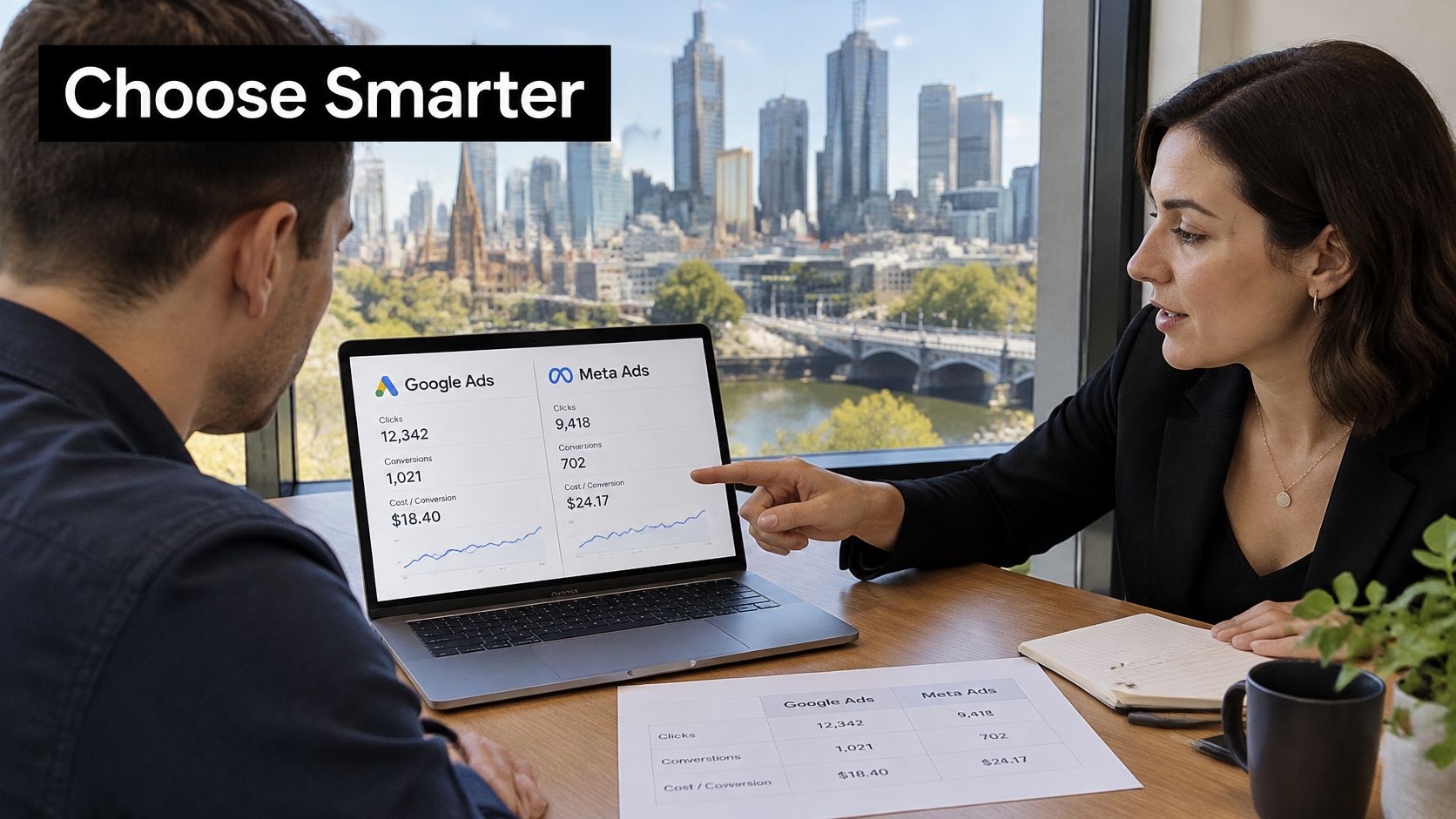
| Campaign type | Best for | Main set-up risk | First check |
|---|---|---|---|
| Google Shopping | Catalogues with a clean product feed | Weak product titles and feed errors | Feed diagnostics and disapproved items |
| Performance Max | Stores with conversion history and a strong feed | Limited control over placements | Asset groups and conversion goals |
| Search campaigns | Brand and high-intent product terms | Broad match wasted spend | Weekly search term report |
| Meta prospecting | New audiences and product launches | Creative fatigue | Results from each tested creative after a set spend |
| Meta retargeting | Visitors who viewed or added to cart | Small audience size | Audience size and frequency |
Google Shopping and Performance Max
For a beginner's guide mindset, start Google Shopping ads with feed hygiene. Put brand, product type, material, size and key use in titles in a consistent order. Fix disapprovals, price mismatches and out-of-stock landing pages first. If Shopping ads aren't spending budget, I check feed status, bids, product eligibility, campaign priority and whether a Performance Max campaign is taking the impressions.
Campaign priority in Google Ads matters when standard Shopping campaigns overlap. Set priority deliberately so a clearance, hero product or high-margin campaign isn't cannibalised by a catch-all. In PMAX vs Google Shopping ads, standard Shopping gives you more direct product and query control. Performance Max can find extra placements, but it needs conversion history, strong assets and clean goals, and it gives you less placement control. I wouldn't let it optimise to add-to-cart if purchases are what pay your bills.
If you're reviewing structure and diagnostics, this guide on how to improve ecommerce Google Ads campaigns is a practical companion. Use it to ask better questions about feeds, conversion goals and wasted queries.
Search still captures high-intent product and brand terms. Review search terms weekly, add negatives, and separate brand defence from generic prospecting so you don't mistake existing demand for growth. Dropshipping stores face the same rules, with less margin for slow delivery promises or thin product data.
Meta Prospecting and Retargeting
We offer Meta Ads agency services, and my testing process is deliberately boring. Launch three to five distinct creative concepts, not five colour variations of one idea. Give each enough spend to produce a readable cost per purchase, judge on purchases and add-to-cart quality, then iterate on the winning angle. Don't quit too early because day two looks ugly, and don't let a concept spend indefinitely because the click-through rate feels encouraging.
Connect Instagram Shop and Facebook Shop only when catalogue data, stock and pricing are reliable. Retargeting product viewers and cart abandoners can work well, but small audiences saturate quickly, so watch frequency and rotate creative.
What budget should you spend on Google Ads or Meta? I set the starting budget at the amount that can produce enough conversions to read a result against your break-even cost per purchase. The cheapest budget that buys clicks usually buys ambiguity. Remember, advertising budgets are paid separately unless otherwise agreed, and we're responsible for campaign management only, not for funding your media.
How to Decide Which Service Comes First
Sequence beats enthusiasm. If you fix things in the wrong order, you'll pay twice, once for the work and again for the bad decisions made with bad data.
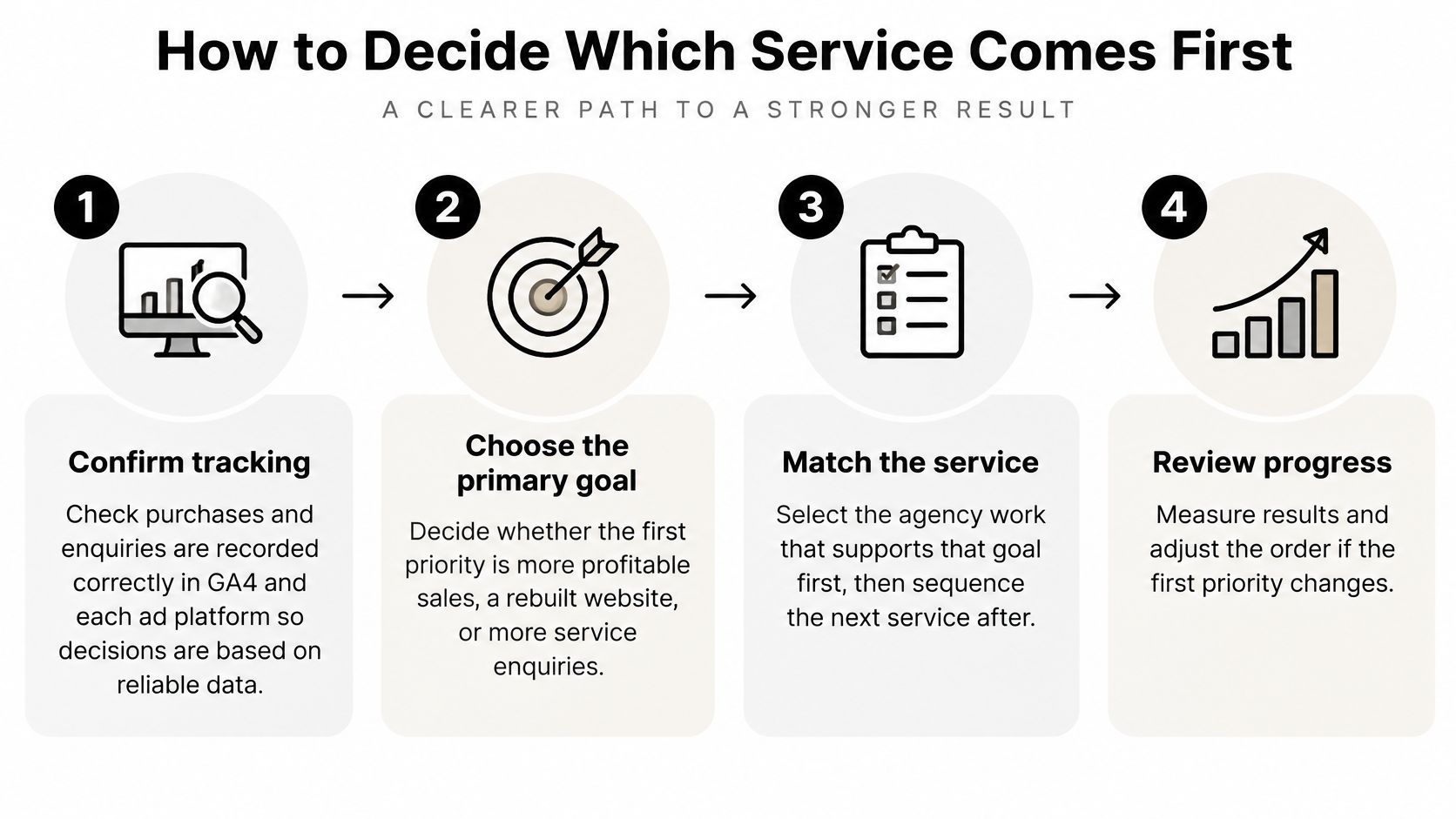
- Confirm tracking: Verify purchases and enquiries in GA4 and each ad platform, counted once, with values that reconcile to real orders. Without this, every later decision is guesswork.
- Check mobile speed and checkout: Paid traffic lands on your store, so a slow product page or broken payment option wastes the click before creative gets a chance.
- Check feed and product pages: Confirm titles, prices, stock, shipping and returns are accurate, because Shopping, Performance Max and Meta catalogue ads all depend on that data.
- Set one test budget on one channel: Choose Search or Shopping where buying intent already exists, or Meta prospecting where you need new demand. Don't launch everything and learn nothing clearly.
- Review, then scale: Scale only when cost per purchase sits below your break-even point after the learning period. If it doesn't, fix offer, page or targeting before adding budget.
The opportunity is real, but it isn't automatic. The CPA Australia small business survey summary reported 44% of Australian small businesses generated more than 10% of revenue through online channels in 2025, compared with a 63% average across the Asia-Pacific markets surveyed. I'd read that as headroom for stores that measure properly, not as permission to spend first.
The common slip looks like this in a monthly report. Google reports strong ROAS, Meta reports strong ROAS, combined claimed revenue exceeds Shopify revenue, and nobody can say which budget to cut. That's not a scaling problem. That's step one unfinished.
What a Small Business Agency Costs in Melbourne
I can't give you an honest universal price without seeing your catalogue, tracking and channels. I can show you how to compare quotes so a cheap proposal doesn't become the expensive one.
Three Fee Models You'll See
- Monthly retainer: Ongoing management, testing, reporting and small development tasks for a set monthly fee.
- Project fee: A defined Shopify or WordPress build, redesign, migration or tracking implementation with a fixed scope.
- Paid media fee: A flat monthly amount or a fee tied to managed ad spend, covering campaign builds, optimisation and reporting.
Your ad spend goes to Google and Meta separately. It isn't part of the agency fee unless a written agreement says otherwise. Ask every small business marketing agency in Melbourne to show those lines apart.
A retainer should name, in writing, the channels covered, reporting cadence, deliverables or hours, who maintains GTM and Conversions API after launch, and what happens when you need urgent store changes. Cost drivers are usually catalogue size, feed cleanup, page count, custom integrations, tracking complexity and the number of channels running at once.
Compare scope, not headline price: One proposal may cover ad setup only. Another may include tracking reconciliation and a monthly profit report. The second can cost more and still save you money if it stops one month of wasted spend.
Treat very low fees with no tracking work as a warning sign. You're not saving money if the agency optimises to duplicated purchases.
How to Choose an Agency That Fits Your Goals
Start with your goal, because the right agency depends on it. A store chasing more profitable sales needs feed, tracking and paid media discipline. A store rebuilding its site needs development judgement first. A hybrid business generating service enquiries needs call and form tracking, local SEO and a well-maintained Google Business Profile alongside the store.

Questions I'd Ask on the First Call
- Who runs my account day to day: Name the person, not just the team, and ask how often you'll speak with them.
- What will you test first: A specific feed, page, audience or creative test beats a promise to optimise everything.
- Which metric decides the first 30 days: For ecommerce, I want verified purchases, cost per purchase and revenue reconciled to orders.
- Who owns tracking after launch: Confirm you own Google Ads, GA4, GTM, Search Console and Meta assets, and that the agency has access rather than ownership.
- Can you trace one sale end to end: Ask them to show a click, the GA4 event, the platform conversion and the Shopify order for the same transaction.
Walk away from guaranteed rankings, fixed revenue or a promised ROAS. Alpha Omega Digital does not guarantee any specific marketing or business outcomes, including Google rankings, enquiries, website traffic, sales, revenue, leads, ROAS, CPA, conversion rates, social media growth, email open rates, or search engine indexing. I know that sounds less exciting than a guarantee. It's also honest, because no agency controls your pricing, stock, product quality or customer service.
That split needs to be explicit. The client remains responsible for advertising budgets, product pricing, stock availability, landing page content, sales process, and customer service. If delivery blows out or a hero product goes out of stock, that's not an ads problem, and pretending otherwise wastes everyone's time.
I work with a partnership mentality, acting like an extension of the client's team with clear communication and honest recommendations. Sometimes the honest recommendation is to do less. Pause a channel, fix margins, improve one product page, and restart with cleaner data.
Use this scorecard on any shortlist. Did they ask about margin and capacity before tactics? Did they check tracking before proposing spend? Did they tell you something uncomfortable in the first meeting? Three yes answers beat a polished pitch.
Brief Your Agency With Numbers This Week
A forty-page brief impresses nobody. Five numbers and a clear statement of what success means for your store will get you further with any agency you talk to, including us.
- Last 90 days of revenue by channel: Add average order value, conversion rate and gross margin by product category if you have it.
- Monthly ad budget you can commit: State whether agency fees sit inside that amount or separate from it. With us, ad spend is paid separately and we handle campaign management, so splitting the two up front avoids confusion later.
- Current cost per purchase or enquiry: A rough figure is fine, but say how you calculated it and whether refunds are included.
- Target break-even ROAS: Derive it from gross margin, then note any categories that need a different target.
- Stock, delivery and returns limits: Tell the agency what you can fulfil profitably, by postcode if delivery costs vary, so it doesn't chase volume you can't absorb.
Those five numbers do something a pitch deck can't. They tell an agency whether your store's profit survives the ad spend it wants you to commit, and they expose fast whether the person across the table reads a P&L or only a click report.
When you submit a project enquiry with an overview of your goals, we'll come back with clear next steps that fit your budget, timeline, and growth target. We're based at Suite 1650, 470 St Kilda Road, Melbourne VIC 3004, Australia, and work with Australian businesses that want their website, ad accounts and sales records pointing at the same profit figure.
Send the numbers before the first call. That way the call is spent on decisions, not data hunting.
Consistency is the unglamorous part. One clean test, one honest report and one fix at a time will teach you more than launching every channel at once.
If your store needs a digital marketing agency in Melbourne that connects Shopify or WordPress development, Google Ads, Meta ads and tracking to profit you can reconcile, talk to Alpha Omega Digital. Send your last 90 days of revenue, margin, current cost per purchase, monthly budget and fulfilment limits through the enquiry form, and we'll come back with clear next steps that fit your budget, timeline and growth target.
Alpha Omega Digital
Read more insights from our team on web design, paid ads, and growth strategy.