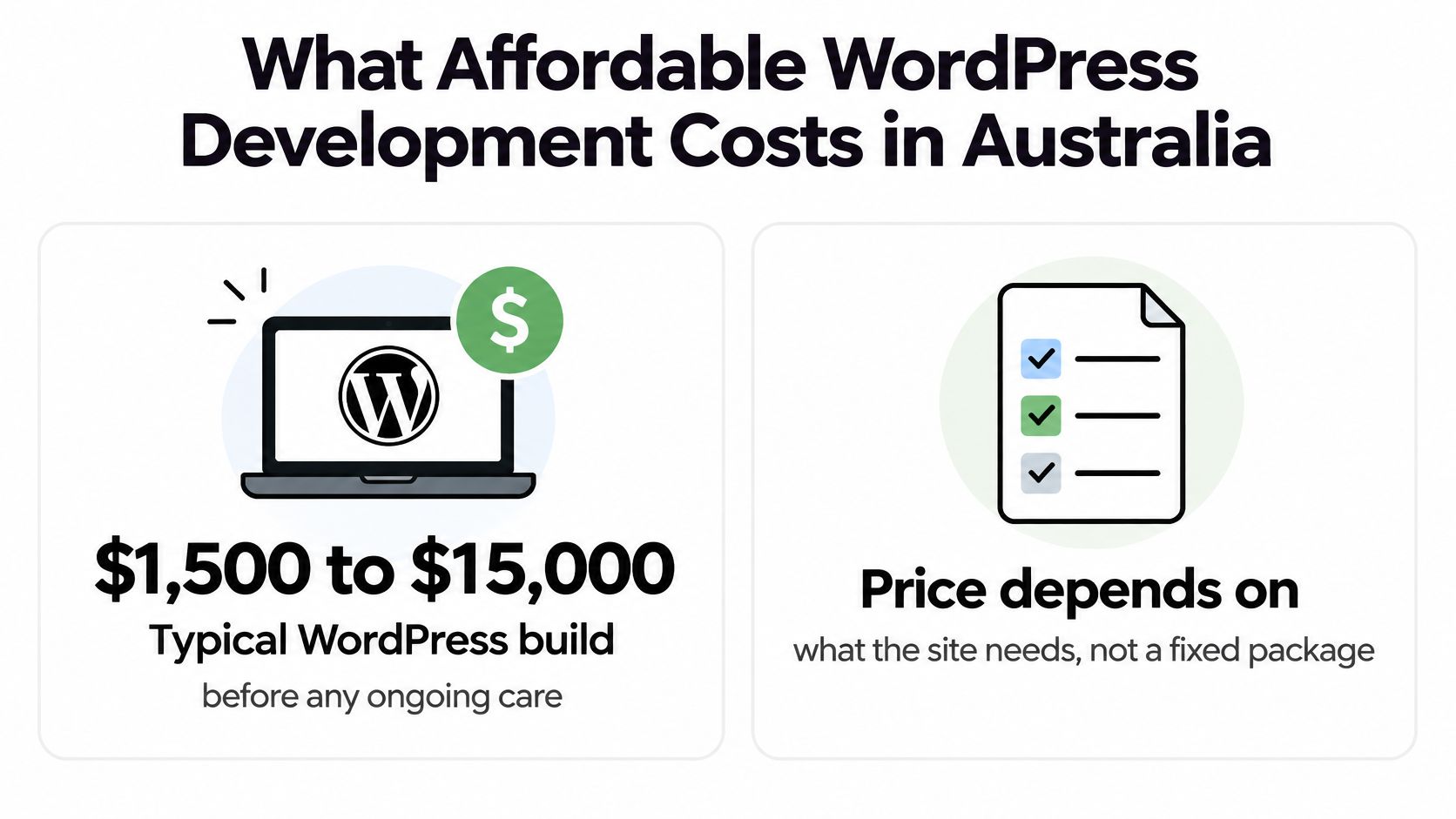
For a small business WordPress site, treat A$1,500 to A$15,000 as a hypothetical planning envelope, not a verified Australian market rate, with hosting, licences and ongoing care budgeted separately. Affordable WordPress development means choosing a scope you can maintain, rather than buying the cheapest launch.
That distinction matters when your website takes orders. The Australian Cyber Security Centre's annual cyber threat report reports average self-reported cybercrime costs of $55,400 for small businesses and $141,300 for medium businesses. Those aren't WordPress-specific losses, but they're a strong reason to judge a website by its operating risks, not just its invoice.
I would protect checkout, recovery and mobile usability before spending on elaborate design. A modest website that customers can use and your team can manage is a better investment than a custom build that nobody can safely update.
What Affordable WordPress Development Costs in Australia
More than 91% of Australian businesses said their internet connection met most or all of their needs in 2024–25, while 50.7% had their own website or app in 2021–22, according to the Australian Bureau of Statistics. Internet access and owning a commercial website are different things, measured in different periods.
There is no defensible universal build price without a written scope. Copywriting, photography, product information, migration and integrations can change the work substantially. A short store with complicated shipping can require more development than a larger informational website. Judge affordability by total cost of ownership: the build invoice plus the recurring spend, and what a failed restore or a slow mobile page costs in lost enquiries.
Match the tier to the work
A starter website uses established layouts and a straightforward enquiry path. Custom sections introduce reusable components, while lead-generation projects require more attention to attribution and enquiry handling.
WooCommerce adds transactional testing. Memberships, booking engines and custom plugins introduce account permissions, business rules and more complicated recovery requirements.
Typical scope and monthly care by project tier
| Project tier | Typical scope | Monthly care (AUD) |
|---|---|---|
| Starter brochure site | Licensed template, core business pages, contact form and basic SEO | A$50–A$150 |
| Business site with custom sections | Custom blocks, expanded content, analytics and tag setup | A$150–A$400 |
| Lead generation site | Service-area pages, enquiry and call tracking, CRM connections | A$250–A$600 |
| Small WooCommerce store | Product catalogue, payment gateway and shipping rules | A$300–A$800 |
| Complex custom build | Memberships, booking engine, custom plugin or multisite | A$500–A$1,500 |
At each tier the recurring amount should buy defined work: updates and backup checks at the starter end, form testing, tracking checks and enquiry-delivery testing in the middle, and checkout testing plus transactional monitoring for stores. A complex build needs its monthly figure priced against documented integrations and recovery requirements. Ask what the number covers before comparing it.
What makes a quote useful
Affordability concerns aren't new. In 2013–14, 27% of businesses with 20–199 employees identified website setup costs as too high, according to the ABS characteristics of Australian business release.
I would choose a fixed-scope proposal over an attractive hourly rate with no deliverables. The cheapest quote is a risk decision: it usually means backups, recovery testing and mobile performance were priced at zero rather than included. Before approaching a WordPress development company, answer:
- Commercial purpose: Must the website generate enquiries, take payments or manage bookings?
- Layout requirements: Which pages need their own design?
- Operational connections: What must connect to stock, fulfilment, email or your CRM?
Those answers place a project in a useful tier. Page count alone doesn't.
DIY Builders, Freelancers or an Agency
The right builder depends on who will operate the website after launch. DIY, freelance and agency routes can all work, but they leave different responsibilities with you.
DIY gives you control and another job
A DIY WordPress design can suit a straightforward business website when you're comfortable learning the editor. You'll still need to select hosting, manage licences, prepare content and investigate problems.
Rankozo's comparison of website builder costs and features is a useful starting point for comparing platform inclusions. Check current provider pricing before committing, particularly for ecommerce, scheduling and integrations.
Choose a template for its structure, not its demonstration photography. Replacing a polished demo with inconsistent product images often exposes how much design work remains.
Freelancers and agencies solve different constraints
A freelancer can offer excellent value when the brief is tightly defined. Direct access to the person doing the work can also make decisions simpler.
The vulnerability is continuity. Establish who can access the code, where documentation lives and what happens when the developer is unavailable.
An agency may allocate separate people to design, development and testing, but the word agency doesn't guarantee those activities are included. Compare deliverables rather than labels, whether you're searching for a WordPress developer in Melbourne or a WordPress developer in Sydney.
| Route | Best fit | Responsibility to clarify |
|---|---|---|
| DIY | Established layouts and an owner willing to maintain them | Troubleshooting and recovery |
| Freelancer | Defined functionality with direct collaboration | Cover during absence and handover |
| Agency | Coordinated design, implementation and ongoing operation | Actual testing and support inclusions |
If you can't restore the website yourself, budget for someone who can demonstrate the process.
I wouldn't choose a marketing agency Melbourne businesses rely on purely because it combines websites and advertising. I'd choose the team that can explain what happens when a customer can't complete an order, who investigates and how the store returns to service.
Scope, Features and Mobile Speed That Move the Price
The hourly rate matters less than what you ask it to build. Build approach, functionality and integrations carry most of the invoice, and a cheap quote on an oversized specification ends up costing more than a fair quote on a tight one.
A useful design review puts customer tasks beside the proposed layouts.

Templates, Gutenberg blocks and bespoke development
A premium theme makes sense when its product and content layouts already match your needs. Configure its typography, spacing and colours rather than rebuilding every component to resemble another website.
Custom Gutenberg blocks make sense when editors repeatedly publish a particular type of content. A reusable specification panel, product comparison or buying guide gives staff useful controls without exposing the entire layout.
Custom blocks repay their build cost through repeated use: consistent presentation and fewer awkward editing workarounds. Built once and used twice, they are an expensive way to draw a box.
A bespoke theme earns its budget when established templates obstruct important buying journeys. When the difference is mostly decorative, it rarely does.
| Feature | Build cost impact | Ongoing cost impact | Skip it when |
|---|---|---|---|
| Custom Gutenberg blocks | Medium | Low | Standard layouts already cover your key pages |
| WooCommerce store | High | Medium | You only need enquiries or a catalogue without checkout |
| Booking or calendar integration | Medium | Medium | Phone or email suits your sales process |
| Membership or login area | High | High | Your content is public |
| Multilingual setup | Medium | Medium | Every customer searches and buys in English |
| Advanced search or filters | Medium | Low | Your catalogue has a small number of products |
These impact labels describe relative implementation effort rather than dollar estimates. An integration with poor documentation can require more work than its visible interface suggests.
Make each integration earn its place
Start with the catalogue, payment processing, shipping, product information and conversion measurement. Add automation when you can name the manual task it replaces.
A Shopify API connection or WooCommerce integration needs more than a successful demonstration. Define which system owns stock, how failed requests are retried and what happens when an order changes after synchronisation.
Shopify development and Shopify design deserve consideration when retail operations are the main requirement. Building custom Shopify apps using Shopify CLI introduces application maintenance, permissions and deployment responsibilities that outlive the launch invoice.
Plugin count alone isn't a quality score. Review what each plugin does, whether another component duplicates it, how it loads assets and who maintains it. A feature that trims the build price but leaves you dependent on a tool nobody can back up or restore is deferred cost.
Treat purchasing functionality as core infrastructure, in the same class of decision as hosting and recovery. The checkout is the part of the website that earns money, so it deserves the same scrutiny as the part that saves it.
Scope rule: Write down the outcomes the website must deliver, then remove features that don't support them.
The video below works through the same build-approach trade-offs.
What a budget build should deliver on mobile
In a 2026 analysis of 50 Australian-facing ecommerce websites, only 16% passed all three mobile Core Web Vitals, according to Marketix Digital's ecommerce performance report. That sample isn't the whole Australian market, but it gives buyers a concrete reason to request mobile testing.
Don't accept a universal performance guarantee without agreed pages, devices and test conditions. Require a testable standard, a baseline and a clear process for fixing failures.
Avoid oversized hero images, overlapping page-builder extensions and third-party scripts loaded where they aren't needed. Use appropriately sized WebP or AVIF images, reserve image dimensions and delay scripts that can wait without breaking consent controls or checkout.
Use this acceptance sequence:
- Test actual devices. Open important pages on a mid-range Android and an iPhone over a mobile connection. Desktop previews won't reveal every interaction delay.
- Check forms and controls. Test touch targets, keyboard selection, autofill and readable error messages. Customers shouldn't lose entered information after a validation error.
- Complete the journey. Purchase a product or submit an enquiry from start to finish, including payment redirects and confirmation emails.
- Verify measurement. Confirm product views, basket additions, checkout starts and purchases reach the intended analytics tools without duplicate transactions.
- Record the baseline. Save load and interaction results before and after deployment so later changes can be evaluated.
Advertising readiness without unnecessary scripts
Setting up Google Tag Manager containers should include named ownership, documented tags and a published version history. GTM and Google Analytics should record completed actions; a button click on its own is not revenue.
For Conversions API installation for Meta, check consent handling and event deduplication between browser and server events. Setting up Meta Conversions API doesn't remove privacy obligations or fix poor campaign strategy.
A beginner's guide to Google Shopping ads should start with accurate product feeds and purchase tracking. Before comparing PMAX versus Google Shopping ads, resolve product eligibility and conversion values.
If Google Shopping ads aren't spending budget, inspect Merchant Center diagnostics, targeting, bids and product coverage before blaming WordPress. Campaign priority in Google Ads isn't a universal fix, and Google Shopping ads for dropshipping still require accurate availability and delivery information.
Finally, configure server caching to exclude cart, checkout and account sessions. Test personalised content explicitly so cached pages don't expose another customer's information.
Three Melbourne Budgets Worked Through
These are hypothetical project scenarios, not completed client projects or quoted market prices. Their budgets illustrate how scope choices work; actual proposals need content, technical and integration requirements.
A Brunswick café with a limited launch
Say a Brunswick café sets an illustrative build budget of A$2,500 to A$4,500, plus A$80 monthly for an agreed hosting-and-care arrangement. The owner needs editable menus, opening hours, a map and a basic booking enquiry form.
I would keep the menu in accessible page content rather than making customers download a document. I'd cut the animated introduction and defer a live availability engine.
The upgrade trigger is operational: staff begin spending enough time confirming bookings that a calendar connection would remove a meaningful workload. The café should agree on that threshold before buying the integration.
A Dandenong plumber buying qualified enquiries
Consider an illustrative A$5,000 to A$9,000 lead-generation budget for a plumbing business. The scope includes useful suburb pages, click-to-call controls and an emergency enquiry form.
The owner cuts decorative animation and postpones dynamic number insertion. A rise in qualified suburb-page enquiries would justify connecting call attribution more closely to campaigns.
For the separate organic-search allocation, SEO 2 RANK's SEO budgeting guide for tradies offers context for distinguishing website work from ongoing search activity.
PPC for tradies needs qualified-call measurement, not just click reports. Google Ads for service-based businesses and Google Ads for contact form submissions should distinguish genuine enquiries from spam and accidental interactions.
A homewares retailer protecting fulfilment
Say a homewares retailer plans A$8,000 to A$14,000 for an illustrative WooCommerce build with 80 products. Shipping rules, clear product dimensions and reliable checkout take priority.
The retailer postpones advanced filtering and another payment method. A sustained order target, combined with customer requests for that payment option, provides a better trigger than adding it because a competitor has it.
| Scenario | Cut at launch | Deferred feature | Upgrade trigger |
|---|---|---|---|
| Café | Animated introduction | Live booking availability | Booking administration becomes burdensome |
| Plumber | Decorative motion | Dynamic call attribution | Qualified suburb enquiries increase |
| Homewares retailer | Complex filtering | Additional payment method | Sustained orders and demonstrated demand |
The reusable lesson is to set the trigger before commissioning the feature. That keeps later spending tied to an actual operational need.
Ongoing Costs, Provider Terms and How to Compare Quotes
A low development invoice can exclude much of what makes a store usable after handover. Content changes, transactional email, licence renewals, recovery work and advertising measurement need someone responsible for them.
Total cost of ownership includes the build, recurring services and the work required to keep the website commercially useful. It should also account for migration or exit costs if you change providers.
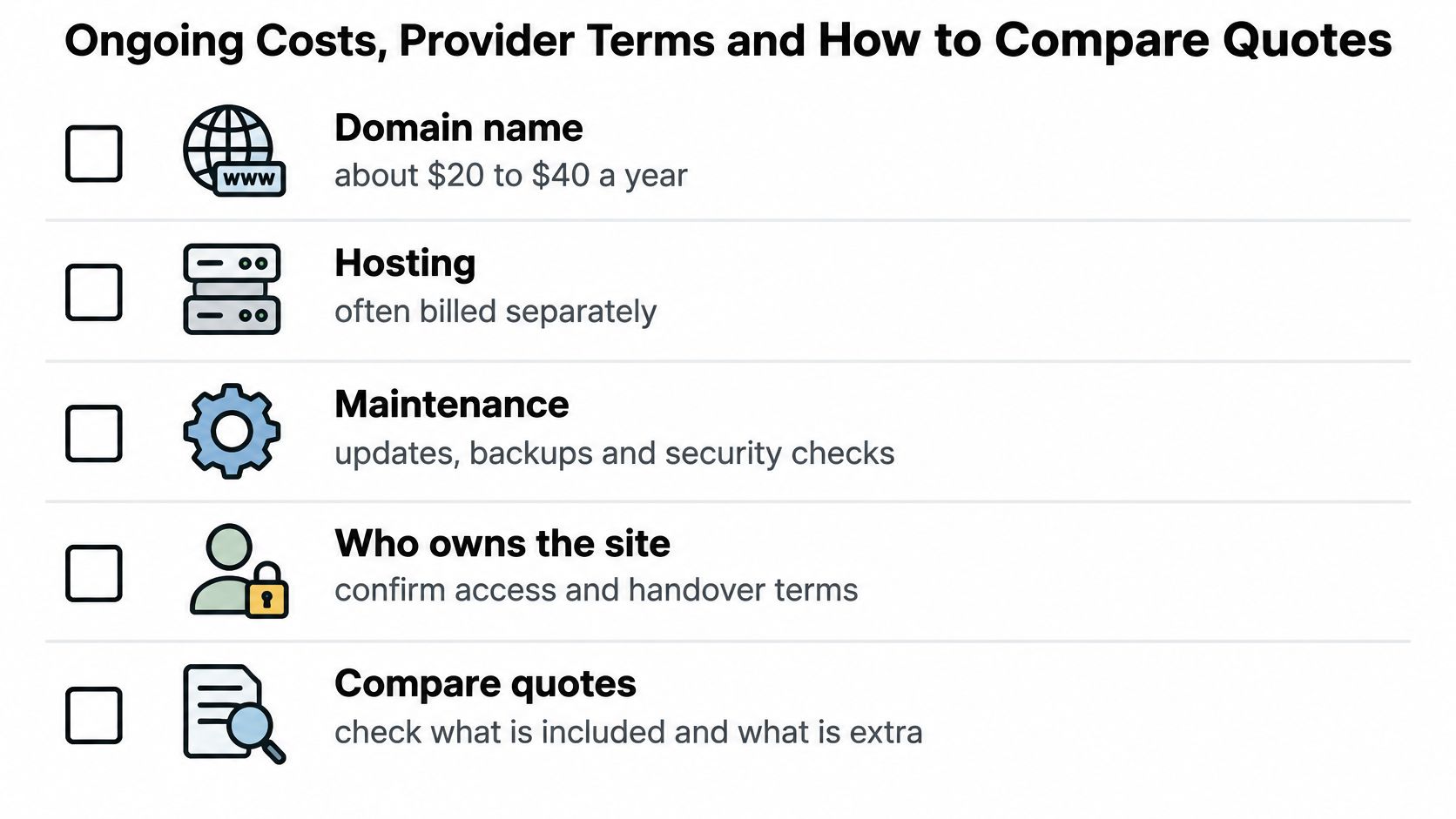
Use this checklist as a prompt, then obtain current prices against your own requirements.
Separate supplier bills from development work
Domain registration is a renewable right to use a name, not an outright purchase forever. Keep the registration account under your business's control and nominate someone to monitor renewal notices.
Likewise, a backup isn't useful because a hosting dashboard displays a successful status. Confirm what's backed up, where copies are stored and whether someone has tested restoration.
| Recurring item | Who should control it | What to establish |
|---|---|---|
| Domain name | Your business | Renewal responsibility and account access |
| Managed hosting | Your business or documented managed arrangement | Resources, staging and support boundaries |
| Premium plugins | Named licence holder | Renewals and consequences of cancellation |
| Transactional email | Your business | Delivery monitoring and sending limits |
| SSL certificate | Named account holder | Whether hosting includes renewal |
| Backup storage | Documented service owner | Retention, isolation and restoration |
| Payment gateway | Your business | Transaction fees, settlement and disputes |
| API services | Your business | Usage billing and spending controls |
At Alpha Omega Digital, clients are responsible for third-party expenses, including domain names, hosting, premium plugins, software licences, Shopify fees, advertising spend, email services, cloud infrastructure, SSL certificates and API usage charges. Those costs need their own budget rather than being assumed part of development.
Read the revision and acceptance terms
Before comparing totals, put the commercial questions in order:
- Ownership and access. Establish who controls the domain, hosting, source files and administrative accounts.
- Revision boundaries. Define a minor revision and distinguish it from a new layout, integration or business rule.
- Payment timing. Record the deposit, milestones and final payment requirements.
- Acceptance. Agree on the tests and review period that determine delivery.
- Breakage response. Record the response target when an update interrupts checkout or forms, along with escalation and recovery responsibilities.
Our minor revisions are included during development unless the proposal states otherwise. Additional revisions outside the agreed scope are charged at the current hourly rate.
A deposit may be required before commencement, and milestone payments may apply to larger projects. Final payment is required before launch or ownership transfer unless otherwise agreed.
Our website acceptance terms cover approval, going live or receiving no revision request within 14 days of delivery. Changes after acceptance may be treated as new work, and ownership of project assets remains with us until payment is received.
A response-time promise isn't a recovery-time promise. Establish when someone starts investigating and what restoration target they're working towards.
Compare the same deliverables
Put competing proposals beside each other and mark each item included, excluded or awaiting clarification. Don't assume an omission means the provider has allowed for it.
Quote comparison checklist
| Quote item | What to check |
|---|---|
| Fixed scope and feature list | Written page and feature list, not just an hourly estimate |
| Named third-party costs | Domain, hosting, plugin licences and payment fees itemised |
| Minor revisions | Number included and what counts as minor |
| Hourly rate for extra work | Stated rate for changes outside scope |
| Deposit and milestones | Amount and due dates for each payment |
| Acceptance window | Days allowed to request revisions after delivery |
| Domain and hosting ownership | Client access, source files and transfer conditions |
| Breakage response time | Stated target for updates that break checkout or forms |
Include recovery in the comparison. Specify off-site copies, restricted administrator access, update testing and a restoration procedure that preserves recent orders wherever possible.
Keep marketing and automation costs visible
A Facebook ads agency should explain its creative testing process and how it measures success beyond platform-reported purchases. Consistent marketing means testing offers and creative systematically, not leaving unsuccessful ads untouched indefinitely.
Instagram Shop and Facebook Shop introduce catalogue administration too. Local SEO and Google Business Profile, formerly Google My Business, require accurate information rather than duplicated suburb content or ranking promises from an SEO agency Melbourne businesses find online.
For call-led campaigns, compare CallRail, GoHighLevel and Twilio against attribution, routing and CRM requirements rather than declaring one universally best. A proposed Twilio custom-number workflow can include automated answering and calendar or Calendly booking, but appointment rules, human escalation and failure handling need testing before launch.
Automated answering can cover after-hours calls without staff fatigue. It shouldn't be presented as guaranteed savings for tradies, hairdressers, beauty therapists, dentists, restaurants or doctors, and clinical or emergency enquiries need appropriate human escalation.
Before trusting any provider's reputation, review relevant ecommerce examples. Inspect product pages, mobile checkout, editing controls and the practical handover, not just homepage screenshots.
Confirm the Budget Before You Sign
Set your operating budget before requesting a design proposal. Otherwise, you can approve a build that fits the launch allowance but leaves no money for the services needed to run it: hosting, licences, backups, recovery and the ongoing work that keeps mobile performance from sliding after launch.
The useful comparison isn't WordPress versus Shopify, freelancer versus agency or template versus custom. It's what your business can launch, operate and improve without losing control of costs.
Send an enquiry that supports a fixed scope
Copy this line into your project enquiry:
Build tier: [required scope]. Annual third-party costs: [confirmed supplier total]. Monthly care: [agreed work and allowance].
Include your goals, budget and timeline, plus your catalogue, shipping requirements and existing integrations. Name who will supply copy and imagery, and who has authority to approve the work. Treat content delivery as part of your side of the contract, because agencies commonly require accurate information, prompt content, milestone approvals and secure handling of login credentials. Stating those commitments upfront is what turns a rough estimate into a fixed scope.
Our project enquiry process returns clear next steps aligned with your budget, timeline and growth target. Alpha Omega Digital is a Melbourne-based agency working with Australian businesses.
Agree on approvals and the next investment
Keep design feedback in one place and nominate a final approver. PinDrop's guidance on how to streamline client design approvals provides a practical reference for consolidating comments and recording sign-off.
Read the payment and acceptance terms before signing, not after. Minor revisions are normally included during development, work outside the agreed scope bills at the hourly rate, and a deposit or milestone payments can apply to larger builds. Final payment generally falls due before launch or transfer of ownership, and a site counts as accepted once you approve it, it goes live, or no revision request arrives within a set window after delivery. Monthly services are billed in advance.
Request a fixed-scope quote detailing the feature list, third-party expenses, revision rules, payment schedule, acceptance, ownership, and breakage response. Bring your commercial priorities so recommendations can be divided into work that must happen now and improvements that can wait. After launch, measure completed sales, qualified enquiries, and operational workload before deciding what to add.
I would make the next feature earn its place through evidence. A documented customer problem is a stronger reason to invest than an unused plugin licence or an attractive demonstration.
Alpha Omega Digital offers affordable WordPress development built around clear scope, maintainability and commercial goals. Send a project enquiry through our contact page and book a free 45-minute strategy session, where we review your current site and show exactly what we would fix, then come back with a fixed-scope proposal. You can also visit Alpha Omega Digital to discuss your project directly.
Alpha Omega Digital
Read more insights from our team on web design, paid ads, and growth strategy.