You're three months into running Meta ads yourself, or you've just taken over an account someone else built, and the numbers don't reconcile. Ads Manager reports a 5x return. Your bank account reports a flat quarter. Somewhere between those two statements sits a gap that no dashboard explains, and a Melbourne agency has just quoted you a retainer without saying which of the two numbers they'd be managing.
The gap is rarely the ads. It's that the account was built to produce cheap conversions rather than profitable customers, and nobody set up tracking that can tell the difference between a $35 enquiry that never answers the phone and a $60 enquiry that books a $4,000 job. What follows is how I'd structure a Facebook marketing agency engagement for a Melbourne ecommerce or service business, what should happen in the first 30 days, and the numbers I'd hold any agency to at the end of it.
What a Facebook Marketing Agency Delivers
Most proposals from a Facebook marketing agency read the same: a page of services, a page of logos, a monthly retainer, and a promise to drive results. The useful question is narrower: Which parts of the work change revenue at your business, and who does them?
Six services make up the bulk of every engagement worth paying for, and each one only earns its fee in the right kind of business.
Core services in a Facebook marketing agency engagement
| Service | What it includes | Best fit |
|---|---|---|
| Audience research | Prospecting, lookalike and retargeting audiences built from site and customer data | Ecommerce stores with customer lists |
| Creative production | Static and short vertical video ads, with copy and offers matched to funnel stage | Brands testing new offers |
| Campaign setup | Business Manager, Meta Pixel and Conversions API configuration | Any account starting from scratch |
| Landing pages | Dedicated pages or product pages matched to each ad set | Campaigns sending paid traffic to a generic homepage |
| Reporting | Weekly spend and cost per result, with a monthly profit view | Owners who want more than platform screenshots |
| Lead follow-up | CRM handoff and response-time tracking | Service businesses taking phone and form enquiries |
Audience research decides how much of your budget reaches people who've never heard of you versus people who abandoned a cart last Tuesday. Campaign setup carries the technical risk: Business Manager structure, the Meta Pixel firing on the right events, and the Conversions API passing server-side events so a browser that blocks tracking doesn't erase half your purchase data.
Landing pages are the row most owners skim and most agencies under-scope. A tight ad set pointed at a homepage with six navigation links wastes the click. Reporting and lead follow-up are where retainers stop being accountable, because a report showing spend and cost per result but not gross profit is a delivery update, not an accountability document.
Alpha Omega Digital provides Meta ads agency services alongside Google Ads, SEO, Shopify and WordPress development, which matters for one reason. Most Meta campaigns underperform on the page they land on or in the inbox they land in, not inside Ads Manager.
Australian adoption is settled. An Australian Competition and Consumer Commission report, cited in DataReportal's Digital 2026 Australia report, found that 70% of small and medium-sized enterprises in a 2023 survey of 250 business owners said they used Facebook, with Instagram at 52%. Merely having a page sets nobody apart. The work that moves revenue is targeting, creative testing, lead quality and attribution.
Three things belong in writing before anyone touches your account:
- A named account lead, with the hours per week that person gives your account.
- A reporting cadence, including what gets reported and on which day.
- Ownership of the Business Manager and pixel, which should sit with you, not the agency.
The table above describes scope, not pricing. Fees and ad budgets swing with catalogue size, order volume and how far your service area reaches, and any agency quoting one flat number before seeing your account is guessing.
Audience Reach and Campaign Structure for Melbourne Businesses
Reach first, structure second. Meta's ad planning tools estimated 17.2 million Facebook users in Australia in early 2025, equal to 81.5% of adults aged 18 and over, according to DataReportal's Digital 2025 Australia report. Those are planning estimates rather than active-user counts, so use them to size an opportunity, not to forecast results.
That reach supports a three-layer structure in almost every account I'd build:
- Broad prospecting with minimal interest stacking, letting Meta's delivery system find buyers. This layer usually takes the largest share because it's where new customers come from.
- Retargeting on product views, add-to-carts and service-page visits inside a 30-day window, which keeps the message relevant without paying to follow people around for months.
- Existing-customer lists uploaded from your CRM or Shopify for repeat purchase, reactivation and exclusion from prospecting so you stop paying to reacquire people who already bought.
Take a Melbourne ecommerce store spending $3,000 a month. I'd start at $1,800 on prospecting, $750 on retargeting and $450 on testing new creative, then review the split after 30 days of delivery data. The testing slice isn't optional spending. It's how the other two layers stay fresh.
A service business runs the same three layers with different mechanics. A plumber or a dental clinic replaces product feeds with suburb-level targeting inside the drive radius, a lead form for quote requests and a click-to-call button on mobile. The retargeting layer covers people who visited the services page or started a form, and the customer list becomes past clients due for a service.
The most common structural mistake isn't too broad an audience. It's an audience so narrow that Meta can't spend the budget you gave it, which pushes cost per result up and makes a decent campaign look broken.
Household and community influence matter too. A parent researching a dentist chooses for a family, a tradesperson gets referred by a neighbour, and an audience of "women 25-34 who like three specific pages" misses all of it. Wide targeting plus specific creative beats narrow targeting plus generic creative nearly every time. Draft your own version with one line per layer naming the audience, the objective and the budget share, and you'll spot the gaps before you spend a dollar.
If you sell products, the split is the sort of thing an ecommerce marketing agency should be able to sketch on one page before the first ad goes live.
Measuring Profitable Growth Rather Than Cheap Leads
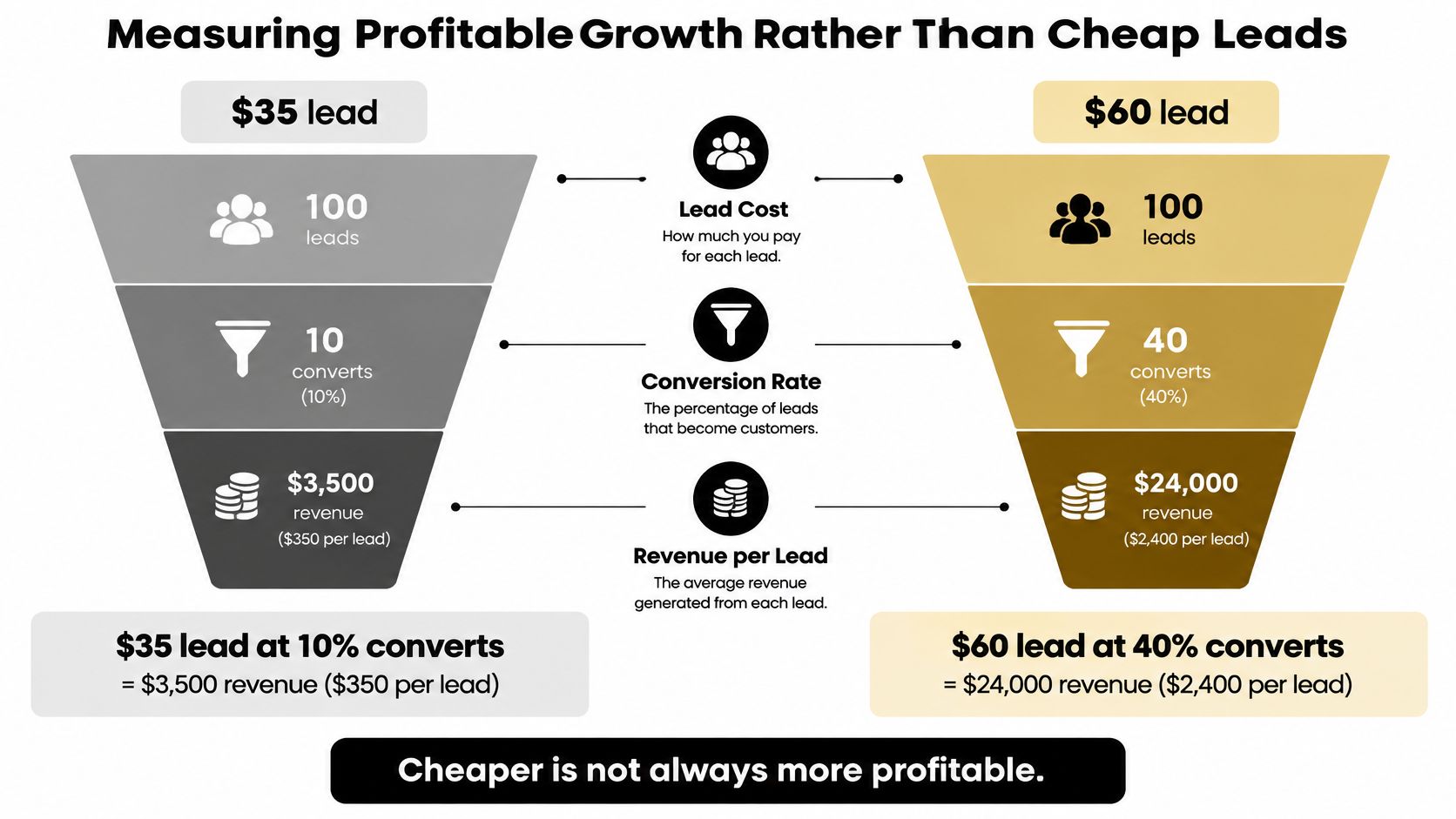
A $35 lead that closes once in ten feels cheaper than a $60 lead that closes four times in ten. At a $3,500 average job, the cheaper enquiry generates $350 in expected revenue per lead while the dearer one generates $1,400. Put it as cost per sale and the gap sharpens: $350 of ad spend per closed job against $150. The expensive lead is the bargain, and cost per lead alone will never tell you that.
Platform metrics answer delivery questions. They don't answer commercial ones, and confusing the two is how businesses end up optimising toward their worst customers.
| Metric | Question it answers | What it can't tell you |
|---|---|---|
| CPM | What it costs to be seen | Whether the right people saw it |
| CTR | Whether the hook earns a click | Whether the click becomes a customer |
| Platform ROAS | Attributed revenue per dollar spent | Whether that revenue would have happened anyway |
| Cost per lead | The price of a form fill | Lead quality, booked rate or margin |
Social commerce is already material in Australia, not theoretical. PayPal's 2025 Australian ecommerce index reported that 30% of Australians had purchased through social media in the previous six months, that Facebook was the most-used platform among social shoppers at 50%, and that social sales made up 37% of total sales for the businesses selling that way.
Practical rule: judge every campaign on cost per qualified lead, booked-job rate and gross-profit customer acquisition cost. Everything else is a delivery diagnostic.
Connecting a Facebook click to a bank deposit takes five mechanisms, and most accounts use one. Use unique promo codes per channel so redemption traces back to the source. Give each campaign a dedicated landing page rather than the homepage. Put a tracking number on phone enquiries so calls appear in reporting at all. Upload CRM outcomes as offline conversions so Meta optimises toward closed deals instead of form fills. Run a geo holdout, turning ads off in one postcode group for a few weeks, to check whether anything would have happened without you.
Our default measurement stack is Google Tag Manager, Google Analytics, Meta Pixel and the Conversions API, with matching event IDs so the same purchase isn't counted twice. From that, a five-line monthly report beats a 20-page deck:
- Spend by layer (prospecting, retargeting, testing).
- Platform-attributed revenue and the orders behind it.
- Gross profit after product cost, shipping and GST, not revenue.
- Cost per qualified lead or booked job, reconciled against the CRM.
- Payback period on new-customer acquisition.
None of those five lines appears in Ads Manager. All of them fit on one page, and they're the difference between an account that reports activity and one that reports profit per customer.
Creative Testing That Finds Your Winning Ad
Creative is the lever that still moves a Meta account, now that audience targeting does less of the work. Testing it properly is a process, not a burst of inspiration in Canva on a Friday afternoon.
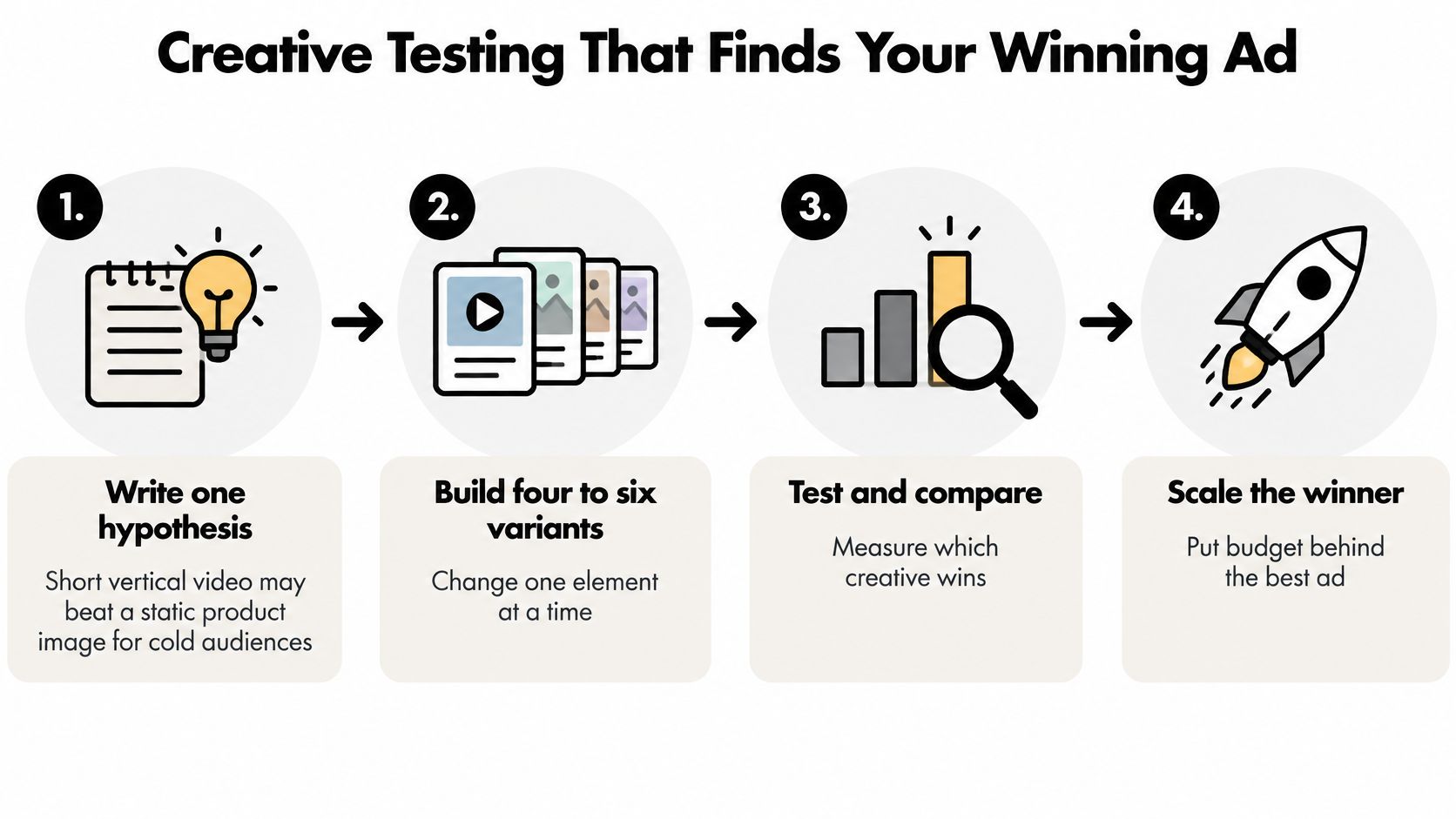
- Write one hypothesis. Example: short vertical video will beat a static product image for cold audiences on the same budget. One sentence, one variable, a guess you can be wrong about.
- Build four to six variants that change one element at a time. If you change the hook, the offer and the format together, you'll learn nothing about which one worked.
- Hold everything else constant. Same audience, same budget, same landing page, same attribution window. A test with a different landing page on each variant is two tests wearing one coat.
- Run long enough to gather real delivery. Judging a variant after a day of 40 impressions produces noise, not a winner.
- Read the early diagnostics first. Three-second views and thumb-stop rate tell you whether the first moment earns attention. They don't tell you whether the ad sells anything.
- Judge the winner on landing-page view rate, qualified-lead rate and purchase conversion. Then decide what gets scaled and what gets retired.
The reason this deserves budget is where Australian ad money is going. IAB Australia's FY2025 online advertising figures put the market at $17.2 billion, with video at 29% of total online advertising expenditure and video on social platforms growing 36.7% year on year to $1.9 billion.
Creative test matrix: what to vary and what to read
| Variable | Example variants | Early diagnostic |
|---|---|---|
| First two seconds | Product shot, creator face, text overlay | Three-second view rate |
| Value proposition | Free delivery, 30-day returns, price drop | Landing-page view rate |
| Proof element | Review quote, before-and-after, stock count | Qualified-lead rate |
| Call to action | Shop now, get a quote, book a call | Purchase conversion rate |
Short vertical video suits top-of-funnel discovery, where the job is to interrupt someone who wasn't shopping. Static images still win on clearance offers with a hard price, because the message is the price and nothing else needs to happen first.
Fatigue shows up as frequency climbing while click-through rate falls, usually two to three weeks into a strong ad's life. When you see it, refresh the first two seconds rather than rebuilding the whole campaign. If video volume is your bottleneck, tools that help you create videos with AI make a five-variant test practical for a small team. Start this week with three variants, a fixed budget per variant and a stop date written in your calendar before the test goes live.
What Good Results Look Like for Melbourne Brands
The pattern is consistent. A campaign underperforms, the owner assumes the ads are weak, and the actual fix sits in the product feed or the checkout.

Take a Melbourne fashion label as a scenario. Broad prospecting finds new shoppers at a workable cost per add-to-cart, retargeting catches people who viewed a dress and left, and nothing converts. The turnaround usually comes from unglamorous work: product feed titles that match how people search, a mobile checkout that stops dropping customers at the payment step, and shipping information visible before the cart.
That's because discovery, trust, assisted conversion and checkout are four different jobs. The first click is rarely the sale, and a report crediting only the last click will misjudge every channel you run.
A Melbourne electrician tells a different story. Success there isn't a cheap form fill, it's a booked callout with a confirmed suburb and a phone number that answers. Lead forms with a call-tracking number and a fast first response outperform clever copy, because the customer with a dead power point rings three electricians and books whoever picks up.
The commercial context explains why this matters. Sprout Social's analysis of Australian social commerce data notes 20.9 million active social-media users in 2025, with more than 58% using social media to research brands or products, and 40% of microbusinesses selling through social media against 32% of businesses overall.
Alpha Omega Digital's selected client work includes Natural Comfort Bedding at 5x ROAS, Sensory Poodle at 4.8x, and Roshe Gallery and St Mary's House of Welcome at 3x each. Read those as client-reported results shaped by each business's margin, stock and offer, not as a forecast for yours.
Kheong Yap of Natural Comfort Bedding described the effect in his own words: "We've been using Alpha Omega Digital for years doing our Facebook and Google ads marketing, and our business has grown in revenue to numbers we used to see back when we had 3 locations. To do these numbers from one location is excellent. Highly recommend."
Before blaming the ads, check readiness. Stock levels that match promised delivery times. Shipping costs shown before checkout. A mobile checkout that completes on a 4G connection in a car park. Consent settings that don't block your own tracking. And a response time measured in minutes, because an enquiry answered two days later was answered after the customer chose someone else.
Choosing and Booking a Facebook Marketing Agency
The first call tells you most of what you need. A serious agency can name who runs the account, say what they would test first, and explain how they will judge the work at day 30. A confident agency talks in broad outcomes and hopes the proposal deck carries the rest.
Ask early, while the answers are still cheap. A senior name on the pitch with a junior doing the work is the common disappointment in this category, and it is easier to detect in a short call than after launch.
Fees, budgets and who pays Meta
Unless agreed otherwise, your ad budget is paid to Meta separately from the agency fee, and the agency handles campaign management only. Put that in the contract so a mid-month card decline does not pause delivery while two businesses assume the other topped it up. The fee itself usually takes one of three shapes:
- Monthly retainer, fixed regardless of spend. Predictable, and it suits steadier accounts where the workload does not swing wildly month to month.
- Percentage of ad spend. It aligns the agency with growth, but it also rewards higher spend, so ask what work increases when the budget increases.
- Project fee, used for a rebuild, a tracking implementation or a launch campaign with a defined end date.
What matters is that you know which model you are on and what happens to the fee if your budget doubles.
Ownership is the next checkpoint. The Business Manager, pixel, ad account and Page should sit in your name, with the agency added as a partner. If an agency will not grant that, you are renting access to your own customer data.
Treat promised ROAS or cost-per-acquisition figures as a warning sign. Margin, stock availability, pricing, landing page content, your sales process and customer service all shape results, and the agency does not control every one of them.
A first-call script and a scoring sheet
Bring a written list and record the answers. Who runs my account, and how much time do they give it each week? What will you test first, and why those tests? Which metric decides at day 30 whether this is working? Who holds the Business Manager, pixel and ad account logins? Vague answers to the last one end more relationships than weak creative does.
Agency scoring sheet
| Criterion | Ask the agency | Red flag |
|---|---|---|
| Account lead | Named person who runs the account and how much time they give it each week | Team member changes after launch |
| Test plan | The first three tests and the reason for each | Only boosting posts |
| 30-day check | Metrics reviewed at day 30 and what counts as success | No success measure agreed |
| Tracking | Pixel, Conversions API and tag setup, and who holds the access | Agency holds the only login |
| Reporting | Monthly report with spend, leads or sales and profit | Platform screenshots only |
| Outcome promises | Clear scope and a list of what is not guaranteed | Guaranteed ROAS or guaranteed ranking |
Before you commit, book a paid social review. A proper one checks account structure, pixel and Conversions API health and the creative currently running, then hands back a 30-day test plan. Bring recent spend and results, Business Manager access, your product or service margins and a description of what happens between an enquiry and a sale. Without those inputs, the review is guesswork.
If you would rather keep the work in-house and add capacity, you can hire a remote social media manager instead of a full agency, though someone still needs to own the technical tracking. Many Melbourne businesses split the two: internal for content, external for media buying and measurement.
Alpha Omega Digital works from Suite 1650, 470 St Kilda Road, Melbourne VIC 3004. For a Meta Ads review, use the contact page and ask for the named account lead, the first 30-day test plan and the access checklist before signing.
Checking Whether Your Facebook Spend Pays Back
Payback is the check that ends most arguments about ROAS. It asks a single question. How long does it take for the gross profit from customers acquired through Meta to cover what you spent acquiring them?
Work it in four steps and you'll never need a platform screenshot to make a decision again.
Step one, get your gross profit per order. Take average order value, subtract product cost, shipping and payment fees, then set aside GST. If an order brings in $120 and costs $55 to fulfil before tax, your gross profit is closer to $59 than $120, and every downstream number depends on using that figure.
Step two, split new from returning customers. Meta will happily claim credit for someone who buys every month anyway. Shopify's new versus returning customer report and a matched offline conversion upload tell you which purchases the ads influenced.
Step three, divide acquisition cost by gross profit per new customer. That gives a payback ratio. A campaign that costs $45 to acquire a customer worth $59 in first-order gross profit pays back on order one but leaves almost nothing for the second order, which is fine for a consumable and dangerous for a one-off purchase.
Step four, watch the cohort, not the month. Track a group of customers acquired in a single month and follow their cumulative gross profit for 90 days. If the curve flattens, the offer attracts one-time buyers and the creative should change.
Blended numbers hide the truth, so separate what Meta reports from what your bank shows and reconcile monthly. If you want a feel for how quotes and costs differ across markets, it's worth a look at this comparison of Facebook advertising costs in the UK to see how the auction prices attention differently to Australia.
If your ads are producing cheap leads that never become profitable customers, Alpha Omega Digital can rebuild the account around gross profit instead of platform ROAS, from the Meta Pixel and Conversions API setup through to the landing page and reporting. If you're spending at least $3,000 a month on paid ads, apply for a month of management free and we'll show you where the money is leaking before you pay anything. Start at Alpha Omega Digital and tell us what your last 90 days looked like.
Alpha Omega Digital
Read more insights from our team on web design, paid ads, and growth strategy.