Three quotes land in the same week. Each agency has a polished homepage, a scrolling portfolio, and a proposal that mentions "conversion-focused design" on page one. Not one of them says who will build your site, what it will be measured against in month two, or what happens to your Google Analytics property if you stop working together.
If you searched for a WordPress web design agency near me and ended up with twelve tabs of near-identical pitches, this is the process I'd hand you. It's how to judge an agency from the client's side, on live sites and written answers, without hiring a developer to translate for you.
Scoring a WordPress Agency Against Seven Criteria
A polished portfolio can conceal a weak process, while a modest-looking proposal may spell out exactly how the site will work. Score each agency against the same criteria so you can compare evidence rather than presentation.
| Criterion | Weight | What good looks like | Red flag |
|---|---|---|---|
| Portfolio | 15 | Live sites relevant to your business, with a clear account of the brief and results | Only mockups or unnamed demo sites |
| UX and design | 15 | Clear page hierarchy, mobile-friendly layouts, and consistent branding | Template swaps with stock imagery and no clear user journey |
| Performance | 15 | Strong mobile performance across sample pages and a plan to maintain it | Slow sample sites and no performance targets in the proposal |
| Conversion strategy | 15 | Clear calls to action, a form and tracking plan, and a post-launch review | A promise to make the site look good without a plan for enquiries or sales |
| Tech stack | 15 | A clear explanation of plugins, custom development, version control, and staging | Page-builder lock-in, excessive plugins, or no staging site |
| References and proof | 15 | Named past clients you can contact and case studies that explain outcomes | Anonymous testimonials and no contactable clients |
| Communication and ownership | 10 | A named project lead, shared access, and a written handover plan | Unclear responsibility or no administrator access for you |
How to turn the table into a decision
Score each agency from one to five on every criterion. Multiply each score by its weight divided by five, then add the results. The maximum is 100. A score above 70 is a reason to book a second call, not a guarantee that the agency is right for you.
Apply a separate veto: rule out any agency scoring below three for performance or conversion strategy. Attractive design cannot make up for a slow site or a build with no clear route from visit to enquiry.
Mobile performance deserves its own scrutiny. In a report on Australian SMEs in the digital economy, the Australian Communications and Media Authority reported that 18% of online SMEs had a mobile-optimised website in May 2013, up from 9% in 2012. That figure is historical, but the practical test remains: ask whether the agency designs and checks the mobile experience as part of the build, rather than treating it as a final adjustment.
Where to find agencies worth scoring
A suburb search can produce firms with very similar portfolios. Look for evidence that helps you decide who deserves a closer look:
- Search by suburb and specialism. “WooCommerce developer Fitzroy” or “Shopify developer Cremorne” can narrow the results more effectively than “best agency”.
- Read Google Business Profile reviews for specific details. A review describing a fix, timeline, or team member gives you more to assess than a rating without context.
- Ask trades and suppliers for referrals. Ask who they would hire again and what made the working relationship effective.
- Check who will build the site. Look for a real person with relevant experience and a clear role in the project. For example, WordPress developers in Melbourne who explain their build process give you more to evaluate than a team page alone.
Location can make meetings easier, but it does not establish the quality of an agency's work or process. Score each option on the same evidence, whether it is nearby or further across Melbourne.
Alpha Omega Digital is a Melbourne web design agency you can include in the comparison. Apply the same criteria to its work and answers as you would to every other agency.
Test Live Sites and Ask the Right Questions
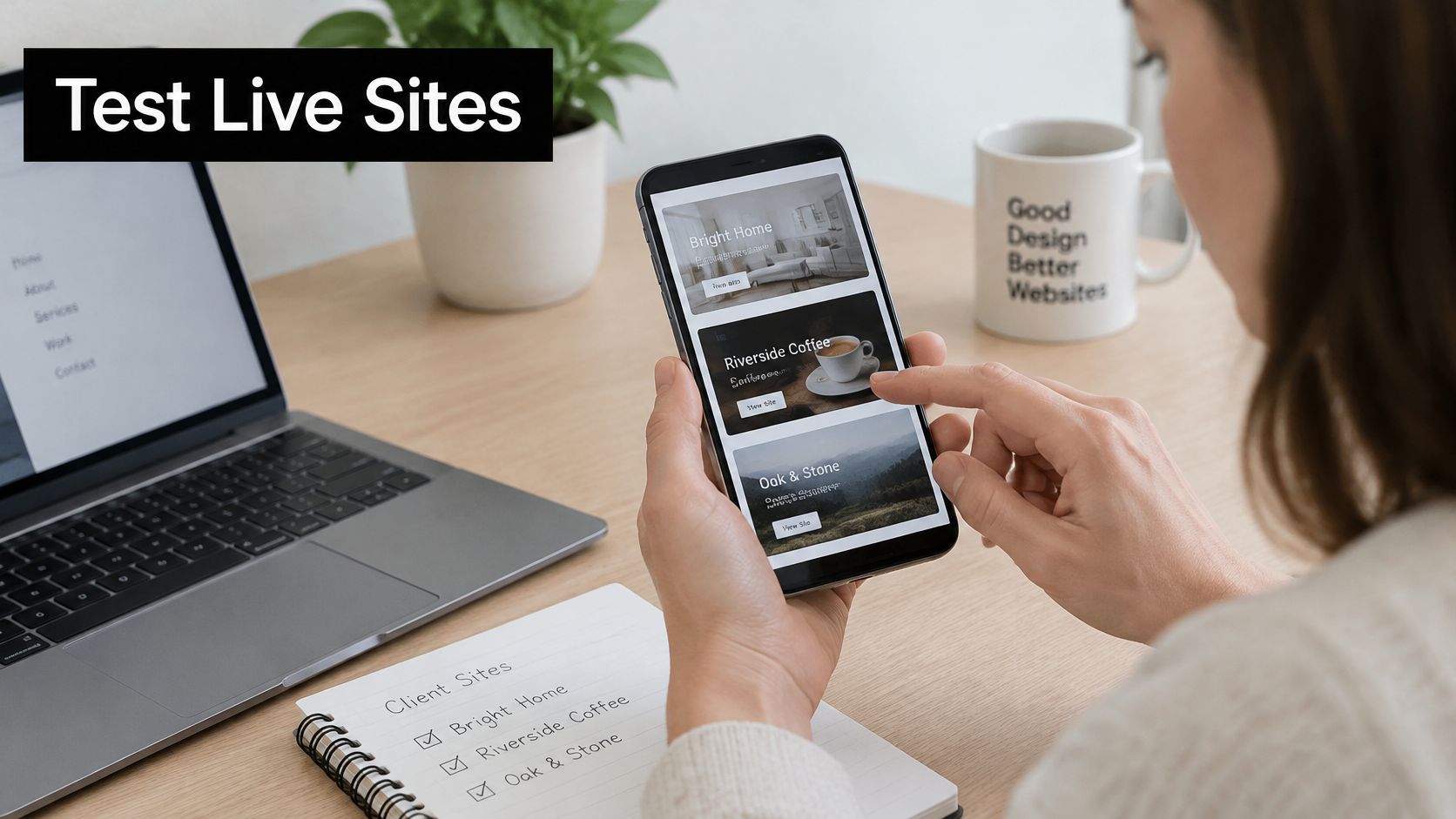
The fastest way to separate a capable agency from a well-dressed one is to test the sites it has already shipped. No logins, no developer, no favours. Forty-five minutes on three live client sites in industries close to yours tells you more than any proposal document.
Seven checks you can run this afternoon
- Open all three sites on your phone, on mobile data. Watch the page arrive: does the layout jump, does the menu work with a thumb, is the phone number tappable? A site that only behaves on a desktop in a warm office is a site losing the customers who browse on the train.
- Run the homepage and one service or product page through Google PageSpeed Insights. Ignore the headline score and read mobile Core Web Vitals. Expect green on most metrics for a recently built site. Repeated red on largest contentful paint across their samples is a template problem, not a page problem, and it will follow you onto every page they build.
- Ask for the plugin list before you sign. Page builders that store content in proprietary shortcodes make any future rebuild expensive. A tight stack of twelve maintained plugins beats forty plugins nobody updates.
- Submit a test enquiry as if you were a customer. Confirm there's a clear thank-you state, then check the message lands in a monitored inbox rather than a database nobody reads. Tracking that stops at "form submitted" never tells you whether a lead reached a human.
- Tab through the site with your keyboard, then run a free WAVE or axe scan. Treat WCAG 2.2 AA as the bar. An Australian scan of 699 websites found 81.8% failed WCAG 2.0/2.1 AA checks, and around 5.5 million Australians, roughly one in five people, live with disability, per the Regional Business Toolkit's WCAG guidance. The most frequent homepage failures are low-contrast text, missing image alternatives and unlabelled form fields, and all three also suppress lead completion. Automated tools can't judge link purpose, content order, keyboard focus quality, or whether alt text carries the business meaning, so a human still has to look.
- Look for custom Gutenberg blocks or a child theme on inner pages. If every page is three stock blocks in different colours, you're buying a template with your logo stapled on. Agencies doing custom WordPress development tend to show it: bespoke blocks, a child theme, a staging URL, a changelog.
- Check redirects and the XML sitemap. Old service URLs should 301 to their replacements, and the sitemap should list canonical pages only. Broken redirects and duplicate URLs are the quiet reason a redesign loses rankings.
Only 16% of Australian small businesses were classified as having high digital engagement, while 60% had a website, according to Deloitte's Connected Small Businesses report. Publishing a site is a different act from building a measurable acquisition system. Insist on a pre-launch baseline covering conversion rate, qualified leads, cost per lead, mobile abandonment and Core Web Vitals, then compare at day 30. After that, run the site as an experiment platform, changing one element at a time with enough traffic to avoid reading daily noise as a trend.
Once you've run those checks, this walk-through is worth watching before your first call, because it frames the same questions from the agency side of the table.
Six questions for the first call
Ask these in order. A strong answer names people, numbers or a written process. A weak one sounds reassuring and commits to nothing.
- Who is the project lead, and who builds the site? Strong: a named person you can email, plus the revision rounds stated in writing. Weak: "our team" and "as many rounds as it takes".
- Who owns the domain, hosting, WordPress admin and the Google Analytics property from day one? Strong: all of it in your name, with you added as administrator before the build starts. Weak: hesitation about logins, or hosting bundled inside the agency's own account.
- How is success measured, what's in the 30-day review, and which Google Tag Manager events get built? Strong: a named conversion action, a GA4 property you own, and events for calls, forms and checkout steps. Weak: "we'll send a monthly report" with no detail on content. For stores, the business.gov.au guide to measuring digital performance sets a sensible floor: online revenue, best-selling products, the advertisements and social posts generating sales, abandoned carts, refunds, and repeat versus first-time buyers.
- Which plugins and page builder, and why? Strong: a short list with a reason for each and a maintenance plan. Weak: "whatever's best for SEO".
- How are updates, backups and uptime handled after launch? Strong: a schedule, offsite backups, a named person watching, and a stated response time.
- Can I speak to two past clients in my industry? Strong: two phone numbers within a day. Weak: "our testimonials are on the website".
On phone leads specifically, ask how calls are attributed. A custom Twilio number with 24-hour answering, booking straight into your calendar or Calendly, catches the enquiries a small team misses at 7pm on a Saturday, which matters most for tradies, hairdressers, beauty therapists, dentists, restaurants and doctors. CallRail and GoHighLevel number pools do a similar job. If call tracking isn't in the proposal and your leads arrive by phone, that's a gap.
If the ownership answers aren't in writing before you pay a deposit, that's your answer. Not the one given on the call, the one that arrives after it.
What a WordPress Project Costs and Who Owns It
Cost answers stay vague for a reason. The honest version is that the number depends on content volume, how many custom blocks you need, which systems have to talk to each other, and how much copywriting the agency carries.
What each project type includes
I've deliberately left dollar figures out of this table. Anyone quoting a price before seeing your content and integrations is guessing, and you'll meet that guess again as a variation fee.
| Project type | Typical timeline | What is included |
|---|---|---|
| Starter brochure site (5 to 8 pages, customised template) | 2 to 4 weeks | Setup, basic SEO, contact form, Google Analytics |
| Custom business site (custom theme, custom blocks, booking or lead forms) | 9 to 16 weeks | UX mapping, Google Tag Manager, conversion tracking |
| WooCommerce store (up to 100 products) | 8 to 14 weeks | Product setup, payments, shipping rules, purchase tracking |
| Ongoing care plan (updates, backups, uptime checks) | Ongoing | Minor fixes included, larger work quoted separately |
| Changes after launch (hourly) | As needed | Quoted before work starts |
Read the timelines as carefully as the scope. A five-page brochure site compresses because a template does most of the work. The moment you add custom blocks, a booking flow or imported product data, the schedule stretches and the budget follows it.
The costs quotes tend to leave out
Your agency isn't the only supplier on the project. Domains, hosting, premium plugins, software licences, Shopify fees, advertising spend, email services, cloud infrastructure, SSL certificates and API usage charges sit on your side of the ledger. A quote that omits them looks cheaper than it is.
The business.gov.au guidance on developing a digital strategy is blunt about the shape of it. Budget for website or custom-software development, software subscriptions, staff training, outsourced work and digital advertising, then give each action a priority, a due date and a responsible person. For a store, the recurring line grows faster: Shopify fees, apps, custom Shopify development in Melbourne for theme blocks or private apps, feed tools and creative production all bill monthly whether or not you're advertising.
Payment rhythm and who holds the keys
Expect a deposit to start, milestone payments through the build, and final payment before launch or before ownership transfers, unless something different is agreed in writing. Ownership questions belong in the same conversation: who holds the theme licence, do you get the custom code and the repository, and what happens to the staging environment after handover. A site you can't move is a site you don't own.
The comparison that actually works
Ask all three agencies for a quote split into three parts: the build, the first twelve months of running costs, and the care plan. Compare those three lines across the quotes. The headline number is the least useful figure on the page, because the cheapest build is often the one with a rebuild in year two.
Timeline and Process from Brief to Launch
Custom WordPress projects rarely fail on design. They fail because nobody agreed who supplies the product photos, or because homepage feedback took three weeks and pushed the build into your busiest quarter.
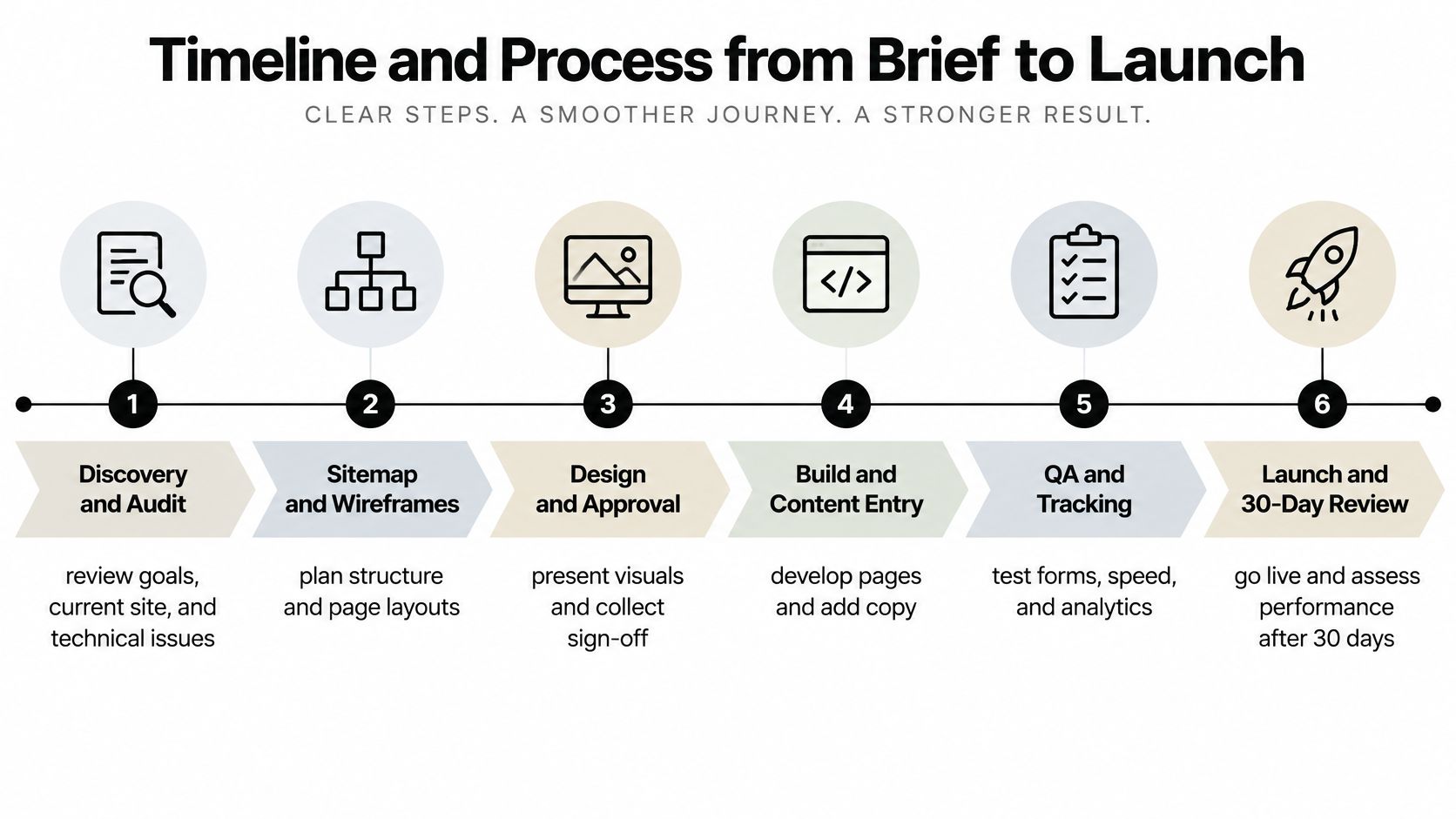
Here's the sequence a well-run project follows, and where the delays usually appear.
| Phase | Typical duration | What happens |
|---|---|---|
| Discovery and audit | 1 to 2 weeks | Analytics, forms, plugins, speed and accessibility baseline |
| Sitemap and wireframes | 1 to 2 weeks | Customer journeys, key landing pages, page hierarchy |
| Design and approval | 2 to 3 weeks | Mobile-first templates and two revision rounds |
| Build and content entry | 3 to 6 weeks | Theme, custom blocks, forms, copy and images |
| QA and tracking | 1 to 2 weeks | Cross-browser checks, forms, redirects, GA4 and GTM events |
| Launch and 30-day review | 1 week, then 30 days | Baseline comparison, handover of logins and documentation |
What you have to supply, and when
Content is the biggest single cause of overrun, and most of it is yours to produce. Logo files and brand assets belong in week one. Photography in week two, or the design slides into stock images that look like everyone else's. Product data and copy before the build phase starts, not during it. Logins for domain, hosting, analytics and any existing forms early enough that access issues don't stall QA.
A brochure site in three weeks is possible when content is ready on day one. A custom business site usually runs nine to sixteen weeks once feedback rounds are counted, and design approval is the phase that stretches first.
The spine of the build
A disciplined WordPress development process runs in six moves. Audit the current site: analytics, forms, indexation, plugins, Core Web Vitals and accessibility. Map the customer journeys and the high-intent landing pages. Prototype the templates mobile-first, because that's where the constraints are. Build on a minimal plugin stack with responsive images, caching and deferred non-critical JavaScript. Run staged QA across devices, browsers, forms, checkout, redirects and tracking. Then monitor monthly against leads, sales, organic visibility and speed budgets.
The clause to read before you approve
A website is usually deemed accepted when you approve the work, when it goes live, or when no revision request arrives within 14 days of delivery. That third trigger catches people who go quiet. Review the staging site properly and inside the window, because after acceptance the same changes become new work at an hourly rate.
Data Ownership, Privacy and Handover Checklist
Most agency quotes compare design, price and portfolio. Almost none answer the question that decides how painful the next three years are: who holds the accounts, the data, and the ability to leave.
Work through this list in order.
- Put every account in your name. Domain, hosting, Google Analytics, Google Tag Manager containers, Google Business Profile, email and payment gateways. You can grant admin access without handing over ownership.
- Trace where enquiries land. Which inbox, which CRM, and how do you export the history if you move? A form that pipes into an agency-owned spreadsheet is a lead list you don't control.
- Know what personal data the site collects. The ABS privacy policy for its own website lists the usual categories: browser and device details, IP address, pages viewed, referring website, search terms, cookies and analytics interactions. Yours will be similar, so confirm the cookie banner and consent settings match what's running.
- Test a restore, not just a backup. Ask where backups are stored, how often they run, and for one test restore. An untested backup is a rumour.
- List every plugin and flag the abandoned ones. Agree in writing who applies security updates and how fast.
- Decide about AI before switching it on. Around 11% of Australian small and micro businesses used AI in 2024–25, compared with 22% of medium-sized and 35% of large businesses, per the ABS Business Characteristics Survey release. Ask which customer data enters third-party tools, how leads are handed to staff, and who reviews AI-drafted answers before they reach a customer.
- Request a written handover document. Login inventory, the review schedule, and the monthly monitoring plan in one file.
Local doesn't automatically mean the data stays in Australia. Melbourne hosting, analytics, email, payments and ad platforms can all sit offshore, so name every vendor that touches customer information.
If the agency won't share logins or export data, the ownership question has already been answered.
Checking Melbourne References and Case Studies
Testimonials on an agency's own site are chosen by the agency. That doesn't make them false. It makes them a starting point, not proof.
How to verify a reference in ten minutes
Ask for two past clients in your trade or industry and ring them. Read Google reviews for dates and project detail rather than star counts. Read case studies for before-and-after numbers: enquiry volume, conversion rate, page load times.
What useful proof sounds like
Ari Melissas of Amari Plumbing and Gasfitting described the process rather than the pixels: "Jane has done an absolute superb job building our website, the whole process has been so smooth to do. She really takes the time to listen to what you want to try and achieve and always gives you the best advice on what she thinks is best for you." Listening and honest advice on what to build are the things you can't get from a portfolio.
Michael Abbacus of L&M Property pointed at a combination rather than a single service: "Jane is an absolute legend for bringing together email outreach and web development to maximise her clients goals." Useful when you're weighing whether one agency should hold both the site and the campaigns.
Anthony Knight of Possum Catchers named the outcome: "We've been super happy with all our dealings and communication. Very happy with our websites in look and design; they are operating well and bring us work." That last clause is the one to chase in every reference call you make.
The credibility check that takes two minutes
A verifiable business address and an ABN you can look up tell you more than a suburb name in a footer. Alpha Omega Digital lists Suite 1650, 470 St Kilda Road, Melbourne VIC 3004 as its office, which is the kind of detail you can check against a search result and a phone call.
End every reference call with the same question: what did you expect at the start, and what changed? The gap between those two answers is the honest review.
Shortlist Three Agencies and Book Your Strategy Call
A strong portfolio can still come with unclear deliverables, ownership terms or ongoing costs. Keep three agencies on your shortlist, then use the first call to test how clearly each one explains its recommendations and next steps.
Compare their scores, but let ownership and live-site checks act as vetoes. Before booking, confirm the proposed timeline fits your calendar and clarify who supplies the content. Bring evidence to the call: your current site analytics, the pages you need to launch, and your budget range.
Alpha Omega Digital offers a free 45-minute strategy session to review your site and show what the team would fix. You can also submit a project enquiry with an overview of your goals and receive clear next steps suited to your budget, timeline and growth target. Use the business.gov.au marketing plan guidance to frame measurable goals for the discussion. If the agency cannot connect its recommendations to an outcome and a way to measure progress, ask for a clearer plan.
If paid search is part of your growth plan, Alpha Omega Digital also offers Google Ads services. Ask how the proposed campaigns will work alongside the website, what reporting you will receive, and which costs sit outside the agency fee.
Use the contact page to arrange a conversation. A useful call should leave you with clear actions, not just a polished pitch.
Alpha Omega Digital provides website design and development, digital marketing and custom software services for Australian businesses. Visit Alpha Omega Digital to submit an enquiry and explain what you want to achieve.
Alpha Omega Digital
Read more insights from our team on web design, paid ads, and growth strategy.