You've got a campaign live, Ads Manager says the leads are cheap, and the office has spent Monday morning ringing people who live two councils outside your service area. Half the rest wanted a small patch-up job when your crew is set up for full extensions. The ads aren't broken. The system around them is.
I've run Meta campaigns for builders, renovators and trades, and the pattern repeats: the account gets judged on cost per lead, while the business only earns money on signed jobs at a margin that covers the crew. Facebook ads for construction work well when you treat them as one part of a chain that runs from a completed project photo through to a contract, with a qualified enquiry sitting in the middle. As a digital marketing agency Melbourne team working with tradies and ecommerce brands, that chain is where we spend most of our time, not on clever targeting.
Campaign Types That Match Each Construction Stage
Say a renovation builder in the inner north runs one broad campaign with a "get a free quote" offer. It pulls kitchen enquiries, extension enquiries, rental repairs and a few people who just wanted a price on a fence. Nothing in the account separates the person planning a build next year from the person who needs something fixed this week, so the office filters everything by phone.
Splitting campaigns by project stage fixes most of that before you touch a targeting setting.
| Campaign type | Best for | Audience | Objective | Main metric |
|---|---|---|---|---|
| Local awareness | New building work and service areas | Homeowners in target suburbs | Reach and video views | Cost per person reached in target suburbs |
| Enquiry generation | Renovations, extensions and fit-outs | Homeowners and property managers | Qualified leads | Cost per qualified enquiry |
| Project gallery retargeting | Visitors who viewed projects or the quote page | Video viewers and website visitors | Enquiries | Enquiry rate from retargeted audience |
| Commercial lead campaigns | Fit-outs and trade services for businesses | Business owners and facility managers | Booked site visits | Cost per booked site visit |
Awareness and enquiry work sit at different ends of the cycle
Local awareness is for the suburbs you've just started servicing, or a new service line nobody associates with your name yet. You're buying recognition, not applications, so judge it on reach inside the postcodes you can drive to and on how much of your project video people watch.
Enquiry generation carries the weight for renovations, extensions and fit-outs. The audience is homeowners and property managers with a project in mind, and the form does the filtering. Cost per qualified enquiry is the number that matters, because a cheap submission from someone outside your scope is a cost, not a result.
Retargeting and commercial campaigns need their own rules
Project gallery retargeting reaches people who already watched your build video or opened the quote page and left. They've seen your work, so the ad can push a specific next step instead of introducing you again. Watch the enquiry rate from that pool rather than its cost per click.
Commercial lead campaigns are a different animal. Property managers and business owners care about capacity, insurance and whether you've done a fit-out like theirs before, so the conversion you want is a booked site visit, not a form fill.
There's real scale behind this. Data published from Meta's advertising tools in the Digital 2024 Australia report indicated Facebook could reach approximately 16.65 million people in Australia in January 2024, about 62.7% of the country's total population. That's potential ad reach, not customers, and it doesn't excuse weak proof in the creative.
Practical rule: before you publish any ad set, check three things. The audience matches a real service area, the creative shows a completed project, and the form asks for suburb, project type and timeframe.
How to Set Up Your First Construction Campaign
The first build should be boring and correct. Here's the order I'd follow, with the slip that usually happens at each step.
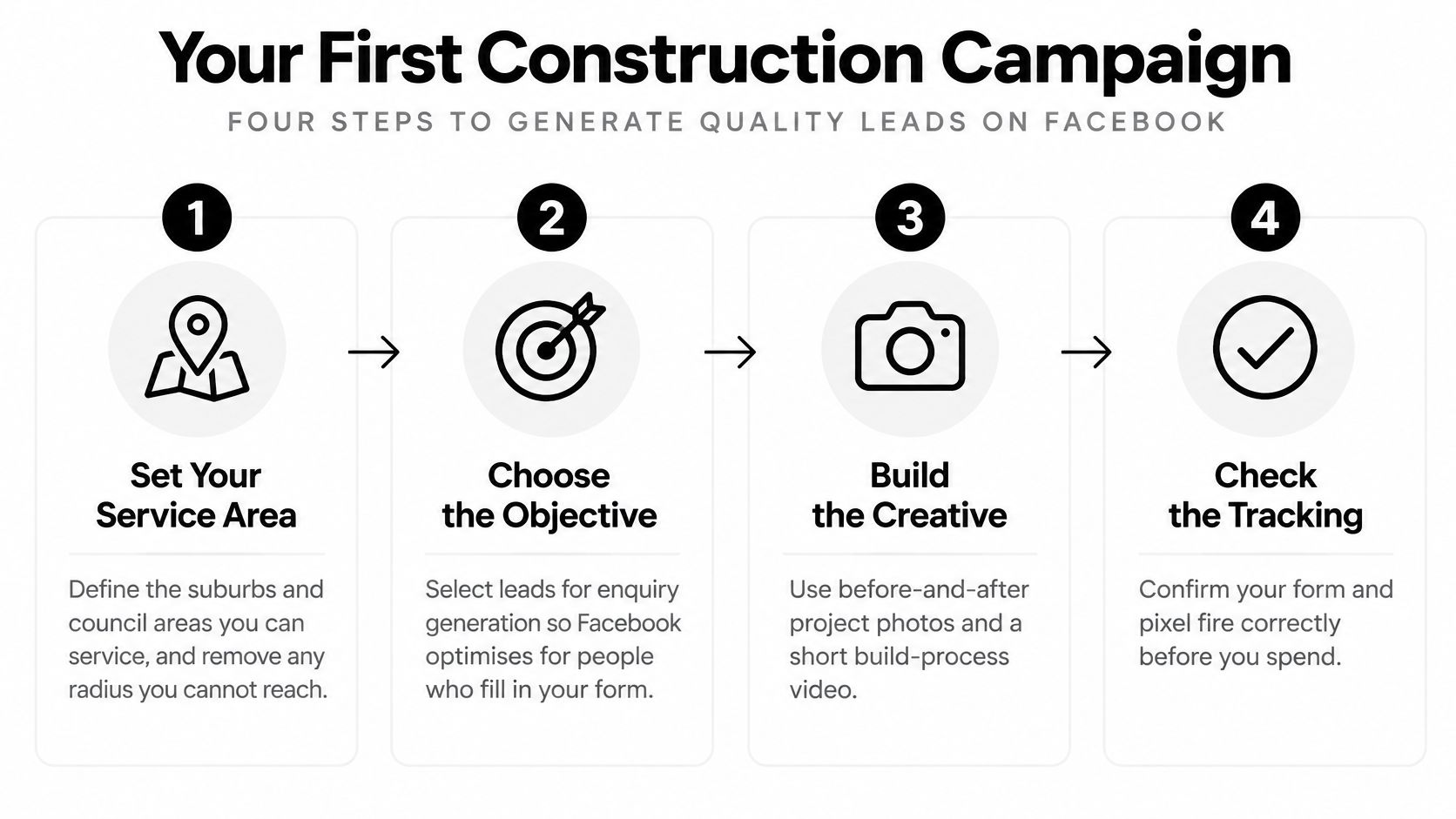
- Define the service area by suburb or council area. Drop any radius you can't service profitably. A 50 km circle around Melbourne pulls in enquiries your estimator will never quote, and you'll pay for every one of them.
- Choose the leads objective for enquiry generation. Traffic objectives find people who click, not people who fill in forms. That mismatch is the single most common reason a first campaign produces clicks and no conversations.
- Build the core audience from location, homeowner interests and age. Keep it reasonably tight for the first fortnight so you can read the results, then test broader targeting once you know what a good enquiry looks like.
- Build the retargeting pool early. Video viewers, page engagers and quote-page visitors accumulate from day one, even if you don't advertise to them yet. Create the audiences now so the pool has history when you switch the campaign on.
- Write creative that opens with one completed project. Add a licence or warranty line and one clear call to action. Three offers in one ad produces hesitation, not choice.
- Send traffic to a dedicated service landing page. A homepage makes the ad look unrelated to the offer the moment someone lands. If the ad says "extension builder in Brunswick", the page should say it too, above the fold.
- Add qualifying questions to the form. Suburb, project type, budget range, timeframe and property status. Five answers tell your estimator whether to call in five minutes or send a polite email.
- Launch two ad sets per service and leave them alone. Same audience, different creative lead. Judging either one after two days tells you nothing except that Meta hasn't finished learning.
What the tracking check looks like before you spend
Submit a test enquiry yourself, on mobile, on a normal connection. Confirm the thank-you page loads, the notification reaches the office inbox, and the lead lands in your CRM with the answers intact. If any of those fail, you're about to pay to lose enquiries.
Call handling deserves the same attention. I'd set up a dedicated tracking number through Twilio rather than using the owner's mobile, then route it to whoever answers, with an after-hours path that takes a message and books a slot. A custom number can be wired to answer around the clock, never call in sick, and drop appointments straight into a calendar or Calendly link, which matters for tradies who spend the day on site and lose work because nobody picked up.
A healthy first fortnight
You're looking for steady enquiries from the target suburbs, most forms completed with the qualifying answers filled in, and a readable difference between the two ad sets. Not a flood. If enquiries arrive but the suburb field is empty or full of places you don't service, fix the form and the geography before you touch the budget.
Creative That Proves Your Build Quality
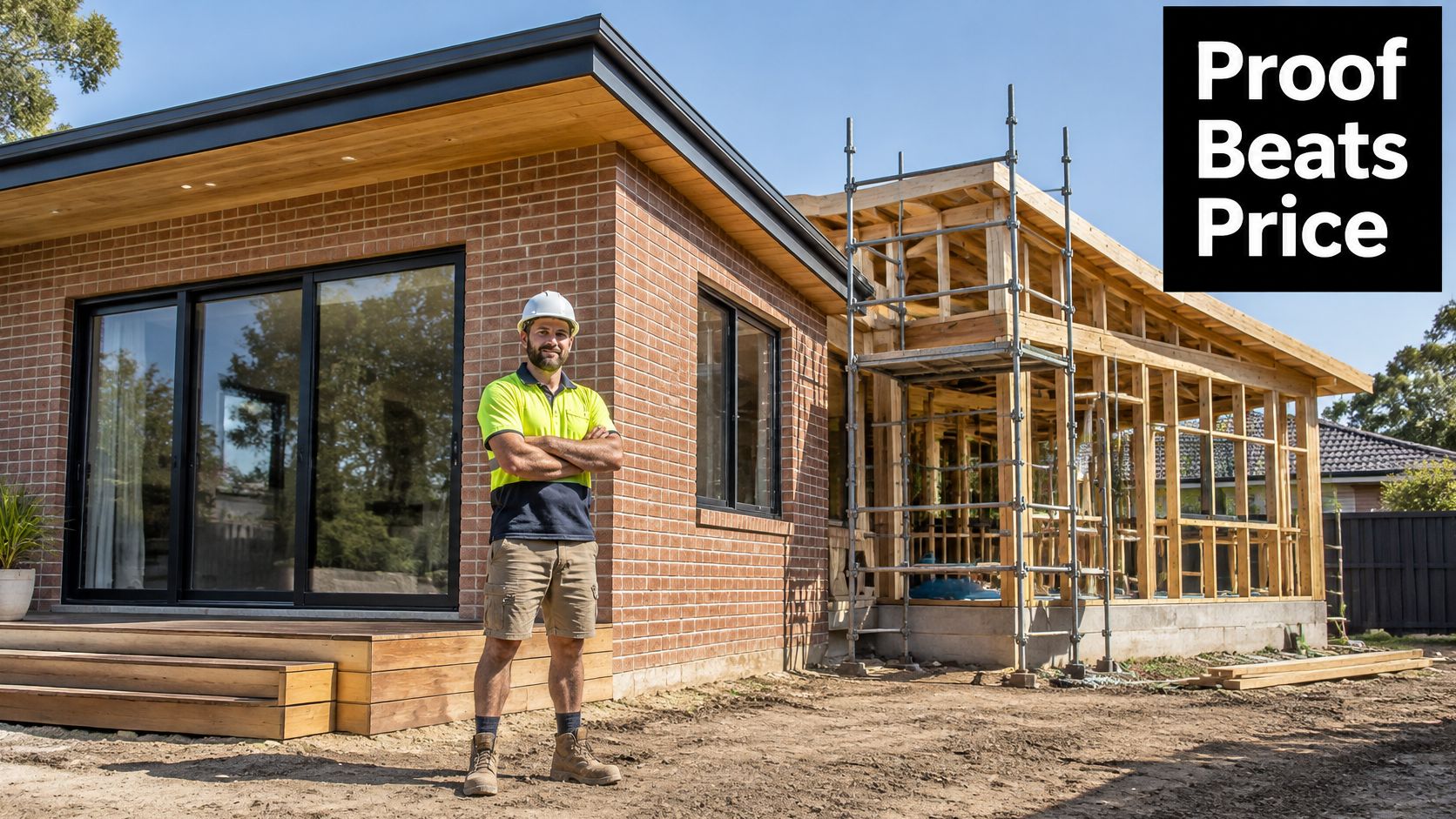
Construction buyers compare trust before they compare price. Someone handing over their house for three months wants to know you've done this before, you're licensed, and you'll turn up. Your creative has to answer that in the first two seconds, because the price conversation happens later on the phone.
Four creative types that earn attention
- Before-and-after project image: the strongest single asset most builders already own. Shoot it from the same angle both times, in daylight, and name the suburb in the copy.
- Build process video: twenty to thirty seconds walking through framing, waterproofing, the finished reveal. It answers the "will they respect my home" question that photos can't.
- Testimonial with suburb and project type: "they finished our extension in Preston before Christmas and cleaned the site every day" beats any claim about being the best in Melbourne.
- Licence and warranty card: a plain graphic with your licence number, insurance status and warranty terms. Unglamorous, and it removes a real objection for high-value work.
Order them proof first, process second, offer third. The offer should be specific: a site assessment or a renovation feasibility consult, not "contact us".
Here's a walkthrough format worth studying before you shoot your own.
Testing without wasting the budget
Run two creative sets against the same audience, one leading with a project photo and one leading with a process video, and compare cost per qualified enquiry after at least two weeks. Same offer, same form, same landing page, so the only variable is the creative.
The trade-off is real. Video costs more to produce and holds attention longer, which helps with expensive extensions where the buyer needs convincing. A single strong photo is cheaper to refresh when fatigue sets in, and for a small trade service it often does the job. I'd start with photos if the budget is tight and add video once one service line is producing qualified work.
Every claim needs to be checkable. Years in business, licence numbers and warranty terms should appear on the landing page too, in plain text, not buried in a PDF. If a homeowner can't verify it in ten seconds, it isn't proof.
Before publishing, check the ad has a real completed project, a named suburb, a licence number, one clear next step, and a landing page that repeats the same promise.
Landing Pages, Forms and Tracking Setup
The sector's digital baseline explains a lot of wasted ad spend. In 2024–25, only 39.8% of Australian construction businesses had their own website or app, compared with 55.1% across all businesses, according to figures reported in this Australian trade marketing guide. Plenty of campaigns are pointing at pages that were never built to convert.

One page per high-value service
Build a dedicated page for renovations, another for extensions, another for commercial fit-outs, another for new builds. Each one carries project photos from that service type, the licence line, a short explanation of what happens after the enquiry, and a qualification form.
Keep the form to five fields that route the job: suburb, project type, approximate budget, timeframe and property status. Whether the property is owner-occupied, rented or under a lease changes who you're talking to and how fast the work can start. On WordPress this is a straightforward build with a form plugin and conditional logic, and the page should load fast on mobile because that's where nearly all your traffic arrives.
Define the events before launch
Install the Meta Pixel and Conversions API where possible, and separate a completed enquiry from a qualified lead. They're different things, and collapsing them into one event teaches Meta to find more people who fill in forms, not more people who sign contracts.
| Event | Fires when | Source of truth |
|---|---|---|
| Enquiry completed | Qualifying form submitted | Landing page or instant form |
| Qualified lead | Suburb, scope and budget fit the service area | CRM |
| Booked site visit | Consultation confirmed | CRM |
| Won project | Contract signed | CRM |
Pass the CRM outcomes back to Meta so optimisation has something better to aim at than cheap submissions. Server-side events also survive browser restrictions that drop pixel fires, which is why the CRM record stays your source of truth when the two disagree.
Test forms against pages, then check the whole chain
Run instant lead forms against landing-page conversions for the same service and judge them on cost per qualified appointment, not cost per lead. Instant forms usually win on volume and lose on intent. Landing pages usually win on intent and cost more per submission. Which trade-off suits you depends on how much filtering your office can absorb.
Finish with a manual check: send a test enquiry, confirm the event fires in Events Manager, and confirm the lead appears in the CRM with the same suburb and project type you typed. If the CRM says Preston and the ad report says something else, fix the plumbing before you spend another dollar.
Consent and Follow-Up After the Form
A construction enquiry form collects a name, a phone number, a property address and enough project detail to reveal someone's financial circumstances. That's not the same as an email signup for a discount code, and treating it that way is where small builders get themselves into trouble.
Two regimes apply. As outlined in this Australian Meta lead generation guidance, the Privacy Act and Australian Privacy Principles require transparency about collection and purpose, while promotional email and SMS activity is governed by the Spam Act, including identification, consent and an unsubscribe facility. Answering someone's quote request is a service reply. Sending them a monthly project newsletter is marketing, and it needs its own permission.
The sequence I'd build
- An immediate service-related reply confirming the quote request and stating when you'll call.
- A separate, optional marketing tick box, unticked by default.
- A privacy notice linked on the landing page and inside the instant form.
- A CRM record storing the consent timestamp alongside the enquiry.
- A follow-up plan that moves from quote reminder to site-visit offer, with an unsubscribe in every promotional message.
More data isn't automatically better. The minimum set a compliant follow-up needs is name, phone, suburb, project type, consent status and timestamp. Everything beyond that has to earn its place by changing how you route or quote the job, and every extra field costs you completions.
Setting expectations for the visit itself helps too. Superior Home Improvement's explainer on home consultation inspection and pricing is a useful reference for what a homeowner should expect during an in-home consult, and mirroring that structure in your confirmation email reduces no-shows because people know what they've agreed to.
Stricter consent language may trim form completions slightly. Cleaner follow-up and contract-level reporting usually more than pay for it.
Before launch, check five things: a working privacy link, separate marketing consent, a stored timestamp, an unsubscribe in every promotional message, and a documented rule for who inside the business can access each lead.
Budget Split and the Metrics That Decide It
The Yellow Social Media Report found 37% of surveyed Australian SMBs had paid for social-media advertising, and among those advertisers Facebook was used by 83%, ahead of Instagram at 22% and LinkedIn at 16%. The same Yellow Social Media Report found building and construction businesses allocated an average 10% of marketing spend to social media. Treat that as a planning reference, not a rule.
Set the total backwards from the job, not forwards from the platform
Start with the gross margin on a typical project and how many jobs your crew and estimator can handle in a quarter. Work back to what you can afford to pay for a won project, then to what you can afford per qualified opportunity given your close rate. The monthly number that falls out of that arithmetic is your budget. A percentage of last year's marketing spend is not.
For the account structure, I'd start at 70% prospecting, 20% retargeting and 10% testing, then adjust for margin, project value and how many enquiries the office can answer in a working day. Prospecting carries location and service creative. The retargeting pool covers video viewers, page engagers, service-page visitors and people who started but didn't submit an enquiry.
Construction buying cycles rarely fit in one session, so creative should progress from proof to a specific offer such as a site assessment or a renovation feasibility consultation. Someone who watched your extension video in March may book in July.
Rank your metrics from weakest to strongest
| Metric | What it tells you | When to act |
|---|---|---|
| Cost per lead | Cheapest signal, weak on buyer quality | Watch the trend only, never decide budget on it alone |
| Cost per qualified enquiry | Share of leads that fit suburb, scope and budget | Compare creative sets weekly once there are enough enquiries |
| Cost per booked site visit | Real buyer intent shown by a booked consult | Adjust targeting when this figure rises for two weeks |
| Cost per won project | Profit signal that reflects the full sales process | Set budget decisions across a 30 to 60 day window |
| Revenue per project against ad spend | Return on ad spend tied to margin | Check against gross margin before scaling |
Consider a renovation builder running two service lines. The cheap lead source produces plenty of small bathroom enquiries, few of which turn into booked visits, and the estimator burns hours quoting work at thin margin. The extension campaign produces costlier enquiries and wins two projects a month. On cost per lead the first campaign looks like the winner. On contribution margin it isn't close.
That gap is under-addressed in Australian advice, which tends to stop at "reply fast and track bookings". Deloitte's 2025 state of digital adoption in construction survey covered 894 businesses across several Asia-Pacific markets, including Australian-headquartered firms, and examined digital-technology adoption and barriers. Operational capability, not ad creative alone, is often the constraint.
Judging windows that don't contradict each other
- Weekly: compare creative sets on qualified-lead rate and booked-consult rate once there are enough enquiries to read.
- Fortnightly: adjust targeting if cost per booked site visit has risen for two consecutive weeks.
- Four weeks: raise budget only after cost per qualified enquiry holds steady for a month and you have spare call capacity.
- 30 to 60 days: judge cost per won project, because that's how long the sales cycle takes.
Import qualified lead, consultation, quote and won contract back to Meta so optimisation targets the stage that pays your crew. These figures are planning estimates, and your margin and project value decide which metric deserves the most weight.
Decide Whether to Launch or Fix Tracking First
Launch only when the landing page, the form qualifiers, the Pixel and Conversions API events, and the CRM follow-up all work. A campaign without tracking spends budget to learn nothing, and you end up arguing about cost per lead because it is the only number you have.
Four questions decide it:
- Is there a real completed project to show? Stock imagery of a kitchen you did not build will not survive a site visit.
- Does the service area match the audience? Every suburb in the targeting should be one you would happily drive to.
- Can the team answer every enquiry within one working day? If not, fix the answering path before you buy more enquiries. Lead generation for trade businesses covers ads, landing pages and call tracking together for this reason.
- Are the qualified and won events defined? Write them down, agree them with whoever quotes the work, and make sure they fire into the CRM.
Four yeses means start with the two-stage budget. Any no means spend the first fortnight on the fix. That is cheaper than a month of unmeasurable spend, especially when cheap form fills take up office time without turning into profitable construction jobs.
If you would rather hand the setup to someone else, Alpha Omega Digital provides Meta Ads management across Facebook and Instagram, including Pixel and Conversions API tracking, alongside Google Ads Management, Website Design & Development, SEO and Website Hosting & Maintenance. Advertising budgets are paid separately unless otherwise agreed. Campaign management is the service, with no guaranteed outcomes, including enquiry volume, ROAS, CPA, traffic, sales, leads or conversion rates. Readers who want a closer look at how accounts are structured can see our Meta ads agency work.
One next step before anything goes live: write down your qualified-lead definition and the value of a won job. That single decision keeps follow-up focused on work that pays the crew, not enquiries that only look good in a platform report.
Jane James
Jane James is an experienced digital marketer focused on Google Ads, Meta Ads and social media. At Alpha Omega Digital she plans, builds and manages paid advertising campaigns and conversion tracking for Australian businesses, with an emphasis on measurable leads and sales rather than vanity metrics.