You've got orders to pack, a supplier waiting for approval and another ad report sitting unread in your inbox. Sales are coming through, but changing a product page takes too long, and you're still not sure which campaigns leave money in the business.
An affordable marketing agency should reduce that workload, not give you another job. I'd judge affordability by what your store can implement, maintain and profit from, rather than by the smallest retainer on a proposal. For an ecommerce owner comparing a marketing agency in Melbourne, that means looking at the fee, your own time and the work that still falls between the cracks.
What an Affordable Marketing Agency Covers for Ecommerce
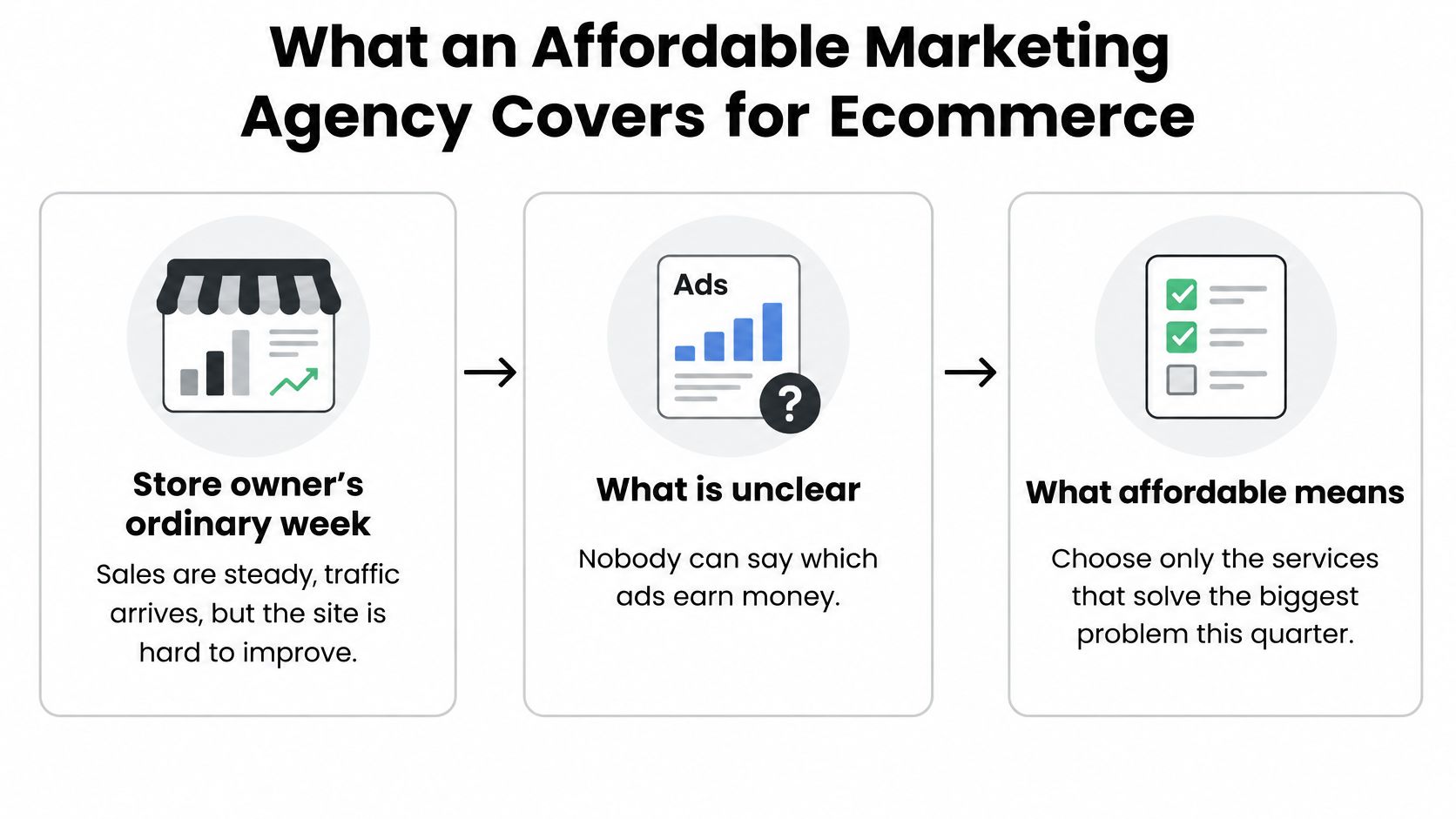
Say you run a homewares store on Shopify. Traffic arrives, customers buy, and nothing looks obviously broken. Yet customers keep asking about delivery, your mobile menu buries popular collections, and your agency reports advertising revenue without checking refunds.
Those are different problems. Buying a broad marketing package won't necessarily solve them in the right order.
The Australian Bureau of Statistics reported seasonally adjusted online retail sales of $4,703.8 million in June 2025, up 13.0% compared with June 2024. That gives ecommerce owners a reason to treat website performance as sales infrastructure, rather than a cosmetic project.
This diagram captures the practical starting point.
Buy the work that removes the bottleneck
A useful modular scope follows the customer's journey:
- Website build or repair: Shopify development or WordPress development should address product templates, mobile speed, cart behaviour and checkout reliability.
- Conversion-focused design: Shopify design and WordPress design should make navigation, product filters, delivery information and trust signals easy to use.
- Google Ads: Search, Shopping, Performance Max and remarketing serve different jobs. Campaign selection should follow your catalogue, margins and available tracking.
- Meta advertising: Facebook and Instagram campaigns need suitable creative, relevant landing pages, Pixel tracking and Conversions API configuration.
- Measurement: Google Tag Manager and Google Analytics should connect advertising activity with meaningful store actions.
- Email and automation: Abandoned-cart messages and post-purchase follow-ups need useful content, sensible exclusions and reliable integrations.
- Hosting and maintenance: Updates, backups, app compatibility and ongoing support belong in the operating budget.
Alpha Omega Digital provides this modular mix, including website design and development, SEO, Google Ads management, Meta advertising, Shopify and WordPress development, app development, CRM integrations, cloud and AWS consulting, and hosting and maintenance.
Keep optional work optional
A small catalogue might need a dependable store and measurement before anything else. A larger catalogue may need product-feed repairs before paid Shopping campaigns deserve more budget.
For a defined platform task, our Shopify development service and WordPress development service provide relevant starting points. The decision should still begin with the operational problem, not the platform's feature list.
AI discovery work is a separate consideration. If your team is evaluating specialist support, Verbatim Digital's white-label AI visibility platform services are a resource to assess against a written discovery brief, not a substitute for fixing checkout.
Practical rule: List the three modules that would remove your biggest weekly problem. Leave everything else out of the initial scope unless there's a clear dependency.
Which Scope Fits Your Business Size
Share of businesses placing online orders by size, year to 30 June 2025
The adoption figures below come from the ABS business characteristics spreadsheet; the priorities are practical recommendations, not ABS findings.
| Business size | Placed online orders | Scope an affordable agency should prioritise |
|---|---|---|
| 0–4 employees | 57.0% | Reliable checkout, clean product pages and a basic Shopping feed |
| 5–19 employees | 73.4% | Integrations with inventory, email and accounting |
| 20–199 employees | 77.5% | Paid campaign structure and Shopify API work |
| 200 or more employees | 85.4% | Governance, reporting and custom build where justified |
Read this as a sequence of operational priorities, not a ranking of marketing competence. Placing orders online measures business purchasing behaviour, not how successfully these businesses sell through their own websites. It doesn't prove that a larger employer needs a more expensive storefront.
Headcount is a useful prompt, but catalogue complexity, order handling and internal capacity should decide the scope.
Small teams need fewer things to maintain
Consider a hypothetical three-person Melbourne homewares brand. The owner handles buying, the warehouse assistant packs orders, and another team member answers customers.
I'd start by checking mobile product selection, delivery information and payment errors. Fix those, then observe checkout behaviour before recommending more advertising. There's little value in building custom functionality that nobody has time to manage.
A standard Shopify theme may be sufficient. On WordPress, carefully configured WooCommerce templates may do the job without a full rebuild.
Custom Gutenberg blocks make sense when staff repeatedly need layouts that standard blocks can't handle cleanly, such as reusable product-care panels or comparison sections. They're less affordable when every routine content edit requires a developer.
Growing teams need connected operations
Now consider a hypothetical twelve-person skincare brand adding subscriptions. A subscription app alone won't solve the reporting problem if repeat orders, discounts and customer records don't reach the CRM correctly.
The useful scope includes:
- Order mapping: Separate initial subscription purchases from renewals.
- Inventory handling: Make stock behaviour clear for subscription and ordinary orders.
- Customer records: Sync relevant consent and purchase information without creating duplicates.
- Exception handling: Decide who responds when a payment, sync or fulfilment step fails.
For a more complex store, Shopify API work should solve a named workflow. Building custom Shopify apps using Shopify CLI adds deployment, permissions, testing and maintenance responsibilities. It shouldn't be the default response to a task an established integration can already handle.
A practical Shopify development crash course for an owner should explain themes, apps, checkout constraints, APIs and ownership. It shouldn't imply that a short tutorial replaces production testing.
A custom build is affordable when it removes a recurring constraint that standard tools can't resolve economically.
Place your business in the closest row, then write down its single most expensive operational frustration. That is a better briefing document than a wish list of features.
How Agency Pricing Models Compare for Online Stores
Agency pricing models and what each one asks of you
These are planning descriptions, not measured industry averages. Confirm the actual workload and fee in a written proposal.
| Model | Best for | Your time each week | Ad budget |
|---|---|---|---|
| DIY with specialist check-ins | Owners with in-house time and a simple catalogue | High, several hours | Paid separately |
| Guided implementation | Stores launching, rebuilding or fixing tracking | Medium, two to four hours as a planning allowance | Paid separately |
| Managed growth retainer | Stores running paid campaigns across several channels | Low, one to two hours as a planning allowance | Paid separately |
DIY buys specialist judgement while leaving implementation with you. Guided implementation shares the work, so you'll still need to supply content, approve decisions and test business processes. Managed growth transfers more execution to the agency, but it doesn't eliminate your responsibility for stock, offers and approvals.
Our advertising budgets are paid separately unless otherwise agreed, and we're responsible for campaign management only. A low management fee attached to substantial media spend is still a substantial monthly commitment.
What actually moves the price
A useful quote identifies its cost drivers rather than hiding them inside a package name:
- Catalogue size: Products, variants, feed attributes and merchandising rules create different workloads.
- Platform requirements: A standard Shopify theme is a different project from custom WordPress templates or Gutenberg blocks.
- Channel count: Google Shopping, Search and Meta each require their own decisions and checks.
- Tracking complexity: GA4, GTM, Meta Conversions API and CRM connections need testing together.
- Creative production: Photography, demonstrations, editing and usage permissions aren't automatically included in media management.
- Reporting requirements: A concise commercial review costs differently from bespoke reporting across teams.
- Integrations: Inventory, email, subscriptions and accounting connections need exception handling, not just installation.
For comparison, imagine a 50-product homewares shop running a single paid channel and a 2,000-SKU fashion label running Shopping, Performance Max and Meta. These are hypothetical scopes, not market benchmarks.
The fashion label needs more feed governance, variant checks, stock exclusions and creative coordination. Similar-looking retainers may conceal very different setup fees or exclusions.
Set the media budget around a useful test
“How much does it cost to start Google Ads?” has separate answers for account setup, management, creative, website changes and media. Ask for each line individually.
For a beginner's guide to Google Shopping ads, I'd start with Merchant Center eligibility, product identifiers, shipping settings, feed quality and purchase tracking. Google Shopping ads for dropshipping also require particular care around supplier stock, delivery promises, returns and actual margin.
With Performance Max versus Standard Shopping, the trade-off is automation and broader inventory access versus more focused Shopping control. Standard Shopping campaign priority helps select between eligible overlapping Shopping campaigns; it isn't a universal lever for controlling Performance Max.
If Google Shopping ads aren't spending budget, check product approval, targeting, bids, feed eligibility and demand before increasing the cap.
Build your estimate as:
One-off setup + recurring management + creative and software + media spend.
State a minimum viable test budget using your expected acquisition cost and the purchase volume needed for a useful decision. There's no defensible universal dollar minimum here. If the store can't fund that test across several channels, narrow the scope rather than dividing the budget into ineffective fragments.
Tracking and Privacy Checks to Set Up First
A campaign can scale on bad information. An owner can also approve tracking without holding a clear record of what the tags collect.
The Office of the Australian Information Commissioner's tracking-pixel guidance explains that pixels can analyse traffic, target advertising and measure performance, and that transaction details such as items viewed or cart additions may be personal information under the Privacy Act.
Build and test the measurement chain
Configure GTM and GA4 ecommerce events. Implement
view_item,add_to_cart,begin_checkoutandpurchasewith consistent item information. These show where shoppers progress or leave; only appropriate conversion events should inform bidding.Install Meta Pixel and Conversions API together. Server-side events can improve signal resilience, but they don't guarantee complete tracking or bypass privacy obligations. Use matching event identifiers for browser and server events so the same purchase isn't counted twice.
Connect purchase measurement to Google Ads. Import GA4 purchases if that's the agreed measurement approach. Avoid treating both an imported purchase and an equivalent native Ads purchase as primary conversions, which can distort bidding.
Document collection and consent decisions. Record what information each tag receives, why it's needed, applicable consent handling and who reviews changes. Don't send customer details or sensitive form contents just because a platform technically accepts them.
Place a test order. Check transaction identifiers, currency, order value and event deduplication. Confirm that refreshing the confirmation page doesn't create another counted purchase.
Schedule anomaly checks. Look for sudden event drops, duplicate transactions, missing revenue and unusual differences between store orders and analytics. Investigate before changing budgets.
Check the systems around the tags
Setting up Google Tag Manager containers also means controlling publishing access, naming tags clearly and retaining a change history. For Shopify, use supported integration methods and check how customer events behave across storefront and checkout.
Email deserves a separate check. If abandoned-cart or order-follow-up messages aren't arriving, MailGenius's SPF and DKIM checker can help assess authentication, although authentication alone doesn't guarantee inbox placement.
For Google Ads contact-form submissions, distinguish a successful submission from a button click. A form error should never become a conversion.
Phone-led businesses need a different measurement chain. CallRail and GoHighLevel are options to assess for PPC call campaigns, but the best call-tracking software is the one that fits your number requirements, CRM, routing and qualified-lead reporting.
A proposed Twilio custom-number workflow could connect call routing, answering and appointment booking with a calendar or Calendly. Treat round-the-clock answering as a tested system requirement, not a promise of error-free service or guaranteed savings. Tradies, hairdressers, beauty therapists, dentists, restaurants and doctors also need appropriate escalation, privacy handling and human backup.
Before launch: Establish who owns the GTM container, who controls the advertising accounts and where the privacy decisions are recorded.
Judging Value and Spotting Red Flags
Clicks, impressions and likes can help diagnose a campaign. They don't establish that the store can afford to keep running it.
We built Alpha Omega Digital to address businesses investing in marketing that looks busy but produces little measurable growth. Our approach is to work as an extension of the client's team, with clear communication and honest recommendations.
I'd evaluate an affordable marketing agency against the commercial decisions it helps you make, not the volume of activity it reports.
Start with revenue that leaves a margin
A useful report connects cost per purchase, return on ad spend and contribution margin. Revenue alone can hide expensive fulfilment, discounting, returns and low-margin product sales.
Ask for a consistent definition of revenue. Gross order value, sales after refunds and revenue excluding tax aren't interchangeable. The agency and store owner should agree on the calculation before judging campaign success.
Then separate new-customer acquisition from existing-customer purchases where the available information allows it. An attractive blended ROAS may conceal heavy reliance on customers who already know the brand.
The ABS business characteristics release reports that only 7% of Australian businesses measured the contribution of digital activities to overall business performance in 2024–25. Measurement deserves a place in the scope, but the deliverable should be a usable business decision, not another dashboard nobody opens.
Use milestones with an action attached
For a hypothetical engagement, a 60-to-90-day milestone might be dependable purchase reporting and a decision on whether the initial acquisition approach deserves continued funding. That's a review point, not a promised result.
The proposal should explain what happens if the milestone is missed. Possible actions include repairing the offer, narrowing the catalogue, replacing creative, changing the landing page or pausing spend.
A milestone without a response plan is just a date.
A worked example of a campaign under pressure
Suppose a store spends $3,000 a month on Meta, records a $60 cost per purchase and has a $45 target. These are hypothetical figures to illustrate the decisions, not an agency result or market benchmark.
During the first 30 days of this example, I wouldn't start by rebuilding everything. I'd first validate purchase counting and establish whether the target makes sense after product costs, fulfilment and expected repeat business.
Then I'd inspect the journey:
- Creative promise: Does the ad explain the product accurately and give shoppers a reason to act?
- Landing-page match: Does the shopper arrive at the product or collection the ad promoted?
- Offer economics: Are delivery costs, discounts or minimum-order conditions discouraging purchases?
- Purchase quality: Are orders being refunded, cancelled or generated mainly by existing customers?
- Stock availability: Are ads sending people to popular variants that can't be purchased?
A responsible agency might conclude that the current offer can't support the target. Increasing spend wouldn't fix that.
Make Meta testing deliberate
Mastering Facebook ads isn't a matter of finding a permanent winning audience. A useful Meta ads creative testing process starts with a hypothesis, such as whether a product demonstration answers a concern better than lifestyle imagery.
Test meaningfully different angles, record the message and landing page, and avoid changing everything simultaneously. Judge creative using purchase quality and commercial outcomes, while using engagement metrics to diagnose where attention drops.
“Facebook ads, don't quit too early” is only sensible advice when the tracking, stock and test design are sound. Consistency means following a decision process, not paying indefinitely for the same underperforming ads.
Our Facebook and Meta advertising service covers the channel, but no channel should receive budget merely because it appears in a retainer.
Look for pushback and clear communication
A good agency asks about margins, stock and average order value before proposing growth. It should also be willing to recommend pausing a weak product line or declining a channel that the business can't support.
Agree on a named contact, a response expectation and what counts as urgent. Routine creative feedback and a broken checkout need different handling.
Watch for these warning signs:
- Guaranteed results: Promises of rankings, sales or a fixed ROAS without acknowledging commercial uncertainty.
- Hidden spend: Bundled pricing that makes management fees and media difficult to distinguish.
- Unclear exits: Contracts that omit notice requirements, handover responsibilities or asset treatment.
- Restricted access: Refusal to provide access to your own ad accounts or Shopify admin.
- Activity-only reporting: Reports that stop at clicks while avoiding purchase quality and profitability.
- Missing foundations: A cheap package that excludes tracking tests or privacy documentation without saying so.
We don't guarantee specific outcomes, including rankings, enquiries, traffic, sales, revenue, leads, ROAS, CPA, conversion rates, social growth, email open rates or search indexing. Accountability means explaining decisions and measuring the agreed work, not pretending an agency controls every influence on performance.
Compare quotes in the same currency, against the same scope, with media included in the total outlay. Only then does “cheaper” mean anything useful.
Choose Your Agency and Claim the Ads Management Offer
Choose the provider whose plan your business can carry out. A strategy that requires constant owner input won't be affordable if you're already packing orders after dinner.
Use the proposal meeting to work through the practical documents together.

Turn the comparison into a decision
Choose your immediate modules. Write down the three problems that deserve attention this quarter. For each, identify who supplies the content, who approves changes and who maintains the result.
Set the total monthly commitment. Include media, management, necessary software and creative production. Confirm which setup work must be paid for before launch.
Score the evidence. Compare revenue-linked reporting, a named milestone, asset ownership and willingness to challenge an uneconomic plan. A sample report and a precise scope are more useful than a polished pitch alone.
Keep the shortlist manageable. Shortlist no more than two providers and request comparable written scopes. Ask each to identify exclusions rather than assuming every service is included.
Don't pay for work just because it sounds thorough. An Instagram Shop or Facebook Shop needs accurate catalogue connections and suitable eligibility, not a tick beside “social commerce”.
The same discipline applies to SEO. For a store with a physical location, local SEO and Google Business Profile, formerly Google My Business, can support local discovery. An SEO agency in Melbourne should still distinguish that work from ecommerce category architecture, product information and technical indexing.
Add landing-page work only when the journey needs it
Cold visitors may need more explanation than returning customers. For a product that requires education, Landra's mobile-first listicles for cold traffic are an option to evaluate as a landing-page format.
The page still needs accurate claims, useful product detail and a clear route to purchase. A new format won't rescue an unclear offer or unavailable stock.
For service-led divisions, use separate lead-generation economics. Google Ads for service-based businesses and PPC for tradies should be judged on qualified enquiries and booked work, rather than ecommerce purchases. That distinction matters whether you're considering Google Ads for plumbers or Facebook ads for electricians.
This video provides another format for considering the agency conversation.
Start with a clear, limited commitment
We offer a free 45-minute strategy session to review your site and show exactly what we'd fix. Bring your storefront, current campaign concerns and the operational task you'd most like to stop handling manually.
Alpha Omega Digital is based in Melbourne, Australia, and also serves clients in Sydney, Brisbane, Newcastle, Perth, Adelaide, Darwin and Hobart. Our ecommerce marketing service combines conversion-focused website work, paid advertising and ongoing support, with scope selected around the store's needs.
If you're a business with a paid ads budget of at least $3,000 a month, I'd love to offer you a low-risk deal: get a month of paid ads management free. Apply through the contact page; the offer covers management, not your advertising spend, and doesn't guarantee rankings, ROAS or sales.
Alpha Omega Digital offers Shopify and WordPress development, paid advertising and measurement support for businesses that need a manageable scope rather than a crowded package. Visit Alpha Omega Digital to discuss your project, book a strategy conversation and apply for the free month of paid ads management if your media budget qualifies.
Jane James
Jane James is an experienced digital marketer focused on Google Ads, Meta Ads and social media. At Alpha Omega Digital she plans, builds and manages paid advertising campaigns and conversion tracking for Australian businesses, with an emphasis on measurable leads and sales rather than vanity metrics.