The website looks good. That's usually the trouble.
Perhaps you signed it off eighteen months ago, or you're two meetings into choosing who builds the next one. The homepage is clean, the logo is sharp, the About page has the team photo. And the enquiry form still produces four leads a month, one of which is a recruiter.
The site isn't ugly. It was never built to do a specific job, and nobody agreed on what that job was before the first wireframe. That's the gap a proper design agency WordPress project closes, and it's the reason the handover question matters more than the portfolio.
What a WordPress Design Agency Actually Delivers
A Melbourne kitchen renovation business signs off a new site in March. Clean typography, a hero shot of a finished extension, a decent services page. By August the form has produced four leads. The owner assumes the website is fine and the problem is marketing, so he starts pricing Google Ads. He's about to spend money sending traffic to a page that can't convert it.
A WordPress design agency is a team that plans, designs, builds and measures a website as a sales tool. That's a different job from a freelancer building what you describe, or a theme you configure yourself. One brief covers strategy, UX and UI design, custom WordPress development, conversion work, hosting and the support that follows launch. Four suppliers become one accountable team.

The commercial case has shifted underneath all of this. Australian Bureau of Statistics figures show online retail sales at 6.3% of total retail sales in 2019, rising to 11.4% in 2024, a permanent step up rather than a pandemic spike that reversed, as the ABS retail trade analysis sets out. You're now competing for a share of spending that mostly starts on a phone.
Three outcomes a good agency accepts accountability for:
- Findability and action. A visitor lands on the right page, understands the offer in seconds and can act without hunting for a phone number.
- Speed on a real phone. Not a Lighthouse score pulled on office wifi, but field data from actual visitors on 4G.
- Attribution. Reporting that shows which pages produced enquiries or sales, so next quarter's decisions rest on evidence rather than opinion.
Here's the definition worth repeating to a colleague or a business partner: an agency builds you an asset you own, measures it against enquiries or revenue, and hands over the keys with documentation. If the last part is missing, you've rented a website, not bought one.
Service businesses, trades and ecommerce brands get the most from that structure, because all three depend on a steady flow of enquiries rather than a one-off brochure.
Core Services and What Each One Covers
Six services sit under one roof at a competent agency. The useful question isn't what's on the list, it's which of them your project needs on day one.
| Service | What It Covers | Who Usually Needs It |
|---|---|---|
| Website design and UX/UI | Research, wireframes, prototypes, design systems | Service businesses and brochure sites |
| Custom WordPress development | Custom themes, Gutenberg blocks, plugin integrations | Businesses needing bespoke features |
| Conversion optimisation | Calls to action, form length, page layout tested against enquiries or sales | Sites with traffic but few enquiries |
| Performance optimisation | Image formats, caching, script loading, plugin audits | Ecommerce and content-heavy sites |
| Hosting | Managed hosting, SSL, backups, uptime monitoring | Every site before launch |
| Maintenance and support | Core, theme and plugin updates, security checks, small content edits | Any site that changes after launch |
Design and UX work starts with research, then wireframes, then a prototype you can click through before anyone writes code. Custom development is where differentiation sits: a bespoke theme with hand-built Gutenberg blocks loads faster and ages better than a page builder stacked with 40 plugins.
What can wait, and what can't. Conversion optimisation, extra landing pages and content expansion can all happen in phase two. Hosting, SSL, backups and performance work cannot, because retrofitting them means rebuilding. I'd rather see a client launch with five tight pages and solid hosting than fifteen pages on a $9-a-month server.
WooCommerce or Shopify for an Ecommerce Build
WooCommerce runs inside your own WordPress installation. You control content, hosting and code, and you pay for plugins and build hours rather than a platform subscription. Shopify is hosted, bundles checkout and payments, charges a monthly plan plus app costs, and keeps you inside its system.
Both are viable because Australian online demand is broad. In June 2025, ABS recorded online non-food sales of $3,253.9 million and online food sales of $1,449.9 million, a seasonally adjusted 13.0% increase year on year, per the ABS retail trade release. Physical goods and consumables both sell online in volume, so platform choice should follow your catalogue and operations, not fashion.
If you want a closer look at either path, our Shopify developers in Melbourne handle theme blocks, app integrations and private apps, and our WordPress developers in Melbourne build custom themes and block libraries for content-led businesses. Both sit alongside our web design in Melbourne service, which covers research, prototyping and design systems.
How to Choose a WordPress Design Agency

A polished proposal can still leave you with a site you cannot manage or move. Use the shortlist meeting to check both the work and the handover: ask to see live examples, test them on a phone, and clarify who will control the domain, hosting, code and performance data after launch.
| Criterion | What Good Looks Like | How to Verify It |
|---|---|---|
| Live portfolio | Named live sites in your industry | Open them on a phone and check how they load |
| Discovery and design process | Research, wireframes and a prototype before build | Ask for a sample brief or case study |
| Technical standards | Field-data Core Web Vitals and WCAG 2.2 Level AA | Request a CrUX or PageSpeed report and ask how accessibility is tested |
| Ownership and handover | You hold the domain, hosting access, code and content | Read the handover and contract terms |
| Ongoing support | Written maintenance scope and response times | Ask for the support schedule in writing |
| Communication | Named project lead and a set update rhythm | Ask who you speak to each week |
Technical standards and ownership deserve close attention. A site that takes several seconds to display on a phone may lose visitors before they reach the content. If the agency controls the domain, hosting or code, changing providers can become difficult and costly. Make sure the contract explains what you receive at handover, including access to performance data.
Accessibility Belongs in the Brief, Not the Polish Pass
Mobile use should shape the design from the start. ACMA reports that 97% of Australian adults used a mobile phone to access the internet in 2025, with 91% going online by phone several times a day, according to its internet use findings. Ask to see how the smallest viewport is handled, including tap targets, forms, navigation that works without hover, and checkout steps.
Specify WCAG 2.2 Level AA. Check that the agency can explain how it will implement semantic headings, keyboard-operable menus, visible focus states, labelled form errors, useful alt text and layouts that hold at 400% zoom.
Practical rule: Ask how a keyboard-only user completes your enquiry form. The answer should describe the actual navigation and form behaviour, not just the visual design.
For a broader perspective on assessing agencies, read the Riff Analytics guide to agency selection before booking calls.
Shortlist agencies that can show relevant live work, explain their discovery process and put ownership terms in writing. Alpha Omega Digital works with a partnership mentality, with clear communication and honest recommendations. Apply that standard when judging any agency: the relationship should support the project without making your business dependent on one provider after launch.
Questions to Ask and Red Flags to Avoid
Ask these six on the first call. The answers tell you more than the proposal document will.
- Who works on my site day to day? A good answer names a person and their role. A bad one describes a "team of specialists" with no names attached.
- Ask for two live sites built for a business like yours, and how fast they load on mobile. The agency should open them on the call and let you watch the load.
- How do you measure success after launch? Enquiries, form completions, sales and revenue by page. Traffic alone is a vanity answer.
- What's included in the price and which third-party costs do I carry? Domain, hosting, premium plugins, licences and platform fees usually sit with you. Ask for the list in writing.
- Who owns the domain, hosting account and code if we part ways? The only acceptable answer is that you do, from day one.
- What happens in the 14 days after delivery? You want a named acceptance window, a bug-fix commitment and a short training session.
Then watch for these flags. Each one breaks a specific row in the criteria table above, so you can check it in the meeting rather than after signing.
- A fixed price before any discovery. It breaks "Discovery and design process", because nobody can scope a build without knowing the content, integrations and page count. You'll learn the cost later.
- No named project lead. It breaks "Communication". Without one contact, questions bounce between account managers and developers, and decisions stall.
- Promised first-page rankings. It breaks "Technical standards". No agency controls Google's results, and the promise signals how the rest of the relationship will be managed.
- A portfolio of stock templates with no live links. It breaks "Live portfolio". If the site isn't public, it isn't evidence.
- Hosting or domain held in the agency's name. It breaks "Ownership and handover", and it's the single most expensive flag to fix later.
- Vague answers on maintenance. It breaks "Ongoing support". Ask for response times in hours, not adjectives.
A strong agency asks as many questions as it answers. If you leave a call having done all the talking and all the asking, you've learned very little.
Discovery to Launch and Its Timelines
Timelines slip for one reason in almost every project: content arrives late. The build itself is rarely the bottleneck. Here's how a mid-sized custom build of 8 to 15 pages runs.
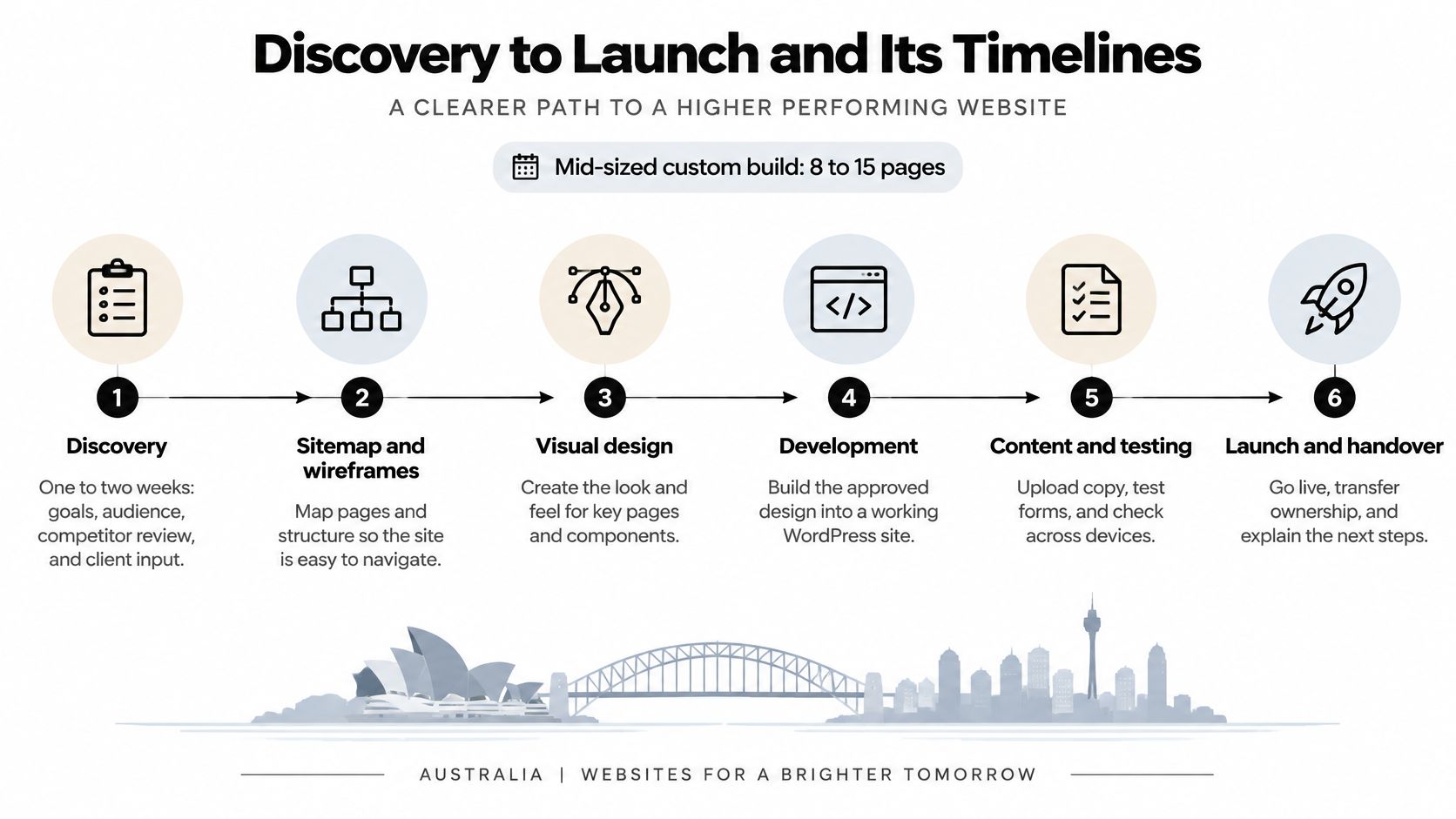
- Discovery, one to two weeks. Goals, audience, competitor review, analytics access. Your job is to hand over analytics logins, name three competitors you admire and write down what a good month looks like in numbers.
- Strategy and sitemap, one week. Page structure, calls to action and the tracking plan. You confirm priority pages and kill pages nobody needs.
- Design and prototype, two to three weeks. Wireframes first, then a clickable prototype you approve before development starts. Approve the structure, not the shade of grey.
- Build and onboarding, three to four weeks. Custom theme, content migration, forms and integrations. You supply brand assets, copy and product data, while late content causes most delays.
- Launch and acceptance, one week. Field-data speed tests, mobile and cross-browser checks, then a 14-day acceptance window after delivery. A website is accepted when you approve it, it goes live, or no revision request arrives inside that window.
- Optimise and scale, ongoing. Review enquiries monthly, fix the pages that leak, plan the next phase of content or landing pages.
Ecommerce builds add two to four weeks for product data, payment configuration and shipping rules.
The Acceptance Test That Matters
Speed is an engineering criterion, not a post-launch SEO task. An Australian benchmark of 50 transactional ecommerce websites found that only 16% passed all three mobile thresholds at the 75th percentile of real-user data: LCP of 2.5 seconds or less, INP of 200 milliseconds or less and CLS of 0.10 or less, as reported in this Australian ecommerce performance benchmark.
The causes are predictable. Heavy page builders, unoptimised hero images, third-party ad scripts and plugin sprawl all inflate rendering, interaction and layout-shift costs. Ask for CrUX field data at the 75th percentile, with mobile and desktop measured separately. A synthetic desktop score proves nothing about a visitor on a train in Melbourne.
What a WordPress Design Project Costs and Returns
Use these indicative ranges for typical projects as a starting point, not as market statistics or a substitute for written quotes. Scope, deliverables and exclusions should be clear before you compare proposals.
| Project Type | Typical Cost (AUD) | Typical Timeline |
|---|---|---|
| Brochure site, 5 to 8 pages, template-based | $3,000 to $8,000 | 4 to 6 weeks |
| Custom design, 8 to 15 pages | $8,000 to $20,000 | 8 to 11 weeks |
| WooCommerce store with products, checkout, payments and performance work | $12,000 to $35,000 | 8 to 14 weeks |
| Conversion-focused redesign with audit, rebuild and page/form testing | $10,000 to $25,000 | 6 to 10 weeks |
| Maintenance and support covering updates, backups, security and minor edits | $150 to $600 per month | Ongoing |
The biggest cost drivers are the number of unique page templates, custom functionality, product variations, and how much copywriting and data entry you provide. Ten pages built from one template can take far less work than ten individually designed templates.
Budget for third-party expenses separately. Domain names, hosting, premium plugins, software licences, Shopify fees where relevant, email services, SSL certificates and API usage charges are paid by the client. Ask for these costs to be itemised, and confirm who controls each account. After launch, you should know who owns the domain, hosting, code and performance data, and how you can access or transfer them.
How to Judge the Return
Australian online retail reached A$4.4112 billion in December 2024 seasonally adjusted, up 12.7% on December 2023, according to the ABS retail trade figures. That figure provides context, but your own traffic, conversion rate and average order value determine whether a rebuild makes financial sense.
Run the arithmetic with your numbers. A store with 5,000 monthly visitors, a 2% conversion rate and an $80 average order value generates $8,000 a month. At a 2.5% conversion rate, the same traffic generates $10,000. A $20,000 rebuild would take about 10 months to recoup that additional $2,000 a month, assuming the improvement holds and the figures are revenue rather than profit. Include costs such as fulfilment and advertising before treating the difference as a return.
For a service business, count enquiries that turn into paid work. If a $15,000 site brings in two additional jobs a month at an average of $1,200 each, the simple payback is about seven months, before expenses and delivery costs. Set the target before signing, then agree how you will track enquiries and sales after launch.
Payback test: If conservative estimates cannot plausibly return the project cost within 12 months, decide whether the spend is for brand value or whether the scope needs to be reduced.
Why a Melbourne Agency Can Be the Right Choice
A finished site can still leave you locked out of the accounts that run it. Domain registrar, hosting login, theme and plugin code, analytics and Search Console: if those sit in the agency's name, the launch is not yours yet.
Local has practical advantages that have nothing to do with patriotism. Same time zone on launch day, and a team that knows how Melbourne buyers search: suburb names, service areas, the difference between a customer in Brunswick and one in Berwick.
That knowledge shows up in small decisions. A trades site needs click-to-call on mobile, a linked Google Business Profile and forms that work one-handed. A retailer needs store hours, pickup options and product pages that still load on a phone in a shopping centre with patchy signal.
The trade-offs are real. A large national firm may carry more depth for an enterprise build with complex integrations. A specialist remote team can be cheaper for a five-page brochure site. Match the supplier to the job, then ask who holds the keys after go-live.
I would not sign until the handover is written down: registrar and DNS, hosting, WordPress admin and the code, performance data, and any ad accounts tied to the site. A website is deemed accepted if you approve the work, it goes live, or no revision request arrives within 14 days of delivery, so "we'll sort access later" is a bad plan.
If you're comparing local options more broadly, this roundup of SEO agencies Melbourne businesses use is a useful sanity check on how agencies present proof, pricing and process. Read three profiles and notice how few name a specific deliverable.
We're a Melbourne agency, and we build WordPress and Shopify sites alongside paid ads and SEO, so the site and the traffic plan sit with one team rather than two suppliers blaming each other. The same process runs remotely for Australian businesses outside Melbourne. For the build scope, see our WordPress developer services and our web design in Melbourne pages. The contact page is the fastest way to start a conversation.
Book a Free Strategy Session Before You Commit
Before you choose an agency, make sure the handover is clear. You should know who will own the domain, hosting account, website code and performance data after launch. Confirm how you'll access each one, and who handles updates once the project is complete.
Prepare a short brief with your goals, current traffic, the pages that matter most, your budget range and target launch date. Then compare three agencies against the criteria above and ask each the six questions. Focus on specific answers about ownership, scope and support, not presentation decks.
Alpha Omega Digital offers a free 45-minute strategy session to review your site and show what the team would fix, in priority order. You can also submit a project enquiry with an overview of your goals. The team will come back with clear next steps suited to your budget, timeline and growth target.
If a rebrand or personal brand shoot is part of the project, arrange imagery before design begins. Hero images can shape page layouts, so personal branding portraits from your own photos may help you plan those decisions early.
Alpha Omega Digital is a Melbourne agency offering WordPress and Shopify development alongside paid media services. Start with the strategy session to discuss what your site needs, how the handover will work, and what support is available after launch.
Alpha Omega Digital
Read more insights from our team on web design, paid ads, and growth strategy.