78% of Australian adults used Facebook in the six months to June 2024, making it the country's most widely used communication or social-media platform, according to the Australian Communications and Media Authority's How We Communicate report. No trade directory, letterbox drop or local footy sponsorship gets near that kind of daily attention for a plumber in Frankston or an electrician in Reservoir.
That number measures reach, not intent. Facebook is an interruptive channel. The homeowner is scrolling at 8pm with no burst pipe and no leaking tap, so the ad has to create the conversation rather than answer one. It suits planned work, seasonal offers, suburb-level awareness and retargeting. For emergency call-outs, search still catches people mid-problem and Facebook mostly doesn't.
Small operators already vote with their budgets. In November 2024, 59.1% of Australian small-business owners surveyed by Reckon used Facebook for marketing, and 44.6% called it their most effective advertising platform. That isn't a survey of tradies alone, but it shows the channel earns its keep for owner-run businesses paying for it out of their own pocket.
Why Facebook Ads Suit Tradies in Melbourne
The more useful number for a trade business is the gap on the other side of the fence. ACMA's research into SME marketing found that only 25% of construction and utilities SMEs were classified as e-marketers, the lowest rate among the categories examined. When most of your competitors run nothing structured, a campaign with tracked leads and a same-day callback stands out quickly.
The mechanics of a campaign are the same whether you lay concrete, wire switchboards or clear blocked drains. The differences sit in three areas: how far you'll drive, how visual the finished job is, and how fast someone picks up the phone. Answer those and the budget plan follows.
- Radius test. Do most of your jobs come from a set of suburbs you can reach in a day? If work regularly comes from 60km away, Facebook's suburb targeting will still feed you enquiries you'll decline.
- Proof test. Can a homeowner judge your standard of work from a photo of a finished job? Bathrooms, kitchens, landscaping and switchboard upgrades pass easily. Skip-bin hire and blocked drains need a different creative approach.
- Response test. Can somebody answer a new enquiry within the hour, even while you're on the tools? A lead that waits until Friday is a lead your competitor has already quoted.
Two yes answers out of three means it's worth testing. Three means the channel usually works. If the response test fails, fix the callback before you spend a dollar, because every dollar spent before that fix is wasted twice.
What Tradies Really Pay per Lead and per Booked Job
Published Australian ranges for enquiry costs spread wide, and the spread is the useful part. Get Paid Leads' breakdown of Facebook ads costs for tradies puts electrical work at $5–$30 per enquiry, plumbing and air-conditioning at $30–$80 per enquiry, and general Facebook leads at $15–$70 per lead across all trade types.
| Trade or Channel | Reported Cost per Enquiry | Source Note |
|---|---|---|
| Electrical | $5–$30 per enquiry | Published Australian trade benchmark |
| Plumbing and air-conditioning | $30–$80 per enquiry | Published Australian trade benchmark |
| All other trades, including builders and landscapers | $15–$70 per lead | General Facebook range, use until your own data replaces it |
Treat the general range as a starting budget assumption for any trade without a dedicated benchmark. Once your first month of campaigns produces real numbers, your own cost per enquiry matters more than anything published.
The same cost breakdown shows why the number inside Ads Manager is the least useful number on the screen. A cheap form fill can sit outside your service area, ask for a minor repair, or arrive with a phone number that never answers. A $60 Facebook lead converting at 12% after four follow-up calls can be less profitable than a $120 lead from a higher-intent channel converting at 40% after one call. The enquiry price means nothing until you multiply it by the work required to close it.
The Break-Even Formula That Beats Any Benchmark
Stop asking what a lead should cost and start asking what a lead is worth to you. The calculation is short:
Allowable cost per lead = average gross profit per job x lead-to-visit rate x visit-to-sale rate, minus your follow-up time.
Here is an illustrative example, built on round numbers so you can swap in your own. A job earns $800 gross profit. Half the leads you contact book a site visit, and 40% of those visits turn into a sold job. That gives $800 x 50% x 40% = $160 of expected gross profit per lead before you pay anyone to answer the phone. A $60 lead leaves $100 headroom and looks comfortable. A $120 lead leaves $40, and an hour of calling, quoting and re-calling can wipe that out entirely.
Two things fall out of that arithmetic. First, your close rate is worth more than your lead cost, because moving the visit-to-sale rate from 40% to 50% adds more headroom than any discount on enquiries ever will. Second, follow-up time is a real cost, so a trade that answers fast can profitably pay more per lead than one that calls back two days later.
Run the same arithmetic with your own margins, booking rate and close rate, then compare the result against the table. A bathroom installer with a high-value job and a 25% close rate can pay far more per lead than a plumber chasing small tap repairs, and no generic benchmark will ever tell them which is which. If you work with a Facebook ads agency on a retainer, put this number in writing before the first campaign launches so everyone judges the same scoreboard.
The only lead cost that matters is the one that still leaves profit after the quote, the drive and the follow-up call.
How to Set Up Suburb-Based Campaigns and Budgets
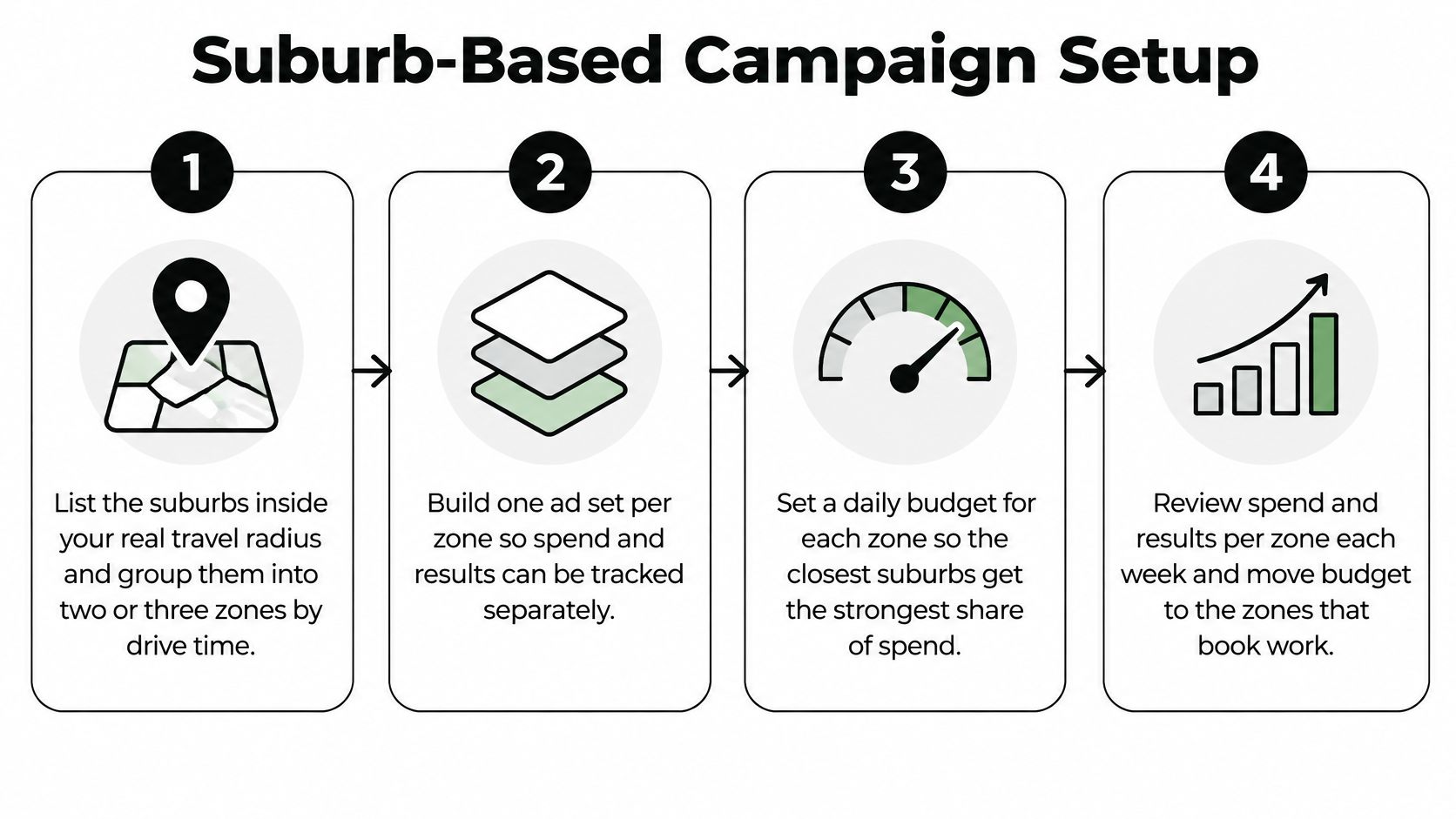
Build the account so the reporting answers the question you have: which suburbs pay, and which only cost. Six steps get you there.
- List your real travel radius, then split it into zones. Group the suburbs you'll service into two or three clusters by drive time. A circle drawn wide enough to look impressive pulls in work you can't reach in a day and inflates every cost figure downstream.
- Give each zone its own ad set. Separate ad sets mean spend, lead cost and booked jobs compare like for like. Lumping all of greater Melbourne into one ad set is the most common structural mistake, because you finish the month knowing the total and nothing else.
- Choose a lead or messaging objective. Keep the click inside the platform where someone can submit in seconds, or push them straight into Messenger. Sending paid traffic to a homepage with the phone number in the footer is where most small budgets die.
- Set the daily budget from your break-even figure. Work backwards from allowable cost per lead and the number of leads the zone needs to be readable. Copying a daily amount from a Facebook group ignores your margins, your trade and your suburb.
- Attach a conversion event that captures job type, postcode, urgency and preferred contact method. This turns a lead count into a qualification record, and it lets you import won jobs back into the platform later so Meta optimises for work sold rather than forms completed.
- Run a fixed test period and change one variable at a time. Two changes at once and you can't tell which one moved the result.
Here's the budget arithmetic for a zone that needs a real read. If a zone needs roughly 30 leads before you judge it, and your test cost per lead sits near $60, plan around $1,800 across the test, which is about $60 a day for a month. Cap each zone so one weak area can't drain the account while the strongest zone starves. Advertising budgets are paid separately unless your agreement says otherwise, and Alpha Omega Digital is responsible for campaign management only, so your media spend goes to Meta and never through us.
After two weeks a working setup looks quiet and orderly: every zone producing enquiries, and a cost per booked job you can read by suburb rather than a single blended average.
Creative That Holds Attention on a Phone
The ad is almost always seen on a phone, in a feed, beside a video of a stranger's dog. ACMA's How We Communicate findings report that 97% of Australian adults accessed the internet via mobile phone in 2025 and 92% used mobile internet daily, while Facebook reached 78% of adults and Messenger 71%. Short vertical video, offer text that reads at a glance, and a landing page that loads fast on 4G aren't optional extras, they're the basic delivery conditions.

Open with the work, not the branding. The first two seconds should show a completed job, the ute, the crew on site or the mess you cleared, because a homeowner meeting your ad mid-scroll has no idea who you are yet.
- Real job photos beat stock imagery every time. Licence details, an ABN and a couple of reviews in the frame do more for trust than a polished template of a smiling technician who doesn't exist.
- Video wants one job, one outcome. A 20-second clip of a switchboard upgrade or a bathroom strip-out holds attention longer than a montage of twelve services.
Put click-to-call or Messenger on the call to action. Messenger's 71% reach matters because plenty of homeowners would rather type a question at 9pm than call a stranger's mobile and leave a message.
Test one variable at a time: the opening shot, the offer, or the proof. Give each version enough days to accumulate data before you call it, because a two-day result on a small suburb is noise. For retargeting, build audiences from video viewers, page engagers and quote-page visitors, then exclude anyone who has already submitted so you're not paying to chase a won enquiry.
Picture an electrician running two versions. One shows a switchboard before and after, with a Book a quote button and the suburb named in the first line. The other shows a logo on a van door. The first one answers "what will you do to my house", the second answers nothing.
The three-second test: show the creative to someone who has never heard of you and ask who it's for, what they do and where they work. If they can't answer all three, the ad isn't ready.
Forms and Consent That Protect Trust and Speed Follow-Up
A form that asks for the street address, three photos and a budget range in one screen reads like paperwork, and paperwork loses leads. Australian digital marketing statistics compiled by Andava report that 43% of Australians are concerned about how companies handle their data, so every field you add is a chance for someone to close the tab.
Three Screens Instead of One
Progressive qualification solves it. Ask for what you need to route the lead, then ask for the rest once you know it's worth quoting.
- Screen one, the triage. Suburb or postcode, job type and urgency. Nothing else. This tells you whether the job is in your zone and whether it's a same-day call or a quote for next month.
- Screen two, the contact preference. Best number, best time to call, and two separate permission lines written in plain language. One covers calls and messages about the job they just asked about. The other is a genuine opt-in for future offers, and it can be declined without losing the enquiry.
- Screen three, the confirmation. State the service area you cover and the response time they should expect, with your business name visible on the screen.
Leave the street address, photos and budget ranges out until the lead has been contacted and qualified. Ask for photos later by SMS, where the conversation is already open.
What Consent Actually Requires
ACMA's guidance on consent expectations for businesses using direct marketing sets it out: businesses marketing by phone, email or SMS should obtain consent, clearly explain the marketing purpose and who will contact the person, and make withdrawal or unsubscribing easy. A quote request is permission to respond to that quote request. It is not blanket permission for every future channel, and the two consent lines above keep the distinction honest.
Put the trust signals near the form rather than on an About page nobody opens: ABN, licence number, warranty terms, the suburbs you cover, recent reviews and real project photos. ACMA also reports misinformation encounters are common on the platform, which is exactly why verifiable detail about your business reduces perceived risk.
The Lead Path After Submit
Route each lead into a CRM or automation workflow the moment it arrives, alert the person who answers quotes, and timestamp the first contact attempt. Anything less and you're measuring submissions while your competitor measures booked jobs.
Cut rule: if a question doesn't change whether you quote the job or how much you charge, delete it.
Tracking Calls and Forms Back to Booked Jobs
Tracking should connect each campaign to booked jobs and won revenue. Set it up in order, testing each step before the next goes live.
Install the Meta Pixel and Conversions API together to send form submissions and key on-site events to Meta. Configure browser events through Google Tag Manager and check that browser and server tracking do not count the same submission twice. Use preview mode to test the setup. Duplicate events inflate lead totals and distort optimisation, making enquiries look cheaper than they are.
Then make the phone measurable. A dedicated call tracking number on the landing page and in the form confirmation puts phone enquiries on the same report as form leads. Keep the campaign source attached as each enquiry progresses to a quote, booking or lost job. Otherwise, you can count calls without knowing which ads brought in paying work.
Beside Meta's numbers, track median response time, contact rate, qualified-lead rate, booked-site-visit rate, quoted-job rate and won revenue per campaign.
Read those measures together. A low enquiry cost can hide a poor close rate, while a dearer lead can still produce a profitable job. Import won jobs back into the ad platform where the technical setup allows, so completed forms are not the only result used for optimisation.
Alpha Omega Digital does not guarantee leads, ROAS or other marketing outcomes. Treat campaign figures as signals, not promises. In your monthly review, divide campaign spend by booked jobs and compare that cost with your break-even figure. Check close rate alongside it, so cheap enquiries do not disguise work that fails to cover your margins.
When to Keep Going, Pause or Scale Your Ads
Two cheap enquiries in three days is not a result. It's a sample of two, on a platform that is still learning who in your suburb responds to your creative, and far too small to read. Calling the whole channel dead at that point is the single most common way tradies waste the setup money they've already spent.
The opposite mistake costs more. Changing the audience on Tuesday, the budget on Thursday and the creative on Saturday means no signal ever settles, and you finish the month with four half-tested ideas and no answer.
Judge a campaign after two to three weeks and at least 30 leads, whichever comes later, and judge it against cost per booked job rather than cost per enquiry.
- Keep running while cost per booked job sits under your break-even figure for two consecutive reviews.
- Pause a zone that produces enquiries but no bookings, and check the leads before blaming the ads. Out-of-area forms and unanswered callbacks look like ad failure from the outside.
- Scale a zone only after it has cleared break-even with stable results across two reviews, and scale in increments rather than tripling the budget overnight.
Watch for ad fatigue too. When the same people see the same creative too often and response drops, refresh the image or video rather than throwing more money at it. A tired creative and a thin budget produce the same symptom and need opposite fixes.
Consistency is what makes this work for a trade business. A campaign that has run steadily for three months, with one change tested at a time, will almost always beat a campaign that was rebuilt four times because one week looked slow.
Apply for a Free Month of Ads Management
Alpha Omega Digital is a Melbourne-based agency that runs Google Ads for plumbers and other trades. Meta Ads management covers Facebook and Instagram ads with Pixel and Conversions API tracking, while lead generation can include ads, landing pages and call tracking.
Use the contact form to start a project enquiry. Share your goals, the suburbs you serve and your average job value. The reply will set out clear next steps that fit your budget, timeline and growth target. Advertising budgets are paid separately unless otherwise agreed, and Alpha Omega Digital is responsible for campaign management only.
Before you enquire, write down your break-even cost per booked job, the suburbs inside your real travel radius, and the last date someone chased a lead in under an hour. Those details make the first conversation practical. They also keep the focus where it belongs, on booked work and margin rather than cheap enquiries.
Jane James
Jane James is an experienced digital marketer focused on Google Ads, Meta Ads and social media. At Alpha Omega Digital she plans, builds and manages paid advertising campaigns and conversion tracking for Australian businesses, with an emphasis on measurable leads and sales rather than vanity metrics.