You can spend a month chasing clicks in Melbourne and still have nothing to show for it except a messy Search Terms report, a few form fills that never answered the phone, and a Shopify store that leaks conversions at checkout. That’s usually when business owners start looking for a Google Ads consultant in Melbourne, because the problem isn’t access to the platform, it’s getting someone who can read the numbers, fix the tracking, and stop the waste.
I’ve seen the same pattern across ecommerce stores, tradies, clinics, and local service businesses. The account isn’t “bad”, it’s just missing structure, clean conversion data, and a consultant who understands that a Google Ads account has to connect to a real website, a real phone line, and a real revenue target. Australia’s internet advertising market hit $18.4 billion in calendar year 2025, with search advertising at $8.0 billion, or about 43.8% of all internet ad spend, which tells you search is still the biggest measurable paid channel to win in Australia. That same market view noted search advertising was above $2.0 billion in Q4 2025, so demand didn’t just spike once and disappear, it stayed strong across the year. Australia’s internet advertising market and search spend
Why Hiring the Right Google Ads Consultant Matters in Melbourne
A Melbourne ecommerce owner once came to me after months of “doing Google Ads” through a generic setup. The ads were live, the budget was moving, and the dashboard looked busy, but the store was bleeding money because the consultant had treated every campaign like a broad traffic exercise instead of a conversion system. The product feed was weak, the landing pages weren’t aligned to search intent, and the account had enough clicks to create noise but not enough structure to create learning.
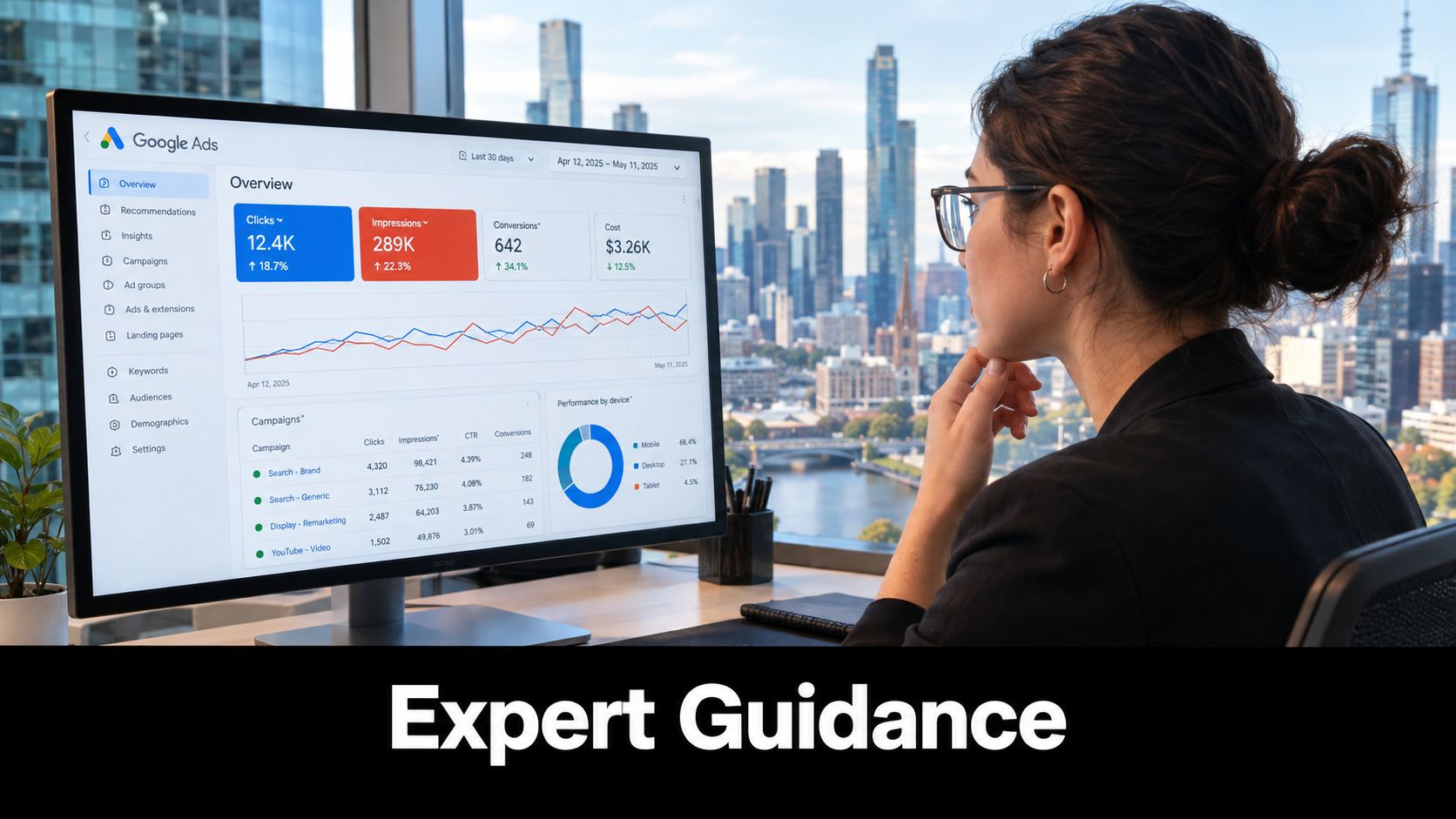
A good Google Ads consultant Melbourne businesses can trust does more than switch bids or launch Search campaigns. They connect the account to the commercial reality of the business, which means margins, lead quality, checkout friction, call handling, and whether the site can convert the traffic you’re paying for. That matters even more now that Australian CPCs sit in a tighter, more competitive range, with industry summaries for 2026 reporting average search CPCs of roughly A$2 to A$4, while some verticals such as legal and insurance can exceed A$10 per click. Australian Google Ads cost benchmarks
Media buyer versus growth partner
A media buyer can launch campaigns. A growth partner takes responsibility for the path from click to lead or sale. In practice, that means they’ll question the keyword theme, check whether GTM and Google Analytics are reading the right conversion events, look at the Shopify API or WordPress form flow, and decide whether the campaign should be judged on cost per lead or ROAS rather than vanity metrics.
That distinction matters because AI-powered campaign types have changed the job. Melbourne businesses are now buying across Search, Shopping, Performance Max, Display, and YouTube, and automation only helps if the inputs are clean. Poor tracking can make automation amplify inefficiency instead of fixing it, which is why the consultant’s real job is often to create the data environment before they chase scaling.
Practical rule: if the consultant talks about “more traffic” before they talk about conversion tracking, they’re probably selling activity, not growth.
How to Shortlist a Google Ads Consultant Melbourne Businesses Can Trust
The shortest path to a useful shortlist is to stop looking for the prettiest website and start looking for proof that the person has handled accounts like yours. For Melbourne ecommerce, that means Shopify work, feed management, Shopping structure, and landing pages that don’t leak revenue. For service businesses, it means lead-gen mechanics, form quality, call tracking, and an understanding of what happens after the click.
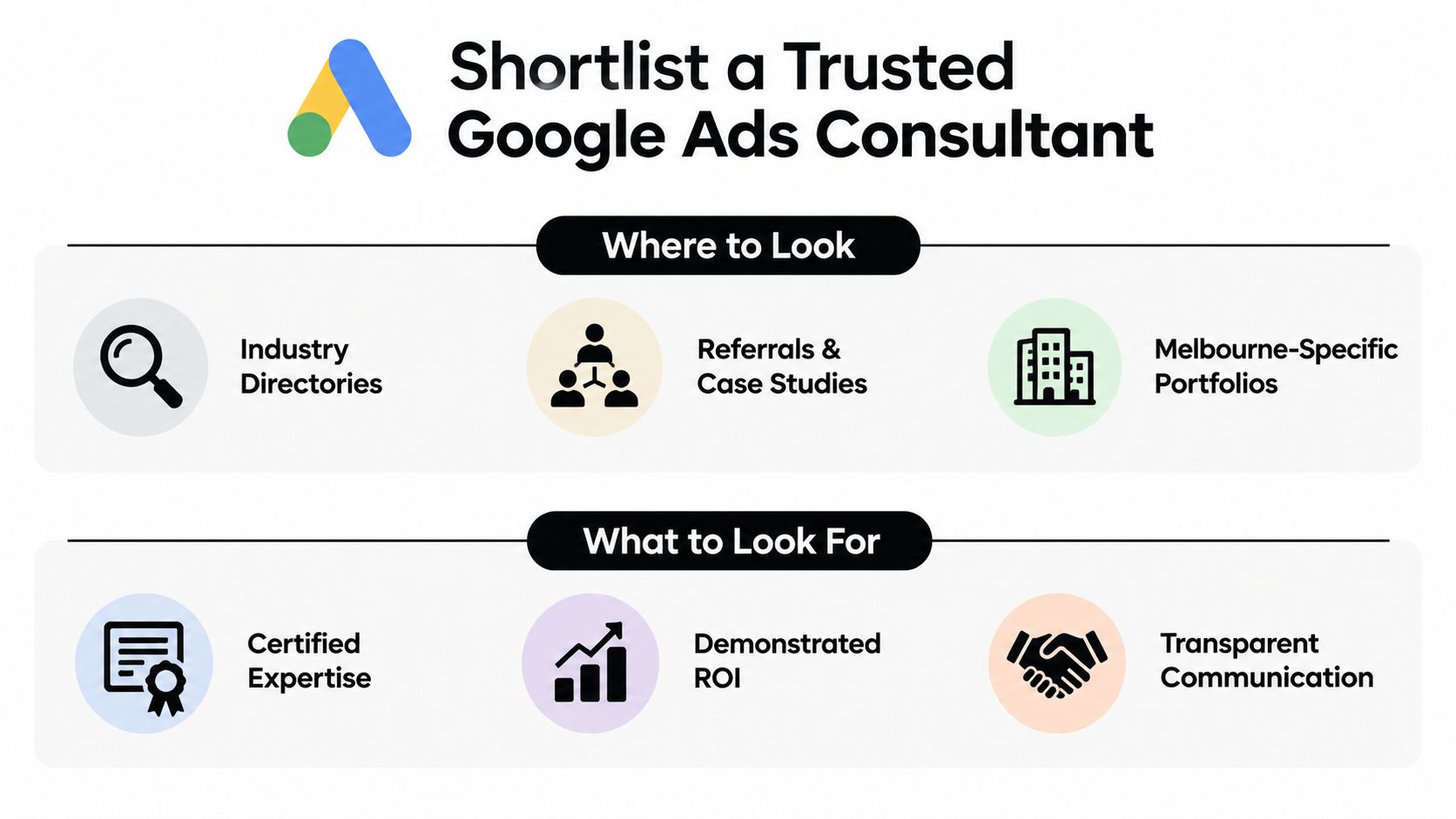
Build the shortlist from relevant proof
Start with three places. Look at industry directories, ask for referrals and case studies, and scan Melbourne-specific portfolios. If a consultant has only worked on generic national lead-gen accounts and never touched a Shopify store, you’re taking a risk by assuming they’ll suddenly understand feed quality, product segmentation, or checkout friction.
Then filter for vertical fit. A consultant who has handled tradies will usually understand booked calls, missed-call risk, and appointment flow. Someone who has worked with ecommerce should be able to talk naturally about Shopify development, product pages, collection structure, and how paid traffic lands on a site that was built for conversion, not just design.
Score the proof, not the pitch
I’d score each candidate on four things. First, whether they’ve worked in your business model. Second, whether they can explain tracking clearly without hiding behind jargon. Third, whether they know how to separate Search from Display and Shopping from Performance Max. Fourth, whether they’re willing to talk about what’s broken on the website, not just what ad copy they want to write.
A consultant who understands WordPress development should be able to talk about forms, custom blocks in Gutenberg, and how landing pages are structured. A consultant who understands Shopify design should be able to talk about product page hierarchy, app bloat, and checkout hygiene. Those are not nice extras, they’re part of the campaign result.
Look for local relevance
Melbourne search behaviour isn’t identical to Sydney, Brisbane, or regional Australia. A consultant who works locally should understand local SEO, Google Business Profile visibility, and how the ad account interacts with maps, calls, and branded search. If they also operate as a digital marketing agency Melbourne businesses can work with, ask them where paid media ends and site conversion work begins.
If the shortlist feels too broad, ask each consultant to name one thing they’d fix in the first 30 days before they spend more money. The answer tells you whether they think in systems or in slogans.
Video can also reveal a lot about process and communication. Here’s a useful walkthrough to compare how different teams explain their approach.
What to Budget and How Pricing Really Works
Budget is where most conversations go soft, because owners want a consultant to “make it work” without first defining what working means. In Melbourne, I’ve seen people try to test Google Ads with a budget that might produce some clicks but not enough signal to optimise anything useful. That’s why the right conversation is about the economics of the business, not just the monthly fee.
Australian benchmarking sources note that many small businesses begin with monthly Google Ads budgets around A$1,000 to A$2,500, which can be enough to test a conversion path but usually needs careful optimisation to produce meaningful lead volume. Other Melbourne-facing guidance suggests competitive local campaigns may need A$3,000 to A$5,000+ per month just to generate enough data for optimisation. That gap is the difference between a test budget and a scalable budget. Australian Google Ads budget benchmarks
Compare the pricing models
A flat retainer gives you predictable management cost. A percentage of spend ties the fee to budget size, which can be fine if the account is stable and mature. A hybrid model is often the most honest for Melbourne SMEs, because it keeps the management conversation separate from media spend while still acknowledging that bigger accounts usually demand more work.
The wrong pricing model is the one that creates false confidence. A cheap retainer with no tracking work can look attractive until you realise nobody is fixing the site, the tags, the feed, or the search terms. On the other hand, a very expensive consultant on a tiny budget can starve the account of data, which makes every decision guesswork.
Melbourne Google Ads Budget and Pricing Reality Check
| Business Type | Typical CPC Range | Viable Test Budget | Scalable Monthly Budget |
|---|---|---|---|
| General local lead gen | A$2 to A$4 | A$1,000 to A$2,500 | A$3,000+ |
| B2B services | About A$3.33 | A$1,000 to A$2,500 | A$3,000+ |
| Consumer services | About A$6.40 | A$1,500 to A$2,500 | A$3,000+ |
| Home services and trades | A$6.80 to A$14.20 | A$2,000 to A$2,500 | A$3,000 to A$5,000+ |
| Legal and other high-cost verticals | Can exceed A$10, and in some cases much higher | Usually too thin for a serious test at the low end | Often needs a materially larger budget |
The table above reflects Australian benchmark ranges already noted in the research brief, and it shows why a small budget can still be sensible in one industry and ineffective in another. A tradie or high-intent service business with strong margins can sometimes justify a narrower test. A high-cost vertical with long sales cycles usually needs more room to learn.
Match budget to margin and lead value
If one closed lead is worth a lot to the business, the consultant can work with a higher CPC and still land profitable results. If lead value is low, the account needs tighter targeting, better landing pages, and stricter conversion qualification. That’s also why a google ads consultant melbourne business owners hire should ask about average job size, close rate, and call handling before they talk about bid strategy.
Budget truth: if nobody can explain how a click turns into revenue, the budget is too low, the tracking is too weak, or the business model doesn’t suit paid search yet.
Interview Questions and Red Flags That Reveal True Expertise
The interview is where polished sales language either holds up or falls apart. I like to keep it to 30 minutes and make the consultant do the thinking out loud. If they can’t explain their process clearly, they usually don’t have one.
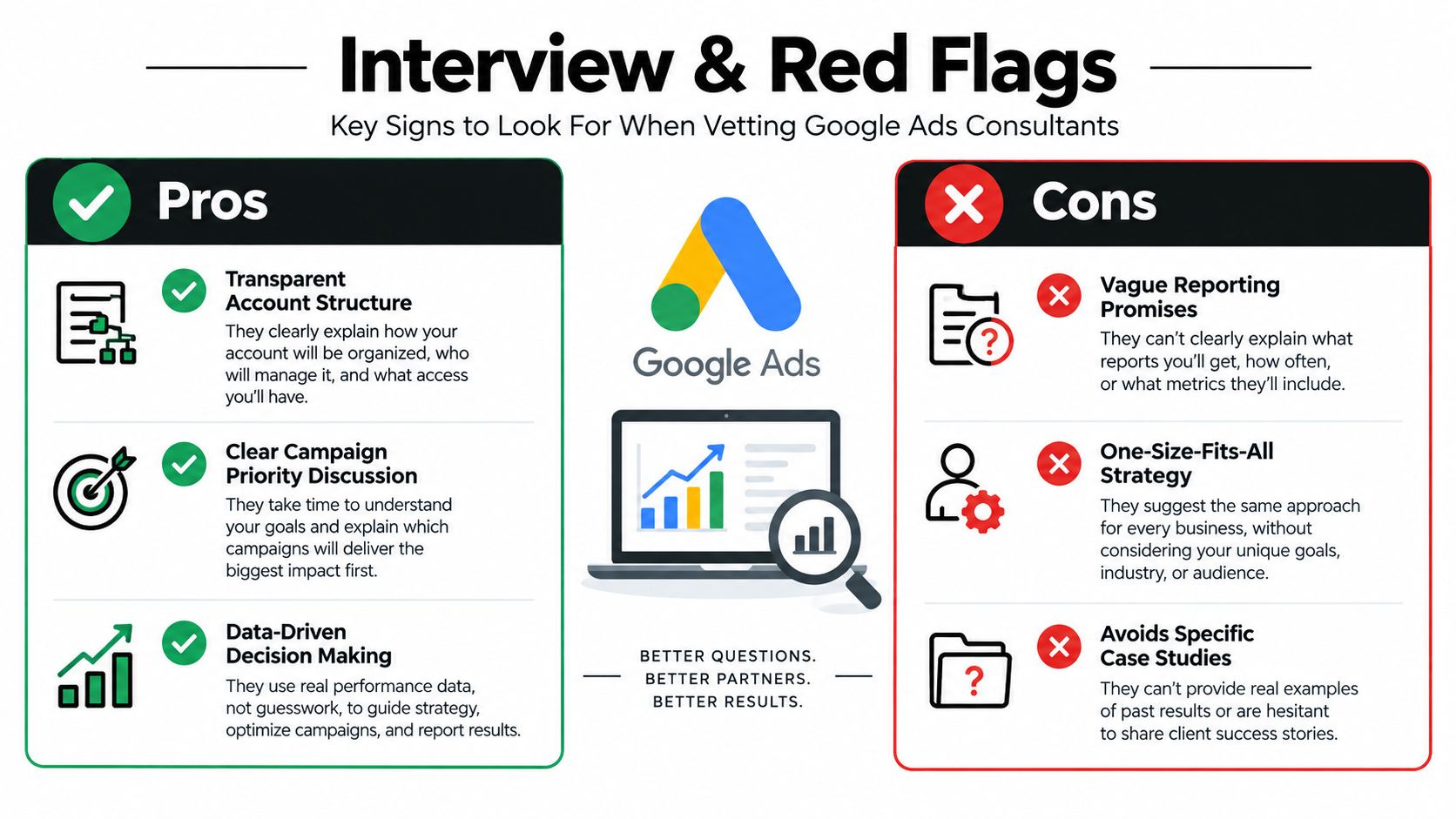
Ask about structure, not slogans
Start with this question, “How would you structure the account in the first month?” A strong answer usually talks about separating Search from Shopping or Performance Max, aligning campaigns to service or product intent, and defining what conversion event will be used as the main performance measure. A weak answer jumps straight to broad keywords, more impressions, or “we’ll test a few things.”
Then ask, “How do you handle campaign priority in Google Ads for Shopping and Performance Max?” Anyone who works in ecommerce should be able to explain how Standard Shopping priority works when the same product is eligible in multiple campaigns. Google’s Standard Shopping priority has Low, Medium, and High levels, and Google’s shopping automation guidance says Performance Max will no longer have priority over Standard Shopping campaigns in Q4 2024. The Google Ads API maps those priority values to numeric codes, Low = 0, Medium = 1, High = 2. Google Standard Shopping campaign priority Google shopping automation and priority mapping
Listen for tracking competence
Ask them how they set up Google Tag Manager containers, Google Analytics, and conversion actions. For ecommerce, ask how they would deal with Meta Conversion API installation, Shopify API events, and whether the site has reliable purchase, lead, or call tracking before budget is scaled. For WordPress, ask how they’d verify forms, thank-you pages, and duplicate conversions.
A serious operator will usually talk about data hygiene before media expansion. A weaker one will talk about creative volume before they’ve even checked whether conversions are firing correctly. If they also work on Shopify development partners style projects or custom WordPress builds, they should be comfortable discussing how site structure affects conversion measurement.
Red flags that should end the call
- Guaranteed rankings: nobody controls every auction, every competitor, or every query.
- Vague ROAS promises: if they won’t define the inputs, the output is a guess.
- No account access: if you can’t own your own ad account, walk away.
- Overbroad keyword expansion: that’s usually a sign they’re buying volume, not intent.
- Avoids specific case studies: real operators can explain what changed and why.
A consultant who also handles Facebook ads agency work should be able to explain how paid social differs from search, especially around attribution and creative testing. If they can’t separate those disciplines, they’re probably blending tactics together without a clear measurement model.
Onboarding and Reporting Setup That Sets You Up for ROI
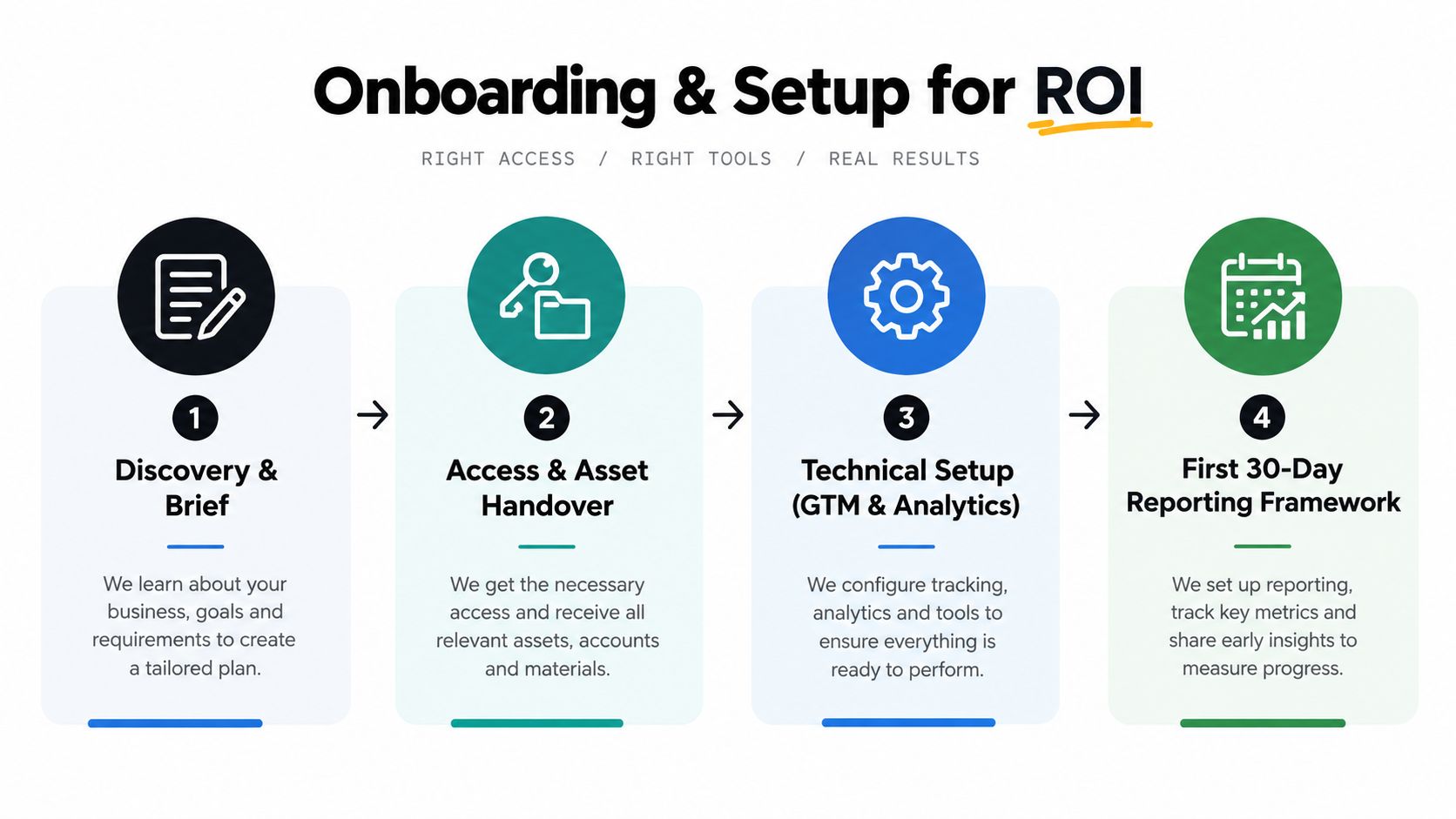
The first 30 days matter more than most business owners realise. If the setup is sloppy, the next six weeks are just a more expensive version of the same problem. Good onboarding is not admin for the sake of it, it’s the foundation that lets AI bidding, Performance Max, and search campaigns read the right signals.
What should happen in the first week
The consultant should ask for access, not assume it. That includes the ad account, Google Analytics, Google Tag Manager, Merchant Centre where relevant, the website CMS, and the phone or call-tracking platform. If the site is on Shopify, they should also look at product feed structure, theme flexibility, and whether the Shopify development setup allows clean event measurement.
If the site is on WordPress, they should check the form stack, plugin load, and whether landing pages can be edited without breaking the page layout. A good WordPress development company will usually understand that conversion pages need speed, simplicity, and fewer distractions than a brochure site. If your site needs custom sections, building custom blocks in Gutenberg can make that work easier later.
The tracking stack matters
A proper setup usually involves GTM and Google Analytics, plus conversion actions that are defined clearly enough for the consultant to optimise against revenue rather than raw clicks. For ecommerce, I want to see purchase data, product visibility, and feed health. For lead-gen, I want clean form submissions, call events, and, where relevant, tracked booking completions.
The first-party data question matters too. AI-driven bidding gets better when the consultant has reliable conversion signals and decent landing page quality, but it gets worse when the site sends mixed signals. That’s why conversion tracking isn’t a technical side project, it’s part of campaign strategy.
Reporting should be simple enough to read weekly
I prefer a report that covers these lines clearly:
- Spend: what was invested
- Leads or sales: what the campaign produced
- Cost per lead or ROAS: the primary performance lens
- Conversion rate: whether the traffic is behaving well
- Wasted spend: where the account spent money with little commercial return
If you run ecommerce, the report should also show product and campaign-level revenue. If you run services, it should show whether calls, forms, or booked appointments are the stronger path. A specialist team such as Alpha Omega Digital can sit in this category of setup and management, but the principle is the same regardless of provider, tracking has to tell the truth before scaling starts.
Reporting rule: don’t let anyone optimise to raw CTR in the early days if the business pays its bills from leads or sales. CTR can look healthy while revenue stays flat.
How to Measure Success and Decide What Comes Next
The cleanest way to judge a consultant is to ask whether the account is producing evidence, not just activity. You want to see whether the campaign is creating qualified leads, booked calls, or profitable ecommerce orders, and whether the consultant can explain why one channel is doing the heavy lifting. That’s especially important for Melbourne tradies and service businesses, where missed calls can hide the true return, and for Shopify stores, where checkout friction can distort the picture.
Call tracking is a good example. Tools like CallRail are widely used for PPC call attribution, and many Melbourne operators also build a custom phone number flow through Twilio so calls can be answered 24 hours, routed into a calendar or Calendly, and captured even when the team’s offline. That can be especially useful for tradies, hairdressers, beauty therapists, dentists, restaurants, and doctors, because the phone doesn’t get sick, tired, or miss a lead after hours.
Keep, optimise, or switch
Keep the consultant when the account is improving, tracking is clean, and they can explain the next test without hand-waving. Optimise when the data is too thin but the account structure is sensible and the conversion path is working. Switch when the consultant keeps changing tactics without fixing measurement, or when they can’t show how the spend turned into commercial outcomes.
For ecommerce, success usually lives in product-level efficiency and a cleaner path from ad to checkout. For lead-gen, success often means better call quality, better form quality, and fewer wasted clicks from broad keyword drift. Australian lead-gen benchmark data shows landing-page conversion rates can vary widely, which is why the same campaign can look excellent in one business and weak in another if the page and offer aren’t right. AU and NZ lead generation benchmarks
A simple ROI reporting template
Use one short document every month.
- Business goal: what result the campaign is meant to drive
- Traffic source: Search, Shopping, Performance Max, or paid social
- Primary conversion: sale, lead, booked call, or appointment
- Commercial result: what happened in the business, not just in Ads
- Decision: keep, scale, change, or pause
That template works whether the consultant is focused on Google shopping ads, google ads for service based businesses, or google ads for contact form submissions. It also keeps the conversation honest if you’re comparing PMAX vs Google Shopping Ads for ecommerce or checking whether your Google shopping ads not spending budget problem is really a feed issue, a bidding issue, or a structure issue.
If you’re still choosing between WordPress Design, Shopify design, Shopify development, WordPress web developer, or even support for Shopify development crash course style implementation, the same measurement standard applies. Good design and development should make paid traffic easier to convert, not harder.
If you’re running paid ads with at least a A$3,000 monthly budget, Alpha Omega Digital plans and manages Google Ads alongside WordPress and Shopify conversion work, so the ad account, the site, and the reporting all point to the same outcome. If you want a Melbourne team that works across ecommerce and lead generation, visit Alpha Omega Digital and use the contact page to start a conversation about your account.
Alpha Omega Digital
Read more insights from our team on web design, paid ads, and growth strategy.