Google held nearly 94% of Australia's general-search market as recently as August 2024, while Bing held 4.7%, according to the Australian Competition and Consumer Commission's general-search report. That's why I treat Google Ads for electricians as a phone system first and an ads platform second. If you can't answer, log, and book the calls it creates, you're not buying jobs. You're buying expensive clicks and handing the work to a competitor who picks up faster.
Electrician Google Ads Numbers to Expect
I don't judge an account on clicks. I judge it on answered calls, qualified enquiries, and booked jobs, because a click price that looks reasonable can still lose money once you follow it through to a real job.
Australian benchmark research puts electricians at a median CPC of A$21.80, with the middle range between A$14.40 and A$22.75, and a median enquiry rate of 14.0%, according to Australian Google Ads benchmark research for electricians. Divide A$21.80 by 14.0% and you get an implied cost per enquiry of about A$156 before anyone checks if that enquiry is in your service area, needs work you do, or books.
The benchmark table to check your account against
| Metric | Benchmark | What it means |
|---|---|---|
| Median cost per click | A$21.80 | Typical auction price for electrician search terms |
| Middle CPC range | A$14.40 to A$22.75 | Where most accounts land |
| Median click-to-enquiry rate | 14.0% | About one enquiry per seven clicks |
| Implied cost per enquiry | About A$156 | A$21.80 divided by 14.0%, before qualification |
| 'electrician' searches per month | About 33,100 | Broad, high-volume term |
Australians search for "electrician" approximately 33,100 times per month on Google, a figure Searchmaxxed published in 2026. That volume doesn't mean you should chase the broad term everywhere. Broad demand is wide, mixed in intent, and expensive to sort out after the click.
Urgent searches are narrower but clearer. Someone searching at night with no power doesn't want a brochure. They want a licensed sparky who serves their suburb and answers now, and the job often goes to the first call that gets picked up. An emergency click you don't answer is money gone, so check your own Melbourne auction insights, search terms, and call recordings before you set CPC targets for these terms.
A qualified enquiry has three parts: the caller is in your service area, they're asking for work you do, and they're ready to book. Anything short of that still costs you the same per click.
My rule: If a booked job can't cover your cost per qualified call after labour, materials, travel, and tax, the campaign isn't working, whatever the platform conversion count says.
Turn the benchmarks into a test budget
Don't start by asking, "What budget should I spend on Google Ads?" Start with what a job is worth to you.
- Write down your average job value: Separate emergency callouts, switchboard upgrades, and small residential jobs, because they don't carry the same margin.
- Decide your maximum cost per booked job: Use gross margin, not revenue. A high-ticket job with heavy materials costs can still be a poor ad target.
- Work backwards to cost per call: Divide your allowable cost per booked job by your expected call-to-booking rate. That's the most you can pay for a qualified call.
- Run a six to eight week test: Fund it enough to produce a judgement, not two clicks a day spread across ten services.
- Review before you scale: Check calls, search terms, suburbs, answer rate, and booked jobs in one sitting. Scale only the campaigns that produced work you want more of.
Compare your own cost per call with that implied A$156 cost per enquiry. Then ask the harder question. After unqualified enquiries, missed calls, and jobs you quote but don't win, does the booked work still pay?
How to Set Up Your First Campaign Step by Step
A tidy setup beats a clever bid strategy every time. Most wasted spend I would look for in a new tradie account comes from loose locations, lazy negatives, and tracking that counts every tap as a win.
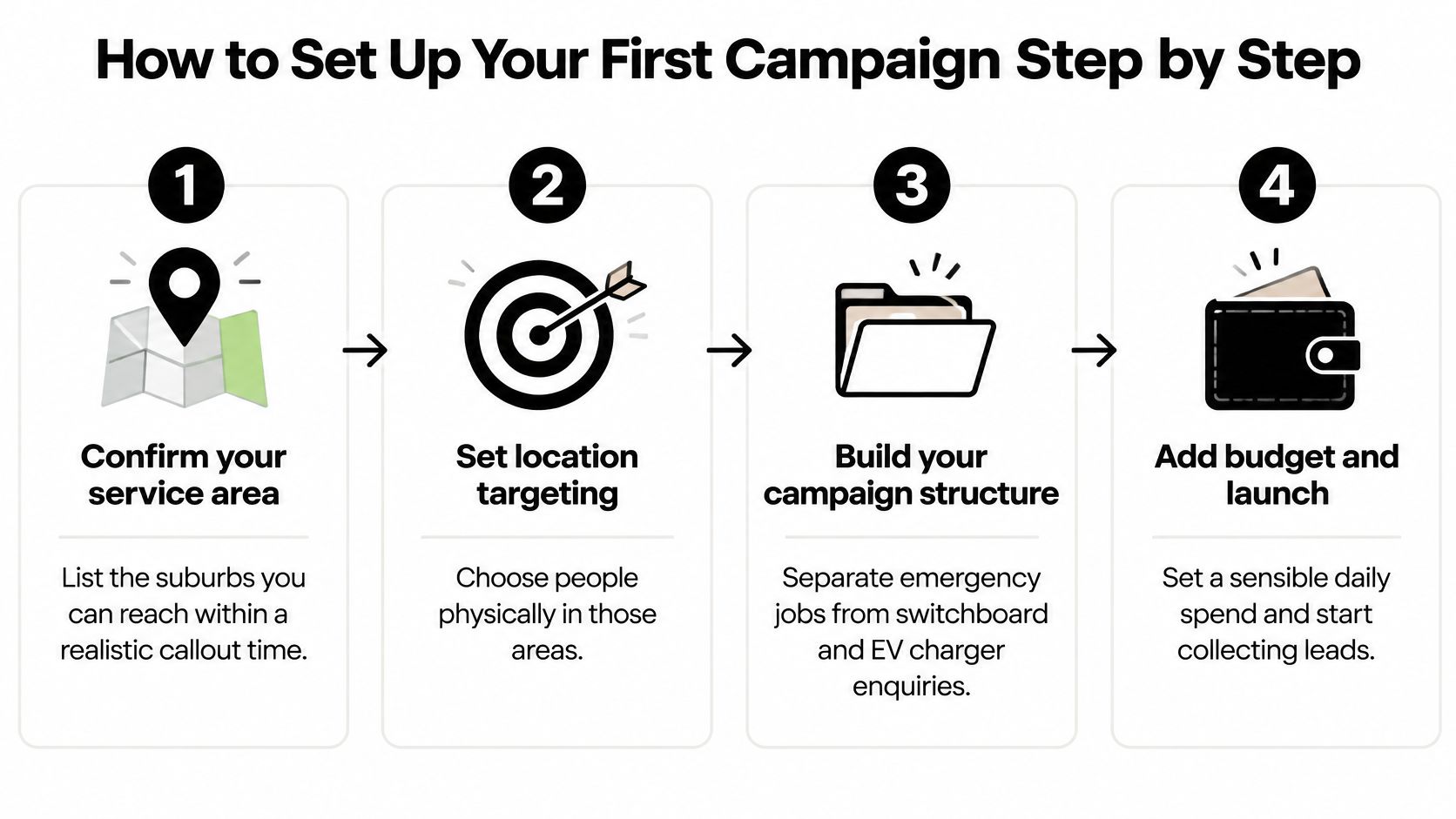
The ten-step setup
- Confirm your service area: List the suburbs you can reach within a realistic callout time. If you won't drive there for a small job at 5pm on a Friday, don't advertise there.
- Set location targeting to presence: Choose people physically in those areas, not people merely interested in them. This is the most common leak in local PPC for tradies, because interest targeting pulls clicks from researchers, former residents, and people planning a move.
- Verify your Google Business Profile: Your map listing sits alongside paid results for local searches, so make sure your name, phone number, hours, service area, photos, and reviews match your ads and site. Mismatches create doubt at the exact moment someone's choosing who to call.
- Create the account with two campaigns only: Start with one emergency campaign and one planned-work campaign. Set a monthly budget that gives you several weeks of usable data. Ten campaigns with tiny budgets teach you nothing.
- Install conversion tracking properly: Use Google Tag Manager and Google Ads together, count form submissions separately, and count calls only after a minimum duration such as 60 seconds. If you're building skills in-house, a structured resource like a London School of Business Administration marketing credential can help you understand why tracking decisions matter, but you still need to test every tag in your own container.
- Add a call asset: Use your local number, enable call reporting, and check that calls from ads are logged as their own conversion action. Don't let a 12-second wrong number train your bidding.
- Build tight ad groups: Start with exact and phrase match around one service theme per ad group. Add a starter negative list for apprenticeship, salary, course, jobs, DIY, wholesale, and training terms before you spend a dollar.
- Point each ad group to a matching page: Emergency ads go to an emergency page. Switchboard ads go to a switchboard page. Sending everything to the homepage forces the visitor to do the sorting work you should've done.
- Schedule ads to answered hours: If nobody picks up after 6pm, don't run call-focused ads at 9pm and hope voicemail saves you. It won't, not reliably.
- Review search terms after seven days: You're looking for irrelevant queries, suburbs outside your patch, and services you don't offer. Add negatives, tighten match types, and fix location settings before you touch bids.
What a healthy first two weeks looks like
You should see logged calls with durations you can listen back to, relevant search terms that sound like buyers, and no spend outside your service area. Your forms should be firing once per submission, your call asset should be recording, and every lead should be traceable to a campaign.
You don't need perfect data in week one. You need clean enough data to make the next decision. If you can't tell which campaign produced a booked job, pause and fix tracking. Optimising blind is just spending with confidence.
Which Keywords and Campaigns to Split Out
One broad campaign mixes a homeowner with a sparking switchboard, a landlord booking smoke alarms, and a shopfitter planning a fit-out. Those people need different pages, different follow-up, and different bids.
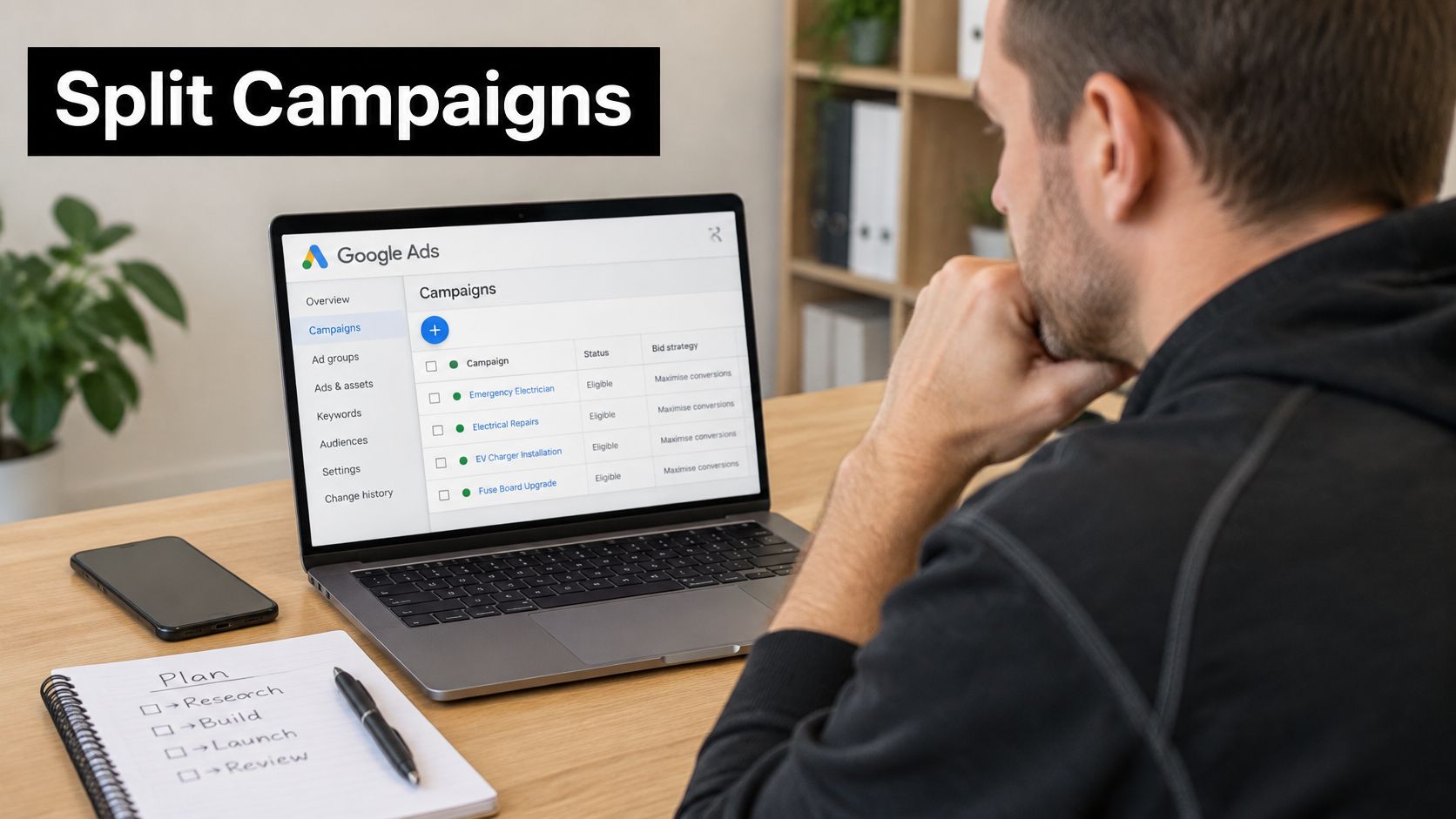
A ClickClick Media playbook for electricians identifies distinct search-demand groups such as emergency work, planned residential jobs, switchboard upgrades, EV-charger installation, solar connections, smoke alarms, and commercial electrical work. That split matters because an emergency query needs immediate phone access while an EV charger query needs technical qualification and a quote pathway.
Campaign split by search intent
| Campaign | Example searches | Landing page focus | Conversion to count |
|---|---|---|---|
| Emergency and after hours | emergency electrician, 24 hour electrician, power outage electrician | Click-to-call, suburbs served, availability | Qualified call of 60 seconds or more |
| Planned residential | electrician for home rewiring, lighting installation, power point installation | Quote request, photos, licence number | Form submission and booked job |
| Switchboard upgrades | switchboard upgrade cost, switchboard replacement electrician | Technical overview, safety certificate | Quote request |
| EV charger installation | EV charger installation Melbourne, home EV charger electrician | Charger options, install process | Quote request and booked site visit |
| Smoke alarm installation | smoke alarm installer near me | Fixed-price service, online booking | Booked job |
| Solar connection | solar connection electrician, solar battery electrician | Connection process, licence, inverter experience | Qualified quote request |
| Commercial electrical | commercial electrician Melbourne, shop fit out electrician | Capability, insurance, project examples | Qualified enquiry |
Build in that order. Emergency first if you can answer and attend quickly, because intent is clearest there. Planned residential next, but keep rewiring and lighting separate if the job values differ. Switchboard and EV charger work usually needs more detail on the page, a site-visit step, and slower follow-up, so don't judge those campaigns on same-day calls alone.
Smoke alarms can work well as a fixed-price, bookable service because the customer often wants compliance sorted with minimal back-and-forth. Commercial work is different again. The buyer may be a builder, facilities manager, or shop owner, and they'll look for insurance, capacity, and reliability before price.
The short walkthrough below is useful if you're reviewing how your account structure looks in practice before you rebuild it.
Negatives and the Local Services Ads trap
Add negatives for employment, training, DIY, wholesale-product, and unrelated appliance-repair searches. Broad match will happily spend your budget on people who can't become customers if you let it.
Split a group into its own campaign when its lead value, urgency, or landing page differs. Merge it when only the wording of the search differs.
Don't copy US advice about Local Services Ads and assume a pay-per-lead shortcut is waiting for you. Google's Australian Local Services Ads help documentation doesn't establish Australia as an eligible market, so I wouldn't build a Melbourne plan around a product you can't reliably buy.
Build the split Search campaigns instead. Judge each one by cost per qualified call or cost per booked job. That's the same discipline a pay-per-lead model would force on you, and it stops a cheap enquiry campaign from looking better than a profitable one.
Emergency Campaigns and After-Hours Ads
Emergency work is where Google Ads can pay quickly, and where it can burn money fastest. The maths looks simple until you remember that clicks don't answer phones, drive vans, or convert themselves into paid callouts.
An Australian keyword analysis for electricians reports estimated CPCs of about AUD $9.16 to $15.16 for emergency terms, with a AUD $1,500 monthly budget buying roughly 99 to 164 clicks before auction variation and invalid clicks. Use that range for planning, then replace it with your own data as soon as you have several weeks of it.
Emergency budget and estimated clicks
| Monthly budget | Clicks at A$9.16 | Clicks at A$15.16 |
|---|---|---|
| A$1,500 | About 164 | About 99 |
| A$3,000 | About 327 | About 198 |
Those click counts aren't the decision. Your decision is cost per qualified call and booked-job rate. A cheaper click that rings a dead phone, hits the wrong suburb, or asks for appliance repair is worth nothing.
Operating rules in the order they affect spend
- Set up call assets and call reporting first: Count a call as a conversion only after a minimum duration or receptionist qualification. A pocket dial shouldn't shape your bids.
- Schedule around genuine availability: If you answer from 7am to 9pm, run emergency ads in those hours. Overnight, either suppress traffic or send people to a page that clearly promises a morning callback.
- Use honest ad messaging: Don't say "24/7" if a tired on-call phone might ring out. State your response window and service area plainly, and you'll get fewer furious tyre-kickers.
- Make the page answer fast: Show suburbs served, licence credentials, safety guidance, dispatch expectations, and a prominent click-to-call button. On mobile, the phone action should be visible without scrolling.
- Protect missed calls: If your team can't cover every hour you advertise, look at an after-hours answering service as one way to capture details instead of letting urgent callers move to the next ad. Check that any service you use logs the call source and hands the job to you quickly.
- Review search terms weekly: Emergency campaigns attract odd queries because the language of urgency overlaps with DIY fixes, power company issues, and appliance faults. Cut them early.
Say a Melbourne sparky answers from 7am to 9pm, covers the inner east, and wants fault-finding and loss-of-power jobs. I'd run emergency ads only in those hours, only in reachable suburbs, and only to a page built for urgent calls. Outside those hours, I'd either pause the ads or use a callback promise I can keep.
After several weeks of search-term and qualified-lead data, set a target cost per acquisition based on booked jobs, not hopes. Scale spend only when the call handling can absorb more volume. More budget into a missed-call problem just creates a bigger missed-call problem.
Landing Pages and Call Tracking That Win Jobs
Your landing page has one job. It needs to convince a stressed or busy person that you're licensed, local, available, and easy to contact, then get out of the way.
What the page must show
- Suburbs you serve: Name them, don't hide behind "Melbourne-wide" if you only cover part of Melbourne.
- Licence number and business details: Put them where a cautious homeowner can find them without hunting.
- Realistic response times: Say what you can do, including after-hours limits.
- One clear phone button: Make it sticky on mobile and use your tracked number consistently.
- A short booking form: Ask for name, phone, suburb, service needed, and urgency. Every extra field costs you enquiries.
- Recent reviews and job photos: Real switchboards, lighting installs, and completed work beat stock photos.
- Fast mobile load: Compress images, remove heavy sliders, and test the page on a mid-range phone over mobile data.
Test it like a customer. Tap the ad, wait for the page, call the number, submit the form, and check where each event lands. If your team can't find the enquiry in the CRM, inbox, or calendar within minutes, the page isn't finished.
Call tracking that proves which ads booked the job
Use a tracking number that logs call duration, the campaign or keyword that produced the call, and whether the call was answered or missed. Some electricians use a dedicated tool such as CallRail, others prefer a follow-up platform such as GoHighLevel, and you can compare call tracking platforms for 2026 if you're weighing recording, attribution, and CRM features side by side.
Another option is a custom Twilio number that logs every call, sends a missed-call text, and writes bookings into your calendar or Calendly. That's the setup I like when a business needs the phone system and the ad tracking to work as one piece. It can answer around the clock and never gets sick or tired, so an emergency call at 2am gets picked up as reliably as one at 2pm.
When we set this up, it sends a missed-call text, books appointments straight into your calendar or Calendly, and logs each call against the campaign that produced it. The same logic suits other businesses that lose calls after hours, including hairdressers, beauty therapists, dentists, restaurants, and doctors, where a few missed bookings can cost thousands in lost business.
Choose on fit, not features: You need call recording if you coach receptionists, a CRM hand-off if multiple staff follow up, and automated booking if missed calls are your main leak.
Close the loop with job-level attribution. Import booked-job value back into Google Ads so, for example, a A$2,400 switchboard upgrade in a worked scenario is credited to the search that produced it. Then your bidding learns from profit, not from raw calls, form spam, and short conversations that never become work.
Diagnose Wasted Spend Fast
Spend is climbing but the phone is quiet. Don't rebuild everything in a panic. Match the symptom to the likely cause, fix the leak that makes you pay for clicks you cannot serve, and give that change time to show up in calls.
Electrician Google Ads symptoms, causes and fixes
| Symptom | Likely cause | Fix |
|---|---|---|
| Clicks but no calls | Location set to interest, generic landing page | Switch to presence targeting and match each page to its ad group |
| Many calls, few jobs | Calls unqualified or answered late | Log call duration, call back missed calls within minutes |
| Spend on apprentice and salary searches | Broad match with no negatives | Add negatives and move keywords to phrase or exact match |
| No conversions for 14 days | Conversion action unlinked or tag not firing | Test the tag and confirm the call conversion is recording |
| Budget gone by midday | Daily budget too small for the auction | Lower bids on low-value terms or raise budget on emergency campaigns |
| Clicks from outside service area | Location targeting too broad | Set presence-only targeting and exclude distant suburbs |
| High CPC on emergency terms | Ads running outside answered hours | Shrink the schedule to answered hours and test bid adjustments |
Start with clicks but no calls, because it's the symptom owners notice first and misdiagnose most often. Check location settings before you blame ad copy. If targeting includes people interested in your suburbs, you can pay for clicks from people who aren't there. Switch to presence targeting as a same-day fix, then check whether each ad group lands on a page that matches the search.
Many calls, few jobs is usually a handling problem, not an ads problem. Listen to recordings, check duration, and look at how fast missed calls get a callback. If your receptionist is qualifying hard but the jobs are wrong, the search terms or page promise may be off. If good callers hit voicemail, fix coverage before you buy more traffic.
Spend on apprenticeship and salary searches is a same-day cleanup. Add the negatives at account or campaign level, review broad match search terms, and move core terms back to phrase or exact match until query quality improves.
If you've had no conversions for 14 days, don't assume demand vanished. Test the tag in Google Tag Manager, place a real call, submit the form, and confirm the conversion action records once. A broken tag can make a profitable campaign look dead and push you into bad decisions.
A budget gone by midday needs a slower look. It may mean your daily budget is too small for a competitive emergency auction, or that low-value terms are eating the morning. Lower bids or pause the low-value terms first. Raise the emergency budget only if answered, qualified calls are already there.
Clicks from outside your service area and high emergency CPCs outside answered hours are both same-day targeting fixes. Exclude distant suburbs, tighten radius or suburb lists, and shrink the schedule. Bid changes, page rebuilds, and new campaigns are several-week changes. Make the fast fixes first, then judge the rest on booked jobs.
Book a Strategy Review
You've got two sensible paths from here. Build the split campaigns, landing pages, negative lists, and call tracking yourself, or get help from a marketing agency in Melbourne that works on Google Ads for service-based businesses every week.
Alpha Omega Digital is a Melbourne digital marketing agency that plans, launches, and optimises Google Ads campaigns for Australian businesses, including electricians and plumbers. The wider team covers WordPress development, Shopify development, web design, SEO, and Meta advertising for businesses that need the site and the ads to work together.
If you want help building the structure covered in this guide, start with our Google Ads agency service. We offer a free 45-minute strategy session where we review your site and show exactly what we'd fix, so you can see the priorities before you commit to ongoing management. You can book through our contact page, and advertising spend is paid separately from the management service unless otherwise agreed.
Bring your numbers when you get in touch. Service area, average job values, call answer rate, current CPCs, and booked-job data if you have it. That information shapes whether your budget can compete in an emergency auction or whether the first win is fixing coverage, tightening the suburb list, or rebuilding the page your ads land on.
We can't guarantee enquiries, rankings, or revenue, and you shouldn't trust anyone who does. Judge any test on your own answered calls, qualified enquiries, and booked jobs. That's the standard your ads need to meet, with or without an agency.
If you're an electrician weighing up Google Ads, visit Alpha Omega Digital to book your free 45-minute strategy session and get clear next steps that fit your budget, timeline, and growth target.
Alpha Omega Digital
Read more insights from our team on web design, paid ads, and growth strategy.