You're looking at a Google Ads account that spent a bit over two thousand dollars last month, logged twenty-one form submissions, and you still can't answer the only question that decides whether any of it was worth doing: which of those enquiries turned into money in the bank?
That gap is where most pest control campaigns live. The dashboard reports conversions. The invoices tell a different story. Somewhere between a termite inspection in Doncaster that became a $2,400 treatment and a one-off cockroach spray in Werribee that cost you more in travel than it earned, the account is either making money or bleeding it.
Paid search works for pest control because the searches are urgent, local and specific. It fails when the campaign is judged on clicks, cheap leads or platform-reported conversion counts instead of profit per booked job after close rate. Everything below is written from that position: margin first, compliance second, and vanity metrics last.
Before you touch a keyword, list three things. The suburbs you can reach and service within a day, the pests you can treat safely and legally with the technicians you employ, and the hours your phone is answered by a person or a system that books work. Those three limits decide which searches are worth buying, and no bidding strategy rescues a campaign that ignores them.
Why Pest Control Searches Are Worth Paying For
Start with the size of the category, because it explains why paid search has so much room in it. The Australian Bureau of Statistics reported that the broader building cleaning, pest control and other support services subdivision generated $17.0 billion in sales and service income in 2016-17, an annual increase of 4.8%, and that services accounted for $15.5 billion, or 91.2%, of that income. That is the whole subdivision, not a pest-only total, so treat it as a floor rather than a promise. The direction still matters: households and businesses buy visits, inspections and treatments, not products on a shelf.
Now picture the moment that generates the click. It's 9pm, something is moving behind the kitchen kickboard, and the homeowner has a phone in one hand and a torch in the other. They don't read a brand story. They search, they tap the first result that says same-day service in their suburb, and they call.
The business that answers wins that job, not the business with the nicest logo.
This is why broad awareness campaigns rarely pay for themselves in pest control. A video about preventative spraying might build familiarity over a year, but it doesn't produce a booked callout on a Tuesday night. Paid search intercepts the person at the point of decision, which is exactly when the willingness to pay is highest and the comparison shopping is shortest.
The decisions that determine whether the account works arrive in a fixed order. How campaigns split by pest problem. What a booked job is allowed to cost after close rate. What you can legally claim and display. How calls get tracked and answered out of hours. How enquiry data gets handled once it's in your CRM. And how offline job outcomes get fed back so bidding learns from revenue rather than form fills.
Get that sequence right and the account compounds. Get it wrong and you spend a fortune learning that a $9 click can buy a $60 job.
Campaign Structure for Each Pest Problem
One campaign per service intent, one landing page per campaign, one conversion you can trace to profit. That is the whole structure in a sentence.
| Service intent | Example search | Landing page | Conversion to track |
|---|---|---|---|
| Emergency pest control | emergency pest control Melbourne | Same-day callout page with licence number | Phone call over a set duration |
| Termite inspection | termite inspection Melbourne | Inspection booking page | Booked inspection imported offline |
| Termite treatment | termite treatment cost | Treatment scope page | Completed treatment and job value |
| Cockroach or rodent treatment | cockroach treatment | Service page for each pest | Quote form plus booked job |
| Prevention research | how to stop mice getting in | Guide content, not a sales page | Engaged visit, reviewed for lead quality |
The emergency row is a different animal to the rest. Someone with a rat in the ceiling at 10pm converts on speed and availability, so the page needs opening hours, a tracked number and a booking action above the fold. Blend it with termite research traffic and you'll blunt both.

Why termite inspection deserves its own economics
Termite work is where the profit sits, and search behaviour reflects it. Termite-related queries make up a large share of pest control search demand in Australia, and inspection and treatment searches carry enough commercial intent to justify dedicated campaigns rather than a shared ad group.
Here is the trade-off nobody puts in a benchmark report. An inspection click may not produce a booking on the same day, and judged purely on cost per lead it looks worse than a cheap spray job that converts in one call. But the inspection is the door to the treatment, the treatment is the five-figure job, and the spray is a rounding error with a van trip attached. Lumped into one campaign, automated bidding averages the two together and funds whichever lead is cheaper, which is usually the one worth least.
Practical rule: judge a campaign on profit per qualified job after inspection, travel and treatment scope, never on cost per lead. A $140 inspection lead that converts at 35% into a $2,000 treatment beats a $45 lead that converts into a $180 spray.
That means inspection, treatment, prevention, emergency infestation and species-specific intent each need their own ad groups, their own landing pages and their own offline conversion imports.
The filters that keep budget where it belongs
Negative keywords do quiet, unglamorous work. Add them at the account level so nothing leaks:
- DIY and product intent: how to get rid of, bunnings, bait station, trap, spray bottle, home remedy.
- Employment and study: pest control jobs, pest control course, apprenticeship, resume, salary.
- Free information and identification: what do termite droppings look like, is this a cockroach, free inspection, government assistance.
- Out-of-area searches: suburbs you won't drive to, other capital cities, interstate terms, "near me" queries from outside your radius.
Location targeting should be set to presence, not presence or interest, and limited to the municipalities you service. A termite job in Frankston is worth driving to. A mouse enquiry in Cairns is a donation to Google.
Every headline should mention the pest and the suburb served, and every call extension should direct to the tracked number assigned to that campaign group, allowing calls to be traced to their specific keyword rather than ending up in a single undifferentiated pile. Before you finalise your own split, compare pest control PPC agencies to see how other operators structure their service tiers and which conversions they treat as the primary goal.
Budget Benchmarks and What a Booked Job Costs
Australian trades and home services have a reasonably consistent cost structure in Google Ads, and it's the closest honest proxy for pest control.
| Metric | Median | Range |
|---|---|---|
| Cost per click | A$9.66 | A$9.15–A$12.00 |
| Platform conversion rate | 10.5% | 6.1%–11.3% |
| Cost per conversion | A$105 | A$91–A$296 |
Those figures come from a dataset of 25 Australian Google Ads accounts reported in Australian Google Ads statistics for trades and home services. Read the number properly: A$105 is media spend per recorded conversion, before you've checked whether the caller was in your service area, whether the quote was accepted, whether the job was cancelled or whether the customer paid.
The close-rate arithmetic that decides everything
Here's the calculation I run before recommending a budget. Take the median of A$105 per conversion and a 40% close rate on qualified leads at an average gross profit of A$300 per job. Each lead is worth A$120 in gross profit (0.40 × A$300), which leaves about A$15 after the media cost and before overhead, vehicles, chemicals and admin.
Now drop the close rate to 25%. The same lead is worth A$75, and at A$105 a conversion you've lost about A$30 per lead before anyone picks up a sprayer.
That single line explains why two pest control businesses in the same suburb, running near-identical campaigns, get opposite answers on whether Google Ads works. The difference is usually how fast they answer the phone and how well they quote, not the keyword list.
Building the budget from jobs backwards
Don't start with a monthly spend. Start with capacity.
- Set the number of booked jobs you can serve in a month without breaking the schedule. Say it's 25 extra jobs.
- Divide by your expected close rate on qualified leads to get the leads you need. At 40%, that's roughly 63 leads.
- Multiply by your cost per conversion to size the media budget. At A$105, that's around A$6,600 a month.
- Sanity-check against gross profit. 25 jobs at A$300 gross is A$7,500, which leaves a thin margin. Push average job value up with termite and commercial work, or improve close rate before scaling spend.
- Hold the plan for four to six weeks before judging it, because offline conversions lag and bidding needs volume to learn.
Two commercial facts matter here. Advertising budgets are paid separately unless otherwise agreed, and the agency is responsible for campaign management only. Nobody can guarantee a specific CPA, ROAS, enquiry count or sales figure, because the variables include your pricing, your answer times and your competitors' behaviour. Treat month one as a test range with a defined ceiling, not a forecast.
Licence and Claim Rules to Check Before Launch
A suspended ad account is bad. A regulator's attention is worse, and it can cost more than a year of ad spend.
Pest-control licensing and advertising rules are set at state and territory level, and they are not uniform. Licence-display requirements, who may perform pest-management work and what an ad may claim all vary between jurisdictions, and penalties for advertising services the operator is not licensed to deliver can be severe. Confirm the current requirements with the relevant regulator in every state or territory you plan to advertise into, because the obligation sits with the advertiser rather than the platform.
What does not vary is where the risk lives. Your ad assets, landing pages, call scripts and location extensions all carry the claim, and all of them need checking before the first impression is served.
A pre-launch checklist that takes an hour
- Confirm the licence for every technician, in every state you advertise into, not just the state where your office sits.
- Display licence numbers where required: in ad copy or callouts where space allows, and always on the landing page near the booking form.
- Audit headline claims. Guaranteed eradication, permanent protection, chemical-free, child-safe and pet-safe all need to be legally supportable and operationally delivered, or they come out.
- Brief the people answering the phone so they do not promise an outcome the technician will not deliver, especially on termite work where the treatment scope depends on an inspection.
- Show the limits on the page: treatment scope, safety instructions, warranty terms and emergency availability. Post-click uncertainty kills more bookings than price does.
- Split campaigns by state or municipality so location-specific claims and licence details stay accurate rather than averaged.
If a claim needs a footnote to be true, it is not worth the risk in a 30-character headline.
Two things improve when this is done properly. The account stops carrying regulatory exposure it never needed, and the landing page becomes more convincing, because a visitor can verify who is licensed, what is included and what result is realistic before they dial. Compliance work doubles as a conversion asset, which is not a sentence you can write about most advertising admin.
A booked job only counts as profit if the licence behind it holds.
Tracking Calls and Answering After Hours
Pest control is phone-first. A homeowner with a wasp nest by the front door doesn't fill in a three-field form and wait for a reply.
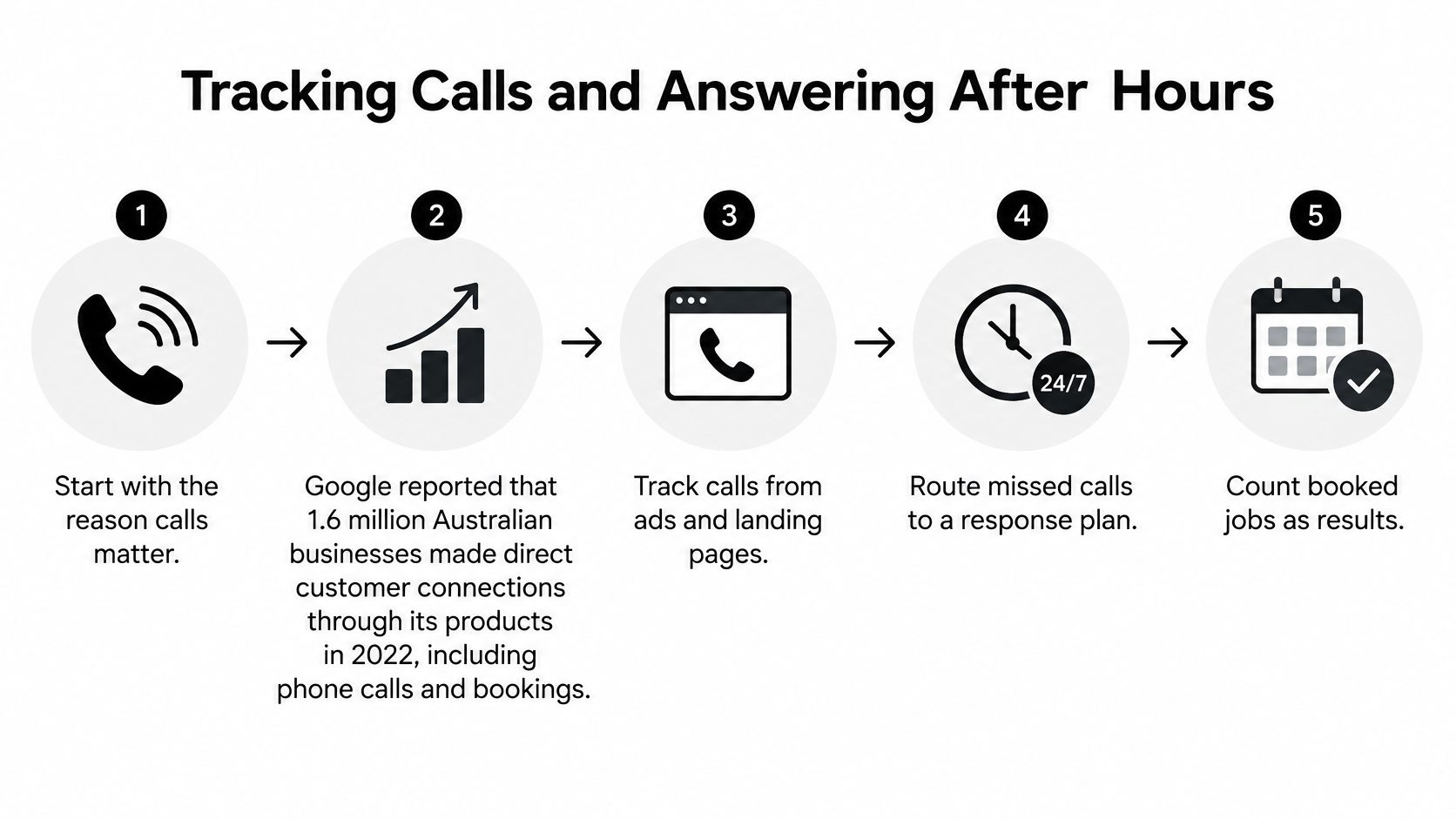
The scale of that behaviour is visible in Google's own figures. The company reported that 1.6 million Australian businesses made direct customer connections through its products in 2022, including phone calls and bookings, per Google's research on how Australians connect with local businesses. That figure covers directions, calls, bookings and reviews across all sectors, not pest control specifically, but it tells you where the intent goes.
The call setup, in order
- Buy a local Australian number in Twilio for each campaign group. A dedicated number per group is what lets you see which pest and which suburb produced the call, and it keeps your main business line clean.
- Build a call flow that forwards to the on-call mobile. Route by time of day so the 7am caller and the 11pm caller hit different paths.
- Set a call-duration threshold as a conversion action in Google Ads, typically 60 seconds. Anything shorter is usually a wrong number, a competitor or a hang-up, and counting it teaches the algorithm to chase rubbish.
- Push the call record to your CRM by webhook: number dialled, keyword, suburb, duration and outcome. Attribution lives or dies here.
- Configure an after-hours flow that answers 24 hours a day, captures suburb, pest type and urgency, then offers a callback window or books the job on the spot.
- Book straight into the team calendar or Calendly so the job exists before anyone speaks to the customer.
- Review missed calls and unbooked callers weekly. This is the highest-return hour in the whole account.
What an answering system genuinely fixes
The case for automated answering isn't novelty, it's arithmetic. A phone system never gets sick, never takes a lunch break and never sounds tired at the end of a heavy day in January. Every unanswered call during a heatwave is a job that went to the next advertiser, and you paid for the click that produced it.
That lost-business problem isn't unique to pest control. The same setup saves bookings for tradies, hairdressers, beauty therapists, dentists, restaurants and doctors, all of whom lose revenue to a phone that rings out at the wrong moment.
Where automation stops: complex quotes, complaint handling, suspected structural damage and anything involving a distressed customer still need a person. Use the system to capture, qualify and book, then hand the hard conversations to someone who can think.
What a working setup should show you at the end of the month: every booked call tied to its keyword, its suburb and its scheduled job. If a call can't be traced to a search term, the tracking is decorative.
Consent and Remarketing for Enquiry Data

Most Google Ads guidance stops at keywords, location targeting and cost per lead. Very little of it deals with what you do with the enquiry afterwards, which is where pest control gets uncomfortable.
A pest enquiry is not a newsletter signup. It carries a name, a street address, details about the property and a description of an infestation. That combination is more sensitive in context than a retail enquiry, and it's collected fast, often from someone who is stressed and not reading carefully.
Under Australia's current privacy framework, direct marketing generally requires that the person consented or would reasonably expect the use, that communications include a simple opt-out method, and that opt-out requests are honoured, as the DLA Piper data protection guide for Australia sets out. Proposed reforms would go further, explicitly covering targeted online advertising and requiring consent for some trading or sharing of personal information for direct marketing.
Read that as a design constraint, not a compliance chore. The accounts that stay safe are the ones built around privacy-safe first-party conversion data rather than unlimited remarketing.
Building the consent trail in order
- Split your audiences by purpose. Emergency call traffic and educational termite content rarely belong in the same remarketing pool, and mixing them means someone reading about termite biology gets chased with callout ads.
- Collect only what the job needs. Suburb, pest type, property type and preferred time will book a visit. You don't need a date of birth.
- Write the consent wording at the form and the booking step, in plain language, saying what you'll send and how often.
- Record when and how consent was given, in the CRM record, not in someone's inbox.
- Restrict remarketing lists to people who requested a quote and agreed to marketing contact. A page view is not consent.
- Include a working unsubscribe in every follow-up, and honour it the same day.
For consent handling across multiple channels once you're running Google, Meta and email together, this guide to GDPR consent management is a useful reference for structuring preferences at the point of collection, even though the Australian framework differs in detail.
For each audience list you build, write down two things: the consent source and the use it was collected for. If you can't complete both, the list shouldn't exist. That single habit will do more for your risk position than any policy document.
The practical upside is better measurement. When you separate emergency from research traffic and minimise the fields you collect, your conversion data gets cleaner, your remarketing gets more relevant and your unsubscribe rate drops. Privacy discipline and lead quality turn out to be the same project.
Landing Pages and Offline Conversions That Show Results
Every campaign needs its own page, not a shared homepage with a suburb swapped in the title. A termite inspection ad landing on a generic "pest control services" page wastes the click, because the visitor has to hunt for the thing they searched for.
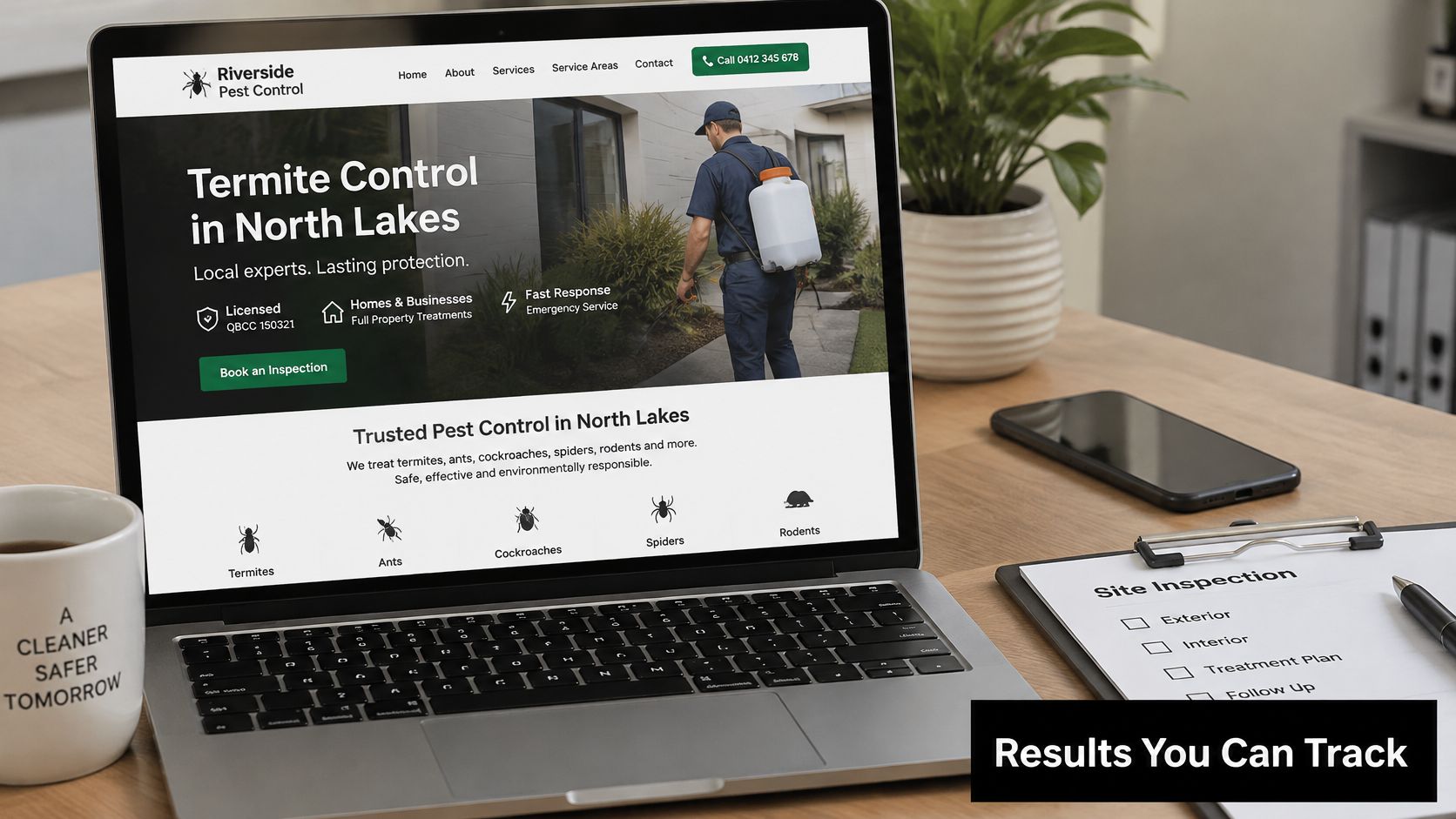
A page that converts carries a fixed set of elements. A headline that repeats the search term. The suburbs served. The pest being treated. The licence number where the rules require it. Treatment scope and what's excluded. Emergency availability and response time. A short booking form, three fields at most. And a click-to-call button that stays visible on mobile without the user scrolling.
If you're testing variants of that page, landing page usability testing methods that lift conversions are worth reading before you redesign anything, because most page problems are clarity problems, not design problems.
Wiring the offline data, step by step
- Install a Google Tag Manager container on every page of the site, including the booking and thank-you pages.
- Add the Google Ads conversion tag and the Google Analytics configuration tag inside that container, so tracking changes don't require a developer each time.
- Create separate conversion actions for booked inspections and completed quote forms. Call conversions follow the duration rule covered in the call tracking setup.
- Tag every CRM outcome as booked, completed or lost, with a reason.
- Export completed jobs with the click identifier and the job value from the CRM.
- Upload those offline conversions to Google Ads weekly. Bidding then optimises toward revenue rather than clicks, and the account starts choosing suburbs, pests and times that produce paid work.
- Review search terms and suburbs every week and cut what never books.
The key point is that the page has to describe what your team can deliver. The client remains responsible for advertising budgets, product pricing, stock availability, landing page content, sales process and customer service, which means an ad promising same-day service in a suburb nobody covers is a promise the marketing can't keep.
The scaling test: profit per booked job stays positive after the offline data arrives. If it doesn't, adding budget just makes the loss bigger faster.
Set Your Budget and Book a Free Strategy Session
Start with one campaign, not five. Pick either emergency pest control or termite inspection in your highest-value suburbs, give it a dedicated landing page and a single tracked conversion, and run it for four to six weeks against the benchmark range. Judge it on profit per booked job once the offline data lands. Add the second campaign only after the first shows positive margin.
That sequencing matters more than any optimisation trick. A single campaign with clean call tracking and honest offline conversions will tell you more in a month than a sprawling account with eleven ad groups and no idea which one pays the wages.
Alpha Omega Digital is a digital marketing agency in Melbourne. We run Google Ads for service businesses, including plumbers, alongside website design and development, so the campaign and the landing page are built by the same team rather than blamed on each other. Advertising budgets sit with you and are paid separately, while the campaign management side is ours.
Two routes in, depending on where you stand. The Google Ads agency page sets out how campaigns are planned and reported if you want to compare approaches first. Or you can go straight to the contact page and start the conversation.
If you're not sure the site can convert the traffic you'd be buying, the free 45-minute strategy session is the faster route. We review your site and show exactly what we'd fix before you commit to anything.
No specific CPA, ROAS or sales result is promised by anyone here, because the outcome depends on your close rate, your answer times and your pricing. The decision in front of you is narrower and entirely within your control: confirm your first campaign, its landing page and the one conversion you'll track to a booked job before you spend another dollar.
Alpha Omega Digital is a Melbourne digital marketing agency that builds and manages Google Ads campaigns for pest control and other service businesses, pairing them with the landing pages, call tracking and offline conversion imports that make the numbers readable. Have a project in mind? Visit Alpha Omega Digital and tell us which pest, which suburbs and which job you want the account to chase.
Alpha Omega Digital
Read more insights from our team on web design, paid ads, and growth strategy.