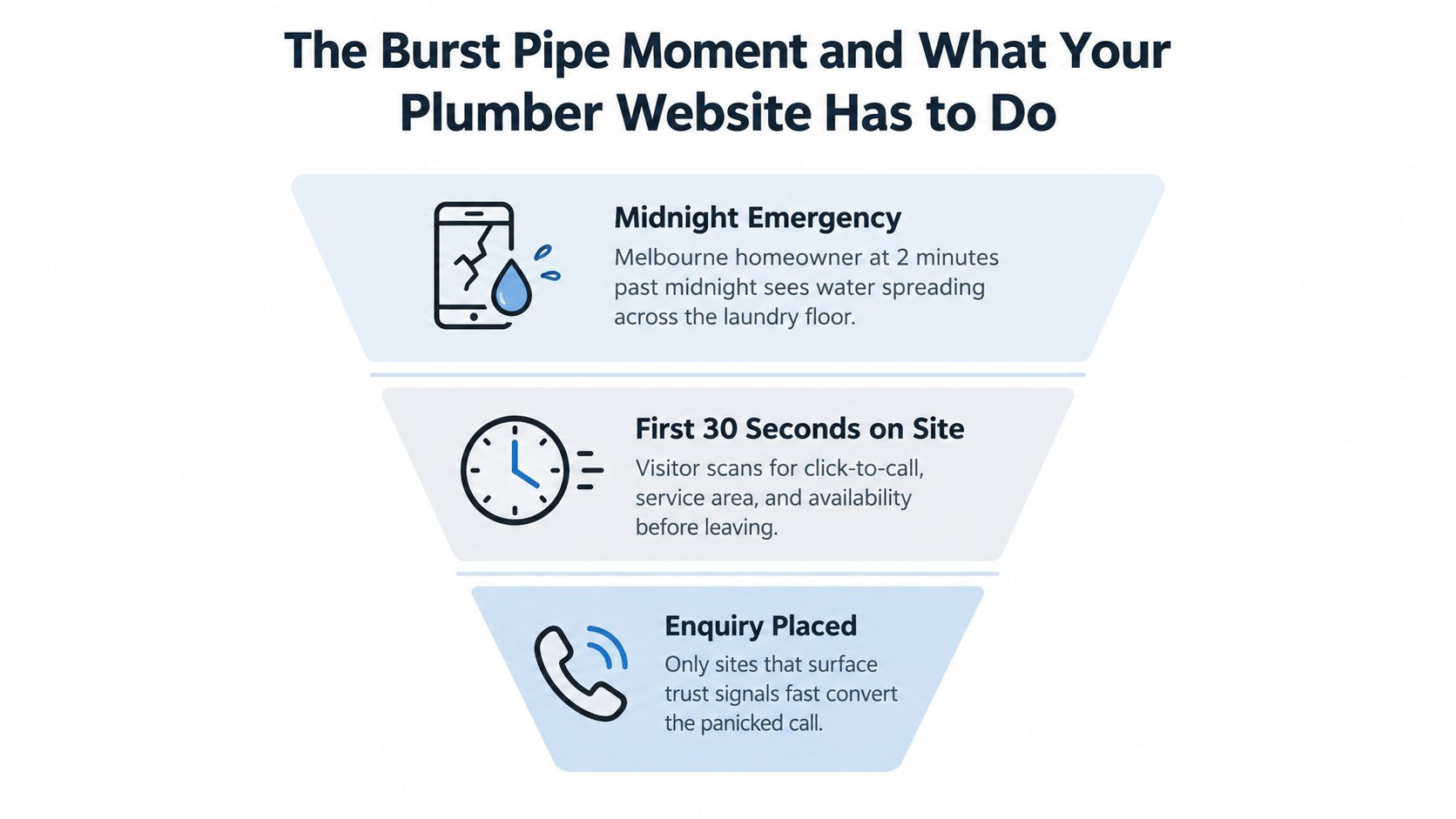
A homeowner in Melbourne searches for an emergency plumber shortly after midnight. Water is spreading across the laundry floor, the phone screen is cracked, and there isn't much patience for a slow animation, a vague service list, or a form asking for unnecessary details. The first site that clearly shows availability, service area, trust signals, and a one-tap call earns the opportunity.
That's the standard I use for plumber website design. Every page should help a real person move from search result to qualified enquiry, while giving the plumbing business enough information to respond, dispatch, quote, and close the job. A website and Google Ads account should work as one lead engine, not as two unrelated marketing expenses.
The Burst Pipe Moment and What Your Plumber Website Has to Do
At 12:02 am, a Melbourne homeowner isn't comparing brand palettes. They want to know whether you cover their suburb, whether you answer after hours, and how quickly they can speak to someone. The best plumber website design makes those answers obvious before the visitor has to scroll.
Design for urgency before decoration
I often see first-time tradie websites over-invest in sliders, animated backgrounds, giant galleries, and complicated menus. Those features can look polished on a desktop monitor, but they don't answer the urgent questions on a small phone screen.
A useful homepage should make four things immediately clear:
- What you fix: State the service in plain language, such as emergency plumbing, blocked drains, hot water repairs, or gas plumbing.
- Where you work: Name the Melbourne suburbs or service areas you cover.
- Why a customer should trust you: Show licence details, insurance information, reviews, real team photographs, and a clear service process.
- What to do next: Put a prominent tap-to-call action above the fold, with a secondary quote or booking option for planned work.
Australian plumber-listing data from September 2026 found that 71.3% of listed plumbers had a website, while another dataset still recorded 4,144 plumbers without one. Website ownership is therefore close to standard practice, but it isn't the competitive advantage by itself. The advantage comes from making the site faster to understand and easier to contact. The Australian listing research also found that 95.7% of listed plumbers had a phone number and 79% had a mobile number, which reinforces the need for a mobile-first contact path.
Practical rule: If a visitor can't identify your service area and contact method within a few seconds, the design is working against the ad spend.
Google Ads makes this even more important. Someone arriving from an emergency plumbing ad has already expressed intent. Sending that person to a generic homepage with ten competing buttons wastes the relevance created by the advert. Send each campaign to a service-specific page with a matching headline, an obvious phone CTA, and a short enquiry path.
Positioning, Brand Voice, and the Pages a Plumber Site Actually Needs
A homeowner with a burst pipe does not arrive with patience for a brand story. They arrive from a Google search or an emergency ad, scan for relevance, and decide whether to call. Planned work follows a slower path, but the same principle applies: the site needs a clear commercial position before anyone starts designing screens.
Choose the commercial angle first
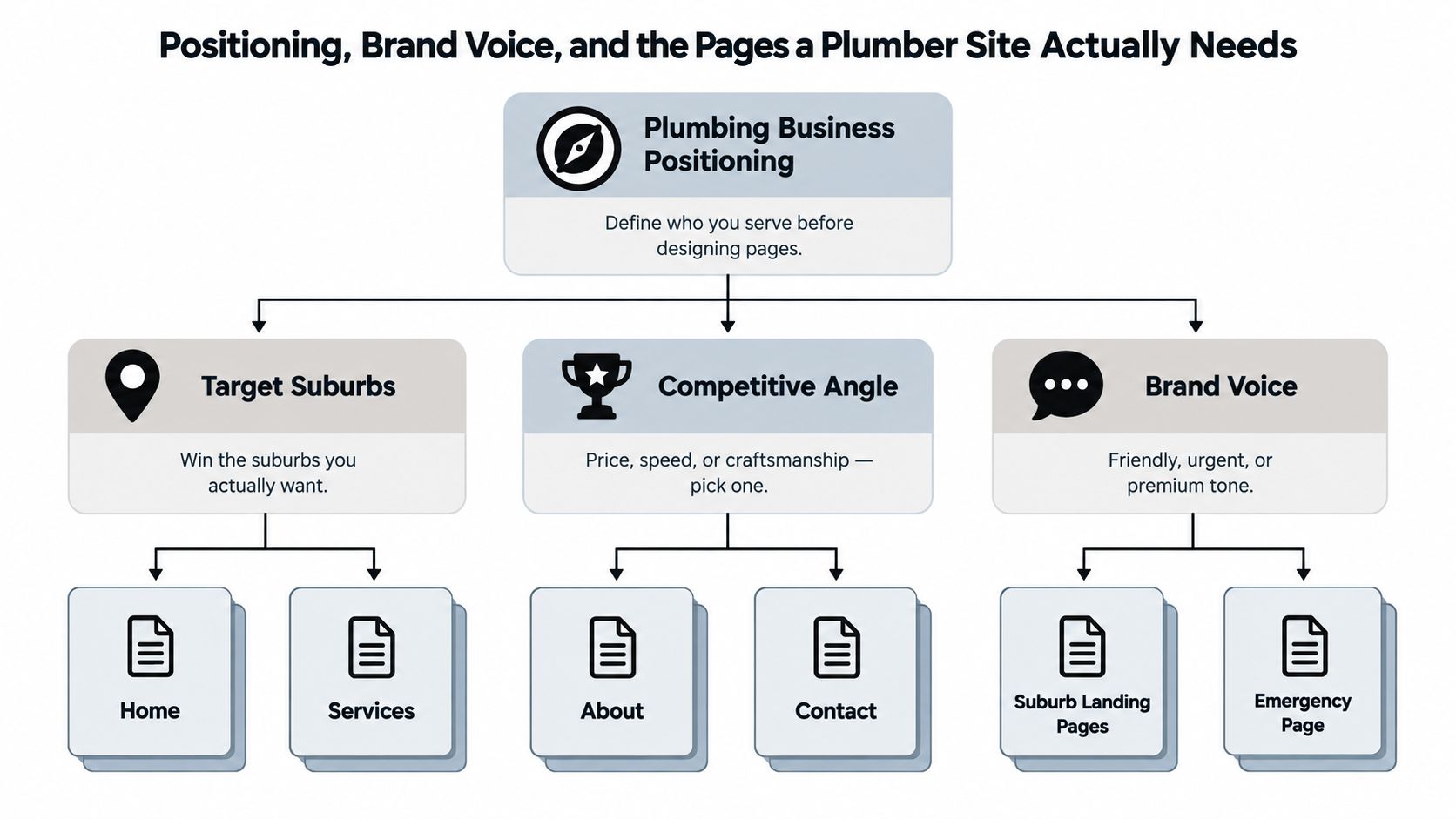
A plumbing business can compete through speed, price, specialist capability, or workmanship. Choose the strongest defensible angle and make it consistent across the website, Google Ads, photography, forms, and CRM lead labels.
“Affordable and premium, fast and thorough, local and nationwide” gives visitors no useful reason to choose the business. A sharper position might focus on emergency residential response, hot water work for homeowners, or scheduled maintenance for commercial properties. That decision also determines which searches deserve dedicated landing pages and which enquiries the sales team should prioritise.
The voice should sound like a capable local operator. Use plain Australian English without hiding behind corporate language, forced slang, or exaggerated humour. “Licensed plumbers for blocked drains across Melbourne” and “Call now for after-hours assistance” communicate more than vague claims about quality. An Australian small-business audit found that 28.8% of plumber homepages used a superlative claim, including “best” or “number one”. The Australian website audit gives useful context: specific evidence is more distinctive than unsupported superiority.
Build a focused sitemap
A practical plumber site usually needs:
- Homepage: Directs visitors to priority services and establishes the business's position.
- Service pages: Give blocked drains, hot water, gas plumbing, leak detection, sewer work, and emergency plumbing relevant destinations.
- Service-area pages: Cover genuine suburb groups with useful local detail, rather than swapping suburb names into duplicate copy.
- About page: Introduces the team, qualifications, licensing, experience, and service standards.
- Reviews page: Organises reputation proof, while relevant reviews also appear near service decisions.
- Emergency page: Removes distractions and prioritises availability, contact, and response expectations.
- Contact page: Handles urgent calls and planned quote enquiries.
The sitemap should reflect the path from paid click to booked job. An emergency Google Ads campaign should point to a page built for that service, while a property-manager campaign may need a maintenance-focused route. Tracking these paths into the CRM shows which pages produce calls, forms, and qualified work, rather than treating every enquiry as equal.
A generic gallery rarely helps on its own. Use real job photographs beside the service they demonstrate. A blog earns its place when it answers genuine customer questions, supports local relevance, or helps someone choose a service. Otherwise, it adds maintenance without improving the booking path.
Homepage and Service Page UX Patterns That Win Mobile Jobs
Mobile layouts need a hierarchy that works with one thumb. Put the phone action in the header, keep the hero message short, and make the service area visible without forcing the visitor to browse through a menu.
A strong homepage hero can follow this pattern:
- Specific H1: Identify the service and location, such as emergency plumbing in Melbourne.
- Short value proposition: Explain the customer outcome without making an unsupported guarantee.
- Primary CTA: Use a tap-to-call button with the phone number included.
- Secondary CTA: Offer a quote form or booking option for non-urgent work.
- Immediate proof: Place reviews, licence information, service coverage, and availability close to the actions.
Service pages should follow the problem rather than the company's internal structure. A blocked drain page can explain warning signs, likely causes, the inspection process, what affects the quote, and how to request help. A hot water page may need separate pathways for repair, replacement, and urgent loss of hot water.
Forms should match intent. Emergency visitors usually need a short path with name, phone number, suburb, and a description of the issue. Planned replacement work can justify additional information, such as property type, preferred timing, and photographs. Collecting everything from every visitor creates friction where speed matters most.
| Homepage and Service Page Element Conversion Impact | Placement | Expected Lift |
|---|---|---|
| Tap-to-call phone action | Header and mobile sticky bar | Removes friction for urgent enquiries |
| Service and suburb headline | Hero area | Confirms relevance immediately |
| Short emergency form | Beside the hero or after the first proof section | Captures visitors who can't call |
| Licence and insurance information | Near the first CTA and contact area | Reduces legitimacy concerns |
| Reviews tied to the service | Beside forms and service explanations | Supports confidence at the decision point |
| Service-area coverage | Hero, footer, and relevant service pages | Filters out unsuitable enquiries |
A page doesn't need every design trend. It needs compressed images, restrained scripts, readable type, strong contrast, and a predictable route to contact. Australian benchmark data records overall website conversion around 1.78%, service-sector conversion around 3.3%, and professional-services pages between 7.4% and 12.3%, depending on traffic quality and offer specificity. The same benchmark reports 4.3% desktop conversion compared with 2.2% on mobile, so mobile friction deserves direct attention rather than a final responsive check. The Australian conversion benchmark supports that mobile-first decision.
Local SEO Foundations Every Plumber Site Needs in Australia
A Melbourne homeowner with a burst pipe searches for help on their phone, checks the map results, and calls the plumber who appears available nearby. Local SEO has to support that path from search result to booked job, with the website, Google Business Profile, Google Ads, and CRM sharing the same service areas and contact details.
Start with an accurate Google Business Profile. Claim and verify it, complete the relevant fields, keep the phone number and operating hours current, and define service areas precisely. The Australian local SEO guidance identifies a verified, maintained profile as the basis for visibility in Google Maps and the local pack.
The website should reinforce that local relevance without turning every page into a suburb keyword list. State the areas served, connect related suburb and service pages through useful internal links, and explain how the team works across those locations. A map can help visitors confirm coverage, but it should support the page rather than replace clear service information. Avoid publishing near-identical suburb pages with no distinct local value.
Structure the technical signals
Keep the business name, address, and phone number consistent across the site and important listings. Add suitable structured data, including LocalBusiness, Plumber, Service, FAQ, and review-related markup where the visible content supports it. Schema helps search engines interpret the relationship between the business, its services, and its locations. It does not compensate for thin or unclear copy.
Australian small-business website audits have found frequent gaps in crawlability, schema, local business markup, 404 handling, and sitemaps. The audit findings show why these checks belong in the launch process, particularly when Google Ads sends paid visitors to pages that also need to perform in organic search.
Measure local visibility by suburb, not through occasional ranking screenshots. Track local pack presence, Business Profile actions, suburb-related queries in Search Console, and organic conversions in GA4 by landing page. Review citation accuracy after any change to the phone number, address, trading name, or service area. Australian local search measurement guidance outlines this broader measurement approach.
Paid and organic activity should use the same service-area language, landing pages, and conversion tracking so every enquiry reaches the right CRM record.
Trust Signals, Reviews, and the CRO Tactics That Lift Enquiry Rates
A plumber is asking a stranger to allow access to their home, diagnose a problem, and potentially approve costly work. Trust needs to appear before the first call, not sit hidden on an About page.
For Australian plumber lead-generation pages, a practical benchmark is roughly 5% to 10% visitor-to-inquiry conversion, with 20% to 35% inquiry-to-client close rates considered healthy. The Australian conversion funnel guidance makes the important distinction that the website should prioritise qualified enquiries rather than imitate an eCommerce checkout.
Match proof to the hesitation
Put licence and insurance details near the contact pathway, not only in the footer. Show real technicians, vehicles, tools, and completed work instead of relying entirely on stock photography. A review about a blocked drain belongs beside the blocked drain enquiry path, while a hot water installation review is more persuasive on the relevant replacement page.
Useful trust modules include:
- Licence and insurance details: Best placed near the first conversion point and on the contact page.
- Google review integration: Use current, attributable reviews near the hero and beside forms.
- Response expectations: Explain availability clearly, particularly for after-hours service.
- Service-area clarity: Tell visitors whether their suburb is covered before they submit.
- Workmanship evidence: Use before-and-after photographs where the comparison is genuine and relevant.
- Process explanation: Show what happens after the enquiry, from initial contact through diagnosis and quote.
Phone and form CTAs serve different jobs. A burst-pipe visitor may need a call immediately, while a customer researching a scheduled hot water replacement may prefer a form with photographs and timing details. Keep the primary action dominant, but don't force every visitor into the same route.
For additional practical ideas on reducing friction and improving enquiry journeys, SnapDial's conversion insights are a useful resource. The important point is to test a specific change, such as CTA wording, field count, trust placement, or form sequencing, rather than redesigning the entire page without knowing what caused the result.
Integrations and Technical Foundations That Keep the Lead Engine Running
A site becomes useful infrastructure when it records what happened after the visitor clicked. At minimum, the stack should connect the website, analytics, advertising account, phone system, and CRM or job-management software.
Build a dependable technical base
For WordPress development, use a stable theme or custom block system, keep plugins limited, compress images, and separate essential functionality from visual extras. Building custom blocks in Gutenberg can give the team reusable service-page components without handing every content editor a page builder full of unnecessary scripts. A capable WordPress website developer should also plan update routines, backups, spam protection, access controls, and error monitoring.
Hosting should suit Australian customers and the expected traffic pattern. Use a reputable host, a suitable CDN, SSL, backups, and monitoring. The exact setup depends on the business, but slow forms, broken phone links, and failed webhook connections are more damaging than a page that looks slightly less elaborate.
Tracking starts with a properly organised Google Tag Manager container. Configure GA4 events for phone clicks, form starts, form submissions, booking completions, and meaningful engagement. Import the right conversions into Google Ads, use call reporting where appropriate, and connect closed-job information when the CRM supports offline conversion uploads.
Call tracking needs care. Tools such as CallRail, Infinity Tracking, and GoHighLevel can help separate calls from organic search, Google Ads, and other channels. Keep the original business number visible where customers need confidence, use dynamic numbers only when the tracking setup is reliable, and test every route before launch.
Connect the enquiry to the job
ServiceM8, Housecall Pro, HubSpot, booking platforms, and calendar tools can receive form submissions and trigger follow-up. A short emergency form might send the lead straight to dispatch, while a larger replacement enquiry could create a task for a salesperson.
A custom number through Twilio can support 24-hour call answering, appointment booking into a calendar or Calendly, and automated handling when the owner is driving, working, or unavailable. The system doesn't get sick or tired, and it can reduce missed opportunities for tradies, hairdressers, beauty therapists, dentists, restaurants, and doctors. It still needs clear scripts, escalation rules, accurate availability, and human oversight.
This is also where an agency may combine WordPress design, Google Ads, GTM, GA4, Meta Conversions API installation, and CRM automation. Shopify development, Shopify API work, custom Shopify apps built with Shopify CLI, Instagram Shop, Facebook Shop, and Google Shopping Ads belong primarily to eCommerce projects, but the same measurement discipline applies. For service businesses, the conversion is usually a call, form, or booked appointment rather than a checkout.
Launch Checklist and When to Hire an Agency Versus DIY
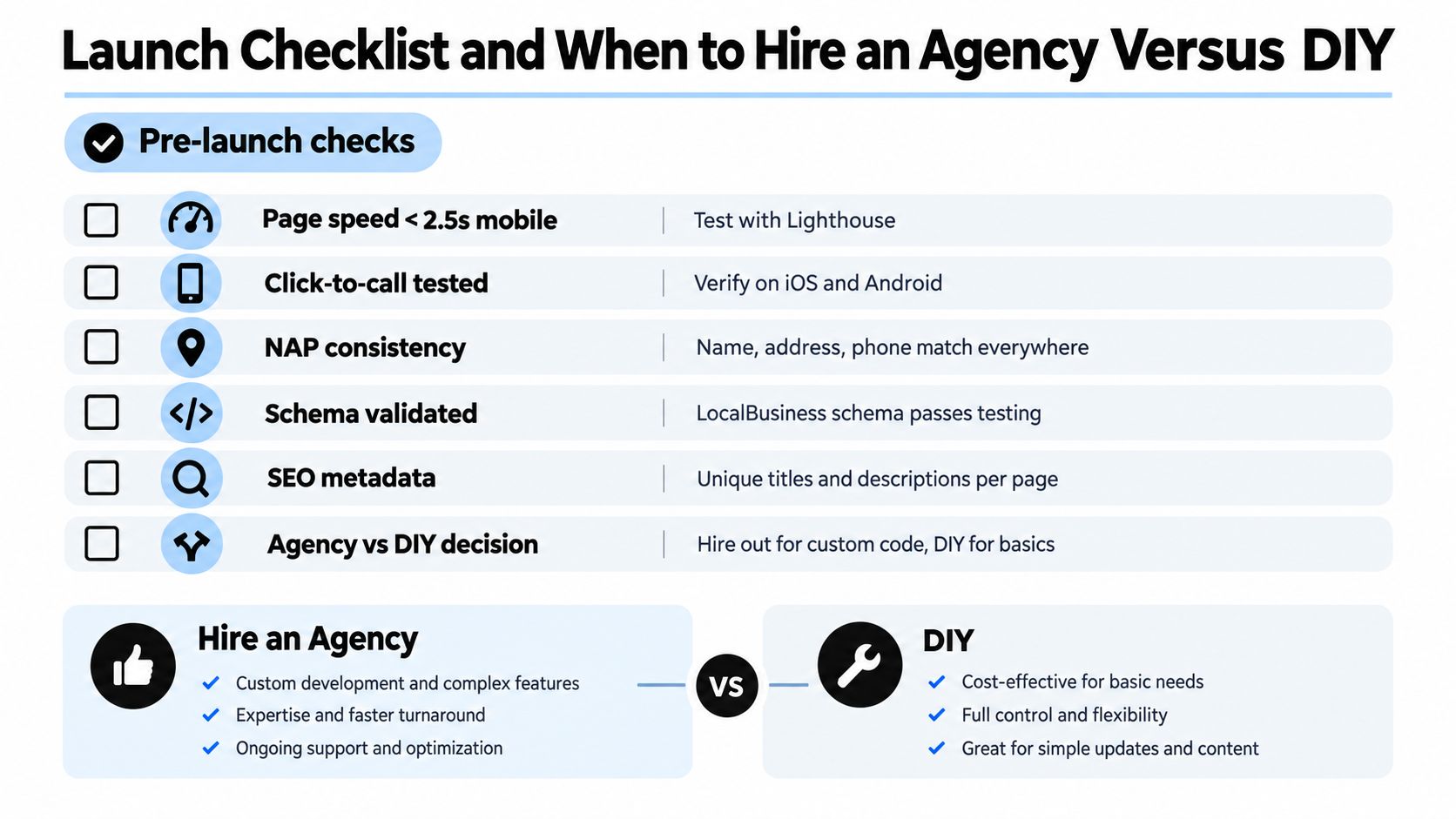
Before launch, test the journey as a customer, not as the person who built the site. Search for the business on a phone, open the advert landing page, tap the call button, submit a form, and confirm that the right person receives the enquiry.
Pre-launch checks
- Performance: Test mobile loading, image weight, script usage, and Core Web Vitals.
- Calling: Test tap-to-call on both iOS and Android devices.
- Lead delivery: Submit test forms and confirm CRM or email receipt.
- Tracking: Check GTM, GA4 events, Google Ads conversions, and call tracking.
- Local information: Match the business name, address, phone number, hours, and service areas across the website and Business Profile.
- Technical SEO: Validate sitemap, robots rules, redirects, metadata, structured data, and the actual 404 page.
- Ad alignment: Match each Google Ads group to a relevant service page, headline, CTA, and conversion event.
- Follow-up: Confirm who answers, how quickly they respond, and what happens when a lead arrives after hours.
DIY can make sense when the business has a narrow service area, limited campaign complexity, and enough time to learn WordPress, copywriting, analytics, and local SEO. A simple site can be launched with a managed theme and carefully written service pages, but the owner still needs to maintain it and test the contact path.
An agency becomes more practical when the business is managing multiple suburbs, spending heavily on paid traffic, adding CRM automation, or losing track of which campaigns produce booked jobs. The right specialist should be able to explain the relationship between landing page relevance, ad intent, call quality, form friction, and closed revenue.
For customers researching local options, this guide to finding a Melbourne plumber offers a useful reminder that local relevance and clear service information matter outside the website itself. Your own site should make the next step easier than a directory search.
The website should keep improving after launch. Review missed calls, poor-quality enquiries, suburb performance, search terms, form abandonment, and booked-job data. Marketing consistency matters because a few days of campaign activity won't reveal every useful pattern, and Facebook Ads testing, Google Ads optimisation, Google Shopping, PMAX versus standard Shopping decisions, and contact-form campaigns all require clean tracking before budget decisions make sense.
Alpha Omega Digital is a Melbourne-based agency that works across WordPress and Shopify development, web design, Google Ads, Meta advertising, analytics, and conversion strategy for businesses across Australia, including Sydney, Brisbane, Newcastle, Perth, Adelaide, Darwin, and Hobart. If you're a business with a paid ads budget of at least $3,000 a month, I'd love to offer you a low-risk deal, a month of paid ads management free. Apply now through the contact page, or visit Alpha Omega Digital to discuss a plumber website and lead engine built around qualified enquiries.
[email protected]
Read more insights from our team on web design, paid ads, and growth strategy.