Seven in ten Australian tradespeople still say word of mouth is their main source of work, according to the 2025 ServiceTitan Australian Tradies Report as covered by 21webs, a survey of 1,025 Australian tradespeople. Read that next to the same survey's other numbers, only 17% using SEO and 29% using Google Ads, and the shape of the problem becomes clear. Most plumbing businesses aren't short of demand. They're short of a system that captures it.
Two leaks drain most plumbing marketing budgets. The first is buying clicks for work you can't service or jobs you don't want. The second, and the bigger one, is dropping the calls that already arrived. Marketing for plumbers gets much simpler once you split campaigns by job urgency and start measuring cost per booked job instead of cost per click. That's what this guide does, section by section.
Marketing Channels That Bring Plumbing Leads
A plumber asking where next month's work comes from needs a straight answer, not a channel menu. The evidence says most plumbing businesses haven't built one yet. The same 2025 ServiceTitan survey of 1,025 Australian tradespeople found only 17% using SEO and 29% using Google Ads, and while 76% had a website, many weren't using it to generate leads. That's not a reason to abandon referrals. It's a reason to stop treating referrals as a strategy and start treating them as a channel you can amplify.
Owning a website isn't the same as running an acquisition channel. A site that lists services and an About page is a brochure. The test is blunt: can you name the exact page, ad and keyword that produced last Tuesday's 8am call? If the answer is "the phone just rings", you're guessing with real money.
What each channel actually produces
| Channel | Speed to first enquiries | Best for | Main ongoing cost |
|---|---|---|---|
| Word of mouth and referrals | Immediate, depends on existing customers | Repeat and trusted local work | Low cash cost, high time cost |
| Google Business Profile | Days to weeks after setup | Map pack visibility for local searches | Low, mainly time for photos and posts |
| Local service pages on the website | Several months | Suburb and service searches over time | Moderate, content and upkeep |
| Google Ads search campaigns | Within days of launch | Urgent and high-intent calls | Daily spend, scales with demand |
| Facebook and Instagram ads | Days, with creative testing | Planned upgrades and awareness in a service area | Ongoing spend and creative refresh |
| Review requests after each job | Immediate once the process is set | Trust before the call | Low, staff time per job |
| Call tracking and missed-call follow-up | Immediate | Proving which channel earns bookings | Monthly platform fee plus setup |
Read that table by speed. Referrals and the Google Business Profile produce calls this week. Paid search produces calls within days of launch, assuming someone answers. Suburb pages take months and compound, which is why stopping them after eight weeks is a common waste.
The order I would start in
Fix the contact path first. Before a single ad runs, make the phone number tappable above the fold on mobile and the enquiry form two fields long. Sending paid traffic to a site that hides the number is the fastest way to lose money in this trade.
Add Google Ads for urgent work only. Blocked drains, burst pipes, gas leaks and no hot water. High intent, short decision window, price insensitive compared with a renovation enquiry. Everything else waits.
Start local organic search now, judge it in six months. One page per service and suburb cluster, written by someone who knows a tempering valve from a pressure limiting valve. It won't rescue this quarter, and it's the asset that stops you renting every job from Google forever.
Close the loop with review requests and call tracking. Neither costs much. Both tell you which of the three above is earning its keep, and they're the difference between marketing as a guess and marketing as a system.
Local Search and Google Business Profile Basics
Plumbing in Australia is a fragmented market, not a fight with a handful of national brands. IBISWorld estimates plumbing services revenue at about $25.1 billion in 2026 across 32,067 businesses, with the business count growing at a compound annual rate of 1.2% between 2021 and 2026 (IBISWorld). For a Melbourne operator, that means thousands of nearby firms chasing the same suburb searches, and local visibility doing more commercial work than any national brand campaign ever would.

The services in that industry classification are usually urgent, geographic and specific. Blocked drains, gas repairs, leaks, hot-water failures. Someone with water coming through a ceiling isn't comparing five quotes. They're picking from the map results and calling the first business that looks legitimate.
The five steps that matter
- Complete the profile properly. Primary category, secondary categories, service areas, trading hours and the same phone number as your website. Set the hours accurately, including after-hours answering rules, because a profile that says open at 9pm and doesn't answer burns trust you paid to build.
- Upload photos of real completed jobs. Your van, your team, the actual install. Not stock images of a wrench. Add the suburb in the caption where it's accurate, which also reinforces the service area.
- Build one page for each core service and suburb cluster. Hot-water repair in Richmond, blocked drains in Fitzroy, gas fitting in Brunswick. Unique content on each, with local detail a copywriter in another country couldn't invent.
- Put the phone number and booking form above the fold on mobile. Most plumbing searches happen on a phone, often standing in a flooded laundry. Every scroll to find your number costs you jobs.
- Keep NAP identical everywhere. Name, address, phone. The same format across your site, profile, directories and any industry listings. Inconsistent details make search engines less confident about which business is where.
If you'd rather audit that consistency across dozens of directories than do it by hand, a top local search ranking software comparison will show which tools check citations alongside map rankings.
Where profiles go wrong
Service areas drawn too wide. A radius covering 60 suburbs tells customers you're never close, and it attracts enquiries you'll decline. Draw the area you can reach in normal traffic, then extend only when you have a second van.
Duplicate pages with the suburb swapped. Ten pages that differ by one word read as spam to both customers and search engines. If you can't write 400 different words about a suburb, you don't need the page yet.
Months of silence. No posts, no new photos, no answered questions. A profile with last year's activity looks like a business that may not pick up.
A check you can run this week
Search your top three services in your own suburb. Note who appears in the map results. Compare their categories, photo count, review count and last post date against yours. Do the same for two neighbouring suburbs you'd like to win. You'll usually find the businesses ranking are not better plumbers, they're better documented. That's a fixable gap, and it costs time rather than media budget.
Matching Campaigns to Each Type of Plumbing Job
One generic landing page loses jobs in both directions. An emergency searcher bounces because there's no number, and a hot-water researcher bounces because there's no indication of price. Plumbing enquiries carry different urgency, different comparison behaviour and different conversion actions, so the campaign has to match the job.
| Job type | Lead intent | Primary conversion action | Response standard |
|---|---|---|---|
| Emergency repairs (burst pipes, blocked drains, gas leaks) | Urgent, looking for someone now | Click-to-call with suburb confirmation | Answer live or call back within minutes |
| Hot-water replacement | Comparing options and prices | Quote form plus finance or rebate information | Quote booking within one business day |
| Planned maintenance and leak detection | Scheduled, medium urgency | Booking form with preferred time slot | Confirm booking the same day |
| Renovation and new installations | Researching providers and licences | Consultation request with project photos | Consultation call within two business days |
Read that as a budget instruction, not a formatting exercise. Emergency work should absorb most of the paid spend because intent is highest and the decision window is minutes. Renovation plumbing deserves content and a consultation form rather than expensive clicks, because that buyer is weeks away from booking and will compare three providers before calling one.
Australian trade research cited by Alpha Omega Digital's guide to Google Ads for plumbers reports that 89% of customers use Google to find local trades, 73% check Google reviews and 65% research a business website before making contact. You're not selling to someone who stumbled onto your ad. You're selling to someone running a quick credibility check while the ad is still open on their phone.
Two searches, two different pages
Say someone searches "blocked drain emergency" at 7pm. The ad should land them on a page with a call button that fills the screen, a line confirming the suburbs covered tonight, and a statement of what the after-hours call-out includes. No carousel, no awards section, no video.
Now say someone searches "hot water system replacement cost". Same business, completely different page. They need indicative pricing by system type, a note on available rebates or finance, warranty terms, and a quote form that asks for the system age and suburb. Pushing that person to a phone button they aren't ready to press just sends them back to the search results.
The biggest gain rarely comes from ranking for more plumbing keywords. It comes from reducing leak between the click and the booking.
A plumber can pay for the right traffic and still lose the job through missed calls, vague forms and slow follow-up. Few agencies connect acquisition numbers to operational ones like answer rate, time to callback, booked-job rate and cancellation rate, which is exactly where the money sits.
Warning signs you've mismatched the campaign
Calls for work you don't offer, like someone asking about septic pumping when you only do maintenance plumbing. Your keywords are too broad.
Quote forms sitting unanswered for a day. If a form enquiry gets a slower response than a phone call, you're training prospects to leave.
High click volume, low booked-job count. That's usually not a keyword problem. It's a landing page or an answering problem, and it needs fixing before you raise the budget.
Turning Calls into Booked Jobs with Fast Follow-Up
Count the calls you missed last week. Twelve is common for a one-van operation doing decent volume, and it doesn't feel like much at the time. Do the arithmetic. Twelve missed calls, one in three would have booked, at an average job value of $350, is four lost jobs and $1,400 a week. Over a year that's roughly $70,000 in work you never quoted because someone was under a sink when the phone rang.
That's the hidden leak in most plumbing marketing, and no amount of extra ad spend fixes it. Raising the budget just sends more calls into the same hole.
How a dedicated tracking number works
The setup I'd build keeps your existing number on the van and forwards calls to a dedicated tracking number provisioned through Twilio. Customers dial the number they've always dialled. Behind it, the system answers 24 hours a day, including while the team is on a job, at 6am on a Sunday, or during the school pickup run.
The number can take the job details, capture the suburb and the fault, book the appointment straight into the owner's calendar or Calendly, and text a callback link after any missed call so the customer isn't left ringing the next plumber on the list. Reporting then shows which ad, keyword and suburb produced each call. No more asking "how did you find us" and writing the answer on a notepad.
This isn't plumber-only. The same logic saves thousands in lost business for tradies, hairdressers, beauty therapists, dentists, restaurants and doctors, anyone whose phone is effectively their sales desk and whose staff can't always pick up mid-task.
A phone that answers every time is worth more than a bigger ad budget. One is a fixed cost, the other is a variable one that grows with the leak.
There's a hard limit worth naming. An answering service can take a booking and reassure a worried customer, but it cannot replace a licensed technician on site, diagnose a fault with certainty, or sign off on compliance work. It buys you the enquiry. Delivering the job is still your trade.
The response standard to hold
Answer live or call back within minutes in business hours. Minutes, not hours. The homeowner with water pooling on the floor is calling three businesses in a row and booking whoever picks up first.
Confirm the suburb and the job type before anything else. That single step filters out-of-area calls and lets you quote accurately later.
Offer a booking time on the first call. Not "we'll get back to you". A slot, even if it's provisional.
Log the outcome. Booked, declined, out of area, wrong trade. If you can't categorise outcomes, you can't tell whether the next dollar should go into ads or answering.
For the operational side of this, faster lead follow-up strategies from The GoHighLevel Experts covers how automated sequences and CRM workflows slot in behind the call, which matters once you're handling enough volume that manual follow-up starts slipping.
How to Set Up Google Ads for Plumbing Calls
Google Ads for a plumbing business is not complicated, but it's easy to set up badly in ways that take a month to notice. Here's the build order I'd use, with the reason each step exists.
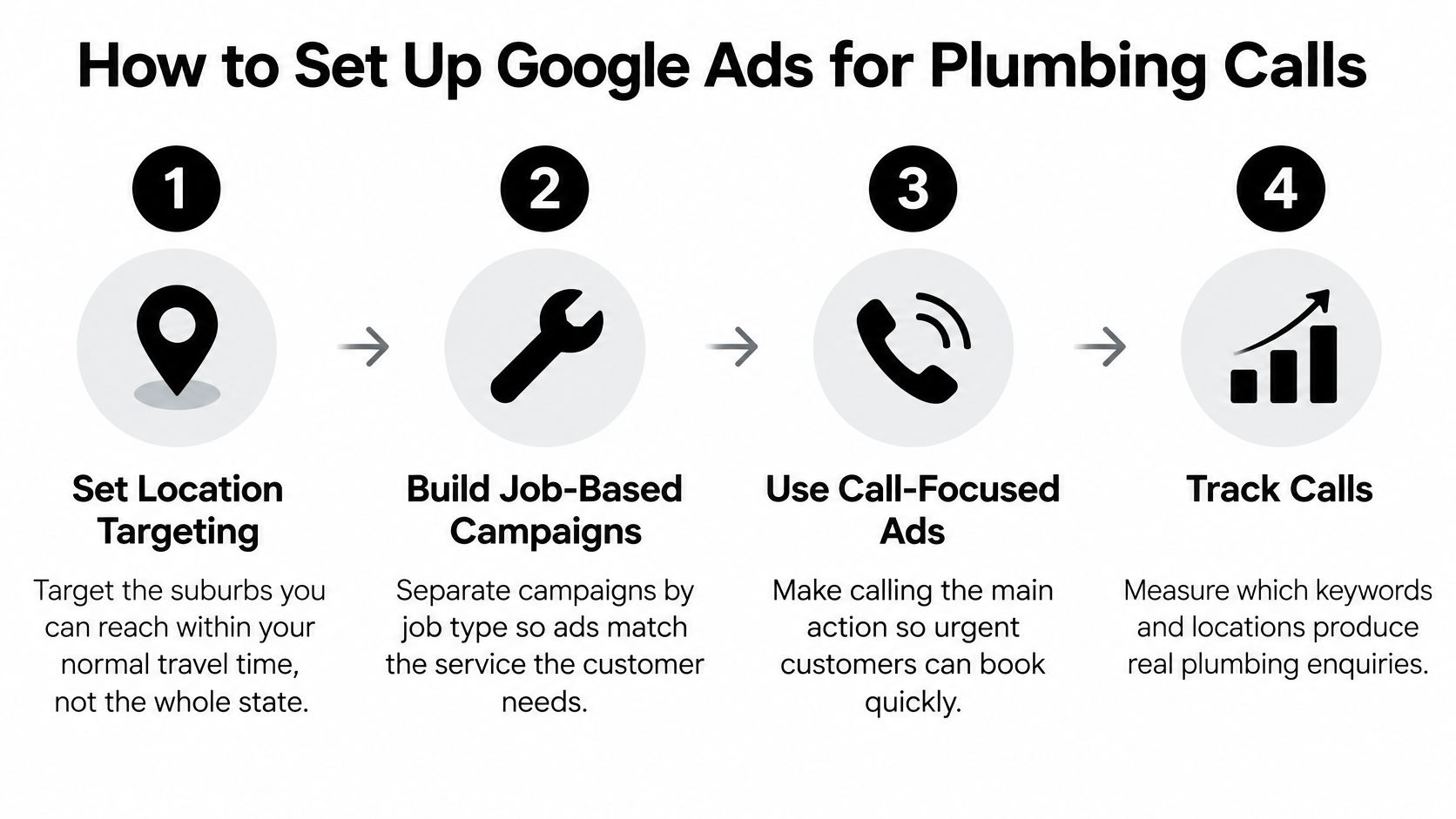
- Set location targeting to your real travel radius. Suburbs you can reach within your normal response time, not the whole state. The common slip is a "Victoria" setting that spends your budget on enquiries from three hours away.
- Build campaigns by job family. Emergency work, hot-water replacement and renovations should never share one budget, because the urgent campaign will spend every dollar and the renovation leads will dry up unnoticed.
- Write ad groups per service and suburb cluster. Headlines that name both, like "Blocked Drain Plumber Richmond", beat clever wordplay every time when someone is standing in a flooded laundry.
- Add call extensions and a dedicated tracking number per ad group. This is the step most accounts skip, and it's the one that tells you which keyword produced the booking.
- Add negatives for DIY, jobs, training, courses, salary and free. Without them you'll pay for clicks from people looking for a career or a YouTube tutorial.
- Set an ad schedule that matches your staffed hours. If you run after-hours answering, extend the schedule and let the answering service take it. If you don't, don't pay for 2am clicks nobody answers.
- Choose a bidding strategy only after about 30 days of conversion data. Smart bidding on a thin data set optimises towards whatever it can measure, and early on that's often nothing useful.
- Read the search terms report every week. Not monthly. Weekly, for the first two months, because that's where the odd queries show up and where your negatives come from.
What the first month should look like
Not a ranking report. You want calls logged by keyword, a search terms report with no obvious junk, and a cost per call trending inside a range the owner can live with. If the account is generating calls but the owner can't tell you which keyword produced them, the tracking isn't finished.
Judge a plumbing account on cost per booked job. Cost per click only tells you what you paid to start a conversation.
Setting a budget that survives the learning period
Google's own guidance for Performance Max recommends an average daily budget of at least three times your target cost per conversion, and warns that on busier days a campaign may spend up to twice its average daily budget (Google Ads Help). Work backwards from the booked job you can afford to win, not the click you can afford to buy.
A target cost per booked job of $150 implies at least $450 a day on a Performance Max campaign, which is beyond most single-van operations. That's why the realistic starting point is search campaigns on urgent services with a daily cap you can sustain for a full month. A cap you have to pause after nine days teaches the account nothing and gives you no data to decide with.
Building Trust Without Risky Review Tactics
Simple informational searches are the fragile part of local marketing. Recent Australian agency reporting, summarised in Click Click Media's plumbing marketing playbook, claims local-service search demand fell 38% as AI started answering straightforward questions directly. Treat it as directional rather than a national benchmark, and the direction still holds: content about fixing a dripping tap earns fewer clicks, while pages that prove service coverage, licensing, availability, response times and pricing boundaries still influence bookings.

That changes what a plumber's website is for. A homeowner with water coming through the ceiling scans for licence, insurance and arrival time before they finish your first paragraph. A customer planning a bathroom rough-in moves slower but compares harder, checking photos of finished work and whether your quoted range matches what other plumbers say. Write for both, and accept that neither is reading for pleasure.
What to publish instead of generic advice
Verified photos of real jobs with the suburb named. Technician names and faces, so the person at the door matches the profile. ABN and licence details where they apply. Emergency call-out rules stated plainly, including what triggers after-hours rates. Pricing boundaries you can defend, like a call-out fee range. Structured FAQs that answer booking questions rather than search-volume questions.
Urgency decides which of these carries the page. On an emergency or burst-pipe page, the trust proof sits where a panicked caller sees it first: after-hours rules, the response range, the licence. On pages for planned work like renovations or hot water replacement, the job photos and pricing boundaries do the selling, because that caller has time to check them. The FAQ that works hardest is the one answering "do you charge to quote", "how fast can you get to Brunswick" and "is your work guaranteed", since it gives a reader and an AI summariser something factual to work with. A page explaining the history of plumbing gives neither.
Reviews, done properly
Buying, fabricating or suppressing reviews misleads customers and can breach consumer law, so it is a tactic to avoid. It also collapses the first time a customer notices the pattern, and recovering from that is harder than building the reviews slowly.
What works instead is boring and consistent. Ask every customer after every job with a direct review link and a standard message. Reply to every review within a day, including the bad ones, factually and calmly, without arguing in public. Keep reviews relevant to the service they describe: a review mentioning a burst pipe does more for your emergency page than a generic five-star line ever will, which is why the standard message should ask what job was done, not just for a rating.
The trust signals to audit this month
- Licence and ABN visible on the page, not buried in a footer.
- Insurance stated, since it's the first thing a cautious homeowner wonders about.
- Response times given as a range you meet.
- Real suburbs named in content, not just a service radius graphic.
- Recent reviews, because a wall of 2019 testimonials reads as a business that stopped caring.
- Technician identity, including who's turning up and whether they're the licensed plumber or an apprentice.
Every paid click that lands on a page missing these signals is a call you'll never know you lost, and lost calls after the click are the leak no dashboard shows you. No marketing approach guarantees rankings or revenue, but you control where the trust assets sit. I'd put them on the emergency and service-area pages first, and I'd judge the work by qualified calls rather than keyword positions.
Measuring Plumbing Marketing by Booked Jobs
Cost per click tells you what you paid to open a conversation. It doesn't tell you whether the conversation became work. Track the funnel as a ladder, with each rung having an owner and a number attached.
The rungs run in order. Impressions and clicks, then calls and form submissions, then answered and booked enquiries, then completed and invoiced jobs, then repeat maintenance work from that customer. Most plumbing accounts are only measuring the top two, which is why the reports look healthy while the calendar stays patchy.
| Metric | What it tells you | Where to check |
|---|---|---|
| Cost per booked job | Real cost to win paying work | Ad spend divided by booked jobs from the same source |
| Answer rate | Share of calls picked up or returned in time | Call tracking log |
| Time to first callback | How fast enquiries get a human response | Call and form logs with timestamps |
| Booked-job rate | Share of calls and enquiries that become bookings | Job management or CRM system |
| Missed-call recovery rate | Missed calls later turned into bookings | Call tracking plus booking calendar |
| Branded search volume | Whether people search the business name after seeing ads or listings | Google Search Console or Business Profile insights |
| Revenue by service type | Which jobs pay and deserve more budget | Invoicing system |
| Repeat maintenance work | Long-term value from existing customers | Customer list in the job management system |
The monthly review routine
Pull call logs by keyword and suburb. Compare booked jobs against quote requests, because a healthy quote pipeline with no bookings often points at pricing or response time. Check how many missed calls were recovered. Look at branded search and map views to see whether visibility is lifting. Then split revenue by service type and ask whether the money is landing on the work you want.
That last question catches more waste than any other. Plenty of accounts generate plenty of calls for jobs with thin margins and heavy travel.
Two decision rules
If a keyword drives calls but few bookings, fix the landing page and the call handling before cutting spend. You've bought demand successfully. The conversion path is the problem, and cutting spend just hides it.
If bookings are strong but volume is low, expand the service area or add service pages. Don't raise the budget on a campaign that's already converting well without first checking whether there's more of the same demand a suburb over.
Agree targets in writing before the first campaign launches, because we don't guarantee specific outcomes such as rankings, enquiries, leads or return on ad spend, and any agency promising those numbers is telling you something about their sales process rather than their media buying. Treat the first months as a test with a defined review point. Judge a campaign after at least 30 days, since early results mostly reflect the learning period rather than the performance of the account.
Choose Your First Three Actions This Month
Three actions, in this order, because each one closes a different leak between the click and the booked job.
Fix the Google Business Profile. Correct categories, current hours, real job photos, and a phone number that matches the site. Set up call tracking with a dedicated number for each campaign, so every call can be traced back to a keyword and a suburb. Rewrite your emergency pages with a call button that fills the screen on mobile and a line confirming the suburbs you cover tonight.
The order matters because urgent work closes fastest and loses the most when the path breaks. A burst pipe caller rings down the results until someone answers, so a profile that ranks, a number that tracks, and a page that asks for the call will book work before any budget increase would. None of the three requires a media spend.
If you want a second opinion before you start spending, we run a free 45-minute strategy session where we review your site and show you exactly what we would fix. Alpha Omega Digital is a Melbourne agency helping Australian businesses grow through websites, Google Ads and SEO, and Google Ads for plumbers is one of the services we run day to day. Book through the Alpha Omega Digital contact page.
"Jane has done an absolute superb job building our website, the whole process has been so smooth to do. She really takes the time to listen to what you want to try and achieve and always gives you the best advice on what she thinks is best for you. I cannot recommend Alpha Omega Digital highly enough.", Ari Melissas, Amari Plumbing and Gasfitting
If you'd rather hand the whole system to a team that measures cost per booked job rather than cost per click, Alpha Omega Digital builds the website, the suburb and service pages, the Google Ads campaigns and the call tracking that connects them to real work. We handle campaign management while your advertising budget stays with the platform, paid separately. Start with a conversation about your service area and the jobs you want more of.
Alpha Omega Digital
Read more insights from our team on web design, paid ads, and growth strategy.