A homeowner in Melbourne notices water marks spreading across the ceiling after a night of heavy rain. They search for a roofer, compare a few results, and call the business that looks credible and responds quickly. If your website only displays a phone number and a few project photos, you may never get the opportunity to quote.
That's the practical reality of roofing lead generation. Demand exists, but the contractors who win are the ones who capture specific searches, separate urgent jobs from research enquiries, and track which calls become profitable work. I've seen tradies waste money on broad campaigns while competitors collect the inspections through better landing pages, clearer offers, faster follow-up, and more disciplined measurement.
The playbook below focuses on the overlooked opportunities, especially unbranded searches, material-led research, insurance-related storm damage, and revenue tracking.
Why Most Roofers Miss the Leads They Deserve
A roofing contractor's website often looks professional enough to pass a quick inspection. It has a logo, a list of services, a gallery, and a contact form. The problem is that it doesn't answer the question a homeowner is asking at the moment they arrive.
Someone searching for “roof repair Richmond after storm” doesn't want to read a general company history. They want to know whether you cover Richmond, whether you handle urgent inspections, whether you work with damaged tiles or metal roofing, and how quickly they can speak with someone. A generic homepage forces that person to do too much work.
I've watched this play out with trades businesses that had excellent crews but weak acquisition systems. Their competitors weren't necessarily better roofers. They had a dedicated page for storm damage, a clear phone-first path, suburb-specific messaging, and a follow-up process that didn't leave enquiries sitting in an inbox.
Practical rule: Build the page around the homeowner's problem, not around the services your business wants to promote.
The opportunity is broader than emergency repairs. The Australian Bureau of Statistics Building Activity Survey collects information on more than 30,000 building jobs every quarter across Australia, including new construction, additions, renovations, and integral building fixtures. That survey isn't a count of roofing leads, but it shows that roofing demand sits inside a recurring building pipeline rather than appearing only after storms.
Stop treating every enquiry as the same
A builder looking for a roofing subcontractor needs different information from a homeowner comparing roof replacement options. A property manager investigating recurring leaks needs a different booking process from someone who needs emergency help after hail.
Separate campaigns and pages should cover:
- Roof repairs, with a focus on the fault, location, and inspection process.
- Roof restoration, including tiles, coatings, flashing, gutters, and maintenance.
- Roof replacement, with material comparisons and clear inclusions.
- Storm damage, with photo uploads, insurance-related guidance, and urgent contact options.
- New builds and extensions, aimed at builders, developers, and homeowners planning construction.
A passive website can support trust, but it won't create a reliable pipeline on its own. For Melbourne roofers, the foundation is a combination of local SEO, Google Ads for high-intent searches, conversion-focused WordPress design, accurate call tracking, and follow-up that turns a form submission into a booked inspection.
Capturing the Unbranded Search Market
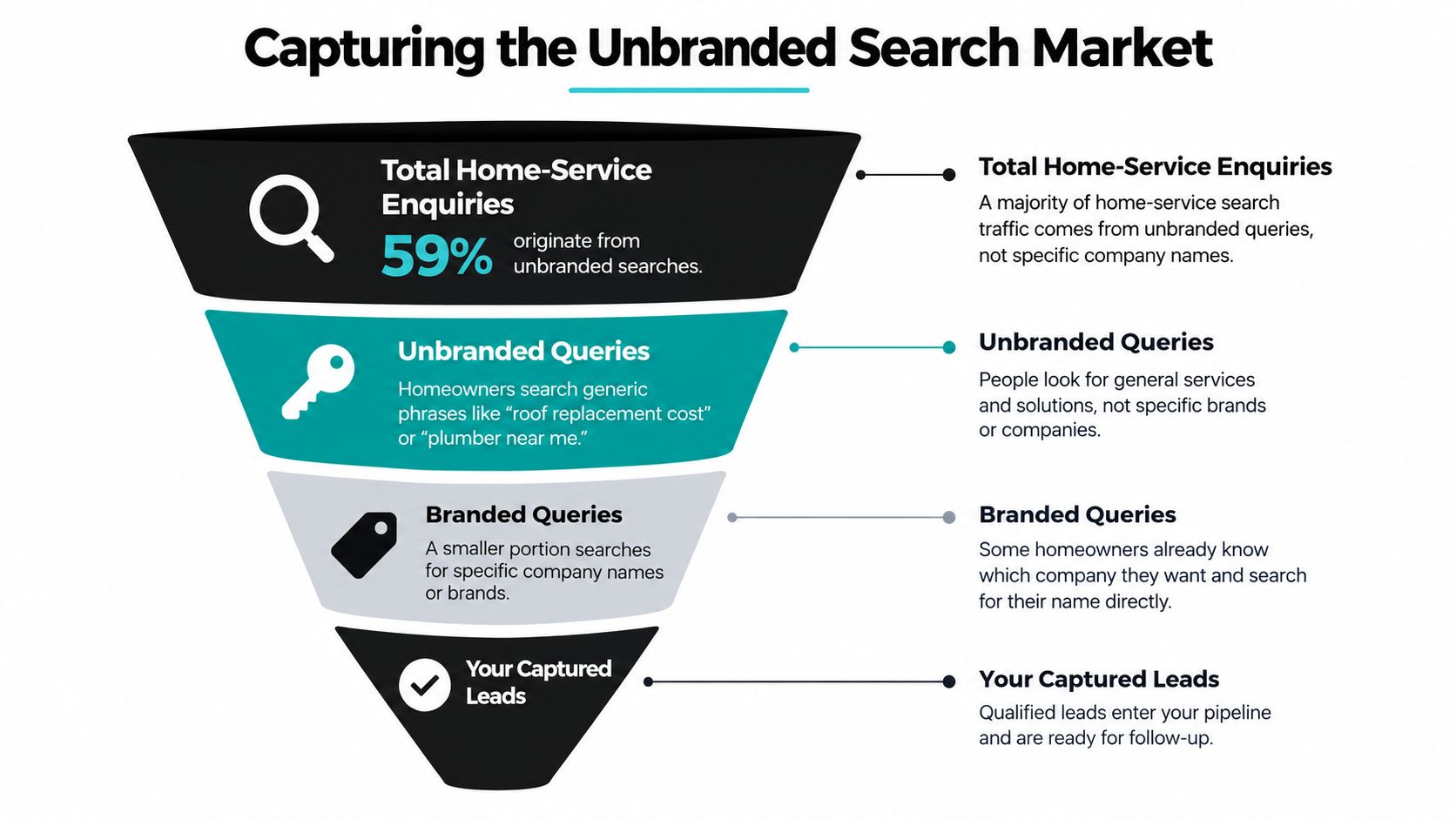
Most roofing businesses start with a short keyword list. It usually includes phrases such as “roofer near me”, “roof repair Melbourne”, and “roof replacement”. Those terms matter, but they don't represent the full market.
An Australian home-services sample found that 59% of enquiries came from search queries missing from the advertiser's keyword list. The same sample found that “near me” searches produced 17% of enquiries and converted at 1.3 times the rate of other searches. Those figures support a simple conclusion: preselected keywords are a starting point, not a complete targeting strategy. The Australian home-services search sample provides the underlying context.
Use search terms as your market research
Start with tightly grouped campaigns for roof repair, roof restoration, reroofing, storm damage, and emergency leaks. Each group should have its own ad language and landing page. Don't send a storm-damage search to a generic “roofing services” page.
Then review the actual search-term report every week. Promote relevant converting queries into exact or phrase-match targets, and exclude searches that indicate irrelevant research, DIY intent, employment searches, training, or unrelated products.
Suburb language matters too. A page targeting “roof repair Richmond” should mention Richmond naturally in the heading, service description, proof, and booking form. It shouldn't be a duplicated template with only the suburb name changed. Use genuine service-area information, local project context, and a clear explanation of what happens after someone enquires.
The sample also found that three-word searches converted at 1.24 times the rate of searches containing five or more words. That supports concise structures such as “roof repair Richmond” and “storm damage roofing Melbourne”, while still leaving room for longer natural-language searches in broad matching and search-term discovery.
Optimise for qualified enquiries
Unknown-query demand can be valuable, but it can also cost more to acquire. The same Australian sample reported that these enquiries cost 1.19 times as much as keyword-worded enquiries. Don't judge that traffic by clicks alone.
Track:
- Cost per qualified lead, not just cost per form.
- Booked inspection rate, separated by campaign and suburb.
- Quote rate, including whether the job was residential, commercial, insured, or maintenance-related.
- Revenue by search term, once your CRM records the final outcome.
That workflow captures demand your original keyword list couldn't predict. It also prevents the common mistake of cutting useful campaigns because their visible keyword performance looks weaker than it really is.
The Massive Demand Behind Australian Roofing Jobs
Roofing businesses don't need to manufacture demand. They need to organise their marketing around the different reasons people need roofing work.
Australia completed 174,730 new dwellings in the 2024–25 financial year, according to the housing pipeline data supplied by the Housing Industry Association. New dwellings create opportunities for builders, developers, roofing subcontractors, and material suppliers. They also require different messaging from an owner investigating an old roof in an established Melbourne suburb.
The existing-home opportunity is just as important. Australia has more than 11 million existing homes, and residential building represented 51% of total construction expenditure over the preceding five years, according to the same HIA submission. Those homes create ongoing demand for leak detection, roof replacement, restoration, guttering, insulation, ventilation, extensions, and storm repairs.
Build campaigns around demand categories
The useful insight isn't that the market is large. It's that the market contains distinct buying situations.
| Demand category | Likely customer | Useful marketing angle |
|---|---|---|
| New roof installation | Builder, developer, owner-builder | Scope, scheduling, materials, compliance |
| Extensions and renovations | Homeowner, builder, designer | Integration with the existing roof |
| Roof restoration | Homeowner, property manager | Condition assessment and staged works |
| Emergency leaks | Homeowner, tenant liaison, manager | Fast triage and inspection booking |
| Storm damage | Insured homeowner | Documentation, photos, scope of works |
| Guttering and ventilation | Homeowner, renovator | Prevention, drainage, condensation, comfort |
A roofing lead generation campaign should reflect those differences. A page for builders may need project coordination information and a commercial enquiry form. A residential replacement page should make material choices easier and explain the inspection process. An emergency page should keep the form short and put the phone number where it can't be missed.
Match budget to the job you want
Don't spread the same offer across every audience. Allocate search campaigns according to capacity, margin, service area, and close process. If your team wants more replacement work, build a replacement campaign with its own landing page and qualification fields. If storm response is profitable but operationally demanding, limit the geographic area to locations you can service promptly.
Local SEO supports the long-term layer. A well-maintained Google Business Profile, accurate service areas, useful project pages, and genuine reviews help homeowners validate your business after seeing an ad. Paid search captures immediate intent, while organic visibility builds an asset that doesn't depend entirely on daily bids.
The business case is strongest when your website, campaigns, and operations agree. Marketing can create demand, but only your team can turn that demand into inspections, quotes, approvals, and completed jobs.
Material-Led Marketing Versus Generic Emergency Ads
Emergency roofing campaigns have an obvious appeal. Someone with a ceiling leak or storm damage may need help immediately, so “emergency roof repair” appears to be the perfect target. The problem is that every competitor sees the same opportunity, and homeowners often feel uncertain about whom to trust after a severe weather event.
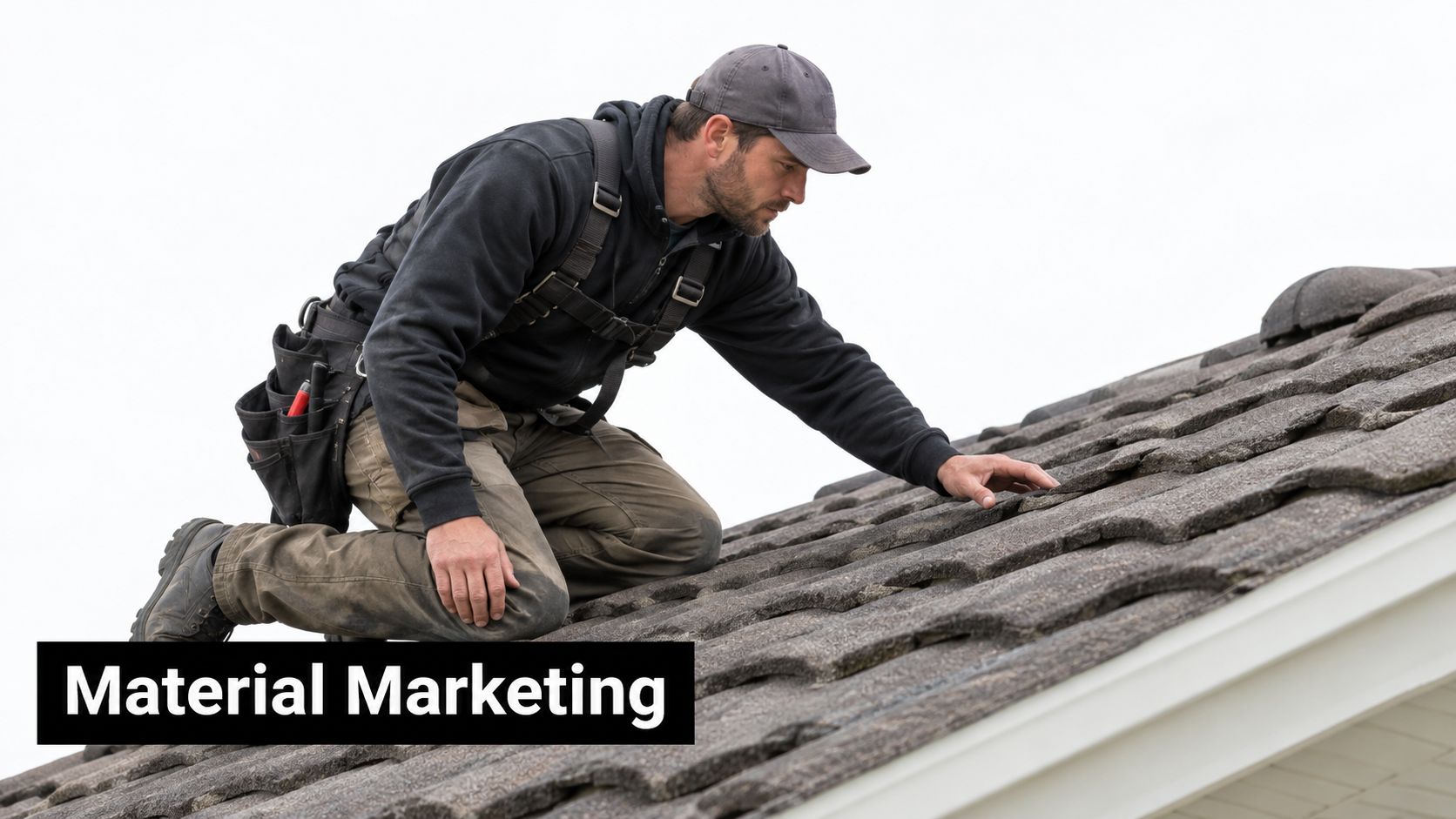
Material and component searches open a different path. Australian SEO analysis indicates that searches for Colorbond roofing and guttering can attract substantially more monthly search interest than “roofer near me”, while emergency and storm-damage phrases are smaller terms. The figures come from a commercial analysis, not a government dataset, but the strategic point is sound. Australian roofing SEO research on material-led searches supports testing product and component categories instead of relying only on emergencies.
Give homeowners a reason to contact you early
A homeowner might begin with “is Colorbond suitable for Melbourne”, “metal roof or tile roof”, “replace gutters or repair them”, or “how does roof ventilation affect condensation”. Those searches show interest, but not necessarily readiness to book. That's precisely why they're valuable. You can establish expertise before the homeowner has chosen a contractor.
Create dedicated pages for:
- Colorbond roof installation and replacement, with suitable applications and clear material inclusions.
- Metal versus tile roofing, covering appearance, maintenance, weight, and lifecycle considerations without making unsupported promises.
- Guttering replacement, explaining when repair is appropriate and when replacement makes more sense.
- Roof ventilation, addressing condensation, airflow, insulation, and the limits of what ventilation can solve.
- Roof material comparison, supported by a photo-based pre-assessment or consultation offer.
Your landing page shouldn't push every visitor straight into a long quote form. Offer a useful next step, such as a material comparison, photo assessment, or inspection that explains what the roofer will check. Then qualify the property, roof type, suburb, intended work, and timeframe.
For local visibility, a complete Google Business Profile for contractors supports the trust layer around these pages. It doesn't replace useful website content, but it gives searchers another place to check your service area, reviews, photos, and contact details.
Emergency campaigns still have a place. They should sit alongside material, maintenance, and renovation campaigns rather than carrying the entire acquisition strategy.
Winning the Storm Damage Insurance Market
Storm damage requires its own operating system. A homeowner dealing with damaged roofing may need urgent protection, evidence for an insurance claim, an inspection, and a clear scope of works. A generic “get a quote” page doesn't handle that sequence well.
Australian insurance data recorded more than 400,000 claims for homes damaged in declared events between 2022 and 2026, costing insurers A$11.3 billion. In 2025, declared events damaged 145,392 homes nationally, according to the Insurance Council of Australia's disaster repairs information. The figures describe insured damage, not roofing leads, but they show why storm response deserves a specialised funnel.
Build the response before the weather event
Create a storm-damage landing page with suburb and postcode fields, a roof-type selector, an urgency question, and a safe photo-upload option. Ask whether the homeowner has contacted their insurer, but don't present your business as an insurer or promise claim approval.
The first response should confirm receipt by SMS and offer a phone-first path. Australian consumer research cited in the supplied insurance data found that 77% preferred speaking with a human for complex enquiries, so a form-only workflow is a poor fit for this category.
A practical sequence looks like this:
- Capture the enquiry with damage type, location, roof material, urgency, and photos.
- Send an immediate confirmation that explains what happens next.
- Route urgent cases to a human who can assess whether temporary protection or an inspection is appropriate.
- Record the outcome in the CRM, including inspection status, quote status, approval, and job value.
- Follow up appropriately, separating an active insurance claim from routine maintenance or future replacement research.
An insurance-ready checklist can become a strong content asset. Explain how to photograph damage safely, retain receipts for mitigation work, document temporary measures, and ask the insurer what evidence is required. Homeowners also benefit from understanding the difference between emergency tarping, temporary protection, and permanent repairs.
When a customer is coordinating an insured project, practical guidance on choosing the right repair builder can help them evaluate contractors more carefully. Your own page should keep the focus on transparent scopes, clear exclusions, inspection findings, and honest communication.
Treat speed as an operational promise
Fast ads are useless if nobody answers the phone. A roofing business can set up a custom number through Twilio, connect it to call tracking, and use an answering workflow that operates 24 hours, doesn't get sick or tired, and books appointments into a team calendar or Calendly. For tradies, hairdressers, beauty therapists, dentists, restaurants, and doctors, that kind of answering system can prevent lost opportunities outside normal office hours.
The point isn't to remove humans from the process. It's to make sure every enquiry receives an immediate response, then reaches the right person when the job needs judgment.
Measuring Success and Tracking Real ROI
A roofing campaign can produce plenty of activity and still lose money. Clicks, impressions, form submissions, and phone calls are useful diagnostics, but they aren't the final outcome. The commercial question is whether the campaign produces qualified inspections, accepted quotes, and profitable completed work.
Start by defining the lead stages inside the CRM. “New enquiry” should not be treated as equivalent to “booked inspection”. Use separate statuses for unqualified, duplicate, outside service area, inspection booked, inspection completed, quote sent, approved, declined, and job completed.
Track calls properly
Use a dedicated tracking number for each major campaign or channel, then connect the call data to the CRM. Tools such as CallRail and GoHighLevel can help teams review call recordings, identify the source of enquiries, and connect phone activity with later outcomes. A Twilio number can sit within a broader phone workflow, including call routing, SMS confirmations, after-hours answering, and calendar booking.
The key fields are practical:
- Source and campaign, so you know which channel generated the enquiry.
- Search term or ad context, where available.
- Call outcome, including missed, answered, qualified, booked, or irrelevant.
- Inspection status, not just lead status.
- Quote and job value, recorded against the original source.
- Lost reason, such as price, timing, location, no response, or unsuitable work.
A call that lasted several minutes may still be worthless if the homeowner was outside your area. A short call can be valuable if it booked a high-margin inspection. Your reporting must reflect those differences.
Connect forms, tags, and offline outcomes
Forms should pass campaign, landing page, suburb, service type, and urgency into the CRM. Use Google Tag Manager and Google Analytics to track form starts, completed submissions, click-to-call actions, photo uploads, and booking completions. Import qualified and converted outcomes back into Google Ads where possible, rather than optimising only for the easiest action to generate.
For Meta campaigns, review event quality and data governance carefully. The Office of the Australian Information Commissioner's guidance on tracking pixels explains that organisations should collect only the personal information necessary, handle sensitive information carefully, provide clear privacy notices, and offer a simple direct-marketing opt-out.
Measurement rule: If your report stops at “lead generated”, it stops before the information you need to make a budget decision.
A Melbourne digital marketing agency should be able to show more than a dashboard of clicks. Alpha Omega Digital can support roofing campaigns with Google Ads targeting, conversion tracking, call tracking, CRM-connected forms, and follow-up automation, while the business keeps the focus on booked inspections and completed jobs.
Don't quit after an early period of mixed results. Roofing demand changes by service, location, weather, and operational capacity. Keep testing the offer, landing page, search terms, creative, qualification fields, and follow-up process. Marketing your business requires consistency, but consistency doesn't mean blindly repeating the same campaign. It means collecting better evidence and making deliberate improvements.
If you're a roofing business with a paid ads budget of at least $3k a month, I'd love to offer you a low-risk deal, one month of paid ads management free. Alpha Omega Digital is a Melbourne-based team that also services Sydney, Brisbane, Newcastle, Perth, Adelaide, Darwin, and Hobart, so contact Alpha Omega Digital to apply and build a roofing lead generation system around qualified inspections, not vanity metrics.
[email protected]
Read more insights from our team on web design, paid ads, and growth strategy.