You've probably reached the point where the current store is costing more than it should. The homepage looks acceptable, but mobile pages feel slow, product discovery is awkward, tracking is incomplete, and paid traffic lands on templates that weren't built to convert. The agency that originally delivered the site may have focused on launch day, while your business now needs a reliable growth system.
That's why choosing a web development agency Melbourne businesses can trust is an ecommerce decision, not a design purchase. Victoria's online retail market is estimated at A$20 billion a year, with spending of about A$2,900 per person, and the state represented roughly 24% of Australia's A$82.6 billion online spending in 2025 (Victoria ecommerce data). A technically weak store can waste valuable demand through slow pages, unclear checkout paths, poor attribution and expensive rework.
This guide gives you a practical way to assess WordPress and Shopify specialists, compare quotes, test technical capability, and judge whether an agency can support revenue after launch.
Why Choosing the Right Agency Matters for Melbourne Businesses
A Melbourne founder may start looking for an agency after a campaign produces clicks but few profitable orders. Google Ads brings visitors, Meta ads create interest, yet the store converts unevenly. The proposals that follow often emphasise polished mock-ups, feature lists and launch dates. The harder question is whether the build will connect customer behaviour, tracking and acquisition costs well enough to support revenue.
Victoria's online-shopping activity is strong, with one regional ecommerce snapshot placing weekly activity at 8% above the national average (Victoria ecommerce market snapshot). Smaller businesses have less room for an expensive rebuild that fails to improve sales. Greater Melbourne's small-business count fell 1.8% in the year to 30 June 2023, while small businesses represented 97.3% of Australian businesses in June 2025 (Australian small-business update). Those conditions make technical vetting and commercial clarity part of the hiring decision.

The build fee is only part of the risk
A low quote can become expensive if the agency selects an unsupported theme, installs unnecessary plugins, skips redirect planning or loses ecommerce data during migration. A polished Shopify storefront can still underperform when product pages hide shipping details, the cart adds friction or conversion tracking cannot distinguish revenue from browsing activity.
Ask what the team will manage after launch. The answer should cover maintenance, UX testing, Google Tag Manager, Google Analytics, Meta Conversions API, Google Ads enhanced conversions and a process for improving product pages using observed behaviour. Tracking added at the end is often incomplete, while tracking planned during development gives campaign and merchandising decisions a usable foundation.
Practical rule: Hire the team that can explain how its development choices affect sales, leads and measurement, not simply the team with the most attractive portfolio.
A capable partner should work across WordPress development and Shopify development, then recommend a platform based on the operating model. WordPress and WooCommerce suit businesses needing ownership, flexible content, custom pricing rules or complex integrations. Shopify suits brands that prefer managed infrastructure, simpler administration and a mature ecommerce ecosystem.
The right agency supports more than launch day. It should make acquisition easier to assess, buying easier for customers and future optimisation less dependent on guesswork.
How to Define Your Goals and Project Scope Before You Enquire
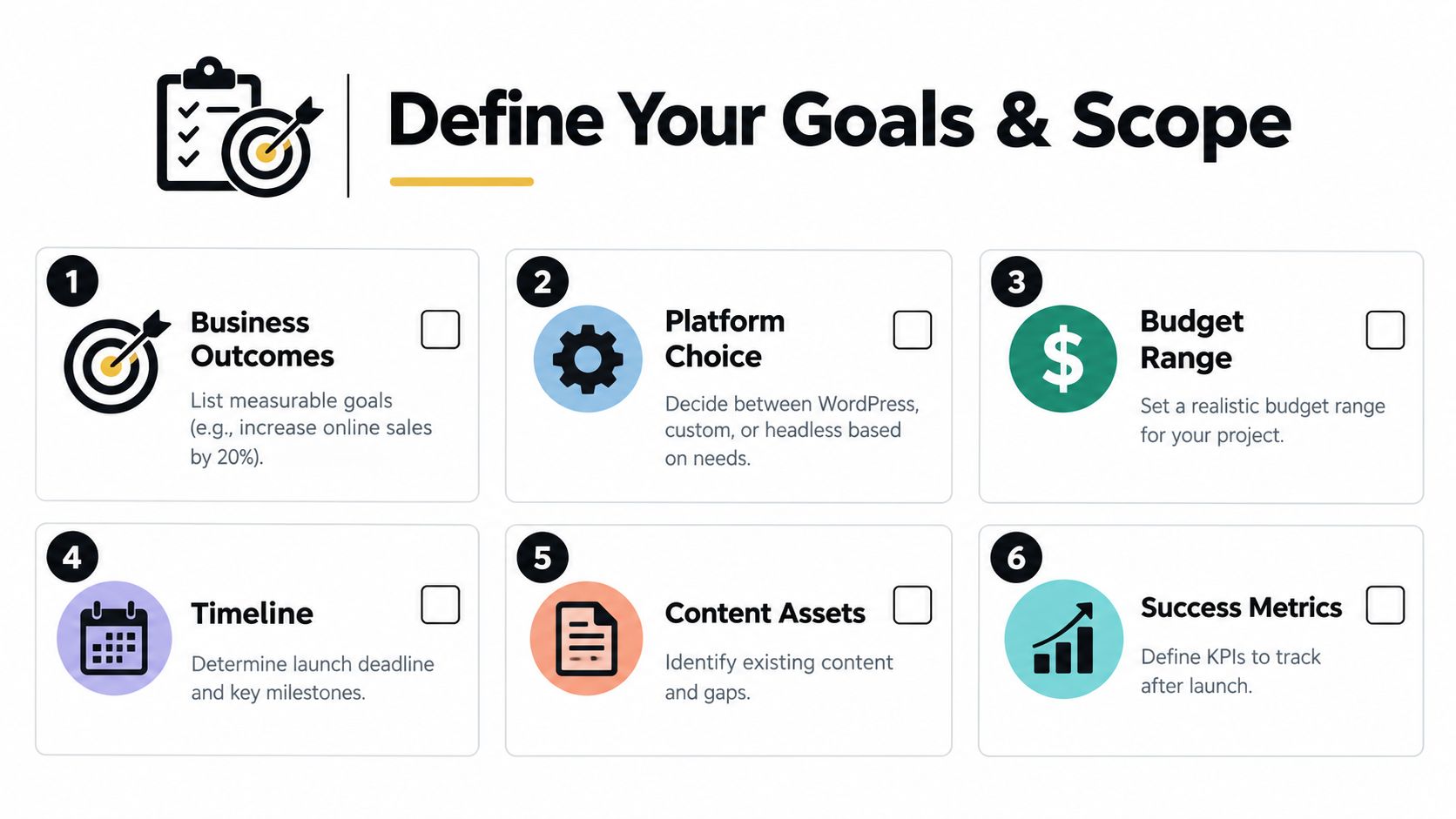
Agencies can only price and plan accurately when the business has described the commercial problem. “We need a modern website” is a starting point, not a scope. Before contacting a WordPress website developer or Shopify developer, write down what must improve and what the new system needs to support.
Start with the business outcome
Choose an outcome that can be observed in analytics or operations. Ecommerce examples include increasing completed purchases, reducing checkout abandonment, improving average order value, making product discovery easier or creating a dependable catalogue structure for SEO. A service business may prioritise qualified contact form submissions, booked consultations or calls from a defined service area.
Then record the current baseline, even if the data is imperfect. List your existing platform, analytics setup, advertising accounts, payment provider, shipping rules, email platform, CRM and product feed. This prevents an agency from discovering essential dependencies halfway through development.
Decide whether you need a rebuild
A full rebuild makes sense when the existing architecture blocks necessary changes, the theme is no longer maintainable, the store has serious checkout issues or the design no longer reflects the product range. It isn't automatically the best answer when the problem is a handful of slow templates, weak product copy or poorly configured campaigns.
An iterative project may deliver more value when the current store has sound foundations. A team might redesign the product page, improve mobile navigation, build a faster collection template and repair tracking before touching the rest of the site.
Choose the platform around operating needs
WordPress and WooCommerce offer control over hosting, code and content. They're useful when you need custom Gutenberg blocks, complex product logic, editorial content, membership features or integrations that don't fit a standard store workflow. A specialist WordPress development company should explain its theme strategy, plugin policy, update process and backup arrangements.
Shopify reduces infrastructure management and provides a focused environment for ecommerce operations. A Shopify development partner can customise themes, create sections, work with the Shopify API, connect external systems and build custom apps using Shopify CLI where the app ecosystem doesn't cover the requirement.
Your scope brief should answer:
- Products: How many product types, variants, collections and product data sources are involved?
- Operations: Who manages inventory, fulfilment, returns, customer support and content?
- Integrations: Which CRM, email platform, ERP, booking system, payment service or shipping tool must connect?
- Content: Which copy, photography, product feeds and brand assets already exist?
- Ownership: Who approves design, supplies content, tests orders and signs off each milestone?
- Measurement: Which events must be recorded in Google Analytics, Google Ads, Meta and your internal reporting?
This brief gives every shortlisted agency the same information. It also exposes agencies that quote quickly without asking about catalogue logic, shipping, tracking or internal responsibilities.
How to Evaluate Technical and UX Capabilities That Drive Conversions
A polished portfolio shows visual skill, not necessarily a store that loads quickly, tracks sales accurately and improves revenue after launch. For Melbourne ecommerce brands, agency vetting is a growth decision. Assess technical delivery, user experience, measurement and post-launch optimisation together, especially in Victoria's $20B ecommerce market.
For mobile performance, Google's Core Web Vitals set practical gates. At the 75th percentile, a good Largest Contentful Paint is 2.5 seconds or less, Interaction to Next Paint is under 200 milliseconds, and Cumulative Layout Shift is below 0.1. Test mobile and desktop separately, using the Google Core Web Vitals guidance via Shopify Australia.
Those thresholds should guide testing, not replace it. Ask whether the agency tests representative product, collection, cart and content templates on realistic phones and networks. A desktop-only review can hide problems affecting phone-heavy Australian traffic. A capable team will also explain which fixes are worth funding, because reducing image weight, third-party scripts and app requests can produce more value than another round of visual polish.
Compare agencies with evidence
| Capability | What Good Looks Like | How to Verify |
|---|---|---|
| Mobile performance | The agency tests LCP, INP and CLS across realistic templates and devices | Request a sample audit showing test conditions and recommended fixes |
| Image handling | Product and hero images are compressed, correctly sized and loaded by priority | Ask who controls formats, responsive sizes and lazy-loading rules |
| Front-end code | Render-blocking assets are limited, JavaScript is deferred where suitable and templates remain maintainable | Request a technical explanation, not only a Lighthouse screenshot |
| Ecommerce UX | Navigation, search, filters, product details, delivery information and checkout work clearly on phones | Complete a test purchase on an existing client site |
| WordPress architecture | The build uses a maintainable theme strategy, selective plugins and reusable Gutenberg components | Ask which code is custom, third-party and covered by updates |
| Shopify architecture | The store uses clean sections, suitable apps and API integrations without unnecessary complexity | Request examples of custom theme and Shopify API work |
| Measurement | Ecommerce and lead events are defined, tested and documented | Request an event map and staging test report |
| QA | Forms, payments, discounts, shipping, emails and analytics are checked before launch | Ask for the launch checklist and defect process |
The strongest WordPress design balances brand expression with predictable interaction. Custom Gutenberg blocks can give internal teams flexible editing without handing every layout choice to a page builder. The strongest Shopify design applies the same discipline through reusable sections, clear product templates and a controlled app stack. The trade-off is straightforward: custom work can fit a specific operation better, while excessive customisation increases maintenance and testing costs.
Measurement needs technical review, not a promise that analytics will be “added later”. Confirm how product views, searches, add-to-cart actions, checkout steps, purchases, forms and phone enquiries will be recorded across Google Analytics, Google Ads and Meta. Ask who validates revenue and transaction values after launch, and whether the agency will investigate tracking discrepancies during optimisation.
Trust signals also affect conversion. Australian web traffic was 59.93% mobile in April 2026, while a 2026 Australian ecommerce analysis found 24% of shoppers bought exclusively on smartphones (Australian ecommerce traffic analysis). Prioritise fast rendering, obvious delivery information, short checkout steps, readable returns policies, payment reassurance and accessible support. Visual polish helps, but it cannot compensate for a phone experience that makes customers work to buy.
Questions to Ask Pricing and Timelines Without Getting Burned
The common assumption is that the lowest website quote is the safest way for an SME to control risk. In practice, an incomplete quote often transfers cost into change requests, emergency fixes, advertising waste and a second rebuild.
Ask each agency to separate strategy, design, development, integrations, migration, testing, launch and ongoing support. You need to know whether product entry, redirects, analytics, conversion tracking, copywriting, photography, hosting, app subscriptions and post-launch fixes are included or excluded.
Questions that expose the real quote
- What is included in the deliverable? Ask for page types, templates, integrations, product migration, testing and training in writing.
- How are revisions handled? “Unlimited” sounds generous but can create an unclear process. Ask how feedback is consolidated and what counts as new scope.
- What delays the timeline? Content, product data, approvals, third-party access and integration decisions often affect launch more than coding does.
- Who owns the accounts and code? Your business should retain appropriate access to domains, analytics, advertising, Shopify, hosting and source assets.
- What happens when the site launches? Get the support window, maintenance terms, response process and optimisation options documented.
- How will measurement be implemented? Ask whether Google Tag Manager containers, Google Analytics events, Google Ads conversion actions, Meta Pixel and Conversions API are part of the project.
For paid search, separate ad spend from management fees and development work. An Australia-focused small-business guide places sensible Google Ads monthly spend often between A$1,000 and A$5,000, with a practical floor of around A$1,500 per month for a single competitive local search campaign (Australian Google Ads budget guide). The underlying calculation is straightforward, daily budget multiplied by about 30.4 days. There's no fixed Google Ads price or minimum contract, so an agency should show how the proposed budget relates to campaign coverage and testing.
A quote that includes tracking should specify the mechanics. Google's documentation explains that enhanced conversions for web can supplement existing tags with first-party data such as email, name, address and phone number, improving the accuracy of conversion measurement when browser-based signals are incomplete (Google Ads conversion documentation).
A reliable proposal makes exclusions visible before the first invoice, not after the first change request.
The same discipline applies to project administration. If you're comparing tools for keeping tasks, approvals, client messages and ownership organised, this complete client management guide offers useful context on the systems agencies may use behind the scenes.
From Onboarding to Launch and Ongoing Optimisation
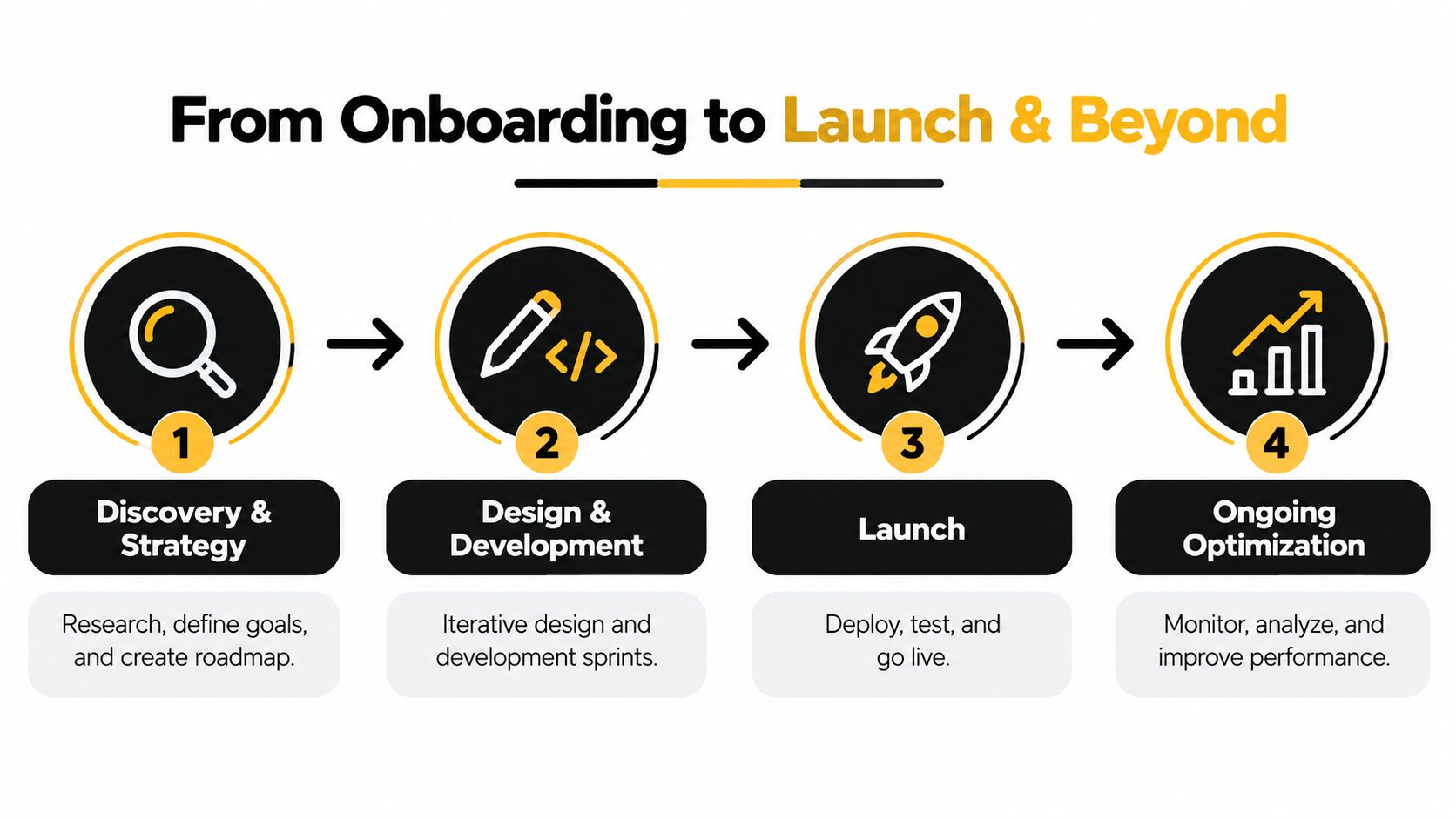
A strong ecommerce project doesn't end when the new URL loads. It creates a controlled path from commercial goals to technical implementation, then uses evidence from real visitors to improve the store.
Discovery and design should settle difficult decisions early
During discovery, the agency should map customer journeys, product or service priorities, campaign landing pages, data sources and operational constraints. That's where you decide whether a custom Gutenberg block, Shopify section, Shopify API integration or custom Shopify app is justified.
Design should then show how users move from landing page to product, cart or enquiry. I want to see mobile layouts before desktop polish is finalised, because navigation, filters, product imagery, sticky actions and form fields behave differently on a small screen.
Development should happen in reviewable stages. The client needs access to working examples, not only static design files. That makes it easier to catch an incorrect shipping assumption, missing variant behaviour or an unworkable content workflow while the change is still affordable.
Tracking is part of the build
A properly configured GTM and Google Analytics setup should record meaningful events rather than load a tag. Ecommerce events may include product views, collection interaction, add-to-cart, checkout progression, purchase and refund information. Lead-generation projects need separate treatment for form submission, phone clicks, booking completions and qualified outcomes.
For Meta, Conversions API installation can supplement browser-based tracking through a server-side connection. A Shopify server-side tracking guide recommends choosing a container region close to the store's traffic, naming Sydney for Australian traffic and Singapore as an APAC fallback. It also specifies that Meta CAPI requires a Pixel ID and System User access token, while Google Ads enhanced conversions require a conversion action, developer token and activation in Google Ads administration (Shopify server-side tracking setup).
The agency should test events in staging and production, compare browser and server events, check deduplication and document ownership. If the implementation can't be explained clearly, it isn't ready for scaling.
Launch is a controlled handover
Before launch, test payments, discount codes, shipping rules, stock status, transactional emails, contact forms, redirects, analytics, advertising conversions and mobile layouts. Record who approves the final release and what happens if a defect appears.
Post-launch work is where ecommerce economics become visible. Australia Post's 2026 ecommerce reporting describes shoppers as more selective, with smaller baskets and a record-low average online basket size (Australia Post ecommerce reporting). That makes shipping clarity, product page testing, checkout improvements, retention flows and merchandising more important than treating the launch as the finish line.
Next Steps to Hire Your Melbourne Agency With Confidence
Shortlist agencies by asking one question: can this team connect development decisions to commercial performance? A strong candidate should be able to discuss platform trade-offs, mobile performance, information architecture, tracking, advertising landing pages and the work required after launch.
Compare your final two agencies using the same evidence:
- Review comparable stores. Look for real WordPress or Shopify ecommerce work, not only brand presentations.
- Test mobile journeys. Browse a collection, open a product, add it to cart and find delivery information.
- Inspect the proposal. Check inclusions, exclusions, ownership, integrations, migration, QA and support.
- Ask about measurement. Confirm the event map, Google Tag Manager container ownership, Google Analytics configuration, Meta Conversions API and Google Ads enhanced conversions.
- Challenge the optimisation plan. Ask what the team will review after launch and how it will prioritise changes.
- Match the partner to your stage. A small catalogue and straightforward checkout may suit Shopify, while complex content, custom pricing or extensive integrations may favour WordPress and WooCommerce.
For brands running paid social, creative production and testing need a repeatable process. A Facebook Ads agency should explain how it tests hooks, offers, formats, audiences and landing pages without changing too many variables at once. If you're assessing tools or partners to scale Facebook and TikTok ads, keep the same standard, ask how testing decisions are recorded and how results connect to actual ecommerce outcomes.
Alpha Omega Digital is one Melbourne-based option for businesses seeking WordPress and Shopify development alongside Google Ads, Meta advertising, tracking and conversion-focused optimisation. The team also services clients in Sydney, Brisbane, Newcastle, Perth, Adelaide, Darwin and Hobart, so local meetings aren't a requirement for the engagement.
The broader lesson is practical. Marketing your business requires consistency, not a single website launch or a few days of advertising. Choose an agency that can build the store, measure the customer journey and keep improving the parts that influence revenue.
If your business has a paid ads budget of at least 3k a month, Alpha Omega Digital offers a low risk deal, a month of paid ads management FREE. Apply through the contact page and visit Alpha Omega Digital to discuss a conversion-focused WordPress or Shopify project with a Melbourne team that can connect development and growth.
[email protected]
Read more insights from our team on web design, paid ads, and growth strategy.