You've probably got the same problem most Melbourne owners have when the website starts feeling stale. The team wants a cleaner design, sales want more enquiries, and you're trying to work out whether you need a quick refresh or a WordPress design agency that can improve conversions, not just make things look nicer.
That decision matters more than many people think. In Australia, the gap is still real, with industry coverage citing ABS reporting that 47.1% of Australian businesses had an online presence, while 63% of microbusinesses, 41.9% of small businesses, and even around 19% of medium-sized enterprises were still offline, which means a lot of buyers are still choosing between first build, rebuild, or proper optimisation rather than cosmetic tweaks alone (ABS-based reporting cited in industry coverage). For a merchant, a service business, or a Melbourne SME, that changes how you evaluate a partner.
A good agency doesn't just ship pages. It thinks about WordPress development, WordPress design, performance, accessibility, analytics, and the path from visitor to lead or sale. The right brief, the right build approach, and the right measurement setup are what separate a brochure site from a site that keeps earning its keep.

Why the Right WordPress Design Agency Matters More Than You Think
I've seen businesses hire on portfolio alone and regret it within months. The design looked sharp, but the site was slow, the contact forms were awkward on mobile, and the owner still had no clear answer on where enquiries came from. That's the gap between a visual supplier and a growth partner.
Design is only one part of the job
WordPress remains central to the Australian web stack. Australia was reported as having 469,707 live WordPress websites in February 2025, ranking 11th globally and accounting for about 1.54% of the world's live WordPress sites (WordPress stats for Australia).
That scale matters because WordPress isn't niche in Australia, it's the platform many local businesses already use. A capable wordpress design agency should understand custom builds, WooCommerce, plugin management, speed tuning, and support after launch. If they only talk about colours, homepage sections, and hero banners, they're solving the smallest part of the problem.
Practical rule: if a proposal never mentions performance, accessibility, tracking, or post-launch care, it's probably a design pitch, not an agency partnership.
Ecommerce and service sites need different thinking
An ecommerce site needs category logic, product discovery, cart confidence, and a checkout path that doesn't leak buyers. A service business needs trust signals, local proof, clear offers, and forms that people can complete without friction. I've watched both types fail for different reasons, even when the branding was strong.
For merchants, the site must support product feed quality, campaign landing pages, and repeatable updates. For lead generation, the site must make calls, form submissions, and booked appointments easy to track. If your agency treats those two models the same, they'll build something pretty but strategically weak.
That's also why I look for measurement setup early, not after launch. If the build includes clean analytics, accessibility checks, and a sensible WordPress integration, you have a site you can improve, not just admire.
How to Shortlist and Evaluate a WordPress Design Agency
The shortlist stage should feel disciplined, not endless. In Melbourne, I'd rather see a business compare three credible agencies properly than browse twenty homepages and choose the one with the nicest animations. The best filter is evidence of real work on live sites, not polished mockups in a portfolio grid.
Compare the right type of partner
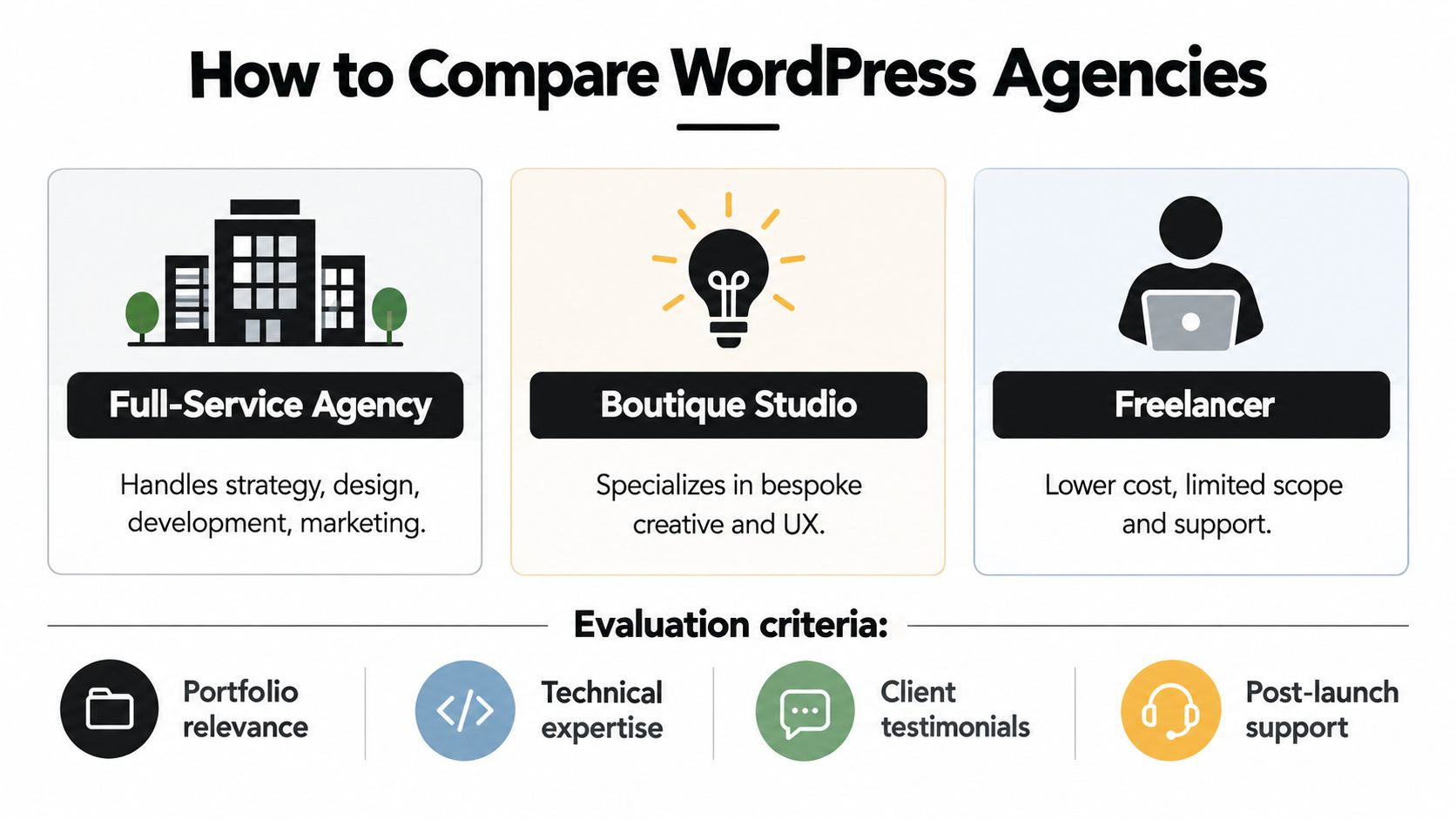
A full-service agency, a boutique studio, and a freelancer can all be the right choice, but for different reasons. Full-service teams are usually stronger when you need strategy, design, development, and marketing to work together. Boutique studios often shine when the UX or visual direction needs a sharper point of view. Freelancers can work well for tight, contained scope, but you need to be honest about support, availability, and breadth.
Useful filter: look for live examples that match your model, ecommerce for ecommerce, lead-gen for lead-gen, and not just visually similar pages.
The evaluation criteria should be simple. Ask whether they've built custom Gutenberg blocks, whether they've handled WooCommerce projects, whether they understand mobile behaviour, and whether accessibility was baked in during build. If the portfolio only shows polished landing pages but no explanation of what happened after launch, you're missing the operational part of the story.
Read evidence, not adjectives
Client testimonials help, but I place more weight on whether the agency can explain decisions. Can they show why a particular homepage hierarchy was used? Can they talk through the content model behind a service page or product collection? Can they point to the trade-offs they made?
A strong shortlist usually has three kinds of proof. One, the work is relevant to your business model. Two, the team can explain the technical choices in plain English. Three, the agency can speak about support after launch without making it feel like an afterthought.
For a broader framework on choosing the right web partner, Uxia's design partner guide is worth reading before you sign anything. It lines up well with the kind of due diligence Australian businesses need to do when the goal is measurable growth, not just a prettier front end.
How to Brief and Interview Your Shortlisted Agencies
A good brief saves a lot of money. A vague brief usually buys you a vague proposal, and then the project gets rewritten halfway through when everybody realises the original scope didn't mean the same thing to both sides. I've seen the cleanest projects start with a short document that answered the business questions early.
Write a brief agencies can actually quote from
Keep it tight, but concrete. State your primary goal, your audience, your products or services, the pages you think you need, and the systems the site must connect to. If you need GTM, GA4, Meta Conversions API, or a bookings workflow, say that up front.
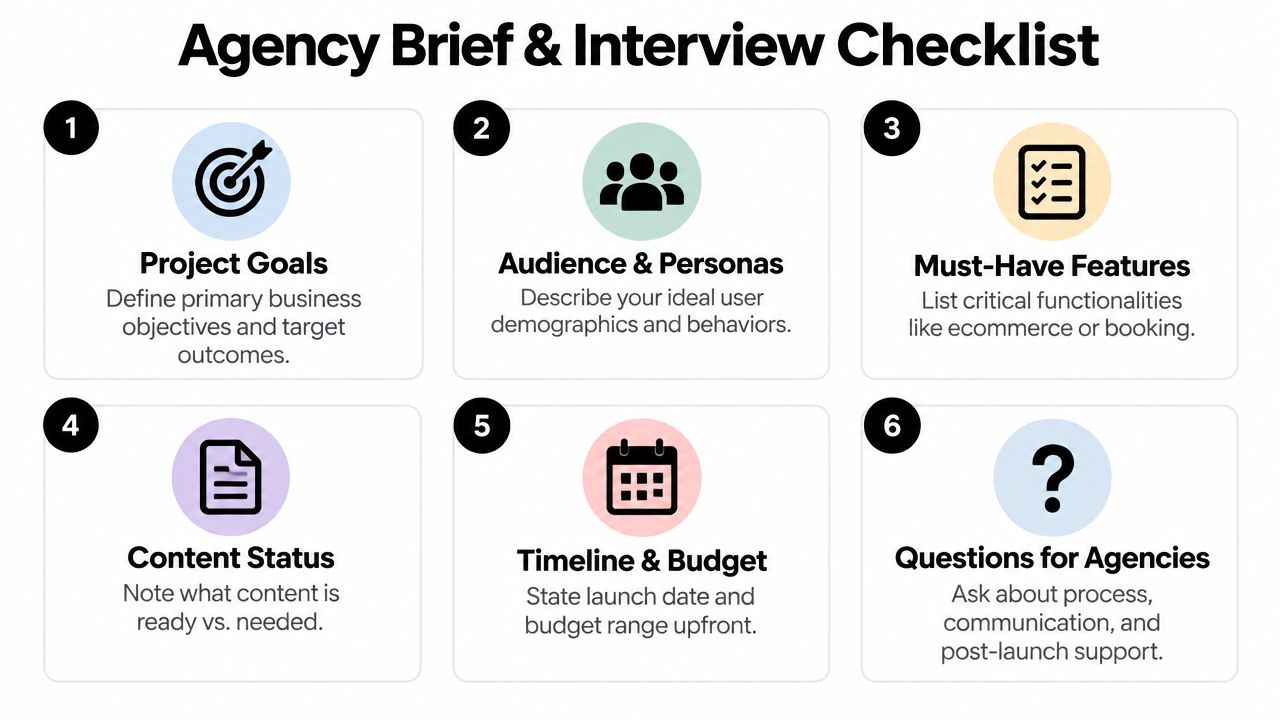
A useful brief also tells the agency what content is ready and what still needs writing, photography, or product cleanup. If you're launching ecommerce, note whether you already have product data and whether the current store needs Shopify development, Shopify design, or a WordPress-to-Shopify migration conversation. If you're quoting WordPress development only, describe whether the project needs custom blocks, template work, or deeper integration work.
Practical rule: the more clearly you define content readiness and tracking requirements, the less likely you are to be surprised by revisions later.
Ask questions that expose real capability
Interview the team like you're buying the way they think, not just their design taste. Ask how they run discovery, how they handle revision rounds, how they QA responsive layouts, and how they test accessibility before launch. Ask what happens when content arrives late, because that's where timelines usually wobble.
You should also ask how they approach building custom blocks in Gutenberg, how they keep page edits manageable for non-technical staff, and what they do when a plugin conflicts with the theme. If the answer sounds like “we'll sort it out later,” that's not process, that's optimism.
For agencies that also handle paid media, ask how the website will support tracking for lead forms, ecommerce events, and ad attribution. That's especially important if you're comparing a marketing agency Melbourne businesses use for both site and campaign work versus a pure design studio. A single team can be efficient, but only if they understand how the build affects performance marketing.
Pricing Timelines and What to Expect in Your Proposal
Most proposal confusion comes from mixing up the kind of work being sold. Theme customisation, custom design, and a full build with tracking and QA are not the same scope, and they shouldn't price the same way. If you want to compare proposals properly, you need to look at what's included, not just the bottom line.
What good proposals usually spell out
A thorough proposal should itemise discovery, sitemap planning, wireframes, visual design, build, QA, launch, and post-launch support. It should also spell out whether training is included, whether hosting is managed, and who owns what at the end. If you're buying a wordpress development company engagement, ownership and handover detail matter as much as the homepage design.
| Proposal Element | What Good Looks Like | Red Flag If Missing |
|---|---|---|
| Discovery | Clear business goals, audience, and site requirements | No mention of strategy or context |
| Sitemap and Wireframes | Pages mapped before design starts | Jumping straight to visuals |
| Design Scope | Defined templates, revision rounds, and component system | “Unlimited changes” without structure |
| Build Scope | Custom templates, plugins, forms, and responsive QA | Vague “development” with no deliverables |
| Tracking Setup | GA4, GTM, and conversion events planned | No analytics or attribution detail |
| Launch and Handover | Training, access transfer, and support plan | No ownership or maintenance clarity |
Timelines should reflect complexity
A small brochure refresh and a multi-product ecommerce rebuild should never feel identical in a timeline conversation. More integrations mean more testing, and custom blocks mean more time spent making sure editors can manage the site safely after launch. If a proposal promises speed but skips QA detail, you're likely paying for shortcuts later.
I'd also be cautious of proposals that hide hosting assumptions or plugin dependencies. That's where projects can drift into scope creep and support headaches. For buyers comparing wordpress web developer, wordpress website developer, or wordpress developer melbourne options, the question is whether the quote captures the operational work, not just the visual layer.
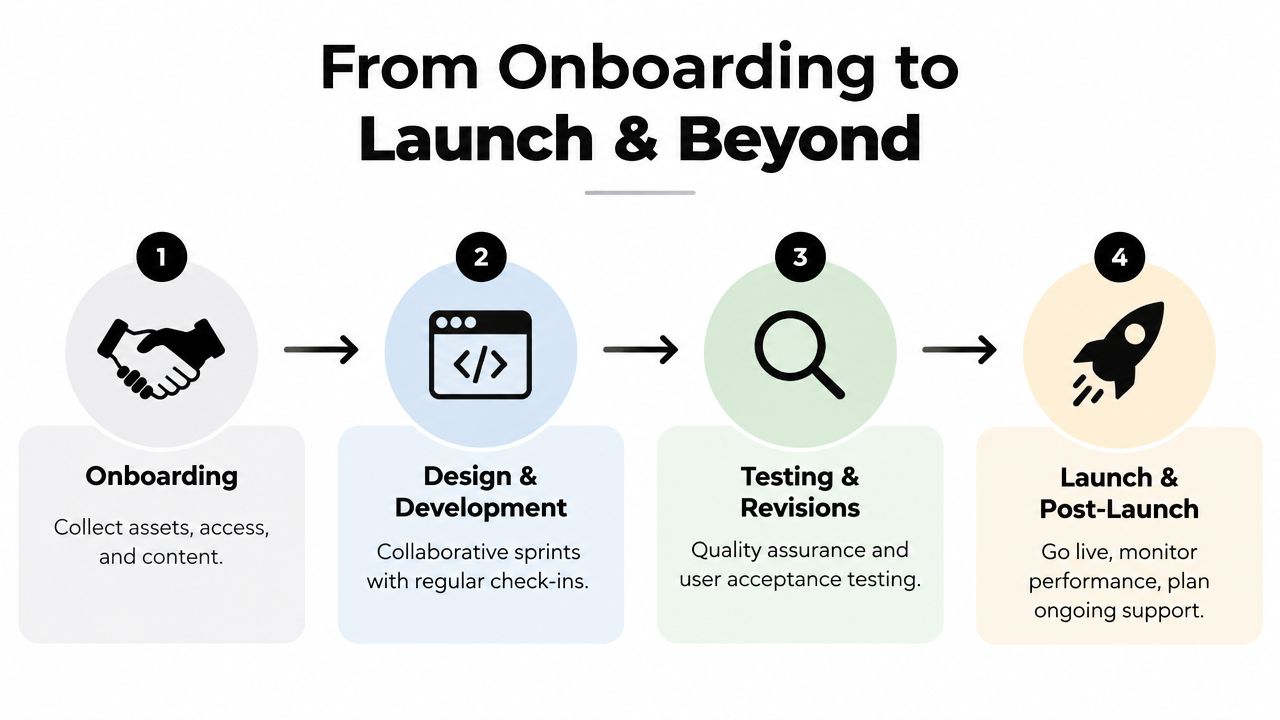
Working Effectively From Onboarding to Launch and Beyond
The easiest projects I've shipped had one thing in common, the agency and client agreed on the working rhythm early. Access, content, approvals, and feedback were handled in a way that kept momentum without turning the project into a chain of surprise decisions. That discipline matters even more when the site has ecommerce, lead capture, or campaign tracking attached to it.
The launch path should be visible from day one
I like projects to move through discovery, design, build, QA, and optimisation in a clear order, with each stage ending in a decision. Onboarding should collect logins, assets, content, and any existing analytics or ad account access. If the project includes a redesign, it should also identify which pages are kept, merged, or retired.
The build itself should be tested in a real environment, not just judged from screenshots. For Australian projects, the practical baseline is to test representative URLs in Sydney and record both first-load and repeat-load performance before and after grouped changes, with mobile and desktop checked separately. The same audit should track LCP, INP, CLS, TTFB, page weight, request count, and the waterfall, because homepage-only testing can hide conversion problems on landing pages and checkout paths (AU-oriented performance guidance).
Accessibility has to be built in, not patched on
Accessibility is not a polish item in Australian web work. Guidance now points to WCAG 2.2 Level AA as the benchmark, and government design standards ask teams to test with assistive technologies, provide alternate formats and multiple pathways, and keep refining interfaces for emerging accessibility issues (Australian accessibility policy guidance).
In practice, the failures are usually familiar, missing alt text, poor contrast, inaccessible forms, weak keyboard navigation, unclear link text, and missing captions or transcripts. I'd rather see those issues handled during component design than argued over after launch. Retrofitting accessibility almost always means rework.
Practical rule: if the agency doesn't talk about accessibility when they talk about wireframes, they're introducing risk before the first page is even built.
Red Flags Success Metrics and Your Next Move
The red flags are usually obvious once you know what to look for. Too many plugins, no staging environment, vague hosting ownership, and no answer on how performance will be measured are all signs the build may become harder to maintain than it should be. If an agency can't explain the technical shape of the site in plain language, they may be more comfortable selling design than delivering a platform.
Watch the signals that create future problems
A bloated plugin stack usually means more conflict risk and more support overhead. A missing staging workflow makes every revision riskier. And if no one can say who owns the code, hosting, and ongoing updates, the handover will probably be messy.
The same applies to measurement. If the proposal doesn't explain how GA4 and ad tracking will be configured, you may launch a good-looking site that can't tell you where leads and sales are coming from. For anyone weighing Google Ads for service based businesses, Google ads for contact form submissions, or ecommerce campaigns, that gap becomes expensive fast.
Measure the business result, not the page count
Success should be judged by the site's ability to support the business model. For ecommerce, that means buyers can find products, trust the store, and complete checkout. For services, that means form submissions, phone calls, and booked appointments are easy to track and easy to convert.
If you're thinking about search and paid media together, a setup that supports Google shopping ads, campaign priority in Google Ads, or PMAX vs Google shopping ads needs clean product data and reliable tracking. On the paid social side, the same logic applies to Meta ads creative testing process, Conversions API installation for Meta, and setting up Google Tag Manager containers. The website has to do its part before the campaign work can do its job.
For businesses wanting one partner to connect website build and paid growth, Alpha Omega Digital handles WordPress development, Shopify development, and performance marketing from Melbourne. If you're evaluating wordpress development Melbourne, wordpress developers Melbourne, or shopify developers for an ecommerce rebuild, that combination can reduce the back-and-forth between site structure and campaign execution.
If you're a business with a paid ads budget of at least 3k a month, I'd love to offer you a low risk deal, get a month of paid ads management FREE. Alpha Omega Digital builds WordPress and Shopify sites with conversion tracking, and then ties the site into Google Ads and Meta work that's measured properly from day one. Visit Alpha Omega Digital if you want a Melbourne team to review your site, your tracking, and your next growth step.
[email protected]
Read more insights from our team on web design, paid ads, and growth strategy.