You're probably staring at a live site that's doing its job, but not giving you enough control. The shop looks fine on the surface, yet every small change turns into a support ticket, tracking is patchy, and the marketing team can't trust what the numbers are telling them. That's where a WordPress developer Melbourne businesses can rely on becomes a growth decision, not just a build decision.
For Melbourne ecommerce brands, the wrong hire usually creates a site that's hard to edit, slow on mobile, and awkward to measure. The right one builds for WordPress development, WordPress design, Shopify development, and campaign tracking together, so the store can move fast without breaking the data layer underneath it. Victoria's tech workforce sat at over 306,000 people in 2024, equal to 8% of the Victorian workforce, and it grew by 110,000 over the decade from 2014 to 2024, which is a strong sign that local demand for digital delivery skills isn't going away, it's tightening competition for good talent too (Victorian Digital Technology Sector Survey Factsheet 2024).
Why a Specialist WordPress Developer in Melbourne Pays Off
A founder I've worked with had a healthy-looking store, decent traffic, and a long list of “small” fixes that kept piling up. The homepage was locked into an old theme, product pages were awkward to edit, and nobody trusted the ad numbers because the tracking had been patched together by different people over time. That's the point where hiring a general web designer looks cheaper on paper, then starts costing more once the site slows down growth.
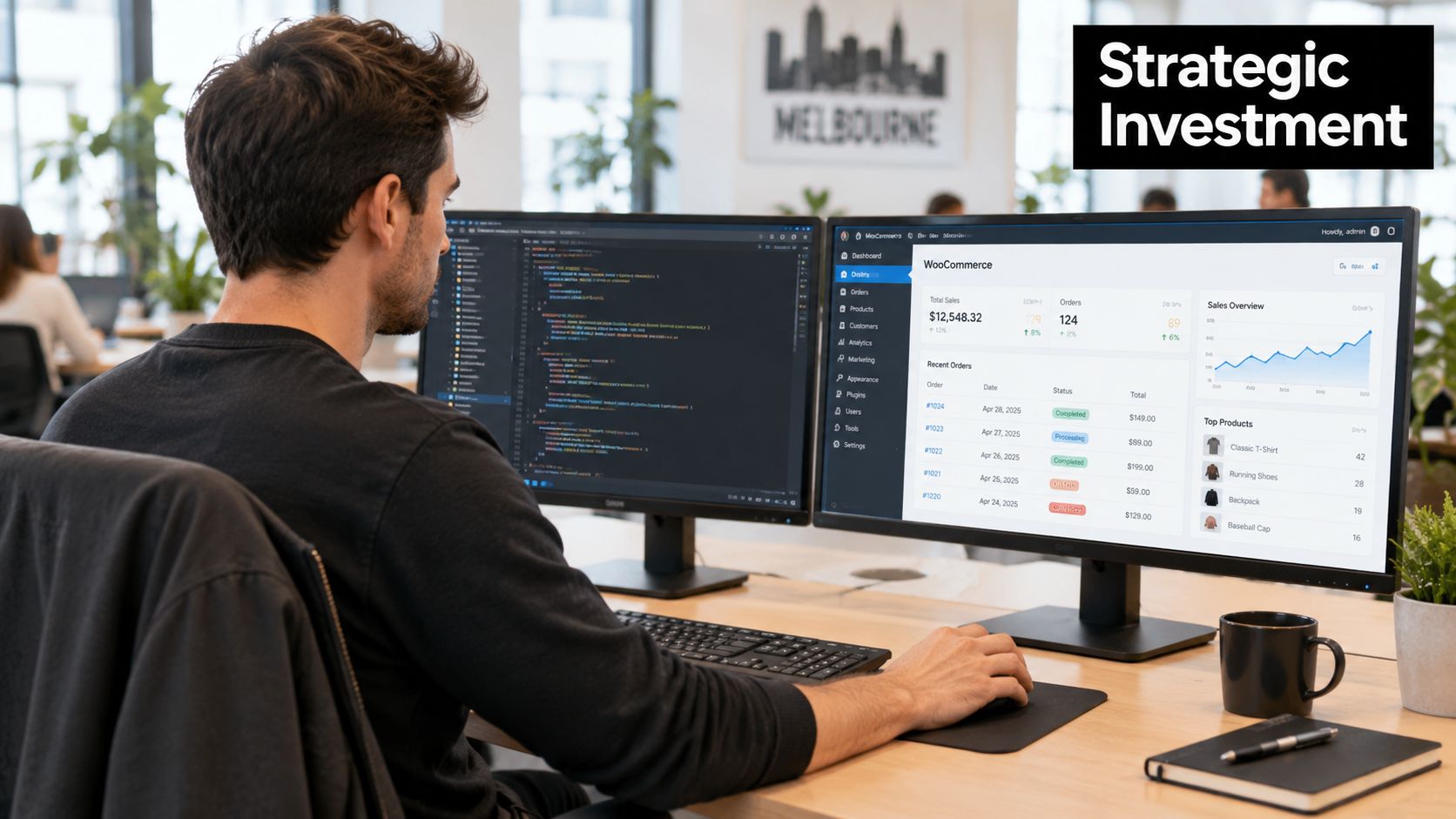
What a specialist actually changes
A true WordPress web developer does more than move blocks around. They build custom Gutenberg blocks when the content team needs repeatable layouts, clean up plugin conflicts before they spread, and set up the structure so future campaigns do not fight the site. In practice, that gives you a cleaner handoff between design, content, SEO, and paid media, especially when the business also runs on Google Ads, Meta ads, or a hybrid WordPress and Shopify stack.
Victoria's broader digital market matters here. The state's ICT sector contributed $34.1 billion to the Victorian economy in FY23 and represented 5% of Victorian value added, while Victoria accounted for 30% of the national technology workforce (Victorian Digital Technology Sector Survey Factsheet 2024). That depth makes Melbourne a strong place to hire, and it also raises the standard. Generalists are common, specialists are harder to keep.
Practical rule: if the site needs custom blocks, measured performance work, and integrations with ads or ecommerce systems, treat the hire like a revenue decision, not a design purchase.
Why merchant thinking wins
The best developers I've hired think like merchants. They ask what needs to be sold, what needs to be measured, and which parts of the site should be editable by non-technical staff. That mindset matters when the site must feed Google Shopping ads, PMAX, Meta Conversion API, or local lead generation campaigns without leaving gaps in reporting.
WordPress is commercially significant in Australia because the footprint is large. One source estimates 666,369 WordPress sites in Australia, and Victoria had over 22,500 Victorian-headquartered ICT businesses in 2023, accounting for 29% of ICT businesses in Australia (BuiltWith WordPress trends). There is enough platform adoption and enough business activity here to justify a specialist, especially for ecommerce brands that need both speed and control.
Freelancer, agency, or in-house
I usually frame the choice this way. A freelancer can work well for a tight fix or a small scoped build. An in-house hire makes sense when website work never stops and the business already has enough process to support them. An agency is the better option when the site needs design, development, tracking, and paid media to work together from day one.
For Melbourne ecommerce owners, the question is not who can “make a site.” It is who can ship something that is easy to update, easier to market, and less likely to fall over when you touch one plugin. That is the standard worth hiring against.
Where to Find and Shortlist Melbourne WordPress Talent
A founder usually loses time by starting with a generic web design list and asking who “also does WordPress.” The faster path is to look where Melbourne developers already show real work, then filter for ecommerce fit, tracking discipline, and maintenance habits. I'd rather see a slightly rough portfolio with commercial results than a polished one full of template reskins.
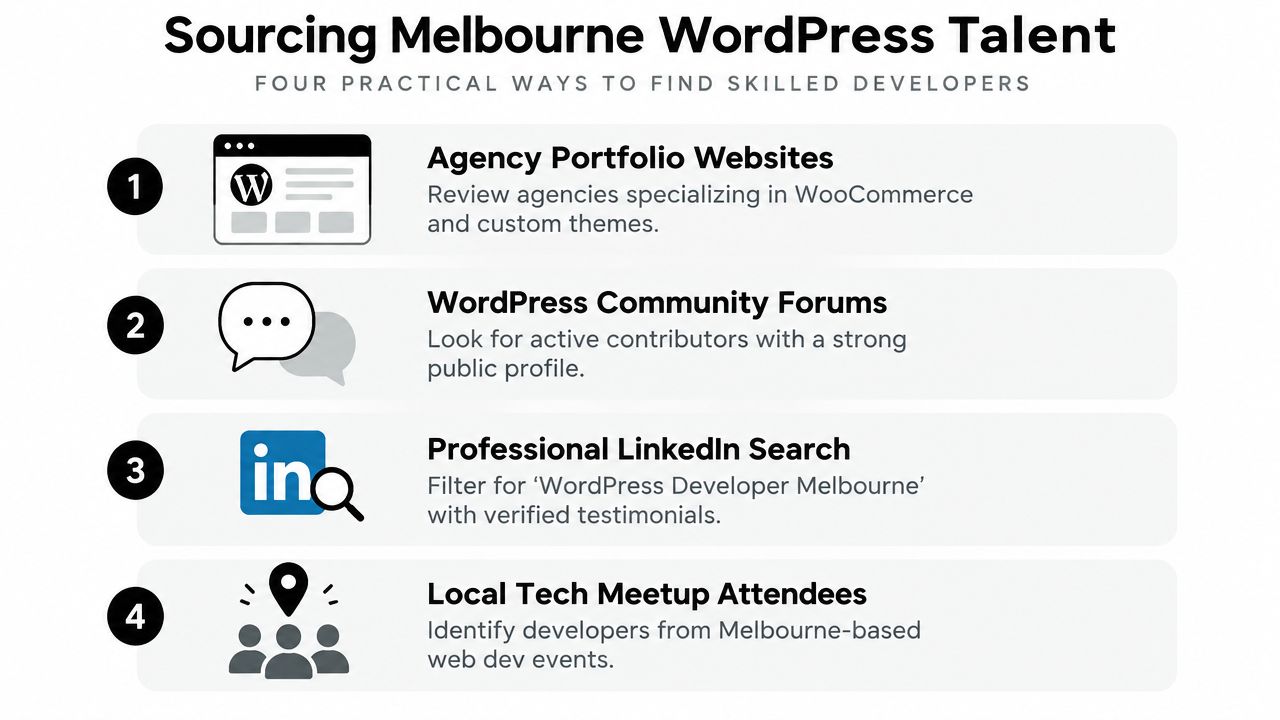
Where strong candidates show up
Agency sites are still the first place I check, especially when the team shows work for WooCommerce, custom themes, and ongoing support. Local referrals help when another founder has already dealt with broken updates, messy analytics, or slow page edits. LinkedIn can work too, but only when the profile includes verified testimonials, a current Melbourne location signal, and project detail instead of a long list of buzzwords.
There's also a practical shortcut for founders who do not want to sift through noise. A developer who cannot explain prioritizing site fixes and restoring broken functionality quickly will struggle when a launch hits problems. A useful reference point is prioritizing site fixes, because strong freelancers and agencies think in terms of triage, not drama.
How I shortlist in under a week
I use four filters before I book a call. First, I look for live Australian stores, not just mocked-up case studies. Second, I check whether the work includes WordPress development, WordPress design, or Shopify development tied to real business goals. Third, I want to see maintenance clients, because ongoing support tells you more about reliability than a single launch. Fourth, I check whether they can talk about tracking and SEO foundations without hand-waving.
A candidate can look strong and still be wrong for an ecommerce brand. If their portfolio only shows brochure sites, they will often understate what it takes to keep checkout flows, search feeds, and ad conversion tracking clean. If they only talk about design, they may not understand the operational side of building for repeatable revenue. For Melbourne brands selling across WordPress and Shopify, that gap becomes expensive fast. The build has to be measurable from day one, with GA4, GTM, and Meta CAPI set up in a way the business can trust.
What to ask for before you speak
Ask for one live site, one custom build, and one example of a problem they fixed after launch. Then ask who maintains the site now and how often they touch it. That usually separates the builders from the order-takers.
For businesses comparing wordpress-developer-melbourne, wordpress-developer-sydney, wordpress-development, wordpress-web-developer, wordpress-website-developer, wordpress-developers, wordpress-development-company, and wordpress-development-melbourne search results, the shortlist should come down to proof, not proximity. Local proof beats generic reach every time.
What to Check in Portfolios and Technical Skills
A portfolio should show more than polished screens. It should show whether the developer can build a site that sells, loads fast, and stays easy to update after launch. If I'm reviewing a wordpress development company or a solo developer, I look for the technical decisions behind the visuals.
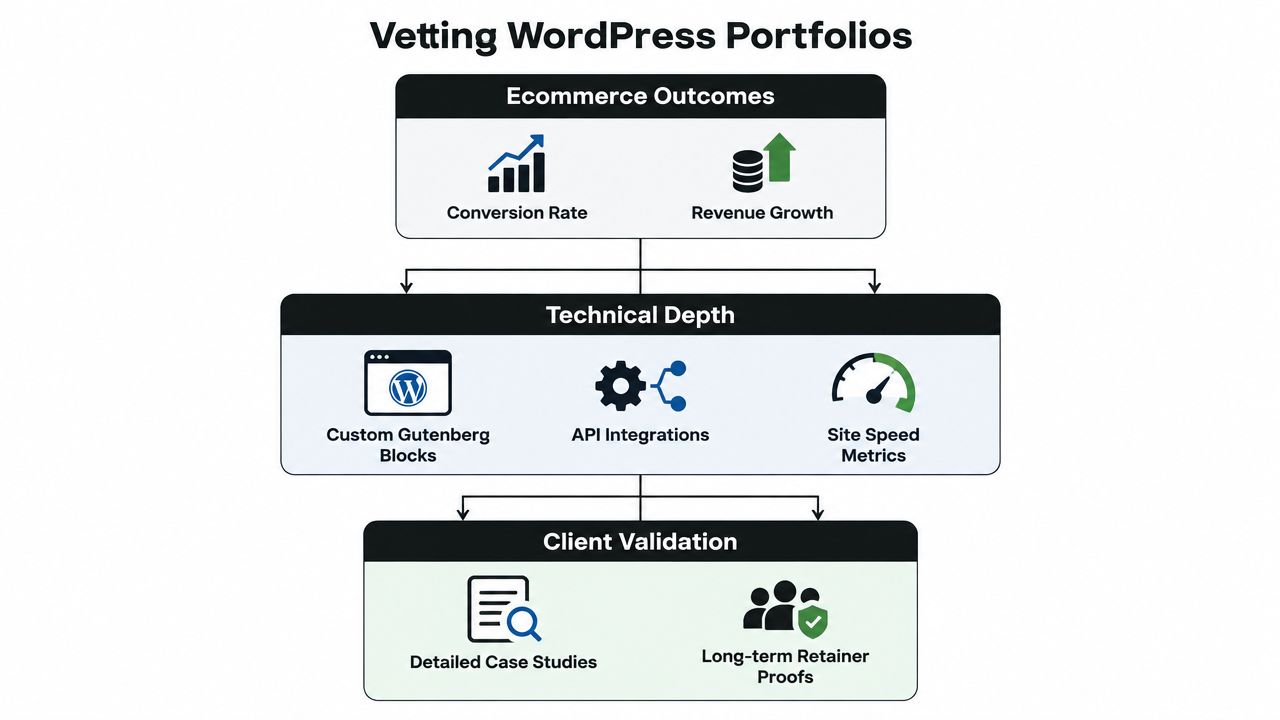
Portfolio signs that matter
The first sign is ecommerce outcomes. I want to see product discovery that feels clear, collection pages that move people toward a decision, and product pages that answer basic questions without making customers dig. The second sign is technical depth, which usually shows up in custom Gutenberg blocks, API integrations, and content structures that let the client update the site without breaking layout. The third sign is client validation, especially long-term support and case studies that explain what changed after launch, not just what the homepage looked like.
For ecommerce brands, the stack often reaches beyond WordPress. If the developer also understands Shopify developer API work, Shopify CLI app builds, or Shopify development partners workflows, that helps when your business runs a split stack or moves between platforms. Good developers stay calm when the brief calls for custom feeds, more flexible storefronts, or a cleaner bridge between content and commerce.
Performance is not optional
For Australian WordPress projects, I treat Core Web Vitals as the launch gate. LCP should be under 2.5 seconds, INP under 200 milliseconds, and CLS under 0.1 (WordPress performance optimisation guidance). The same source notes that only 43.44% of WordPress sites passed all three Core Web Vitals on mobile, and the median mobile Lighthouse performance score was 38/100 across 16.9 million websites.
That's why I ask for before and after speed evidence. I want to know whether the developer checks mobile field data first in PageSpeed Insights, reviews the 28-day Core Web Vitals report in Search Console, and then uses Lighthouse or DevTools to isolate render-blocking scripts, oversized images, and layout shifts before release. If they can't explain that sequence, they probably won't know how to protect the site after launch either.
A clean portfolio with no speed evidence usually means the developer is judging themselves by appearance, not by site health.
What to verify in the integrations
If the site needs GTM and Google Analytics, ask who sets up the container and how event naming is handled. If the business uses Meta, ask how they approach Meta Conversion API installation and what they do when browser tracking and server-side tracking disagree. If the build includes search marketing, ask how they handle Shopping feed health, checkout events, and form submissions so the marketing team can trust the numbers.
The same portfolio should show awareness of Shopify API work, building custom Shopify apps using Shopify CLI, and whether the developer can connect the store to reporting tools without creating duplicate conversions. The strongest people I've worked with don't treat analytics as an afterthought. They treat it as part of the build.
Interview Questions and Paid Trials That Reveal Quality
The best interviews don't sound like sales calls. They sound like two people trying to reduce risk before money changes hands. I've found that a short, specific interview plus one paid trial task tells you more than a polished portfolio ever will.
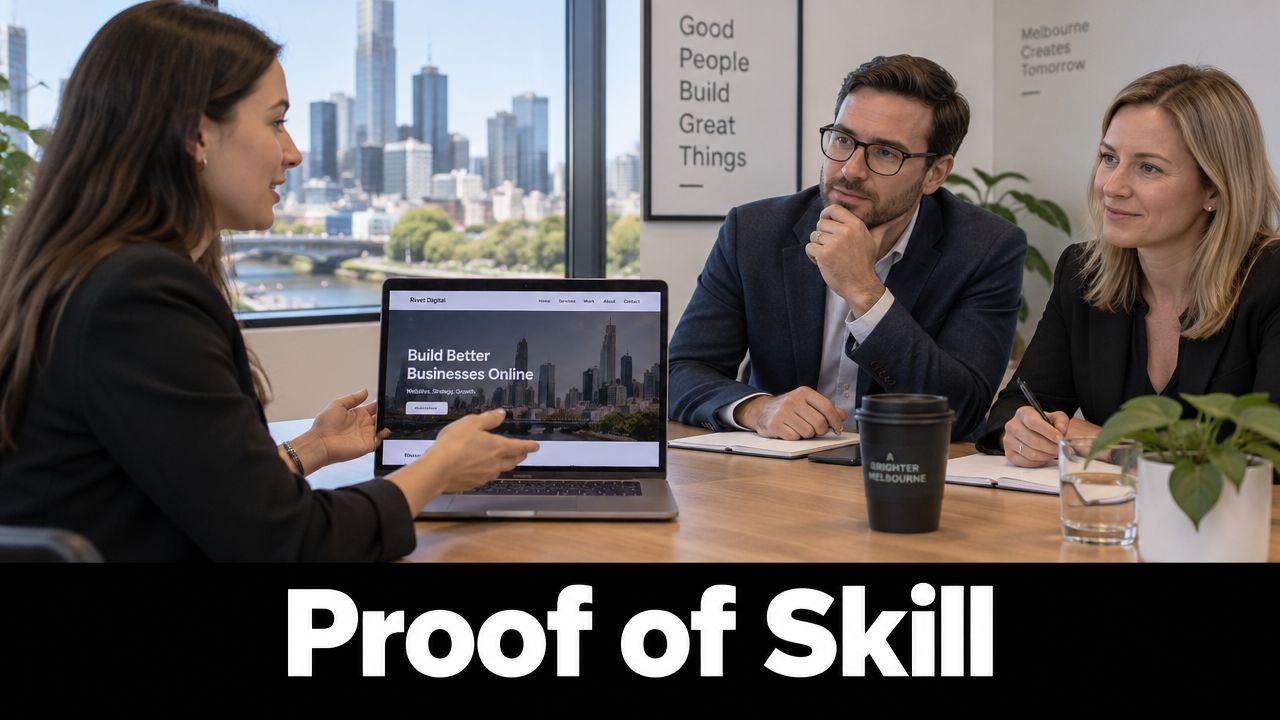
Questions that cut through the fluff
Start with the build itself. Ask, “How would you structure a custom Gutenberg block system for a client who needs to update content weekly?” A strong answer talks about reusable blocks, naming conventions, content constraints, and how the editor experience stays manageable for non-technical staff.
Then move into ecommerce and measurement. Ask, “How do you connect GTM, GA4, and Meta Conversion API so the store can be measured from day one?” The answer should mention event planning, tag governance, and testing, not just plugin installation. If the project touches Shopify, ask how they handle Shopify development, Shopify design, or custom app work, and whether they've used Shopify CLI in a real build.
A useful outside resource for structuring that conversation is scoring rubrics for tech hiring. I like rubrics because they force you to compare candidates on the same dimensions, instead of getting distracted by charisma.
What good answers sound like
Good answers are concrete. They usually mention how they'd separate tracking for product views, add-to-cart actions, form submissions, or contact form submissions for service-led ecommerce leads. They'll also talk about failure modes, like duplicate tags, inconsistent time zones, or data mismatches between platforms. If the candidate can't explain how they'd verify the setup after deployment, they're not ready to own measurement.
Practical rule: if a developer says tracking is “easy” but can't walk through QA, they're not giving you a build plan, they're giving you a guess.
The paid trial that exposes real skill
Keep the trial small. One landing page section, one custom block, or one tracking task is enough. The goal is to see how they communicate, how they handle edge cases, and whether they leave the work cleaner than they found it. For ecommerce clients, I like a task that includes one content update, one responsive issue, and one measurement request.
Score the trial on four things. Did they ask clarifying questions? Did they keep the code tidy? Did they explain their choices clearly? Did they catch the kind of issue a merchant would care about, like a broken event or a clumsy mobile layout? That's the kind of evidence that predicts whether they can handle a live site under pressure.
Pricing Timelines Contracts and Ongoing Support in Melbourne
Most pricing confusion comes from people lumping every WordPress job into one vague bucket. A brochure site, a custom theme build, and serious ecommerce work do not belong in the same conversation. Melbourne buyers need a model that separates scope, risk, and support from the start.
Budgeting without guesswork
Recent Australian and Melbourne pricing guides show small-business WordPress projects commonly land around A$3,000 to A$10,000 in Melbourne, while custom theme builds can reach A$8,000 to A$25,000+ and serious custom WordPress work can run A$15k to A$80k depending on complexity (Melbourne WordPress pricing guide). That spread matters because cheap builds often omit the parts that make the site easier to grow, like content systems, QA, and tracking discipline.
A support plan is where many sites either stay healthy or drift into repair mode. For site maintenance for WordPress, I look for updates, backups, uptime monitoring, performance checks, and enough editorial support to keep small issues from becoming launch-blocking problems. A useful reference point is site maintenance for WordPress, because ongoing care is part of the cost of ownership, not an optional add-on.
Melbourne WordPress Engagement Models Compared
| Engagement Model | Typical Cost Range | Best For | Risk to Watch |
|---|---|---|---|
| Fixed scope brochure build | A$3,000 to A$10,000 | SMEs that need a clear site and limited revisions | Scope creep when the brief changes mid-build |
| Custom theme build | A$8,000 to A$25,000+ | Brands that need stronger design control and custom layouts | Underestimating content and QA effort |
| Serious custom WordPress work | A$15k to A$80k | Ecommerce, integrations, and complex workflows | Teams who budget for build only, not support |
| Retainer support | Varies by scope | Sites that need updates, monitoring, and optimisation | Paying for time without clear maintenance priorities |
Contracts and support that actually help
A solid agreement should say who owns the code, who handles backups, how support requests are logged, and what counts as a new scope item. It should also spell out timelines for discovery, build, review, and launch, because the fastest way to delay a project is to leave feedback cycles vague. GST, payment terms, and IP ownership should be written clearly, not implied.
For Melbourne businesses, the best contract is the one that makes the next six months less chaotic. If the build includes ecommerce, ad tracking, or local search work, support needs to cover more than theme updates. It needs to protect the parts of the site that affect revenue and reporting.
Final Checklist Red Flags and Choosing Your Developer
A bad hire usually looks fine in the first meeting. The cleaner test is whether the developer can explain trade-offs in plain English, show how they set up tracking, and describe what happens after launch if sales drop or a plugin update breaks the site. For ecommerce brands, that matters more than a polished proposal.
Final checklist
- Portfolio depth: Look for live ecommerce work, custom blocks, and real maintenance history, not just concept designs.
- Tracking proof: Ask how they set up GA4, GTM, and Meta Conversion API so the site can be measured from day one.
- Shopify awareness: If your business uses both platforms, confirm they understand Shopify development, Shopify design, and API workflows.
- Local SEO awareness: A complete Google Business Profile matters because a complete profile earns 7× more clicks than an empty one, and Australian brands with active profiles logged the highest monthly actions among the countries studied (Australian local SEO statistics).
- Lead tracking: If you run service-led ecommerce or trades, ask how they measure calls, direction requests, and website clicks, since those are the core local SEO actions tracked month to month (monthly local SEO tracking guide).
Red flags I walk away from
If a developer cannot show how they test speed from an Australian location, that is a warning sign. If they will not discuss rollback plans, QA, or what happens when a plugin update breaks the site, walk away. If they treat Instagram Shop, Facebook Shop, Google Shopping feed health, or Google Ads for service-based businesses as separate from the website, they are not thinking like a growth partner.
The right developer should connect the site to the rest of the marketing stack. That includes Facebook ads creative testing, PPC for tradies, call tracking software such as CallRail or HighLevel, and the measurement discipline that shows when to keep spending and when to fix the site first.
Contracts and support that help
A solid agreement should say who owns the code, who handles backups, how support requests are logged, and what counts as a new scope item. It should also spell out timelines for discovery, build, review, and launch, because vague feedback cycles are one of the fastest ways to delay a project. GST, payment terms, and IP ownership should be written clearly, not implied.
For Melbourne businesses, the best contract is the one that makes the next six months less chaotic. If the build includes ecommerce, ad tracking, or local search work, support needs to cover more than theme updates. It needs to protect the parts of the site that affect revenue and reporting.
[email protected]
Read more insights from our team on web design, paid ads, and growth strategy.