You've probably done this already. You send five “quote please” emails, wait two days, then open a spreadsheet and try to compare agencies that all sound competent and all price the work differently. One talks about brand storytelling. One talks about UX. One says they can “do WordPress and Shopify and SEO and Google Ads”. None of that helps if you just want to avoid hiring the wrong team.
I run into this with Melbourne SMB owners all the time. Most aren't bad buyers. They're just being asked to make a technical, commercial and marketing decision with very little signal. If you've never hired a WordPress web design agency before, the risk isn't just wasting money. It's ending up with a site that looks fine, loads badly, edits badly, and needs a rescue six months later.
A good agency doesn't just install a theme and hand over logins. It should think about speed, hosting geography, accessibility, tracking, content workflows, paid traffic readiness, and what happens after launch. That matters whether you're hiring a marketing agency Melbourne business owners trust for lead generation, a digital marketing agency Melbourne ecommerce brands use for growth, or a specialist WordPress team.
What Most Business Owners Get Wrong When Hiring a WordPress Web Design Agency
The first mistake is choosing on looks alone.
A polished portfolio can hide a messy build. I've seen beautiful homepages sitting on bloated themes, overloaded plugins, and page builders that make simple edits painful. A site can win design points and still hurt your SEO, ad performance, and conversion rate.
Portfolio isn't proof
If you're only judging mockups or finished screenshots, you're missing the important part. You need to know what the backend feels like, how the templates are structured, and whether your team can use the thing without calling a developer every week.
Common mistakes I see:
- Picking the nicest-looking homepage: That's how owners end up with a slow WooCommerce checkout and no thought given to GTM, Google Analytics, or conversion tracking.
- Ignoring who builds the site: The salesperson isn't always the developer. Ask who handles WordPress development, who builds custom blocks in Gutenberg, and who owns QA.
- Treating WordPress as interchangeable: It isn't. A clean custom block theme is not the same as a patched-together premium template.
- Skipping contract review: That's how you get trapped in vague scope, weak handover terms, or surprise bills for basic changes.
- Underestimating post-launch costs: Hosting, plugin licences, support, updates, and tracking fixes don't disappear after go-live.
Practical rule: If an agency can't show you how a client edits pages, products, forms, and landing sections inside WordPress, don't assume the build is usable.
Cheap builds usually become expensive
I've seen businesses get quoted a low upfront price, then hit with extra costs for things that should have been discussed early. Adding a contact form. Cleaning up analytics. Fixing a broken mobile menu. Rebuilding templates so blog content doesn't look like an afterthought.
If you want to validate user feedback before a full redesign, tools like the Formbricks WordPress survey plugin can help collect on-site responses without turning the whole process into a custom dev project.
Here's the blunt version. Don't hire a WordPress web design agency because they can make something look good. Hire one because they can build something your business can run, measure and improve.
Why the Australian WordPress Market Looks the Way It Does in 2026
Australia has a big WordPress installed base, and that shapes how agencies operate.
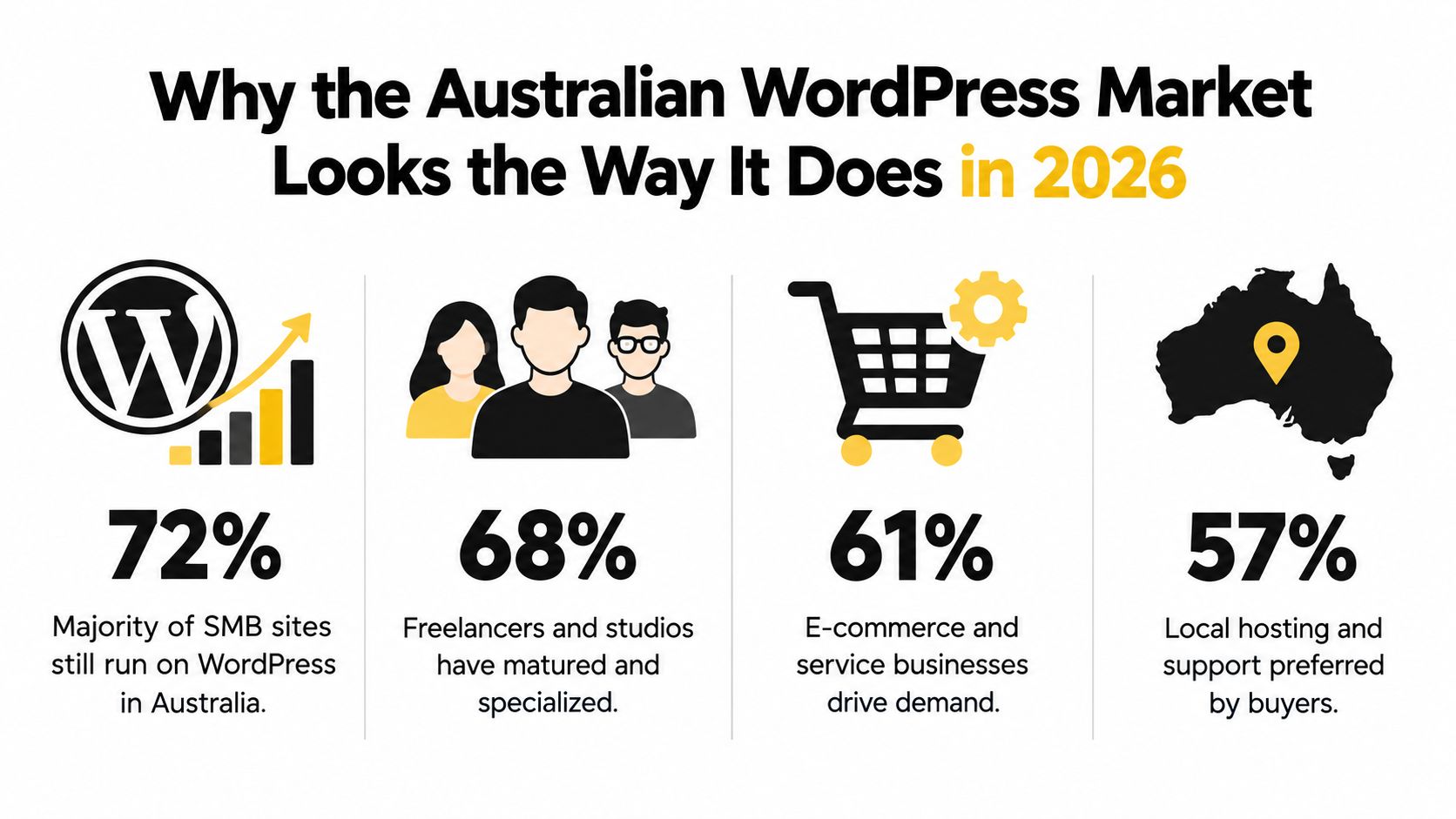
One industry tracker estimates WordPress powers 666,369 Australian websites and holds about 45% of Australia's CMS market in 2026, within a broader environment of more than 4.2 million active websites (Australian CMS market statistics). That matters because most buyers aren't choosing WordPress for novelty. They're choosing it because it's familiar, flexible, and already embedded in the market.
A crowded market creates a signal problem
More suppliers should make buying easier. It often does the opposite.
A 2026 Australian company database identified 252 WordPress web design companies headquartered in Australia, with Melbourne leading at 28 firms, ahead of Sydney at 26 and Brisbane at 19 (Australian WordPress web design company database). That means there's a real local talent pool for WordPress design, WordPress development, ecommerce setup, SEO foundations and ongoing support.
It also means almost anyone can spin up a decent-looking site and call themselves a specialist.
Why discovery calls matter more now
A lot of mediocre work is being hidden behind polished pitch decks and AI-assisted mockups. That's why I put far more weight on the discovery call than the portfolio grid.
On that call, the right agency should ask how you acquire customers, whether you rely on Google Ads or Meta, whether you need GTM and Google Analytics set up properly, whether you're running Shopify alongside WordPress content, and what your local SEO and Google Business Profile goals are.
Good agencies don't just ask what pages you want. They ask how the website will help you sell.
For ecommerce brands, that often includes Shopify development, Shopify design, Shopify API work, Instagram Shop and Facebook Shop setup, product feed quality, and how Google shopping ads fit into the broader acquisition plan.
Freelancer vs Boutique Studio vs Full-Service Agency
Not every business needs the same delivery model. Most owners get this wrong because they buy based on personality or price instead of complexity.
If your site is simple, your buying process should be simple. If your business needs integrations, CRO thinking, analytics, paid ads support, and a roadmap, you need more structure.
The short version
| Engagement Model | Best Fit Project | Typical AUD Range | Watch Out For |
|---|---|---|---|
| Freelancer | Small brochure site, simple rebuild, low integration needs | Qualitatively lower-cost than a studio or agency | Single point of failure, weak documentation, patchy support during holidays |
| Boutique Studio | SMB marketing site, small WooCommerce build, brand refresh with strategy | Mid-range investment | Varying technical depth between studios |
| Full-Service Agency | Larger ecommerce build, custom integrations, growth retainer, multi-stakeholder project | Higher investment | Over-servicing simple projects, slower process if you only need a basic site |
When a freelancer makes sense
A freelancer is fine when the brief is narrow. Five pages. A contact form. Maybe a blog. One decision-maker. No complex CRM integration. No need for advanced Meta conversion API setup, custom Gutenberg blocks, or a reporting layer.
The trade-off is continuity. If that person disappears, gets busy, or hands over a site with poor documentation, you're exposed.
Why boutique studios are often the sweet spot
For many SMBs, a boutique team is the most sensible option. You usually get stronger design direction, a clearer project manager, and enough technical capability to build properly without the overhead of a large agency.
That's especially true if you need a build that ties into local SEO, Google My Business, ecommerce merchandising, service landing pages, or content structures that support paid search later.
If you want to sanity-check whether a site you admire is built on WordPress before you ask who made it, this WordPress tech fingerprint tool is a handy way to inspect the stack.
When to skip straight to an agency
Go bigger if your site is part of a bigger growth system.
That includes:
- Multi-channel growth: You need WordPress plus Google Ads, a Facebook ads agency workflow, or Meta ads creative testing tied to landing page changes.
- Advanced ecommerce: You need Shopify development partners, Shopify API work, custom app logic, or a hybrid content and commerce setup.
- Measurement matters: You need GTM, Google Analytics, server-side style thinking, call tracking, or proper conversion setup for contact form submissions.
- Roadmap thinking: You're planning campaigns, SEO, CRO and development together over time.
If you're already spending on traffic and need a site that supports that spend, a proper web and growth partner is worth more than a cheap build.
A Practical Vetting Checklist Before You Sign Anything
Most agency selection goes wrong because owners ask vague questions and accept vague answers. Don't ask whether they “do custom websites”. Everyone says yes. Ask them to prove how they build, how they test, and how they support the site after launch.
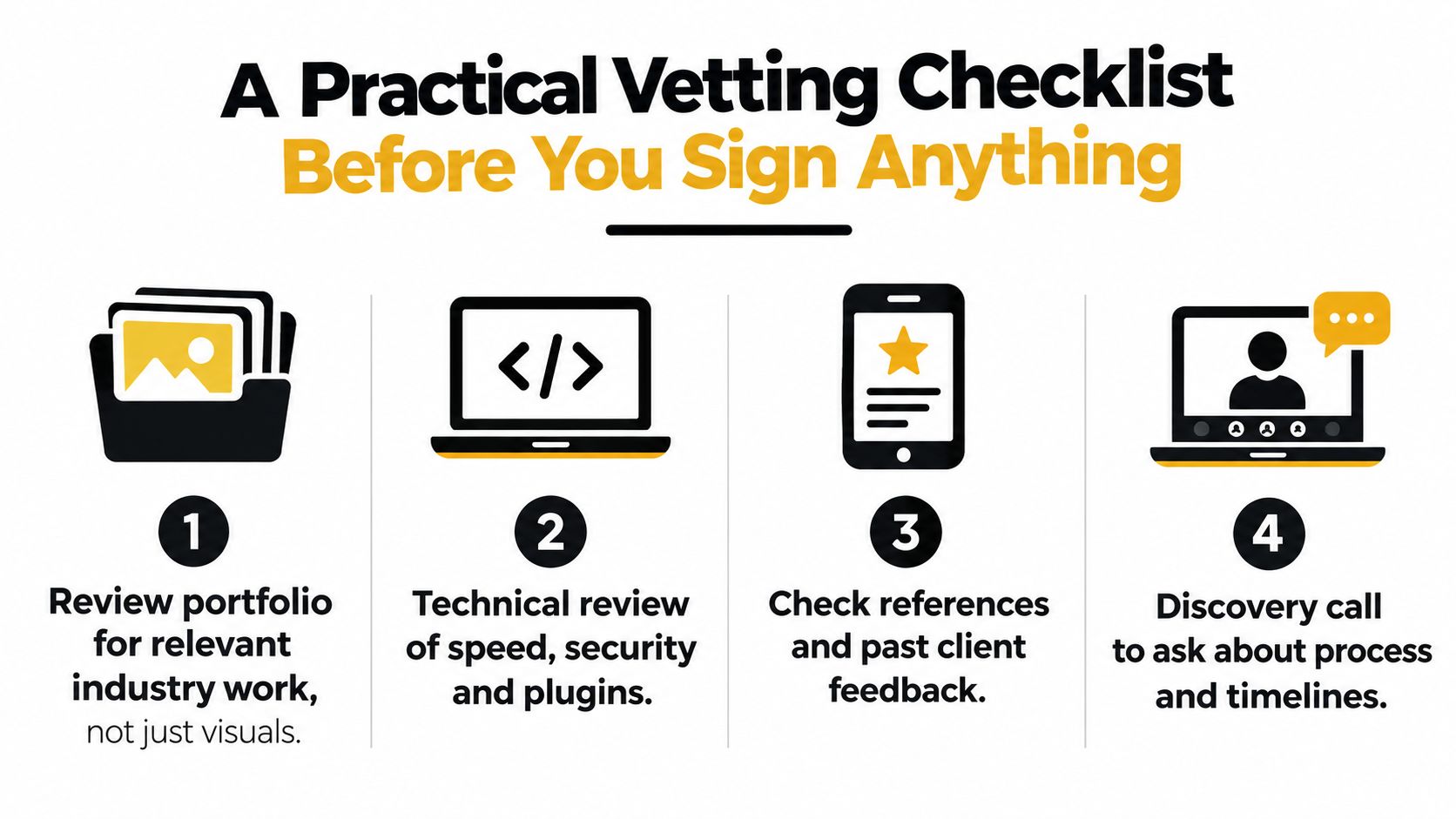
Start with the portfolio, then go deeper
A portfolio should only earn the next conversation. It should not win the project on its own.
Ask them to open a recent live build and show you:
The page editor
Can your team edit key pages cleanly? If they use Gutenberg, can they explain why they built custom blocks instead of leaning on a heavy page builder?The plugin stack
Which plugins are installed, and why? If they dodge the question, that's a bad sign.The theme structure
Is it a real custom theme or a dressed-up premium template?
Ask to see a live admin walkthrough, not screenshots. Screenshots hide pain.
A serious WordPress website developer should be comfortable showing the editor experience, reusable blocks, form handling, blog workflows, and anything tied to ecommerce or lead generation.
Review technical quality, not just design quality
For Australian WordPress sites, a practical workflow is to benchmark representative URLs on mobile and desktop separately using Australian test locations, then record LCP, INP, CLS, TTFB, page weight, request count, and waterfall bottlenecks. Common targets used here are LCP at or below 2.5 seconds, INP at or below 200 milliseconds, and CLS at or below 0.1 (Australian WordPress speed benchmarking guidance).
That's the level of conversation I'd expect from a competent WordPress development company.
A useful extra primer sits below if you want a plain-English overview before your calls:
Check references like you actually mean it
Don't ask “were you happy?” Ask sharper questions:
- Did they hit deadlines
- Did the final invoice stay close to the proposal
- How did they handle scope changes
- Were post-launch fixes included or billed
- Could your team edit the site without help
Listen for diagnosis on the discovery call
The strongest agencies push back. They'll challenge weak assumptions, ask about your conversion goals, and question whether WordPress or Shopify is the better fit.
If all you get is a fast quote and a promise to make it “modern”, keep looking.
For businesses comparing providers, Alpha Omega Digital is one option that combines website builds with paid media and measurement work, which matters if the site has to support Google Ads, Meta ads, or ecommerce growth rather than just sit online.
What a WordPress Project Actually Costs in Australia
Price confusion usually comes from one bad assumption. Owners think they're paying for pages. They're not. They're paying for decisions.
A proper WordPress project includes discovery, information architecture, UX, design, development, tracking setup, content population rules, QA, launch planning, and post-launch support. That's why two agencies can quote very different numbers for what sounds like the same site.
Scope drives price more than page count
If you need a marketing site with clear service pages, lead forms, local SEO foundations and clean editing, that's one level of work.
If you need WooCommerce, subscriptions, custom checkout fields, product filters, Shopify API integrations, Meta conversion API installation, Google Tag Manager containers, or a custom reporting layer, the complexity jumps fast.
| Project Type | Typical Range (AUD) | What's Usually Included | Watch Out For |
|---|---|---|---|
| Small business marketing site | Qualitatively the lowest of the three bands | Strategy, UX/UI, WordPress design, development, forms, standard tracking, launch support | Template-heavy builds sold as custom |
| Custom WooCommerce or advanced learning platform build | Mid-tier investment | Custom functionality, product or course setup, integrations, QA, conversion-focused templates | Missing performance and checkout optimisation |
| Enterprise or multi-site build | Highest investment | Discovery workshops, custom architecture, integrations, governance, staging and deployment workflows | Long timelines without clear ownership and milestone detail |
Why pricing gets distorted
The biggest trap is comparing a proper proposal against a cheap execution quote.
A low quote often excludes:
- Accessibility work such as keyboard navigation, contrast review and semantic structure
- Performance engineering for mobile speed, media handling and script control
- Tracking setup for GA4, GTM, Meta events and conversion mapping
- Content migration rules that stop publishing from becoming chaotic
- Staging and launch discipline so the site doesn't break during go-live
If a quote looks cheap, assume something important is missing until proven otherwise.
Ask how they handle ongoing costs
Post-launch costs are normal. What matters is whether they're explained clearly.
You should ask about hosting, plugin renewals, backup systems, support retainers, tracking support, and what happens if you later need Shopify development, local SEO landing pages, Google shopping campaign support, or a new Meta ads landing page built quickly.
A good proposal doesn't hide these costs. It names them.
Red Flags That Should Make You Walk Away
You don't need to catch every issue. You just need to catch enough of them before you sign.
The worst rebuilds I see usually started with the same warning signs. The owner ignored them because the agency was responsive, confident, or cheaper than the others.
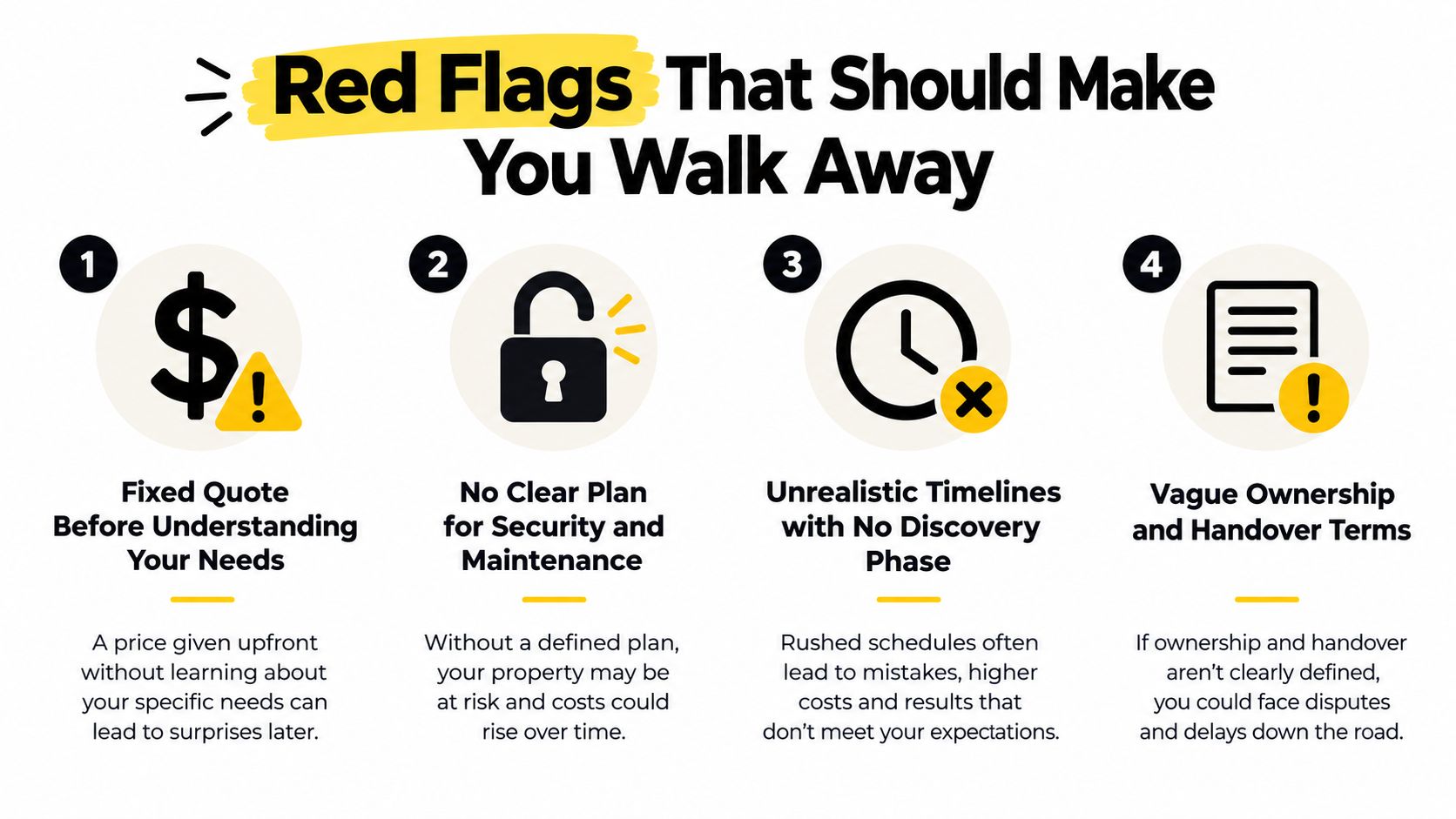
The big ones
A fixed quote before discovery
If they haven't reviewed your content, integrations, goals, and current setup, the quote is guesswork.“Custom design” that really means a premium theme
There's nothing wrong with themes when used. There is something wrong with charging custom pricing for template work.No clarity on plugins or stack
If they won't say what tools they use, they're hiding either inexperience or technical debt.No staging or deployment explanation
Every agency doing real WordPress development should have a clean process for testing and releasing changes.
Contract and ownership problems
This is where owners get burnt.
Watch for contracts that keep the domain, hosting account, licences or core assets under the agency's control without a clean transfer path. Also watch vague milestone structures, weak support terms, and anything that makes handover sound optional.
Walking away from a shaky proposal is cheaper than paying another team to rebuild it later.
Behaviour on the call matters
If they avoid commercial questions, that tells you a lot.
A solid agency should want to know:
- whether you rely on Google Ads for service leads
- whether you need Google Ads for contact form submissions tracked properly
- whether you run Meta and need conversions API installation
- whether ecommerce is on WordPress or Shopify
- whether local SEO and Google Business Profile matter to your lead flow
If they never ask how the site makes money, they're probably building for appearance, not outcomes.
Performance Accessibility and What Happens After Launch
Launch day is not the finish line. It's the start of ownership.
If an agency can't talk confidently about performance, accessibility, and support, they're not a growth partner. They're a theme installer.
Performance is a commercial issue
Australian WordPress performance data shows hosting geography matters. Sites hosted in the US can add roughly 150 to 250 milliseconds of latency per round trip compared with hosting in Sydney or Singapore, and one Australian CrUX-based summary reported only 43.4% of WordPress sites passing all three Core Web Vitals on mobile (Australian WordPress performance research).
That should immediately change how you judge proposals.
For an Australian audience, I'd want performance targets written into the scope, especially on mobile. The baseline targets I look for are the same ones many local practitioners use: LCP at or below 2.5 seconds, INP at or below 200 milliseconds, and CLS at or below 0.1. If an agency only talks about desktop screenshots, that's not enough.
If you want a plain-English checklist to make your WordPress site faster today, that resource is a decent starting point before you speak to developers.
Accessibility is not optional
Australian policy guidance updated in 2025 points to WCAG 2.2 Level AA as the current conformance expectation, and the same guidance notes Australian internet performance has improved, with median fixed download speeds of 95.29 Mbps and mobile speeds of 122.20 Mbps at the end of 2025 (Australian accessibility policy guidance).
That matters because user expectations are higher. People don't just want pages to load. They expect them to work.
For ecommerce, I'd specifically check:
- Keyboard access across menus, filters and checkout
- Alt text rules for product imagery
- Colour contrast on buttons, badges and sale labels
- Form usability on mobile
- Accessible WooCommerce checkout flows
Support after launch needs to be defined
The support model should be in writing before you pay the deposit.
| Care Area | Managed Retainer | Break-Fix Support |
|---|---|---|
| Updates | Scheduled core, theme and plugin updates | Done only when something fails |
| Security | Ongoing monitoring and patching | Reactive clean-up after issues |
| Performance | Regular reviews and optimisation | Usually ignored until the site feels slow |
| Content edits | Minor changes included or scoped clearly | Billed ad hoc |
| Tracking | GTM, GA4 and event maintenance as needed | Fixed only when reporting breaks |
| Ecommerce support | Ongoing merchandising and conversion fixes | One-off repairs with delays |
For ecommerce brands, this matters even more if your site supports Google shopping ads, PMAX vs standard shopping testing, Meta creative testing, Shopify app integrations, or paid campaigns for seasonal launches. A slow or broken page doesn't just annoy visitors. It wastes ad spend.
My advice is simple. Before signing with any WordPress web design agency, ask for a written commitment covering performance targets, accessibility expectations, hosting location, support inclusions, and ownership on handover.
If you need a site that does more than look polished, Alpha Omega Digital builds WordPress and Shopify websites with paid media, tracking, and conversion performance in mind. If your business has a paid ads budget of at least 3k a month, I'm happy to offer a low-risk deal: get a month of paid ads management free, then apply through the contact page and we'll see if the fit is right.
[email protected]
Read more insights from our team on web design, paid ads, and growth strategy.