At its heart, a search engine marketing agency is a team of specialists laser-focused on one thing: getting your business seen on search engines like Google through paid ads. It’s not just about driving clicks. I've learned from years of experience that it’s about putting your products or services right in front of the people who are actively looking for them right now.
What an SEM Marketing Agency Actually Does for Your Business
When I first got into this industry, "SEM" was one of those buzzwords that got thrown around in every meeting. Let's cut through the noise. I want to share what a dedicated SEM agency—especially the kind of digital marketing agency Melbourne businesses count on—actually does day-to-day. It’s so much more than just 'running ads'.
We're talking about a dynamic field that needs constant attention. Recent industry analysis shows the Australian digital marketing market is set to hit a massive $1.5 billion in 2025, growing at a steady 12% each year. This boom is driven by new tech and a huge demand for things like voice search. And with Google owning a staggering 93% of all search engine use in Australia, sitting on the sidelines with paid search just isn't an option anymore. You can explore more on the state of Australian marketing to see the full picture.
More Than Just Keywords and Bids
A true SEM partner gets into the guts of your business. For my eCommerce clients, that means I need to understand their profit margins, customer lifetime value, and what makes them unique before we even think about spending a dollar on ads. It's a blend of creative strategy and technical groundwork.
My daily grind is part art, part science:
- Strategic Campaign Building: We don’t just throw money at broad keywords. We build campaigns around what the user is trying to do—whether that’s pushing high-priority Google Shopping ads for a dropshipping store or generating precise leads through a contact form.
- Technical Implementation: This is the stuff that happens behind the scenes. We handle everything from setting up Google Tag Manager containers and configuring the Meta Conversion API to making sure your analytics are actually firing correctly. For clients on custom platforms, we even build out connections using the Shopify API.
- Continuous Optimisation: An SEM campaign is never "set and forget." We're constantly running creative tests for Meta ads, analysing campaign priorities in Google Ads, and deciding when to use PMAX versus standard Google Shopping ads to squeeze out the best possible return.
A Focus on Measurable Growth
At the end of the day, the only thing that matters is turning clicks into sales. Everything we do is tracked, measured, and reported back to you. We focus on the metrics that actually move the needle—Return On Ad Spend (ROAS), Cost Per Acquisition (CPA), and the quality of the leads coming in.
This data-first approach lets us make smart decisions, ensuring every dollar of your marketing budget is working as hard as possible for your Shopify or WordPress store. It’s a partnership built on transparency and a shared obsession with tangible business growth.
The Core Services That Power Your eCommerce Growth
Let's get into the engine room of a successful SEM campaign. For an eCommerce business, this isn't just about getting seen; it's about turning visibility into sales. From my experience working with Melbourne-based online stores, a powerful SEM strategy is built on a few core, interconnected services that work together to find, attract, and convert customers.
At the heart of any effective SEM strategy is a clear workflow that moves from planning and execution to optimisation and growth. This process ensures every dollar spent is deliberate and aimed at achieving specific business goals.
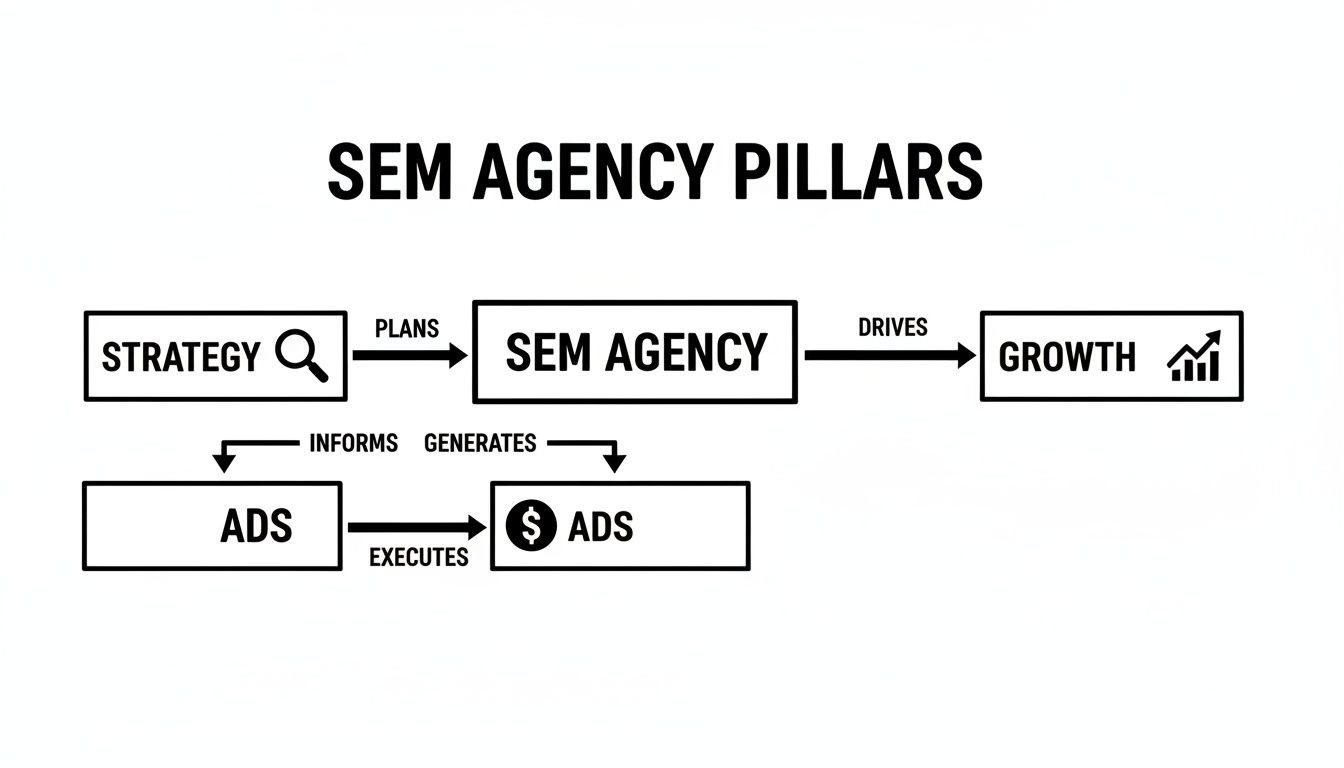
This visual breaks down the essential pillars of an SEM agency's work, showing how strategy informs ad execution, which in turn fuels measurable growth. It’s a continuous cycle where data from one stage refines the next, creating a smarter, more efficient campaign over time.
Mastering Google Shopping and PMax
For any eCommerce brand, Google Shopping Ads are non-negotiable. These aren't just text ads; they are visual product listings that appear at the top of search results, showing customers exactly what you're selling before they even click.
A common crossroads we face with clients is deciding between standard Shopping campaigns and Performance Max (PMax).
- Standard Shopping: This gives you granular control. You can set campaign priorities, manage bids on specific products, and use negative keywords to filter out irrelevant traffic. I find this works brilliantly for businesses with very specific margins or those wanting to push particular product lines.
- PMax: This is Google’s AI-driven powerhouse. It takes your product feed and assets and promotes them across all of Google's channels—YouTube, Display, Search, Discover, Gmail, and Maps. It’s fantastic for maximising reach but requires you to trust the algorithm. The trick is feeding it the right audience signals and top-notch creative.
One hard-won lesson is that you don't always have to choose. We often run both, using campaign priority settings to ensure our standard Shopping campaigns capture high-intent, branded searches while PMax handles broader discovery and prospecting. The ultimate aim of many SEM strategies is to maximize your return on investment through effectively driving conversion growth.
Facebook and Instagram Shops: The Social Commerce Engine
While Google captures active searchers, social platforms help you create demand. Setting up Facebook and Instagram Shops turns your social profiles into digital storefronts, making it seamless for users to browse and buy without leaving the app.
This creates a frictionless shopping experience that is crucial for impulse buys and engaging a mobile-first audience. We connect these shops directly to our clients' Shopify or WordPress product catalogues, so inventory and pricing are always in sync.
The most significant shift I’ve seen in recent years is the absolute necessity of the Meta Conversion API (CAPI). After Apple's iOS14 update, browser-based tracking became unreliable. CAPI sends conversion data directly from your server to Meta, bypassing browser limitations and giving you a much more accurate picture of ad performance.
Without CAPI, you’re flying blind. You can't properly attribute sales to your ads, your custom audiences will be incomplete, and Meta's algorithm won't have the data it needs to find more customers like your existing ones. It’s a complex setup involving tools like Google Tag Manager, but it’s the bedrock of any successful Meta ads strategy today. Getting this right is a top priority for every eCommerce client we onboard.
SEO and SEM: A Partnership for Dominating Search Results
One of the most common questions I hear from business owners is, "Should I invest in SEO or SEM?" It’s a fair question, but my answer is always the same: it’s not an either/or choice. The real key to dominating search results is to treat them as a powerful partnership.
From my experience, especially as a marketing agency Melbourne brands rely on, I've seen firsthand how these two channels feed each other. SEM, particularly Google Ads, gives you immediate visibility and a treasure trove of invaluable keyword data. For a new Shopify store trying to make its first sales, this is an absolute lifesaver.
Meanwhile, SEO builds the long-term, organic authority that creates sustainable growth and credibility. It's the marathon to SEM's sprint.
How Paid Data Fuels Organic Growth
Think of your SEM campaigns as a real-time market research lab. Every click, conversion, and search term from your Google Ads provides concrete data on what your customers are actually looking for and what language resonates with them.
We constantly analyse our paid campaigns to identify high-converting keywords that we can then target with our SEO efforts. If a specific long-tail keyword in a Google Shopping campaign is driving profitable sales, you can be sure we're building a content strategy around it. This synergy takes the guesswork out of SEO.
A Solid Technical Foundation is Non-Negotiable
Here’s the thing: neither SEO nor SEM can succeed on a weak foundation. This is where expert WordPress development becomes the bedrock supporting both channels. A slow, clunky, or poorly coded website will absolutely kill your conversion rates and sabotage both your ad spend and your organic rankings.
As a WordPress developer, I can tell you that a clean, fast, and mobile-responsive site is critical. It improves your Quality Score in Google Ads, which lowers your costs, and it's a massive ranking factor for SEO. You simply can't have one without the other.
This dynamic is even more critical in Australia's competitive market. With Google holding a firm grip on 93% of the search market, mastering both paid and organic strategies is essential for visibility. This is especially true given that 68% of searches happen on mobile devices, a fact that reinforces the need for high-performing, mobile-first websites. The projected growth of the SEO industry highlights this synergy perfectly; you can learn more about these powerful Australian marketing statistics.
As search continues to evolve with AI and more complex algorithms, the relationship between paid, organic, and technical SEO will only deepen. Partnerships between a core SEO agency Melbourne businesses trust, SEM specialists, and even specialised LLM visibility tracking agencies will become crucial for navigating future search results. This integrated approach ensures you capture customers today while building a valuable asset for tomorrow.
How to Budget for Google Ads and What to Expect
"How much should I spend?" It's always the first question business owners ask me, and for good reason—it’s the most important one. While there's no single magic number, after running campaigns for hundreds of eCommerce businesses, I can give you a straight, practical answer on budgeting for Google Ads and what you should realistically expect.
Your total investment really breaks down into two parts. The first is your ad spend—that's the money you pay directly to Google every time someone clicks on your ad. The second is the agency management fee, which covers the strategy, setup, day-to-day optimisations, and reporting handled by your SEM marketing agency.
Setting a Realistic Starting Budget
For a new eCommerce store, going all-in with a massive budget is a recipe for burning cash. The first few months are all about gathering data and figuring out what works. You need enough budget to run meaningful tests, but not so much that you're risking your entire marketing fund on unproven ideas.
Here are a few starting points I’ve seen work well for different types of online businesses:
- Niche Shopify Store (e.g., selling handmade leather goods): A starting ad spend of $1,500 – $3,000 per month is a solid place to begin. This gives you enough clicks to test different product campaigns and audience signals without breaking the bank.
- Growing eCommerce Brand (e.g., an established clothing line): For a business with some brand recognition and a wider product range, a budget of $5,000 – $10,000 per month provides the fuel needed to scale up winning campaigns and start experimenting with channels like PMax.
- Aggressive Growth/National Brand: Larger brands aiming to capture serious market share might start at $20,000+ per month. This level of investment supports broad-reach campaigns across multiple channels and a much more rigorous creative testing process.
The key isn't the starting number itself, but your commitment to consistency. Marketing your business is a long-term game. An inconsistent, stop-start budget will never give the algorithms enough time to learn or your agency enough data to make smart optimisations.
What to Expect in the First 90 Days
The first three months are what I call the "learning phase." Don't expect a 10x return on ad spend in week one. This period is all about setting a baseline and finding those little pockets of opportunity.
Your agency should be laser-focused on:
- Technical Setup: Making sure your Google Tag Manager containers are firing correctly, conversions are tracking accurately, and your product feed is fully optimised. Get this wrong, and everything else is a waste of time.
- Initial Testing: Launching campaigns to see which products, keywords, and ad creatives actually resonate with your audience. This is where we separate assumptions from reality.
- Data Collection: Gathering crucial performance data to understand your initial Cost Per Acquisition (CPA) and Return On Ad Spend (ROAS).
Think of this initial investment as buying data, not just immediate sales. It builds the foundation for profitable scaling later on. A good digital marketing agency in Melbourne will be completely transparent about this, providing clear reports on what they're learning and how they're iterating based on that data. Patience in this phase is what separates the businesses that win with SEM from those that quit too early.
The Technical Backbone of a Winning SEM Campaign
You can have the most incredible ads in the world, but they’re completely worthless if they send people to a website that’s slow, confusing, or has broken tracking. Having spent years in the trenches with both marketing and development, this is where I believe true expertise really shines. It's the technical foundation that separates a campaign that just spends money from one that actually generates a return.
A solid technical setup, often from a skilled Shopify development partner or a proficient WordPress developer in Melbourne, is completely non-negotiable for SEM success. Without it, you’re just flying blind and burning through ad spend.
The Critical Role of Tracking and Tag Management
Before a single dollar gets spent on ads, the tracking has to be flawless. This all starts with a properly configured Google Tag Manager (GTM) container. Think of GTM as the central nervous system for all your marketing data; it lets us deploy and manage tracking pixels and scripts without needing a developer for every tiny change.
When we onboard a new eCommerce client, my very first job is to audit their GTM setup. I make sure that:
- Google Analytics 4 is capturing key events like
add_to_cartandpurchase. - The Meta Pixel and Conversions API are working together for accurate Facebook Ads attribution.
- Google Ads conversion tracking is set up to measure ROAS effectively.
This meticulous setup means every click and conversion is accounted for. It gives us the clean, reliable data needed to make smart optimisation decisions. It’s the difference between guessing and knowing what actually works.
Why Clean Code and Platform Expertise Matter
A website’s performance is directly tied to its code quality. As a wordpress development company, we've seen countless times how bloated themes or conflicting plugins can slow a site to a crawl, absolutely killing conversion rates. A fast-loading site isn't just a "nice-to-have"; it's a core part of a successful ad campaign because it improves your Google Ads Quality Score, which can literally lower your ad costs.
This is also where deep, platform-specific knowledge comes into play. For instance, we often use the Shopify developer API to build custom solutions that solve unique business challenges. A standard app from the store just might not cut it for a client with a complex inventory system or a unique subscription model.
I remember one client who was struggling with a clunky, third-party app for product bundles. It was slow and the user experience was terrible. We built a lightweight, custom Shopify app using the Shopify CLI that integrated seamlessly into their theme. Not only did it improve site speed, but the experience was so much better that their average order value jumped by 15% within a month.
This is the kind of problem-solving—whether it's building custom blocks in WordPress Gutenberg for a better content experience or developing a bespoke app—that a technically proficient SEM marketing agency brings to the table. We don't just run ads; we make sure the entire digital ecosystem is optimised to convert the traffic those ads generate. Your website and your ads have to work in perfect harmony.
Key Questions to Ask Your Future Melbourne SEM Agency
Choosing the right agency is one of the most critical calls you'll make for your business. I've been on both sides of this conversation, and I want to arm you with the questions that get past the sales pitch and reveal what an agency is really made of. Forget the generic stuff; let's get into the specifics.

This isn't about hiring someone who can just "run ads." It's about finding a partner who thinks like a business owner—someone who's just as obsessed with your profit margins and customer lifetime value as you are. A great marketing agency in Melbourne should feel like an extension of your own team.
Questions About Strategy and Process
The best agencies run on proven, battle-tested processes. Their answers here will tell you if they have a repeatable system for getting results or if they're just making it up as they go. Don't be shy about digging into their day-to-day.
Here’s what I'd ask:
- "What's your creative testing process for Meta ads?" A strong answer should sound structured. They'll talk about isolating variables—testing audiences, ad copy, images, and videos separately—and using data, not guesswork, to iterate on what works.
- "How do you measure success beyond last-click?" The customer journey, especially in eCommerce, is rarely a straight line. A sophisticated agency will talk about different attribution models and how they use tools like Google Analytics to understand every touchpoint that led to a sale.
- "When a campaign is working, what's your process for scaling it?" This question uncovers their growth mindset. They should talk about more than just upping the budget. Look for answers about expanding to new audiences, testing new ad formats, and protecting your profitability (ROAS) as you grow.
Questions About Technical and Platform Expertise
A brilliant SEM campaign is built on a rock-solid technical foundation. If an agency can't talk fluently about the tech side of things, it’s a massive red flag, particularly for businesses running on platforms like Shopify or WordPress.
Any agency can talk about keywords and bids. The real experts are the ones who also understand the code, the APIs, and the tracking that makes it all work. This is where the money is actually made or lost.
I always probe their technical depth with these:
- "Can you walk me through your experience with the Meta Conversions API and Google Tag Manager?" Their response should be confident and detailed. They shouldn't just name the tools; they should explain why these are non-negotiable for accurate tracking and optimisation in a post-cookie world.
- "What’s your experience with Shopify or WordPress development?" Even if you aren't hiring a Shopify developer or a WordPress developer, their familiarity with your platform is crucial. An agency that understands how your site is built can diagnose problems faster and collaborate seamlessly with your dev team.
Finding the right digital marketing agency in Melbourne comes down to finding a partner who gets your goals and has the proven systems to hit them. Use these questions as your guide to find a team that can genuinely deliver.
Your SEM Marketing Agency Questions Answered
To wrap things up, here are a few of the most common questions I get from eCommerce owners in Melbourne and across Australia when they're thinking about bringing on an SEM agency. I'll give you the straight-up answers to help you make the final call with confidence.
How Long Until I See Results?
This is the big one, isn't it? For PPC campaigns like Google Ads, you can start seeing traffic and data almost instantly—often within the first week. But let's be clear: "results" in the form of a profitable Return On Ad Spend (ROAS) usually take the first 90 days to lock in. My experience has shown that this initial period is all about gathering data, running tests, and optimising like mad.
When it comes to the SEO side of things, it’s a longer game. You should expect to see real, meaningful movement in your organic rankings and traffic within 4-6 months. SEO is about building sustainable, long-term authority, not scoring overnight wins.
What's the Difference Between SEM, SEO, and PPC?
It’s easy to get these terms tangled up. The simplest way I explain it to my clients is like this:
- SEM (Search Engine Marketing): This is the whole shebang. It's the big umbrella strategy that covers everything you do to get seen on search engines, both paid and organic.
- SEO (Search Engine Optimisation): This is the organic, unpaid part of SEM. It involves fine-tuning your website's content and technical side so you rank higher naturally, without paying for clicks.
- PPC (Pay-Per-Click): This is the paid advertising piece of the puzzle, like running Google Ads. You pay a fee every time someone clicks on your ad.
A complete SEM strategy from a top marketing agency in Melbourne will almost always blend SEO and PPC. They don't just coexist; they actively support and strengthen each other.
Can I Just Do SEM Myself?
You absolutely can run your own Google Ads, but the real question is whether it's the best use of your time. These platforms are constantly shifting, and managing them effectively requires deep expertise, specialised tools, and a whole lot of attention. I've spent years mastering this, and it's a full-time job to stay on top of it.
Partnering with an agency gives you access to a team of specialists whose entire job is to stay ahead of these changes and get the most out of your budget. More often than not, they'll generate a far better return than you could achieve on your own, freeing you up to do what you do best—run your business.
Alpha Omega Digital is a marketing agency based in Melbourne, Australia but also services clients from Sydney, Brisbane, Newcastle, Perth, Adelaide, Darwin and Hobart. Have a project in mind? Contact us
[email protected]
Read more insights from our team on web design, paid ads, and growth strategy.